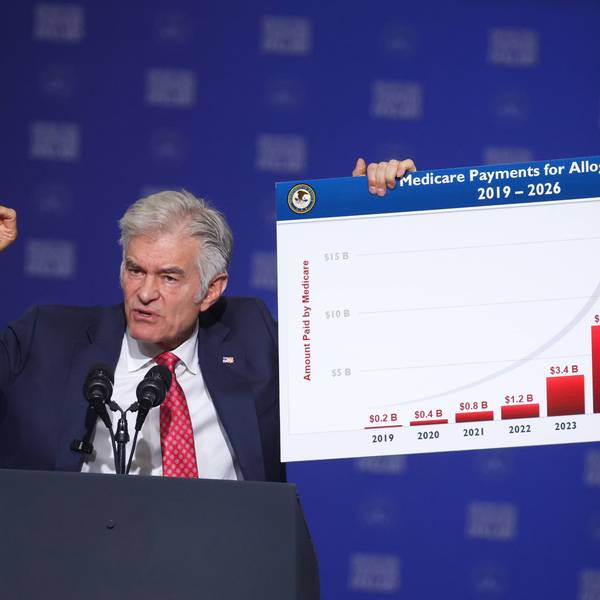
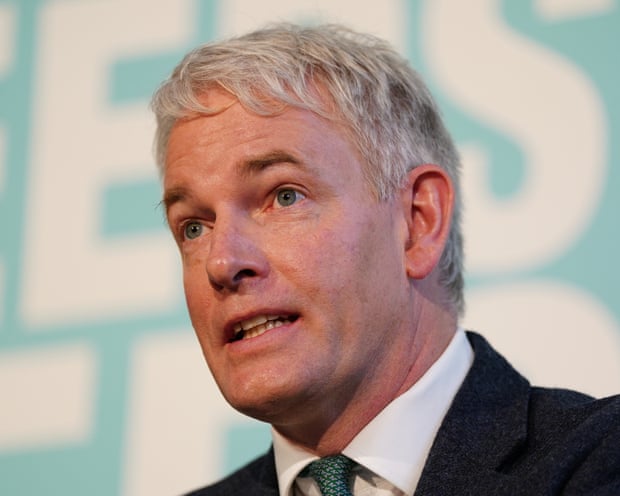
Danny Kruger acknowledged during the press conference in London that Reform was an ‘ill-disciplined’ ship. Photograph: Ben Whitley/PA
Party’s Doge chief says he would cut civil service and close six government offices – most of which are already closing
Reform UK would allow ministers to ignore international law and give them the ability to fire civil servants in a Donald Trump-style overhaul of government powers, the party’s new efficiency tsar has said.
Danny Kruger, who defected to Reform from the Conservatives last month, set out the party’s plans to change the way the government and civil service operate, handing more power to the cabinet.
The party’s department of government efficiency (Doge) chief said he would want to rewrite the ministerial code and the civil service code to free the government from current constraints.
“There is a glaring objection that I have to the ministerial code … which is that it requires them to acknowledge international law in their decision-making. That is an immediate change we would make,” Kruger said.
A line in the code says: “The ministerial code should be read against the background of the overarching duty on ministers to comply with the law, including international law and treaty obligations.”
Nigel Farage reminds you that he’s the man that brought you Brexit and asks what could possibly go wrong.Nigel Farage urges you to ignore facts and reality and be a climate science denier like him and his Deputy Richard Tice. He says that Reform UK has received £Millions and £Millions from the fossil fuel industry to promote climate denial and destroy the planet.Nigel Farage explains the politics of Reform UK: Racism, Fake anti-establishmentism, Deregulation, Corporatism, Climate Change Denial, Mysogyny and Transphobia.
Acclaimed author Michael Lewis wrote a book about the first Trump administration entitled The Fifth Risk, outlining the consequences when people who don’t understand how the government of a vast, complex and multifaceted nation works are put in charge of said government.
The bestseller was more gripping and fascinating than any work of fiction. It outlined the realities that followed Donald Trump’s 2016 campaign promises to shrink the federal bureaucracy. In it, Lewis quotes lawyer Max Stier, who he describes as the American with the greatest understanding of how his nation’s government worked. Stier offers the truism that “the basic role of governments is to keep us safe.”
You might deduce that this means those in charge during, and ahead of, emergencies should know what to do and how to do it. And, they have to want to do it. In the case of Trump term one, there was often evidence that some or all of these three elements were lacking. Evidently, planning for distant risk was not something that Trump and his team were interested in prioritising.
Fast forward to July 2025, and US headlines are filled with images of devastating flash floods in which more than 100 Texans, many of them children, lost their lives. In Kerr County, outside of San Antonio, water levels of the Guadalupe River rose to what was considered a once in a “100-year catastrophe”. Nobody saw it coming, or at least not to the extent that it did. Despite official warnings, the result was one of the worst natural disasters ever faced by the state.
Get your news from actual experts, straight to your inbox.Sign up to our daily newsletter to receive all The Conversation UK’s latest coverage of news and research, from politics and business to the arts and sciences.
Days earlier, Trump’s “big beautiful bill” was passed in the Senate with a tight 51:50 majority. Republican Texas senator Ted Cruz was among the supporters of a bill which will cut funding for the National Weather Service (NWS) by 6.7% in 2026. These come on the back of earlier resource reductions to the NWS and the National Oceanic and Atmospheric Association (NOAA).
Within days of the Texas floods, Democrats were calling for an investigation into whether previous budget cuts might have affected capacity for flood preparedness in Kerr County.
For the bereaved, talk of culpability will hardly bring solace. And any immediate political blame game presents as unseemly in the middle of so much personal tragedy. But a New York Times article reported that “some experts say that staff shortages might have complicated forecasters’ ability to coordinate response”. Such speculative language does not offer clarity or reassurance, and even the often brash president has thus far refrained from finger pointing.
Nonetheless, uncomfortable conversations are necessary, as it is clear that slashing federal funding does not serve the nation well. Trump already had budget cutting form, as his first-term efforts to slash NOAA and related programme funding demonstrated.
In 2017, the Environmental Protection Agency (EPA) was also targeted for staff and funding reductions. This came along with the appointment of EPA chiefs who appeared uninterested in prioritising the climate crisis. More recently, the controversial spending cuts agency the Department of Government Efficiency (Doge), headed by Elon Musk, included NOAA in its sights.
Yale University’s Center for Environmental Communication said that while there was no clear evidence that budget cuts had affected weather forecasting in the Texas case, Trump’s planned additional cuts would affect some of NOAA’s key flash flood forecast tools. This includes the Flash project, which improves accuracy, timing and specificity of warnings, such as those that occurred in Texas on July 4. It also said that the weather service had lost many of its most senior staff, which would increase the risks associated with weather-related tragedies.
Flood water in Texas rose spectacularly fast causing dozens of deaths.
Cuts and the climate
Across the board, Doge has targeted other agencies that the public rely on in a crisis, including the Federal Emergency Management Agency (Fema), where plans to reduce staffing by about 20% are currently coming into effect. With responsibility for managing natural and climate-fuelled disasters from hurricanes to floods, the agency has become busier in recent years as disasters have evolved from seasonal to perennial.
Rob Moore, the director of flooding solutions at the Natural Resources Defense Council, an influential environmental body, argued that “America’s disaster safety net is unraveling.”
There are likely to be more floods, and other nature-based catastrophes with multiple probable causes and features. While outright prevention may not always be possible, governmental risk and disaster management can help to preclude the devastation seen on July 4 in Texas.
The problem with responding to long-term risk with short-term or inadequate solutions is that one day, an existential threat could arrive for which the US will not be ready. The danger may not even be as overwhelming as a global pandemic or nuclear threat. It could be as mundane as a local river overflowing. For those who lost their loved ones in Texas, there is nothing distant about their anguish.
A country with the world’s largest economy does not have to cut federal bureaucracy corners. Wasting tax dollars is never a vote winner, but funding vital emergency services like Fema and the National Weather Service is a fundamental feature of an advanced democracy. As is investing in the technology and personnel to do all possible to predict flash floods. Trump would do well to remember this as he meets the bereaved in Kerr County.
Donald Trump urges you to be a Climate Science denier like him. He says that he makes millions and millions for destroying the planet, Burn, Baby, Burn and Flood, Baby, Flood.Nigel Farage urges you to ignore facts and reality and be a climate science denier like him. He says that Reform UK has received millions and millions from the fossil fuel industry to promote climate denial and destroy the planet.Neo-Fascist Climate Science Denier Donald Trump says Burn, Baby, Burn.
Reform UK chair Zia Yusuf and Tesla CEO Elon Musk. DeSmog collage. Credit: Sky News / Real Time with Bill Maher / YouTube / Pexels / Graeme Maclean / Wikimedia Commons
Reform UK leader and figurehead Nigel Farage hasn’t been alone in basking in the media spotlight of late.
Farage has been accompanied by his party chair, Zia Yusuf, a multi-millionaire tech entrepreneur who has helped to orchestrate Reform’s explosive rise.
Yusuf has overseen the party’s growth to over 200,000 members and 400 regional branches since he took the role in July 2024 – helping to propel Reform to a swathe of victories at last week’s local elections.
The party is now being shaped in Yusuf’s image, who has “extraordinary” powers to kick out Reform members, and even its candidates. His position has no term limit, and there is no formal procedure to remove him – not even by Farage.
With these vast constitutional powers in place, Yusuf appears to be following the lead of his hero in business and politics: Elon Musk.
“The greatest entrepreneur of all time”
Press coverage of the Reform chair often describes him as having worked in “finance”, but Yusuf refers to himself as a “tech entrepreneur” and to Reform as a “start-up”.
While he did spend several years at the investment banks Merrill Lynch and Goldman Sachs in his early 20s, Yusuf left the world of finance for tech entrepreneurship in 2014, becoming the CEO of the luxury digital concierge company Velocity Black, which he co-founded.
Velocity Black is a mobile app for the super rich that allows them to have anything they want at the touch of a button, from exclusive restaurant reservations to private jet holidays. Yusuf founded the firm alongside Alex MacDonald, his old classmate at the private Hampton School in London.
They sold the company in 2023 to the U.S. bank Capitol One for £233 million, with Yusuf reportedly making £32 million on the sale.
Long before he turned to politics, Yusuf credited Musk – the CEO of the electric car company Tesla – as an inspiration for the founding of Velocity Black, telling The Independent in 2018 that “we agreed with Elon Musk – it [Velocity Black] can’t be slightly better; it’s got to be amazing”.
This fondness has continued following their mutual journeys into the political limelight. In the wake of Musk falling out with Farage over the latter’s refusal to embrace far-right organiser Tommy Robinson, Yusuf praised Musk for being, “by some distance, the greatest entrepreneur of all time”, saying that he “will be forever grateful for all [Musk] has done and will do for humanity”.
More recently, Yusuf has called Musk the “ideal person” to run Donald Trump’s Department of Government Efficiency (DOGE), which aims to radically reduce the size of the federal government. Musk’s department has made sweeping cuts to public services – including to climate agencies – sacked government staff en masse, and closed whole departments with no oversight or transparency.
And though Musk’s relationship with Farage has frayed in recent months, Yusuf hasn’t ruled out the possibility of receiving a major donation from Musk in the future – even despite his extreme unpopularity in the UK.
Reform UK chair Zia Yusuf and leader Nigel Farage. Credit: Imageplotter / Alamy Stock Photo
Yusuf’s admiration for Musk is clear, but to what extent will admiration lead to imitation?
There are clues in his recent speaking engagements. “Silicon Valley has a unique culture that’s impossible for anyone else to replicate, but look, we need to stop wasting taxpayer money,” Yusuf said in March, alluding to Musk’s attempts to eliminate “government waste”.
Yusuf has argued that a Reform government in Westminster should replicate the efforts of DOGE, saying that “we do need to massively cut the size of the bureaucratic state and probably cut the civil service by more than half”.
As he’s stated on X, the social media platform owned by Musk, “Reform is drafting detailed plans to identify, immobilise and remove all elements of the Blob [a derogatory reference to the civil service] hostile to the interests of the British people. This plan will be implemented on day one of Nigel Farage becoming prime minister”.
Reform has also vowed to set up “a British DOGE for every county and every local authority in this country” following its victories in last week’s local elections.
This potentially poses a threat to the UK’s climate ambitions. Farage and Yusuf have stated their intention to cut local climate schemes, advocating instead for more fossil fuel production.
Since becoming party chair, Yusuf has expressed a variety of anti-climate stances. He has claimed that North Sea oil reserves are a “gift from God”, and that the pursuit of net zero emissions by 2050 is “religious madness” and a “catastrophic act of self-harm” to the UK economy.
“President Trump’s victory represents the rejection of open borders, socialist economics, woke ideology, net zero fanaticism and [diversity, equity, and inclusion schemes] by right thinking people in America,” Yusuf posted in November. “The UK is next.”
A Power Grab?
Yusuf crashed onto the political scene in the summer of 2024, taking on the role of Reform chair shortly after donating £200,000 to the party. His contribution was the second-highest to the party of the general election campaign and almost a-third of the total funds raised by Reform in the final week before the election.
The 38-year-old has a close relationship with Farage, who he met at a cocktail party held by Stuart Wheeler, the former treasurer of UKIP, close to a decade ago. On the general election campaign trail, Farage said that Yusuf could one day lead Reform, commenting that “aside from his generosity, [Yusuf] will be a great asset and media performer during this campaign and beyond”.
When asked by The Guardian whether he would run for a seat in Parliament in 2029, Yusuf responded: “I’m absolutely open to it. This is a sincere comment. I will serve in whatever capacity Nigel asks of me”.
Recently, there has been talk of Yusuf gaining an unusual amount of power in the party. The Independent’s political editor David Maddox wrote in early March that “the only person to regularly get top billing on Reform events along with Mr Farage is Mr Yusuf. […] Press notices for their mini conferences state that people will hear from ‘Nigel Farage, Zia Yusuf and many more’. No mention of MPs.”
Maddox added that a “senior member” inside Reform had claimed that Yusuf was plotting a leadership coup “in plain sight”.
This bears some resemblance to Musk and his role in the Trump administration. Though he is less actively involved in DOGE following plunging Tesla sales across the globe, Musk has been accused of setting the new government’s agenda from the shadows, after donating more than $290 million to Trump’s campaign.
And there are other ways in which Yusuf is mirroring Musk.
Reform has stated its intention to profile every UK voter, and is already facing allegations of breaching private data.
Though the Reform privacy policy says that it aims to comply with UK data protection laws, the party is being sued by a group of 50 claimants for failing to respond to Data Subject Access Requests, through which voters can ask political parties to disclose the information they hold on them. Following the initiation of legal proceedings, Reform told the claimants that it did not hold any of their data.
DOGE has been accused of being slapdash with data, having accessed vast amounts of highly-sensitive personal information held by the U.S. government, despite rulings from several judges that Musk’s department is violating privacy law.
Given his constitutional powers, his party’s hunger for personal data, his anti-government ideology, and his tech background, Zia Yusuf seems to have many close parallels with Elon Musk.
On the BBC’s Political Thinking with Nick Robinson in February, he was asked the question directly: “Are you Nigel Farage’s Elon Musk?”
Yusuf demurred. “I am certainly no Elon Musk. I think Elon Musk is singular,” he said.
However, he hastened to add: “I’ve tried to learn as much as I can about him”.
The sole responsibility for any content supported by the European Media and Information Fund lies with the author(s) and it may not necessarily reflect the positions of the EMIF and the Fund Partners, the Calouste Gulbenkian Foundation and the European University Institute.
Nigel Farage reminds you that he’s the man that brought you Brexit and asks what could possibly go wrong.Elon Musk urges you to be a Fascist like him, says that you can ignore facts and reality then.Nigel Farage explains the politics of Reform UK: Racism, Fake anti-establishmentism, Deregulation, Corporatism, Climate Change Denial, Mysogyny and Transphobia.