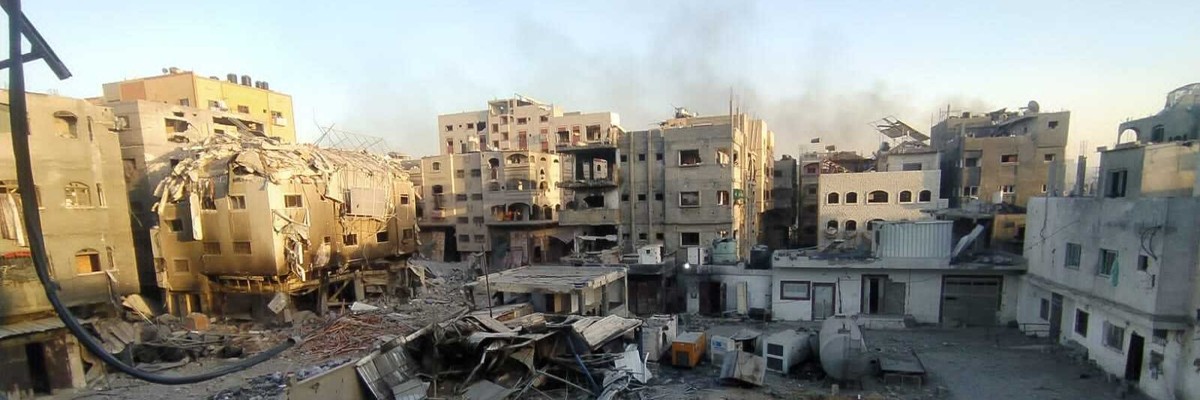
A view of destruction following the Israeli attack on the courtyard of Kamal Adwan Hospital and its surrounding buildings in Beit Lahia, Gaza on December 25, 2024. (Photo: Khalil Ramzi Alkahlut/Anadolu via Getty Images)
By targeting hospitals—essential lifelines in a besieged region—Israel not only deepens the humanitarian crisis but also sends a chilling message: no space, not even those dedicated to saving lives, is off-limits.
The recent Israeli raid on Kamal Adwan Hospital, or KAH, the only partially operating hospital in northern Gaza, is the latest phase of Israel’s egregious disregard for international humanitarian law and the sanctity of medical facilities. This audacious act highlights the alarming impunity with which Israel conducts its war of genocide in Gaza, and further aggravate the suffering in Gaza.
In attacking KAH, Israel resorted to the same discredited lies used to justify its assault on al-Shifa Hospital in November 2023, falsely alleging that Hamas operated a command center beneath the facility. This fabricated story has long been employed as a pretext to target medical facilities across Gaza. During its raid on al-Shifa Hospital in November 2023, Israeli forces found no evidence of a military presence yet proceeded to arbitrarily destroy the hospital without justification.
Eyewitness accounts report that Israeli forces stormed KAH under the pretext of searching for individuals allegedly connected to militant groups. Hospital staff were forcibly removed from their posts, and several patients, including children, were left unattended during the raid. Patients and medical staff faced severe intimidation and arrest, critical care was forcibly disrupted as soldiers combed through wards and operating rooms, ultimately setting the hospital on fire after failing to uncover the alleged military infrastructure.
Western media, in particular, frequently report on Israeli atrocities as though they are inevitable natural disasters, devoid of human accountability or compassion.
Two days after setting KAH ablaze, Israel escalated its attacks on Gaza’s medical infrastructure, killing seven civilians in a strike on al-Wafaa Hospital in Gaza City and shelling the nearby Ahli Baptist Hospital. Despite mounting evidence disproving its claims, Israel, unchallenged, repeated the same fabricated justification: that fighters were allegedly operating within the hospitals. This unsubstantiated template has become a routine pretext for targeting healthcare facilities, disregarding international laws designed to protect civilians and medical institutions during conflict.
Israel’s disinformation regarding the presence of military targets within Gaza’s medical facilities continues to be reported unquestionably by Western media, despite a well-documented track record of inaccuracies and history of falsehoods. This uncritical reporting not only undermines journalistic integrity but also perpetuates misleading narratives, often downplaying or outright ignoring Israeli crimes. By omitting the broader context of occupation, two-decade blockade, and systemic oppression, these media platforms contribute to a distorted representation of the reality on the ground. Western media, in particular, frequently report on Israeli atrocities as though they are inevitable natural disasters, devoid of human accountability or compassion. This approach not only erases the agency behind these tragedies but also dehumanizes Palestinian lives, reducing them to mere statistics.
The failure to keenly examine and challenge Israel’s repeated falsehoods reflects a blatant bias in Western journalism. By granting disproportionate weight to Israeli perspectives while sidelining Palestinian voices, these outlets perpetuate stereotypes and reinforce systemic racism. This one-sided, remote reporting on Gaza undermines the principles of journalistic integrity and fuels global indifference to the plight of the civilians. The lack of accountability for such biased coverage underscores the need for a more equitable and truthful approach by reporting directly from inside the war zone.
The targeting and subsequent destruction of hospitals is not random but part of a broader, systematic pattern of military violence against all aspects of civilian life in Gaza.
The raid on KAH is not an isolated incident but a manifestation of a broader military policy aimed at inflicting maximum pain on the people of Gaza. Already deprived of food, water, power, and adequate medical supplies due to Israel’s blockade, the timing of the raid on the only partially functioning hospital in northern Gaza, is emblematic of a systematic strategy to render the region uninhabitable.
The international community’s tepid response to such blatant violations has emboldened Israel to act with impunity. Despite clear evidence of war crimes, accountability remains elusive. The lack of meaningful action from global powers and institutions undermines the credibility of international law and signals to Israel that it can evade consequences.
Hospitals, including military hospitals, are recognized as neutral spaces under international law, protected from military aggression to ensure the uninterrupted provision of critical care during times of war. The United Nations has both a moral and legal obligation to uphold and enforce Article 18 of the Fourth Geneva Convention, which explicitly prohibits attacks on medical facilities. Anything less would be a betrayal of the principles that underpin international humanitarian law and a failure to stop war crimes.
The genocidal war on Gaza is not merely a regional issue; it is a moral litmus test for the global community. Every bomb dropped, every home destroyed, and every life lost in Gaza is a stain on humanity’s conscience. The international community must confront this genocide with the urgency and resolve it demands. Failing to act not only condemns Gaza’s population to further suffering but also erodes the very foundations of international law and human decency.
The international community’s response for the Israeli genocide in Gaza has been woefully inadequate. While some countries issue lukewarm condemnations, others, like the United States, provide unwavering support for Israel to “finish the job.” This double standard exposes the hypocrisy of the U.S. and Western powers that, ostensibly, champion human rights and international law in other contexts while turning a blind eye to the injustice in Palestine.
The Israeli attacks on medical facilities reveal a deliberate intent to coerce the population into forced “voluntary” ethnic cleansing. The targeting and subsequent destruction of hospitals is not random but part of a broader, systematic pattern of military violence against all aspects of civilian life in Gaza. This includes hospitals, schools, shelters, religious centers, agricultural infrastructure, water wells, bakeries, and aid distribution networks. These calculated assaults are designed to dismantle the foundations of daily life, exacerbate the humanitarian crisis, and strip the population of even the most basic means of survival.
The international community’s conspicuous silence and failure to hold Israel accountable have emboldened such actions, creating an environment where impunity reigns. By targeting hospitals—essential lifelines in a besieged region—Israel not only deepens the humanitarian crisis but also sends a chilling message: no space, not even those dedicated to saving lives, is off-limits.
Israeli war crimes in Gaza cannot be ignored. The world must respond—not with platitudes or empty gestures, but with concrete actions to ensure that those responsible for this ongoing genocide are held accountable.
Genocide denier and Current UK Prime Minister Keir Starmer is quoted that he supports Zionism without qualification. He also confirms that UK air force support has been essential in Israel’s mass-murdering genocide. Includes URLs https://www.declassifieduk.org/keir-starmers-100-spy-flights-over-gaza-in-support-of-israel/ and https://youtu.be/O74hZCKKdpAUK Foreign Minister David Lammy confirms that UK government and military are active participants in Israel’s genocides and that the F-35 parts that they suspended from supplying to Israel are instead simply diverted via the United States. He says see https://youtu.be/QILgUHrdWRE
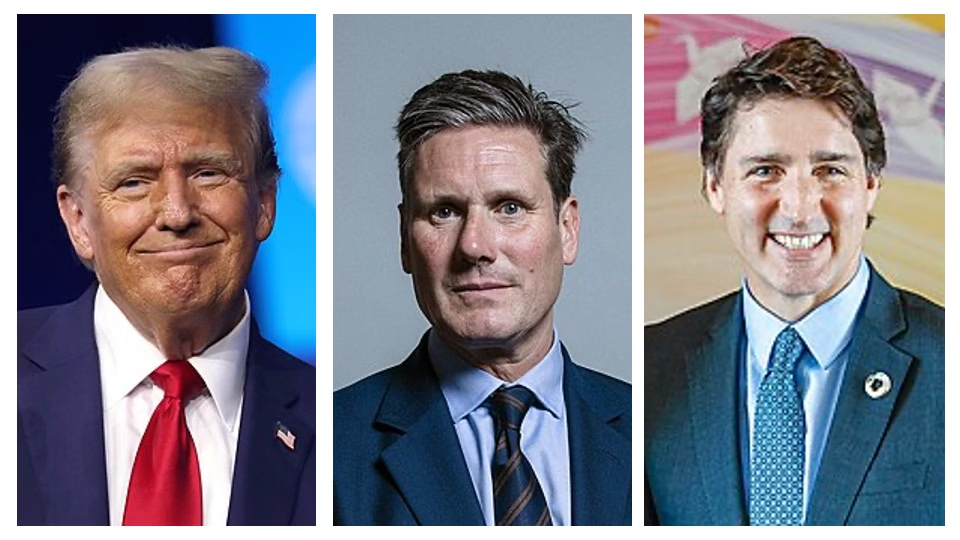
As 2024 closes, Donald Trump (left) is taking over in the U.S., Keir Starmer (center) in the UK, and Canada’s Justin Trudeau (right) ends the year on shaky ground. Credit: DeSmog/Wikimedia Commons
Our editors and reporters weigh in on a year of seismic political events, and what they’re paying close attention to in 2025.
It’s no exaggeration to say that the global political terrain fundamentally shifted this year.
Donald Trump is heading to the White House, Keir Starmer helped end 14 years of Conservative rule in the U.K. and Justin Trudeau is ending the year on shaky ground in Canada.
It was one of the most volatile and consequential years for climate action we’ve ever tracked at DeSmog. To help you make sense of it, we’ve asked our editors and contributors to weigh in on what they see as the year’s biggest takeaways – and the trends they’re paying attention to heading into 2025.
‘We discovered a lot of new documents’
Brendan DeMelle, executive director: Whenever someone on the DeSmog team finds a new document demonstrating what the fossil fuel industry knew long ago, and we reflect on the fact that humans possessed clear knowledge of climate risks and yet made decisions to deny the science and delay action, it gives us great pause to consider the power of corporate interests over basic self-preservation of our species.
In 2024, we discovered a lot of new documents and evidence demonstrating industry’s early knowledge of climate science dating to the 1950s, and a subsequent pivot to denial and delay strategies that seem unfathomable now. They knew better, they ignored responsible actions for decades, and here we are witnessing the devastating consequences which are in line with Exxon’s own models. People are suffering and dying. And what are the oil majors doing? Doubling down on production.
Publishing this evidence of denial and deception always gives me hope that we can make an impact far greater than our size. Climate justice has the wind in its sails, and every document and data point we can add only quickens the velocity of accountability.
I’m also excited that documents that we found and published years ago continue to have great impact, both in climate liability lawsuits and in civil society. We’re thrilled about the news that Geoff Dembicki’s book ‘The Petroleum Papers’ — which was based on Imperial Oil documents DeSmog found — has been optioned for a TV series.
What I’m paying attention to in 2025: With our recent appointment of Geoff Dembicki as global managing editor, our team will be increasingly connecting the dots between international themes and actors in our global work to expose false solutions and shine light on the reach of climate denial and extreme right-wing attacks on the public interest across the world.
We’ll be tracking the international spread of MAGA and the ongoing work of what we call the architecture of denial — networks like Jordan Peterson’s Alliance for Responsible Citizenship (ARC), Atlas Network, Koch Network, Tim Dunn’s America First Policy Institute (AFPI), Project 2025 and other players. We’ll expose their coordinated efforts to undermine environmental protections and criminalize dissent to crush the public interest. We will not stop fighting for the future. And the way we do that at DeSmog is through hard-hitting investigative journalism that centers accountability for climate delay and denial.
‘A resurgence of old-school climate denial’
Geoff Dembicki, global managing editor: I spent a lot of 2024 reporting on a single person – the Canadian conservative influencer Jordan Peterson, who’s evolved over the past few years into one of the world’s most consequential deniers of the climate crisis. In the spring, I went to sold-out Peterson performances in New York City and Fort Worth, where I learned that he’s using religious appeals to undermine public faith in science. My key takeaway: that anti-climate messages are becoming increasingly central to the worldview of the religious right, complicating political efforts to enlist the public in climate action with appeals to economic self-interest.
What I’m paying attention to in 2025: It’s impossible to ignore the most turbulent political event of 2024 – the reelection of Donald Trump. As we move into 2025, I’ll be paying special attention to the ways that a second Trump administration alters the global landscape of climate disinformation and fossil fuel expansion.
I fear that with Trump’s selection of Chris Wright as Energy Secretary – a fracking executive who’s been eagerly endorsed by the CO2 Coalition and other anti-science organizations – we are set to see an aggressive resurgence of old-school climate denial. And I will be closely looking at the influence Trump’s win has on Canada, where the Conservative Party leader – and fossil fuel populist – Pierre Poilievre is campaigning to unseat Prime Minister Justin Trudeau in a federal election scheduled for 2025.
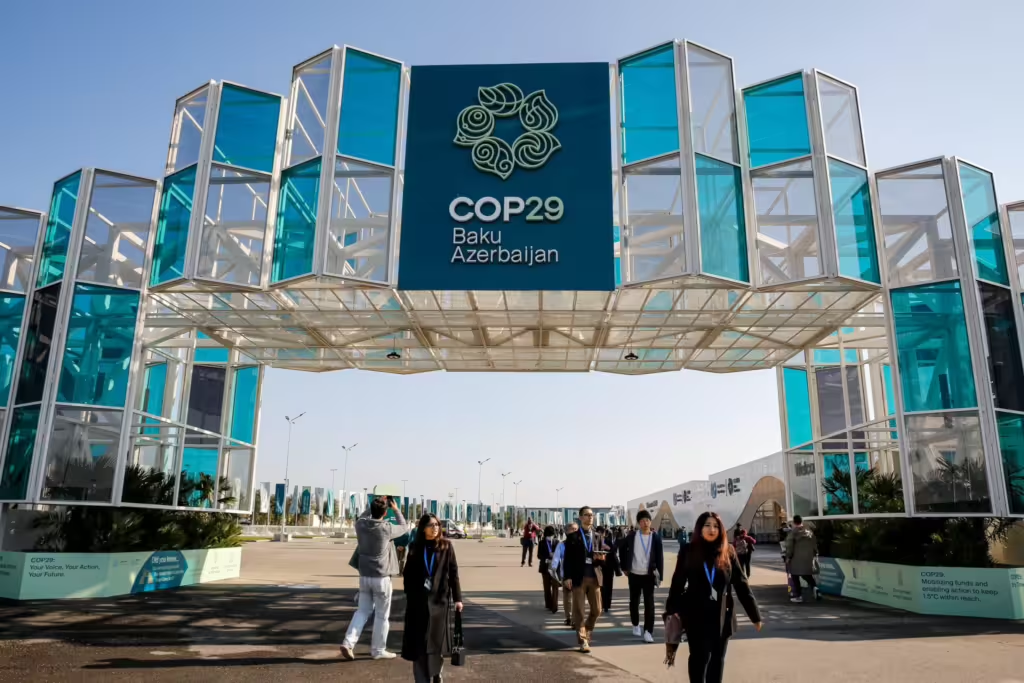
The COP29 entrance in Baku, Azerbaijan. Credit: Michal Busko / Alamy
Polluting industries’ new front against nature protection
Hazel Healy, UK editor-in-chief: In 2024 I travelled to the UN biodiversity talks in Colombia, with DeSmog reporter Rachel Sherrington. It was DeSmog’s first-ever nature-protection summit, and we’d heard mixed reports about whether there was any business lobbying going on at all. In Cali, along with tropical birds and old-school salsa, we were shocked to find oil and gas majors present, showcasing their biodiversity credentials with no hint of irony, with other usual suspects who used their participation to block regulations, such as the pesticide lobby.
We did what DeSmog did best – mapped, analysed, and counted the delegates, learning that business lobbyists had doubled since the last summit. We applied the same lens, for the third year running to shine a light on ag lobbying at the climate COP less than a month later. My takeaway? That anti-climate agribusiness lobbying is not only here to stay, it’s taking aim at both nature and climate – and both must be tackled together.
What I’m paying attention to in 2025: I will be keeping an eye on how the big ag lobby is organising ahead of the COP30 climate summit in Brazil – seen as a beacon of hope by many in the movement for sustainable food and farming, but subject to powerful meat interests. We will be listening carefully to big ag’s talking points and challenging disinformation when we hear it. It’s also going to be really interesting to see the evolution of fledgling EU laws against greenwashing by corporations, and see whether any more cities follow the lead of Dutch city the Hague in banning fossil fuel ads altogether.
‘Far-right parties gaining a new foothold’
Sam Bright, UK deputy editor: The UK general election dominated my coverage in 2024 – a six-week blitz of stories about the parties and politicians vying for our votes. We followed the money and found that, between the last election and the beginning of the 2024, the ruling Conservative Party had accepted £8.4 million from fossil fuel interests, climate science deniers, and polluting industries. We applied the same methodology to Reform UK, the radical right-wing party led by Trump fanatic Nigel Farage, and found that 92 percent of its funding during the period had come from dirty donors. This was somewhat ironic, given that Farage and his deputy Richard Tice now represent two of the constituencies most exposed to climate change.
What I’m paying attention to in 2025: I will be closely following the tentacles of the Trump administration in 2025 – tracking the ways in which his climate denial agenda is being exported to the UK and Europe. For years, DeSmog has been mapping the connections between dark money libertarian groups on both sides of the Atlantic. With Trump in the White House, Farage climbing in the polls, and far-right parties gaining a new foothold in Europe, these political connections are likely to intensify – posing a major threat to global climate action.
‘Astroturfing and disinformation campaign’
TJ Jordan, investigative reporter (PR/Advertising, False Solutions): I worked for a global PR agency for four years, so I have a headstart in knowing where to look when investigating how these companies quietly protect the fossil fuel industry. In 2024 I analysed agency board directors’ ties to polluting companies; challenged the sustainability award shows rewarding agencies that work for oil producers; and went inside the elite PR firm fostering oil-reliant Azerbaijan’s image as a climate innovator ahead of hosting COP29. But my most challenging (and rewarding) project was a six-month investigation into the dirty tactics of a British-owned PR agency called MetropolitanRepublic.
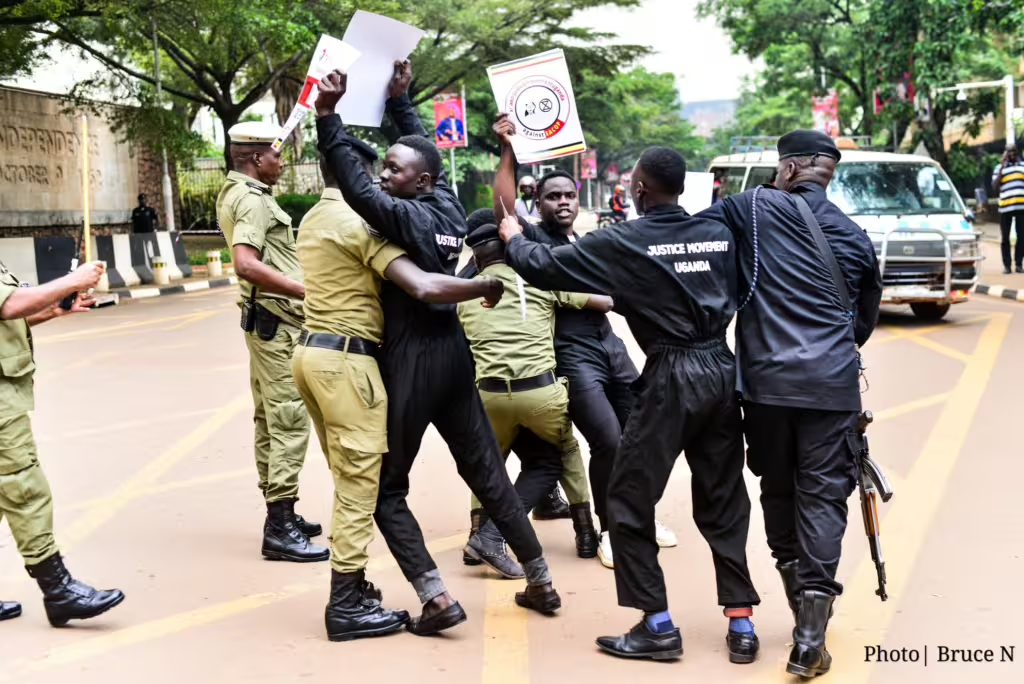
Protestors from student human rights group Justice Movement Uganda opposing the East Africa Crude Oil Pipeline. Credit: Bruce Nahabwe
The agency “squashed” (their word, not mine) the voices of Ugandan environmental land defenders on behalf of French oil giant TotalEnergies — which is building the world’s longest heated crude oil pipeline across Uganda and Tanzania — with a carefully constructed astroturfing and disinformation campaign called “Action for Sustainability.”
What I’m paying attention to in 2025: U.S.-based ad and PR holding company Omnicom is about to become the biggest provider of marketing, advertising, public relations, and lobbying services to the fossil fuel industry, after it bought fellow industry giant IPG. Outside pressure from the UN and campaign groups like Clean Creatives is increasing on big holding companies to reassess their work protecting the reputations of oil and gas producers. I’ll be keeping a close eye on how the Omnicom-IPG consolidation affects the individual agencies in these holding company networks and their ability to make decisions on who they work for.
‘The fallout of Canada’s new anti-greenwashing law’
Sarah Berman, Canada editor: Our reporters closely followed misleading fossil fuel ads and the fallout of Canada’s new anti-greenwashing law, which targets environmental claims that can’t be backed with evidence. The new legislation pushed the fossil fuel lobbyist group Pathways Alliance to immediately scrub its website of all content. The Canadian Association of Petroleum Producers followed suit, removing a section of its website devoted to carbon capture and storage.
Canada Action, a third-party advertiser that claimed Canadian liquified natural gas (LNG) would help cut global carbon emissions on transit shelter ads, cut references to the environmental benefits of LNG on its website. Canadian oil sands companies even blamed the new law for delayed sustainability reports. Now, major cities like Toronto are looking to ban misleading fossil fuel ads on transit.
What I’m paying attention to in 2025: We’ve seen fewer greenwashing claims on transit in the second half of 2024, but the fight over Canada’s anti-greenwashing legislation is not over and DeSmog will continue to follow the latest developments. Our reporters expect oil sands companies and their allies to fight any effort to hold them accountable for spreading misinformation. Will this new legislation further push emitters to distance themselves from false solutions? Or will a Canadian election bring in a new government that is more favourable to polluters?
Our series revealed links between hard-right farming groups and the Viktor Orbán-funded MCC Brussels think tank, dissected the false claims made ahead of the elections as well as the political candidates spreading them, and shone a light on the diverse stances between farming groups on protests. In Ireland, our work mapping the connections of the powerful farming lobby was cited in the parliament (Oireachtas) and became a major talking point ahead of a critical decision by the EU on whether to extend the country’s nitrates derogation.
What I’m paying attention to in 2025: This will be a crucial year for the newly elected European Commission to transform its agriculture and food sectors and to beef up its climate targets. As 720 MEPs get to work, we’ll investigate the populist politicians looking for ways to weaken key legislation, and continue to scrutinise the lobbying tactics of powerful corporations. With elections on the horizon in Germany and Poland, we’ll look to work in partnership with European journalists to enhance our cross-border coverage at this pivotal time.
‘Trump-oriented politics within Canada’
Mitchell Anderson, Canada contributor: I spent much of 2024 focusing on the evolving situation in Alberta, which produces almost 40 percent of Canada’s emissions with only 12 percent of the population. This work included itemizing unfunded environmental liabilities associated with fossil fuel extraction, particularly expanding oil sands operations. Alberta is also pushing the Pathways carbon capture scheme, a twice-rejected coal mine expansion in the foothills of the Rockies, and funded a $7 million “scrap the cap” ad campaign that would likely violate new federal competition regulations if the province was a company.
All of these issues have been fertile ground for Desmog commentary that seeks to highlight cracks and contradictions within populist Alberta politics.
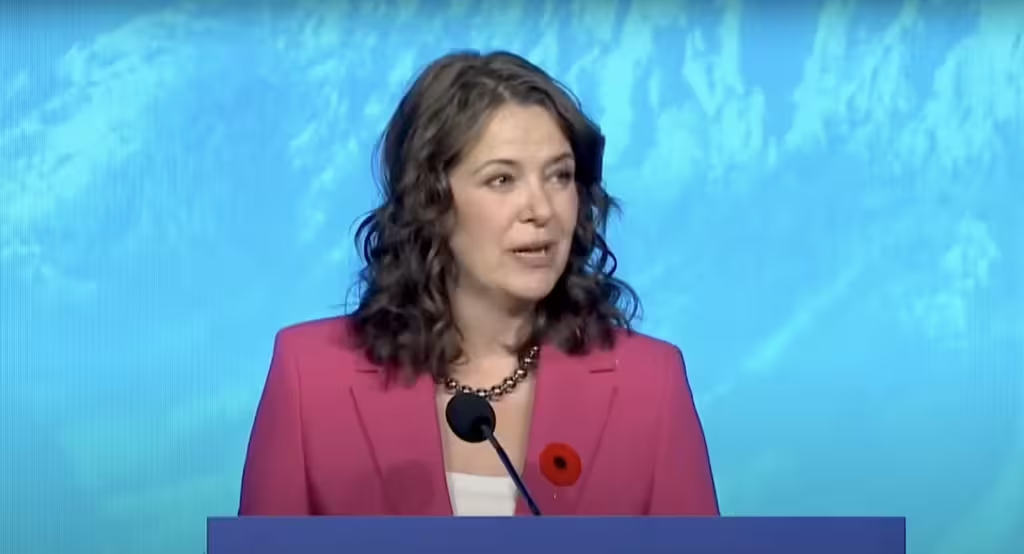
Alberta Premier Danielle Smith speaks at the UCP annual meeting, where delegates voted for an erroneous resolution claiming atmospheric CO2 is at a 1,000-year low. Credit: Danielle Smith / YouTube
What I’m paying attention to in 2025: The second Trump administration promises to upend many norms within society, politics, and the energy sector. DeSmog is well positioned to highlight how this chaotic political period will impact renewable technology, the fossil fuel industry, and our climate future. I will continue to focus on stories about the evolving situation in Alberta, which in many ways has become a cultural beachhead for Trump-oriented politics within Canada.
Neighbouring British Columbia has become a political counterweight by aggressively scaling up renewable energy, creating numerous opportunities for contrasting case studies that highlight these diverging trajectories. A Canadian election in 2025 will add additional interest to a turbulent year as Pierre Poilievre seeks to centre his campaign against carbon pricing – often in the absence of facts.
‘The DeSmog team will be very busy’
Taylor C. Noakes, Canada contributor: My focus areas in 2024 were principally industry and political reactions to new anti-greenwashing legislation; debunking industry-friendly (and often politically expedient) false solutions to the climate crisis (like LNG, hydrogen, and carbon capture); and Canada’s ongoing culture war against renewables, which has resulted in nonsensical political decisions (like instituting a solar and wind power moratorium in Canada’s sunniest and windiest province).
As in years past, I covered a number of major industry conferences in Canada and the United States (including annual carbon capture, hydrogen, LNG, and oil/gas industry conferences, mostly in Alberta). Highlights from these events include a ten minute one-on-one scrum with the Premier of Alberta on the failures of carbon capture, and reporting on Jane Fonda leading an anti-LNG protest (whose turnout was larger than the number of conference attendees).
What I’m paying attention to in 2025: I anticipate the new American president’s energy policies will have profound effects on Canada – whether it’s tariffs that sink what’s left of Canada’s oil and gas sector, American resource nationalism that prioritizes local resource exploitation over Canadian imports (or some combination thereof), or a Canadian reaction to U.S. trade war sabre rattling that emphasizes either an accelerated transition or the subsidized development of new markets for old technology.
Whatever course it takes, I suspect the DeSmog team will be very busy. I’m looking forward to how this shakes out at the series of annual conferences I typically attend. In addition, I plan on keeping a close eye on hydrogen and carbon capture projects, as well as the growing grassroots resistance to fossil fuels, pipelines, and the industry in general. Successful Indigenous resistance to fossil fuel projects offers exciting opportunities for optimistic climate-change related reporting. Similar efforts by cities to ban fossil fuel advertising, and the use of gas for cooking, as well as rural communities banning CO2 pipelines, indicate real momentum and tangible results from the ground up.
The immovable object that is the fossil fuel sector is meeting the unstoppable force that is people’s innate desire to live on a healthy planet. 2025 is going to be a thrilling year for environmental reporting.
‘Focusing on the financial’
Sharon Kelly, U.S. reporter: One of the oldest adages in investigative reporting is to follow the money. In seeking to understand what’s driving fossil fuel companies to double down on greenwashing and environmentally damaging projects, it helps to have a clear picture of what their incentives are and how those incentives are created. My work for DeSmog in 2024 focused on the financial: examining federal subsidies for carbon capture, created in the name of combatting climate change but with the effect of making it worse; reporting on evidence shale drillers attempted price-fixing to inflate oil prices, and on price-gouging by corporations when climate-fueled disasters strike; and seeking to understand oil and gas industry liabilities like abandoned wells – and what happens on the ground when companies fail to pay to clean up.
What I’m paying attention to in 2025: The risks and uncertainties surrounding fossil fuels are, if anything, amplified by the incoming administration. Despite the Trump administration’s ties to the oil and gas industry, Trump’s first term was marked by upheaval and disruptions for fossil fuel companies (and the rest of us). Autocratic impulses are often, at their core, a telling sign of fragility.
Whatever 2025 brings, we intend at DeSmog to keep the heat on the industry by examining the financial side of the climate crisis and the companies that have fueled it – whether that’s investigating the role false solutions play in oil and gas companies’ plans for the future, scrutinizing how over-hyped investments can cause outsized environmental damage while falling short for communities and investors alike, or staying watchful for fossil fuel companies seeking to benefit from the political power of the far-right (and vice versa).
‘Mapping the big money and political connections’
Adam Barnett, UK reporter
2024 was a target rich environment for anyone looking to cover climate denial, with a mountain of smog descending on the UK. So much, in fact, that I had to compile a map of the donors, media, think tanks, and fossil fuel companies pushing the Conservative government to turn against net zero. I also debunked the big climate myths peddled during the UK general election campaign, since the British media wasn’t going to.
I gave the post-election Tory leadership contest the same treatment, exposing the climate record of the candidates and the dirty money pumped into the campaign – along with the Tories’ growing ties to Donald Trump’s Project 2025.
What I’m paying attention to in 2025: With Conservative Party leader Kemi Badenoch flying to Washington to build ties with the incoming Trump team, a U.S. ambassador to the UK with oil and gas interests (both also covered in 2024), and Reform’s Nigel Farage curling up at the feet of Elon Musk, I expect to be covering the growing influence of Trumpian climate denial on the UK — along with transatlantic groups like Jordan Peterson’s Alliance for Responsible Citizenship (ARC), which is headed by a Tory peer.
Scientists and campaigners are calling on governments and tech companies to tackle climate disinformation. Credit: MauriceNorbert via Alamy
An open letter from climate scientists and campaigners warns of the dangers associated with false climate claims.
Governments around the world must take “immediate and decisive action” to tackle climate disinformation, scientists and campaign groups have urged as talks at the COP29 climate summit in Baku, Azerbaijan enter their fourth day.
A coalition of 55 climate information integrity groups and 42 leading climate scientists and experts have signed an open letter urging countries to counter the risk of false and misleading claims that are wrecking efforts to slow climate change.
It comes two days after UK Prime Minister Keir Starmer spoke at COP29 arguing that “there is no national security without climate security” – and a week after the election in the United States of Donald Trump, who has previously called climate change a “hoax”.
The letter published today – signatories to which include Friends of the Earth, the Institute of Strategic Dialogue, and regional branches of Greenpeace and WWF – lists steps governments could take.
These include adopting a universal definition of climate disinformation, such as the working definition proposed by the Climate Action Against Disinformation (CAAD) coalition, another signatory.
According to the letter, the definition should cover anything that misrepresents scientific data or “falsely publicises” supposed solutions to climate change which in fact contribute to global warming, often referred to as “greenwashing”.
Such a definition should cover “deceptive or misleading online behaviour” that undermines public understanding of climate change, the fact it is caused by human activity, and the need for urgent mitigation and adaptation action, the letter said.
Signatories also urged governments to take action against organisations which give a platform to climate disinformation – including social media outlets, advertising technology providers, broadcasters, and publishing companies.
“The spread of disinformation continues to undermine and delay our collective ability to act, jeopardising progress at crucial negotiations and the upcoming G20 Summit in Brazil”, the letter said.
“Climate disinformation, waged by vested interests, undermines climate action and puts our collective future at risk. Our information ecosystem is being damaged, and those responsible must be held accountable.”
The letter ends by arguing that “by adopting these principles, governments can foster a healthier and safer online environment that supports informed decision-making and enables effective climate action.”
The world’s leading climate science group, the UN’s Intergovernmental Panel on Climate Change (IPCC), has warned that efforts to tackle climate change were being delayed by “rhetoric and misinformation that undermines climate science and disregards risk and urgency”.
“As disinformation continues to be an obstacle to vital climate action, the message from this open letter to decision makers globally is clear: protecting truth in the climate conversation is critical if we are to secure meaningful change”, said Max MacBride, Head of Counter-Disinformation at Roots Greenpeace, the NGO’s grassroots campaign initiative.
“At Roots, we see every day how climate disinformation stifles youth advocacy, and we join this call to hold governments and platforms accountable for enabling informed, equitable climate action”, he said.
Climate Disinformation Threats
A CAAD report published earlier this week found that climate disinformation is widespread online, and is hobbling efforts to address climate change.
The report said that social media platforms bear responsibility for allowing “super spreaders” to “pollute their platforms with debunked claims attacking renewable energy and electric vehicles”.
CAAD also found that fossil fuel companies were allowed to use digital advertising across Meta platforms to greenwash their reputations, by promoting false solutions or presenting fossil fuels as essential to the energy transition.
A study published in February found that 14 percent of Americans don’t believe climate change is real – even as growing numbers of Americans say they are concerned about the climate.
“In the US, we’ve painfully experienced the role disinformation has played in thwarting disaster response and threats to the lives of responders”, Kate Cell, Senior Climate Campaign Manager at the Union of Concerned Scientists, told DeSmog.
“As climate-fueled disasters become more common around the world, governments can protect their residents by addressing the problem of climate disinformation systemically.”
Another report released this week by the scrutiny NGO InfluenceMap found 2.500 cases of fossil fuel companies pushing arguments which contradict IPCC recommendations since COP28 last year.
Thais Lazzeri, founder of educational group FALA, a signatory to the letter, told DeSmog: “The letter comes at a unique time for Brazil, which is hosting the G20 and the incoming COP30 Presidency. The alliance of so many Brazilian institutes and professionals shows the urgency for answers and the intersectoral power of this Brazilian network, willing to work together.”
She added: “At the opening of the Brazil space at CO29, Environment Minister, Marina Silva, said that denialism doesn’t fit. The Brazilian government can lead by example and guarantee information integrity policies and strategic, connected actions to change the game.”
DeSmog has previously reported on news media spreading false climate claims, with The Telegraph newspaper in the UK attacking climate solutions – a trend that has increasing since July’s general election. As revealed by DeSmog in 2023, one in three presenters on the right-wing broadcaster GB News had spread climate disinformation during the previous year.
“It is much easier to pollute the waters of public discussion on climate change causes and consequences than it is to keep them clean and productive,” said Max Boykoff, signatory to the letter and professor of Environmental Studies at Boulder University in Colorado and founder of the Media Climate Change Observatory, a project which analyses mentions of climate change in news media.
“Therefore, more proactive, clear, accurate and effective communication efforts are consistently and repeatedly needed. That motivates this call for government action to curb disinformation about climate change.”
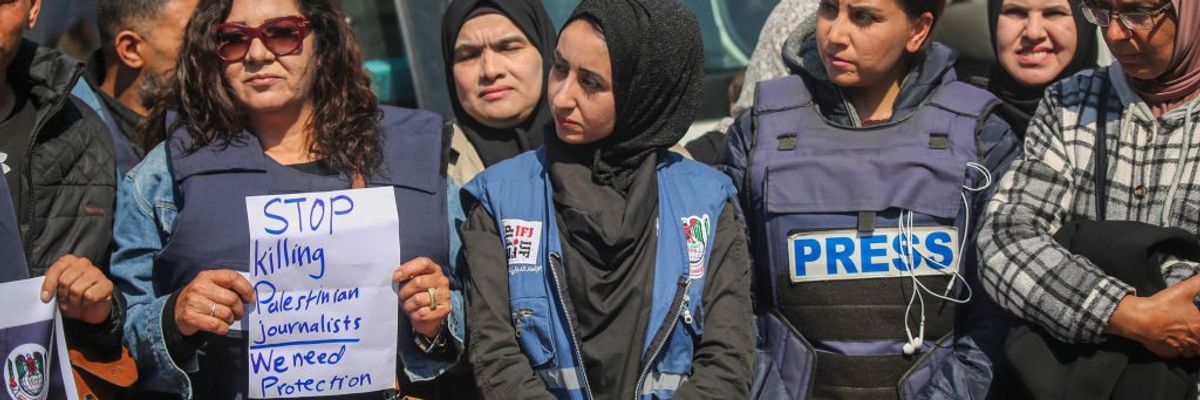
Palestinian journalists stage a protest to draw attention to Palestinian press killed while covering the war in the Gaza Strip on February 26, 2024 in Rafah. (Photo: Ahmad Hasaballah/Getty Images)
“Israel has repeatedly made similar unproven claims without producing credible evidence,” said the Committee to Protect Journalists.
Seasoned observers of Israeli disinformation campaigns on Wednesday responded with pointed skepticism to a claim by the country’s military that half a dozen Al Jazeera journalists are linked to militant Palestinian resistance groups.
The Israel Defense Forces (IDF) claimed Wednesday that intelligence recovered during the ongoing invasion of Gaza revealed that Al Jazeera journalists Anas Al-Sharif, Alaa Salama, Hossam Shabat, Ashraf Saraj, Ismail Abu Amr, and Talal Aruki are affiliated with either Hamas—which governs Palestine’s coastal enclave and led the October 7, 2023 attack on Israel—or Palestinian Islamic Jihad (PIJ).
This, the IDF said, “unequivocally proves that they function as military terrorist operatives of the terrorist organizations in the Gaza Strip.”
However, critics accused Israel of targeting the six journalists for exposing Israeli war crimes to the world.
“There’s a very clear reason why Israel has been killing journalists,” asserted U.S. investigative journalist Jeremy Scahill:
After killing over 175 journalists in Gaza, Israel is now threatening and smearing 6 Al Jazeera journalists covering the carnage in northern Gaza. As @jeremyscahill says, every journalist should condemn these horrific attacks and call for their protection. Enough. pic.twitter.com/eUNeYjXUik
As the Washington, D.C.-based Institute for Public Accuracy noted:
Shabat… wrote Tuesday: “I’m a reporter on the ground in North Gaza, and I’m here to tell you that no aid has entered the besieged area for the past 21 days. The Israeli and American governments are spreading inaccurate information.
University of Edinburgh professor Nicola Perugini noted that some of the six journalists “are covering the new phase of the genocide, the complete depopulation of northern Gaza.”
“The aim is to transform the last witnesses into killable targets,” he said.
The Israeli army is releasing fabricated dossiers framing several Al Jazeera journalists as "Hamas operatives." Many of them are covering the new phase of the genocide, the complete depopulation of northern Gaza. The aim is to transform the last witnesses into killable targets. pic.twitter.com/q0FIXVEUid
Al Jazeera —which is banned from operating in Israel but is the only major international media network on the ground in Gaza, as Israeli authorities prohibit foreign reporters from entering the besieged strip—denies the IDF’s claim.
Others noted that Israeli forces have killed numerous Al Jazeera workers as part of a war on journalists in which at least 128 media professionals have been killed, according to the New York-based Committee to Protect Journalists (CPJ). The United Nations says more than 170 media workers have been killed by Israeli forces.
“This is an assassination threat and an attempt to preemptively justify their murder,” Scahill said of Israel’s claim against the six Al Jazeera journalists.
“Anyone claiming Israel has offered ‘irrefutable’ proof to back up these allegations is either ignorant of the systematic campaign of lies, propaganda, and fake news unleashed by Israel or is trying to aid and abet the murder of more journalists,” he added. “That is what is irrefutable.”
Palestinian journalists are risking their lives to share the truth about Israel’s ongoing genocide in Gaza and the occupied West Bank. They must be protected.
CPJ said on social media that it “is aware of accusations made by the Israel Defense Forces against several journalists in Gaza accusing them of being members of militant groups.”
“Israel has repeatedly made similar unproven claims without producing credible evidence,” the group noted. “After killing Al Jazeera correspondent Ismail Al Ghoul in July, the IDF previously produced a similar document, which contained contradictory information, showing that Al Ghoul, born in 1997, received a Hamas military ranking in 2007—when he would have been 10 years old.”
The Paris-based international press freedom group Reporters Without Borders (RSF) has filed multiple complaints at the International Criminal Court alleging “war crimes against journalists in Gaza,” including the apparently intentional targeting of media professionals.
In one filing, RSF said it “has reasonable grounds for thinking that some of these journalists were deliberately killed and that the others were the victims of deliberate IDF attacks against civilians” and accused Israel of “an eradication of the Palestinian media.”
“You don’t shut down the media unless you have something to hide.”
In June, the Gaza Project—an investigative journalism initiative led by the Paris-based nonprofit Forbidden Stories—”analyzed nearly 100 cases of journalists and media workers killed in Gaza, as well as other cases in which members of the press have been allegedly targeted, threatened, or injured.”
The project found “a chilling pattern” of journalists who “may have been targeted even though they were identifiable as press.”
In one case that enraged journalists and others around the world, at least one IDF member sent 19-year-old Palestinian reporter Hassan Hamad text messages threatening him and his family if he did not stop documenting Israel’s assault on Gaza, which has left more than 152,000 Palestinians dead, maimed, or missing, millions more starved or sickened, and much of the territory in ruins.
Hamad refused. Earlier this month, Israeli forces assassinated him in a drone strike on his home in the Jabalia refugee camp.
U.S. citizens working in media have also been harmed by Israeli forces while on the job in Gaza and Lebanon, where IDF bombardment and invasion have killed and wounded thousands of people.
On Tuesday, a dozen members of U.S. Congress led by Sen. Bernie Sanders (I-Vt.) urged the Biden administration—which supports Israeli with billions of dollars in military aid and diplomatic cover—to investigate Israeli attacks on journalists including Dylan Collins, who was with a group of six other reporters covering cross-border clashes between Israel and Hezbollah in southern Lebanon when an IDF tank opened fire on their position despite their clear identification as press. Collins and five others were injured, and Lebanese Reuters journalist Issam Abdallah was killed.
[EPISODE 15] "The only thing I was thinking about was to save my life": Christina Assi recounts how she was wounded while reporting from Lebanon#AFP80years 🎥 @collinsofdyl 📲 Margarita Govorine 📲 Chloé Rabs pic.twitter.com/z1iE3eZ9tM
Israel’s targeting of American journalists predates the current war and includes the 2022 killing of renowned Palestinian American Al Jazeera reporter Shireen Abu Akleh. Multiple probes have concluded Abu Akleh was deliberately targeted by an IDF sniper as she was covering a raid on the Jenin refugee camp in the illegally occupied West Bank.
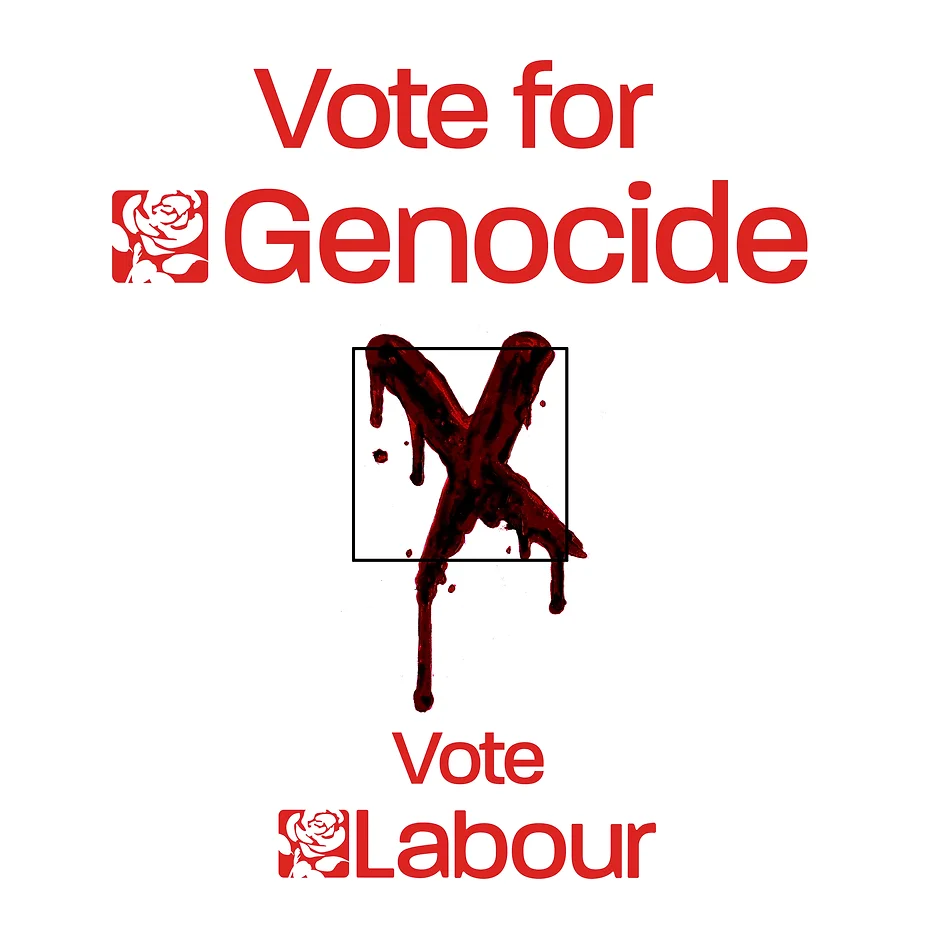
Zionist Keir Starmer is quoted “I support Zionism without qualification.” He’s asked whether that means that he supports Zionism under all circumstances, whatever Zionists do.UK Foreign Secretary David Lammy says that UK is suspeding 30 of 350 arms licences to Israel. He also confirms the UK government’s support for Israel’s Gaza genocide.Vote For Genocide Vote Labour.
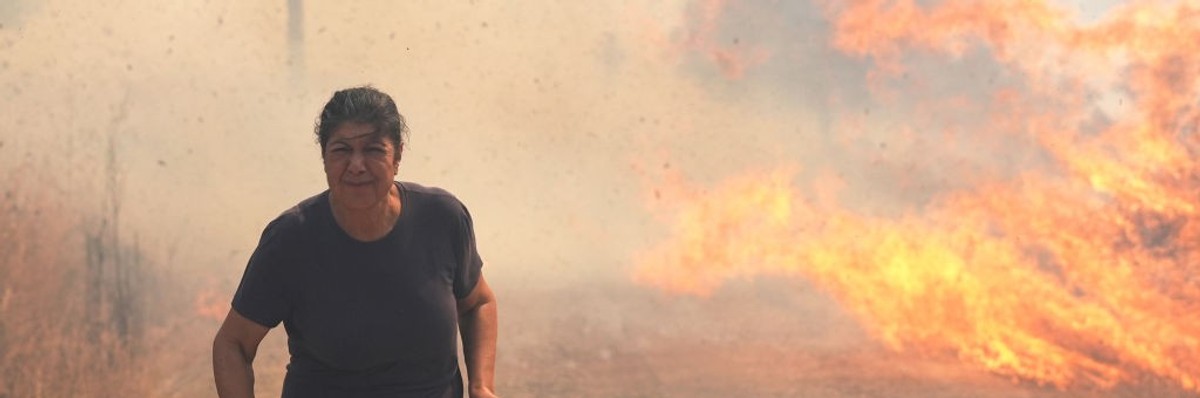
Civilians flee a forest fire that broke out close to residential areas at Cesmealti in Urla district of Izmir, Turkey on July 31, 2024. (Photo: Mahmut Serdar Alakus/Anadolu via Getty Images)
“We need to tackle the root cause and get serious about reducing record levels of greenhouse gas emissions,” said the head of the World Meteorological Organization.
As scientists around the world on Thursday released new data about recent record-smashing heat, one United Nations adviser placed blame for the lack of ambitious climate action on the fossil fuel industry’s decadeslong disinformation efforts.
“There is this prevailing narrative—and a lot of it is being pushed by the fossil fuel industry and their enablers—that climate action is too difficult, it’s too expensive,” Selwin Hart, a special adviser to the U.N. Secretary-General António Guterres and assistant secretary-general of the Climate Action Team, told The Guardian‘s Fiona Harvey.
“It is absolutely critical that leaders, and all of us, push back and explain to people the value of climate action, but also the consequences of climate inaction,” said Hart, former executive director of the Caribbean at the Inter-American Development Bank and Barbados’ ambassador to the United States and the Organization of American States.
Investigations by academics, journalists, and lawmakers as well as ongoing legal battles have exposed how Big Oil not only has heated and polluted the planet but also knew about the devastating impacts of fossil fuels decades ago and opted to spread lies so shareholders could make massive profits—which they continue to rake in today.
“Climate appears to be dropping down the list of priorities of leaders,” Hart said, pointing to polling that shows people around the world want a rapid transition to clean energy. “But we really need leaders now to deliver maximum ambition. And we need maximum cooperation. Unfortunately, we are not seeing that at the moment.”
According to The Guardian:
[Hart] warned that the consequences of inaction were being felt in rich countries as well as poor. In the U.S., many thousands of people are finding it increasingly impossible to insure their homes, as extreme weather worsens. “This is directly due to the climate crisis, and directly due to the use of fossil fuels,” he said. “Ordinary people are having to pay the price of a climate crisis while the fossil fuel industry continues to reap excess profits and still receives massive government subsidies.”
Yet the world has never been better equipped to tackle climate breakdown, Hart added. “Renewables are the cheapest they’ve ever been, the pace of the energy transition is accelerating,” he said.
Hart’s comments came as the European Union’s Copernicus Climate Change Service (C3S) announced that last month “was the second-warmest July globally in our data record, with an average ERA5 surface air temperature of 16.91ºC,” or 62.44ºF.
From June 2023 to June 2024, each month was the hottest on record, according to C3S. Samantha Burgess, the agency’s deputy director, noted that now, “the streak of record-breaking months has come to an end, but only by a whisker.”
“Globally, July 2024 was almost as warm as July 2023, the hottest month on record,” Burgess stressed. “July 2024 saw the two hottest days on record. The overall context hasn’t changed, our climate continues to warm. The devastating effects of climate change started well before 2023 and will continue until global greenhouse gas emissions reach net-zero.”
The U.N.’s World Meteorological Organization (WMO) said Thursday that the new C3S data “underlines the urgency of the Call to Action on Extreme Heat” issued by Guterres last month, shortly after July 22 became the hottest day ever recorded.
“Widespread, intense, and extended heatwaves have hit every continent in the past year,” said WMO Secretary-General Celeste Saulo in a statement. “At least 10 countries have recorded daily temperatures of more than 50ºC in more than one location. This is becoming too hot to handle.”
Saulo highlighted that “Death Valley in California registered a record average monthly temperature of 42.5ºC (108.5ºF)—possibly a new record observed for anywhere in the world. Even the remote frozen ice sheets of Antarctica have been feeling the heat.”
“The WMO community is committed to responding to the U.N. secretary-general’s Call to Action with better heat-health early warnings and action plans,” she pledged. “Recent estimates produced by WMO and the World Health Organization indicate that the global scale-up of heat-health warning systems for 57 countries alone has the potential to save an estimated 98,000 lives per year. This is one of the priorities of the Early Warnings for All initiative.”
“Climate adaptation alone is not enough,” she added. “We need to tackle the root cause and get serious about reducing record levels of greenhouse gas emissions.”
C3S wasn’t alone in releasing new data on Thursday; the U.S. National Oceanic and Atmospheric Administration (NOAA) also shared some key points for the country’s climate in July, with the full report set to be released on Tuesday.
NOAA’s top takeaways were:
The average temperature of the contiguous U.S. in July was 75.7ºF, 2.1ºF above average, ranking 11th warmest in the 130-year record.
The Park Fire is the fourth-largest wildfire in California history as of August 6; beginning on July 24, it burned approximately 401,000 acres and destroyed over 560 structures.
On July 15, a derecho that spawned 32 tornadoes broke the Chicago-area record for most tornadoes in a day.
On July 1, Beryl became the earliest Category 5 hurricane and the second Category 5 on record during the month of July in the Atlantic Ocean.
Other major events in July included California’s Thompson Fire, which forced over 13,000 people to evacuate, and Washington, D.C. enduring 101ºF on July 17, tying a record for the longest streak of temperatures above 100ºF. NOAA also found that “for the January-July period, the average contiguous U.S. temperature was 54.5ºF, 3.2ºF above average, ranking second-warmest on record.”