Tourists and locals paddleboard at the sunrise on the Mediterranean Sea in Barcelona, Spain July 2, 2025. REUTERS/Nacho Doce Purchase Licensing Rights
June 2 (Reuters) – Spain registered record sea temperatures for the month of May along much of its coastline, the country’s port authority said on Tuesday, as the UN forecast a moderate or possibly strong El Nino, which could drive up global temperatures in coming months.
Twelve out of 15 deep-water buoys recorded their highest-ever temperatures for the month of May, as well as six out of 14 buoys along the coast, according to the Spanish port authority.
Human-caused climate change was behind the phenomenon, said Ruben del Campo, spokesperson for Spanish weather agency AEMET.
Nigel Farage urges you to ignore facts and reality and be a climate science denier like him and his Deputy Richard Tice. He says that Reform UK has received £Millions and £Millions from the fossil fuel industry to promote climate denial and destroy the planet.Donald Trump urges you to be a Climate Science denier like him. He says that he makes millions and millions for destroying the planet, Burn, Baby, Burn and Flood, Baby, Flood.Elon Musk urges you to be a Fascist like him, says that you can ignore facts and reality then.
A pumpjack operates in the foreground while a wind turbine at the Buckeye Wind Energy wind farm rises in the distance, September 30, 2024, near Hays, Kansas, US
THE United Nations climate negotiations got under way today in the Brazilian city of Belem, known as the gateway to the Amazon River.
The negotiations follow the leaders’ summit which was held last Friday where leaders pushed for greater urgency and co-operation in the fight to curb global warming by drastically reducing the carbon pollution that causes it.
Andre Correa do Lago, president of this year’s Cop30, emphasised that negotiators engage in “mutirao,” a Brazilian word derived from an indigenous word that refers to a group uniting to work on a shared task.
“Either we decide to change by choice, together, or we will be imposed change by tragedy,” do Lago wrote in his letter to negotiators Sunday. “We can change. But we must do it together.”
Complicating the calls for togetherness is the United States. The Trump administration did not send high-level negotiators to the talks and is withdrawing for the second time from the 10-year-old Paris Agreement.
Donald Trump urges you to be a Climate Science denier like him. He says that he makes millions and millions for destroying the planet, Burn, Baby, Burn and Flood, Baby, Flood.Elon Musk urges you to be a Fascist like him, says that you can ignore facts and reality then.Nigel Farage urges you to ignore facts and reality and be a climate science denier like him and his Deputy Richard Tice. He says that Reform UK has received £Millions and £Millions from the fossil fuel industry to promote climate denial and destroy the planet.
U.S. President Donald Trump gestures while speaking during a news conference to discuss crime in Washington, D.C. on August 11, 2025. (Photo: Jim Watson/AFP via Getty Images)
“The administration’s actions are unprecedented, unnecessary, and unlawful,” declared Washington, D.C. Attorney General Brian Schwalb.
U.S. President Donald Trump on Monday moved to deploy the National Guard on the streets of Washington, D.C., while also officially taking over the city’s police department.
What’s more, Trump suggested that this could be a model for other American cities.
As reported by NBC News, Trump said during his announcement on plans to deploy the National Guard in the nation’s capital that “other cities are hopefully watching this” and that he hoped it would make them “self-clean up, and maybe they’ll self-do this and get rid of the cashless bail thing and all of the things that caused the problem.”
Trump then named Baltimore, Oakland, New York, and Chicago as potential future targets for National Guard deployments and other measures.
Shortly after Trump made his announcement, Washington, D.C. Attorney General Brian Schwalb indicated that he was not taking the president’s attempt to take over his city’s police force lying down.
“The administration’s actions are unprecedented, unnecessary, and unlawful,” he declared in a post on X. “There is no crime emergency in the District of Columbia. Violent crime in D.C. reached historic 30-year lows last year, and is down another 26% so far this year. We are considering all of our options and will do what is necessary to protect the rights and safety of District residents.”
Rep. Mary Gay Scanlon (D-Pa.) was also quick to condemn the president’s takeover of D.C. law enforcement as an unnecessary power grab.
“The president’s attempt to federalize the D.C. Metropolitan Police Department and deploy the National Guard on the streets of our nation’s capital is an abuse of power,” she said. “It’s an egotistical, pathetic attempt to stoke fear and distract from his failures: America is less affordable, healthy, and safe under this administration.”
Minnesota Gov. Tim Walz, who last year served as the Democratic Party’s vice-presidential nominee, chided critics who had accused him in the past of exaggerating the authoritarian threat of a second Trump term.
“The road to authoritarianism is littered with people telling you you’re overreacting,” he wrote on X.
The NAACP, meanwhile, compared Trump’s enthusiasm for deploying the National Guard in Washington, D.C. to purportedly battle crime with the lackadaisical attitude he took toward deploying the National Guard when his supporters violently stormed the United States Capitol building on January 6, 2021.
“As a reminder: The same president who proclaims he wants to take back our capital during a historic 30-year low crime rate also couldn’t find the National Guard on Jan. 6,” the organization wrote.
Public Citizen co-presidents Lisa Gilbert and Robert Weissman issued a joint statement slamming Trump’s actions and outright labeling him a “despot.”
“As autocrats commonly do, Trump is seeking control over the national capital in order to intimidate and squelch dissent,” they said. “Like despots around the world and throughout history, Trump is also relying on the pretextual deployment of military force to intimidate and project power, to suppress protest and undercut democracy.”
As reported by Politico, Trump’s seizure of the D.C. police is on borrowed time from a legal perspective. While the Home Rule Act gives Trump the power to take control of the D.C. police force for emergencies, this power only lasts for 30 days, after which he must seek authorization from Congress to maintain control.
Global temperatures in the first quarter of 2025 were the second warmest on record, extending a remarkable run of exceptional warmth that began in July 2023.
This is despite weak La Niña conditions during the first two months of the year – which typically result in cooler temperatures.
With temperature data for the first three months of the year now available, Carbon Brief finds that 2025 is very likely to be one of the three warmest years on record.
However, it currently remains unlikely that temperatures in 2025 will set a new annual record.
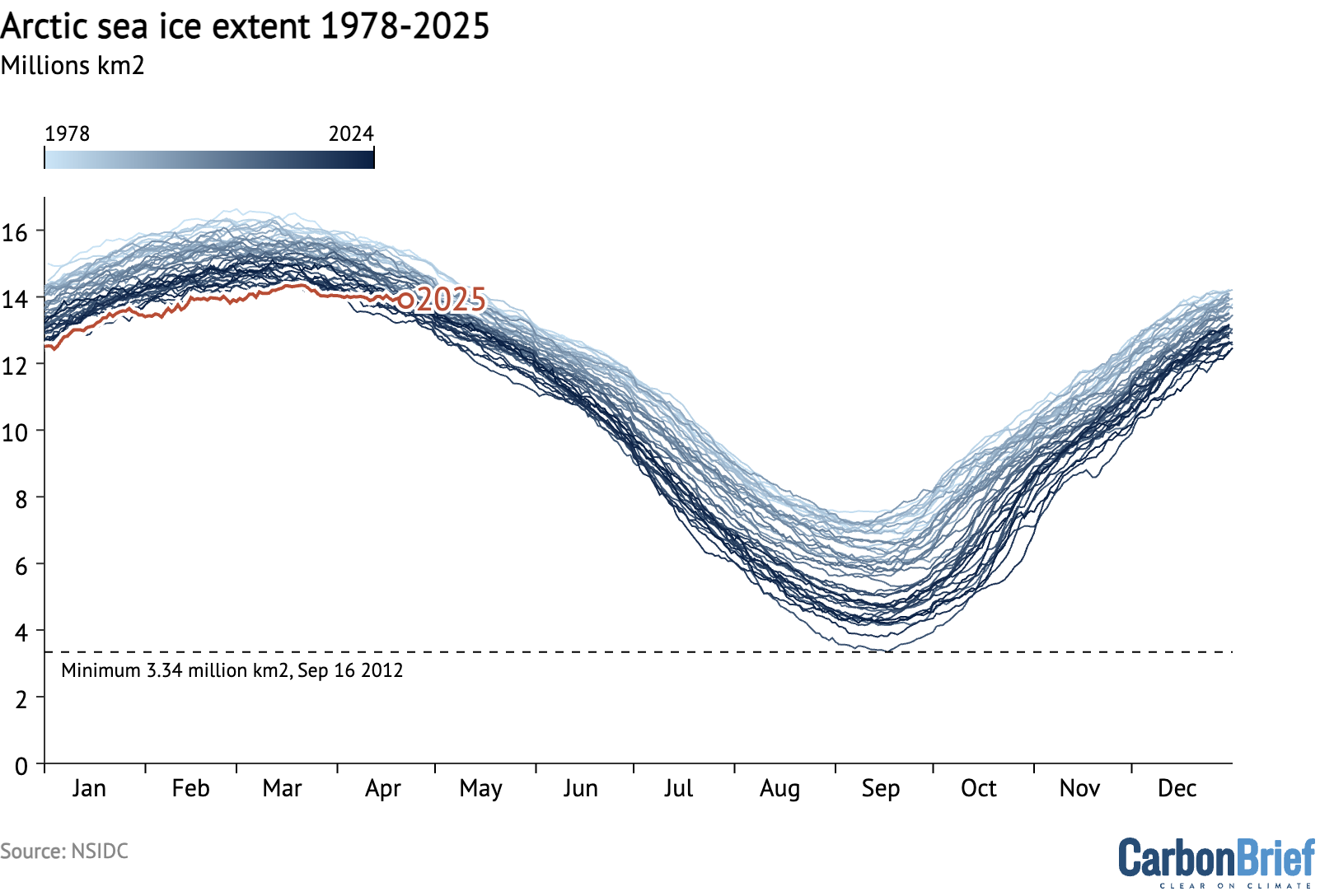
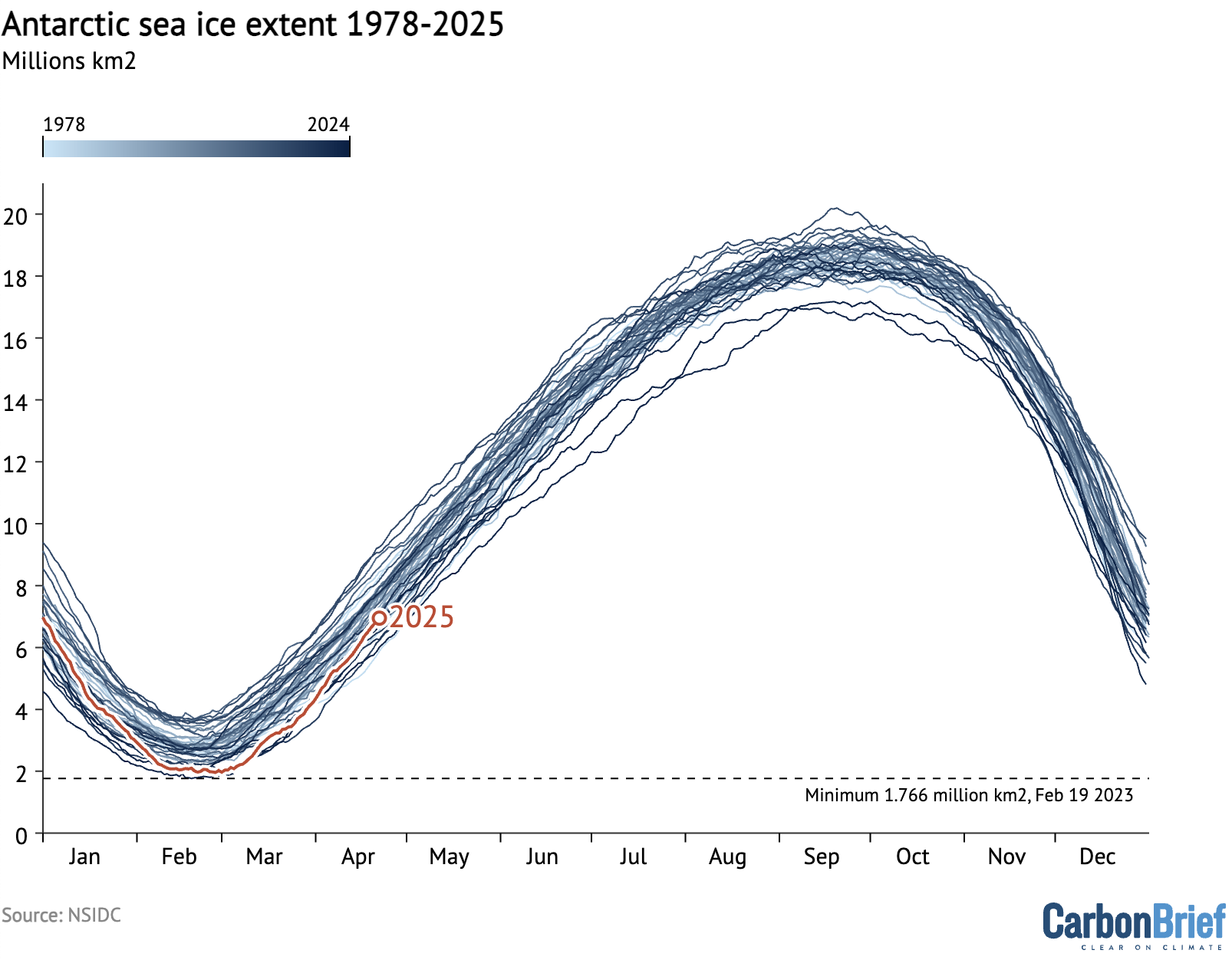
In addition to near-record warmth, the start of 2025 has seen record-low sea ice cover in the Arctic between January and March – and the second-lowest minimum sea ice extent on record for Antarctica.
The figure below shows the annual temperatures from each of these groups since 1970, along with the average over the first three months of 2025.
(It is worth noting that the first three months may not be representative of the year as a whole, as greater historical warming rates mean that temperatures relative to pre-industrial levels tend to be larger in the northern hemispheric winter months of December, January and February.)https://interactive.carbonbrief.org/state-of-the-climate/2025-04/records-with-2024-to-date.htmlAnnual global average surface temperatures from NASA GISTEMP, NOAA GlobalTemp, Hadley/UEA HadCRUT5, Berkeley Earth and Copernicus/ECMWF (lines), along with 2025 temperatures so far (January-March, coloured dots). Anomalies plotted with respect to the 1981-2010 period, and shown relative to pre-industrial based on the average pre-industrial temperatures in the Hadley/UEA, NOAA and Berkeley datasets that extend back to 1850. Chart by Carbon Brief.
Starting with this state of the climate update, Carbon Brief will be showing a World Meteorological Organization (WMO) aggregate of the five surface temperature records, rather than highlighting any particular one, reflecting a single best-estimate across the different groups.
The WMO aggregate is calculated by averaging the different records using a common 1981-2010 baseline period, before adding in the average warming since the pre-industrial period (1850-1900) across the datasets – NOAA, Hadley, and Berkeley – that extend back to 1850.
The figure below shows how global temperature so far in 2025 (black line) compares to each month in different years since 1940 (with lines coloured by the decade in which they occurred) in the WMO aggregate of surface temperature dataset.https://interactive.carbonbrief.org/state-of-the-climate/2025-04/monthly-global-temp-anomalies.htmlTemperatures for each month from 1940 to 2025 from the WMO aggregate of temperature records. Anomalies plotted with respect to a 1850-1900 baseline. Chart by Carbon Brief.
The first three months of 2025 have been unusually warm, coming in in the top-three warmest on record across all the different scientific groups that report on global surface temperatures. This is despite the presence of moderate La Niña conditions in the tropical Pacific, which typically suppress global temperatures.
January 2025 was the warmest January on record in the WMO aggregate, February was the third warmest and March was tied with 2016 as the second warmest.
When combined, the first three months of the year in 2025 were the second-warmest Q1 period in the historical record, just 0.035C below the record set in 2024 after the peak of a strong El Niño event, as shown in the figure below.https://interactive.carbonbrief.org/state-of-the-climate/2025-04/Q1-temp-plot.htmlQ1 temperature anomalies from 1850 through 2025 from the WMO aggregate of temperature records. Anomalies plotted with respect to a 1850-1900 baseline. Chart by Carbon Brief.
The persistence of warmth after the end of the 2023-24 El Niño event – and through a weak La Niña – has been highly unusual by historical standards. In most prior cases, global temperatures returned closer to the long-term temperature trend following the return to neutral El Niño Southern Oscillation (ENSO) conditions in the tropical Pacific.
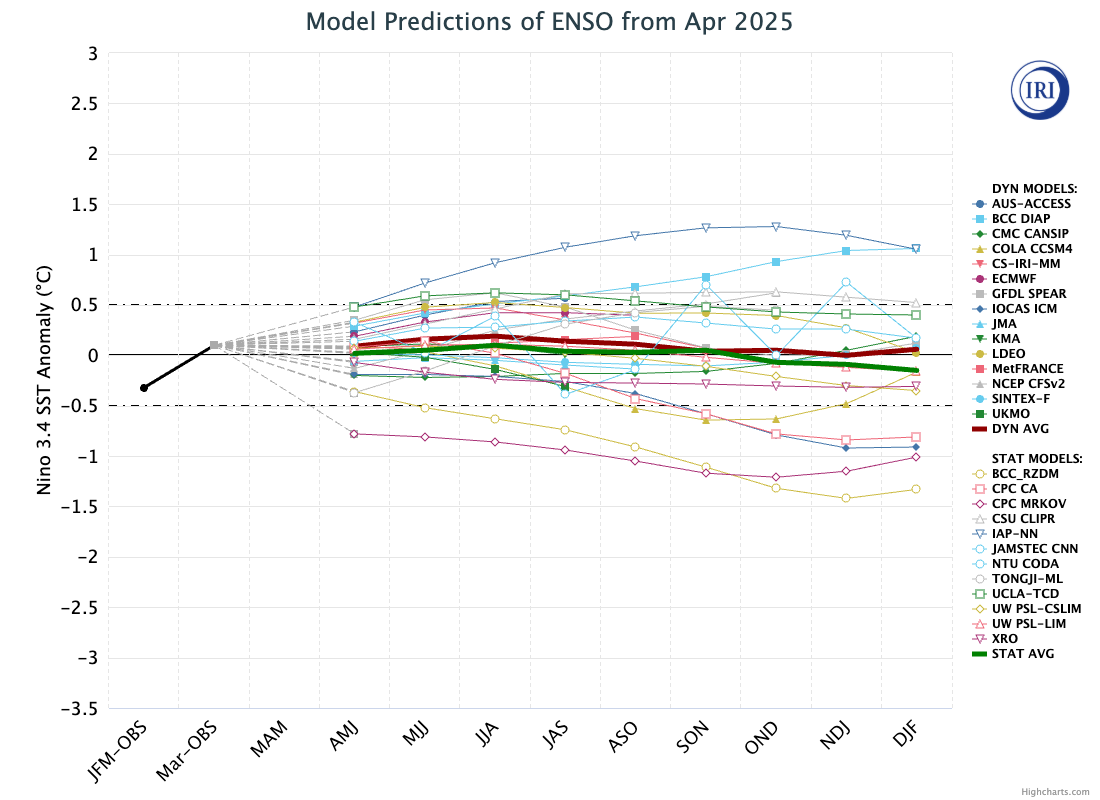
Weak La Niña conditions have faded over the past month, with ENSO-neutral conditions returning and expected to persist for most models through the remainder of the year. However, predictions of ENSO status are particularly uncertain at this time of year due to a phenomenon known as the “spring predictability barrier”.
The figure below shows a range of different forecast models for the ENSO for the rest of this year, produced by different scientific groups. The values shown are sea surface temperature variations in the tropical Pacific – known as the El Niño 3.4 region – for overlapping three-month periods.
By looking at the relationship between the first three months and the annual temperatures for every year since 1970 – as well as ENSO conditions for the first three months of the year and the projected development of El Niño conditions for the remaining nine months – Carbon Brief has created a projection of what the final global average temperature for 2025 will likely be.
The analysis includes the estimated uncertainty in 2025 outcomes, given that temperatures from only the first quarter of the year are available so far.
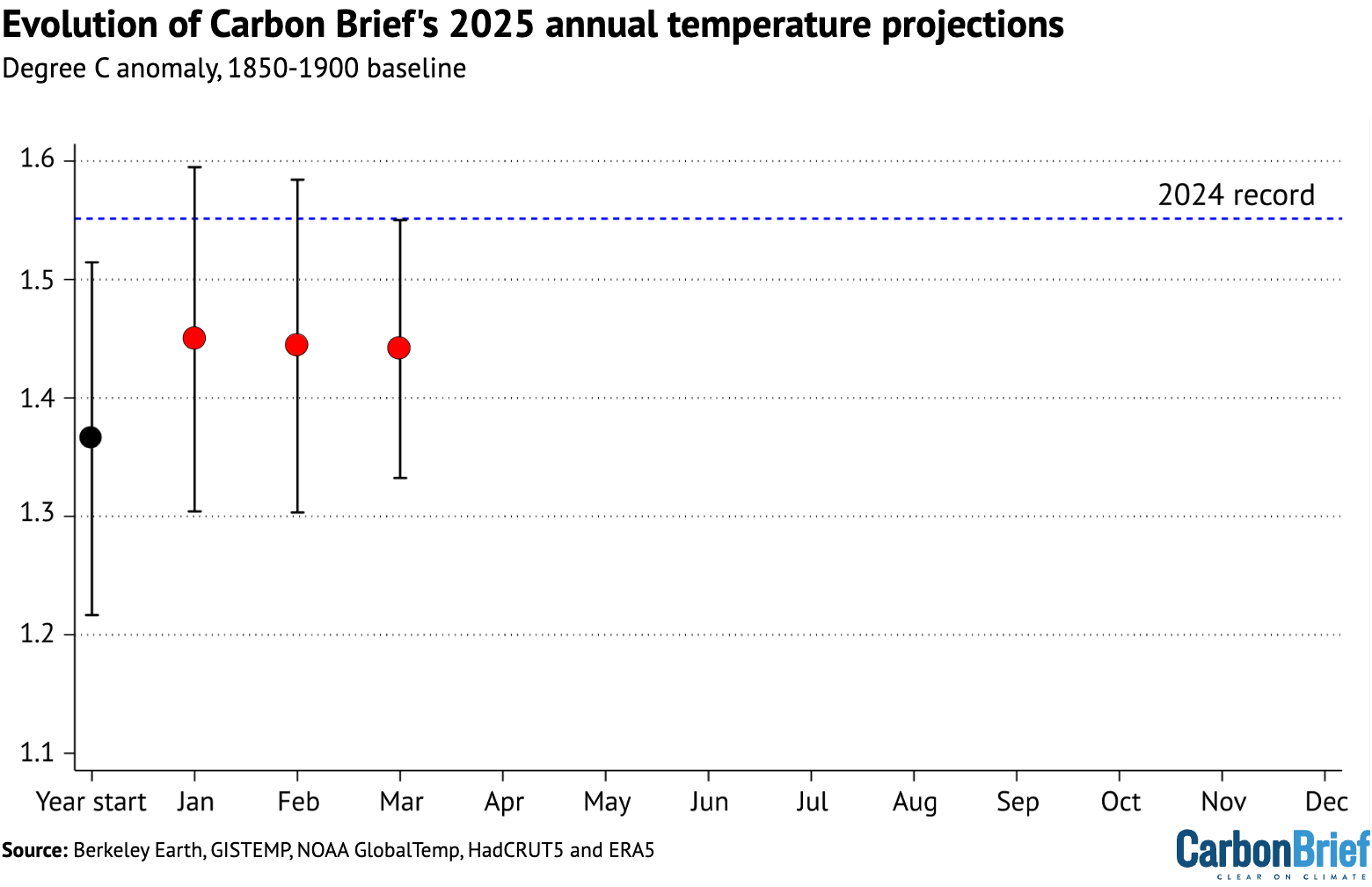
The chart below shows the expected range of 2025 temperatures using the WMO aggregate – including a best-estimate (red) and year-to-date value (yellow). Temperatures are shown with respect to the pre-industrial baseline period (1850-1900).https://interactive.carbonbrief.org/state-of-the-climate/2025-04/Q1-2025-estimate.htmlAnnual global average surface temperature anomalies from the WMO aggregate plotted with respect to a 1850-1900 baseline. To-date 2025 values include January-March. The estimated 2025 annual value is based on the relationship between the January-March temperatures and annual temperatures between 1970 and 2024. Chart by Carbon Brief.
Carbon Brief’s projection suggests that 2025 is virtually certain to be one of the top-three warmest years, with a best-estimate approximately equal to global temperatures in 2023.
However, this model assumes that 2025 follows the type of climate patterns seen in the past – patterns that were notably broken in 2023 – and to a lesser extent in 2024. Other recent estimates – such as one published by Berkeley Earth – give a higher probability of around 34% that 2025 will set a new temperature record.
The figure below shows Carbon Brief’s estimate of 2025 temperatures using the WMO aggregate, both at the beginning of the year and once each month’s data has come in. The estimate jumped notably after t2025 saw the warmest January on record, but has been relatively stable over the past three months.
Carbon Brief’s projection of global temperatures based on the WMO aggregate at the start of the year, and after January, February, and March global surface temperature data became available. Chart by Carbon Brief.
Record-low Antarctic and Arctic sea ice
Both Arctic and Antarctic sea ice extent spent much of early 2025 at record, or near-record, lows.
The figure below shows both Arctic and Antarctic sea ice extent in 2025 (solid red and blue lines), the historical range in the record between 1979 and 2010 (shaded areas) and the record lows (dotted black line).
(Unlike global temperature records, which only report monthly averages, sea ice data is collected and updated on a daily basis, allowing sea ice extent to be viewed up to the present.)https://interactive.carbonbrief.org/state-of-the-climate/2025-04/sea-ice-graph.htmlArctic and Antarctic daily sea ice extent from the US National Snow and Ice Data Center (NSIDC). The bold lines show daily 2025 values, the shaded area indicates the two standard deviation range in historical values between 1979 and 2010. The dotted black lines show the record lows for each pole. Chart by Carbon Brief.
Arctic sea ice saw a new record low nearly each day between January and March, recording a record-low winter peak extent in late March. Ice extent subsequently moved out of record-low territory in April.
It is worth noting that, as northern hemisphere winter conditions remain cold enough to refreeze sea ice, there tends to be less variability in extent year-to-year in the winter than in the summer, as the chart below illustrates.
Antarctic sea ice started the year within the historical range (1979-2010), before plunging to tie for the second-lowest minimum on record in late February. It has since recovered in April, and is currently on the low end of the historical range.
dizzy: Trump is attempting to censor research and information like this.
Neo-Fascist Climate Science Denier Donald Trump says Burn, Baby, Burn.Elon Musk urges you to be a Fascist like him, says that you can ignore facts and reality then.Orcas discuss Donald Trump and the killer apes’ concept of democracy. Front Orca warns that Trump is crashing his country’s economy and that everything he does he does for the fantastically wealthy.
A bald eagle in Kachemak Bay state park, Alaska, one of many species protected from extinction by legislation in the Endangered Species Act. Photograph: Alamy
Fears grow for endangered species as the US president sets about dismantling basic laws to protect them to make way for oil and gas drilling
Donald Trump has already begun dismantling parts of the envied US endangered species protections in his quest to boost oil and gas drilling, in part using a panel with an ominous name: the God squad.
…
A ‘God squad’ to decide protections for species
One of Trump’s first executive orders after returning to the White House in January shows, though, that he is prepared to further escalate an overhaul of endangered species laws, experts say. The order, which declared a national energy emergency even amid a record glut of oil and gas drilling, calls for the endangered species committee, a group nicknamed the “God squad”, to meet at least quarterly.
This committee, which would be led by Burgum, five other senior officials from different government agencies and a representative from an affected state, has rarely been used but has the power to override the Endangered Species Act even if it results in the extinction of a species, hence its existential nickname. …
Neo-Fascist Climate Science Denier Donald Trump says Burn, Baby, Burn.Elon Musk urges you to be a Fascist like him, says that you can ignore facts and reality then.


 A pumpjack operates in the foreground while a wind turbine at the Buckeye Wind Energy wind farm rises in the distance, September 30, 2024, near Hays, Kansas, US