President Donald Trump answers questions from reporters after signing an executive order in the Oval Office of the White House, March 31, 2026, in Washington
US PRESIDENT Donald Trump struck a hard line today in a social media post, demanding that Iran stop blocking the Strait of Hormuz, or the US would bomb the Iranians “back to the Stone Ages.”
A day earlier, President Trump had said the US “will not have anything to do with” ensuring the security of ships passing through Hormuz; that was itself an apparent backtrack from an earlier threat to attack Iran’s power grid and other infrastructure if it didn’t open the strait by April 6.
…
Mr Trump has continued to insist that negotiations between the US and Iran are progressing well and claims Iran is “begging to make a deal.”
The Iranians have said that while messages have been sent between Tehran and Washington, there have been no formal negotiations.
Iranian President Masoud Pezeshkian said today his country has the “necessary will” to end the war with the US and Israel.
Talking to Al Jazeera, Iranian Foreign Minister Abbas Araghchi said: “You cannot speak to the people of Iran in the language of threats and deadlines.
“We do not set any deadline for defending ourselves.”
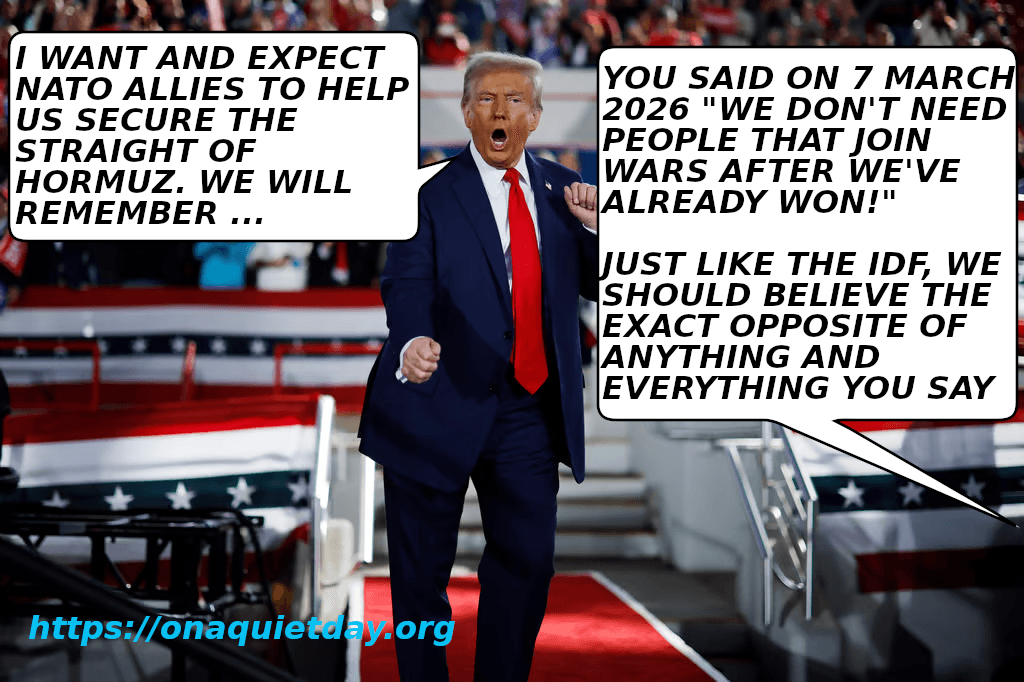
Donald Trump calls for help from NATO allies in securing the Straight of Hormuz despite saying on 7 March 2026 that they don’t need people to join wars after they’ve already won. He’s challenged with the claim that he lies as much as the IDF.Keir Starmer explains that UK is actively supporting Israel’s genocidal expansion and repeats his previous quotation that he supports Zionism “without qualification”. Keir Starmer said “I said it loud and clear – and meant it – that I support Zionism without qualification.” here: https://www.jewishnews.co.uk/keir-starmer-interview-i-will-work-to-eradicate-antisemitism-from-day-one/Orcas discuss how Trump was re-elected and him being an obviously insane, xenophobic Fascist.
An F15 fighter jet landing at RAF Lakenheath, Suffolk
ANTI-WAR protesters set up an international peace camp at RAF Lakenheath today amid evidence that US nuclear weapons have arrived at the base.
Organised by Lakenheath Alliance for Peace, of which CND is a member, the camp is protesting against US B61-12 nuclear bombs at the site.
The camp, which began with a 24-hour vigil, is also highlighting its role in facilitating Israel’s genocide in Gaza and the ongoing illegal attacks on Iran.
CND ad vans will tour around East Anglia, including at towns and villages near the base, to demand PM Sir Keir Starmer kick out US President Donald Trump’s nukes from Britain.
The camp is also calling on communities to join a major Give Peace a Chance demonstration and blockade at RAF Lakenheath from noon this Saturday.
CND general secretary Sophie Bolt said: “Over 60 per cent of the British population oppose the deployment of these US nuclear weapons in Britain.
“With the reckless leadership of Donald Trump, they put us on the front line of his devastating wars.
“Both RAF Lakenheath and nearby RAF Mildenhall have been heavily involved in the ongoing illegal attacks of Iran.
Keir Starmer explains that UK is actively supporting Israel’s genocidal expansion and repeats his previous quotation that he supports Zionism “without qualification”. Keir Starmer said “I said it loud and clear – and meant it – that I support Zionism without qualification.” here: https://www.jewishnews.co.uk/keir-starmer-interview-i-will-work-to-eradicate-antisemitism-from-day-one/Keir Starmer objects to criticism of the IDF. He asks how could anyone object to them starving people to death, forced marches like the Nazis did, bombing Gaza’s hospitals and universities, mass-murdering journalists, healthworkers and starving people queuing for food, killing and raping prisoners and murdering children. He calls for people to stop obstructing his genocide for Israel.Orcas discuss Genocide-supporting and complicit Zionists. Donald Trump, Keith Starmer, David Lammy, Rachel Reeves, Angela Rayner and Wes Streeting are acknowledged as evil genocide-complicit and supporting cnuts.
US President Donald Trump exits Air Force One on March 29, 2026 at Joint Base Andrews, Maryland. (Photo by Nathan Howard/Getty Images)
“NATO is a defensive alliance,” said one UK military analyst as the president demanded help in his unprovoked war on Iran. “It’s not been clear what the legal justification for the war is.”
President Donald Trump on Tuesday lashed out at European countries over the message leaders have been clear about since the US joined Israel in waging an unprovoked war against Iran—an assault that swiftly led Iran to retaliate by closing the Strait of Hormuz, sending global oil prices skyrocketing.
The war, Europe has said, is not one the United States’ longtime allies have started or that they’ll be “dragged into,” and the worldwide economic consequences are the responsibility of the countries that chose to attack Iran.
Reports that France over the weekend barred US military planes headed for Israel from flying over its territory appeared to particularly send Trump into a rage, prompting him to call the French government “VERY UNHELPFUL” on his social media platform, Truth Social.
“The U.S.A. will REMEMBER!!” said the president Tuesday morning.
He then took aim at countries across Europe, writing, “Go get your own oil!” in a separate missive.
Trump repeated previous suggestions that US allies are “cowards” for not offering their assistance in the unprovoked war, demanding that they “build up some delayed courage, go to the Strait, and just TAKE” the oil by force.
“You’ll have to start learning how to fight for yourself, the U.S.A. won’t be there to help you anymore, just like you weren’t there for us,” he added.
France denied the reports that it had prevented US planes from flying over its airspace, but it is one of a number of longtime US allies that have reportedly taken action to avoid complicity in the US-Israeli war, which experts say is a clear violation of international law, including the United Nations Charter, and which has killed nearly 2,000 Iranians and over 1,000 people across the Middle East as the conflict has widened.
Italian officials have denied the US military the use of an airbase in Sicily, saying the Trump administration had not gone through the required authorization procedure. Spanish Prime Minister Pedro Sánchez has been most vocal about refusing to help the US war effort, saying Trump had embarked on an “illegal war” as his administration announced the US military would be barred from Spanish airspace after an earlier statement that the US could not use Spain’s military bases for operations involving the Iran war.
One senior European government official told Politico last week that Trump’s demands for help have been “absurdly incoherent to put it mildly,” considering the White House has also demanded that countries in Europe step up their efforts to defend Ukraine without relying on the US.
“The big picture is: The US has asked us to take care of and defend our own countries, take care of supporting Ukraine… and now [the] Middle East and global supply chains,” the official said.
Defense Secretary Pete Hegseth on Tuesday reiterated Trump’s message, saying that “there are countries around the world who ought to be prepared to step up on this critical waterway as well.”
“It’s not just the United States Navy,” said Hegseth, who has attempted to rebrand the Department of Defense as the Department of War. “Last time I checked, there was supposed to be a big, bad Royal Navy that could be prepared to do things like that as well.”
Hegseth: "The president was clear this morning in his Truth that there are countries around the world who ought to be prepared to step up on this critical waterway as well. Last time I checked there was supposed to be a big bad Royal Navy that could be prepared to do things like… pic.twitter.com/WTVurKV2jQ
On Sky News in the UK on Tuesday, military analyst Sean Bell issued a reminder after Hegseth’s and Trump’s comments that “it’s not a [North Atlantic Treaty Organization] war.”
“NATO is a defensive alliance,” said Bell. “It’s not been clear what the legal justification for the war is.”
Iran’s closing of the Strait of Hormuz, through which about 20% of the worldwide oil supply flows, has sent oil prices soaring in the US and around the world. In the US, gas prices hit an average of $4 per gallon on Tuesday, and Europe has seen prices go up by about 70% since the war began.
European leaders on Tuesday were meeting to discuss the growing energy crisis, with the European Commission urging governments to consider a public call for people to reduce their use of energy, particularly in the transport sector.
As the global community faces the economic consequences of the war, Trump’s comments on Tuesday bolstered the previous day’s reporting by The Wall Street Journal that the president is “willing to end the US military campaign against Iran even if the Strait of Hormuz remains largely closed, administration officials said, likely extending Tehran’s firm grip on the waterway and leaving a complex operation to reopen it for a later date.”
At Drop Site News, journalist Murtaza Hussain joined co-founder Ryan Grim for a discussion on Tuesday about Trump’s latest comments.
While noting that Trump has “engaged in deception” and could actually “be gearing up to launch some operation intended to open the strait” by force, Hussain said that the suggestion that the US will no longer ensure global shipping routes are flowing could be a a “fall of the Berlin Wall moment.”
“The entire basis of the American empire is that it’s a maritime empire,” said Hussain. “So if now, very perfunctorily, the US is saying, ‘We’re not going to defend one of the most important shipping lanes on the entire planet,’ where 20% of the world’s energy comes out of… It’s kind of like the Suez crisis, which put the nail in the coffin of the British empire.”
Grim added that despite Hegseth’s claim that the US has “set the conditions for success” in the Strait of Hormuz, the Trump administration actually “took an open strait, made it closed, and are now going to walk away.”
The end result of the US and Israel’s decision to attack Iran could be the further isolation of the two countries, said Grim.
“If the US decides it doesn’t have the military capacity or willingness to open the strait violently, the idea that France is going to do it is preposterous,” he said. “What France would more likely do is call up Iran and say, ‘What’s the price?’… If you’re Israel and you’re calling Iran, you’re probably not going to get the same deal… You would imagine Iran would say, ‘Here’s what it costs, and it gets a little cheaper if you cut ties with Israel…’ All of a sudden, they’re a global player now, because they have this leverage.”
Donald Trump calls for help from NATO allies in securing the Straight of Hormuz despite saying on 7 March 2026 that they don’t need people to join wars after they’ve already won. He’s challenged with the claim that he lies as much as the IDF.Keir Starmer explains that UK is actively supporting Israel’s genocidal expansion and repeats his previous quotation that he supports Zionism “without qualification”. Keir Starmer said “I said it loud and clear – and meant it – that I support Zionism without qualification.” here: https://www.jewishnews.co.uk/keir-starmer-interview-i-will-work-to-eradicate-antisemitism-from-day-one/
Donald Trump sings and dances, says that it’s fun to kill everyone …
WASHINGTON, DC – MARCH 26: U.S. President Donald Trump reacts as he speaks during a Cabinet meeting in the Cabinet Room of the White House on March 26, 2026 in Washington, DC. This is Trump’s second Cabinet meeting of 2026 and the first since the United States and Israel began attacking Iran on February 28. (Photo by Chip Somodevilla/Getty Images)
The US president, trapped by his own ego, has wrought unparalleled destruction to the people of Iran, the Middle East, and the world.
The judgment on the Trump administration’s war on Iran is already largely settled across mainstream media, public opinion, and much of the analytical sphere.
What remains supportive of the war is limited to two predictable camps: official government discourse and the president’s most loyal supporters, along with entrenched pro-Israel constituencies.
Beyond these circles, the war is widely understood as reckless, unjustified, and strategically incoherent.
Among the wider American public, this conclusion is not abstract. It is shaped by growing unease, economic anxiety, and a mounting sense that the war lacks both purpose and direction.
A defeat in Iran would not simply be a policy failure; it would represent the collapse of that identity. For a leader driven by narcissistic imperatives, such a collapse is existential, threatening not only his political standing but his relationship with his own base.
Since the outbreak of the war on February 28, 2026, polling has consistently pointed in one direction. A Pew Research poll in late March found that 61 percent of Americans disapprove of Trump’s handling of the conflict.
Another AP-NORC survey showed that six in ten Americans believe US military action against Iran has already “gone too far,” while even Fox News polling found 58 percent opposition.
These numbers confirm a broader trend that began early in the war and has only intensified. Reuters reported on March 19 that just 7 percent of Americans support a full-scale ground invasion.
In that same reporting, nearly two-thirds of respondents said they believe Trump is likely to pursue one anyway, highlighting a growing disconnect between policy and public will.
Days later, Reuters noted that Trump’s approval rating had dropped to 36 percent, with rising fuel prices and economic instability cited as key drivers.
The longer the war continues, the more its consequences are internalized by ordinary Americans, turning distant conflict into immediate economic pressure.
Among the American intelligentsia, opposition is no longer confined to traditional anti-war circles. It now spans ideological boundaries, including segments of Trump’s own political base.
Reporting from the 2026 Conservative Political Action Conference, The Guardian observed that many MAGA supporters warned the war risks becoming another “forever war.”
This convergence is significant, reflecting not a passing disagreement but a deeper structural shift in public perception.
Yet mainstream media—from CNN to Fox News—has largely avoided confronting what many Americans already recognize: that the war aligns closely with the agenda of Israeli Prime Minister Benjamin Netanyahu.
Within Washington itself, unease is also becoming more explicit. The Wall Street Journal reported in March that lawmakers from both parties are increasingly skeptical of the administration’s approach.
At the strategic level, the war’s foundational assumptions have already begun to unravel. Israel’s early calculations that escalation might trigger internal collapse in Iran have failed to materialize.
Iran’s political system remains intact, its leadership stable, and its military cohesion unbroken under Supreme Leader Ali Khamenei.
At the same time, Tehran has demonstrated its ability to retaliate across multiple fronts, targeting Israeli territory and US military assets in the region.
Its geographic leverage over the Strait of Hormuz continues to exert pressure on global energy markets, amplifying its strategic position despite sustained attacks.
The structural reality is therefore unavoidable. Regime change in Iran would require a massive ground invasion, a broad coalition, and a prolonged occupation.
Even under such conditions, success would remain uncertain, as the experience of Iraq has already demonstrated with devastating clarity.
This raises the central question: why continue a war whose strategic premises are already collapsing?
Part of the answer lies not in strategy, but in psychology. A substantial body of political psychology research, frequently cited in relevant 2026 analyses, describes Trump’s leadership style as deeply narcissistic. Traits such as grandiosity, hypersensitivity to criticism, and an overriding need to project dominance are not incidental—they actively shape decision-making.
Trump’s rhetoric has long relied on humiliation, domination, and spectacle, framing politics as a contest of strength rather than negotiation.
Within this framework, escalation becomes a psychological necessity. To retreat risks appearing weak, while compromise risks humiliation.
For a leader whose identity is built on projecting strength, such outcomes are politically and personally intolerable.
This dynamic is reinforced by the broader culture of the administration, where senior officials have repeatedly relied on language such as “obliteration” and “total destruction.”
Such rhetoric, however, has not been matched by evidence of a coherent long-term strategy, exposing a widening gap between performance and planning.
At the same time, the administration’s fixation on masculine power—on dominance, strength, and spectacle—has contributed to a profound underestimation of its adversary.
Iran is not a fragmented state waiting to collapse, but a regional power with decades of experience in asymmetric warfare and strategic resilience.
Yet Trump appears to have operated under the assumption that American power alone guarantees outcomes, an illusion reinforced by past displays of military force.
Reuters reported in late March that Trump is now increasingly pressured to “end the war” quickly, as the administration confronts what it described as “only hard choices.”
The same report cited officials acknowledging that there is no clear exit strategy, leaving the administration caught between escalation and political fallout.
One official told Reuters that there are “no easy solutions” left, underscoring the depth of the strategic impasse.
Another added that any withdrawal would have to be framed carefully to avoid appearing as a defeat, reflecting the administration’s concern with optics as much as outcomes.
This is where the psychological dimension becomes decisive. Trump has constructed a political identity rooted in strength, dominance, and victory.
A defeat in Iran would not simply be a policy failure; it would represent the collapse of that identity. For a leader driven by narcissistic imperatives, such a collapse is existential, threatening not only his political standing but his relationship with his own base.
This is why some analysts—and even figures within Trump’s own orbit—have begun to float a theatrical exit strategy. As Reuters reported on March 14, White House adviser David Sacks stated bluntly that the United States should “declare victory and get out” of the war on Iran, calling for disengagement despite the absence of a clear strategic outcome.
Such a move would allow Trump to claim success while disengaging from an increasingly untenable conflict, preserving the image of strength even in the face of strategic failure.
But this reveals the deeper truth of the war. The “victory” being pursued is not military—it is psychological.
The US-Israeli war on Iran is therefore not only a moral and legal crisis. It is also a geopolitical catastrophe shaped, in no small part, by the psychology of a leader unwilling to confront the consequences of his own disastrous decisions.
Climate science denier Donald Trump confirms that he knows nothing about democracy and that more liquid gold is being secured according to his policy of global privateering.Donald Fuhrump says that Amerikkka doesn’t bother with crimes or charges anymore, not being 100% Amerikkkan and opposing his real estate intentions is enough.Orcas discuss how Trump was re-elected and him being an obviously insane, xenophobic Fascist.
Explosions erupt following strikes at Tehran Oil Refinery in Tehran on March 7, 2026. (Photo by Atta Kenare/ AFP via Getty Images)
It’s a dirty business that’s ruining the planet and jeopardizing our futures in countless ways, of which this despicable war in Iran is just the latest and highest profile.
Oil is both a major driver of this war and, for now at least, the primary way Americans are feeling its effects. The war drives home the grim reality that we are hostage to this toxic ooze that burns dirty, poisons wildlife, causes cancer, and accelerates climate change. The necessity to wean ourselves off of it, as quickly and completely as possible, has never been more apparent.
An Oil Crisis of Trump’s Own Making
Even Trump is subservient to the whims and demands of the oil economy. Since he started the war, he’s tried desperately to control the chaotic effect his bombing campaign has had on global oil markets. Trump may not be bright, but he understands one very basic political reality: He can cover up the Epstein files, get away with all manner of fraud and graft, and even commit war crimes—but he cannot let the price of gas get too high.
Oil makes all our lives dirtier and less safe. Fighting wars so we can dig it up until it’s all gone—or until we are—is as stupid, reckless, and self-destructive a thing as any animal has ever done.
From a strategic perspective, then, the focal point of the war quickly became the Strait of Hormuz, a narrow passageway out of the Persian Gulf that pinches down between southern Iran and the Omani Musandam Peninsula. The strait is an essential shipping lane for 20% of the world’s liquefied natural gas (LNG), as well as a third of the global fertilizer trade. With essentially uncontested control of the strait, Iran has closed it to “enemy-linked” ships. Iran insists that non-hostile ships pay a toll in Chinese yuan, which is an attempt to undermine the supremacy of the petrodollar.
The crisis at the Strait of Hormuz is entirely of Trump’s own making, and has triggered an erratic series of threats, pleas, lies, and bargaining from him as he tries to keep his stupid war from grinding the global economy to a halt. Trump has even threatened to deploy the US Navy to escort ships through the strait. One has to wonder how sailors feel about being offered up as bodyguards for Qatari tankers, thrown into a situation where they would be wide open for Iranian drone and missile attacks.
Trump the Oil Imperialist
Trump sees this war almost entirely through the lens of oil. As part of alleged ceasefire negotiations, Trump claimed Iran “gave us a present… worth a tremendous amount of money… it was oil-and-gas related.” That turned out to be Iran allowing 10 oil ships through the Strait of Hormuz. Trump also implied that those high gas prices causing so many people pain at the pump are actually good for the country. Because the US is a net exporter of oil, Trump said, “When oil prices go up, we make a lot of money”—perhaps forgetting that most Americans do not own oil companies.
Compare Trump’s constant talk of oil with the Bush administration’s 2003 invasion of Iraq. In 2003-06, calling Iraq a war for oil was considered a conspiracy theory. Dissidents and war critics were driven out of polite conversations for even bringing it up. Insinuating that the troops would ever be deployed for such an ignoble purpose was treated as beyond the pale, if not treasonous, by Fox News and the Bush White House.
This time, there’s next to no pretense of nobility in Trump’s war. While lots of motivations, with varying degrees of believability and logic, have been given—ranging from halting Iran’s nuclear capabilities to ushering in Armageddon—the Trump administration is perfectly open about the centrality of oil to their war mission. In a way, it’s almost refreshing to hear a politician speak so forwardly about their imperialist intent, even if it does lay bare the villainy of the US empire.
In addition to the Strait of Hormuz, Trump is focused on Kharg Island, a small island in the Persian Gulf that handles up to 90% of Iran’s crude oil exports. Sen. Lindsey Graham (R-SC), who is among the most bloodthirsty war hawks on the planet, encouraged Trump to seize Kharg Island (and compared such an operation to Iwo Jima, in which 7,000 Marines died—no skin off Lindsey Graham’s back). Trump himself then said, while discussing his military options, “My favorite thing is to take the oil in Iran.”
Trump has long openly fantasized about using the military to conquer oil fields. In 2013, before his political career really started, he tweeted, “I still can’t believe we left Iraq without the oil,” and he repeated this urge to plunder Iraq’s oil during the 2016 election. To Trump, this is just how the world works: If your guns and bombs make bigger holes and explosions, you get to just take whatever you want, anywhere in the world. There is no right, no wrong, no law.
This also tracks with how Trump has handled the oil industry in Venezuela. Last year, Trump started claiming that Venezuela had stolen, or “unilaterally seized and sold American oil.” This claim was a reference to Venezuela nationalizing their oil industry and evicting American oil companies. Then, in January, the US military abducted Venezuelan President Nicolás Maduro, an astonishing breach of international norms. With Maduro gone, Trump began shadily directing Venezuelan oil revenue into an offshore Qatari account.
The Need to Wean Ourselves off of Oil
Such oil imperialism long predates Trump. Just ask other offenders of the US oil monopoly, like Muammar Gaddafi or Saddam Hussein. Oil is the locus of US foreign policy. The US military itself is the single largest institutional polluter and user of fossil fuels. It’s a dirty business that’s ruining the planet and jeopardizing our futures in countless ways, of which this despicable war in Iran is just the latest and highest profile.
The simple answer to all this madness is to wean ourselves off of oil. It won’t be easy, and we’ll probably never be fully rid of it, but we aren’t even trying. There are a million ways we could start cutting back, a million investments we could make toward a future that is as oil free as possible. But Trump is doing everything he can to keep us addicted to it, including starting an unpopular and illegal war.
Trump has always been particularly pro-fossil fuel. He loves the nonsensical phrase “beautiful clean coal.” He calls green energy a “scam” and has repeatedly made the utterly deranged claim that windmills cause cancer. His administration displays a psychotic obsession with destroying green energy initiatives, most recently paying a French energy company $1 billion to cancel a wind farm and instead invest in oil and gas.
Oil makes all our lives dirtier and less safe. Fighting wars so we can dig it up until it’s all gone—or until we are—is as stupid, reckless, and self-destructive a thing as any animal has ever done. With a little bit of will and some leadership, we could control our greed and addiction. If we were able to do that, we might not find ourselves charging into the Middle East on such a regular basis, burning through American lives and treasure, killing countless men and women and children, and making the rest of the world hate us.
Climate science denier Donald Trump confirms that he knows nothing about democracy and that more liquid gold is being secured according to his policy of global privateering.Donald Trump urges you to be a Climate Science denier like him. He says that he makes millions and millions for destroying the planet, Burn, Baby, Burn and Flood, Baby, Flood.Orcas comment on killer apes destroying the planet by continuing to burn fossil fuels.