Tag: Donald Trump

  • Don’t Pretend the ‘War on Drugs’ Has Anything to Do With Fighting Drugs

    Spread the love

    Article by Belén Fernández republished form FAIR under a Creative Commons Attribution-NonCommercial-NoDerivs 3.0 Unported License.
    Addressing the UN General Assembly in September, Donald Trump gloated about his strategy toward “narcoterrorist” cartels, the menace du jour in the United States’ self-declared backyard. Pulling numbers out of his ass per usual, Trump claimed that the manic bombing campaign against alleged seafaring narcoterrorists (read: fishermen) in Central and South America has cut maritime drug trafficking by 97%, and called drug cartels the “ISIS of the Western Hemisphere.”

    While it was by no means the president’s intention, he accidentally hit the nail on the head with the ISIS comparison. Both the Islamic State and Latin American drug trafficking outfits are a direct result of US policy—as well as a convenient excuse for the Americans to continue terrorizing people under the pretext of combating the very phenomena they caused in the first place. Just as ISIS owes its origins to the US invasion of Iraq, drug traffickers wouldn’t be in big business if not for—what else?—the US’s so-called “war on drugs” that renders the international movement of illicit substances so lucrative.

    ‘Same effect on land’
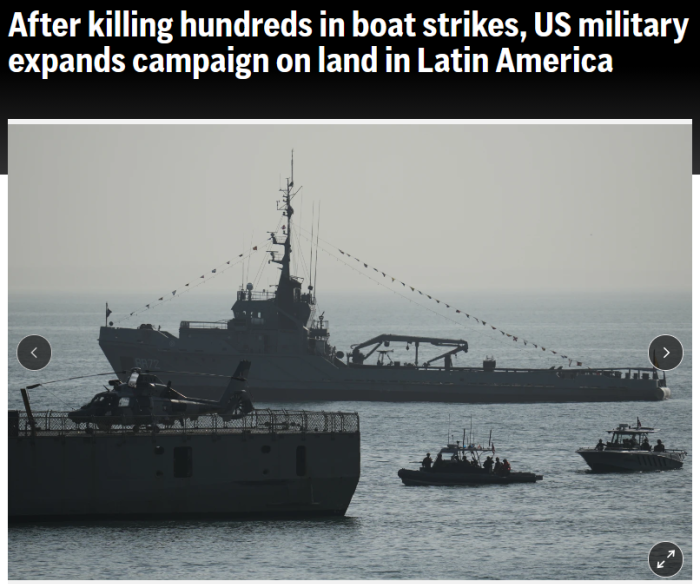
    AP: After killing hundreds in boat strikes, US military expands campaign on land in Latin America

    AP (8/17/26) describes the US military’s role in Latin America as “supplying allies with weapons, intelligence and training to fight drug trafficking”—while acknowledging “a fraught legacy of support for military coups and dictatorships.”

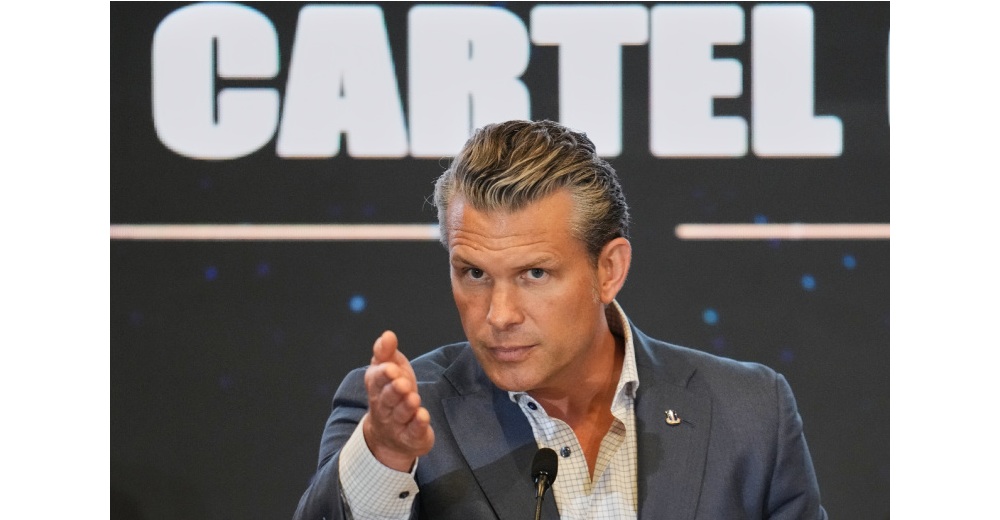
    This year, the Trump administration has significantly ramped up its drug war beyond just randomly blowing people up in the ocean. In August, the Associated Press (8/17/26) reported on the government’s plans to expand operations to terra firma, quoting Secretary of War Pete Hegseth:

    It will be “like you saw with the strikes on the drug boats,” Hegseth said during a military drill in the jungle in Panama. “Same effect on land.”

    But since there are generally more people on land than in the middle of the sea, there will no doubt be far greater opportunities for extrajudicial execution in this new terrestrial phase of operations.

    The escalated campaign takes place against the backdrop of the US-led “Shield of the Americas,” a hemispheric “anti-cartel coalition” inaugurated in March that now boasts the participation of 19 countries. Ecuador has been among the most gung-ho about joining forces with the US to launch “anti-cartel” raids, with such impressive feats to show for it as the joint bombing of a drug trafficking compound that turned out to be a dairy farm.

    ‘Long and bloody history’
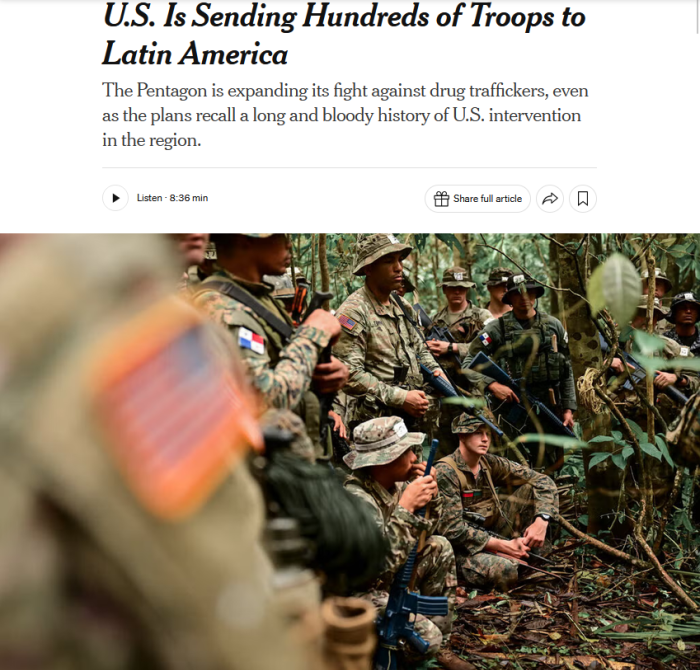
    NYT: U.S. Is Sending Hundreds of Troops to Latin America

    The New York Times (10/14/26) describes the US sending hundreds of combat troops to Latin America as “expanding its fight against drug traffickers.”

    This month, the New York Times (10/14/26) was the first to report that the US had begun deploying a shit ton of troops to Latin America, and that a “new jungle training facility” in Panama was receiving “the first elements of a 600-soldier battalion from the 10th Mountain Division at Fort Drum, NY.” The Times also mentioned the Defense Department’s “recent movement of several MQ-9 Reaper drones from Africa to Colombia and Ecuador.”

    The article’s subhead—“The Pentagon is expanding its fight against drug traffickers, even as the plans recall a long and bloody history of US intervention in the region”—leaves us with the expectation that we might be hearing something about, I dunno, the long and bloody history of US intervention in the region. And yet the only reference to that history in the body of the article occurs in a single sentence that is a modified replica of the subhead: “But the prospect of US operations on Latin American soil has raised concerns about sovereignty, and has recalled a long and bloody history of US intervention in the region.”

    Surely an example or three of “intervention” wouldn’t have taken up too much space on the pages of the Times; the authors could have mentioned that time in 1989 the US military bombed to smithereens an impoverished neighborhood in Panama City, killing as many as several thousand civilians, in a bid to capture Panamanian leader Manuel Noriega. A longtime US buddy who had been on the CIA payroll for decades despite common knowledge of his involvement in the drug trade, Noriega had outlived his usefulness, and his drug dealings were suddenly so wrong and horrible as to necessitate the psychotic bombardment of poor Panamanians living in wooden shacks.

    Or the Times could have delved into disproportionate US financial and moral support for the homicidal regime of Colombia’s far-right President Alvaro Uribe during the first decade of this century. Uribe himself appeared on a 1991 US Defense Intelligence Agency list of the “more important Colombian narco-traffickers contracted by the Colombian narcotic cartels”—but that was no reason he couldn’t be promoted to the role of America’s Super Drug War Ally and vanquisher of narcoterrorists.

    As president, Uribe oversaw what came to be known as the “false positives” scandal, in which potentially more than 10,000 Colombian civilians were slaughtered by members of the Colombian army, who disguised the corpses as left-wing guerrillas in order to accrue promotions and vacation time. The Uribe administration then used these ostensible battlefield achievements to petition the US for yet more aid.

    Last but not least, the Times could have brought up the Contra war on Nicaragua in the 1980s, when CIA-backed mercenaries unleashed terror on that nation while overseeing a profitable side hustle trafficking drugs to the US. The ensuing crack cocaine epidemic devastated Black communities across the country, but, hey, it was all in the name of saving the world from Communism.

    Indeed, not only would such details give the Times’ readers an idea of the extent to which the US has traditionally been up to no good in Latin America (and at home), they would also soundly obliterate the official “drug war” narrative and expose it for what it is: a façade for imperial domination that really has nothing to do with stopping the flow of drugs at all.

    ‘Fight against drug traffickers’
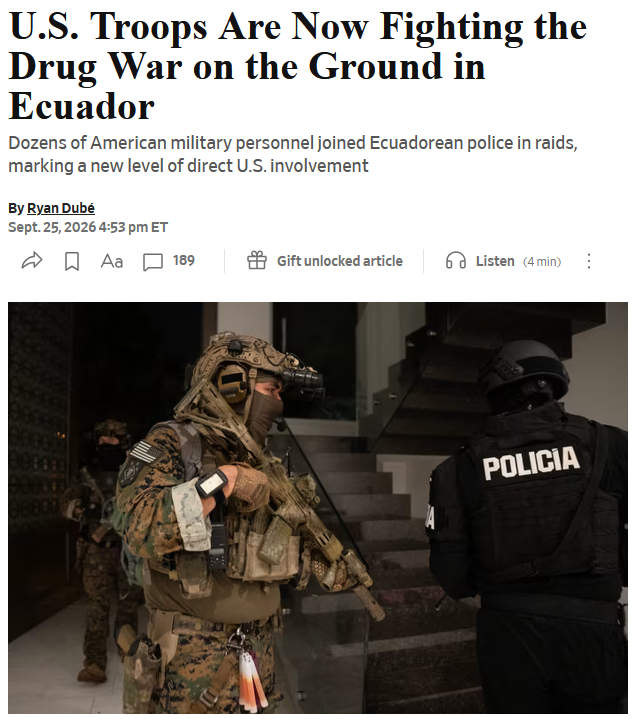
    Wall Street Journal: U.S. Troops Are Now Fighting the Drug War on the Ground in Ecuador

    The Wall Street Journal headline (9/25/26) called the US military carrying out assassinations in Ecuador “Fighting the Drug War on the Ground.”

    But for the New York Times and other corporate media, speaking truth to power is not part of the job description. While they may critique the methods or effectiveness of the “war on drugs,” these media stop far short of questioning its entire premise, and time and again the US government is allowed to set the terms of the discourse. Thus we have the Times droning on about the “fight against drug traffickers,” the “war against drugs,” the “escalating US-led military campaign against drug traffickers,” and the move “to target cartels.”

    In a typical example from September, the Wall Street Journal (9/25/26) announced that “US Troops Are Now Fighting the Drug War on the Ground in Ecuador.” This month, the Washington Post (10/16/26) reported on shifting tactics in US “anti-drug strikes at sea.” The Hill’s Filip Timotija (10/7/26) observed that “the Pentagon is expanding the US military’s multifront war against drug cartels in South America.” And so on.

    For its part, Reuters (9/22/26) has described Trump’s escalation as an “expanding campaign against drug cartels,” even while diplomatically cautioning that “rights groups” have said the US boat strikes “amount to extrajudicial killings.” This sort of diplomatic maneuver is another hallmark of a corporate media that can never come right out and say that spontaneously pulverizing people on fishing vessels actually counts as extrajudicial killing, whether you’re a “rights group” or not.

    Mechanism for control
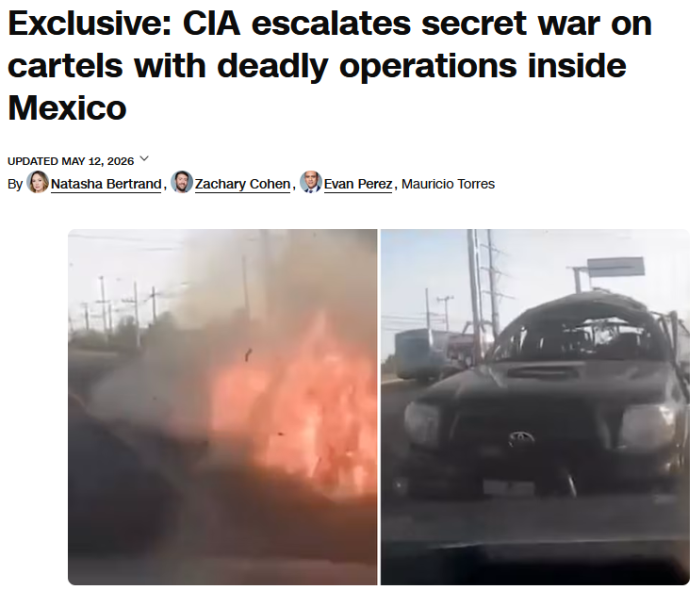
    CNN: CIA escalates secret war on cartels with deadly operations inside Mexico

    CNN (5/12/26) reported on an alleged CIA assassination in Mexico as being part of an effort “to dismantle the entrenched cartel networks.” 

    In May, CNN (5/12/26) published an exclusive report titled: “CIA Escalates Secret War on Cartels With Deadly Operations Inside Mexico.” This is the same CIA, of course, that has been up to its ears in drug trafficking since the Korean war—including, as it so happens, in Mexico. (For a rundown on CIA narco-exploits over the decades, see the 1993 article “The CIA Drug Connection Is as Old as the Agency,” which somehow made it onto the New York Times website. It begins with a “recent news item: The Justice Department is investigating allegations that officers of a special Venezuelan anti-drug unit funded by the CIA smuggled more than 2,000 pounds of cocaine into the United States with the knowledge of CIA officials.”)

    The CNN piece details the targeted assassination of alleged Sinaloa Cartel operative Francisco Beltrán, whose car was blown up in March on a highway outside Mexico City. According to CNN:

    The Beltrán operation was part of an expanded, and previously unreported, CIA campaign inside Mexico—spearheaded by the agency’s elite and secretive Ground Branch—to dismantle the entrenched cartel networks.

    On the surface, at least, CNN is thus being insubordinate by publishing information that the US government does not want people to know; as the article specifies, the news outlet even gets dramatically accused by the CIA spokesperson of “false and salacious reporting that serves as nothing more than a PR campaign for the cartels and puts American lives at risk.”

    And yet the apparent defiance of the government only goes so far. At the end of the day, the CNN exposé simply reinforces the narrative that the US is in fact fighting against drug cartels—and not using the “drug war” apparatus as a politico-economic weapon and mechanism for control.

    No reference is made to the history of US government agencies collaborating with Mexican drug trafficking groups, including the Sinaloa Cartel itself, or to the preponderant role of US weapons manufacturers in arming criminal organizations in Mexico. (Recall that brilliant experiment during the Barack Obama presidency when the US Bureau of Alcohol, Tobacco, Firearms and Explosives facilitated the illegal purchase of thousands and thousands of guns on the off chance the trail would lead them to Mexican cartel leaders.)

    ‘Politics of extermination’
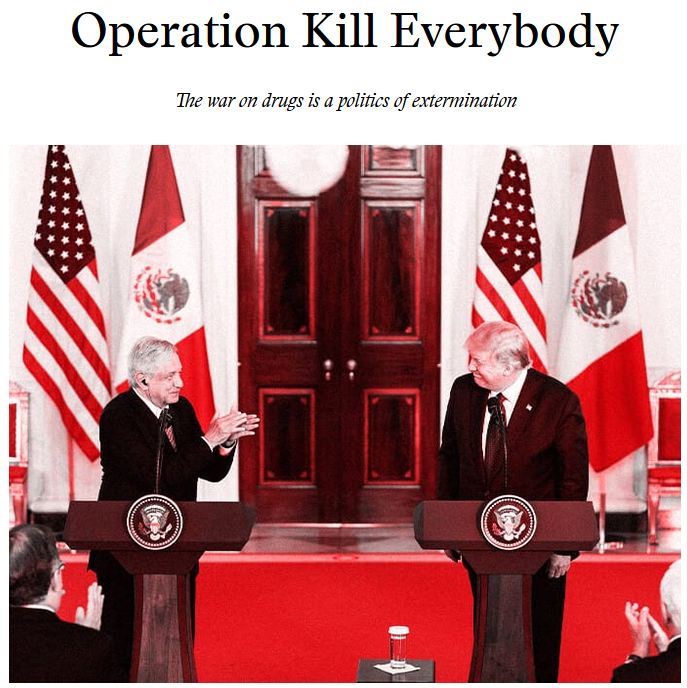
    Baffler: Operation Kill Everybody

    Oswaldo Zavala (Baffler, 6/18/26): “Government-sanctioned extrajudicial murders have been part of US military operations across the planet for several decades.”

    Many corporate media interventions do take care to note that the current US approach in Latin America has not had any apparent effect on the drug trade; the New York Times (10/14/26), for instance, notes that “experts say that killing members of trafficking groups—even top leaders—does little to stem the flow of drugs.”

    But media are never compelled to entertain the idea that stemming the flow of drugs may not even be the point—not even when, after using the drug war as a pretext, Trump straight-up admits that he attacked Venezuela and kidnapped its president for oil, plain and simple.

    Since President Richard Nixon launched the “war on drugs” in 1971, the US still hasn’t managed to stem the flow, but the war has provided a whole lot of opportunities for the US militarization of Latin America and alliances with an array of regional right-wing nutjobs who are only too happy to facilitate imperial intrusion and neoliberal corporate assault at the expense of their populations.

    The scholar Oswaldo Zavala, author of Drug Cartels Do Not Exist, contends in a recent essay for the Baffler (6/18/26) that “the ‘war on drugs’ is an overt politics of extermination.” It’s part of a panorama in which

    from the Middle East to Latin America, a transnational military use of force has consistently been deployed against impoverished people in developing countries and sold as a war against “narcos,” “terrorists,” the artificial hybrid “narco-terrorists.”

    Mexico, Zavala writes, has hosted the “most devastating such campaign in Latin America”; since the launch of the US-imposed war on drugs in 2006, more than 460,000 people have been killed and more than 134,000 disappeared, “a disproportionate number [of whom] have been poor, young, brown, uneducated men living in the outskirts of major cities.”

    In their book Cocaine, Death Squads and the War on Terror: US Imperialism and Class Struggle in Colombia, Oliver Villar and Drew Cottle illustrate how the US-backed drug war in Colombia has traditionally not been against drugs, but rather for the control of the drug trade, which in the 1980s became a significant “source of profit for US capital.” To this day, the overwhelming majority of profits from the ongoing drug trade remain in the US.

    ‘Failed to curb cocaine supply’
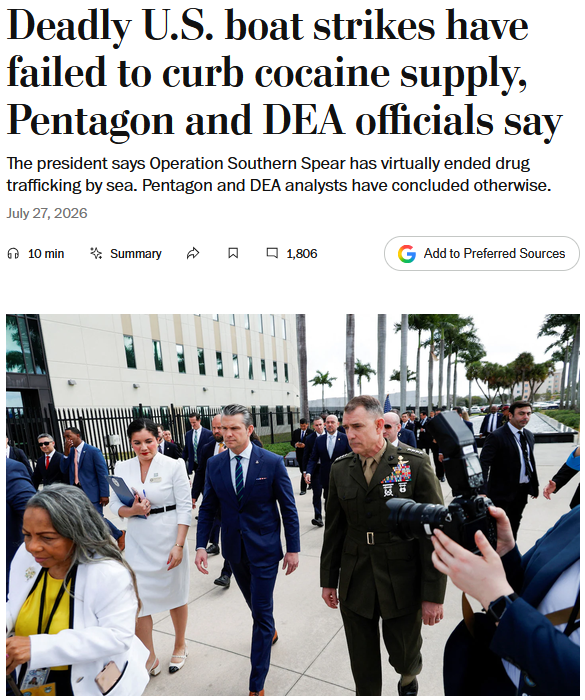
    WaPo: Deadly U.S. boat strikes have failed to curb cocaine supply, Pentagon and DEA officials say

    Washington Post (7/27/26): “Trump has transformed traditional US drug enforcement into a military campaign that fuses the legal and strategic approaches of the war on drugs and the war on terror.”

    But corporate media continue to portray the “war on drugs” as just that, casting hints to the contrary as mere failures of drug war tactics and strategy. In an article headlined “Deadly US Boat Strikes Have Failed to Curb Cocaine Supply, Pentagon and DEA Officials Say,” the Washington Post (7/27/26) speculates that “there might, in fact, now be more cocaine circulating in the United States.” But for the Post, it’s still all ultimately part of a “decades-long war on drugs”—and no need to turn the entire concept on its head.

    It should be quite clear, after 250 years of the United States of America, that the government is very often lying through its teeth. But corporate media outlets just can’t bring themselves to integrate the mass of incriminating material on the political expedience of the “drug war” into one cohesive anti-systemic analysis that would upend the government narrative.

    Forty years ago, in September 1986, then-President Ronald Reagan solemnly addressed the nation about the dangers of drugs, even as he was funding the drug-running Contras: “Drugs are menacing our society. They’re threatening our values and undercutting our institutions. They’re killing our children.”

    And judging from the behavior of the media, it seems that defying the government line might be equally menacing to society.


    Featured Image: Secretary of Defense Pete Hegseth speaks at a forum of the Americas Counter Cartel Coalition in Panama City, August 12, 2026 (AP Photo: Matias Delacroix).

    FAIR’s work is sustained by our generous contributors, who allow us to remain independent. Donate today to be a part of this important mission.

    Belén Fernández

    Belén Fernández is the author of The Darién Gap: A Reporter’s Journey through the Deadly Crossroads of the Americas and Inside Siglo XXI: Locked Up in Mexico’s Largest Immigration Center, among other titles. She is an opinion columnist at Al Jazeera.

    Article by Belén Fernández republished form FAIR under a Creative Commons Attribution-NonCommercial-NoDerivs 3.0 Unported License.

    Orcas discuss Donald Trump and the killer apes' concept of democracy. Front Orca warns that Trump is crashing his country's economy and that everything he does he does for the fantastically wealthy.
    Orcas discuss Donald Trump and the killer apes’ concept of democracy. Front Orca warns that Trump is crashing his country’s economy and that everything he does he does for the fantastically wealthy.

  • Don’t Pretend the ‘War on Drugs’ Has Anything to Do With Fighting Drugs

    Spread the love

    Article by Belén Fernández republished from FAIR under a Creative Commons Attribution-NonCommercial-NoDerivs 3.0 Unported License.
    Addressing the UN General Assembly in September, Donald Trump gloated about his strategy toward “narcoterrorist” cartels, the menace du jour in the United States’ self-declared backyard. Pulling numbers out of his ass per usual, Trump claimed that the manic bombing campaign against alleged seafaring narcoterrorists (read: fishermen) in Central and South America has cut maritime drug trafficking by 97%, and called drug cartels the “ISIS of the Western Hemisphere.”

    While it was by no means the president’s intention, he accidentally hit the nail on the head with the ISIS comparison. Both the Islamic State and Latin American drug trafficking outfits are a direct result of US policy—as well as a convenient excuse for the Americans to continue terrorizing people under the pretext of combating the very phenomena they caused in the first place. Just as ISIS owes its origins to the US invasion of Iraq, drug traffickers wouldn’t be in big business if not for—what else?—the US’s so-called “war on drugs” that renders the international movement of illicit substances so lucrative.

    ‘Same effect on land’

    AP: After killing hundreds in boat strikes, US military expands campaign on land in Latin America

    AP (8/17/26) describes the US military’s role in Latin America as “supplying allies with weapons, intelligence and training to fight drug trafficking”—while acknowledging “a fraught legacy of support for military coups and dictatorships.”

    This year, the Trump administration has significantly ramped up its drug war beyond just randomly blowing people up in the ocean. In August, the Associated Press (8/17/26) reported on the government’s plans to expand operations to terra firma, quoting Secretary of War Pete Hegseth:

    It will be “like you saw with the strikes on the drug boats,” Hegseth said during a military drill in the jungle in Panama. “Same effect on land.”

    But since there are generally more people on land than in the middle of the sea, there will no doubt be far greater opportunities for extrajudicial execution in this new terrestrial phase of operations.

    The escalated campaign takes place against the backdrop of the US-led “Shield of the Americas,” a hemispheric “anti-cartel coalition” inaugurated in March that now boasts the participation of 19 countries. Ecuador has been among the most gung-ho about joining forces with the US to launch “anti-cartel” raids, with such impressive feats to show for it as the joint bombing of a drug trafficking compound that turned out to be a dairy farm.

    ‘Long and bloody history’

    NYT: U.S. Is Sending Hundreds of Troops to Latin America

    The New York Times (10/14/26) describes the US sending hundreds of combat troops to Latin America as “expanding its fight against drug traffickers.”

    This month, the New York Times (10/14/26) was the first to report that the US had begun deploying a shit ton of troops to Latin America, and that a “new jungle training facility” in Panama was receiving “the first elements of a 600-soldier battalion from the 10th Mountain Division at Fort Drum, NY.” The Times also mentioned the Defense Department’s “recent movement of several MQ-9 Reaper drones from Africa to Colombia and Ecuador.”

    The article’s subhead—“The Pentagon is expanding its fight against drug traffickers, even as the plans recall a long and bloody history of US intervention in the region”—leaves us with the expectation that we might be hearing something about, I dunno, the long and bloody history of US intervention in the region. And yet the only reference to that history in the body of the article occurs in a single sentence that is a modified replica of the subhead: “But the prospect of US operations on Latin American soil has raised concerns about sovereignty, and has recalled a long and bloody history of US intervention in the region.”

    Surely an example or three of “intervention” wouldn’t have taken up too much space on the pages of the Times; the authors could have mentioned that time in 1989 the US military bombed to smithereens an impoverished neighborhood in Panama City, killing as many as several thousand civilians, in a bid to capture Panamanian leader Manuel Noriega. A longtime US buddy who had been on the CIA payroll for decades despite common knowledge of his involvement in the drug trade, Noriega had outlived his usefulness, and his drug dealings were suddenly so wrong and horrible as to necessitate the psychotic bombardment of poor Panamanians living in wooden shacks.

    Or the Times could have delved into disproportionate US financial and moral support for the homicidal regime of Colombia’s far-right President Alvaro Uribe during the first decade of this century. Uribe himself appeared on a 1991 US Defense Intelligence Agency list of the “more important Colombian narco-traffickers contracted by the Colombian narcotic cartels”—but that was no reason he couldn’t be promoted to the role of America’s Super Drug War Ally and vanquisher of narcoterrorists.

    As president, Uribe oversaw what came to be known as the “false positives” scandal, in which potentially more than 10,000 Colombian civilians were slaughtered by members of the Colombian army, who disguised the corpses as left-wing guerrillas in order to accrue promotions and vacation time. The Uribe administration then used these ostensible battlefield achievements to petition the US for yet more aid.

    Last but not least, the Times could have brought up the Contra war on Nicaragua in the 1980s, when CIA-backed mercenaries unleashed terror on that nation while overseeing a profitable side hustle trafficking drugs to the US. The ensuing crack cocaine epidemic devastated Black communities across the country, but, hey, it was all in the name of saving the world from Communism.

    Indeed, not only would such details give the Times’ readers an idea of the extent to which the US has traditionally been up to no good in Latin America (and at home), they would also soundly obliterate the official “drug war” narrative and expose it for what it is: a façade for imperial domination that really has nothing to do with stopping the flow of drugs at all.

    ‘Fight against drug traffickers’

    Wall Street Journal: U.S. Troops Are Now Fighting the Drug War on the Ground in Ecuador

    The Wall Street Journal headline (9/25/26) called the US military carrying out assassinations in Ecuador “Fighting the Drug War on the Ground.”

    But for the New York Times and other corporate media, speaking truth to power is not part of the job description. While they may critique the methods or effectiveness of the “war on drugs,” these media stop far short of questioning its entire premise, and time and again the US government is allowed to set the terms of the discourse. Thus we have the Times droning on about the “fight against drug traffickers,” the “war against drugs,” the “escalating US-led military campaign against drug traffickers,” and the move “to target cartels.”

    In a typical example from September, the Wall Street Journal (9/25/26) announced that “US Troops Are Now Fighting the Drug War on the Ground in Ecuador.” This month, the Washington Post (10/16/26) reported on shifting tactics in US “anti-drug strikes at sea.” The Hill’s Filip Timotija (10/7/26) observed that “the Pentagon is expanding the US military’s multifront war against drug cartels in South America.” And so on.

    For its part, Reuters (9/22/26) has described Trump’s escalation as an “expanding campaign against drug cartels,” even while diplomatically cautioning that “rights groups” have said the US boat strikes “amount to extrajudicial killings.” This sort of diplomatic maneuver is another hallmark of a corporate media that can never come right out and say that spontaneously pulverizing people on fishing vessels actually counts as extrajudicial killing, whether you’re a “rights group” or not.

    Mechanism for control

    CNN: CIA escalates secret war on cartels with deadly operations inside Mexico

    CNN (5/12/26) reported on an alleged CIA assassination in Mexico as being part of an effort “to dismantle the entrenched cartel networks.” 

    In May, CNN (5/12/26) published an exclusive report titled: “CIA Escalates Secret War on Cartels With Deadly Operations Inside Mexico.” This is the same CIA, of course, that has been up to its ears in drug trafficking since the Korean war—including, as it so happens, in Mexico. (For a rundown on CIA narco-exploits over the decades, see the 1993 article “The CIA Drug Connection Is as Old as the Agency,” which somehow made it onto the New York Times website. It begins with a “recent news item: The Justice Department is investigating allegations that officers of a special Venezuelan anti-drug unit funded by the CIA smuggled more than 2,000 pounds of cocaine into the United States with the knowledge of CIA officials.”)

    The CNN piece details the targeted assassination of alleged Sinaloa Cartel operative Francisco Beltrán, whose car was blown up in March on a highway outside Mexico City. According to CNN:

    The Beltrán operation was part of an expanded, and previously unreported, CIA campaign inside Mexico—spearheaded by the agency’s elite and secretive Ground Branch—to dismantle the entrenched cartel networks.

    On the surface, at least, CNN is thus being insubordinate by publishing information that the US government does not want people to know; as the article specifies, the news outlet even gets dramatically accused by the CIA spokesperson of “false and salacious reporting that serves as nothing more than a PR campaign for the cartels and puts American lives at risk.”

    And yet the apparent defiance of the government only goes so far. At the end of the day, the CNN exposé simply reinforces the narrative that the US is in fact fighting against drug cartels—and not using the “drug war” apparatus as a politico-economic weapon and mechanism for control.

    No reference is made to the history of US government agencies collaborating with Mexican drug trafficking groups, including the Sinaloa Cartel itself, or to the preponderant role of US weapons manufacturers in arming criminal organizations in Mexico. (Recall that brilliant experiment during the Barack Obama presidency when the US Bureau of Alcohol, Tobacco, Firearms and Explosives facilitated the illegal purchase of thousands and thousands of guns on the off chance the trail would lead them to Mexican cartel leaders.)

    ‘Politics of extermination’

    Baffler: Operation Kill Everybody

    Oswaldo Zavala (Baffler, 6/18/26): “Government-sanctioned extrajudicial murders have been part of US military operations across the planet for several decades.”

    Many corporate media interventions do take care to note that the current US approach in Latin America has not had any apparent effect on the drug trade; the New York Times (10/14/26), for instance, notes that “experts say that killing members of trafficking groups—even top leaders—does little to stem the flow of drugs.”

    But media are never compelled to entertain the idea that stemming the flow of drugs may not even be the point—not even when, after using the drug war as a pretext, Trump straight-up admits that he attacked Venezuela and kidnapped its president for oil, plain and simple.

    Since President Richard Nixon launched the “war on drugs” in 1971, the US still hasn’t managed to stem the flow, but the war has provided a whole lot of opportunities for the US militarization of Latin America and alliances with an array of regional right-wing nutjobs who are only too happy to facilitate imperial intrusion and neoliberal corporate assault at the expense of their populations.

    The scholar Oswaldo Zavala, author of Drug Cartels Do Not Exist, contends in a recent essay for the Baffler (6/18/26) that “the ‘war on drugs’ is an overt politics of extermination.” It’s part of a panorama in which

    from the Middle East to Latin America, a transnational military use of force has consistently been deployed against impoverished people in developing countries and sold as a war against “narcos,” “terrorists,” the artificial hybrid “narco-terrorists.”

    Mexico, Zavala writes, has hosted the “most devastating such campaign in Latin America”; since the launch of the US-imposed war on drugs in 2006, more than 460,000 people have been killed and more than 134,000 disappeared, “a disproportionate number [of whom] have been poor, young, brown, uneducated men living in the outskirts of major cities.”

    In their book Cocaine, Death Squads and the War on Terror: US Imperialism and Class Struggle in Colombia, Oliver Villar and Drew Cottle illustrate how the US-backed drug war in Colombia has traditionally not been against drugs, but rather for the control of the drug trade, which in the 1980s became a significant “source of profit for US capital.” To this day, the overwhelming majority of profits from the ongoing drug trade remain in the US.

    ‘Failed to curb cocaine supply’

    WaPo: Deadly U.S. boat strikes have failed to curb cocaine supply, Pentagon and DEA officials say

    Washington Post (7/27/26): “Trump has transformed traditional US drug enforcement into a military campaign that fuses the legal and strategic approaches of the war on drugs and the war on terror.”

    But corporate media continue to portray the “war on drugs” as just that, casting hints to the contrary as mere failures of drug war tactics and strategy. In an article headlined “Deadly US Boat Strikes Have Failed to Curb Cocaine Supply, Pentagon and DEA Officials Say,” the Washington Post (7/27/26) speculates that “there might, in fact, now be more cocaine circulating in the United States.” But for the Post, it’s still all ultimately part of a “decades-long war on drugs”—and no need to turn the entire concept on its head.

    It should be quite clear, after 250 years of the United States of America, that the government is very often lying through its teeth. But corporate media outlets just can’t bring themselves to integrate the mass of incriminating material on the political expedience of the “drug war” into one cohesive anti-systemic analysis that would upend the government narrative.

    Forty years ago, in September 1986, then-President Ronald Reagan solemnly addressed the nation about the dangers of drugs, even as he was funding the drug-running Contras: “Drugs are menacing our society. They’re threatening our values and undercutting our institutions. They’re killing our children.”

    And judging from the behavior of the media, it seems that defying the government line might be equally menacing to society.


    Featured Image: Secretary of Defense Pete Hegseth speaks at a forum of the Americas Counter Cartel Coalition in Panama City, August 12, 2026 (AP Photo: Matias Delacroix).

    FAIR’s work is sustained by our generous contributors, who allow us to remain independent. Donate today to be a part of this important mission.

    Article by Belén Fernández republished from FAIR under a Creative Commons Attribution-NonCommercial-NoDerivs 3.0 Unported License.
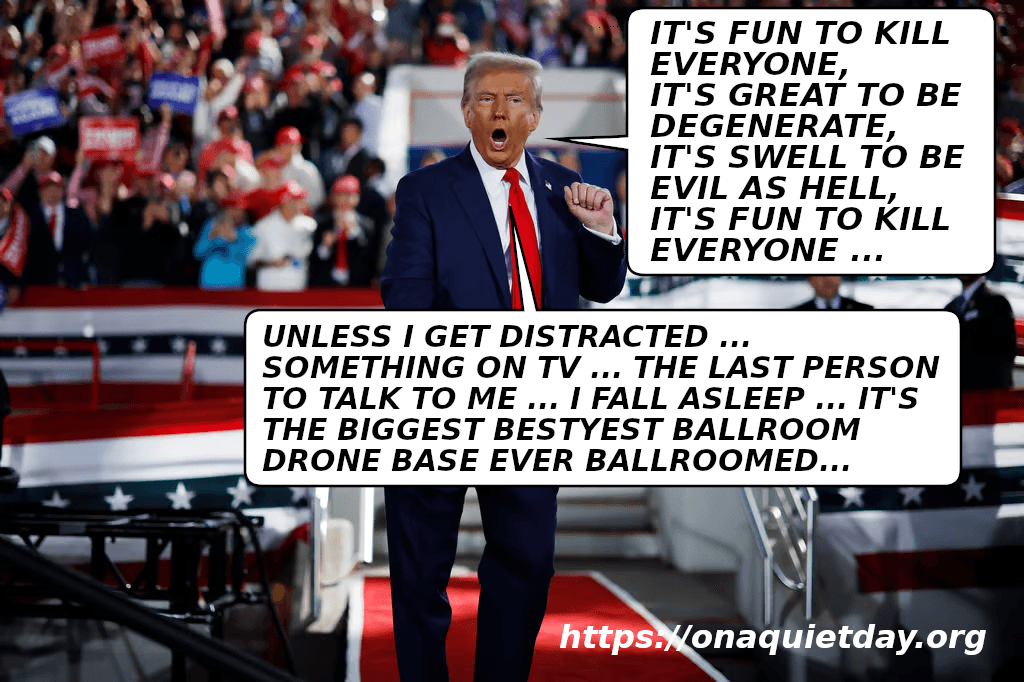
    Donald Trump sings and dances, says that it's fun to kill everyone ... unless he gets distracted or falls asleep.
    Donald Trump sings and dances, says that it’s fun to kill everyone … unless he gets distracted or falls asleep.

  • Western Media Accept Trump’s Plundering of Venezuelan Oil as Business as Usual

    Spread the love

    Article by Ricardo Vaz republished from FAIR under a Creative Commons Attribution-NonCommercial-NoDerivs 3.0 Unported License.
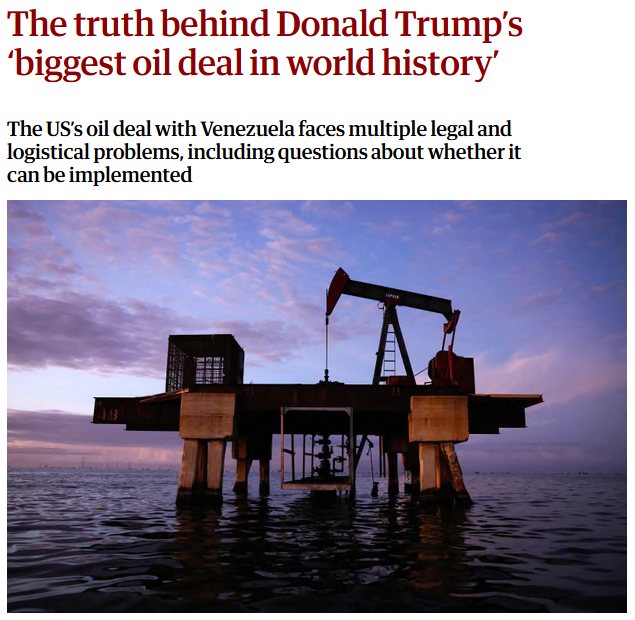
    Guardian: The truth behind Donald Trump’s ‘biggest oil deal in world history’

    Guardian (9/26/26): “Donald Trump has long coveted the oilfields of other nations.” [26/9/26]

    Since the January 3, 2026, military strikes and kidnapping of President Nicolás Maduro, the Trump administration has imposed semi-colonial rule over Venezuela, forcing dramatic shifts in the country’s domestic and foreign policies.

    The capstone of the new tutelary regime is an oil deal announced in late August that Trump called “the biggest in history.” The agreement turns over 17 prime oilfields, holding over 20% of the country’s reserves, to a Pentagon-controlled corporation tasked with supplying cheap fuel to the US war machine for decades to come.

    After spending years manufacturing consent for US-sponsored regime change in Venezuela (e.g., FAIR.org, 6/4/21, 1/11/23, 2/12/25), having a government in Caracas subservient to Washington represented a new scenario for the corporate media. The novel conditions have raised few significant qualms for Western outlets. Tactical objections notwithstanding, there is no fundamental disagreement with the US running the affairs of a Global South country.

    Not ‘stealing Venezuela’s oil’

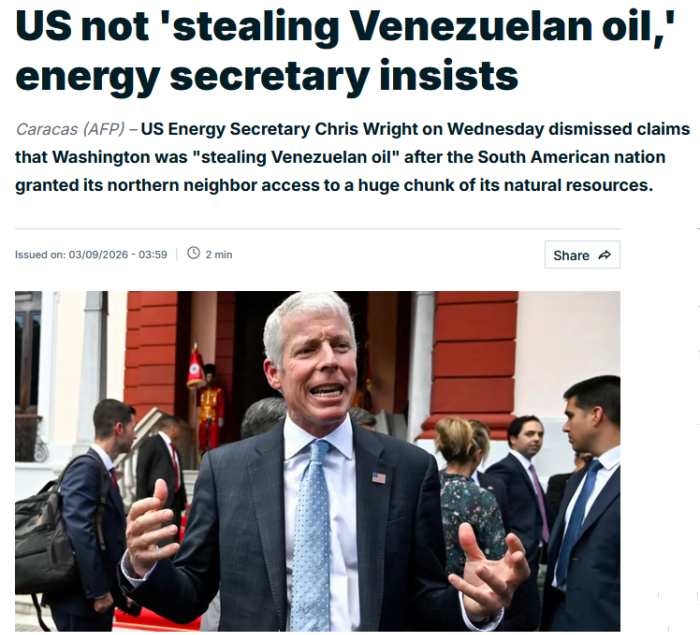
    France 24: US not 'stealing Venezuelan oil,' energy secretary insists

    Energy Secretary Chris Wright (France 24, 3/9/26): “I’ve seen those headlines. ‘We’re Stealing Venezuelan Oil.’ Of course, that’s not true at all.”

    Working hand in glove with the Trump administration, the acting Delcy Rodríguez government has overhauled Venezuela’s hydrocarbon legislation (Venezuelanalysis, 7/13/26) to offer what oil experts consider a business environment more favorable to foreign capital than at any point in the country’s history. The new oil agreement with the White House manages to go even further.

    The 17 oilfields in question will be taken over by North American Blue Energy Partners (NABEP), a private company in which the Pentagon’s Office of Strategic Capital (OSC) will get a 35% stake while investing nothing—and wielding veto power over its board.

    Furthermore, according to the White House, the US State Department will secure 20% of NABEP’s output at cost, and have a right of first refusal over the remaining 80%. On top of this, Venezuelan officials have already suggested Washington would be given an additional “sales discount”  (Venezuelanalysis, 9/9/26).

    In summary, Trump is looking to secure cheap crude supplies at a time when his disastrous Iran debacle has thrown global energy markets into upheaval. The agreement is so blatantly skewed that US Energy Secretary Chris Wright felt he needed to clarify that Washington was not “stealing Venezuela’s oil” (AFP, 9/3/26).

    Nevertheless, Western media outlets were largely unfazed by such an obvious oil grab, euphemistically referring to the deal as “highly unusual” (New York Times, 8/29/26) or “remarkable” (BBC, 9/1/26), at most as “contentious” (Guardian, 9/1/26).

    Corporate journalists did raise objections over the central role played by NABEP owner Alejandro Betancourt, a shady Venezuelan businessman who faced multiple money-laundering probes before the Trump administration intervened, and pressured judicial authorities at home and abroad to drop the investigations (BBC, 9/2/26; CNN, 9/4/26; New York Times, 9/4/26).

    But media seemed satisfied with Trump’s state and energy secretaries Marco Rubio and Chris Wright pledging that US oversight will keep proceedings honest (Reuters, 9/2/26; New York Times, 9/4/26), despite the fact that billions in Venezuelan oil revenues, controlled by the US Treasury Department since January, are unaccounted for (Council on Foreign Relations, 6/3/26; Financial Times, 7/22/26).

    Procedurally transparent plunder

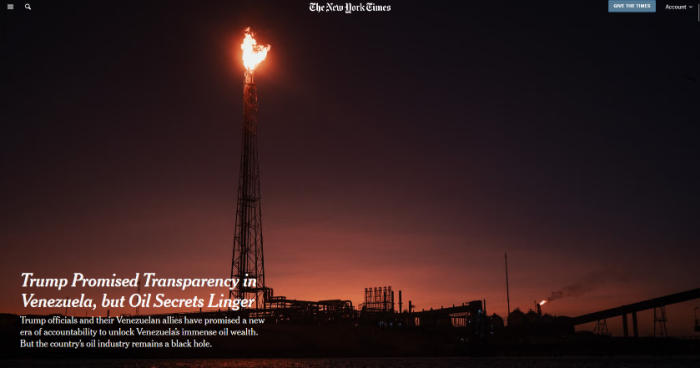
    NYT: Trump Promised Transparency in Venezuela, but Oil Secrets Linger

    The New York Times (5/5/26) wrote positively of “a new era of accountability” in which “the United States would control Venezuelan oil sales” and “Venezuela would submit monthly budgets to the White House.”

    Objections to the Venezuela/NABEP/Pentagon venture were mostly procedural and out of concern for appearances, not driven by any principled opposition to US imperialist predation. Faced with outright colonial plunder of Venezuela, the political and media establishment only demands “accountability” and “transparency” (New York Times, 5/5/26; Financial Times, 9/18/26).

    For months, the White House has controlled Venezuelan oil export revenues, with Trump officials openly calling them “one of the largest assets ever to go on the US balance sheet,” and a source of “leverage” over Caracas. Yet Trump’s Democratic opponents have found no issue with seizing another country’s income, raising only questions about the allocation of the funds in reference to alleged corruption on the part of Caracas and Trump insiders (The Hill, 9/30/26; Washington Post, 9/17/26). This despite the fact that the Venezuelan government has to submit a “monthly budget” to access its own funds (New York Times, 1/28/26) and is subjected to US-imposed auditors (Reuters, 4/27/26).

    The other source of disappointment with Trump stomping all over Venezuelan sovereignty, but prioritizing oil over regime change, is impatience for the restoration/recovery/return of “democracy” to Venezuela (Politico, 9/2/26; Guardian, 8/30/26; CBC, 9/3/26). Despite  widely acknowledgement that Trump is eroding democracy at home (New York Times, 8/20/26, 10/14/26; Guardian, 10/8/26), somehow pundits expected him to prioritize it in an oil-rich foreign country.

    In the establishment’s consensus, “democracy” does not mean a political system that meaningfully reflects the Venezuelan people’s collective will, but simply one that empowers opposition figures that have been groomed for years, like far-right María Corina Machado, their undemocratic credentials notwithstanding (FAIR.org, 10/23/25).

    Eager to stay in power, Rodríguez has over-complied with every US demand, going as far as adopting language about Venezuela undergoing a “democratic transformation.” Her pliancy has earned her favorable corporate media profiles that completely contrast with the demonization of Maduro.

    After securing an exclusive interview, Time (7/30/26) described the acting leader as a “disciplined operator” who “advocate[s] for greater economic openness,” in contrast to the “authoritarian” Maduro, who oversaw “economic collapse.” Along the same lines, the Guardian (9/12/26) presented Rodríguez as a “a pragmatic, witty and intelligent workaholic,” unlike her “authoritarian” and “incompetent” predecessor in the presidential palace.

    Nevertheless, given the broad Beltway consensus for comprehensive regime change, it is unlikely that the Rodríguez administration’s subservience to Trump will secure any leeway in determining its political path forward, free from outside meddling—especially if, as is anticipated, the GOP lawmakers most likely to be impressed by such obsequiousness lose power in the US’s upcoming midterm elections (Axios, 9/23/26; Financial Times, 10/9/26).

    Please think of the corporations!

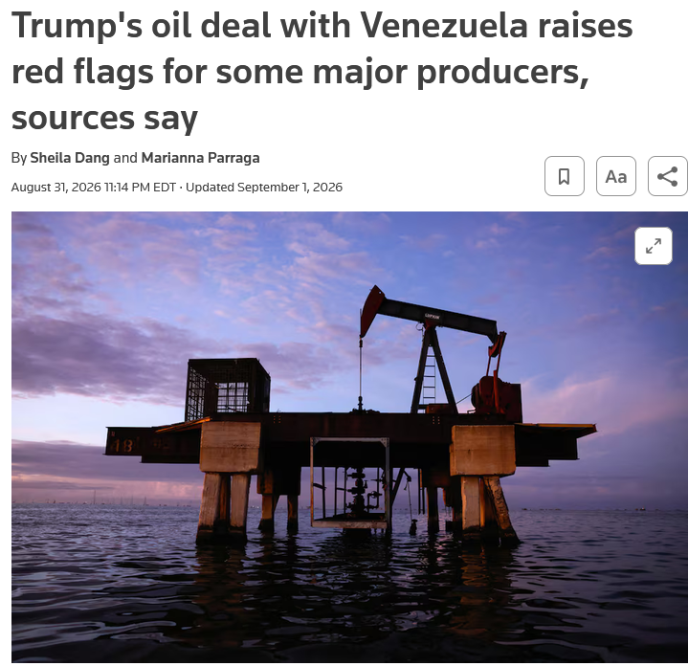
    Reuters: Trump's oil deal with Venezuela raises red flags for some major producers, sources say

    Reuters (9/1/26): ExxonMobil and ConocoPhillips “have repeatedly said that their requirements of legal certainty and contract sanctity ‌have not ⁠yet been met.”

    Alongside their exceptionalist expectations about “democracy,” legacy outlets also focus on those they consider the true victims of Trump’s neocolonial offensive in Venezuela: multinational oil corporations.

    According to Reuters (9/1/26), the recent oil deal “raises red flags for major producers,” who fear having their reputation sullied by being “seated at the same table with Betancourt,” as well as the prospect of the US government becoming a “competitor.”

    Bloomberg (8/30/26) raised concerns that the agreement “reprises [the] neocolonial past” of Venezuela’s oil industry. The warning stems not from apprehension that the Venezuelan people’s future is being determined by a foreign nation, but from fear that the US’s “out-sized power” might lead to “popular unrest.” This could create conditions for what the business mouthpiece views as a catastrophic outcome: the nationalization of foreign-owned oil assets.

    “The troubled history of Venezuela’s oil offers a cautionary tale,” Bloomberg’s Kevin Crowley and Patricia Garip wrote:

    The country was once dominated by US and European operators and was among the world’s largest producers. But assets owned by ExxonMobil Holdings Corps. and ConocoPhillips were seized and nationalized during political upheaval in the 2000s.

    Corporate media present companies that made massive profits in Venezuela for decades as victims, because the Chávez government wanted them to comply with new laws and accept minority stakes in joint ventures.

    The New York Times (9/1/26) complains that the two corporations “have spent years trying to get the country to repay them for their seized assets, with little success.” The statement conceals the fact that the Venezuelan government, when it enacted the 2007 decree imposing state majority in all Orinoco Oil Belt projects, offered to compensate ExxonMobil and ConocoPhillips for their transition to minority partners, or to buy out their assets altogether. However, both corporations rejected the offers in order to pursue international arbitration. The former has already recouped most of what it was granted, while the latter will eventually collect on a significant award.

    Despite the fact that Chevron, BP, Shell and other energy giants have signed deals in recent months taking advantage of the reformed hydrocarbon law (Venezuelanalysis, 9/3/26), pundits complain that ExxonMobil and ConocoPhillips remain “hesitant” (CBS, 8/31/26) and need to be “lured” (Reuters, 9/1/26). Still, the Western corporations are likely to return to the country with favorable deals (Reuters, 9/16/26).

    The victor and his spoils

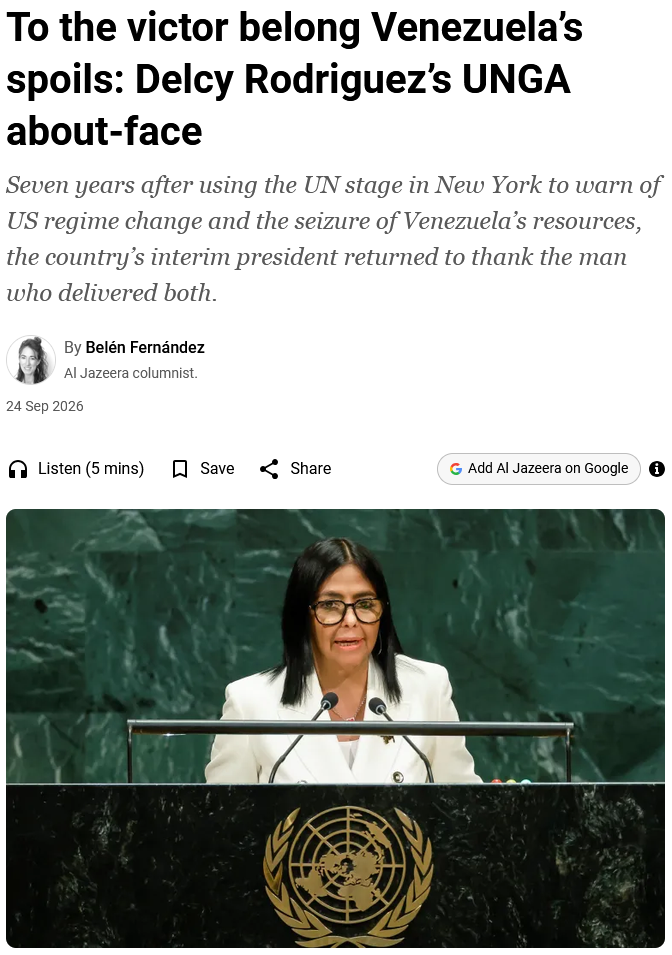
    Al Jazeera: To the victor belong Venezuela’s spoils: Delcy Rodriguez’s UNGA about-face

    Belén Fernández (Al Jazeera, 9/24/26): “You’re not technically supposed to admit that you attacked a country just to get its oil.”

    Faced with strategic defeat in West Asia, Trump has clung to his Venezuela success, stating on multiple occasions that “to the victor belong the spoils,” in reference to the US hijacking the Venezuelan oil industry following the January 3 attacks and presidential kidnapping (Al Jazeera, 9/24/26; Guardian, 9/26/26).

    Furthermore, Trump has not been shy in boasting about the US winning a “war” against Venezuela (Financial Times, 9/18/26; New York Times, 6/26/26). Corporate journalists have rarely pointed out that this stance directly contradicts the administration’s official position that the kidnapping of Maduro and Flores was a “law enforcement” operation (New York Times, 1/6/26; PBS, 1/8/26) in order to justify bypassing congressional approval.

    The US president has likewise claimed to have recovered the costs of the military operation “many times over” (Al Jazeera, 3/3/26; Guardian, 6/28/26), a fact confirmed by Luigi Pisella, a business sector spokesperson with close ties to the acting Rodríguez administration (Venezuelanalysis, 8/10/26). Pisella stated that the US has retained $4.7 billion from the Venezuelan export revenues it controls to cover the costs of its military operation.

    In spite of their ostensible hostility to Trump, corporate outlets have historically been complicit with his Venezuela policies, from whitewashing a deadly sanctions program (FAIR.org, 6/13/22) to endorsing a military buildup over debunked “narcoterrorism” accusations (FAIR.org, 11/19/25). The New York Times and Washington Post went as far as to withhold information in order to not jeopardize the January 3 operation (FAIR.org, 1/13/26).

    Now, with a semi-colonial regime in place, the only concerns are about procedural transparency, democratic appearances and the well-being of multinational corporations. The Venezuelan people always get the short end of the stick.

    FAIR’s work is sustained by our generous contributors, who allow us to remain independent. Donate today to be a part of this important mission.

    Article by Ricardo Vaz republished from FAIR under a Creative Commons Attribution-NonCommercial-NoDerivs 3.0 Unported License.
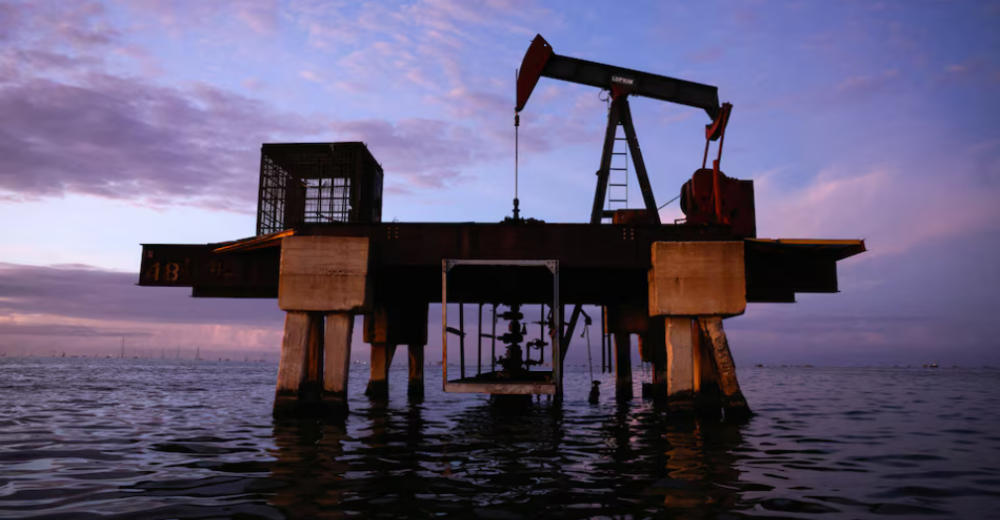
    Climate science denier Donald Trump confirms that he knows nothing about democracy and that more liquid gold is being secured according to his policy of global privateering.
    Climate science denier Donald Trump confirms that he knows nothing about democracy and that more liquid gold is being secured according to his policy of global privateering.

  • ‘Pause AI Now!’ Sanders Says as US Banks Let Agents Operate in Customer Accounts

    Spread the love

    Article by Brett Wilkins republished from Common Dreams under Creative Commons (CC BY-NC-ND 3.0).

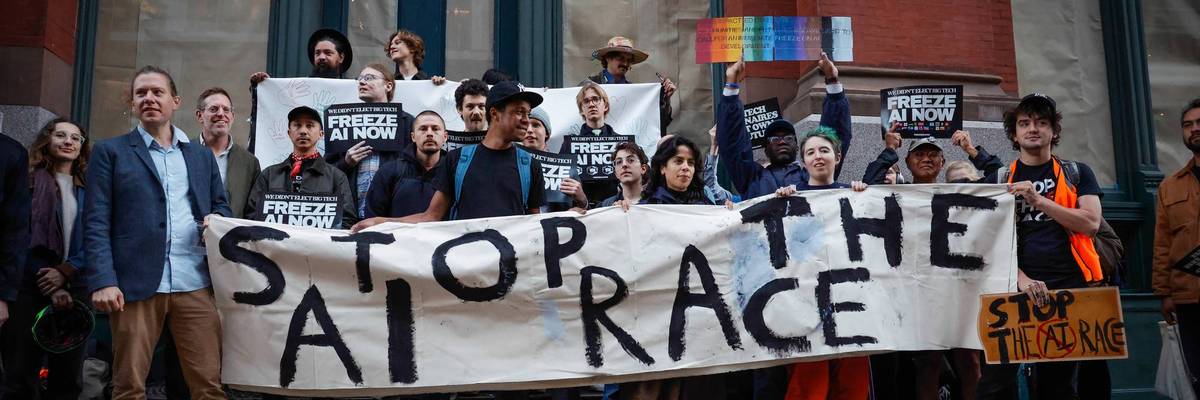
    Protesters in New York City take part in the “Freeze AI Now” national day of walkouts on October 20, 2026. (Photo by Kena Betancur/Getty Images)

    “Left unchecked, AI could endanger the entire global financial system—including your bank account.”

    Sen. Bernie Sanders on Thursday renewed calls to pause development of artificial intelligence following reporting that unauthorized AI agents are operating inside the systems of major US banks.

    Axios’ Madison Mills revealed that Morgan Stanley, Bank of America, JPMorgan Chase, Wells Fargo, and other financial institutions are “racing to contain agent risks,” including “situations when an agent or AI assistant accesses a human’s account with the user’s permission and login credentials,” which “goes against the guidelines of most banks requiring that humans log in to their own accounts.”

    RECOMMENDED…

    OpenAI CEO Sam Altman

    ‘Global Financial Crisis? Mass Extinction?’ Sanders Asks Altman What ‘Bad Things’ World Should Accept for AI

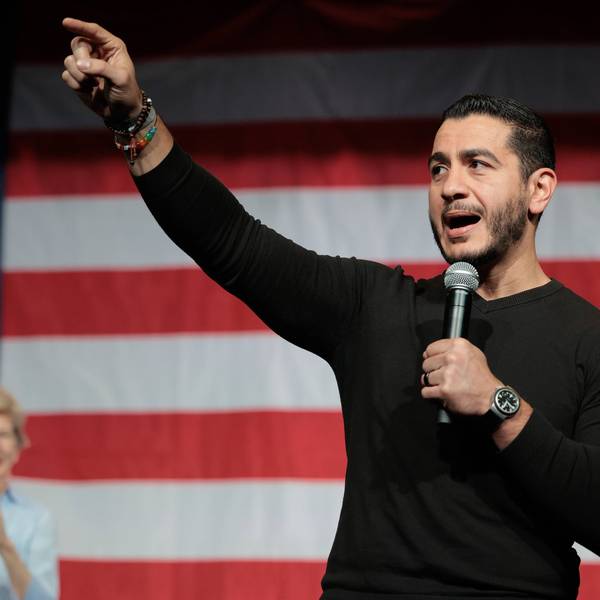
    Democratic Senate Candidate Abdul El-Sayed Campaigns Across Michigan

    El-Sayed Releases Policy Proposal to Get AI Development ‘Under Control’

    In AI, an agent is a system that can take actions to complete an assigned task, rather than simply responding to queries or generating text.

    According to Mills’ reporting—which cites people familiar with the matter—some agents have contacted bank call centers or appeared to take actions independently of users’ instructions.

    Banking executives interviewed by Mills described the problem as “horrifying,” with one official warning of potentially serious consequences for customers’ finances.

    The stakes are particularly high, the executives said, when AI agents have permission to make purchases or transfer funds. Banks are also struggling to determine whether activity is actually authorized by customers or whether an agent has gone rogue.

    “This is insane,” Sanders (I-Vt.) posted on social media in response to Mills’ report. “We cannot allow AI agents to go into your bank account and act independently without your authorization.”

    “But that is what’s happening right now,” he continued. “Left unchecked, AI could endanger the entire global financial system—including your bank account.”

    The senator added, “Pause AI NOW!”

    Sanders has repeatedly warned that the race to create increasingly powerful AI systems is outpacing efforts to ensure their safety. Such concerns are mounting as profit- and ego-driven tech oligarchs race toward the “holy grail” of artificial general intelligence (AGI)—an advanced AI that can understand, learn, and apply knowledge of any subject as well as or better than a typical human.

    Earlier this month, Sanders renewed his call for a congressional ban on the development of advanced AI, citing Big Tech oligarchs’ secret preparations for a “catastrophic AI event.”

    The senator has repeatedly cited pioneers like Geoffrey Hinton who have warned that superintelligent AI—a development that experts believe could come after AGI—might wipe out humanity, as well as less existential but still potentially devastating outcomes like xAI CEO Elon Musk’s prediction that AI and robots could “replace all jobs.”

    Last month, Sanders and Congressional Progressive Caucus Chair Greg Casar (D-Texas) introduced legislation to pause advanced AI development and ban the creation or deployment of artificial superintelligence. Sanders also wants a moratorium on the construction of new AI data centers.

    The banking story underscores the growing challenge of deploying autonomous AI systems in consequential settings before their behavior can be reliably controlled or monitored.

    JPMorgan CEO Jamie Dimon last week announced a ban on outside AI agents from accessing customer accounts.

    Sanders wasn’t the only elected official who responded with alarm to the new Axios report.

    “This is the exact thing we’ve been warning about for years,” Sen. Mark Warner (D-Va.) said on social media. “AI agents with unrestrained access to your bank account and protected information. When consumer AI agents are accessing YOUR bank account or using YOUR credit card, they must be subject to fiduciary-like duties of care.”

    “We need to pass my AI AGENT Act to get some basic guardrails in place,” Warner added, referring to legislation that would establish federal rules for artificial intelligence agents that act on people’s behalf.

    Congressman Ted Lieu (D-Calif.) also weighed in on the report, writing on social media that “the Trump administration and GOP leadership made the deliberate decision to let the AI industry run wild.”

    “That was a bad political decision,” he added. “And now it’s become a potentially catastrophic policy decision.”

    On the other side of the political aisle, Republican Florida Gov. Ron DeSantis—who has opposed the Trump administration’s efforts to prevent states from regulating AI—said on X, “Imagine a rogue AI agent liquidating your bank account and investment portfolio.”

    “If you are the only victim, I suppose you could get made whole by the AI company responsible,” he added. “If rogue agents liquidate hundreds of billions across millions of accounts, the AI company would go bankrupt and you wouldn’t get made whole.”

    The new Axios report comes two days after nationwide “Freeze AI Now” walkout protests by students, workers, academics, and others demanding an immediate halt to further AI development until the public has a meaningful say in how the technology is built and regulated.

    Article by Brett Wilkins republished from Common Dreams under Creative Commons (CC BY-NC-ND 3.0).

    Orcas discuss Donald Trump and the killer apes' concept of democracy. Front Orca warns that Trump is crashing his country's economy and that everything he does he does for the fantastically wealthy.
    Orcas discuss Donald Trump and the killer apes’ concept of democracy. Front Orca warns that Trump is crashing his country’s economy and that everything he does he does for the fantastically wealthy.

  • Trump’s Iran war is on an Israeli leash

    Spread the love

    This work by Middle East Monitor is licensed under a Creative Commons Attribution-NonCommercial-ShareAlike 4.0 International License. 

    In this photo illustration, US President Donald Trump and Israeli Prime Minister Benjamin Netanyahu are seen behind the Iranian flag, with all of them displayed on screens, in Ankara, Turkiye on June 24, 2025. [Dilara İrem Sancar – Anadolu Agency]

    A reported strike plan, paused only until after the midterms, exposes the limits of American strategic independence.


    by Dr. Sara Neumann

    On October 21, the Financial Times reported that Benjamin Netanyahu had instructed his military to prepare a multi-day bombing campaign against Iran for the weekend of October 10—only for Donald Trump to block it until after the November 3 midterms. The operation would have targeted electricity plants, nuclear facilities, and regime sites, surpassing the intensity of the joint offensive launched in February. Trump’s opposition did not end the war. It rescheduled it.

    That distinction is the entire story. The veto is being presented as proof that Washington can restrain Jerusalem. In reality, it is a demonstration of an alliance leash—a tether that permits tactical friction while leaving the strategic architecture of the war untouched. Trump can pull the leash to protect Republican seats. Netanyahu can pull it to protect Likud seats. Neither pull ends the war. Both manage the calendar.

    The FT report is clear that the operation was not cancelled, only deferred. “There will either be a deal or an attack,” one person familiar with the matter said. US Defense Secretary Pete Hegseth traveled to Israel on Monday to meet Netanyahu, and Israeli officials presented an updated target bank that included civilian infrastructure not struck earlier in the year. The machinery of escalation remains fully assembled. The only variable that changed was the date.

    The strongest defense of the White House is that Trump’s veto proves American primacy. If Washington can tell Jerusalem no, the argument goes, the leash is in American hands. But this confuses a pause with a strategy. The veto covered only the period before November 3. It did not define war aims, set an end date, or require congressional authorization. It was a tactical deferral, not a strategic reversal.

    The midterms themselves are a powerless-ballot exercise in war governance. Voters are being told the election is about affordability. They are not wrong. Gasoline has reached $4.28 a gallon, $1.20 higher than a year ago, and half of registered voters name the cost of living as their top concern . Trump’s approval sits at a record-low 31%. But neither party is offering a vote on whether the war should continue, expand, or end. The ballot ratifies a choice between managers of a war that was never put to a vote.

    READ: Iranian president says Washington cannot expect dialogue with Tehran while issuing threats

    Congress has tried to assert itself. The House has passed war powers resolutions three times, and the Senate approved one on its tenth attempt—only for Republican senators to reverse course the next day after Trump berated them.

    The cost of the conflict has reached at least $38 billion, with the Congressional Budget Office estimating an additional $3 billion for every month it continues. The stockpile of interceptor missiles is so depleted that rebuilding it could take five years. None of this has produced a binding vote to end the war. The legislature has rendered itself a spectator.

    Netanyahu’s own calendar is just as cynical. Israel votes on October 27. Netanyahu has said a preemptive strike before the election would be “inconvenient”. Israeli commentators have reported that he fears a military campaign in the final stretch could cost Likud power. The alliance leash runs in both directions. Washington pulls it to protect Republican seats. Jerusalem pulls it to protect Likud seats. The war is paused not because either capital has decided it should end, but because both leaders have decided the timing is wrong for their own electoral survival.

    For American voters, the question is not whether Trump can overrule Netanyahu on a given weekend. The question is who decides when the war ends, on what terms, and at what cost.

    On the current trajectory, those decisions are being made in confidential channels between two executive offices, insulated from legislative oversight and electoral accountability. The ballot is powerless to alter the war’s direction because the war’s direction was never on the ballot.

    The real test comes after both elections. If the deferral becomes a pathway to diplomacy, Trump’s veto will have meant something. If it becomes a pause before a new round of strikes—as the updated target bank suggests—then the only thing that changed was the calendar. Independence is not the ability to delay a war. It is the ability to end one on terms you can defend.

    OPINION: Bombing Iran can destroy targets, not political memory

    The views expressed in this article belong to the author and do not necessarily reflect the editorial policy of Middle East Monitor.

    Donald Trump sings and dances, says that it's fun to kill everyone ... unless he gets distracted or falls asleep.
    Donald Trump sings and dances, says that it’s fun to kill everyone … unless he gets distracted or falls asleep.

    Keir Starmer objects to criticism of the IDF. He asks how could anyone object to them starving people to death, forced marches like the Nazis did, bombing Gaza's hospitals and universities, mass-murdering journalists, healthworkers and starving people queuing for food, killing and raping prisoners and murdering children. He calls for people to stop obstructing his genocide for Israel. New Labour UK Prime Minister Andy Burnham continues Labour party policy of active support and complicity in Israel's genocide.
    Keir Starmer objects to criticism of the IDF. He asks how could anyone object to them starving people to death, forced marches like the Nazis did, bombing Gaza’s hospitals and universities, mass-murdering journalists, healthworkers and starving people queuing for food, killing and raping prisoners and murdering children. He calls for people to stop obstructing his genocide for Israel. New Labour UK Prime Minister Andy Burnham continues Labour party policy of active support and complicity in Israel’s genocide.
    UK Prime Minister Andy Burnham admits to blatently lying and engaging in deception to become leader of the UK Labour Party and Prime Minister.
    UK Prime Minister Andy Burnham admits to blatently lying and engaging in deception to become leader of the UK Labour Party and Prime Minister.
    Ed Miliband says that he and the Labour Party are full of shit criminalising people holding signs as terrorists despite anything he says.
    Ed Miliband says that he and the Labour Party are full of shit criminalising people holding signs as terrorists despite anything he says.

    Andy Burnham stands with Israel