With Everyone Looking for Iran War Off-Ramp, Experts Offer ‘Exit Plan’

Spread the love

Original article by Brad Reed republished from Common Dreams under Creative Commons (CC BY-NC-ND 3.0). 

A woman looks on as residents and emergency workers sift through rubble of a residential building that was hit in an airstrike in the early hours of March 27, 2026 in Tehran, Iran. (Photo by Majid Saeedi/Getty Images)

“The United States and Iran are trapped in a conflict in which each new escalation only deepens a shared, losing predicament… Sooner rather than later, both will confront the urgency of finding an off-ramp.”

Multiple reports published in the last two days have indicated that President Donald Trump is seeking to wrap up his illegal war in Iran, which has significantly hurt his domestic political standing—partially by raising gas prices at a time when polls show US voters are primarily concerned about the cost of living.

While ending the Iran war will not be simple, some foreign policy experts believe that it can be done if both the US and Iran truly understand that deescalation is in both nations’ best interests.

RECOMMENDED…

U.S.-Israel War Against Iran

‘Unlike the United States,’ Says Security Chief, Iran ‘Has Prepared Itself for a Long War’

'This War Is Dumb as Hell': Military Historian Assesses Trump's Disaster in Iran

‘This War Is Dumb as Hell’: Military Historian Assesses Trump’s Disaster in Iran

George Beebe, director of grand strategy at the Quincy Institute for Responsible Statecraft and former director of the CIA’s Russia analysis, and Trita Parsi, executive vice president of the Quincy Institute, have written an essay published on Thursday by Foreign Policy outlining what an achievable Iran “exit plan” would look like.

The authors acknowledged the immense challenges in getting both sides to meet one another halfway, but said this option is preferable to a drawn-out war that will leave both nations poorer and bloodied.

On Iran’s side, argued Beebe and Parsi, a deal would involve renewing “its stated commitment to never pursue nuclear weapons,” re-opening the Strait of Hormuz to all shipping vessels, and making a commitment “to denominating at least half of its oil sales in US dollars rather than the Chinese yuan.”

The US, meanwhile, would “grant sanctions exemptions to countries prepared to finance Iran’s reconstruction” and “would also permit a specified group of states—such as China, India, South Korea, Japan, Turkey, Iraq, and others in the Gulf—to resume trade with Tehran and the purchase of Iranian oil, thereby easing global energy prices.”

Beebe and Parsi emphasized that this deal would only be a first step, and they said the next step would be restarting negotiations to establish a nuclear weapons agreement similar to the one previously negotiated by the Obama administration that Trump tore up during his first term.

“The United States and Iran are trapped in a conflict in which each new escalation only deepens a shared, losing predicament,” they wrote. “Neither can compel the other’s surrender. Sooner rather than later, both will confront the urgency of finding an off-ramp—one that does not hinge on the other’s humiliation.”

Even if Trump takes this course of action, however, there is no guarantee it will succeed, in part because of how much he has already damaged US alliances across the world.

In an analysis published Thursday, Sarah Yerkes, senior fellow at the Carnegie International Endowment for Peace’s Middle East Program, argued that even nations in the Middle East that stand to benefit from a weakened Iran are now thinking twice about their dependence on the US for their security needs, given that Trump’s war has resulted in Iran launching retaliatory strikes throughout the region.

Yerkes also highlighted how Trump’s handling of European allies is making it less likely that they will play a significant part in helping him end the conflict.

“Europe, which is not eager to enter what it sees as a war of choice, has refrained from proactively joining US and Israeli strikes,” Yerkes explained. “One of the clearest examples of the transatlantic rift was over the initial reaction to closures in the Strait of Hormuz, the shipping channel for approximately 20% of the world’s seaborne oil and LNG traffic. Multiple European countries refused to cow to Trump’s demand that they send warships to help keep the strait open, inviting public ire from Trump.”

The bottom line, warned Yerkes, is that “each day the war continues, without explicit goals or a clear exit strategy, opposition to the United States—from friends and foes, inside and outside—is also likely to grow, making America less safe and less secure.”

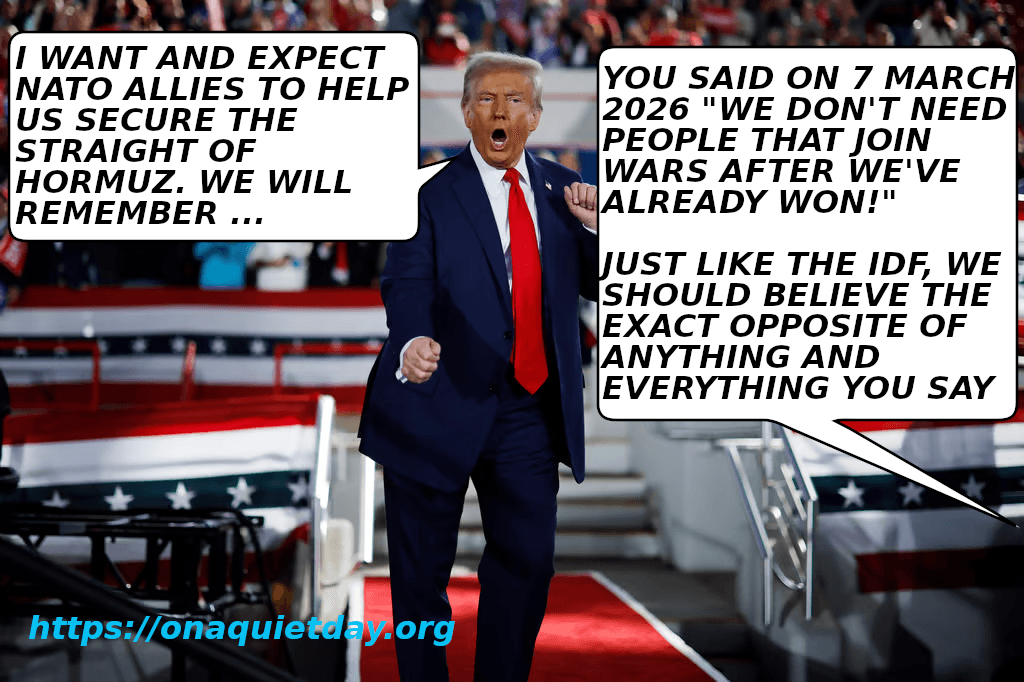
Donald Trump calls for help from NATO allies in securing the Straight of Hormuz despite saying on 7 March 2026 that they don't need people to join wars after they've already won.
Donald Trump calls for help from NATO allies in securing the Straight of Hormuz despite saying on 7 March 2026 that they don’t need people to join wars after they’ve already won.
Continue ReadingWith Everyone Looking for Iran War Off-Ramp, Experts Offer ‘Exit Plan’

‘No Patient Deserves This’: Doctors, Nurses Say Trump Blockade Is Killing Sick Cubans

Spread the love

Original article by Brett Wilkins republished from Common Dreams under Creative Commons (CC BY-NC-ND 3.0). 

A doctor talks to a patient in the cardiology room of the Calixto Garcia Hospital in Havana on February 12, 2024.
 (Photo by Yamil Lage/AFP via Getty Images)

“We do everything with love to assist people, but the reality right now is that we don’t have enough resources,” said one Cuban doctor, who added that “the main cause of everything is the USA.”

The Trump administration’s oil blockade of Cuba—an escalation of the 65-year US stranglehold on the socialist island’s economy—is killing Cubans amid a severe shortage of electricity and critical basic medical supplies, doctors and nurses there told reporters this week.

“I can’t tell you how many deaths, but I’m sure there are more than in the same period last year,” Dr. Alioth Fernandez, chief anesthesiologist at William Soler Pediatric Hospital in Havana, told The New York Times in an article published Friday. “I see it in shift handovers, in colleagues’ comments, and in children I’ve operated on.”

RECOMMENDED…

CUBA-DAILYLIFE

11,000 Children Among Tens of Thousands ‘Waiting for Surgery’ in Cuba Due to US Blockade

TOPSHOT-CUBA-US-ENERGY-BLACKOUT

‘US Siege Is Warfare’: Cuba Faces Second Nationwide Blackout in Under a Week

Cuba’s universal healthcare system is internationally known. Its “Army of White Coats” has been deployed around the world, both to provide routine and specialized care, as well as during emergencies such as the Haiti earthquake, Sierra Leone Ebola outbreak, and Covid-19 pandemic in Italy.

Despite decades of success under increasingly adverse conditions, Cuba’s vaunted health system is under tremendous strain, due in no small part to the cumulative effects of generations of US economic sanctions.

“Since I was born, this is the most difficult time, without any doubt,” José Carlos, a resident intern at Havana Cardiology Institute, told the Canadian Broadcasting Corporation on Thursday. “We do everything with love to assist people, but the reality right now is that we don’t have enough resources.”

The lack of fuel is limiting ambulance service and keeping many doctors and other medical professionals from commuting to hospitals that are canceling surgeries and discharging patients early. As Common Dreams reported earlier this week, more than 96,000 Cubans—including 11,000 children—are waiting for surgery due to the fuel shortage.

“Everything is hitting us—energy, resources, transportation,” Carlos told the CBC.

When the lights go out, neonatal nurses use hand-pumped ventilators to keep infants alive. Without power, hospitals and clinics can’t administer chemotherapy cycles or dialysis treatments.

“I don’t know how long we can keep going,” Xenia Álvarez, the mother of a 21-year-old man who suffers a rare genetic disease and requires full-time use of a ventilator, told The New York Times.

Shortages of basic medicines and supplies are forcing doctors to substitute medications, delay treatments, or even ask patients’ relatives to find supplies themselves. Antibiotics, painkillers, and medications to treat chronic diseases are scarce, as are gloves, syringes, and diagnostic equipment. Hospital staff also report difficulty maintaining sterile conditions.

While the US government claims that humanitarian goods like medicine are exempt from sanctions, critics counter that the fuel blockade, along with severe restrictions on banking and shipping, effectively block many medical supplies from reaching the island. The Trump administration has also been pressuring countries into expelling the lifesaving Cuban medical teams, sparking widespread outrage and condemnation.

After the Fidel Castro-led revolution that ousted the US-backed dictatorship of Fulgencio Batista, the United States imposed an economic embargo on the island that has been perennially condemned by an overwhelming majority of United Nations member states for 33 years. Cuba says US sanctions have cost its economy more than $200 billion in inflation-adjusted losses.

US Secretary of State Marco Rubio recently admitted that the economic chokehold is meant to force political change in Cuba while simultaneously disparaging the Cuban economy as “dysfunctional.”

Rubio also said that although President Donald Trump is currently focused on the US-Israeli war of choice on Iran—one of seven nations attacked since the self-proclaimed “president of peace” returned to the White House—he would “be doing something with Cuba very soon.”

Trump said earlier this month that he believes he’ll “be having the honor of taking Cuba,” language echoing the 19th century US imperialists who conquered the island along with Puerto Rico and the Philippines from Spain.

In addition to patients, the crisis in Cuba is also taking a physical and psychological toll on Cuban doctors—who, even with a recent raise earn just 100 pesos, or about $2.40, per 12-hour shift. This, in a country in which a dozen eggs cost nearly $10. Many doctors rely upon side hustles to get by.

“Doctors’ pay is just for basic things,” said Carlos. “It doesn’t allow you to buy many things in the supermarket or go to a restaurant or a hotel, or things like that.”

Breakdowns and burnout are on the rise.

“I’ve seen doctors cry,” one physician, who wished to remain anonymous for fear of retaliation, told Reuters. “With this crisis, they cry. They’ve stopped working, they’ve become depressed. You can see it on their faces.”

Despite the worsening situation, Carlos told the CBC that he does not want to leave Cuba, and blamed the US for the crisis.

“The main cause of everything is the USA,” he said. “I have no doubt about that.”

Some do want to leave, blaming their own government as well the US embargo for Cuba’s suffering. Others are taking things one day at a time.

“We don’t know what will happen,” a nurse who gave only her first name, Rita, told the CBC, “so we just keep working.”

The mounting—and preventable—deaths in Cuba are prompting renewed calls for the US to lift sanctions on Cuba.

“No patient deserves this. Trump’s cruel Cuban blockade is killing people unnecessarily,” National Nurses United, the largest US nurses’ union, said on social media Friday. “Depriving Cubans of essential resources needed to sustain life and health is an unconscionable violation of human rights. Nurses say: End the blockade now!”

Congresswoman Ilhan Omar (D-Minn.) also weighed in during a Thursday floor speech in which she said that “Cuba poses no threat to us, yet we are strangling an entire nation with economic warfare.”

“Families are going without food. Water systems are failing. Hospitals are struggling to stay open,” she continued. “These tactics are designed to suffocate an island into submission. Make no mistake: This unconscionable suffering is occurring because Trump is trying to force regime change.”

“Hands off Cuba,” Omar added. “End the blockade now.”

Donald Trump sings and dances, says that it's fun to kill everyone ...
Donald Trump sings and dances, says that it’s fun to kill everyone …

Continue Reading‘No Patient Deserves This’: Doctors, Nurses Say Trump Blockade Is Killing Sick Cubans

Trump says seizing Iranian oil is ‘an option’ amid ongoing war

Spread the love

This work by Middle East Monitor is licensed under a Creative Commons Attribution-NonCommercial-ShareAlike 4.0 International License.

United States President Donald Trump walks toward the White House upon his arrival in Washington, DC, from Memphis, Tennessee, United States, on March 23, 2026. [Celal Güneş – Anadolu Agency]

US President Donald Trump has said that seizing Iranian oil remains “an option”, as the war between the United States, Israel, and Iran continues.

Speaking during a cabinet meeting at the White House, Trump told reporters that taking control of Iran’s oil resources is being considered, though he did not provide further details.

“It’s an option on the table,” he said, while also referring to previous US involvement in oil sectors such as Venezuela.

Trump added that he is uncertain whether a deal can be reached with Iran, claiming that Tehran is seeking an agreement, though Iranian officials have repeatedly denied this.

READ: Iran says oil exports reach 1.5M barrels per day despite war

“The Iranians are begging for a deal, not me,” he said, describing them as “good negotiators.”

The US president also stated that military operations against Iran are “ahead of schedule”, predicting that the war — now in its fourth week — could end soon.

Meanwhile, US Middle East envoy Steve Witkoff spoke of “strong indications” of progress toward persuading Iran to reach a deal, noting that a 15-point framework proposal had been conveyed to Tehran through a Pakistani mediator.

He added, “The Iranians are stalling in the talks and looking for a way out, and reaching a deal would be in the best interests of both Iran and the world.”

READ: Iran announces mobilising 1 million fighters to repel potential US ground invasion

Keir Starmer explains that UK is participating defensively in Trump and Israel's criminal war for Israel's genocidal expansion in Iran and states that he supports Zionism "without qualification". Keir Starmer said "I said it loud and clear – and meant it – that I support Zionism without qualification.” here: https://www.jewishnews.co.uk/keir-starmer-interview-i-will-work-to-eradicate-antisemitism-from-day-one/
Keir Starmer explains that UK is participating defensively in Trump and Israel’s criminal war for Israel’s genocidal expansion in Iran and states that he supports Zionism “without qualification”. Keir Starmer said “I said it loud and clear – and meant it – that I support Zionism without qualification.” here: https://www.jewishnews.co.uk/keir-starmer-interview-i-will-work-to-eradicate-antisemitism-from-day-one/
Donald Trump calls for help from NATO allies in securing the Straight of Hormuz despite saying on 7 March 2026 that they don't need people to join wars after they've already won.
Donald Trump calls for help from NATO allies in securing the Straight of Hormuz despite saying on 7 March 2026 that they don’t need people to join wars after they’ve already won.
Climate science denier Donald Trump confirms that he knows nothing about democracy and that more liquid gold is being secured according to his policy of global privateering.

Continue ReadingTrump says seizing Iranian oil is ‘an option’ amid ongoing war

No Kings, no exceptions: How Trump’s Iran war exposes the death of American democracy

Spread the love

This work by Middle East Monitor is licensed under a Creative Commons Attribution-NonCommercial-ShareAlike 4.0 International License.

by Greg Pence

Demonstrators hold a protest against the war on Iran next to Recruting Station in Times Square, New York City, United States, on Sunday, March 22, 2026. [Selçuk Acar – Anadolu Agency]

On 28th February 2026, the United States went to war. No congressional debate. No public deliberation. No formal declaration. Just a midnight operation, with top lawmakers notified only minutes before the bombs fell, announcing that American aircraft were already striking Tehran. This is not how a republic wages war. This is how a king does.

The strikes on Iran — codenamed Operation Epic Fury— killed Iranian Supreme Leader Ali Khamenei and multiple senior officials, put American lives in harm’s way without a single vote of the people’s representatives, and shook global energy markets to their foundations.

Article I of the Constitution gives Congress, not the president, the power to declare war. Trump did it anyway. And in doing so, he did not merely break a rule — he broke the foundational compact of American self-governance.

The White House’s legal rationale was collective self-defence under the UN Charter. But the United States was not under attack. Iran had not struck American soil. Administration officials released conflicting statements about the aims of the operation, ranging from ending Iran’s nuclear program to outright regime change — language that has no grounding in any congressional mandate or democratic debate. As Senator Andy Kim told TIME, lawmakers and the American public were being asked to accept military escalation without understanding the endgame: “The President has really boxed us in and put us on the hook for things that we haven’t discussed as a country.” When senators demanded classified briefings, they largely received stonewalling. What followed was not strategic clarity but performative chaos: on the same day his administration surged forces to the region, Trump posted on social media about winding down. He threatened to bomb Iranian power plants if the Strait of Hormuz was not opened on his timetable.

And when asked about rising gas prices, he shrugged: *”If they rise, they rise.”* These are not the words of a commander-in-chief accountable to a republic. They are the words of a man who believes he answers to no one.

Dissent has come from across the political spectrum, which is precisely what makes the administration’s contempt for Congress so damning. [Senator Chris Van Hollen]() called it plainly: “Trump is lying to the American people as he launches an illegal, regime-change war against Iran. This is endangering American lives and has already resulted in mass civilian casualties.” Kentucky Republican Thomas Massie declared: “This is not ‘America First.’ The Constitution conferred the power to declare or initiate war to Congress for a reason — to make war less likely.” Army veteran and Ohio Republican Warren Davidson said simply: “War requires Congressional authorization.” These are conservatives honouring their oath, not partisans playing politics. And yet the war powers resolutions they championed failed to override a presidential veto, as most Republicans fell in line. Senator Tim Kaine’s warning now hangs over every future presidency: “Don’t hide under your desk and just let the president do it on his own. Because if you do, you’re opening the door for presidents of either party into the future just to wage war willy-nilly.”

The U.S.–Israeli War on Iran: Gains and Losses

The human cost is already devastating — over 1,400 Iranians killed, thirteen American soldiers dead — and the economic cost is being borne by the entire world. Brent crude surpassed $126 per barrel at its peak, its highest level in years. The Strait of Hormuz — through which 20 percent of global oil supplies flow — was effectively closed, and QatarEnergy, responsible for 20 percent of the world’s LNG supply, declared force majeure on all exports. Global stocks fell 5.5 percent in the war’s opening days. Inflation is forecast to rise across the eurozone, the United States, and Asia simultaneously, presenting central banks with the spectre of stagflation — while the president who lit the fuse demands that the Federal Reserve cut interest rates.

Families in Chicago and Chennai, in Lagos and London, are absorbing the price of a decision made by one man without asking anyone’s permission.

The World Economic Forum put the deeper betrayal into words: the United States “has imposed enormous costs on many of the same economies it relies on as trading and strategic partners.” Allies were not consulted. The democratic world was not asked. And yet it is paying, country by country, household by household, for a war it did not vote for and cannot stop. This matters far beyond economics. The United States built the post-war international order on the premise that even the most powerful nation would operate within rules and seek legitimacy before using force. When that premise collapses, the argument for democratic governance in an age of strongmen collapses with it. A world with kings — whether in Moscow, Beijing, or Washington — is a more dangerous world for everyone.

The phrase “No Kings” is not a slogan invented by the left. It is the founding premise of the American republic, inscribed in the separation of powers and in a Constitution written by men who had lived under a monarchy and refused to recreate one. This war is the most dramatic breach of that premise yet — but not the first. Trump launched strikes on Iranian nuclear facilities last year without a congressional vote. He ordered the capture of Venezuela’s president without one.

Each unchallenged act of unilateral power makes the next easier. This is how republics die — not in a single dramatic moment, but in the slow accumulation of precedents no one stopped in time.

On March 28, over 3,000 No Kings protests are scheduled across every state in this country. Join them. Bring your neighbors. Bring your children, so they can see what democracy looks like when citizens defend it. This is not a partisan call — it is a constitutional one, and it belongs to everyone who believes that in America, the people decide. Not one man. Not a king.

We have tried kings before. We know how it ends.

When presidents lie, diplomacy dies: The global cost of post-truth under Trump

The views expressed in this article belong to the author and do not necessarily reflect the editorial policy of Middle East Monitor.

Keir Starmer explains that UK is participating defensively in Trump and Israel's criminal war for Israel's genocidal expansion in Iran and states that he supports Zionism "without qualification". Keir Starmer said "I said it loud and clear – and meant it – that I support Zionism without qualification.” here: https://www.jewishnews.co.uk/keir-starmer-interview-i-will-work-to-eradicate-antisemitism-from-day-one/
Keir Starmer explains that UK is participating defensively in Trump and Israel’s criminal war for Israel’s genocidal expansion in Iran and states that he supports Zionism “without qualification”. Keir Starmer said “I said it loud and clear – and meant it – that I support Zionism without qualification.” here: https://www.jewishnews.co.uk/keir-starmer-interview-i-will-work-to-eradicate-antisemitism-from-day-one/
Donald Trump calls for help from NATO allies in securing the Straight of Hormuz despite saying on 7 March 2026 that they don't need people to join wars after they've already won.
Donald Trump calls for help from NATO allies in securing the Straight of Hormuz despite saying on 7 March 2026 that they don’t need people to join wars after they’ve already won.
Climate science denier Donald Trump confirms that he knows nothing about democracy and that more liquid gold is being secured according to his policy of global privateering.

Continue ReadingNo Kings, no exceptions: How Trump’s Iran war exposes the death of American democracy

Yemen’s Houthis say to intervene militarily if needed amid Iran-US war

Spread the love

This work by Middle East Monitor is licensed under a Creative Commons Attribution-NonCommercial-ShareAlike 4.0 International License

People listen to Houthi leader Abdul-Malik al-Houthi as he speaks via video conference, in Sana’a, Yemen on March 17, 2023 [Mohammed Hamoud – Anadolu Agency]

The leader of Yemen’s Houthi group said Thursday that his movement “is not neutral” in the ongoing war between Iran, the US and Israel, warning that his group will intervene militarily if regional developments dictate it, Anadolu reports.

“We are not neutral, but our position stems from belonging to Islam and the Islamic nation,” Abdul-Malik al-Houthi said in a televised speech cited by the group’s Al-Masirah television.

“Any field developments will be met with military stance if needed, as in previous rounds.”

He said the US-Israeli strikes on Iran have harmed the economic interests of the world’s countries and regional security and stability, calling the assault “unjustified.”

READ: Yemen’s Houthis warns of action as regional tensions escalate

“Developments in the region over the past years show that the US and Israel are working to implement a Zionist plot that targets all countries of the region with a view to changing the Middle East and creating the Greater Israel,” he said.

Backed by Iran, the Houthis control most of Yemeni provinces, including the capital Sanaa, since 2014.

The group carried out missile and drone attacks against Israel and ships passing in the Red Sea in retaliation for Israel’s deadly offensive on the Gaza Strip, which has killed more than 72,000 people since October 2023.

The US and Israel have maintained airstrikes on Iran since Feb. 28, killing so far over 1,340 people, including then-Supreme Leader Ali Khamenei.

Iran has retaliated with drone and missile strikes targeting Israel, along with Jordan, Iraq, and Gulf countries hosting US military assets, causing casualties and damage to infrastructure while disrupting global markets and aviation.

READ: Trump prefers peace but ready to ‘unleash hell’ in Iran: White House

This work by Middle East Monitor is licensed under a Creative Commons Attribution-NonCommercial-ShareAlike 4.0 International License

Donald Trump calls for help from NATO allies in securing the Straight of Hormuz despite saying on 7 March 2026 that they don't need people to join wars after they've already won.
Donald Trump calls for help from NATO allies in securing the Straight of Hormuz despite saying on 7 March 2026 that they don’t need people to join wars after they’ve already won.
Keir Starmer explains that UK is participating defensively in Trump and Israel's criminal war for Israel's genocidal expansion in Iran and states that he supports Zionism "without qualification". Keir Starmer said "I said it loud and clear – and meant it – that I support Zionism without qualification.” here: https://www.jewishnews.co.uk/keir-starmer-interview-i-will-work-to-eradicate-antisemitism-from-day-one/
Keir Starmer explains that UK is participating defensively in Trump and Israel’s criminal war for Israel’s genocidal expansion in Iran and states that he supports Zionism “without qualification”. Keir Starmer said “I said it loud and clear – and meant it – that I support Zionism without qualification.” here: https://www.jewishnews.co.uk/keir-starmer-interview-i-will-work-to-eradicate-antisemitism-from-day-one/
Orcas discuss how Trump was re-elected and him being an obviously insane, xenophobic Fascist.
Continue ReadingYemen’s Houthis say to intervene militarily if needed amid Iran-US war