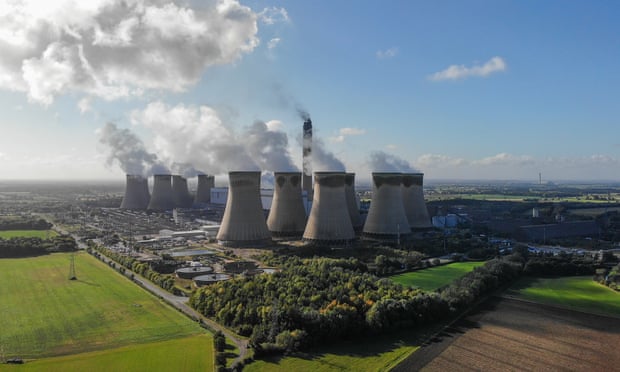
Drax was responsible for 11.5m tonnes of CO2 last year, or nearly 3% of the UK’s total carbon emissions. Photograph: SOPA Images/LightRocket/Getty Images
Drax received £22bn in subsidies despite being UK’s largest emitter in 2023, though company rejects ‘flawed’ research
The Drax power station was responsible for four times more carbon emissions than the UK’s last remaining coal-fired plant last year, despite taking more than £0.5bn in clean-energy subsidies in 2023, according to a report.
The North Yorkshire power plant, which burns wood pellets imported from North America to generate electricity, was revealed as Britain’s single largest carbon emitter in 2023 by a report from the climate thinktank Ember.
The figures show that Drax, which has received billions in subsidies since it began switching from coal to biomass in 2012, was responsible for 11.5m tonnes of CO2 last year, or nearly 3% of the UK’s total carbon emissions.
Drax produced four times more carbon dioxide than the UK’s last remaining coal-fired power station at Ratcliffe-on-Soar in Nottinghamshire, which is due to close in September. Drax also produced more emissions last year than the next four most polluting power plants in the UK combined, according to the report.
Regardless of who wins next month, fossil fuel interests have multiple levers for influencing policy.
The UK is heading to the polls on July 4. Although it doesn’t get enough attention, the two major parties — the Conservatives and Labour — have chosen climate change and, in particular, fossil fuel production in the North Sea as a clear political dividing line for the electorate.
As polling day draws closer, and election fervour takes hold, we will see the forces of British climate obstruction in full effect. Influential individuals, organisations and media outlets that seek to block, dilute, delay, or even reverse climate policies will attempt to widen that political dividing line with a mixture of claims to be defending individual freedoms, putting growth first, being ‘climate realists’, or by displacing concerns about the UK’s responsibility to act on climate change through ‘whataboutism’.
The Conservative government, under Prime Minister Rishi Sunak, has pushed ahead with issuing hundreds of new oil and gas licences in the North Sea. The government was due to further reform the licensing regime so permits are handed out on an annual basis, all under the auspices of ‘energy security’, but the election has halted the bill’s progress through Parliament. Future licences are expected to yield just three weeks’ worth of gas per year.
Sir Keir Starmer’s Labour Party, however, announced that it will end new licensing for oil and gas in the North Sea, with the very large caveat of honouring those already approved. But even this announcement ignited fierce resistance from the media, trade unions, Labour’s political opponents and some figures it deemed allies. The plan was labelled as “Thatcher on steroids”, “naive”, and risked “creating a cliff-edge” for industry and investment in and around the North Sea. In response to the vitriol, Starmer conceded that fossil fuels will continue to be used in the UK “for many, many years”.
This episode provides a useful insight into how climate obstructionism operates in the UK. In a new publication for the Climate Social Science Network (CSSN) based at Brown University, alongside Dr Ruth McKie and Dr James Painter, we identified three major channels through which obstructionism operates in Britain and the network of organisations that sustain it.
Financial Power
The first is the material. This speaks to the financial and structural power of the fossil fuel industry that allows it to use threats of capital flight and job losses to curry favourable policy conditions and fend off tax hikes that would dent profitability. It also speaks to party donations, where fossil fuel firms, or those that benefit from their expansion, provide funds to individual politicians or the wider party for access and a say over policy.
Since 2019, the Conservatives have received £8.4 million in donations from big polluters and those with direct links to fossil fuel production. The current Energy Security and Net Zero Secretary, Claire Coutinho, accepted a £2,000 donation in January 2024 from Lord Michael Hintze, a funder of the UK’s leading climate science denial group, the Global Warming Policy Foundation. Labour too have taken money from big polluters, most notably Drax, whose North Yorkshire power plant is the UK’s single largest source of emissions.
Alongside the material sits the institutional. The policy making process in the UK provides a multitude of opportunities for actors to shape policy, all within the bounds of proper procedure and due process. All Party Parliamentary Groups (APPGs), informal groups of politicians organised around key themes or policy issues, have provided an effective fora for obstructionist actors to garner access and shape policy. The rules governing APPGs often inhibit public scrutiny. Trade associations, and the companies they represent, can be omitted from official parliamentary transparency logs as only benefits in kind above £1,500 a year must be declared — a threshold many industry bodies claim not to meet.
Revolving doors between industry and government are another institutional means through which fossil fuel interests can determine policy. An investigation by The Ferret found that since 2011, 127 former oil and gas employees have gone into top government roles and been appointed to ministerial advisory boards. At least a dozen of these individuals were given roles in the North Sea Transition Authority, the organisation tasked with governing oil and gas production, as well as within departments responsible for writing energy and climate policy. Shutting this revolving door, or even just slowing it down through ‘cool-off’ periods, would go some way in curtailing obstructionism.
Climate Delay
The final, and perhaps most pronounced, thread of climate obstructionism in the UK is discursive, primarily promoted through the media. The right-leaning media in the UK, such as the Daily Telegraph and Daily Mail, have persistently opposed climate policy and action. This opposition used to be grounded in outright denial, where the integrity of climate science was disputed and denigrated. Now, though, a more pernicious form of discursive obstructionism is prevalent; that of climate delay.
Countless op-eds and articles have been published that acknowledge climate change but dispute the necessity of addressing it, the cost of implementing climate policy (both economically and in terms of national security), and the efficacy of green technologies such as wind turbines, electric vehicles (EVs) and heat pumps. These interventions, which are sometimes made by individuals with direct links to sceptic organisations or else use their framing, often push blatant untruths to the public, such as renewable energy pushing up household energy bills or solar panels jeopardising British farming. The media continues to both demonise climate activists and undermine public support for key climate policies.
In this election, watch out for climate obstructionism. While institutional channels may be curtailed due to purdah, others will pick up the slack. With all parties now firmly on an election footing, donations will become a crucial resource for knocking doors and getting out the vote in marginal seats. The sources of these donations, and the interests behind them, will bear the thumbprint of the fossil fuel industry. The media will increase its scrutiny of manifesto pledges and publish a litany of analyses. It is highly likely that Labour’s climate policy will be painted as a threat to national security, an insurmountable cost to the public purse, and reflecting the demands of both Vladimir Putin and Just Stop Oil simultaneously. The foundation of this framing has already been set.
What is less clear, though, is what comes after July 4. With a change of government comes a reconfiguration of interests and, for the winners, concessions will be made to those actors and constituencies that helped get them past the post. For the losing party, most likely to be the Conservatives, there may be an ideological reorientation that ends the cross-party consensus on tackling climate breakdown, making them the party of climate obstructionism that challenges the necessity of net zero and fights for more oil and gas.
This election might be the one that ends 14 years of Conservative rule, but it’s not likely to be the one to end climate obstructionism in the UK.
Freddie Daley is a Research Associate at the Centre for Global Political Economy at the University of Sussex.
Peter Newell is a Professor of International Relations at the University of Sussex.
They are the authors of a chapter in Climate Obstructionism across Europe, a new collection of essays analysing the organisations, politicians, think tanks and media outlets seeking to delay, derail and denigrate climate policy, produced by the Climate Social Science Network.
dizzy: I don’t agree that there is “cross-party consensus on tackling climate breakdown.” I suggest that instead the Conservative and Labour parties are indistinguishable in their support of plutocracy, sucking up to the rich and powerful. The Conservatives under Sunak have made no pretence of their intention to forge ahead with exploiting North Sea fossil fuels all they can and Labour do not intend to stop the Rosebank North Sea oil and gas field. Starmer has abandoned so many pledges that he should be recognised as as much a liar as Tony Blair or Boris Johnson.
The title of “… the party of climate obstructionism that challenges the necessity of net zero and fights for more oil and gas. ” is currently shared by the Conservatives and climate denier Nigel Farage’s Reform UK.
Rishi Sunak on stopping Rosebank says that any chancellor can stop his huge 91% subsidy to build Rosebank, that Keir Starmer is as bad as him for sucking up to Murdoch and other plutocrats and that we (the plebs) need to get organised to elect MPs that will stop Rosebank.
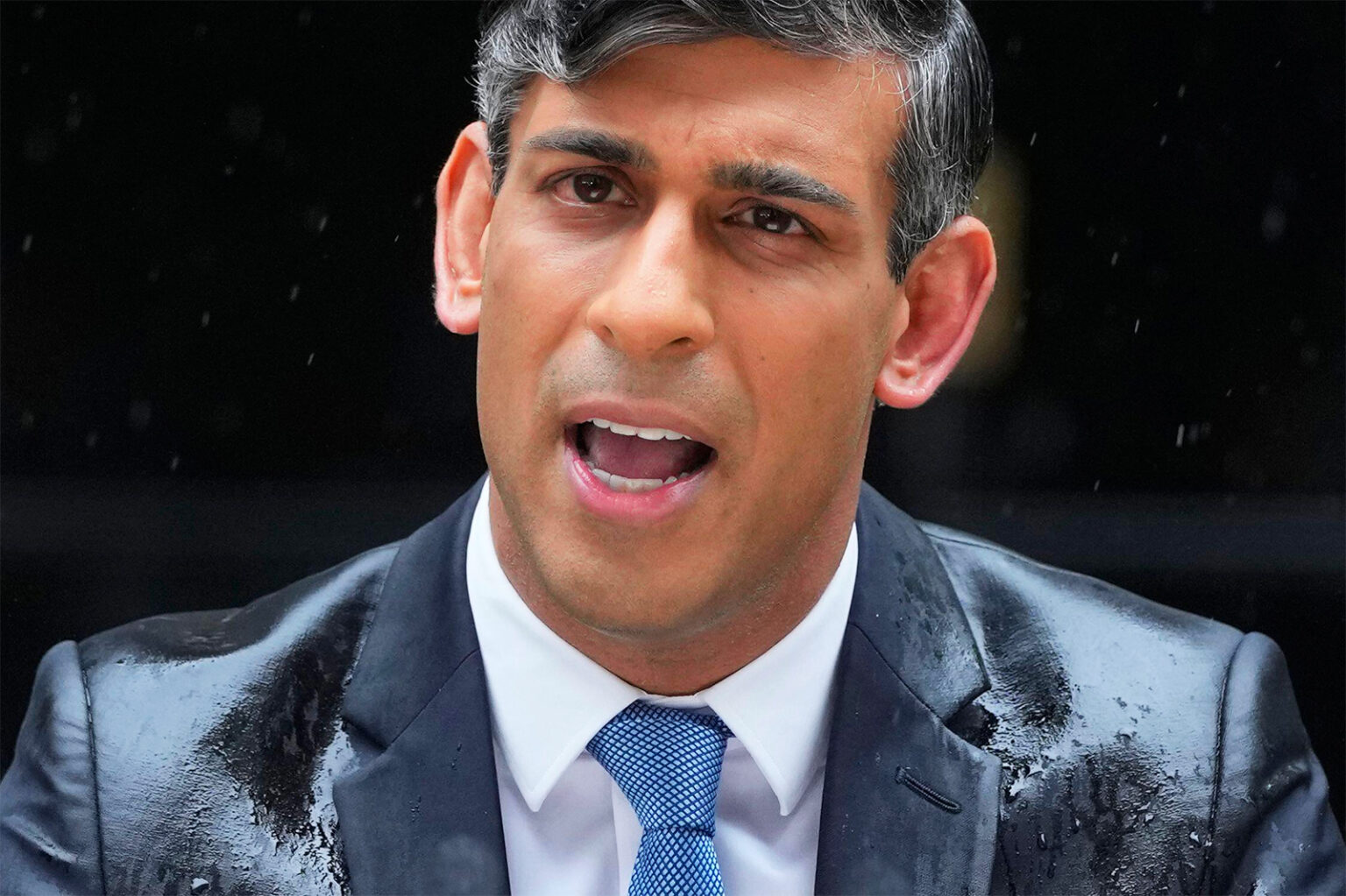
Prime Minister Rishi Sunak. Credit: Associated Press / Alamy
“Outrageous” findings show that the Conservative Party “is clearly in bed with the fossil fuel lobby”, say MPs and campaigners.
The Conservative Party has received £8.4 million since December 2019 from oil and gas interests, highly polluting industries, and individuals who have expressed or supported climate science denial, DeSmog can reveal.
This comes as climate action is increasingly being used as a “wedge” issue to divide voters ahead of the next election, which is due to be held on 4 July.
Over the last year, the governing Conservative Party has watered down its support for the UK’s flagship 2050 net zero emissions target, and has enacted policies to increase fossil fuel extraction. In July, Prime Minister Rishi Sunak confirmed that his government plans to issue hundreds of new oil and gas licences, as well as introducing annual licensing rounds, claiming that he intends to “max out” the UK’s fossil fuel reserves.
Sunak launched the election campaign by claiming that he had “prioritised energy security and your family finances over environmental dogma”.
DeSmog reviewed the donations to every major Westminster party since 12 December 2019 and found that the Conservative Party and its MPs had received 80 times more polluting cash than the Liberal Democrats (£132,600), and 160 times more than Labour (£41,600). The anti-net zero party Reform UK has received more than £2 million in polluting donations since December 2019, accounting for more than 90 percent of its funding.
Since the December 2019 election, the Conservatives have received £2.35 million from fossil fuel interests, £5.7 million from highly polluting industries, and £404,000 from supporters of climate science denial.
“No political party should be taking any money from fossil fuel interests whatsoever,” Caroline Lucas, the Green Party MP for Brighton Pavilion, told DeSmog.
“To have the Conservative party of government in their pocket to the tune of £8.4 million is simply outrageous and unacceptable. Is it any wonder they’ve adopted so many reactionary and dangerous policies to prop up planet-wrecking fossil fuels? He who pays the piper, calls the tune.”
The Conservative Party did not respond to DeSmog’s request for comment.
Fossil Fuel Donations
Since the 2019 general election, the Conservative Party has received more than £2 million from fossil fuel companies, their executives, and those with a financial interest in oil and gas.
These donations have come from some of the party’s highest-ranking figures.
Tory peer Lord Michael Spencer is a former party treasurer who sits on the board of its endowment fund, the Conservative Party Foundation. In a personal capacity and through his family office, IPGL, Spencer has given £548,500 to the party since December 2019.
Spencer currently holds an 18.8 percent (£4.5 million) stake in the oil and gas exploration company Deltic Energy, which has been awarded multiple North Sea licences by the government.
He previously told DeSmog that he believes “it is totally in the best interest of the UK to replace imported oil and gas by energy extracted from our own North Sea.”
He added in a new comment that “using our own oil and gas clearly is a huge benefit to UK balance of payments” – with reference to the amount that the UK exports versus the amount that it imports.
Spencer has a number of oil and gas interests. His House of Lords register of interests shows that he has a stake in Pantheon Resources, a UK company exploring for oil in Alaska, and previously had a stake in Cluff Energy Africa, which is described as an “early stage oil prospecting company seeking licences in Africa (Angola and Sierra Leone)”.
Tory peer Lord Michael Farmer has also donated £317,000 to the party since the last election. Until April 2024, Farmer held shares in the fossil fuel giants Shell and BP, each worth more than £100,000. Farmer still holds shares in BHP Group, which has mining and oil assets. In 2022, BHP’s petroleum business merged with the energy company Woodside, with the new firm being 48 percent owned by BHP shareholders, creating a “global top 10 independent energy company”.
The Conservative Party has also received £75,900 from Amjad Bseisu, the CEO of EnQuest – a company that has been awarded North Sea oil and gas licences, as well as licences to explore CO2 storage under the North Sea. EnQuest declined to comment.
Alasdair Locke, who chairs the UK’s largest independent petrol station operator Motor Fuel Group, has given £280,000 to the Tories since December 2019. Locke is also the non-executive chair of Well-Safe Solutions, a firm that decommissions oil and gas wells, and is the founder and former executive chairman of Abbot Group, a major North Sea oil and gas services company.
Balmoral Holdings, an engineering firm heavily involved in the North Sea industry, has given £335,000 to the party, while more than £100,000 has been donated by Matthew Ferrey, a former senior partner at oil trading firm Vitol.
Donations worth £63,000 have also been given by Nova Venture Holdings, a firm owned by Jacques Tohme, who describes himself as an “energy investor” on LinkedIn and says that he is the co-founder and former director of Tailwind Energy, an oil and gas company.
In 2023, Serica Energy bought Tailwind, reportedly making Serica one of the 10 largest North Sea oil and gas producers.
“This investigation is yet more evidence of the stranglehold the oil and gas industry has on our politics,” Georgia Whitaker, Greenpeace UK’s climate campaigner, told DeSmog. “And it’s bill payers and the climate that will continue to suffer because of it.
“The governing party we’ve had for the last 14 years is clearly in bed with the fossil fuel lobby. We’ve seen rowback after row back on climate policy, as well as highly damaging rhetoric from political leaders. It’s clear that the Conservatives can’t be trusted to make the right decisions about energy policy.
“We already have the solutions to cut bills, increase energy security and cut emissions, but the government has ignored them in favour of pandering to vested interests at the expense of the rest of us. Dirty money from fossil fuels, highly polluting industries, or climate deniers should have no place in our politics.”
Carbon-Intensive Industry
The largest polluting donation to the Conservatives came from Amit Lohia, a petrochemicals executive whose business interests include a Russian textiles plant, as previously revealed by DeSmog. Lohia donated £2 million to the party in March 2023.
The Conservative Party also received more than £1.7 million during this period from the construction giant JCB and its proprietors the Bamford family. JCB sells its products in 150 countries and specialises in heavy machinery. The company, chaired by Tory peer Lord Anthony Bamford, also sells diesel-powered generators.
According to the government’s Environmental Audit Committee, the UK’s built environment is responsible for 25 percent of the UK’s greenhouse gas emissions. The construction industry is responsible for 18 percent of large particle pollution in the UK, a figure that rises to 30 percent in London, according to a report by Impact on Urban Health, and the Centre for Low Emission Construction.
Aviation entrepreneur Christopher Harborne has given more than £1.6 million to the party since the last election. Harborne is the owner of AML Global, an aviation fuel supplier operating in 1,200 locations across the globe with a distribution network that includes “main and regional oil companies”, according to its website. Harborne is also the CEO of Sheriff Global Group, which trades in private jets.
In addition to his Conservative Party donations, since December 2019 Harborne has given £465,000 to Reform UK, the country’s most overtly anti-net zero political party.
Aviation emissions accounted for eight percent of the UK’s annual greenhouse gas emissions before the pandemic, according to the government’s Climate Change Committee (CCC).
In response to DeSmog’s request for comment, Harborne posted a lengthy statement on the AML Global website. He said: “I am not a climate science denier and … I do not seek to influence any government through donations or lobbying regarding their policies on climate change or in favour of corporate interests.”
Harborne added that “there is overwhelming scientific evidence that human activity and in particular the use of hydrocarbons as an energy source is accelerating climate warming due to the greenhouse effect.”
He noted that he supports “aviation industry initiatives to improve fuel efficiency and the use of sustainable aviation fuel” and that he is “financing a business that is creating ambitious and innovative new designs for next generation aircraft that will have a radically lower carbon footprint.”
Climate-Denier Donors
Climate science denial is a growing feature of mainstream British politics. Its proponents dispute the settled consensus around human-caused climate change and the need to reach net zero emissions by 2050, displacing informed debate with divisive conversations that mislead the public.
The Climate Action Against Disinformation global coalition has observed that “climate has become co-opted into the culture wars”, which has widened the potential scope of mis- and disinformation around both the causes of and best solutions to global heating.
Since the 2019 election, the Conservative Party has received hundreds of thousands of pounds from individuals who have funded and promoted climate science denial.
Hedge fund manager Lord Michael Hintze has donated £294,000 to the Tories and a number of its MPs, including energy security and net zero secretary Claire Coutinho in January 2024.
Hintze, a Conservative peer, was one of the early funders of the Global Warming Policy Foundation (GWPF), the UK’s leading climate science denial group, which has claimed that carbon dioxide has been mis-characterised as pollution, when it is a “benefit to the planet”.
Hintze has said that he believes “there is climate change” caused “in part due to human activity over the past century”. However, he has said that “all sides must be heard” on climate change “to reach the right conclusion for society as a whole“.
A number of climate consensus studies conducted between 2004 and 2015 found that between 90 percent and 100 percent of experts agree that humans are responsible for climate change. A study published in 2021, which reviewed over 3,000 scientific papers, found that over 99 percent of climate science literature says that global warming is caused by human activity.
The UN’s Intergovernmental Panel on Climate Change (IPCC), the world’s foremost climate science body, has stated it is “unequivocal that human influence has warmed the atmosphere, ocean and land”.
The party has also received £90,000 from First Corporate Consultants, a firm owned by Terence Mordaunt, a director and former chair of the GWPF. Mordaunt told openDemocracy in 2019 that “no one has proved yet that CO2 is the culprit” of climate change.
The IPCC has stated that carbon dioxide “is responsible for most of global warming” since the late 19th century, which has increased the “severity and frequency of weather and climate extremes, like heat waves, heavy rains, and drought”.
Jolyon Maugham, director of the Good Law Project, told DeSmog: “No one who has seen how the Conservative Party chose Big Oil over families during the cost of living crisis will be surprised by these numbers. But that shouldn’t dull our sense of quite how grim all of this is.”
Other Parties
Last year First Corporate Consultants also donated £200,000 to Tory rivals, the right-wing party Reform UK, which has been the second largest recipient of donations from polluting sources since December 2019.
Of the £2.5 million that Reform UK has received in donations since the 2019 election, around 92 percent (£2.3 million) of that income has been given by fossil fuel interests, polluting industries, or climate science deniers.
Reform UK has received £515,000 from former Tory donor Jeremy Hosking, whose investment firm had more than $134 million (around £108 million) invested in the energy sector at the close of 2021, two thirds of which was in the oil industry, along with millions in coal and gas.
Hosking, who also donated £50,000 to the Conservatives during this period, previously told DeSmog: “I do not have millions in fossil fuels; it is the clients of Hosking Partners who are the beneficiaries of these investments.” He declined to comment further for this article.
Hosking told The Guardian in May that he had ended his donations to Reform UK and is now channelling his political donations to Reclaim, a radical right-wing party led by actor Laurence Fox.
Since December 2019, Reform UK has also received more than £1.1 million from businesses run by its leader Richard Tice, who is a prominent climate science denier. Tice has claimed that “there is no climate crisis”, and has also expressed the view that “CO2 isn’t a poison. It’s plant food”. Reform UK campaigns on an overtly anti-climate platform. It has called for the UK’s 2050 climate target to be scrapped, and has proposed holding a “referendum on net zero”.
Reform UK has also received more than 50 loans collectively worth around £1.4 million from a company called Tisun Investments, which is owned by Tice, since the start of 2020.
A Reform UK spokesman said: “Climate change is real, Reform UK believes we must adapt, rather than foolishly think you can stop it. We are proud to be the only party to understand that economic growth depends on cheap domestic energy and we are proud that we are the only party that are climate science realists, realising you can not stop the power of the sun, volcanoes or sea level oscillation.
“The deniers are those who continually gaslight the public into thinking you can stop these powerful natural forces. We must use the energy under our feet, rather than send our money and jobs abroad.”
The Liberal Democrats and Labour have received much smaller sums from fossil fuel interests, polluters, and climate science deniers since December 2019. DeSmog’s analysis found that the Lib Dems have received £132,600, including £10,000 from energy investor Hosking, and £110,600 from Christopher D. Leach, who runs a private plane chartering and management business.
The Labour Party has received £41,600, including £9,600 from the aviation firm Airbus, and £12,000 from biomass company Drax, which is the UK’s largest single source of carbon emissions. Labour has also received sizeable donations from green technology entrepreneurs, including eco-campaigner Dale Vince.
The Scottish National Party (SNP) did not receive any Westminster donations from fossil fuel interests, polluters, or climate science deniers, according to DeSmog’s research.
Labour and the Liberal Democrats did not respond to DeSmog’s request for comment.
An Onward event at the 2022 Conservative Party conference featuring Cabinet minister Michael Gove. Credit: PA Images / Alamy
Ministers met with Onward, accused of being “a fossil fuel dinosaur in new clothing”, more than any other think tank last year.
An oil and gas funded group had the most registered meetings with government ministers among all think tanks last year, DeSmog can reveal.
Onward describes itself as a think tank bringing “bold and practical ideas for the centre right”. Since its launch in 2018 it has gone through a meteoric rise, quickly becoming one of Westminster’s most influential think tanks.
DeSmog analysed the meetings of every government department in 2023 and found that ministers met with the group on 17 occasions across the year, an average of well over once a month and more than any other think tank.
Onward doesn’t disclose full details of its funding but unlike many think tanks it publicly shares the list of organisations that have donated “more than £5,000 twice a year” to the group.
Its list of funders in the first half of 2023 included several oil and gas giants, including Shell, BP, and Equinor. These three companies are also listed as members of Onward’s ‘Business Network’, which is open to those who donate £12,000 a year. In exchange, Onward says that it offers its members quarterly “invitations to private roundtables with senior policymakers and opinion formers”.
Onward offers other perks to its Business Network members, including the opportunity to see its reports before they are published, though it insists that donors are precluded from influencing the contents of its publications.
In the second half of the year, Onward also received funding from Lord Michael Spencer, a Tory mega-donor and former party treasurer who holds shares in oil and gas companies.
Onward’s corporate supporters included Drax, the UK’s largest single source of CO2 emissions. Drax is the operator of a major wood pellet burning power station in Yorkshire that receives billions of pounds in government environmental subsidies despite producing millions of tonnes of carbon emissions a year while burning trees from historic woodlands.
“Onward might sound progressive, but it looks suspiciously like a fossil fuel dinosaur in new clothing,” Green Party co-leader Carla Denyer told DeSmog.
“With so much fossil fuel money oiling the wheels of Westminster it is small wonder the Tories are maxing out oil and gas licences and have granted approval for Rosebank, the largest undeveloped oilfield in the North Sea.
“It’s time to break the links between government and fossil fuel funded think tanks and engage instead in a bit of blue sky thinking.”
Onward’s meetings in 2023 included two with ministers from the Department for Energy Security and Net Zero (DESNZ), which is responsible for the government’s climate policies.
One of those meetings, held in June with Net Zero Minister Andrew Bowie, was to discuss the role of hydrogen in the transition to net zero.
Though it’s widely acknowledged that hydrogen will have a role in decarbonising some industrial processes, it has become the subject of growing controversy. Experts have warned that exaggerating the potential of the technology risks delaying climate action by distracting from the transition to renewable energies. Hydrogen is favoured by gas companies, as it is often made using natural gas and deploys existing infrastructure.
As a result, hydrogen continues to be the subject of a major lobbying effort in Westminster.
Vested interests, including oil and gas companies, have spent hundreds of thousands of pounds in recent years sponsoring political party conferences and parliamentary advocacy groups, advocating for the role of hydrogen in the clean energy transition.
UK gas infrastructure operator National Gas hosted an Onward event at the 2023 Conservative conference on the UK’s “need” for hydrogen, entitled “Gassed up”.
An Onward spokesperson said that as a not-for-profit organisation the group relies “entirely on the generosity of our network to support our research programme”, which allows the group to “routinely meet and share our research with government and shadow ministers”.
They stressed that they “do not take commissions from companies or government for specific pieces of research” giving the group “complete editorial control over our priorities and conclusions”.
Onward and Tufton Street
Onward is currently led by former Financial Times journalist Sebastian Payne, who is attempting to become a Conservative parliamentary candidate.
The think tank’s advisory board and board of directors are manned by Conservative MPs and peers, former Conservative Party treasurers, and business figures. Current Net Zero Secretary Claire Coutinho was a member of the Onward advisory board prior to her appointment to the Cabinet.
When Rishi Sunak became prime minister in October 2022, it was reported that Onward alumni had taken up several advisory posts in his government – the second highest number of any think tank. Sunak’s deputy chief of staff Will Tanner, who leads on policy, is the co-founder and former director of Onward.
Onward alumni were only outnumbered by former staff members of Policy Exchange, a right-wing think tank that formerly employed Sunak. Policy Exchange has received funding from fossil fuel giant ExxonMobil, and has been credited by Sunak for helping to draft laws that have cracked down on climate protests. DeSmog has also revealed that Shell and BP were allowed “ample opportunity” to shape a Policy Exchange report on carbon taxes that was later endorsed by Sunak’s government.
Over the last year, the prime minister has also overseen a row-back of several key climate pledges. In July, Sunak confirmed that his government planned to issue hundreds of new oil and gas licences, a move condemned by opposition MPs and charities. Oxfam’s climate policy adviser Lyndsay Walsh said the move “will send a wrecking ball through the UK’s climate commitments”.
Sunak has said his government intends to “max out” the UK’s oil and gas reserves, and has legislated to introduce annual North Sea licensing rounds. This is despite the International Energy Agency stating that new fossil fuel exploration is “incompatible” with the Paris Agreement target of limiting global heating to 1.5C.
Regulators also approved government plans for the development of the controversial Rosebank oil field, operated by Equinor, even though the project has been dubbed a “carbon bomb” by environmental law charity ClientEarth.
In September, the government scrapped a number of net zero pledges, including pushing back a ban on the sale of combustion engine vehicles, and weakening plans to phase out gas boilers.
Sunak’s predecessor Liz Truss had close ties to a number of “free market” think tanks based in and around 55 Tufton Street, Westminster. This included the Institute for Economic Affairs (IEA), a think tank that was funded by BP for at least 50 years. Former IEA director general Mark Littlewood said that Truss had spoken at IEA events more than “any other politician over the past 12 years”, and the pair have now launched the group Popular Conservatism to lobby for more libertarian policies.
DeSmog found that the IEA met with ministers on nine occasions in 2023, almost half as many as Onward.
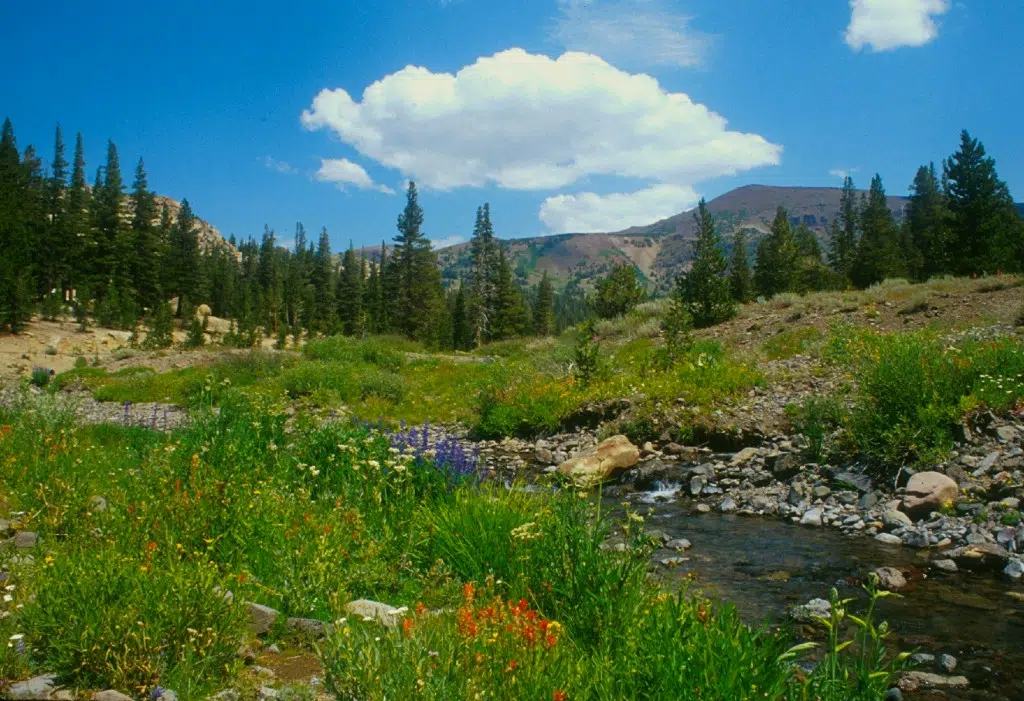
Meadow and woodlands in Tuolumne County, one of the two rural counties where Golden State Natural Resources proposes to build a wood pellet production facility. Credit: Malcolm Manners(CC BY 2.0 DEED)
Plans by biomass giant Drax to manufacture wood pellets sourced from Californian forests will endanger natural habitats and increase toxic air pollution for rural communities, campaigners warn.
The British energy company has partnered with Golden State Natural Resources, a government-linked nonprofit which plans to build two industrial plants in rural California counties that would produce one million tonnes of compressed wood fiber pellets a year.
One plant would be in Tuolumne County in the foothills of the Sierra Nevada Mountains, and the other in Lassen County in the state’s far northeast. From there, pellets would be shipped by rail to the city of Stockton, exported internationally, and burnt as biomass fuel to create electricity.
At its board meeting last Wednesday, Golden State Natural Resources ratified a Memorandum of Understanding (MOU) with Drax.
The agreement comes as a BBC investigation revealed that Drax was burning rare forest wood in the Canadian province of British Columbia.
BBC Panorama found that in 2023 the company took more than 40,000 tonnes of wood from so-called “old-growth” forests in B.C. Following the investigation, the company issued a statement expressing confidence that its “biomass is sustainable and legally harvested.”
Drax already operates 18 wood pellet plants across the U.S. and Canada, but the MOU finalized on February 28 is the most concrete indication yet of Drax’s ambition to expand into California, a state with 33 million acres of forest.
The wood pellets Drax produces are treated as “carbon neutral” under international accounting rules, based on an assumption that new-growth trees will capture the carbon lost by wood burnt for electricity. But scientists and campaigners have long disputed these claims.
A 2021 study from the European Academies Science Advisory Council concluded that burning wood for energy “is not effective in mitigating climate change and may even increase the risk of dangerous climate change.” A power station operated by Drax in the UK generates 8 percent of the UK’s “renewable” electricity, but is also the single largest emitter of carbon dioxide.
Golden State Natural Resources claims its forest management techniques reduce the risk of wildfires — a claim which has also been disputed by campaigners — and that it maintains “stringent guardrails” to ensure the sourcing of materials for pellets is sustainable. Drax also says its pellets are made from “sustainable biomass” generated from low-grade roundwood, sawmill residues, and forest residues — although several investigations have found instances of the company using primary forest materials.
The plan calls for sourcing wood from areas that encompass eight National Forests, and activists in California have raised concerns that the production of this “renewable” power could endanger vital biodiversity in the forests, home to California’s endangered gray wolves. They are also concerned that the facilities could harm local communities, some of which face high health burdens.
A January 2024 study by the journal Renewable Energy found that thousands of tons of toxic air pollutants, from nitrogen oxide to volatile organic compounds, are emitted in the pellet-making process, especially in the southeastern United States where most pellet plants are located.
Rita Frost, a forests advocate from environmental nonprofit Natural Resources Defense Council (NRDC), said the project would “diminish our forests’ ability to contribute to the fight against climate change, increase carbon emissions during a critical juncture when we must be reducing them instead, and compound health harms in vulnerable communities.”
‘Trojan Horse’
Golden State Natural Resources is a nonprofit co-founded by a state agency and a service organization that represents California’s rural counties. A document on the group’s website describes its purpose as “to build wildfire and forest resilience in the state and spur economic opportunities in rural communities.”
The MOU between Drax and the Californian nonprofit echoes those goals, stating that the companies should “work collaboratively and in good faith” to identify “potential sustainable vegetation management projects on forest land that meet the dual goals of promoting forest resilience and producing sustainable biomass fuel.”
GSNR says its proposed project would source pellet materials from a mixture of native forests undisturbed by human activity, and forests that have been subjected to logging cycles but allowed to regenerate, as well as privately managed timberland.
On its “Frequently Asked Questions” page, GSNR claims that its removal of accumulated fuel will help California’s forests burn “with less frequency and less intensity over the long term.”
A quarter of California — more than 25 million acres — is classified as under very high or extreme fire threat, with over 25 percent of the state’s population living in these high fire-risk areas. The counties where GSNR plans to cite its facilities have small populations but are no strangers to fire; the second-largest fire in state history, which covered nearly one million acres, burned partially in Lassen County.
But the practice of removing trees or thinning forests to reduce fire danger is controversial, and some experts say it can actually increase the severity of fires.
Michelle Connolly, an ecologist and director of Conservation North, says GSNR is justifying its activity by using “scientific-sounding language to make it seem like they know what they’re doing.”
“Logging and road building in any kind of primary forests is associated with increasing fire risk,” she said.
“Fire is the latest Trojan Horse for industry to get into natural forests they otherwise might not get to violate. Pellets originating from primary forest are not sustainable in any way, shape or form.”
Megan Fiske, a wildlife biologist at the Central Sierra Environmental Resource Center and a Tuolumne County resident, also has concerns over the impact of the clearance on forest health and natural habitats.
Each facility would source wood from a 100-mile radius, an area that includes eight National Forests and a major biodiversity hotspot. Dozens of endangered or threatened species take refuge in these zones — including California’s fledgling population of gray wolves, which were threatened with extinction and have only recently returned to the state.
“We need to restore the forest ecosystem and its natural processes,” Fiske told DeSmog.
“Removing the nutrients and other benefits imparted by ‘biomass’ does not restore the forest ecosystem or its natural processes, which provide tremendous ecosystem services.”
Environmental Pollution
The number of industrial wood pellet mills has risen rapidly in the U.S. and Canada to meet a rising demand for biomass-fuelled energy in Europe and Asia.
The two production plants planned for California are located in former timber industrial areas in rural counties, where drought and other extreme weather events associated with rising temperatures from climate change compound existing health inequalities.
Tuolumne County, which is home to part of Yosemite National Park, has a higher-than-average pollution burden, high rates of asthma and cardiovascular disease, and a high poverty rate, according to data in CalEnviroScreen 4.0 Indicator Maps.
Residents in Lassen have similar health outcomes to the state average, but on average die earlier than their neighbors.
The mapping tool CalEnviroScreen shows that the communities living around the port of Stockton, where the pellets will be shipped from, are some of the most disadvantaged in the state, based on factors including poor air quality, low income, and poor health indicators.
Though subject to environmental regulations, the production of pellets can release vast amounts of sawdust and other harmful particulates that impact air quality.
In May 2023, The Guardian reported a U.S. plant supplying wood pellets to Drax had violated air pollution limits in Mississippi. A September 2022 investigation by Unearthed found Drax was driving “environmental racism” after air pollution claims in the southeastern United States. Drax paid out $3.2 million to settle.
“These are not the kinds of jobs that our rural communities deserve. They are low wage positions and extremely dangerous working conditions.” – Nick Joslin
Nick Joslin, forest and watershed watch program manager at the Mount Shasta Bioregional Ecology Center, resides in Siskiyou County, an area where wood would be sourced and then transported by truck to the pellet mill in the Lassen County town of Nubieber.
“Siting a facility of this size in a small town is completely irresponsible,” he said.
“There are no services and no housing. Where would any newly employed people live? Where would they receive basic services or send their kids to school? The facility would run 24 hours a day with noise, lighting, dust, and noxious fumes.”
Golden State Natural Resources has also said the project will create 128 full-time jobs once both sites are operational, but Joslin is skeptical that these will provide the economic opportunities the county needs.
“These are not the kinds of jobs that our rural communities deserve. They are low wage positions and extremely dangerous working conditions,” Joslin added.
Fiske, of Tuolumne County, says the counties of the Sierra Nevada once exploited by the gold, timber, and water industries are now being hit by the latest cycle of commercial-scale resource extraction.
“We must keep the rivers clean and healthy, we must keep the forests from emitting too much wildfire smoke. All while the logging trucks and water trucks deteriorate our local roads and slow and impede traffic. All while employees are imported from elsewhere to take the temporary, barely living wage jobs.”
‘False Solutions’
As a “renewable” energy provider, Drax has benefited from billions of pounds in subsidies from the UK government. The thinktank Ember has estimated it will have collected more than £11 billion between 2012 and 2027, when the support runs out.
The company is now looking to gain an estimated £31.7 billion in additional subsidies for the controversial technology of bioenergy, carbon capture and storage (BECCS) — where emissions from burning organic matter are captured and buried underground.
Advocates promote this as a “carbon negative” climate solution, but experts and campaigners have argued that BECCS is technically unproven, and that the practice poses risks for biodiversity, land, and food security.
The UK government this year approved two new carbon capture units at Drax’s Yorkshire power station, while Drax is looking to roll out the technology to other countries — among them the U.S.
DeSmog reported in 2022 that Drax had lobbied California’s government to build a BECCS plant in the state, describing it as an “ideal location.” A UK government consultation on Drax’s future subsidies closed on Thursday (February 29), with a decision expected in April.
Campaigners say both the burning of biomass, and the attempted capture of its emissions, is deeply flawed.
“For California, there’s no time to waste on false solutions like this,” Rita Frost of NRDC told DeSmog.
“Any climate plan that relies on BECCS development with Drax is extremely high risk. Funds should instead be directed to wind and solar energy, which are not only low-cost and low-risk, but actually help fight the climate crisis.”
Drax and Golden State Natural Resources did not respond by publication time to specific questions submitted.