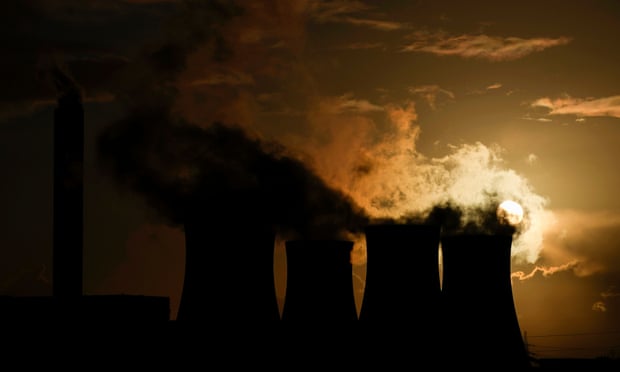
PROTESTERS descended on Westminster today to demand that the government stop using taxpayers’ money to bankroll the destruction of forests.
More than 100 environmental activists from groups including Axe Drax, Fossil Free London and Greenpeace gathered outside the Department of Energy Security and Net Zero, calling for an end to the vast subsidies granted to the Drax biomass power plant.
The North Yorkshire plant is Britain’s largest carbon emitter, yet receives almost £1.5 million a day for burning biomass wood chips, a fuel source that Drax claims is “carbon neutral.”
As part of the action, a choir celebrated Christmas trees in song and handed out origami trees to civil servants entering the building.
Four people dressed as tree-like creatures representing the millions of trees burned by Drax presented the department with a Greenpeace petition, bearing the signatures of over 120,000 people, calling for an end to the subsidies.
The power plant burned six million tonnes of wood pellets last year, equivalent to about half a billion Christmas trees.
In February, a BBC Panorama investigation revealed that Drax had continued to burn wood from rare primary forests in Canada, after the programme first made the discovery two years ago.
The plant was then forced to pay £25 million to Ofgem for failing to provide adequate data on the type of wood it sources.
Drax power plant in Yorkshire. Credit: A.P.S. (UK) / Alamy Stock Photo
Scope of corporate influence underscores concerns the technology will be used to prolong demand for planet-heating natural gas.
This story is the third part of a DeSmog series on carbon capture and was developed with the support of Journalismfund Europeand published in partnership with the Guardian.
The UK government’s move to award £22 billion in subsidies to carbon capture projects followed a sharp increase in lobbying by the fossil fuel industry, DeSmog can reveal.
Oil and gas giants such as Equinor, BP, and ExxonMobil attended 24 out of 44 external ministerial meetings to discuss carbon capture and storage (CCS) in 2023, according to official transparency records.
That represented a surge in activity relative to 2020-2022, when ministers held about half as many meetings to discuss the technology, and oil and gas companies would attend seven to 10 of these discussions each year.
Meeting notes obtained via freedom of information requests showed how oil executives were involved in shaping policy, and used their access to underscore the need to continue developing oil and gas.
During a call in December with three Equinor executives, one of the company’s team told Jeremy Allen, then director of the Department for Energy Security and Net Zero, that Equinor “appreciate[s] the…collaborative approach to policy development.”
An executive from ExxonMobil’s Low Carbon Solutions division “spoke of the outstanding need for oil and gas, at the same time as needing to lower emissions” in a meeting with then energy minister Graham Stuart in March last year at the CERAWeek oil trade show in Houston.
The growing engagement by oil and gas companies has sharpened concerns among climate advocates that industry is skewing the UK’s carbon capture strategy to justify building new gas-fired power plants — prolonging demand for natural gas, a source of planet-heating carbon dioxide (CO2) and methane emissions.
“Fossil fuel companies often have the engineering know-how to build these projects, so the government naturally has to meet with them,” said Laurie Laybourn, environmental policy researcher and associate fellow at the Institute for Public Policy Research think tank. “But that might create a risk whereby these companies unduly influence policy and roll-out in a way that benefits them.”
Others engaging regularly with ministers on CCS policy include heavy manufacturing companies, CCS technology firms, lobby groups, and investment funds.
Researchers, climate groups, and local councils were less well represented, the transparency records showed. No individual organisation from these sectors has attended more than three meetings with ministers on carbon capture since the start of 2020.
Meanwhile, lobby group the Carbon Capture and Storage Association (CCSA) — which represents dozens of fossil fuel companies — attended 20 meetings, and Equinor 16. BP, ExxonMobil, Scottish power company SSE, and Drax, a biomass power plant and the UK’s biggest CO2 emitter, also attended nine meetings each during the same period.
‘Wrong Pathway’
The new Labour government announced plans last week to extend £22 billion in subsidies for carbon capture over 25 years, saying the strategy can help meet climate goals and support a broader revitalization of British industry.
The policy builds on the previous Conservative administration’s plans to establish four CCS “clusters,” where carbon capture would be used to trap some of the CO2 emitted by fossil-fuel burning factories and power plants. Pipelines would then carry the captured gas underground to be stored in depleted oil and gas reservoirs under the North and Irish Seas.
The government’s plans include backing proposals by Equinor and BP — two of the companies that have met most frequently with ministers since January 2020 — to build new “low-carbon” gas-fired power stations fitted with carbon capture units, which are slated to be among the first to receive state support.
A group of scientists and campaigners warned last month that such projects would allow the companies to continue extracting and burning natural gas based on the promises of unproven and expensive carbon capture technology — at the taxpayer’s expense.
“Putting the UK on the wrong pathway could be catastrophic,” said the letter, addressed to Secretary of State for Energy Security and Net Zero Ed Miliband.
Carbon Tracker, a financial think tank, warned in a March report that building new gas-fired power plants “could lock consumers into a high-cost and fossil-based future” and urged the UK to focus on deploying carbon capture in hard-to-decarbonise sectors such as cement.
“These ‘low-carbon’ gas projects are not really low carbon if you look at the whole supply chain,” said the report’s author Lorenzo Sani, referring to the large amount of natural gas, which is mostly comprised of the potent greenhouse gas methane, that leaks during the extraction and transport of the fuel.
“They also continue this paradigm that we have today of linking our economies with fossil fuels, whose markets are volatile and often controlled by external actors to the UK,” Sani added.
‘Struggle to Keep Investors Upbeat‘
The Intergovernmental Panel on Climate Change and International Energy Agency envisage significant deployments of carbon capture for reaching net zero emissions by mid-century.
However, many environmental groups are sceptical. Researchers point to the frequent failure of projects to meet carbon capture targets, cost-overruns, the need for multi-billion dollar subsidies, and the tendency of the oil and gas industry to use the technology to justify investments in new fossil fuel projects — rather than focus on cleaning up existing dirty industries.
The surge in lobbying by companies seeking public money coincided with the previous Conservative administration’s pledge of £20 billion in subsidies for carbon capture projects in March 2023.
Three months after that funding was announced, lobby group the CCSA told ministers its members were concerned about delays and there was a “struggle to keep investors upbeat”, according to meeting notes.
The CCSA has attended more government carbon capture meetings (20) than any other organisation since January 2020, including two meetings between January and March 2024, the latest period for which records are available.
The organisation had a presence at both this and last year’s Labour party conferences. The CCSA’s Head of Communications Joe Butler-Trewin has held various organising and research roles within the party, while CEO Ruth Herbert worked as a civil servant under Miliband, when he was Secretary of State for Energy and Climate Change from 2008 to 2010. Miliband was a guest speaker at the CCSA’s annual meeting last year.
Now Secretary of State for Energy Security and Net Zero, Miliband and the new Labour government announced plans last week to extend £22 billion in subsidies for carbon capture over 25 years, saying the strategy can help meet the country’s climate targets and support a broader revitalization of British industry.
When asked to comment on concerns that their CCS projects may “lock in” fossil fuel dependency, BP and Equinor gave almost identical statements, saying that CCS is essential for the UK’s transition to net zero and will create jobs.
The Department for Energy Security and Net Zero said CCS will play a “vital role” in its plans for a clean energy system by 2030. The department also pointed to independent government advisor the Climate Change Committee’s description of carbon capture as a “necessity, not an option”.
The CCSA did not respond to requests for comment.
‘Outstanding Need for Oil and Gas’
Two meetings with ExxonMobil designated for the discussion of “carbon solutions” were used by both the company and then senior Department for Energy Security and Net Zero minister Graham Stuart to reaffirm the need for continued oil and gas production in the UK, meeting notes show.
On March 8, 2023, Stuart met with at least one executive from ExxonMobil’s Low Carbon Solutions division at the CERAWeek oil trade show. Representatives from the North Sea Transition Authority regulator and the Department for Business and Trade were also present.
According to notes from the meeting, the ExxonMobil executive “spoke of the outstanding need for oil and gas, at the same time as needing to lower emissions.”
Just over three months later, on June 15, Stuart met with representatives from ExxonMobil again to “discuss carbon solutions”.
However, after discussing ExxonMobil’s CCS capabilities, Stuart then told attendees “that the UK government has championed the need for new oil and gas licenses.” An ExxonMobil executive replied that “this was important in attracting new investment.”
Later in the meeting, minutes show that Stuart “reiterated that the Government supports the continued development of oil and gas resources on the UKCS [UK Continental Shelf].”
Four months later, the then Conservative government announced it was granting hundreds of new oil and gas licences in the North Sea.
‘Easily Spun‘
In the March 2023 meeting, ExxonMobil touted the success of carbon capture projects in the United States that had been used to pump more oil using “enhanced oil recovery” — where CO2 is injected into the ground to extract hard-to-reach oil and gas.
Meeting notes show an ExxonMobil executive told Stuart that the company had “captured 40% of all the CO2 that has ever been captured”.
The ExxonMobil employee’s statement appeared to refer to the approximately 120 million tonnes of CO2 captured by its Shute Creek gas-processing plant in Wyoming, which opened in 1986 and often features in ExxonMobil’s promotional materials.
However, 47 percent of the CO2 captured over Shute Creek’s lifetime had been sold for enhanced oil recovery, according to a 2022 study by U.S.-based think tank the Institute for Energy Economics and Financial Analysis. Another 50 percent of the gas was vented back into the atmosphere when it couldn’t be sold. Just three percent was stored.
The meeting notes did not record any discussion of these caveats.
“CCS is technically complex and difficult for anyone but industry experts to fully understand,” said Lindsey Gulden, a former ExxonMobil climate and data scientist. “That means it can be easily spun to give cover to the oil industry as they attempt to navigate the growing public concern over climate change.”
ExxonMobil did not respond to a request for comment.
dizzy: A new government was elected 4 July 2024 while the lobbying will mostly have been with the previous Tory government. It follows that our current government has accepted and progressed with the previous government’s decisions. Is it fair to accuse them of simply rubber-stamping the previous government’s decisions?
Experienced climbers scale a rock face near the historic Dumbarton castle in Glasgow, releasing a banner that reads “Climate on a Cliff Edge.” One activist, dressed as a globe, symbolically looms near the edge, while another plays the bagpipes on the shores below. | Photo courtesy of Extinction Rebellion and Mark Richards
The Drax power station in Selby, England. The site was one of the UK’s worst methane hotposts. Photograph: Christopher Furlong/Getty Images
Greenpeace urges Labour to ‘fulfil international obligations’ as critics question accuracy of official data
…
The Guardian and Watershed Investigations analysed official methane emissions data from the National Atmospheric Emissions Inventory (NAEI) along with information on the Watershed pollution map to identify Britain’s methane hotspots.
Top of the list was a site near Glynneath in Wales, home to the Aberpergwm colliery, the UK’s last coalmine. Next was Selby, the location of industry including Drax power station, as well as a number of old landfills and farmland. The top 10 also includes power stations, oilwells and Slough trading estate, home to a wide range of industry.
…
Greenpeace’s chief scientist and policy director, Dr Doug Parr, said: “These alarming findings highlight that, despite the UK joining a global pledge to reduce methane emissions by nearly a third by 2030, a proper British action plan has yet to materialise.
“Given its potency, and the fact that it is in fact a short-lived greenhouse gas, reducing methane emissions could help rapidly slow the warming that is creating the climate crisis.
“The new government must fulfil the UK’s international promises, and has the opportunity to come up with an exemplary, internationally leading plan for tackling methane from both the energy and farming sectors.”
Labour leader, Keir Starmer, addresses delegates at the 2022 Labour Party conference in Liverpool. Credit: Karl Black/Alamy
Campaigners have accused the party of allowing “climate wreckers” to access its flagship annual conference.
This year’s Labour Party conference will feature events sponsored by an oil and gas trade group, the owner of the UK’s largest emitting power plant, and a gas distribution company, DeSmog can reveal.
The conference, which is being held from 22 to 25 September in Liverpool, is one of the largest political gatherings in Europe and will feature set piece speeches from Labour’s newly-elected Cabinet ministers.
Although the full conference agenda is yet to be released, the New Statesman magazine has published a list of firms that will be sponsoring its panel events. These include the controversial energy company Drax, the fossil fuel lobby group Offshore Energies UK, and the gas company Cadent.
Labour, which has been in power for less than three months, has already unveiled an ambitious raft of policies to tackle climate change, including plans to decarbonise electricity by 2030, facilitated by a state-owned company GB Energy.
Robert Noyes, Fossil Free Parliament campaigner, told DeSmog that the New Statesman was “selling its readers short” by accepting sponsorship from polluting companies and their lobbyists.
He added that “Labour must not allow its energy programme to be further captured by corporate interests. It pollutes our politics and dilutes their agenda… Climate wrecking sponsors have got to go.”
Labour’s annual conference hosts dozens of fringe events organised by external groups, which tend to feature a panel of speakers – including a representative from the corporate sponsor. All the events hosted within the official conference zone are reviewed and approved by the party.
“No other partnered event will get you as close to the biggest names and most important conversations in Labour politics,” the New Statesman says about its 2024 agenda.
The party faced protests at its conference in 2022, when the New Statesman hosted a debate on Britain’s net zero climate goals sponsored by Drax. The firm’s plant in Selby, Yorkshire, which burns wood pellets to generate electricity, is the single biggest source of carbon dioxide emissions in the country according to the climate think tank Ember. Drax disputes this claim.
Drax has received state subsidies worth more than £7 billion since 2012, and the government is currently considering whether to extend this financial assistance to 2027 so the firm can build facilities to capture and store carbon emissions.
The Labour Party accepted a £12,000 donation from Drax in September 2022, while the company has frequently sponsored events at both Conservative and Labour conferences.
The New Statesman is one of a number of major media companies to have come under fire for boosting the profiles of polluting companies through commercial partnerships. An investigation by DeSmog and Drilled previously revealed that many of the world’s most trusted English-language news outlets regularly promote the fossil fuel industry’s narratives on climate-related topics.
In May, former Green Party MP Caroline Lucas pulled out of the New Statesman’s energy and climate change conference over its sponsorship by the oil company Equinor. Days later, Labour MP Alex Sobel, who chairs the All-Party Parliamentary Group on Net Zero, also withdrew from a Politico energy and climate summit due to its Equinor sponsorship.
Drax, Cadent, OEUK, the New Statesman, and the Labour Party were approached for comment.
Drax
A number of investigations have shown that Drax harvests wood from some of the world’s most precious forests.
In August, the firm agreed to pay £25 million following an investigation from the energy watchdog Ofgem found that Drax had failed to supply enough evidence about the type of wood that it imports.
Drax says that its electricity is “carbon neutral” given that trees can be planted to reabsorb emissions – a claim that has been disputed by climate experts. More than 500 scientists signed a letter in 2021 stating that it would take decades for the carbon emitted by burning wood to be balanced with the planting of new trees.
The New Statesman published a sponsored article from Drax in May, written by the executive in charge of the firm’s bioenergy with carbon capture and storage (BECCS) project, claiming that it will “make a sizable contribution to the UK’s climate change targets”.
Almost all of the net zero emissions pathways modelled by the UN-backed Intergovernmental Panel on Climate Change (IPCC) and the International Energy Agency envision huge deployments of CCS technology by the middle of the century.
However, as DeSmog has shown, most large-scale CCS projects underperform or fail to meet their capture targets. As the November 2023 Production Gap Report, produced by climate experts, pointed out: “the track record for CCS has been very poor to date, with around 80 percent of pilot projects over the last 30 years ending in failure.”
Sally Clark from the campaign group Biofuelwatch said it’s “deeply concerning” that Drax is set to sponsor a fringe event at the Labour conference.
“Events like these give Drax the opportunity to influence decision-makers and greenwash its planet-wrecking tree burning at a time when the government is considering whether to grant huge new subsidies to continue funding Drax’s harm to forests, wildlife, communities and the climate,” she added.
“If we are to prevent the worst impacts of climate breakdown, we need to kick big polluters like Drax out of our politics and instead invest in real climate solutions, such as wind and solar power, and protect the world’s best carbon-storing technology – trees.”
OEUK
Offshore Energies UK (OEUK) is set to join Drax as a sponsor of the New Statesman’s 2024 Labour conference agenda. OEUK is the “leading representative body” for the country’s oil and gas industry, while its members include some of the world’s largest fossil fuel companies, such as Shell, ExxonMobil, and Equinor.
The group lobbies the government, both in public and private, to enact policies that benefit oil and gas companies.
DeSmog previously revealed that OEUK and its members met with ministers over 200 times in the year after the 2022 Russian invasion of Ukraine as part of a lobbying blitz to undermine the proposed windfall tax on energy company profits. The tax was launched in 2022 but contained loopholes including tax relief on investments in UK fossil fuel extraction.
OEUK has vocally opposed Labour’s policy of extending the windfall tax from 75 percent to 78 percent until 2029, claiming that it could cost 42,000 jobs – a figure that has been disputed by experts.
The group’s CEO David Whitehouse even went so far as to accuse Labour of being unable to “do the maths” over its windfall tax plans. Labour has also said that it won’t be granting any new North Sea oil and gas licences – a policy that has likewise been criticised by OEUK.
This isn’t the first time that the New Statesman has accepted sponsorship from OEUK. The lobby group sponsored a Labour conference event in 2023 hosted by the magazine and attended by Sarah Jones, Labour’s then shadow minister for decarbonisation and industry (who now holds this role in government).
“Cash-strapped media are increasingly easy prey for climate wreckers eager to launder their reputations,” said Robert Noyes. “When outlets like the New Statesman take funding from such lobby groups like OEUK, they sell their readers to the interests of that lobby.”
Cadent
The UK’s biggest gas distribution network, Cadent, which provides fuel to 11 million homes and businesses, is also listed as a sponsor for the upcoming conference.
Gas boilers are used to heat around 85 percent of UK homes, which together produce 14 percent of the UK’s greenhouse gas emissions.
Cadent sponsored a New Statesman event at last year’s Labour conference, attended by the firm’s chief strategy and regulation officer, Tony Ballance.
In response to a question from DeSmog, Ballance advocated for the role of hydrogen in home heating, and claimed there was “limited” scientific evidence opposed to the deployment of the fuel.
The gas industry has championed hydrogen as a replacement for gas in heating, arguing that it can easily replace existing methane gas and can use existing pipelines to transport and store the fuel.
However, heat pumps are up to five times more efficient than gas boilers according to the International Energy Agency, and can be run on electricity generated via renewable energy sources. A peer-reviewed assessment of over 50 independent studies in 2024 concluded that hydrogen use in domestic heating is inefficient, costly and resource-intensive compared to other low-carbon options such as heat pumps.
It is possible to produce ‘green’ hydrogen using solar and wind, which is widely seen as an important way to decarbonise industrial processes where it is hard to avoid greenhouse gas emissions. However, the overwhelming majority of hydrogen – around 95 percent worldwide – is currently produced using fossil fuels.
Even so, the gas industry has cast doubt on heat pumps, while talking up the merits of hydrogen.
An investigation by DeSmog in July 2023 found that the Energy and Utilities Alliance (EUA), which represents the vast majority of the UK’s gas boiler manufacturers and distributors – including Cadent – had paid for an extensive negative PR campaign to “spark outrage” against heat pumps in the British press.
Cadent was one of two gas networks to win a government contract to trial hydrogen for home heating ahead of the government’s decision on the policy, expected in 2026. But plans for the village of Whitby in Cheshire were scrapped in July after a sustained local campaign, which raised concerns over the safety of hydrogen in homes.
Wind turbines at Loftsome Bridge, East Yorkshire, with Drax Power station in the distance
ACTIVISTS slammed the police today for diverting resources away from tackling racist riots and targeting peaceful climate protesters instead.
Protesters opposing Drax power station, Britain’s largest carbon emitter, were due to set up a protest camp today.
But police pre-emptively arrested 22 activists under public order offences, including conspiracy to interfere with key national infrastructure.
Police seized tents, toilets, a track for wheelchairs and other equipment to make the peaceful protest safe and accessible, organisers Reclaim the Power said.
The Silver Commander for the police operation, Supt Ed Haywood-Noble, admitted that police resources were “stretched nationally,” but still thought it was “essential” that the operation go ahead.
He claimed: “Policing is not anti-protest, we are anti-crime, and we are here to protect the public.”
The protest organisers hit back at the force for making the “unfathomable decision” to divert resources away from communities under attack in the racist violence sweeping Britain.
They accused the police of prioritising the arrest of peaceful protesters over “locating and arresting people who are actually organising far-right riots with bricks, knives and other weapons.”
I’m wondering why the police are seizing “tents, toilets, a track for wheelchairs and other equipment to make the peaceful protest safe and accessible”. Is that part of their job too?