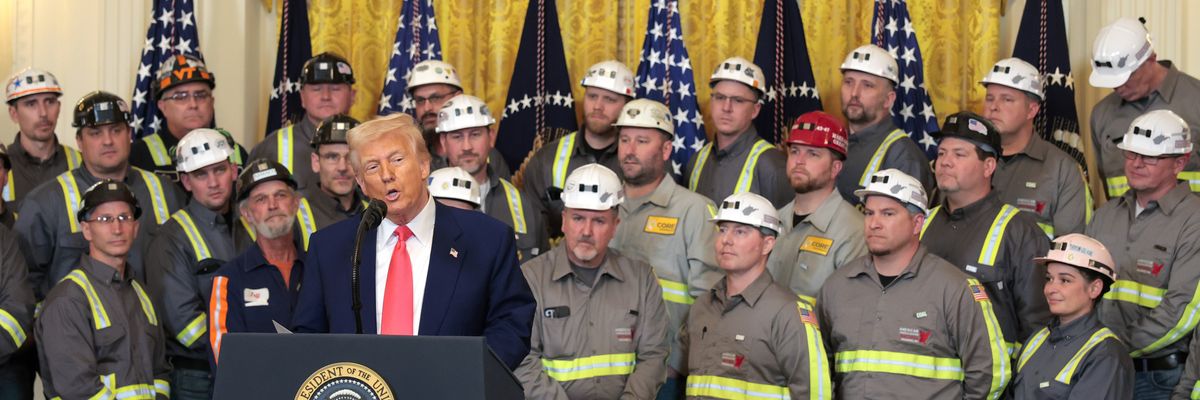
U.S. President Donald Trump speaks alongside coal and energy workers during an executive order signing ceremony in the East Room of the White House on April 8, 2025 in Washington, D.C. (Photo: Anna Moneymaker/Getty Images)
“Coal is a disaster for our health, our wallets, and the planet,” said one environmental lawyer.
U.S. President Donald Trump on Tuesday signed multiple executive orders that aim to boost the coal industry, a move that critics denounced as “reckless” and “breathlessly stupid” even before the orders were officially unveiled.
Among the orders signed Tuesday, Trump directed U.S. Secretary of the Interior Doug Burgum to acknowledge the end of a moratorium that had halted new coal leasing on public lands and to prioritize coal leasing and related activities, and also directed U.S. Secretary of Energy Chris Wright to determine whether coal used in steel production can be considered a “critical material.” According to Reuters, permitting this classification would pave the way for the administration to use emergency powers to boost production.
Trump also paused environmental regulation imposed under former President Joe Biden that applied to certain coal-burning power plants thereby purportedly “safeguarding the nation’s energy grid and security, and saving coal plants from closure.”
Additionally, one order directed the “Energy Department to develop a process for using emergency powers to prevent unprofitable coal plants from shutting down in order to avert power outages,” according to The New York Times, a move that may face court challenges.
Jill Tauber, vice president of litigation for climate and energy at the green group Earthjustice, said Tuesday: “Coal is a disaster for our health, our wallets, and the planet. President Trump’s efforts to rescue failing coal plants and open our lands to destructive mining is another in a series of actions that sacrifices American lives for fossil fuel industry profit. Instead of investing in pollution, we should be leading the way on clean energy.”
“The only way to prop up coal is to deny reality, and the reality is that people no longer rely on coal because it’s expensive, unreliable, and devastating to public health,” said Julie McNamara, an associate policy director with the Union of Concerned Scientists, in a statement on Tuesday.
“Instead of supporting the economy-boosting clean energy transition that maintains widespread public support across the country, President Trump is relentlessly attempting to tear it down.”
Trump has vowed to support what he calls “beautiful, clean coal,” though the industry has been in decline for years. Coal-fired electricity generation has dropped from 38.5% of the country’s generation mix in 2014 to 14.7% in 2024, according to a 2025 factbook from BloombergNEF and the Business Council for Sustainable Energy. Coal is also the dirtiest fossil fuel.
The executive order builds on previous moves by the Trump administration. Last month, Environmental Protection Agency Administrator Lee Zeldin announced an effort to rollback a host of EPA regulations, including some that will impact coal producers.
On the first day of his second term, Trump declared a “national energy emergency” intended to help deliver on his campaign pledge to “drill, baby, drill.” That emergency defined energy to include oil, natural gas, uranium, coal, biofuels, geothermal, flowing water, and critical minerals—but it omitted solar and wind.
Reporting earlier Tuesday indicated that Trump would sign an order invoking presidential emergency authority to force coal-fired power plants to stay open.
In a statement released in response to that reporting, Tyson Slocum, energy program director at the watchdog Public Citizen, said: “Reviving or extending coal to power data centers would force working families to subsidize polluting coal on behalf of Big Tech billionaires and despoil our nation’s public lands.”
“Coal kills. In the last two decades, nearly half a million Americans have died from exposure to coal pollution,” said Ben Jealous, executive director of the environmental organization the Sierra Club in a statement on earlier on Tuesday, also in response to reports that executive orders were forthcoming.
In another move that generated swift criticism, Trump signed an executive order on Tuesday directing U.S. Attorney General Pam Bondi to investigate state policies that are aimed at confronting the climate crisis and to take action to stop enforcement of those laws.
According to The Washington Post, it is unclear what authority would the agency would rely on. The order specifically calls out state climate superfund laws in New York and Vermont.
“President Trump’s executive order weaponizes the Justice Department against states that dare to make polluters pay for climate damage,” said Cassidy DiPaola, communications director of Make Polluters Pay—a campaign to build public support for climate litigation—in a statement on Wednesday.
“This is the fossil fuel industry’s desperation on full display—they’re so afraid of facing evidence of their deception in court that they’ve convinced the president to launch a federal assault on state sovereignty. We are watching corporate capture of government unfold in real time,” DiPaola added.
Power-mad orange gasbag Donald Trump says Burn, Baby, Burn.Elon Musk urges you to be a Fascist like him, says that you can ignore facts and reality then.Orcas discuss how Trump was re-elected and him being an insane, xenophobic Fascist.
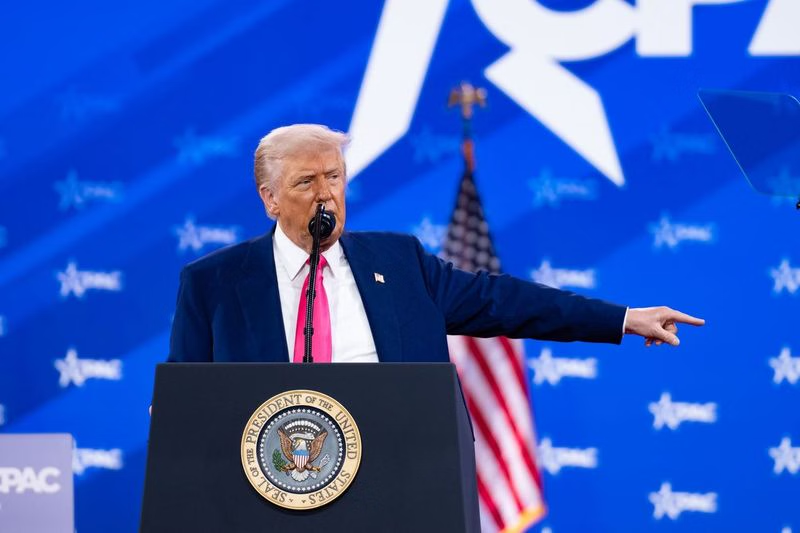
Trump boasted about withdrawing from the “one-sided” Paris Agreement, saying, “It was a disaster.” Credit: Zach D. Roberts
Conservative conference featured global right-wing speakers from Liz Truss to JD Vance calling for an end to climate protections.
Just a month into President Donald Trump’s chaotic administration, American and international conservatives swooped into the 2025 Conservative Political Action Conference (CPAC) outside Washington, D.C., in mid-February, and took a knee to the president, non-elected billionaire Elon Musk, and their fossil fuel deregulation agenda.
After numerous speeches heralding the MAGA movement by major figures on the right, including Vice President JD Vance, DOGE chief Elon Musk, ex-Trump aide Steve Bannon, and Speaker of the House Republican Mike Johnson, on the last day of the four-day event, Trump himself spoke to the faithful. Basking in chants of “USA, USA,” Trump boasted about withdrawing from the “one-sided” Paris Agreement, saying, “It was a disaster, it was a disaster.”
“I terminated the Green New Scam,” he went on, referring to the Green New Deal, which was never enacted or proposed as an actual bill. “One of the greatest hoaxes ever played on this country is the Green New Scam. We spent trillions of dollars on this nonsense … It really set back our country.”
In a rambling speech bereft of solid policy or facts, Trump also said he “canceled Joe Biden’s insane electric vehicle mandate, where everybody has to have an electric,” again referring to non-existent legislation. Biden did not mandate people to switch to electric cars; he had progressively stricter pollution standards.
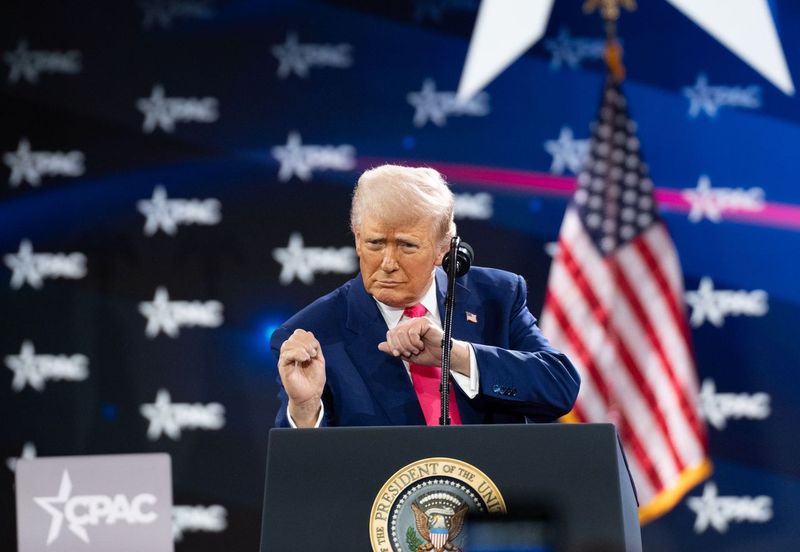
Trump’s final reference to the environment in his speech was that “people can buy any type of car they want, except for hydrogen. The only thing you can’t do is buy a hydrogen-powered car. You know why? They said it really works great, but when it doesn’t work, you never find a body. It’s a bet that’s a bad sign.” As of this publication date, no one has been disintegrated by a hydrogen car explosion. He then ended with his signature dance as the Village People’s “YMCA” blared over the loudspeakers.
Trump dances to the song, “YMCA” at CPAC 2025. Credit: Zach D. Roberts
Trump’s references to fake climate policy was emblematic of this year’s CPAC discussions on the environment. In past years, the conference’s environmental speakers were more “scientific,” with conservative climate denialists showing graphs and data to prove their theories that climate change seemingly does not exist. But with no breakout sessions this year, the gathering was all anti-climate talk and pro-MAGA with zero attempts at science.
Take former UK Prime Minister Liz Truss’s talk on Thursday, Feb. 20, the second day of CPAC. Truss, who had previously served as the UK’s environment secretary, expressed her anger that her move to end the ban on fracking in Great Britain was brought back in 2022 by her predecessor, Prime Minister Rishi Sunak.
Truss was famously only in office for 45 days. “Sadly, I wasn’t in office long enough to actually make [the fracking ban] happen,” she told the conference crowd.
“We have net-zero policies that have decimated our oil and gas industry,” she said. “The net result is we have the highest energy prices in the developed world. And in Britain, we’ve just seen the last steel plant close down last year. We cannot produce our own steel anymore.”
Former UK Prime Minister Liz Truss echoed Trump’s disdain for big government. Credit: Zach D. Roberts
The former Prime Minister, who spent much of her adult life in government, then repeated Trump’s disdain for the “deep state,” saying, “We want to dismantle the British deep state, which is older and more entrenched than the American one.”
“We need a great restoration bill to repeal all of the terrible laws, from the Equality Act to the Climate Change Act, the Human Rights Act to the Constitutional Reform Act,” she said. “We need to eradicate judicial activism in Britain and restore parliamentary sovereignty.”
CPAC has expanded its international influence and speakers over the last few years with annual South Korea and Hungary meetings. Leader of the Reform UK party Nigel Farage, who also attended, has spoken at the conference for many years, and is considered a bit of a celebrity here.
Wright Vows to Axe Regulations
On the first day of the conference, U.S. Energy Secretary Chris Wright’s speech pushed Trump’s “drill baby drill and build baby build” philosophy. The former fracking CEO of Liberty Energy promised that his and Trump’s other cabinet departments would be “working feverishly” to remove regulations to pave the way for higher energy production. He also emphasized removing restrictions the Biden Administration put on fossil fuel appliances like gas stoves.
Last year, gas stoves were the new “plastic straws” in the world of right-wing media as conservative news outlets claimed the Democratic administration was looking to ban them fully, which it was not.
U.S. Energy Secretary Chris Wright talked about the amount of energy needed for AI data centers. Credit: Zach D. Roberts
Economic competition with China has been a running theme through many of the speeches at CPAC for years. But now, with the massively successful launch of DeepSeek, finding energy for artificial intelligence operations is a priority. Wright’s speech emphasized the energy use that AI technology will demand and claimed that it will lead to “enormous benefits” in drug discovery and national security. “We want China to lead the way in AI? I would feel naked if their AI was better than ours,” he said.
AI and tech companies donated huge amounts to the Trump campaign, to the tune of tens of millions of dollars. That investment has paid off as the closure of the Consumer Financial Protection Bureau and Trump’s changes at the FTC and FCC to reign in their powers will benefit the tech world immensely. Trump has even rescinded Biden’s executive order warning people about AI.
Dunleavy’s Political Ambitions
One of Trump’s first executive orders demanded the nation “unleash Alaska’s extraordinary resource potential.”Environmental rights organization, EarthJustice replied, “While the Trump administration’s plans were made clear in the orders, it’s important to note that the vast bulk of the actions cannot be made unilaterally by the President without cooperation from government agencies, Congress, or other authorities.”
Running throughout CPAC on the big screens in the main ballroom amounted to campaign ads for Alaska Gov. Mike Dunleavy, who wants to leave his job in the 49th state. Called the “worst-kept-secret,” Dunleavy had been auditioning for a gig in the Trump administration, but now that that doesn’t seem to be happening, he’s likely looking at running for Senator against one of his fellow Republicans, Dan Sullivan, who is up for reelection in 2026, or Lisa Murkowski, who is up in 2028. The ad, which features Trump prominently, has the President speaking about how he will work with Dunleavy to provide “energy to Alaska and allies around the world.”
A campaign ad screened at CPAC for Republican Gov. Mike Dunleavy’s Senate campaign. Credit: Zach D. Roberts
From the CPAC stage, Gov. Dunleavy told the audience that Trump “sees us [Alaska] as a solution to many of America’s problems.” A $44 billion liquified natural gas pipeline project that both Trump and Dunleavy are pushing is oddly not planned to send energy to the lower 48, but to Asian customers. Japan has been trying to curry favor with Trump for access since that could help the nation diversify supplies away from riskier sources like Russia.
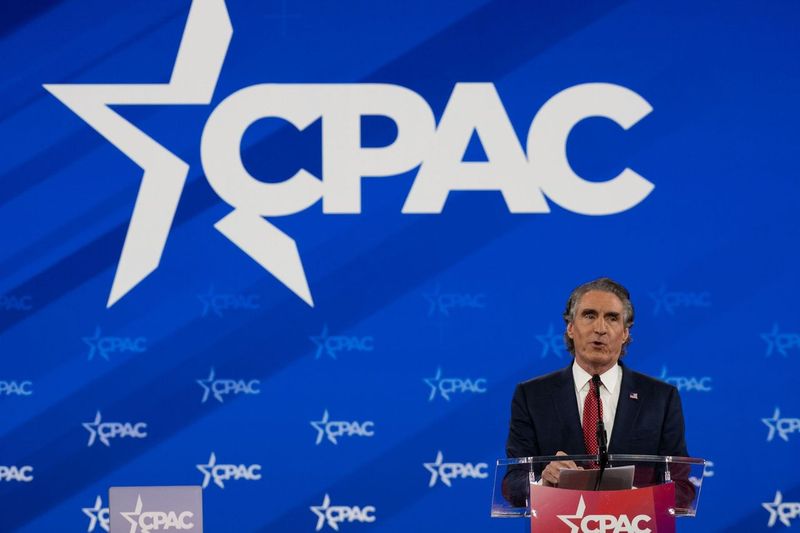
Secretary of the Interior Doug Burgum
President Trump has commanded the new Secretary of the Interior, Doug Burgum, to find new ways to exploit public lands. The goal, Burgum explained in his CPAC speech, is to “sell to our friends and allies.” He claims that doing so will “end our trade deficits” and “the wars abroad.” Ultimately, Burgum claims this work will set up President Trump to “win the Nobel Prize.”
Burgam, a billionaire former two-term governor of North Dakota and a software developer, has extensive ties to the oil and gas industry, including hundreds of thousands in investments. After a brief run for President in 2024, Burgam endorsed Trump.
Interior Secretary Doug Burgum aims to exploit public lands to “sell to our friends and allies.” Credit: Zach D. Roberts
Burgam will also chair the newly founded National Energy Dominance Council with Energy Secretary Chris Wright as vice chair. The council “will advise President Trump on strategies to achieve energy dominance by improving the processes for permitting, production, generation, distribution, regulation, and transportation across all forms of American energy.” It will also cut “red tape” through axing regulations.
CFACT Was the Lone Climate Group in Hall
Down in the exhibit hall, the tables that many years ago mainly saw small government groups were filled with culture warriors – groups opposed to abortion, trans rights, and other historically underrepresented communities. This year, the lone group in the hall focusing on climate was CFACT, Committee for a Constructive Tomorrow, a “conservative libertarian think tank.”
Nate Meyers, CFACT’s national field coordinator was clear on the group’s approach to the “science” of climate change –“It’s not settled at all,” he said. Meyers verbally added, “™”[trade mark]] as he said the words “climate change” when speaking to DeSmog.
https://www.youtube.com/embed/QKjLqdrm3N0?feature=oembedCFACT’s Nate Myers speaks with DeSmog. Credit: Zach D. Roberts
Collegians for a Constructive Tomorrow is CFACT’s college campus organization, which, according to Myers, has 32 campus groups. Like Charlie Kirk’s Turning Point USA, CFACT aims to capture the minds of young people, according to Myers., “College campuses are so totally captured by the left. Statistically, you’re more likely to be instructed by a Marxist than you are a Republican,” he said.
“That demonstrates a huge need for alternative viewpoints on college campuses,” he added. “And it’s kind of a cliche thing to say, but the children and young people are our future.”
When asked who funds CFACT, Myers mentioned small donations and occasional larger direct donations, emphasizing the grassroots nature of the organization. When DeSmogasked if they received backing from Koch Inc., like many similar climate-denying groups, Myers demurred, saying he wasn’t a fan of Koch.) In the past, CFACT has received large sums from Koch’s Donors Trust, along with all the other usual suspects of right-wing climate denying donors.
The study was published as President Donald Trump was blasted for an executive order that one critic said shows he wants to turn the Alaskan Arctic into the “the world’s largest gas station.”
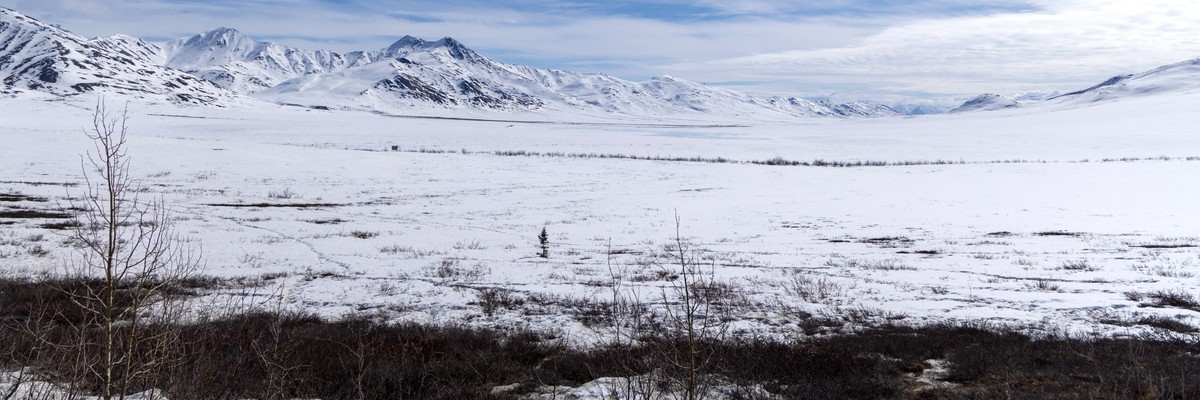
For thousands of years, the land areas of the Arctic have served as a “carbon sink,” storing potential carbon emissions in the permafrost. But according to a study published in the journal Nature Climate Change Tuesday, more than 34% of the Arctic is now a source of carbon to the atmosphere, as permafrost melts and the Arctic becomes greener.
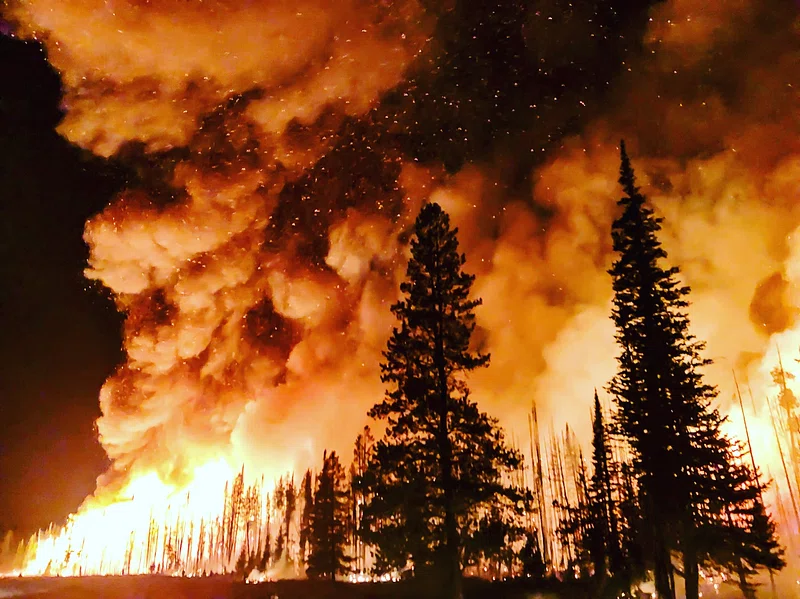
“When emissions from fire were added, the percentage grew to 40%,” according to the Woodwell Climate Research Center, which led the international team that conducted the research.
The study, which was first reported on by The Guardian, was released the day after President Donald Trump issued multiple presidential actions influencing the United States’ ability to confront the climate crisis, which is primarily caused by fossil fuel emissions, including one directly impacting resource extraction in Alaska, a section of which is within the Arctic Circle.
Sue Natali, one of the researchers who worked on the study published in Nature Climate Change, told NPR in December (in reference to similar research) that the Arctic’s warming “is not an issue of what party you support.”
“This is something that impacts everyone,” she said.
As the permafrost—ground that remains frozen for two or more years—holds less carbon, it releases CO2 into the atmosphere that could “considerably exacerbate climate change,” according to the study.
“There is a load of carbon in the Arctic soils. It’s close to half of the Earth’s soil carbon pool. That’s much more than there is in the atmosphere. There’s a huge potential reservoir that should ideally stay in the ground,” said Anna Virkkala, the lead author of the study, in an interview with The Guardian.
The dire warning was released on the heels of Trump’s executive order titled “Unleashing the Alaska’s Extraordinary Resource Potential” that calls for expedited “permitting and leasing of energy and natural resource projects in Alaska,” as well as for the prioritization of “development of Alaska’s liquefied natural gas (LNG) potential, including the sale and transportation of Alaskan LNG to other regions of the United States and allied nations within the Pacific region.”
The order also rolls back a number of Biden-era restrictions on drilling and extraction in Alaska, which included protecting areas within the Arctic National Wildlife Refuge from oil and gas leasing.
“Alaska is warming four times faster than the rest of the planet, a trend that is wreaking havoc on communities, ecosystems, fish, wildlife, and ways of life that depend on healthy lands and waters,” said Carole Holley, managing attorney for the Alaska Office of the environmental group Earthjustice, in a statement Monday.
“Earthjustice and its clients will not stand idly by while Trump once again forces a harmful industry-driven agenda on our state for political gain and the benefit of a wealthy few,” she added.
Trump wants to turn the Alaskan Arctic into the “the world’s largest gas station,” said Athan Manuel, director of Sierra Club’s Lands Protection Program, in a statement Monday. “Make no mistake, Trump’s rushed and sloppy actions today are an existential threat to these lands and waters, and the communities and wildlife that depend on them.”
“This vast lease sale—for millions of acres—poses threats to Gulf communities and endangered species while contributing to the climate crisis this region knows far too well,” said one advocate.
Calling the Biden administration’s plan to go ahead with an offshore drilling lease sale “mind-boggling” as the United States faces escalating climate harms including “record heat, fires, and flooding,” several advocacy groups filed a federal lawsuit Friday challenging the U.S. Interior Department’s impending sale of 67 million acres in the Gulf of Mexico to the fossil fuel industry.
Groups including the Center for Biological Diversity (CBD), Earthjustice, and Friends of the Earth (FOE) filed the lawsuit saying that in moving forward with Lease Sale 261—the last of three offshore lease sales mandated by the Inflation Reduction Act—the Interior Department did not sufficiently consider the environmental impacts on people and wildlife across Gulf communities.
“As steward of the country’s public lands and waters, Interior has a duty to fully consider the harms offshore leasing can cause, from air pollution to oil spills, and beyond,” said Julia Forgie, attorney for the Natural Resources Defense Council, one of the plaintiffs. “This vast lease sale—for millions of acres—poses threats to Gulf communities and endangered species while contributing to the climate crisis this region knows far too well. We are holding the agency to its obligation to carefully assess these risks and the climate fallout of this giveaway to Big Oil.”
“If we are going to make a dent in the climate crisis, business as usual must stop.”
A study published in May in Environmental Research showed that people living near offshore drilling rigs are at heightened risk for respiratory and cardiovascular issues as well as other serious illnesses, along with facing the rising threat of extreme weather due to fossil fuel emissions from such projects.
Lease Sale 261 could result in the production of more than 1 billion barrels of oil and 4 trillion cubic feet of fossil gas over the next 50 years, noted the groups, leading to more than 370 tons of greenhouse gases at a time when scientists and energy experts are warning that continued fossil fuel extraction is threatening the planet.
The sale is scheduled to be held on September 27, around the same time that the Interior Department is expected to release its proposal for a five-year offshore oil and gas leasing program.
That proposal could include as many as 11 new offshore lease sales “with the potential to emit up to 3.5 billion tons of carbon pollution,” said the groups.
The lawsuit filed on Friday accused the Bureau of Ocean Energy Management (BOEM) of presenting “an incomplete and misleading picture of oil spill impacts and risks based on flawed modeling that failed to properly consider reasonably foreseeable accidents” in its analysis of environmental impacts that could be caused by Lease Sale 261.
“The final SEIS [supplemental environmental impact statement] failed to take the required ‘hard look’ at the significant impacts of this action,” reads the lawsuit. “For example, the bureau did not rationally evaluate the impacts of greenhouse gas (GHG) emissions, relying instead on problematic modeling and assumptions to conclude that these massive lease sales will result in only slightly higher emissions than not leasing at all, and further failed to consider the impacts of such fossil fuel development on climate goals and commitments. With regard to environmental justice, the final SEIS arbitrarily dismissed the impacts of onshore oil and gas infrastructure—refineries, petrochemical plants, and other industrial sources that process fossil fuels and related products from these lease sales—on Gulf communities.”
The lawsuit was filed as thousands of people in Louisiana’s so-called “Cancer Alley” were ordered to evacuate due to a chemical leak and fire at a petroleum refinery.
Hallie Templeton, legal director for Friends of the Earth, said the group will “keep fighting until the Gulf of Mexico is off the table for good.”
“Unfortunately, given BOEM’s history of sacrificing the Gulf of Mexico to Big Oil, this lease sale decision comes as no surprise,” said Templeton. “Our lawsuit should also come as no surprise, since BOEM continues to rely on the same outdated, broken environmental analysis. If we are going to make a dent in the climate crisis, business as usual must stop.”