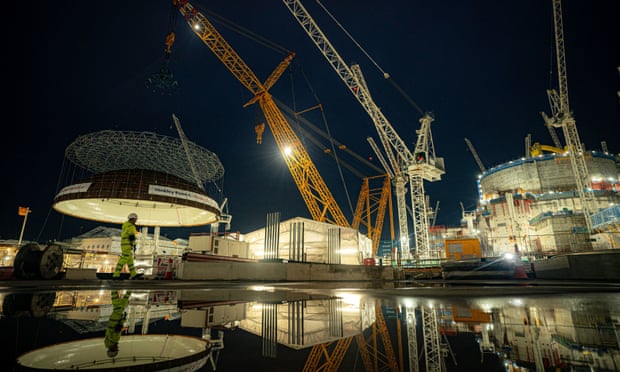
“Nuclear power is hugely expensive and far too slow to come on line. The only thing delivered by EDF so far at Hinkley Point in Somerset is overspend and delay. Electricity was promised by 2017 with a price tag of £22bn but this has mushroomed to 40bn and Hinkley is still producing no power.
“The money being spent on this nuclear gamble would be far better spent on insulating and retrofitting millions of homes, bringing down energy bills and keeping people warmer and more comfortable. We should also be investing in genuinely green power such as fitting millions of solar panels to roofs and in innovative technologies like tidal power. All this would create many more jobs than nuclear ever will.”
A host of parliamentarians were previously employed by agencies with fossil fuel clients.
At least 24 newly elected MPs used to work for public relations, consultancy and lobbying firms that have a history of representing oil and gas companies, DeSmog can reveal.
A DeSmog analysis of the MPs entering Parliament after the 2024 general election found that two dozen had a background working for oil and gas giants, coal power station conglomerates, as well as other highly polluting clients.
The findings have sparked concerns that fossil fuel interests in Parliament may influence policy-making.
“I entered politics after working as an engineer in the renewables industry exactly because I could see we had the technology to make the transition to clean and green energy, but we were lacking the political will to make it happen,” said Green Party co-leader and Bristol Central MP Carla Denyer.
“Part of what stops this transition from occurring is the embedded influence of the fossil fuels industry in politics.”
Labour’s new Ossett and Denby Dale MP Jade Botterill started working at lobbying firm Portland after her parliamentary candidacy was announced in September 2023. Portland’s clients include oil major BP, French energy firm EDF, Heathrow Airport, and Chinese state-owned oil company CNOOC. Another Labour MP – Laura Kyrke-Smith – worked for Portland several years ago. She told DeSmog that she didn’t represent any oil firms while working for the company.
Portland told DeSmog that they “do not comment on client relationships”.
At least three new Labour MPs – Oliver Ryan, Mary Creagh, and Steve Race – previously worked for Lexington Communications, a lobbying firm that works for oil giant Phillips 66, the International Airlines Group (IAG), and Eren Holding, a firm that runs coal-fired power stations in Turkey.
New Conservative MP for Bromsgrove Bradley Thomas spent at least five years working for Phillips 66, latterly as a strategy lead, before becoming an independent consultant to the sector.
Almost a third of Labour’s new MPs have a background working in communications and lobbying, according to the Sunday Times, a similar share to the Conservatives. Due to the UK’s limited transparency rules around lobbying, it’s often impossible to know whether these individuals worked on behalf of oil and gas clients.
However, we do know that several other major lobbying and consultancy firms with fossil fuel links – in addition to Lexington and Portland – used to employ a number of new MPs. These include:
Teneo (clients include BHP, Centrica, and EnQuest)
Four Communications emphasised that its work for the Oman Oil Company ended in 2019, though the firm also has offices in the petrostates United Arab Emirates, and Saudi Arabia.
In June 2024, United Nations Secretary-General António Guterres said that PR agencies had “aided and abetted” the fossil fuel industry, “acting as enablers to planetary destruction”. He called on these agencies to stop taking on new fossil fuel clients, and to set out plans to drop their existing ones.
“Fossil fuels are not only poisoning our planet – they’re toxic for your brand,” he said.
All the MPs named in this article were approached for comment.
Gas Lobbyists and Energy Consultants
Several new MPs have also worked for much smaller groups with links to the energy industry. This includes Labour’s new Cannock Chase MP Josh Newbury, who between 2019 and 2022 worked as senior parliamentary officer for the Energy and Utilities Alliance (EUA) – a trade group for the gas industry and fossil fuel boiler manufacturers.
DeSmog revealed in 2023 that the EUA, which is led by former Labour MP Mike Foster, was behind a barrage of negative press attacking heat pumps as a home heating source. Foster has repeatedly labelled pro-heat pump campaigners as a “green cult”.
New Liberal Democrat MP for St Neots and Mid Cambridgeshire Ian Sollom worked as the principal of StrategicFit, an energy sector strategic consultancy that has worked for the oil major ExxonMobil, and the Chinese state oil firm CNOOC.
Sollom told DeSmog that “as a scientist entering Parliament, I am committed to the phasing out of fossil fuels, and my previous career primarily focused on improving decision making and collaboration between energy companies, regulators and other stakeholders”.
Liberal Democrat MP for Cheltenham Max Wilkinson used to work for Camargue, which lobbied politicians in Westminster on behalf of the oil company Esso while he was employed by the firm.
A spokesperson for the Liberal Democrats stressed that Wilkinson did not work for any oil and gas clients.
Fossil fuel companies have extensive existing ties to Westminster politics. DeSmog revealed that, from the 2019 general election to the start of the 2024 election campaign, the Conservative Party received £8.4 million from oil and gas interests, climate science deniers, and polluting industries.
Meanwhile, a number of leading right-wing think tanks have received direct funding from the fossil fuel industry. Onward, which hosted the most government meetings of any think tank in 2023, receives funding from Shell and BP.
All the agencies named in this article were approached for comment.
As nuclear plant is hit by further delay, real cost will be far higher after inflation is included, as project uses 2015 prices
In 2007, the then EDF chief executive said that by Christmas in 2017, turkeys would be cooked using electricity generated from atomic power from Hinkley. Photograph: Ben Birchall/PA
The owner of Hinkley Point C has blamed inflation, Covid and Brexit as it announced the nuclear power plant project could be delayed by a further four years, and cost £2.3bn more.
The plant in Somerset, which has been under construction since 2016, is now expected to be finished by 2031 and cost up to £35bn, France’s EDF said. However, the cost will be far higher once inflation is taken into account, because EDF is using 2015 prices.
The latest in a series of setbacks represents a huge delay to the project’s initial timescale. In 2007, the then EDF chief executive Vincent de Rivaz said that by Christmas in 2017, turkeys would be cooked using electricity generated from atomic power at Hinkley. When the project was finally given the green light in 2016, its cost was estimated at £18bn.
…
However, the Hinkley Point C delay will add to concerns over project delays and costs, as well as skills in an industry earmarked to deliver a quarter of the national electricity demand by 2050.
comment by dizzy: This is not at all surprising. EDF were extremely late and over-budget with 2 nuclear power station of the same design as Hinkley C when it started.
Yet public ownership is opposed passionately by the Conservative government, while the leader of the opposition has said he is “not in favour” of it – despite his election on a platform that committed to “bring rail, mail, water and energy into public ownership to end the great privatisation rip-off and save you money on your fares and bills”.
Public ownership is on the media’s radar, too. When Labour leader Keir Starmer announced his policy to freeze bills this week, he was asked why he wouldn’t also nationalise energy, replying that: “In a national emergency where people are struggling to pay their bills … the right choice is for every single penny to go to reducing those bills.”
But so long as energy remains privatised, every single penny won’t. Billions of pennies will keep going to shareholders instead.
The energy market was fractured under the mass privatisations of the Thatcher governments in the 1980s. It contains three sectors: producers or suppliers (those that produce energy), retailers (those that sell you energy), and distribution or transmission (the infrastructure that transports energy to your home).
It is important to bear this in mind when we’re talking about taking energy into public ownership. We need to be clear about what we want in public ownership and why.
By 2019, Labour had a detailed plan on how to do this – worked up by the teams around then shadow business and energy secretary Rebecca Long Bailey and then shadow chancellor John McDonnell. The plan is not the only way, but it illustrates what exists and how one could go about re-establishing a public energy ecosystem, run for people not profit.
The recent TUC report shows the cost of nationalising the ‘Big 5’ energy retailers – British Gas, E.ON, EDF, Scottish Power and Ovo – to be £2.8bn, which would go on buying all the companies’ shares. That’s a lot of money, equivalent to more than the annual budget of the Sure Start programme in 2009/10 (its peak year). But it’s a one-off cost, not an annual one.
And it’s not like the current privatised system doesn’t have its costs: since June 2021, the UK government has spent £2.7bn bailing out 28 energy companies that collapsed because they put short-term profits ahead of long-term stability – companies like Bulb Energy. We have spent billions of pounds already to get nothing in return. So £2.8bn is not a large amount of money to pay to gain these assets, rather than just bailing them out.
The big energy retail companies made £23bn in dividends between 2010 and 2020 according to Common Wealth, and £43bn if you include share buy-backs. What you choose to do with that surplus in public ownership is another matter: you could use it to invest in new clean energy or to lower bills or fund staff pay rises, rather than subject your workers to fire-and-rehire practices as British Gas did last year.
Labour’s previous plan also involved taking the distribution networks – the National Grid – into public ownership. This would end the profiteering at this level, too – with £13bn paid out in dividends over the five years prior to 2019. As Long Bailey said at the time, we need “public driven and coordinated action, without which we simply will not be able to tackle climate change”. Like previous nationalisations, the purchase of the grid and distribution networks could be achieved by swapping shares for government bonds. By international accounting standards, the cost is fiscally neutral as the state gains a revenue-generating asset, which more than pays for the bond yield.
The final part of the plan – and the most complicated – is production and supply. It would be impossible to nationalise the oilfields of Saudi Arabia or Qatar – and for good reasons we should want to leave fossil fuels in the ground, anyway, rather than contest their ownership.
And so what Labour proposed in 2019 was a mass investment in new renewable energy generation projects, with the public sector taking a stake and returning profits to the public. For example, under the ‘People’s Power Plan’, we proposed 37 new offshore wind farms with a 51% public stake, delivering 52GW alone by 2030, equivalent to 38 coal power stations. There were additional proposals for onshore wind, solar, and tidal schemes, as part of a 10-year £250bn Green Transformation Fund, which included other schemes like the Warm Homes insulation initiative.
Labour’s new shadow chancellor Rachel Reeves has promised a similar level of investment – a £28bn a year climate investment pledge.
Any surplus energy would then be sold on international markets, with a People’s Power Fund – a sort of sovereign wealth fund – to deliver public investment in local communities’ social infrastructure: a genuine levelling-up fund, perhaps.
Many people will say this can’t be done, but of course it has been before. The 1945 Attlee government nationalised energy and successive Conservative governments – including those of Churchill, MacMillan and Heath – were happy to have a nationalised asset. Harold MacMillan famously accused Margaret Thatcher of “selling off the family silver” when she privatised state industries.
When I was born in 1979, the National Coal Board, British Gas and British Petroleum were all publicly-owned or majority publicly-owned companies. Between them, they were the major suppliers of our energy. Our gas bills came from British Gas and our electricity bills from our regional electricity board (in my case Seeboard, the South Eastern Electricity Board), and coal and oil fuelled our power stations.
The regional electricity boards had been brought into being by the Attlee government’s Electricity Act 1947, when electricity companies were forcibly merged into regional area boards and nationalised. The Coal Industry Nationalisation Act 1946 and the Gas Act 1948 had together brought energy into public ownership.
Seeboard was privatised in 1990, and later became part of EDF Energy – ironically, the nationalised French energy company, whose profits from the UK’s stupidity are used to subsidise French consumers.
The French government has now fully nationalised EDF (previously it was 84% publicly owned), and household energy bills rose by just 4% this year – compared to over 50% in the UK and a forecast 200% by January 2023.
If Starmer doesn’t want to listen to me (or his own commitments from 2020), perhaps emulating the centrist Emmanuel Macron in this instance would be palatable?
From the depletion of fish stocks to the burning of the Amazon, profit has proved a failed regulator for use of our natural resources
In his later years, Robin Cook argued: “The market is incapable of respecting a common resource such as the environment, which provides no price signal to express the cost of its erosion nor to warn of the long-term dangers of its destruction.”
From the depletion of fish stocks to the burning of the Amazon, profit has proved a failed regulator for use of our natural resources. The market has also failed to decarbonise at pace, or to end the scourge of fuel poverty.
On the media this week, shadow energy secretary Ed Miliband said Labour is “continuing to look at what the right long-term solution is for our energy system”. It is up to all of us to campaign for that solution to be public ownership – whether that’s from within the Labour Party (like me) or from the outside.
Leader of the Opposition Jeremy Corbyn should be commended in opposing and Prime Minister Theresa May should be commended in showing caution and wisdom in the proposed Hinkley Point C nuclear power station. There are so many causes for concern in these proposals. Hinkley Point C should not proceed at any cost and there should be thorough, clear and sober assessment.
The proposed Hinkley Point C reactors (2 of them) are a new and unproven design of reactor, the European Pressurized Reactor (EPR). EPRs are a form of Pressurised Water Reactor.
The four EPRs already being built have all experienced construction problems and are all uncompleted, over-budget and delayed by years.
Four EPR units are under construction. The first two, in Finland and France, are both facing costly construction delays (to at least 2018). Construction commenced on two Chinese units in 2009 and 2010.[1] The Chinese units were to start operation in 2014 and 2015,[2] but are now expected to come online in 2017.[3]
Olkiluoto 3 in Finland was scheduled to go online in 2009. It is currently expected to start operation in 2018. source It is hugely over-budget. source
Flamanville 3 in France was due to start operation in 2012. It is currently delayed until late 2018. source
These dates of 2018 should be regarded as optimistic spin likely to be superseded with later dates.
Flamanville‘s lid and base to the reactor vessel are flawed and below the required standard, weakened by excessive carbon content in the steel. There are suggestions that the French nuclear safety authority (ASN) may require that the vessel is replaced or even that the project is abandoned.