Election results withheld after “staged” coup in Guinea-Bissau; opposition cries foul

Spread the love

Original article by Pavan Kulkarni republished from peoples dispatch under a Creative Commons Attribution-ShareAlike 4.0 (CC BY-SA) license.
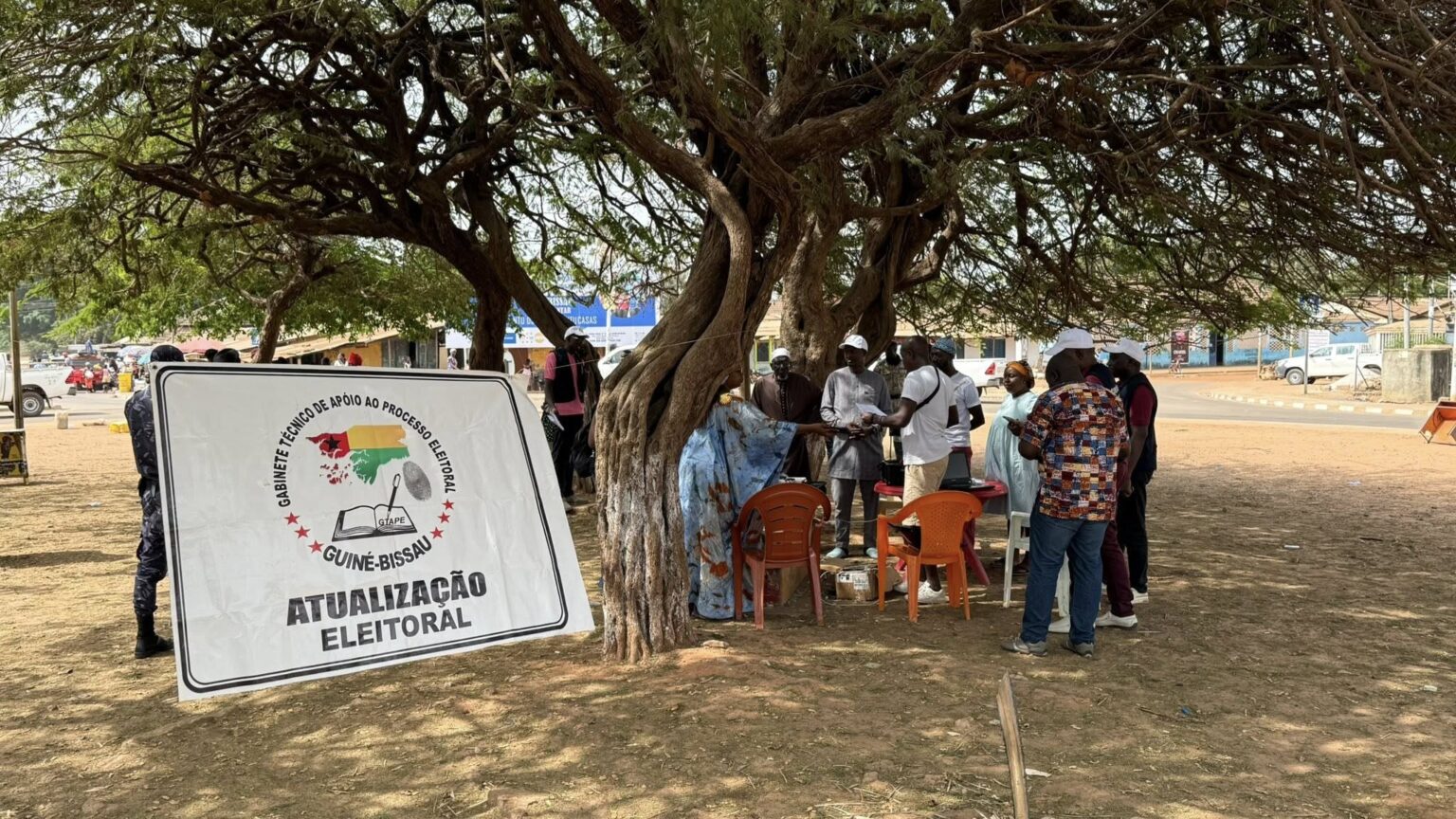
Preparations in April 2025 by Guinea-Bissau’s National Electoral Commission. Photo: CNE Guinea-Bissau

Guinea-Bissau’s election commission has claimed inability to announce election results after soldiers siege ballots and destroy servers holding the voting data after a coup allegedly staged by the outgoing president. Opposition parties accuse the commission of collaboration.

Seizing the ballots, tally sheets, and computers from the offices of Guinea-Bissau’s National Election Commission (CNE), soldiers have destroyed the servers storing the voting data submitted by the various Regional Election Commissions (CREs).

“We do not have the material and logistic conditions to follow through with the electoral process,” Idrissa Djalo, a senior official of the CNE, said on Tuesday, December 2. The CNE’s HQ came under attack on November 26, one day before it was scheduled to announce the results of the Presidential and parliamentary elections held on November 23.
However, opposition parties are not convinced by Djalo’s reasoning that the CNE is unable to announce election results under the circumstances.

When the “regional tabulation was concluded at the national level and throughout the diaspora,” on November 26, the “minutes were already in the possession of the… candidates, representatives of the Public Prosecutor’s Office, and the Judicial Police,” said a statement by the National Campaign Directorate for Fernando Dias da Costa.

“Furthermore, a copy of the minutes and all electoral operation documents are delivered to the Regional Governor, who keeps them under his custody and responsibility. [Therefore], it is evident that conditions exist for the conclusion of the electoral process.”

Demanding the “convening of the CNE plenary and the publication of the results”, the statement condemned the “Executive Secretariat of the CNE” for collaborating with the “coup d’état staged by” Embaló in an “attempt to sabotage the electoral process.”

Opposition parties maintain that data submitted by the CREs show that Dias had won with over 50% of the votes. National and international electoral observers had also agreed that incumbent Umaro Sissoco Embaló had been voted out.

Swearing himself in as the president in 2020 at a hotel guarded by soldiers after a disputed election, Embaló has since dissolved the parliament twice. To thwart the return to constitutional order by preventing the transfer of power after losing elections, Embaló staged this coup, according to opposition parties and members of the dissolved parliament.

Read: Guinea-Bissau: A coup staged to protect the neocolonial order?

Claiming to be under arrest while still communicating with the French media, Embaló flew to neighboring Senegal a day after the staged coup on November 27. He was not welcome. Progressive Senegalese protested alongside Guinea-Bissau’s diaspora against hosting him in the country.

Dismissing his claim that he was the victim of a coup as a “sham” orchestrated by himself, Senegal’s Prime Minister Ousmane Sonko said in a parliamentary session on November 28: “We want the electoral process to continue. The [electoral] commission must be allowed to declare the winner.”

On November 29, Embaló flew from Senegal’s capital, Dakar, to Brazzaville, capital of the Republic of Congo.

The following day, Guinea-Bissau’s diaspora population protested in Paris, London, Portugal’s Porto, and Brazil’s São Paulo, demanding disclosure of the electoral results and release of political prisoners held by the military.

Among the high-profile political prisoners is Domingos Simões Pereira, president of the dissolved parliament and leader of the historic African Party for the Independence of Guinea and Cape Verde (PAIGC), which had led the liberation struggle against Portuguese colonialism. He was Embaló’s main challenger, barred from contesting the election at the last moment.

Read: With PAIGC barred, will elections in Guinea-Bissau legitimize a neocolonial dictatorship?

The PAIGC-led coalition then backed the candidacy of the Party for Social Renewal (PRS) leader Dias, who is said to have won the election. Dias himself narrowly escaped capture by soldiers and has found asylum in Nigeria.

On December 2, security forces detained another member of parliament, Marciano Indi, at the Osvaldo Vieira airport, where he was waiting for his flight to Nigeria’s capital, Abuja, to attend a parliamentary session of the Economic Community of West African States (ECOWAS).

Earlier, on November 27, ECOWAS had suspended Guinea-Bissau from all decision-making bodies. Then on November 29, the African Union (AU) also announced its suspension of the country “from all AU activities until constitutional order is restored.”

Original article by Pavan Kulkarni republished from peoples dispatch under a Creative Commons Attribution-ShareAlike 4.0 (CC BY-SA) license.

Continue ReadingElection results withheld after “staged” coup in Guinea-Bissau; opposition cries foul

Guinea-Bissau: A coup staged to protect the neocolonial order?

Spread the love

This article by Pavan Kulkarni republished from peoples dispatch under a Creative Commons Attribution-ShareAlike 4.0 (CC BY-SA) license.

Presidential candidate Fernando Dias da Costa of the Party for Social Renewal (PRS) in a pre-election meeting. Photo: JAAC / Facebook

Claiming to be under arrest, President Embaló has left the country while his opponents remain in custody after a military coup a day ahead of the announcement of the final results

The military coup in Guinea-Bissau on November 26 was not directed against the outgoing president, Umaro Sissoco Embaló, but orchestrated by him to thwart the return to constitutional order, opposition parties and members of the dissolved parliament allege.

Claiming to be arrested by the coup leaders – while still communicating with the French media – Embaló flew to neighboring Senegal the following day. His opponents, on the other hand, are still held in military custody.

The coup came on the heels of the long-delayed elections on Sunday, November 23. Both domestic and international observers had reportedly agreed that Embaló was voted out of the presidency.

“Why would anyone do a coup against a losing candidate?” asked Imani Umoja, Central Committee member of the African Party for the Independence of Guinea and Cape Verde (PAIGC).

Having led the country’s liberation struggle against Portuguese colonialism under the leadership of the Marxist revolutionary Amilcar Cabral, PAIGC is the country’s largest party. Its presidential candidate, Domingos Simões Pereira, Embaló’s main opponent, was barred from contesting the election by the Supreme Court, whose legitimate president had been replaced in 2023 by militias of the presidential guard under Embaló’s command.

Read: With PAIGC barred, will elections in Guinea-Bissau legitimize a neocolonial dictatorship?

“We had three options. One was to boycott the election,” which would have only handed over power to Embaló for the second term without a fight, Umoja told Peoples Dispatch. “Or we could have taken the streets in protest, but that is what the regime wanted. They would have killed us and postponed the election,” further extending his rule that had already continued beyond his term.

“So we decided to back one of the candidates approved to contest. Dias was our natural choice,” because he is the head of the Party for Social Renewal (PRS) – a splinter from the PAIGC. “There is no great ideological difference between us,” he added, explaining the split was over tactical differences, overcoming which the two parties had often collaborated on broader struggles.

Although the leadership of the PRS identified the party as “social-democratic” as opposed to PAIGC’s “socialist” identification, the rank-and-file of both parties are Cabralists.

“So we were able to reach an agreement that once Dias becomes the president, he would reverse all the unconstitutional decrees by Embaló.”

An unconstitutional regime 

Swearing himself in as the country’s president at a hotel guarded by soldiers in February 2020 after a disputed election against the PAIGC leader Pereira, who was barred from contesting this time, Embaló had the president of the Supreme Court replaced, practically at gunpoint, in November 2023. Then, in December that year, he unconstitutionally dissolved the parliament, where the PAIGC had the majority, justifying the action by citing a coup attempt he had allegedly staged himself.

Removing the ministers constitutionally chosen by this parliament, he replaced them with a so-called “Government of Presidential Initiative.”

Thus, grabbing all power and dismantling democratic structures, Embaló has allegedly been signing away in secret valuable natural resources and lucrative infrastructure projects to France and the neighboring West African states under its neocolonial yoke.

A reversal of this neocolonial penetration was set to begin under Dias’s presidency, starting with the restoration of the dissolved parliament, the National People’s Assembly, dominated by the PAIGC and presided by its leader and barred candidate, Pereira.

According to the vote count from each region published by the Regional Electoral Councils, Embaló bagged around 43% of the votes, while Dias had won with about 53%, said Umoja.

A staged coup

However, one day before the National Electoral Council was set to publish the final results, summing up the nationwide count and the votes from the diaspora, gunfire erupted near the presidential palace.

“But there was no fighting. Soldiers were shooting in the air,” said Umoja. Embaló then told the French media that he had been removed from power in a coup led by a group of soldiers who had put him under arrest. “It was all staged. The coup was not against Embaló, but Dias… the president-elect.”

Opening fire near the National Election Council, “another group of armed people from the Ministry of Interior, accompanied by some soldiers, barged into its office and seized the phones of all the workers there, including the representatives of the candidates,” he added.

“A group of heavily armed militias associated with the Presidential Palace” also “invaded the campaign headquarters of the presidential candidate [Dias],” said Ruth Monteiro, Director of the Office of the President of the National People’s Assembly, namely Pereira.

Pereira was arrested with Dias’s National Representative, Octávio Lopes, and several others, Monteiro added. Dias himself managed to escape arrest “through a back door,” he later said in a video message.

Shutting down the radio, the officers who carried out the coup read out a statement on television, declaring themselves in charge, christening their junta as the “High Military Command for the Restoration of Order.”

Announcing the closure of borders, they ordered the suspension of the electoral process “until further notice”, ostensibly to thwart the “capture of Guinean democracy” by “narcotraffickers”.

Labeling this as “a self-coup orchestrated by Umaru Sissoko Embaló, who was overwhelmingly defeated at the polls,” the West Africa People’s Organization said: “The very clear aim is to prevent the electoral body from announcing results that are unfavorable to this well-known agent of the neo-colonial system.”

On November 27, when General Horta Nta Na Man swore in as transitional president for one year, the junta announced that it “strictly prohibits any demonstration, march, strike or action that disrupts peace and stability.”

Protests

“We cannot fold our hands while our leadership is imprisoned unjustly. When our leader and candidate was barred from contesting, we chose to avoid” a confrontation by not taking to the streets, backing another candidate instead. “But now we have run out of options. We have to protest.”

The Amílcar Cabral African Youth (JAAC) posted videos of protest marches in some neighborhoods around the Ministry of Interior. Large-scale protests are at high risk at the moment in Guinea-Bissau. A large section of “our leadership is still in hiding,” Umoja added.

However, the diaspora is mobilizing. In Dakar, the capital of Senegal, progressive Senegalese activists protested alongside the diaspora outside the Guinea-Bissau embassy against hosting Embaló in the country. “Dictators are not wanted anywhere!” Umoja remarked.

JAAC Portugal and Firkidja di Pubis, an organization of Guinean students and workers abroad, protested in Lisbon, capital of their former colony, outside the Community of Portuguese Language Countries (CPLP), chaired by Embaló.

“The CPLP and the so-called international community” is complicit with Embaló, who “orchestrated a fake coup d’état with the sole purpose of derailing the electoral process in which the people had defeated his dictatorship,” Firkidja di Pubis accused. Protesters demanded the “completion of the electoral process in which the people chose Fernando Dias da Costa as their President.”

Should the junta not pay heed, Umoja warns, “Embaló’s followers in the military are only those who are paid” for their loyalty, but the bulk of the rank-and-file soldiers are unpaid.

The PAIGC denounced on Saturday, November 29, that a group of masked and armed men raided their headquarters, attacking party leaders and those present. In statements released, the party alleges that the objective of the raid was to plant weapons in the office to later serve as evidence against them. The party called on the international community to “follow these events closely and support all of the efforts to preserve democratic legality.” The party has also called for authorities to release Pereira and all others arrested amid the coup plot.

This article by Pavan Kulkarni republished from peoples dispatch under a Creative Commons Attribution-ShareAlike 4.0 (CC BY-SA) license.

Continue ReadingGuinea-Bissau: A coup staged to protect the neocolonial order?

Federal Police investigate Bolsonaro and allies for alleged coup attempt; Liberal Party president arrested

Spread the love

Original article republished from Brasil de Fato.

Advisors to former President Jair Bolsonaro were arrested this Thursday morning (8) – Douglas Magno/AFP

On Thursday (8), Brazil’s Federal Police (PF) carried out an operation to investigate the involvement of former President Jair Bolsonaro, some of his former ministers and advisers in a criminal organization that allegedly planned a coup d’état in 2023. Two of Bolsonaro’s former advisers were arrested, and multiple search and seizure warrants were executed.   

The country’s Federal Police carried out 33 search and seizure warrants, four preventive arrest warrants and 48 additional precautionary measures. These measures included restrictions on contact with other individuals under investigation, travel bans (with an order to surrender Bolsonaro’s passport within 24 hours) and suspension of public functions. Notably, during the 2022 presidential campaign, organized groups allegedly spread misinformation about election fraud, intending to make it easier for military intervention.   

The investigation focuses on two main aspects:   

Dissemination of falsehoods: The first axis targets the spreading of lies about electronic voting machines, whose supposed “hacking” and “fraud” occurred during the 2022 elections, which Bolsonaro lost.   

Acts to undermine democracy: The second axis involves planning actions to overthrow democracy, including the invasion of the National Congress on January 8, 2023, with military support.   

The alleged offenses under investigation include criminal organization, the violent undermining of the democratic state and an attempted coup.  

Original article republished from Brasil de Fato.

Continue ReadingFederal Police investigate Bolsonaro and allies for alleged coup attempt; Liberal Party president arrested