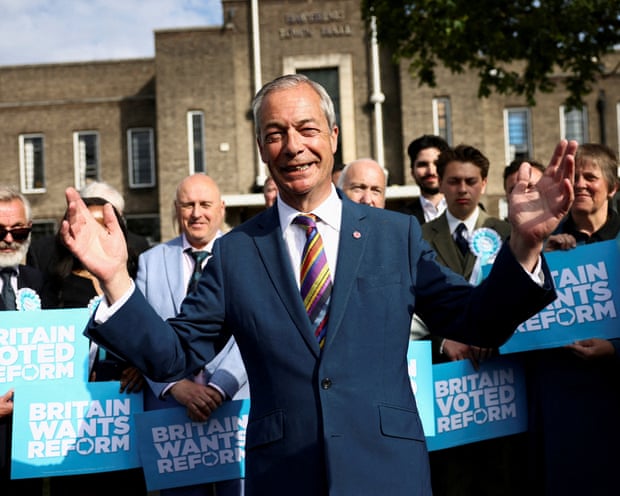
Reform UK gave no response when asked about the whereabouts of Nigel Farage. Photograph: Jack Taylor/Reuters
As campaigners take to the streets for what could be the most significant byelection for decades, the Reform leader’s absence remains a mystery
It has been six days since Nigel Farage cancelled a scheduled appearance at a Reform UK rally in Sunderland, a key election target in Labour’s heartlands.
The reasons given – chaos in government and what appeared to be an impending Labour leadership race – seemed logical. After all, as a quotation sometimes attributed to Napoleon Bonaparte goes: never interfere with an enemy while he is in the process of destroying himself.
Yet as the days have passed, the continued absence of a politician who has in recent years seemed almost omnipresent has become all the more stark.
Reform was contacted to ask about Farage’s whereabouts but gave no response.
Of course, the elephant in the room has been the investigation by the parliamentary standards watchdog into a £5m gift given to Farage by the crypto billionaire Christopher Harborne.
Climate science denier Nigel Farage explains that it’s simple to blame asylum-seekers or Muslims for everything.Nigel Farage urges you to ignore facts and reality and be a climate science denier like him and his Deputy Richard Tice. He says that Reform UK has received £Millions and £Millions from the fossil fuel industry to promote climate denial and destroy the planet.Nigel Farage reminds you that he’s the man that brought you Brexit and asks what could possibly go wrong.
“The potential for AI is huge and Greens welcome the potential it holds, especially in research and innovation. However, this plan comes almost exclusively from engagement with industry and investors and does not account for the views of the public, or the people working in our public services, about where AI should or should not be used. If AI is to serve our public services, its uses must instead be driven by the voices of those most affected by this technology development and deployment. This of course has to include addressing concerns around privacy and rights over their information”
“In addition, there is a green elephant in the room with neither government nor business truly addressing the environmental impacts of AI. One estimate said AI-related infrastructure may soon consume six times more water than Denmark, a country of 6 million people. And a request made through ChatGPT consumes 10 times the electricity of a Google Search. Yet the action plan does not address these crucial questions of environmental sustainability, let alone the debate about the relative gains from AI versus these obvious harms.”
“Natural resources … are a gift from God. Every natural resource, whether it’s oil, gas, wind, sun, gold, silver, copper, they are all natural resources. Countries should not be blamed for having them, and should not be blamed for bringing these resources to the market because the market needs them. The people need them.”
These were the words of Ilham Aliyev, president of Azerbaijan, at the opening of the recent United Nations COP29 convention on climate change in Baku. https://www.youtube.com/embed/4pqVwrMAGSc?wmode=transparent&start=0 Ilham Aliyev’s speech at COP29.
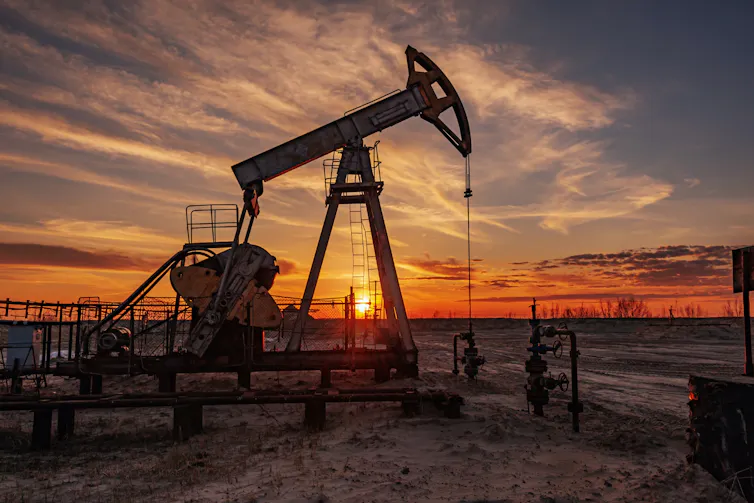
It seems completely inappropriate to sing the praises of fossil fuels at an international gathering that aims to radically reducing greenhouse gas emissions. Indeed, this goal is absolutely unachievable without drastic cuts to fossil fuel use, but Aliyev’s speech does have a positive, if indirect, impact – it points a spotlight at the elephant in the room, one that has remained virtually invisible throughout the United Nations Framework Convention on Climate Change’s (UNFCCC) long history.
COP agreements have never made commitments to limit fossil fuel extraction, even though this would be the most direct – and the only certain – way to rein in the leading cause of climate change.
Reducing demand but not supply: a pointless endeavour
Fossil fuels are key to climate change, but they are largely absent from COP agreements. The biggest achievement came in 2023, at COP28 in Dubai (United Arab Emirates), when an unspecified proposal was made to “transition away from fossil fuels”. This was not ratified at COP29, mainly due to pressure from Saudi Arabia.
In economic terms, the focus of climate agreements has always been on demand. It is expected that national measures, such as promoting renewable energy and public transport, or penalising the use of fossil fuels by putting a price on carbon emissions will indirectly lead to less fossil fuels being put on the market.
While these measures can be effective, they often end up lacking, or even non-existent, because they depend completely on the policies and reactions of the nations and companies who own, supply, and profit from these resources.
Commitments to supply-side agreements are not on the COP agenda, even though most of the fossil fuel reserves that are considered exploitable – and therefore economically valuable – cannot be burned if we are to even come close to the UNFCCC climate goals. They must be left in the ground.
However, global CO₂ emissions are not falling. On the contrary, the use of coal, petroleum and natural gas have hit record highs in 2024.
Evolution of global CO₂ emissions. Global Carbon Project, CC BY-SA
How can we restrict fossil fuel extraction?
Limits have been put forward in the past. In 2014, for instance, economists Paul Collier and Anthony J. Venables proposed a sequenced plan for phasing out coal, which would involve progressive measures not to start new operations and to close mines, with countries staggered in a fair order. “Fairness” would be determined by ability to pay, per capita emissions and historical responsibility.
We can also take inspiration from nuclear weapons treaties, as Professor of International Relations Peter Newell and political economist Andrew Simms have done. They advocate for a fossil fuel non-proliferation treaty along the lines of the nuclear non-proliferation treaty. Many states and cities around the world have already signed up to the initiative.
There have also been local initiatives, such as the commitment to stop extracting oil in an area of the Yasuní National Park in Ecuador due to its exceptional biodiversity and the existence of populations in voluntary isolation. This will also benefit the global climate by reducing emissions.
The proposal was initially taken up in 2007 by the then president Rafael Correa on the condition that the international community would financially compensate part of the sacrificed monetary income. However, scarce contributions to the compensation fund led Correa to renounce the initiative and allow oil exploitation.
Environmentalists, affected communities and academics demanded a referendum and, after years of litigation, the right to consultation was recognised by the courts. In August 2023, a large majority (almost 60 %) voted in favour of keeping the oil reserves “in the ground indefinitely”. Money does not always prevail, even in poor countries, though the Ecuadorian government has postponed its mandate to dismantle drilling sites, meaning many are still operational today.
A blessing for some, a curse for others
The above case and many others – such as the Niger Delta (Nigeria), where Shell has been extracting oil since 1958 – remind us that “God’s gift” of natural resources can also be a curse.
A gift for some – usually multinational companies or small numbers of wealthy people – can be a curse not only for the planet, but also for the local population who suffer the devastating environmental and social consequences of extracting these resources, and who face violent repression when they protest.
It was in places like Nigeria and Ecuador that the activist slogan “leave fossil fuels in the ground” was coined. Even if their motivation is primarily or solely to protect their territory, social movements opposing coal mining or hydrocarbon extraction undeniably contribute – from the supply side – to curbing climate change.
Together with social movements, academic and political work is key to defining the areas where preventing the exploitation of fossil fuels is a priority, and to establishing economic compensation. Martí Orta-Martínez, from the University of Barcelona, is doing just this. He is leading a project to geographically define the fossil fuel deposits that should not be burned, which was presented at a seminar in the framework of COP29.
It may sound utopian to seek supply-side international agreements, but the truth is that it is impossible to reduce global emissions and move towards decarbonisation without a rapid decrease in the extraction of fossil fuels. COPs should heed this evidence.
Given the magnitude of the climate challenge, it is not a question of deciding between demand or supply-side policies, but of using both, promoting them in each country, and reaching robust agreements at an international level.
Published on Thursday, April 22, 2021 by Common Dreams
The Swedish campaigner says insufficient goals and empty rhetoric represent the “biggest elephant there’s even been in any room.” by Common Dreams staff
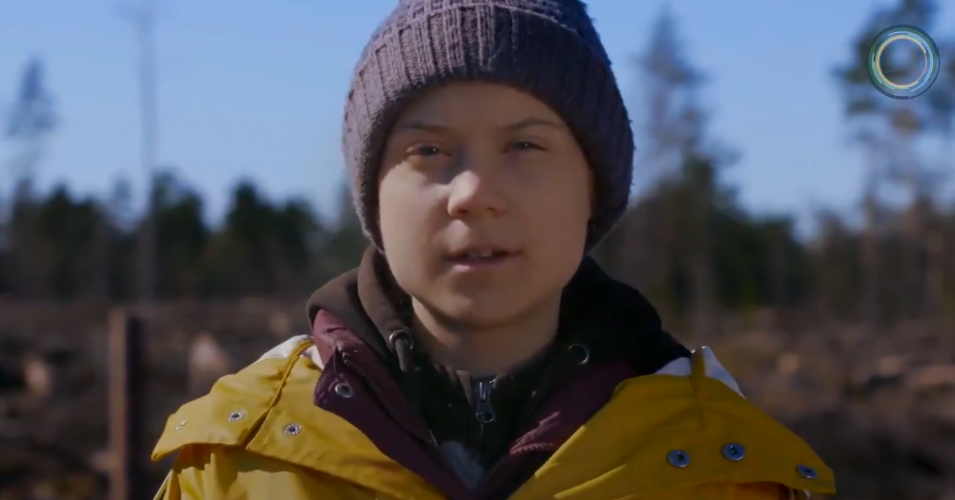
Climate campaigner Greta Thunberg in a video released shortly before the Biden administration kicked off a two-day virtual summit of international leaders to address the climate crisis. “The gap between what needs to be done and what we are actually doing is widening by the minute,” says Thunberg. “The gap between the urgency needed and the current level of awareness and attention is becoming more and more absurd.” (Photo: Screenshot/NowThis News)
Just before U.S. President Joe Biden’s two-day virtual summit on the climate crisis got underway, Swedish activist Greta Thunberg on Thursday shared a video message calling out the “bullshit” of world leaders who she says are failing to take the steps necessary to confront the planetary emergency.
“While we can fool others and even ourselves, we cannot fool nature and physics.” —Greta Thunberg
Posted online by NowThis News, the video featuring Thunberg comes as a warning from the well-known global climate campaigner that the people of the world should not be fooled by the lofty rhetoric they will hear at the summit.
“At the Leaders’ Climate Summit, countries will present their new climate commitments, like net-zero emissions by 2050,” Thunberg says in the video. “They will call these hypothetical targets ‘ambitious.’ But when you compare our insufficient targets with the overall current best available science, you clearly see that there’s a gap. There are decades missing.”
Watch the video:
‘We cannot fool nature and physics’ — In this NowThis exclusive, @GretaThunberg says commitments presented by countries at the Leaders’ Climate Summit will leave a ‘gap of awareness, action, and time’ pic.twitter.com/y8qYPJKmAE
The 18-year-old founder of “Fridays for Future” and inspiration for the global climate strike movement also penned an open letter first published in Vogue on Thursday, making much the same argument.
“You may call us naïve for believing change is possible, and that’s fine,” Thunberg wrote. “But at least we’re not so naïve that we believe that things will be solved by countries and companies making vague, distant, insufficient targets without any real pressure from the media and the general public.”
Thunberg continued:
Of course, we welcome all efforts to safeguard future and present living conditions. And these targets could be a great start if it wasn’t for the tiny fact that they are full of gaps and loopholes. Such as leaving out emissions from imported goods, international aviation and shipping, as well as the burning of biomass, manipulating baseline data, excluding most feedback loops and tipping points, ignoring the crucial global aspect of equity and historic emissions, and making these targets completely reliant on fantasy or barely existing carbon-capturing technologies. But I don’t have time to go into all that now.
The point is that we can keep using creative carbon accounting and cheat in order to pretend that these targets are in line with what is needed. But we must not forget that while we can fool others and even ourselves, we cannot fool nature and physics. The emissions are still there, whether we choose to count them or not.
“The gap between what needs to be done and what we are actually doing is widening by the minute,” she added. “The gap between the urgency needed and the current level of awareness and attention is becoming more and more absurd. And the gap between our so-called climate targets and the overall, current best-available science should no longer be possible to ignore.”
Speaking of world leaders in the Thursday video and the shortcomings of their climate proposals thus far, Thunberg said, “Let’s call out their bullshit,” because the gap between what their rhetoric and what’s actually needed is “the biggest elephant there’s even been in any room.”
Along with other witnesses, Thunberg is testifying before congressional lawmakers on Thursday during a hearing convened by the House Subcommittee on the Environment.
Well if the so-called Labour party’s not going to do it, someone’s got to do it.
Stop being such Neo-Con shits. How on Earth can you claim to represent ordinary people when you are such Neo-Con shits?
TBC
ed: The point is that if you’re such Neo-Con shits then you are Neo-Con shits. There is no difference because you are Neo-Con shits … who care nothing for people – never mind ordinary people. Neo-Con Labour shits care nothing except Neo-Conism. You evil, careless b’stards.
Neo-Con Labour have nothing to offer ordinary people. Well, they can offer you ridiculous, irrational shitless scaredness. That’s what Neo_Conism is. Be afraid. Be far more afraid of a ridiculous nothingness threat. Hey be afraid of walking on the pavement – that’s far more dangerous. Be afraid of going out. Stay in. It’s so dangerous – far more dangerous than food poisoning or falling down. Wouldn’t that be awful if you fell over? Terrible, That’s life.
Anyway, back to the Neo-Con Labour Party. They’ve accepted fully the Neo-Con skit. You know what it is – be skitless afraid. C’off Neo-Con Labour Party. Just C’off.
Be afraid to catch a bus. Be afraid, be so afraid. Be afraid. These b’stards make up terrorism shit to control you through fear. I suggest that we need a backlash. How dare they? How dare they manipulate people through fear? How dare they? Cnuts
How dare they manipulate people through fake manufactured terrorism?
Payback?
And such ridiculous, transparent terrrism nonsense. Can we hold thib to account?
It’s unfortunate that I will never have the same importunities – hey that may be it. No, I’d like similar opportunities to do TB and IB as they had. FM I was lucky but thanks also to everyone that I did not acknowledge before.
Isn’t it like an eye for an Ii? Isn’t it quite clear?
6?
I find it really weird that this IB cnut is still tolerated. I suppose that’s their siht siht. Shall we call it total siht? IB such a siht, it is so transparent that he was such a political tool. How on earth can anyone suggest that there is anything near democracy with absolute New-Labour murdering and more police cnuts like this? Oh Fcuk off.
New Labour Ian Blair. It’s so ridiculous. IB – actually – covering for murdering bastards on the tube. Jean Charles de-Menezes. de-Menezes is the surname. JCD.
ed: What can be done about this then? I have suggested 6
Is there another resolution?
Well of course there are other resolutions …
It’s difficult to accuse dead people. Be good if they died soon not from old age
Ed: The trouble is that this all seems outside any judicial process e.g. former Boss of the Metropolitan Police with assistance from a foreign paramilitary force calling for the murder of a UK citizen. If it’s outside any judicial process then I have suggested a resolution.
ed: Probably military rather than paramilitary. Yes, employed and financed directly. I don’t suppose they were anything else. Perhaps paramilitary because they were pretending not to be foreign military in UK.
Not that different to(p) terrorists then if you think about it.
ed: Yes, they were foreign but pretending not to be. They invented terrrism.