‘Monumental Victory for the Ocean’: Norway Halts Plans for Deep-Sea Mining

Spread the love

Original article by Olivia Rosane republished from Common Dreams under Creative Commons (CC BY-NC-ND 3.0). 

Kirsti Bergstø, leader of the Socialist Left Party, speaks at a protest against deep-sea mining outside Norwegian Parliament.  (Photo: Greenpeace)

One campaigner called it “a testament to the power of principled, courageous political action, and… a moment to celebrate for environmental advocates, ocean ecosystems, and future generations alike.”

Environmental organizations cheered as Norway’s controversial plans to move forward with deep-sea mining in the vulnerable Arctic Ocean were iced on Sunday.

The pause was won in Norway’s parliament by the small Socialist Left (SV) Party in exchange for its support in passing the government’s 2025 budget.

“Today marks a monumental victory for the ocean, as the SV Party in Norway has successfully blocked the controversial plan to issue deep-sea mining licenses for the country’s extended continental shelf in the Arctic,” Steve Trent, CEO and founder of the Environmental Justice Foundation, said in a statement. “This decision is a testament to the power of principled, courageous political action, and it is a moment to celebrate for environmental advocates, ocean ecosystems, and future generations alike.”

“Today, thanks to the SV Party and all those around the world who spoke up against this decision, the ocean has won. Now, let’s ensure this victory lasts.”

Norway sparked outrage in January when its parliament voted to allow deep-sea mining exploration in a swath of its Arctic waters larger than the United Kingdom. Scientists have warned that mining the Arctic seabed could disturb unique hydrothermal vent ecosystems and even drive species to extinction before scientists have a chance to study them. It would also put additional pressure on all levels of Arctic Ocean life—from plankton to marine mammals—at a time when they are already feeling the impacts of rising temperatures and ocean acidification due to the burning of fossil fuels.

“The Arctic Ocean is one of the last pristine frontiers on Earth, and its fragile ecosystems are already under significant stress from the climate crisis,” Trent said. “The idea of subjecting these waters to the destructive, needless practice of deep-sea mining was a grave threat, not only to the marine life depending on them but to the global community as a whole.”

“Thankfully, this shortsighted and harmful plan has been halted, marking a clear victory in the ongoing fight to protect our planet’s blue beating heart,” Trent continued.

In June, Norway announced that it would grant the first exploratory mining licenses in early 2025. However, this has been put on hold by the agreement with the SV Party.

“This puts a stop to the plans to start deep-sea mining until the end of the government’s term,” party leader Kirsti Bergstø said, as The Guardian reported.

Norway next holds parliamentary elections in September 2025, so no licenses will be approved before then.

The move comes amid widespread opposition to deep-sea mining in Norway and beyond. A total of 32 countries and 911 marine scientists have called for a global moratorium on the practice. More than 100 E.U. parliamentarians wrote a letter opposing Norway’s plans specifically, and the World Wide Fund for Nature (WWF) has sued to stop them.

“This is a major and important environmental victory!” WWF-Norway CEO Karoline Andaur said in a statement. “SV has stopped the process for deep seabed mining, giving Norway a unique opportunity to save its international ocean reputation and gain the necessary knowledge before we even consider mining the planet’s last untouched wilderness.”

Haldis Tjeldflaat Helle, the deep-sea mining campaigner at Greenpeace Nordic, called the decision “a huge win.”

“After hard work from activists, environmentalists, scientists, and fishermen, we have secured a historic win for ocean protection, as the opening process for deep-sea mining in Norway has been stopped,” Helle said in a statement. “The wave of protests against deep-sea mining is growing. We will not let this industry destroy the unique life in the deep sea, not in the Arctic nor anywhere else.”

https://twitter.com/Greenpeace/status/1863553791758565560?ref_src=twsrc%5Etfw%7Ctwcamp%5Etweetembed%7Ctwterm%5E1863553791758565560%7Ctwgr%5Ea3413baf36f0c5699fefd01a7c8808124e45c27c%7Ctwcon%5Es1_c10&ref_url=https%3A%2F%2Fwww.commondreams.org%2Fnews%2Fnorway-halts-deep-sea-mining

Sorry, this content could not be embedded. [X/twitter embed still broken … Is there a work-around?]
X

However, Norway’s Arctic waters are not entirely safe yet.

Prime Minister Jonas Gahr Stoere, of the Labour Party, toldTV2, on Sunday, “This will be a postponement.”

The government said that other work to begin the process of deep-sea mining, such as drafting regulations and conducting environmental impact surveys, would move forward. Norway is currently governed by the Labour and Center parties. The two parties leading in polls for September’s elections—the Conservatives and Progress Party—also both back deep-sea mining, according toReuters.

“If a new government attempts to reopen the licensing round we will fight relentlessly against it,” Frode Pleym, who leads Greenpeace Norway, told Reuters.

Other environmental groups tempered their celebrations with calls for further action.

Trent of the Environmental Justice Foundation said that “while today is a cause for celebration, this victory must not be seen as the end of the struggle.”

“We urge Norway’s government, and all responsible global actors, to make this a lasting victory by enshrining protections for the Arctic Ocean and its ecosystems into law, and coming out in favor of a moratorium or ban on deep-sea mining,” Trent added. “It is only through a collective commitment to sustainability and long-term stewardship of our oceans that we can ensure the health of the marine environment for generations to come.”

Trent concluded: “Today, thanks to the SV Party and all those around the world who spoke up against this decision, the ocean has won. Now, let’s ensure this victory lasts.”

Andaur of WWF said that this was a “pivotal moment” for Norway to “demonstrate global leadership by prioritizing ocean health over destructive industry.”

As WWF called on Norway to abandon its mining plans, it also urged the nation to reconsider its exploitation of the ocean for oil and gas.

“Unfortunately, we have not seen similar efforts to curtail the Norwegian oil industry, which is still getting new licenses to operate in Norwegian waters, including very vulnerable parts of the Arctic,” Andaur said. “Norway needs to explore new ways to make money without extracting fossil fuels and destroying nature.”

Greenpeace also pointed to the role Norway’s pause could play in bolstering global opposition to deep-sea mining.

“Millions of people across the world are calling on governments to resist the dire threat of deep-sea mining to safeguard oceans worldwide,” Greenpeace International Stop Deep-Sea Mining campaigner Louisa Casson said. “This is a huge step forward to protect the Arctic, and now it is time for Norway to join over 30 nations calling for a moratorium and be a true ocean champion.”

Original article by Olivia Rosane republished from Common Dreams under Creative Commons (CC BY-NC-ND 3.0). 

dizzy: Welcome back BTW, hosting server was down for an hour or so 9.30 – 10.30 a.m. GMT. Seems fast now.
Continue Reading‘Monumental Victory for the Ocean’: Norway Halts Plans for Deep-Sea Mining

Ahead of Treaty Negotiations, Hundreds March to ‘End the Plastic Era’

Spread the love

Original article by OLIVIA ROSANE republished from Common Dreams under Creative Commons (CC BY-NC-ND 3.0).

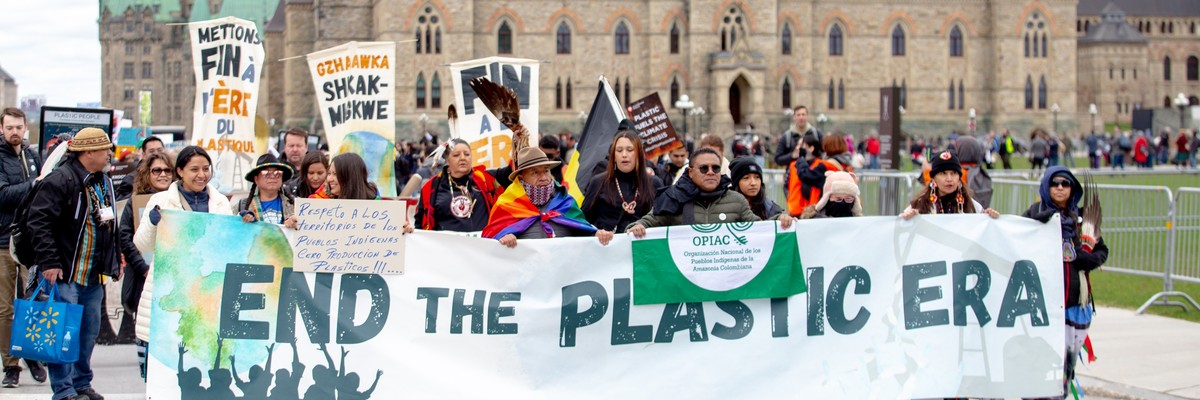
Frontline community members and environmental groups marched in Ottawa, Canada, on Sunday, April 21, 2024 to demand an ambitious Global Plastics Treaty.
 (Photo: Ben Powless/Survival Media Agency)

“As adults who come to Ottawa to negotiate the plastic treaty, you must protect our rights to live in a healthy and safe environment,” one young activists said.

Days before national delegates gather for the fourth and penultimate negotiations to develop a Global Plastics Treaty in Ottawa, Canada, around 500 Indigenous and community representatives, members of civil society and environmental groups, and experts and scientists gathered for a “March to End the Plastic Era” on Sunday.

The protesters, organized under the banner of Break Free From Plastic, called for a treaty that significantly reduces plastic production and centers the frontline communities most impacted by the plastics crisis.

“Delegates must act like our lives depend on it—because they do,” Daniela Duran Gonzales, senior legal campaigner with the Center for International Environmental Law, said in a statement. “Our climate goals, the protection of human health, the enjoyment of human rights, and the rights of future generations all rest on whether the future plastics treaty will control and reduce polymers to successfully end the plastic pollution crisis.”

“Short-sighted business interests must be out of the room because the only way to achieve equitable livelihoods is when we have a healthy planet.”

The official meeting of the Intergovernmental Negotiating Committee (INC) to craft a “international legally binding instrument on plastic pollution, including in the marine environment,” will run from April 23 to 29 in the Canadian capital.

Break Free From Plastic called the negotiations a “make or break” moment for the treaty, which is supposed to be completed in late 2024 in Busan, South Korean. However, civil society groups have expressed concern that oil-producing countries and the plastics industry will water down the agreement and steer it toward waste management and recycling, which has been revealed to be a false solution to plastic pollution knowingly promoted by the industry for decades.

The last round of negotiations concluded in late 2023 in Nairobi, Kenya, with little progress made after 143 fossil fuel and chemical lobbyists attended.

Salisa Traipipitsiriwat of Thailand, who is the senior campaigner and Southeast Asia plastics project manager for the Environmental Justice Foundation, said ahead of Sunday’s march that it was “crucial for world leaders to step up and put the people and planet at the forefront.”

“Short-sighted business interests must be out of the room because the only way to achieve equitable livelihoods is when we have a healthy planet,” Traipipitsiriwat added.

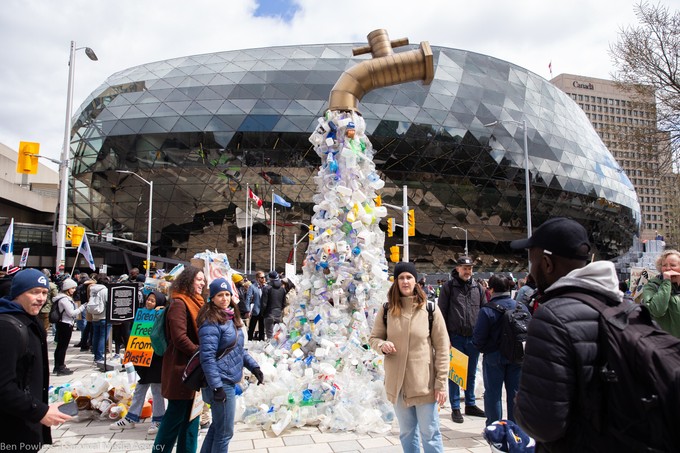
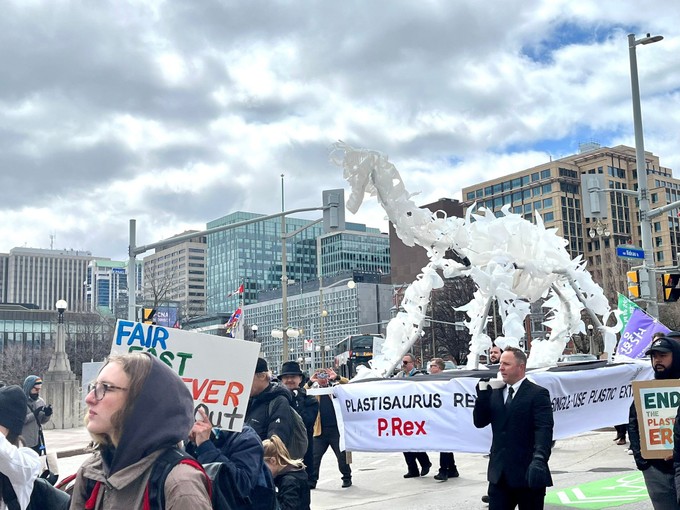
On Sunday, marchers gathered for a press conference at 10:30 am ET before marching at around 11:30 am from Parliament Hill to the Shaw Center, were negotiations will begin on Tuesday. Crowds began to disperse around 1:30 pm. Participants carried large banners with messages including, “End the plastic era,” “End multigenerational toxic exposure,” and pointing out that 99% of plastics came from fossil fuels. The gathering featured live music and art, including a giant tap pouring out plastics and a “Plastisaurus rex” with the message “Make single-use plastic extinct.”

(Photo: Break Free From Plastics)

“Now’s the time to be bold and push for a treaty that cuts plastic production and holds polluters accountable,” Julie Teel Simmonds, a senior attorney at the Center for Biological Diversity, said in a pre-march statement. “I’m inspired to be joining so many advocates in Ottawa, standing up against the enormous harm the fossil fuel and petrochemical industries are causing to people’s health and the planet. I hope to see countries showing ambition this week, and I urge them to remember what’s at stake for future generations.”

Civil society groups have compiled several demands for an ambitious and effective treaty. These are:

  1. Centering human rights, especially those of Indigenous communities, young people, and workers most impacted by plastic pollution;
  2. Protecting the rights of Indigenous peoples throughout the treaty process;
  3. Dealing with plastics across their entire lifecyle;
  4. Reducing production as a “nonnegotiable” part of the treaty;
  5. Eliminating toxic chemicals and additives from plastics;
  6. Bolstering reuse systems for plastics that are non-toxic;
  7. Prioritizing first prevention, then reuse, recycling, recovery, and disposal when managing plastic waste;
  8. Ending “waste colonialism” by strengthening regulations for trading plastics;
  9. Guaranteeing a “just transition” for people employed across the plastics lifecycle;
  10. Including “non-party” provisions in the treaty;
  11. Establishing a mechanism to fund countries so they can fully implement the treaty; and
  12. Enshrining conflict-of-interest policies as a protection against plastics industry lobbying.

The coalition emphasized the need to tackle the problem of plastic from cradle to grave.

“Plastic doesn’t just become pollution when it’s thrown away,” said Jessica Roff, the U.S. and Canada plastics and petrochemicals program manager for the Global Alliance for Incinerator Alternatives. “Plastic is pollution, from the moment the fossil fuels are extracted from the ground to the eternity of waste it spawns.”

Chrie Wilke, global advocacy manager for the Waterkeeper Alliance, said “Clearly the crux of the plastic pollution crisis is too much plastic being produced. There is no way to recycle our way out of this. We must face the fact that plastic and petrochemicals, at current production levels, endanger waterways, communities, and fisheries across the globe. Cutting production and implementing non-plastic alternatives and reuse systems is essential.”

(Photo: Ben Powless/Survival Media Agency)

Activists also emphasized the environmental justice implications of plastic pollution, and how some communities and groups are more burdened than others, both from the dangers of the production process and from waste disposal.

“Children and youth like me suffer the most and are recognized as a vulnerable group,” said Aeshnina ‘Nina’ Azzahra, the founder of River Warrior Indonesia. “My playground and my future are at risk. We all want our environment to be plastic-free, but please don’t put your burden on the other side of the world—this is NOT fair. As adults who come to Ottawa to negotiate the plastic treaty, you must protect our rights to live in a healthy and safe environment.”

Jo Banner, co-founder and co-directer of The Descendants Project, said:”Frontline community members, such as myself, are participating in these treaty negotiations with heavy hearts as our communities back home are struggling with sickness and disease caused by the upstream production of plastic.”

“Although our hearts are heavy, they are full with passion urging negotiators to aim for an ambitious treaty that caps plastic production,” Banner added. “Areas such as my hometown, located in the heart of Louisiana’s Cancer Alley, need a strong treaty now. There is no more time to waste.”

Original article by OLIVIA ROSANE republished from Common Dreams under Creative Commons (CC BY-NC-ND 3.0).

Continue ReadingAhead of Treaty Negotiations, Hundreds March to ‘End the Plastic Era’