Rescue workers carry a severely injured man after pulling him from the rubble following a strike in southern Tehran, Iran, March 13, 2026
GERMAN revolutionary socialist Karl Liebknecht, who was shot in the back by Freikorps forces in Berlin’s Tiergarten in January 1919, described imperialism and militarism as destructive forces acting as a “cyclone” and a “vampire.”
He stated: “Capitalism is war; socialism is peace.”
Today, Liebknecht’s words are prescient precisely because the cyclone of death and destruction displayed by US imperialism’s vampiric mission to suck up wealth around the world, from Venezuela to Iran, contrasts with the real achievements of socialist China, which has not been at war since 1979.
The permanent state of war extolled by Donald Trump’s grotesque demand to boost Pentagon spending by 150 per cent to $1.5 trillion to create his “dream military,” constitutes more military spending than the military budgets of China, Russia and Iran combined.
Yet with global stock markets inflated by vast quantities of fictitious capital, Trump’s militarist boasts assume a critical role in keeping share prices high.
In Europe too, militarism is the strategic choice of political elites. In November 2025, the EU introduced its Military Mobility Package for swift and efficient movement of military assets and personnel across borders through a “Military Schengen” — war without frontiers.
A year ago in March 2025, EU Commission president Ursula von der Leyen announced “ReArm Europe” — subsequently rebranded as “Security Action for Europe” because “Safe” sounds much nicer — €800bn of EU military spending for war in Ukraine.
…
Despite the enthusiasm of generals, arms dealers and bourgeois politicians for cutting public education, healthcare, housing and civil infrastructure investment to pay for arms spending, no European government has yet succeeded in the wholesale switch of public spending from welfare to warfare necessary to satisfy their demands.
This weekend’s Stop the War Coalition conference in London is a welcome opportunity to reinforce the message that adorns the masthead of this newspaper, “For Peace and Socialism.”
The demand that increasingly unites trade unionists and peace campaigners across the world, is for welfare, not warfare.
Climate science denier Donald Trump says that more liquid gold is being secured according to his policy of global privateeringDonald Trump explains why he established his Bored of PeaceDonald Trump warns against following the https://onaquietday.org blog, says that it’s easy atm, she only needs to report war crimes supporting Israel’s genocidal expansion.
Original article by Abdul Rahman republished from peoples dispatch under a Creative Commons Attribution-ShareAlike 4.0 (CC BY-SA) license. See the original article for embedded content.
The strike was called jointly by the worker unions and farmers groups to demand the withdrawal of the anti-people policies, such as the four new labor codes and the recently signed trade deals with the US and the EU.
The strike was called jointly by the worker unions and farmers groups to demand the withdrawal of the anti-people policies, such as the four new labor codes and the recently signed trade deals with the US and the EU
300 million workers, farmers, students, and professionals from various fields took to the streets across India on Thursday, February 12, in defense of their rights and to denounce the policies of the ultra-right-wing government in the country.
Workers went on strike shutting down thousands of coal fields, refineries, factories, banking, and transportation in remote corners of the country, heeding the call of the Central Trade Unions (CTUs), a joint platform of major trade unions in India, including the Centre for Indian Trade Unions (CITU), the All India Trade Union Congress (AITUC), the All India Central Council of Trade Unions (AICCTU), and the Hind Mazdoor Sabha (HMS), among others.
The All India Kisan Sabha (AIKS) congratulates crores of Indian workers, agricultural workers and toiling peasantry for making the 12th February 2026 General Strike a historic success. The anger of working people against the (1/n) pic.twitter.com/jfItzhDVeg
The workers were joined by millions of farmers and agricultural workers from across the country under the call of the Samyukta Kisan Sabha (SKM) and the All India Agricultural Workers Union (AIAWA), among others. The farmers and agricultural workers demonstrated at all the district headquarters and the village centers across India.
is a warning to the ruling dispensation: Withdraw the slew of anti-people bills and acts and restore the pro-worker and pro-farmer policies. If the Modi government fails to respond adequately to the demands of the toilers of the country, it will be inviting a much longer (9/n) pic.twitter.com/UT0eVGOlqU
In several places, workers and farmers were joined by students, women’s organizations, and other civil society groups who extended their solidarity with the strike call.
Strikers in many areas defied attempts by factory owners and security forces to stop the strike by picketing the factory gates and marching on the streets to implement the strike.
In several states, such as Kerala, Odisha, and Tripura, among others, most of the business establishments were shut in solidarity with the strike call. Demonstrations were held at government offices with thousands marching, shouting slogans, carrying banners, posters, and red flags.
general strike in the coming days.
Red Salute to the 12th February 2026 General Strike!
In the capital, Delhi, workers held large gatherings at the state secretariat. Later they also gathered at Jantar Mantar, where the central leadership of the CTUs and the SKM made speeches calling the strike a success.
Sudip Dutta, president of the CITU, claimed that the one day strike is just symbolic and if the Narendra Modi-led government fails to fulfill their demands it should be ready to see larger and longer strikes in the coming days as workers and farmers will not allow the government to harm their interests or sell India’s national sovereignty to the US and other foreign powers.
One of the major demands of the strike was the withdrawal of the trade deals India has recently agreed to with the US and the EU. The CTUs, SKM, and left parties in India have called the deals a surrender of the country’s sovereignty and harmful to the interests of the millions of farmers in the country as they allow open access of Indian markets to foreign farm products.
general strike in the coming days.
Red Salute to the 12th February 2026 General Strike!
Another key demand was the withdrawal of the four new labor codes brought by the Modi government despite long term opposition by the trade unions, and withdrawal of a new rural employment guarantee act called the VB GRAM G Act.
The SKM and the AIAWU have claimed that the VB GRAM G Act actually makes the right to employment ineffective. They want the earlier MGNREGA back which was withdrawn by the government.
general strike in the coming days.
Red Salute to the 12th February 2026 General Strike!
Farmers and workers in India have also been demanding the withdrawal of a series of laws brought by the Modi government, such as the electricity law, seed bill, and others, calling them pro-corporate and anti-people.
The protection of India’s secular and democratic polity was one of the major demands raised during the strike. The CTUs, the SKM and others believe that the Hindu supremacist Bharatiya Janata Party (BJP)-government is threatening the secular and democratic nature of India by pursuing majoritarian and authoritarian actions.
The major left parties in the country: Communist Party of India (Marxist), Communist Party of India (CPI), Communist Party of India (Marxist-Leninist) Liberation and others also supported the strike call.
The CITU and the SKM thanked millions for participating in the strike on Thursday, calling it “historic”. They mentioned the large-scale participation of workers from unorganized sectors and peasants and cautioned the government to listen to their demands.
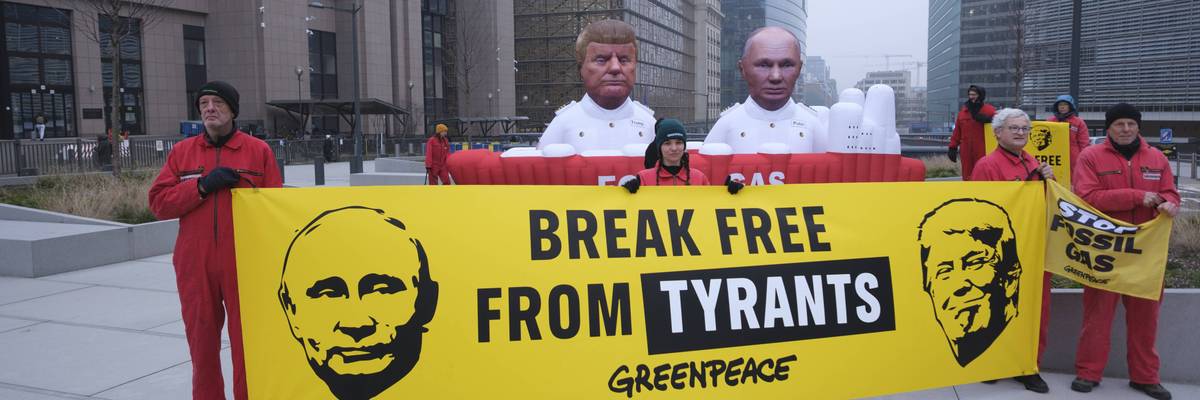
Greenpeace activists demonstrate against US fossil fuel imports to Europe on January 26, 2026 in Brussels, Belgium. (Photo by Thierry Monasse/Getty Images)
“The EU is at a fork in the road: It can follow the US down a volatile, destructive path or it can forge its own course toward stability.”
As the European Parliament debates the trade agreement reached last year by President Donald Trump and European Commission President Ursula von der Leyen, more than 120 civil society groups from across Europe and the globe on Thursday warned that the demands Trump has made on the bloc and his “contempt for international law” have made clear that the US is currently “no longer a good-faith partner.”
In solidarity with countries that have been directly threatened with Trump’s “fossil-fueled imperialism”—Venezuela and Greenland—the EU must reduce its reliance on US fossil fuels and cancel the negotiation and implementation of the trade deal, said Oil Change International, one of the signatories of the open letter that was sent to von der Leyen and other top EU officials.
The letter notes that Trump has already shown that in a deal with the US, the EU will be pressured to “dilute its own climate commitments” and “enrich US fossil fuel companies” at the bloc’s expense.
“His administration has attacked the EU’s methane regulation and its Corporate Sustainability Due Diligence Directive, seeking to weaken Europe’s ability to hold corporations accountable for climate and human rights harms,” reads the letter, which was also signed by Coal Action Network in the UK, Urgewald in Germany, and a number of US-based groups including Public Citizen.
Von der Leyen agreed to the deal last July after Trump threatened the bloc with “economically devastating tariffs,” the groups wrote, ensuring the EU would import $750 billion in US energy products including liquefied natural gas (LNG).
Those imports will “contaminate the air and water of nearby communities, increasing their risk of cancers, asthma, and other serious health harms,” warns the letter, while also being projected to raise energy costs for households across Europe.
Up to 1 in 4 homes in the EU already struggle to adequately heat, cool, or light their homes, wrote the groups.
James Hiatt, executive director of the US group For a Better Bayou, called on EU leaders to “side with communities like mine, not the fossil fuel executives bankrolling Trump, by ending its reliance on US gas.”
“There’s nothing clean about US LNG,” said Hiatt. “This industry has destroyed wetlands, damaged fishermen’s livelihoods, and condemned Gulf South communities like mine to higher rates of heart conditions, asthma, and cancer. We’re also on the frontlines of hurricanes and flooding made worse by continued fossil-fuel dependency Europe keeps importing.”
The groups wrote that “every euro spent on US non-renewable energy, and every fossil fuel investment made by European companies and banks in the United States, fuels Trump’s authoritarian agenda at home and his imperial ambitions abroad.”
“The only way Europe can reach energy independence and free itself from outside pressures is by implementing a just transition away from fossil fuels and relying on energy sufficiency/efficiency and homegrown renewable energy,” reads the letter. “Done well, this can support decent jobs and sound local economies.”
By ratifying the deal with the US, the groups added, the EU will only be “switching one dangerous dependency for another,” following its phase-out of oil imports from Russia.
The bloc will also be “giving up its sovereignty bit by bit, losing the competitiveness battle, deepening the climate crisis which will be putting its own people’s lives at even higher risk from extreme weather, and jeopardizing its ambitions to be seen as a global climate leader,” reads the letter.
Trump’s threat to seize Greenland from the Danish kingdom and his illegal strikes on Venezuela—aimed, his administration has admitted, at taking control of its oil—have shown how willing the president is to violate international law if it serves his own interests, the groups suggested.
The groups made specific demands of EU leaders, calling on them to:
Stand in solidarity with Latin American nations threatened by the US, including Venezuela, and with Greenland, affirming that “it is up to its people, and only them, to decide on their future”;
Put forward a motion at the United Nations condemning the Trump administration’s “blatant violations of international law”;
Immediately cancel negotiations and implementation of the US-EU trade deal;
Engage with EU member states to renew the European Green Deal and establish a binding roadmap for the phase-out of fossil gas, in particular US LNG;
Defend the existing EU Methane Regulation and ensure it is applied to imports; and
Support the First International Conference on the Just Transition Away from Fossil Fuels, organized by the governments of Colombia and the Netherlands.
“Under Trump, the US has become a rogue state that violates international law and bullies sovereign nations into submitting to its ‘energy dominance’ agenda,” said Myriam Douo, false solutions senior campaigner for Oil Change International. “The EU must stop wasting money on risky, expensive US fossil fuels, which threaten climate goals, put people at greater risk of climate disasters, and harm communities with toxic pollution.”
“The EU is at a fork in the road: It can follow the US down a volatile, destructive path or it can forge its own course toward stability,” said Douo. “It can save billions, build a resilient economy, and ensure its long-term energy security and independence through a just transition to renewable energy.”
Donald Trump urges you to be a Climate Science denier like him. He says that he makes millions and millions for destroying the planet, Burn, Baby, Burn and Flood, Baby, Flood.Elon Musk urges you to be a Fascist like him, says that you can ignore facts and reality then.Orcas discuss Donald Trump and the killer apes’ concept of democracy. Front Orca warns that Trump is crashing his country’s economy and that everything he does he does for the fantastically wealthy.
This work by Middle East Monitor is licensed under a Creative Commons Attribution-NonCommercial-ShareAlike 4.0 International License.
People displaced from El Fasher and other conflict-affected areas are settled in the newly established El-Afadh camp in Al Dabbah, in Sudan’s Northern State, on November 09, 2025. [Stringer – Anadolu Agency]
The EU on Tuesday warned that Sudan is facing a “catastrophic” humanitarian crisis, urging all parties to grant unhindered humanitarian access and resume negotiations for an immediate ceasefire, Anadolu reports.
Addressing the European Parliament’s plenary session in Strasbourg, the EU commissioner for equality and acting commissioner for crisis management, Hadja Lahbib, said hunger, malnutrition, and disease are rapidly spreading across the country, while international humanitarian law is being violated.
Lahbib described the situation in Darfur and Kordofan as “particularly shocking,” recalling last month’s “horrific attacks” against civilians by the paramilitary Rapid Support Forces (RSF) during their capture of El-Fasher and Bara.
“Thousands of civilians in El-Fasher have been killed on ethnic grounds, in house-to-house raids, mass detentions. People (are) unable to leave the city,” she said.
The commissioner noted that the RSF continues to block humanitarian assistance, further shrinking the humanitarian space in Sudan.
Since the conflict erupted in April 2023, more than 120 aid workers have been killed, making Sudan “one of the deadliest places in the world” for humanitarian staff.
Lahbib stressed that 21 million people face acute food insecurity, according to the latest assessment by the UN-backed Integrated Food Security Phase Classification, and warned that bureaucratic hurdles continue to obstruct aid operations.
She recalled that EU foreign ministers last week adopted sanctions against the RSF’s second-in-command, Abdelrahim Dagalo, for human rights violations and reiterated the bloc’s call for full accountability for atrocities committed in the country.
Lahbib also stressed the need for diplomatic engagement with regional actors to apply pressure on the warring sides.
“Considering the work of Kuwait, UAE, Egypt, Saudi Arabia, and the US, we have to take into account all interests and regional actors, including Türkiye,” she noted.
“Sudan has become a living nightmare for its people and a humanitarian catastrophe,” she said, adding that supporting humanitarian efforts in the country remains a priority for the European Commission.
Separately, the EU and the African Union condemned the atrocities committed by the RSF following their capture of the city of El-Fasher, and urged an immediate end to the conflict in Sudan.
Since April 2023, the Sudanese army and the RSF have been locked in a war that regional and international mediations have failed to end. The conflict has killed thousands of people and displaced millions of others.
This work by Middle East Monitor is licensed under a Creative Commons Attribution-NonCommercial-ShareAlike 4.0 International License.
The UK has announced much harsher rules for asylum seekers including the prospect of more deportations for those whose applications fail. The US is trebling the size of its deportation force. The EU is doubling its border budgets. And in the coming decades, hundreds of millions of people might be displaced by ecological changes.
In the face of this challenge, those countries which are most responsible for climate change have two options. Either they can share resources more equitably, and fund adaptation plans on a massive scale. Or they can prevent others from accessing resources and liveable land through physical and regulatory walls, enforced through mass deportation.
Recent events show that, faced with this choice, many governments are choosing not to share resources to anywhere near the extend needed, and are instead building higher walls.
Climate change is already making life unliveable in some parts of the world. According to a 2020 report from thinktank the Institute for Economics and Peace (IEP), 2.6 billion people face high or extreme water stress. By 2040, this may jump to 5.4 billion. Droughts, heatwaves, floods, cyclones, food shortages and related conflicts will force millions from their homes.
Most of these people will move internally within nations, but this too is likely to mean more walls and borders. In very unequal countries, internal migration has already triggered security-driven responses, with a rise in gated communities and other segregated living arrangements to keep the poorer away from the wealthy.
Many other climate migrants will be pushed to travel internationally. It’s likely their motivation will be characterised by many as economic rather than due to climate change. But it’s misleading to separate “economic” from “climate” migrants. When drought kills crops in Somalia or floods wash away farmland in Pakistan, the loss of income is inseparable from the climate shocks that caused it.
Even before the worst impacts hit, climate change is already woven into the economic pressures that push people to move – shrinking harvests, emptying wells and ruining livelihoods. The most severe climate-driven displacement is still ahead, but it has already begun.
Importantly, these pressures come with inequalities in causing climate change and bearing the costs. The richest 1% of the world’s population produces as much carbon as the poorest two-thirds, according to a study of global emissions in 2019 by Oxfam. Northern Europe and the US alone account for 92% of historical emissions.
Those who have contributed the least to climate change are the worst affected and often have the fewest resources to adapt, forcing many people to migrate.
More walls, more deportations
In this context, governments of wealthier countries are massively increasing spending on migration policing. In the US, proposed funding levels are extraordinary.
Recent legislation allocates nearly US$30 billion (£22 billion) to the Immigration and Customs Enforcement agency (Ice) for enforcement and deportation operations – roughly three times its current budget.
The US has also authorised US$45 billion for new detention centres – a 265% increase, more than the entire defence budget of Italy – and US$46.6 billion for additional border walls. Under this plan, Ice would become the largest US law enforcement agency, three times the size of the FBI.
Donald Trump’s policies can be easily labelled as the excess of one would-be autocrat, but this is a global trend across the political spectrum, albeit implemented with more acceptable language by the centre-left.
Introducing the UK Labour government’s new asylum and returns policy, Prime Minister Keir Starmer said: “We need an approach with a stronger deterrent effect and rules that are robustly enforced.” But previously-supportive MPs from his own party have warned this will mean “Ice-style raids” to deport asylum seekers.
The European Commission’s 2028–34 budget proposal earmarks €25.2 billion (£21.7 billion) for border management and €12 billion for migration, plus €11.9 billion for the Frontex border agency – more than double its current resources.
All this effectively triples current migration and border spending. In 2024, the EU ordered 453,000 non-EU nationals to leave, and actually deported 110,000 of them.
This is part of a much wider pattern, with borders today being far more militarised than at the end of the cold war. After decades of globalisation, states are now reterritorialising, building armoured fortifications against unwanted flows.
In the past two decades, more than 70 new international barriers have gone up, including Poland’s barbed-wire fence with Belarus, Greece’s steel wall on the Turkish border, Turkey’s stone wall on its Iranian border, and the new sections of the infamous wall between the US and Mexico.
Israel has built an “iron wall” around Gaza and border fences through much of the West Bank. Supposedly built to prevent Palestinians moving into Israel, these barriers have become a clear example of migration control tied to power grabs for land and resources.
A crossroads for human rights
Resource-driven migration pressures are rising just as the world is hardening its borders. In July 2025, the International Court of Justice declared that countries have a legal responsibility to address and compensate for climate change – and can be held accountable for their emissions. It is another signal that as humanity, we are at a crossroads.
The world can either prioritise universal human rights by sharing resources. Or it can attempt to protect a small, wealthy minority through walls, mass deportations and border violence on an unprecedented scale.
Keir Starmer refuses to be outcnuted by Nigel Farage’s chasing the racist bigot vote.Climate science denier Nigel Farage explains that it’s simple to blame asylum-seekers or Muslims for everything.

 Rescue workers carry a severely injured man after pulling him from the rubble following a strike in southern Tehran, Iran, March 13, 2026