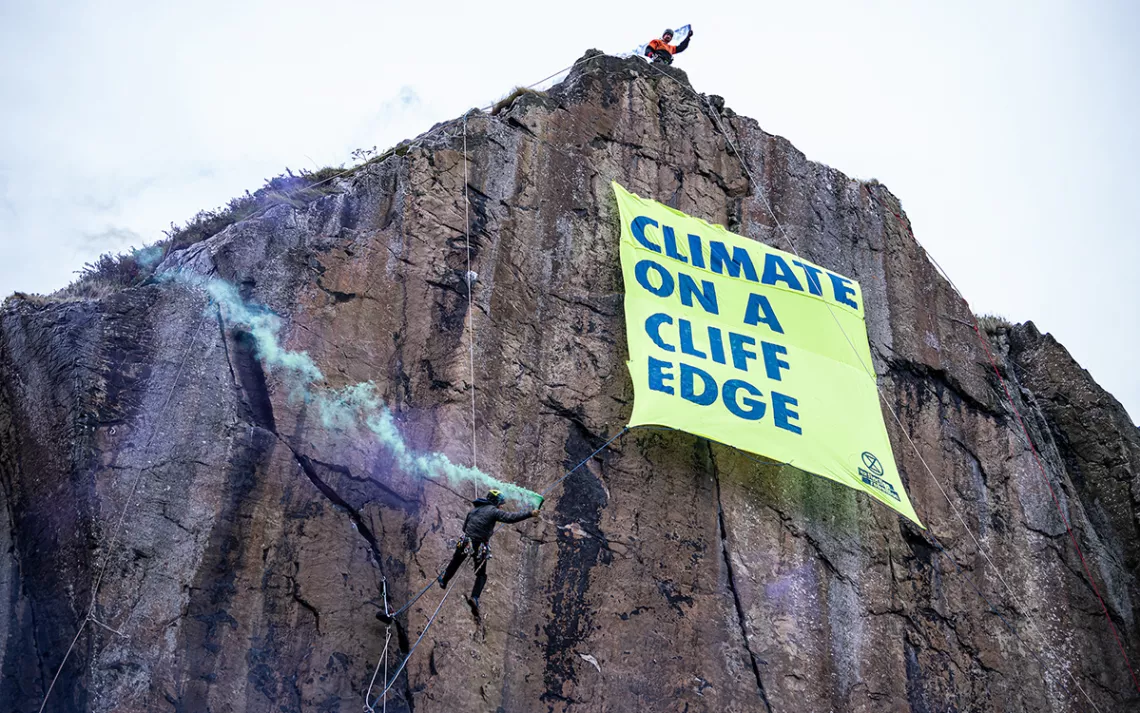
Experienced climbers scale a rock face near the historic Dumbarton castle in Glasgow, releasing a banner that reads “Climate on a Cliff Edge.” One activist, dressed as a globe, symbolically looms near the edge, while another plays the bagpipes on the shores below. | Photo courtesy of Extinction Rebellion and Mark Richards
Without action on climate crisis, far greater numbers will also experience floods, wildfires and droughts, according to report
Eight times as many children around the world will be exposed to extreme heatwaves in the 2050s, and three times as many will face river floods compared with the 2000s if current trends continue, according to the UN.
Nearly twice as many children are also expected to face wildfires, with many more living through droughts and tropical cyclones, according to the annual state of the world’s children report.
…
The report, released on Wednesday, World Children’s Day, forecasts how the climate crisis, demographic shifts (sub-Saharan Africa and south Asia are projected to have the largest child populations in the 2050s) and breakthrough technologies will affect children’s lives in the future.
The report said technologies such as artificial intelligence (AI) will bring benefits and risks to children, who are already interacting with AI embedded in apps, games and learning software. The digital divide remains stark, however. In 2024, almost 95% of people in high-income countries are connected to the internet, compared with about 25% in low-income countries.
“Children are experiencing a myriad of crises, from climate shocks to online dangers, and these are set to intensify in the years to come,” said Catherine Russell, Unicef’s executive director. “The decisions world leaders make today – or fail to make – define the world children will inherit … Decades of progress, particularly for girls, are under threat.”
Much of the emphasis of the report is on the impact of the climate crisis on children, nearly half of whom (approximately 1 billion) live in countries that face a high risk of environmental disasters. Even before they take their first breath, children’s brains, lungs and immune systems are susceptible to pollution, disease and extreme weather. As they grow, their education, nutrition, safety, security and mental health are shaped by the climate and environment.
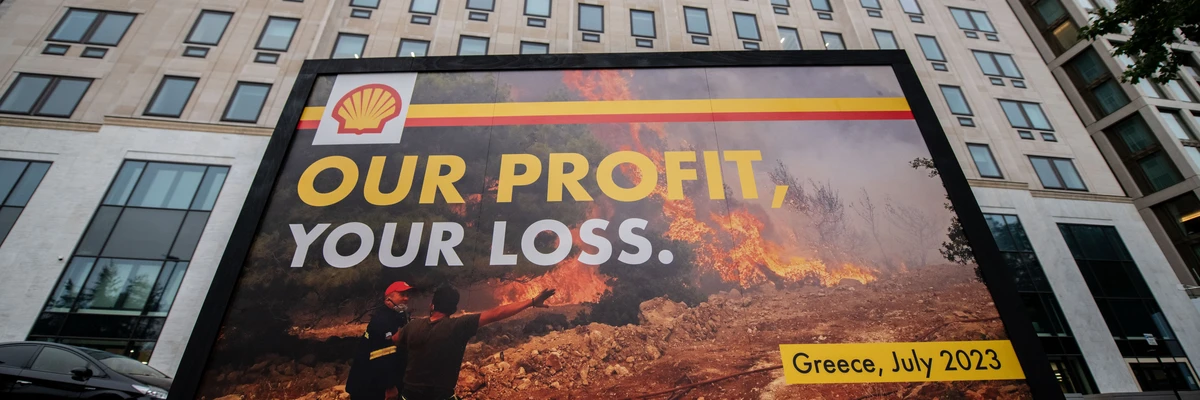
Greenpeace activists display a billboard during a protest outside Shell headquarters on July 27, 2023 in London. (Photo: Handout/Chris J. Ratcliffe for Greenpeace via Getty Images)
With average global temperatures set to see another record high this year, the chances of holding warming to no more than 1.5C continue to dwindle.
Keeping warming below 1.5C by the end of the century – in line with the long-term goal of the Paris Agreement – now likely involves “overshooting” 1.5C and then bringing temperatures back down later by removing carbon dioxide (CO2) from the atmosphere.
(What this means for “net-negative” emissions is covered in a previous guest post.)
This raises a number of unknowns in terms of what overshoot means for the impacts of climate change on the planet, people and ecosystems.
For example, even if global temperatures can be brought back down again by the end of the century, will the impacts of climate change also reduce? Will coral reefs be able to recover or will glaciers reform? What will it mean for the world’s coastlines, food production and endangered species?
For the past three years, we have been working on a Horizon Europe-funded project called PROVIDE to dive deeper into what overshoot really looks like for countries, regions and cities.
This data is available on the Climate Risk Dashboard – a tool to help people see how climate change will affect them and how it depends on the actions taken today.
Until carbon emissions are reduced to net-zero, the world will not stop warming. Delay will result in ever more intense climate impacts – and increase the risk of crossing irreversible thresholds.
Urban heat stress under overshoot
One of the clearest and most acute impacts of climate change is on extreme heatwaves. Our findings suggest that, were global average temperatures to decline, extreme heat events in most locations will also decrease, on average.
But achieving a new balance in local climates would be a slow process, influenced by ongoing climate system adjustments for decades – if not centuries – to come.
Reversing climate change would most probably take several decades, even if overshoot is limited to a few tenths of a degree. This implies that the climate risks that generations alive today will be exposed to are largely determined by collective actions today.
We can illustrate these differences for the risks of extreme heat stress for the Indian city of Chennai, one of 140 cities for which we modelled urban heat stress risks at 100-metre spatial resolution.
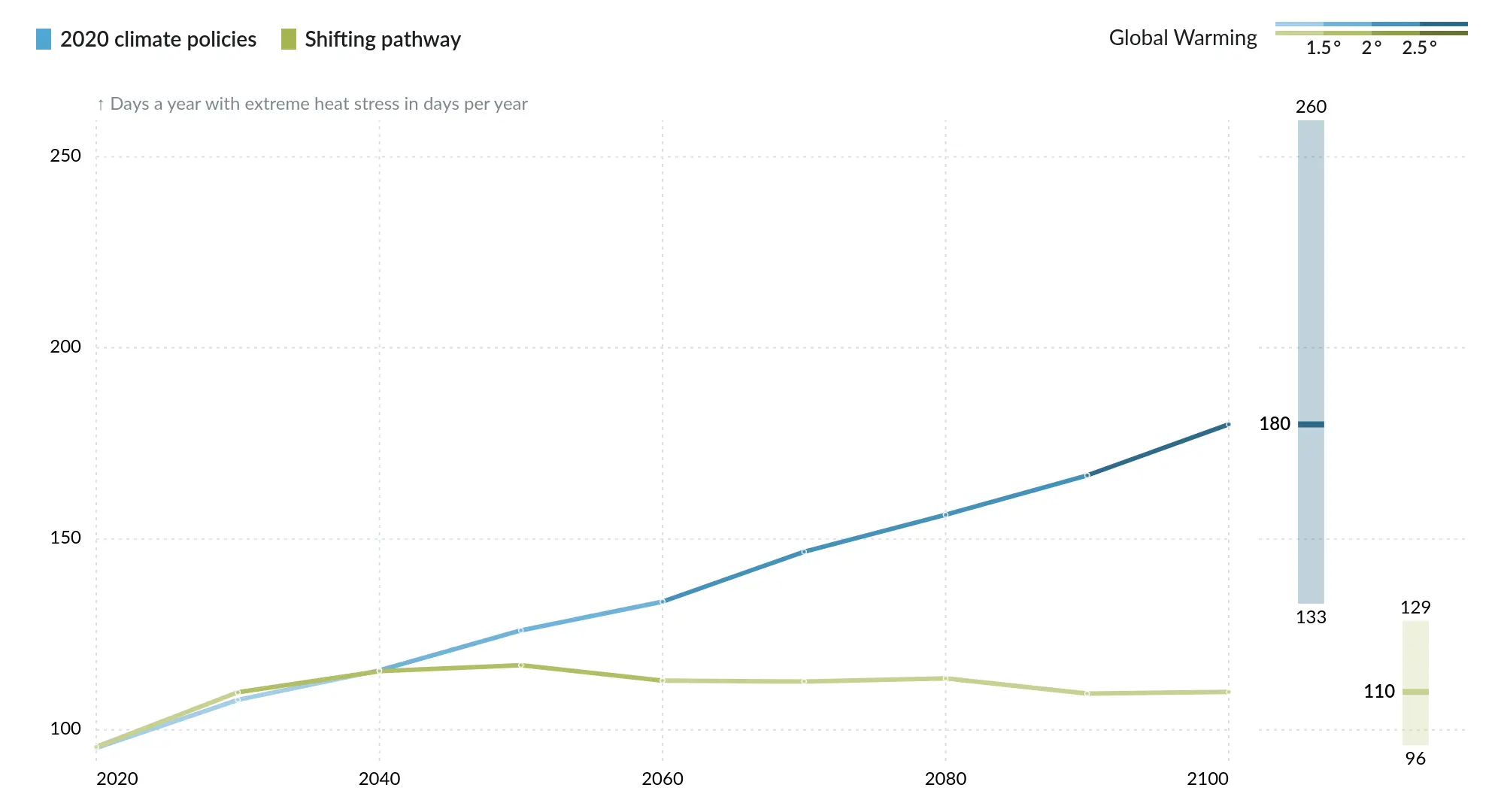
The chart below shows the projected annual number of days of extreme heat stress in Chennai – defined as days where wet-bulb globe temperature (WBGT) goes over 31C. (WBGT is a metric that combines air temperature, humidity and exposure to direct sunlight.)
This level of heat stress approaches the limits of human survivability (without adaptation) – for example, physical outdoor labour is almost impossible under these conditions.
Under current 2020 climate policies, leading to a best estimate of about 3C of warming in 2100, extreme heat days increase pretty much unchecked. By the end of the century, around half of the days (180) per year would experience extreme heat stress conditions (or even higher).
In contrast, in a 1.5C low-overshoot scenario (the IPCC Shifting Pathway), the number of extreme heat stress days would peak mid-century at around 120 days , before declining again to around 110 days by 2100 as global average temperature decreases from just above 1.5C to around 1.3C. This is a modest decline in extreme heat risk, yet a profound difference from a 3C world.
Projected days a year with extreme heat stress in Chennai from 2020 to 2100 under the climate policies of 2020 (blue) and 1.5C low-overshoot scenario called “IPCC Shifting Pathway” (green). Source: PROVIDE Dashboard
Irreversible consequences from overshoot
There are many other impacts of climate change that will be irreversible – for centuries to millennia – at peak temperatures, let alone if society is able to bring warming back down.
Yet, a lot of these losses can still be avoided by stringent mitigation. For example, our multi-scenario framework allows us to explore glacier futures showing unavoidable, or “locked-in”, risks even under the lowest emission scenario we have explored, and compare them with the avoidable risks through stringent mitigation.
Below, we provide an example for glacier volume projections for Peru, where glaciers serve as an essential freshwater resource during the extremely dry season of June to September. Due to past warming, glacier loss will continue over the coming decades. Under a current policy scenario (blue dots), 50% of the glacier volume might be lost as early as 2050.
Yet this does not need to happen. In fact, stringent mitigation pathways (green dots) are still possible that give a four-in-five chance of preserving 50% of today’s glacier ice in Peru, avoiding the worst and helping to maintain some of their vital uses.
Chart illustrating risks of losing 50% of 2020 glacier volume for Peru today and in 2030, 2050 and 2100, under the climate policies of 2020 (blue) and 1.5C low-overshoot scenario called “IPCC Shifting Pathway” (green). Shading highlights the avoidable risk. Source: PROVIDE Dashboard.
Overshoot risks for the biosphere
Climate change represents a major threat to biodiversity globally. We modelled species at risk from local extinction for about 135,000 terrestrial fungi, plants, invertebrates and vertebrates based on the Wallace Initiative.
Under the assumption that the 1950-2000 reference climate was suitable for the species at question, we model the proportion of species for which the local climate becomes unsuitable under ongoing climate change.
In the chart below, we illustrate the risks to species in one of the countries with the world’s richest terrestrial biodiversity, Brazil. Under the current policy scenario (blue dots), the likelihood of 50% of species being at risk of local extinction rises to 74% by 2100. Yet, our analysis shows that this likelihood can still be avoided almost entirely by stringent mitigation (green dots).
Chart showing the likelihood of 50% of Brazilian species being at risk of local extinction today and in 2030, 2050 and 2100, under the climate policies of 2020 (blue) and 1.5C low-overshoot scenario called “IPCC Shifting Pathway” (green). Shading highlights the avoidable risk. Source: PROVIDE Dashboard.
It is important to highlight that species loss does depend on a range of factors – of which climate suitability is only one. Yet there is a range of other human-caused stressors to biodiversity loss and a complex interdependencies of species and food webs in particular in the most biodiverse ecosystems implies the risk of knock-on effects and ecosystem tipping points.
We also note that our results do not necessarily imply global species extinction and do not allow us to quantify if and how species survival under different overshoot trajectories would emerge.
Overshoot will stress adaptation planning
Overshoot outcomes matter for climate risk assessments. Yet, in contrast with the prominence of overshoot pathways in the climate mitigation literature, their implications for adaptation planning have not been widely explored.
Overshoot would increase the threat of climate change that society needs to adapt to – and make that adaptation more difficult. Some options may become unavailable due to limits of adaptation.
Also, timescales matter. Reversing an overshoot will take decades. Even assuming reversibility of climate hazards in the future as temperatures come down, this might only matter for adaptation decisions that involve a planning horizon of 50 years or more.
This is illustrated in the chart below, from our recent Nature study. This shows a stylised trajectory of warming (top chart) with overshoot (red bars) and how it compares to planning horizons for some example adaptation options (green bars), the lifetime of those measures (blue bars) and the intergenerational equity they involve (bottom chart).
The possibility of reversing long-term impacts in the future does not reduce the urgent need to act now on closing the wide gap in current adaptation efforts.
Figure showing: a) stylised temporal evolution of a reversible climate impact driver under a peak and decline scenario. Dashed lines indicate a low and high overshoot outcome with median timescales of global temperature reversibility typically in line with those from the IPCC AR6 database; and b) stylised illustration of adaptation-relevant timescales starting in 2030, including different planning horizons for adaptation planning (green bars) and lifetimes of individual adaptation measures (blue), and the effect of applying discounting (reflecting societal preferences towards intergenerational equity) to future damages and adaptation benefits. Source: Schleussner et al. (2024)
Limit peak warming and aim for long-term decline
While our results clearly underscore the importance of limiting peak warming to as low as possible, there are also very good arguments for aiming for a long-term global temperature decline, irrespective of the peak warming level.
For a wide range of time-lagged climate impacts, such as ice sheet, peatland and permafrost loss, as well as large-scale irreversible tipping points, achieving temperature decline well below 1.5C is key to limiting long-term risks from global warming.
Overshoot is clearly not an alternative way to achieve a similar climate outcome. Effectively limiting climate risks requires restricting peak warming as low and as close to 1.5C as possible – and then aim for long-term decline to reduce the climate impact legacy of human-caused emissions.
Greenpeace activists display a billboard during a protest outside Shell headquarters on July 27, 2023 in London. (Photo: Handout/Chris J. Ratcliffe for Greenpeace via Getty Images)
“Every house burnt to the ground, every town forced to evacuate, every ecosystem lost to a wildfire is a necessary consequence of a business model like Shell’s.”
With much of the world reeling from record-shattering heat and devastating wildfires, the London-based oil giant Shell is poised to ramp up its investments in planet-warming fossil fuels after ditching its plan to cut oil production.
An analysis released Thursday by the rights group Global Witness estimates that Shell’s investments in oil and gas projects are set to surge to around $14.5 billion this year, a 10% increase over 2022. The company is expected to spend far less on what it defines as “renewables and energy solutions.”
“Fossil fuels are the number one cause of climate breakdown, which is stoking extreme heatwaves, forest fires, and drought,” said Jonathan Noronha-Gant, a senior campaigner at Global Witness. “Every house burnt to the ground, every town forced to evacuate, every ecosystem lost to a wildfire is a necessary consequence of a business model like Shell’s, which prioritizes short-term cash grabs over the safety and survivability of our societies.”
The new analysis came as Shell reported $5.1 billion in second-quarter profits, a major decline compared to the company’s record-setting $11.5 billion in profits during the same period last year. Despite the profit dip, which Shell blamed on falling oil and gas prices, the company announced a 15% quarterly dividend increase and $3 billion in stock buybacks.
“CEO Wael Sawan’s fossil fuel direction continues to be solely aimed at profit for shareholders,” Nine de Pater, a campaigner with Friends of the Earth Netherlands, said in a statement. “This is immoral and completely irresponsible. We are seeing the impact of the climate crisis around the world this summer: the wildfires in Greece and heat records in southern Europe, Algeria, and India, among others, and the floods in Italy and Afghanistan.”
“Shell’s profits clearly show that the company chooses profits over human lives,” she added.
Shell, which has known about the climate impacts of burning fossil fuels since the 1970s, announced last month that it intends to boost gas production in the coming years while abandoning its plan to reduce oil production by up to 2% per year.
In an interview weeks after the announcement, Sawan claimed it would be “dangerous and irresponsible” to curb oil and gas production even as scientists say that’s exactly what’s needed to avert catastrophic warming.
Global Witness recently estimated that Shell’s reversal on oil production could generate an average of “29 million tonnes of extra carbon per year, almost as much as Denmark emits annually.”
“By 2030,” the group added, “Shell’s extra estimated emissions would be as much as Spain—one of Europe’s largest polluters—produces in one year.”
Sherry Rehman, Pakistan’s minister for climate, told the Guardian that the country was facing an “existential crisis” as climate emergencies were being felt from the north to south of the country.
Rehman warned that the heatwave was causing the glaciers in the north of the country to melt at an unprecedented rate, and that thousands were at risk of being caught in flood bursts. She also said that the sizzling temperatures were not only impacting crops but water supply as well. “The water reservoirs dry up. Our big dams are at dead level right now, and sources of water are scarce,” she said.
Rehman said the heatwave should be a wake-up call to the international community. “Climate and weather events are here to stay and will in fact only accelerate in their scale and intensity if global leaders don’t act now,” she said.