Citing Bogus ‘Threats’ to US, Trump Expands Already Devastating Sanctions on Cuba

Spread the love

Article by Brett Wilkins republished from Common Dreams under Creative Commons (CC BY-NC-ND 3.0).
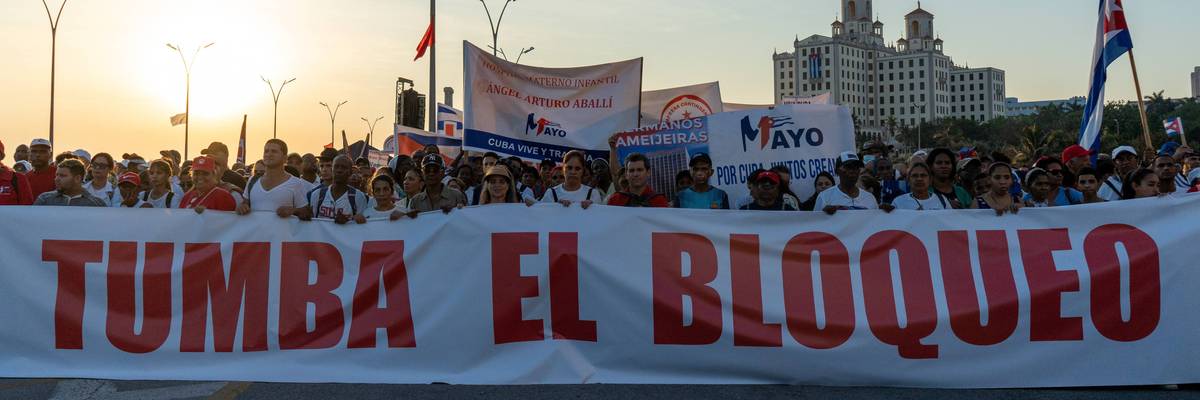
Cubans hold a banner reading, “Knock Down the Blockade” during an International Workers’ Day rally near the US Embassy in Havana on May 1, 2026. (Photo by Magdalena Chodownik/Anadolu via Getty Images)

The president’s latest aggression toward Cuba comes amid his repeated threats to “take” the island.

Citing Cuba’s ties with its ally Iran, President Donald Trump on Friday signed an executive order expanding the already crippling US sanctions regime against Cuban officials, as the US administration has the island in its crosshairs after ousting Venezuela’s socialist leader.

Trump’s executive order cites highly dubious “national security threats posed by the communist Cuban regime,” including Havana’s alignment “with countries and malign actors hostile to the United States.”

RECOMMENDED…
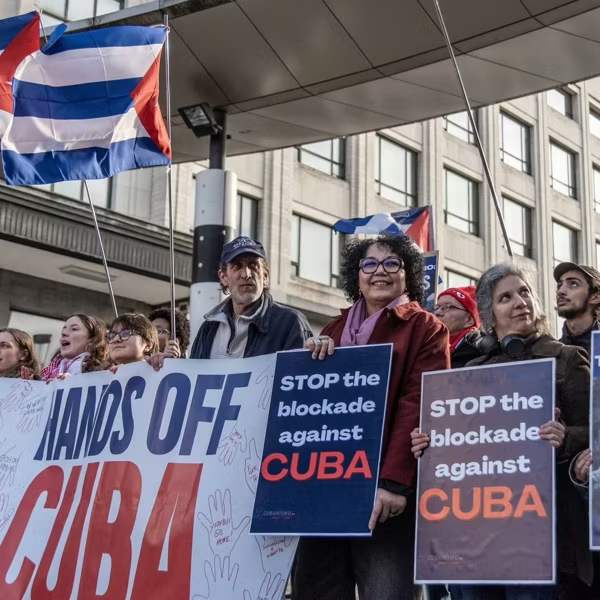
People protest against Trump aggression against Cuba with signs reading "Stop the Blockade Against Cuba"

‘This Is Insane’: Alarm Bells Follow New Report of Looming US Plan to Attack Cuba
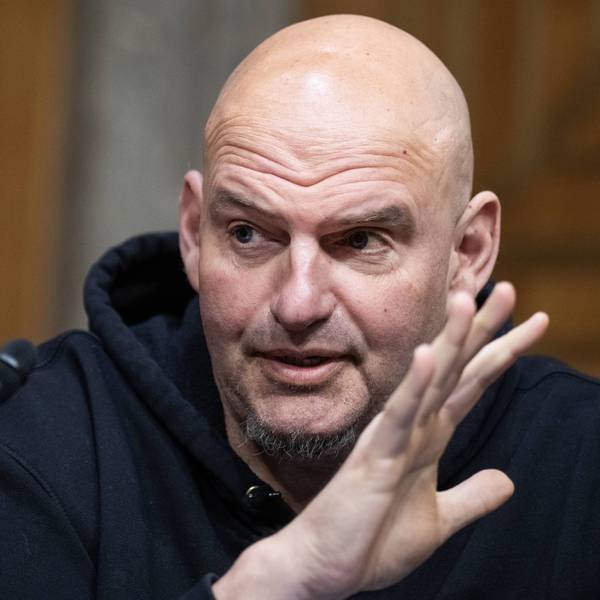
US Sen. John Fetterman in his hoodie in the Senate

Fetterman Helps GOP Senators Sink Democrat Effort to Block Trump War on Cuba

The directive “imposes new sanctions on entities, persons, or affiliates that support the Cuban regime’s security apparatus, are complicit in government corruption or serious human rights violations, or are agents, officials, or material supporters of the Cuban government,” without identifying any of the affected groups or individuals.

For 65 years, the US has imposed an economic embargo on Cuba that has adversely affected all sectors of the socialist island’s economy and severely limited Cubans’ access to basic necessities including food, fuel, healthcare, and medicines—with disastrous results. The Cuban government claims the blockade cost the country’s economy nearly $5 billion in just one 11-month period in 2022-23 alone. United Nations member states have perennially—and overwhelmingly—condemned the embargo.

The Trump administration also imposed a fuel blockade and reinstated Cuba on the US State Sponsors of Terrorism list, from which former President Joe Biden removed the country before leaving office in 2021. Cuba was initially added to the list during the Reagan administration amid a decadeslong campaign of US-backed Cuban exile terrorismfailed assassination attemptseconomic warfare, and covert operations large and small in a futile effort to overthrow the revolutionary government of longtime leader Fidel Castro.

Cuba says US-backed terrorism has killed or wounded more than 5,000 Cubans and cost its economy billions of dollars.

The Cuban government—which was celebrating International Workers’ Day on Friday—did not immediately respond to the expanded sanctions.

Experts warned that the new sanctions are worryingly broad, with Georgetown Law visiting scholar Peter Harrell writing on X that “basically any non-US person or company doing any business in/with Cuba could be sanctioned.”

Harrell noted that the edict “gives the Trump administration a fair amount of easy-to-deploy firepower to drive remaining international businesses out of Cuba.”

“The questions will be in implementation,” he added. “For example, will Trump sanction a Chinese firm installing renewable energy in Cuba?”

Trump’s edict comes months after the president ordered the invasion of Venezuela and abduction of socialist President Nicolás Maduro and amid the ongoing US-Israeli war on Iran, the 10th country bombed during the course of Trump’s two terms in office.

Trump last month declared that “we may stop by Cuba after we’re finished with this,” referring to war on Iran that’s left thousands of people dead or wounded, including hundreds of children. The president has also said that he believes he’ll “be having the honor of taking Cuba,” language echoing the 19th century US imperialists who conquered the island along with Puerto Rico, Guam, and the Philippines from Spain in another war waged on dubious pretense.

“Whether I free it, take it—I think I can do anything I want,” Trump said of the island and its 11 million inhabitants.

Article by Brett Wilkins republished from Common Dreams under Creative Commons (CC BY-NC-ND 3.0).

Orcas discuss how Trump was re-elected and him being an obviously insane, xenophobic Fascist.
Donald Fuhrump says that Amerikkka doesn't bother with crimes or charges anymore, not being 100% Amerikkkan and opposing his real estate intentions is enough.
Donald Fuhrump says that Amerikkka doesn’t bother with crimes or charges anymore, not being 100% Amerikkkan and opposing his real estate intentions is enough.
Donald Trump sings and dances, says that it's fun to kill everyone ...
Donald Trump sings and dances, says that it’s fun to kill everyone …

Continue ReadingCiting Bogus ‘Threats’ to US, Trump Expands Already Devastating Sanctions on Cuba

Cuba’s victory at Playa Girón and Castro’s legacy inspire renewed calls for global anti-imperialist solidarity

Spread the love

Article by Nicholas Mwangi republished from peoples dispatch under a Creative Commons Attribution-ShareAlike 4.0 (CC BY-SA) license.

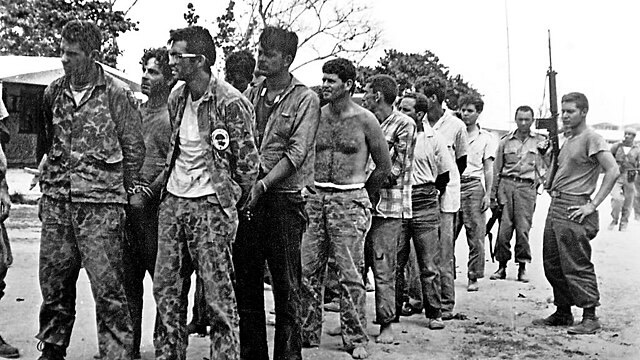
US forces captured in the Bay of Pigs invasion. Photo: Wikimedia Commons

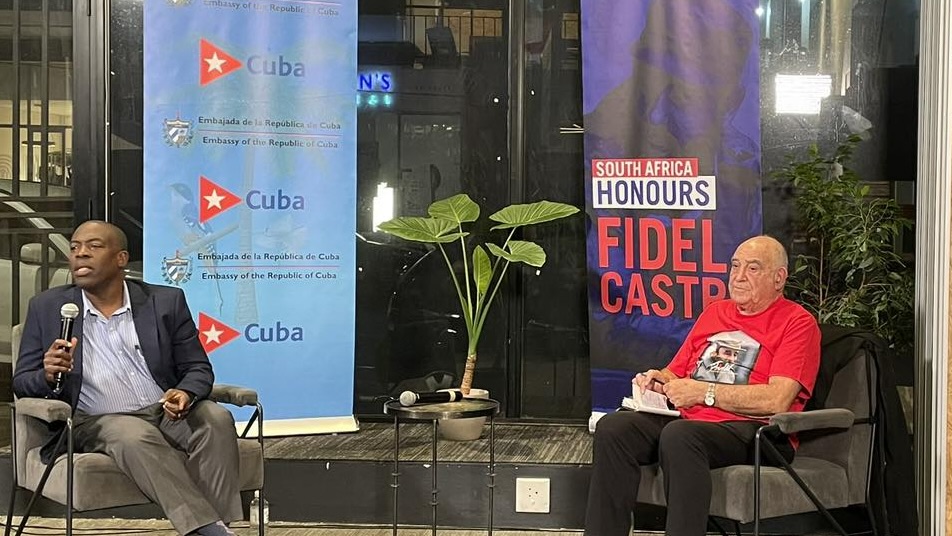
This month’s Anti-Fascist Friday in South Africa commemorated and reflected on the victory at the Bay of Pigs invasion, known in Cuba as Playa Girón, as well as the centenary of Fidel Castro. The event was addressed by Cuban diplomat Jesus Perz and veteran figure of South Africa’s liberation struggle Ronnie Kasrils.

On April 17, the Anti-Fascist Friday Forum in South Africa convened at the Forge in Johannesburg, marking two historic milestones: the centenary of Fidel Castro and the 65th anniversary of the victory at Playa Girón. The event was organized as a political intervention linking past revolutionary victories to the urgent tasks of confronting imperialism today. The event was addressed by Cuban diplomat Jesus Perz and veteran figure of the South African liberation struggle Ronnie Kasrils.

“Imperialism is not invincible” – Cuba’s defining moment

Opening the discussion, Jesus Perz delivered a detailed historical account of the events leading up to the invasion, emphasizing the political clarity and mass mobilization that defined Cuba’s response.

“On April 15, United States forces bombarded Cuban airfields to destroy our capacity to defend ourselves on air,” Perz explained. “But instead of weakening us, it prepared our people politically and militarily for what was coming.”

He described how, just a day later, a mass demonstration in Havana became a turning point.

“It was on April 16, during a massive gathering to honor those killed in the bombings, that Fidel Castro declared the socialist character of the Cuban Revolution,” Perz said. “He called on the people: ‘Let us march to the front, let us take up arms, and let us face the enemy with conviction.’”

The location holds symbolic importance. Playa Girón, he said, “Was an area where poor and humble Cubans lived, people for whom the revolution was made. The choice of that site by US imperialism shows clearly who they were targeting, the most oppressed.”

According to Perz, the battle that followed was fundamentally unequal, yet transformative.

“On one side, CIA-trained mercenaries. On the other, workers, peasants, women, Black Cubans, people who had never before held power,” he said. “And in less than 72 hours exactly, the invasion was defeated.”

Read more: Why the US wants to destroy Cuba

He stressed the broader significance of the victory:

“This was not only a military defeat of the United States. It was a defeat of imperialism by socialism. It showed the world that a small nation, organized and conscious, can defeat a superpower.”

Cuban diplomat in South Africa Jesus Perz and renowned South African anti-apartheid activist and veteran of the struggle Ronnie Kasrils. Photo: PAT

From military defeat to economic warfare

Perz explained that after its failure at Playa Girón, the United States shifted its strategy toward long-term destabilization.

“In 1960, US officials made it clear, if they could not defeat the revolution militarily, they would try to suffocate it economically,” he said. “The objective was to create hardship, lack of food, lack of medicine, so that the Cuban people would turn against their own government.”

He drew direct parallels to the present:

“What we are experiencing today is not new. The blockade, the pressure, the attempts to isolate Cuba, these are continuations of that same policy.”

Despite these pressures, Perz pointed out Cuba’s refusal to abandon its principles.

Read more: “This is our Moncada, our Bay of Pigs,” says young Cuban communist leader

“In the 1980s, we were told that if we stopped supporting African liberation struggles, the blockade could be lifted,” he said. “Our answer was clear; no. There is no possibility of abandoning our brothers and sisters in Africa.”

He situated this stance as important to Cuban identity:

“Internationalism is not optional for us. It is how we repay our debt to humanity. Our ancestors came from Africa, our strength, our resistance, our courage are rooted there. To abandon Africa would be to abandon ourselves.”

Kasrils: “The Cuban Revolution shaped our struggle”

Taking the floor, Ronnie Kasrils connected Cuba’s revolutionary experience to Africa’s liberation struggles, drawing from decades of personal involvement in the anti-apartheid movement.

Looking at the Cuban flag hanging on the wall, Kasrils remarked, “The Cuban flag stands for national independence, freedom, and anti-fascism.” “Its meaning has penetrated deeply into the consciousness of our struggle here in South Africa.”

He described how Cuba entered his political consciousness in the early 1960s.

“I had just joined the struggle as a young student after the Sharpeville massacre,” he recalled. “Within the movement, we began singing, ‘Go take the country the Castro way…’ That was the mood.”

Kasrils highlighted the decisive role Cuba played in Africa, particularly in Angola.

“When Angola was under threat from apartheid South Africa, from CIA-backed forces, it was Cuba that responded,” he said. “Not as invaders, but at the request of the Angolan people, to defend their sovereignty.”

He described the impact of this intervention:

“The Cuban presence changed the balance of forces. It was central to the defeat of apartheid’s regional aggression and contributed directly to our own liberation.”

Read more: Angola’s debt to Cuba is unfinished

Further he said; “[I] had the privilege of being in Cuba in a delegation led by Joe Slovo. We met Fidel Castro in the defense headquarters. He explained the battle of Cuito Cuanavale, how Cuban and Angolan forces dealt a decisive blow that led to Namibia’s independence and impacted South Africa’s freedom. Our freedom was driven by internal forces, but international solidarity was enormous.”

Humanity in struggle

A recurring theme in Kasrils’ remarks was the centrality of ordinary people in revolutionary struggle.

“Fidel said the revolution is of the humblest, by the humblest, and for the humblest,” he said. “When the humblest are armed with consciousness as well as weapons, real change becomes possible.”

He stressed that this principle remains relevant today.

“Revolutionary intellectuals are vital,” Kasrils noted, “but the link must always be with the humblest. They are the ones who stay with you to the end.”

National sovereignty and global struggle

Both speakers discussed the importance of sovereignty in contemporary struggles.

“The most important principle,” Kasrils argued, “is national sovereignty and independence. Without it, nothing else is possible.”

However, he warned against viewing struggles in isolation.

“The connection between Havana and Tehran, between Palestine and Africa, is not accidental,” he said. “These are all fronts in the same struggle against imperialism.”

Read more: Iran shows that sovereignty stems from military self-sufficiency and anti-colonialism, says Iranian professor

Perz echoed this sentiment:

“We are always open to dialogue with any country,” he said. “But it must be based on respect for our sovereignty, our independence, and our dignity as a people.”

With deepening crisis, widening inequalities, and intensifying imperialist interventions, the Anti-Fascist Friday gathering made clear that the anniversaries of Fidel Castro and the victory over the Bay of Pigs invasion are more than moments of remembrance, they are calls to action.

Article by Nicholas Mwangi republished from peoples dispatch under a Creative Commons Attribution-ShareAlike 4.0 (CC BY-SA) license.

Continue ReadingCuba’s victory at Playa Girón and Castro’s legacy inspire renewed calls for global anti-imperialist solidarity

“Even though our weapons were smaller, we didn’t stop fighting”: the testimony of a Cuban combatant after the US attack on Venezuela

Spread the love

Original article by Pablo Meriguet republished from peoples dispatch under a Creative Commons Attribution-ShareAlike 4.0 (CC BY-SA) license.

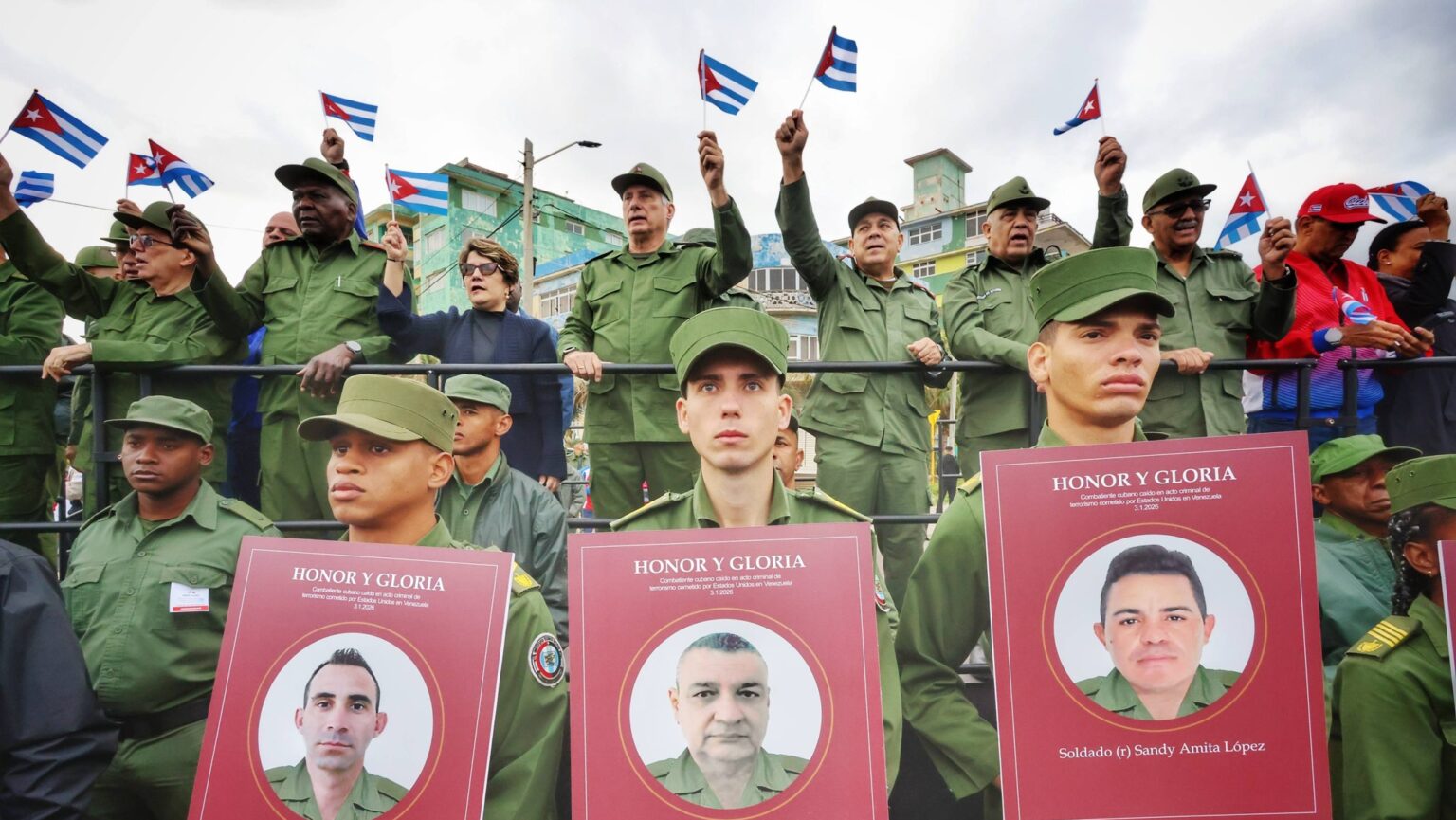
Cuban soldiers during a demonstration honoring the 32 combatants killed in the US attack on Venezuela. Source: Miguel Díaz-Canel/Facebook

Yohandris Varona Torres, a Cuban combatant and survivor of the US attack on Venezuela, describes the events of January 3.

Cuba honored 32 soldiers who fell in combat with the US army on January 3 in Venezuela, carrying out security activities legally agreed upon with the Caracas government. Many of the Cubans killed were part of the personal security detail of Venezuelan President Nicolás Maduro, who was kidnapped after the attack and transferred to the United States. Hundreds of thousands of Cubans attended the ceremonies commemorating the fallen in what the Cuban government described as a new attack against the Revolution.

But not all Cubans who fought against US forces died. Little by little, the testimonies of Cuban soldiers who survived a clearly uneven fight have been revealed.

The testimony of a surviving combatant

Among them is Yohandris Varona Torres, who gave an interview to Adelante, a Cuban media outlet. Varona had been in Venezuela for just over two months as a security guard until the day of the intervention, where, according to Venezuelan authorities, 100 people died and 100 more were injured.

“We fought there against the planes that were firing at us. Even though our weapons were smaller, we didn’t stop fighting; we confronted them. I am trained, and I know how to fight, but they were superior to us. At that moment, my only thought was to fight. We had to shoot, and I started doing so,” said Varona during the commemoration ceremony for the fallen combatants.

Regarding his personal experience during the attack, Varona stated that despite the narrative that the mainstream media tried to impose, the forces on the ground did confront US troops: “That night, I had gone on duty at midnight and was supposed to be there for six hours. The attack took place at approximately 2:00 a.m. It was dawn. Everything was dark. If a helicopter comes at you, the only thing you can do is shoot at it and defend yourself. That’s how it was. We were shooting until the very last moment.”

Varona also spoke about the huge technological gap between Venezuelan and US forces. The same argument had already been made by Cuban President Miguel Díaz-Canel, who explained the difference in weaponry and military infrastructure between the troops defending Venezuelan soil and the US attackers.

In addition, Varona said that after the attack, there was dispersion, and that there was no timely support to collect their dead compatriots: “Our comrades are a glory for all of Cuba. They were my brothers. They were working with me. I saw them all fall, and I carried them all. There was no support from anyone for that, but nobody was left on the field. We preserved them in one of our dormitories. I cannot explain the pain. But at least no one was left in Venezuela. Here they are, in our homeland.”

In the face of threats of possible new aggression against Cuba, during his speech to the crowd honoring the dead, Díaz-Canel said that revolutionaries are willing to fight to the bitter end if a similar or worse attack were to occur against the island. In the same spirit, Yohandris Varona Torres declared: “I will always be at my country’s disposal to fight the enemy wherever necessary. That is what the Commander [Fidel Castro] taught us. And the deaths of my comrades cannot be in vain.”

Original article by Pablo Meriguet republished from peoples dispatch under a Creative Commons Attribution-ShareAlike 4.0 (CC BY-SA) license.

Donald Fuhrump says that Amerikkka doesn't bother with crimes or charges anymore, not being 100% Amerikkkan and opposing his real estate intentions is enough.
Donald Fuhrump says that Amerikkka doesn’t bother with crimes or charges anymore, not being 100% Amerikkkan and opposing his real estate intentions is enough.
Elon Musk urges you to be a Fascist like him, says that you can ignore facts and reality then.
Orcas discuss how Trump was re-elected and him being an obviously insane, xenophobic Fascist.

Continue Reading“Even though our weapons were smaller, we didn’t stop fighting”: the testimony of a Cuban combatant after the US attack on Venezuela

In 1979, Fidel called it “genocide”: Cuba’s legacy of solidarity with Palestine

Spread the love

Original article by Pablo Meriguet republished from peoples dispatch under a Creative Commons Attribution-ShareAlike 4.0 (CC BY-SA) license.

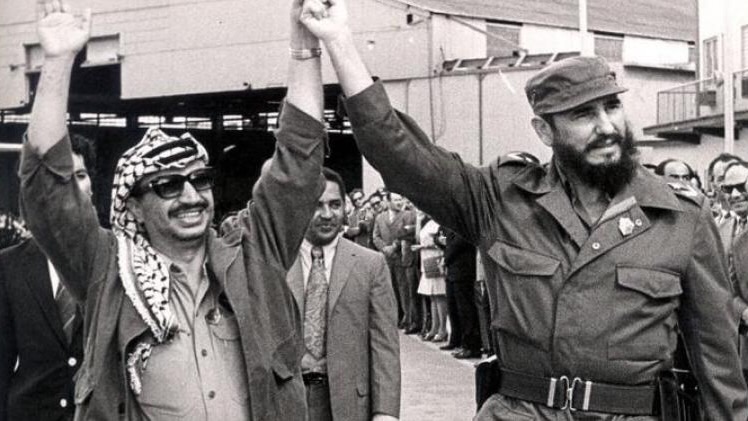
Palestinian leader Yasser Arafat and Cuban President Fidel Castro. Photo: Cuba Sí

On the 99th anniversary of Fidel Castro’s birth, we remember the revolutionary government’s support for Palestine, especially its condemnation of the genocide of the Palestinian people.

In a famous speech, Fidel Castro, the supreme leader of the Cuban Revolution, stated that medical, civil, and military support for the Angolan people was provided without expectation of any material reward. He pointed out that this way of thinking exposes an imperialist ideology, according to which one country supports another, always expecting to benefit materially in some way. “Revolutionaries expect nothing, which means that revolutionaries must devote themselves totally to a cause, to their ideas, to their noble goals, without expecting anything in return.”

This was the same principle that Fidel applied in supporting the Palestinian people’s struggle almost from the beginning of the revolutionary process he led since 1959. It is no coincidence that one of the most renowned Palestinian leaders, Yasser Arafat, visited the Caribbean Island eight times, on the personal invitation of Castro.

On October 12, 1979, at the United Nations Assembly, Fidel denounced before the world Israel’s process of territorial expansion, supported by the United States, at the expense of Palestinian territory. “The basis for a just peace in the region begins with Israel’s total and unconditional withdrawal from all occupied Arab territories and for the Palestinian people, the return of all their occupied territories and the restoration of their inalienable national rights, including the right of return to their homeland, self-determination, and the establishment of an independent state in Palestine, following General Assembly Resolution 3236,” Fidel said.

Castro acknowledged that this expansion was achieved through the killing of Palestinians, thus becoming one of the first world leaders to speak of “genocide” against the Palestinian people: “We repudiate with all our strength the ruthless persecution and genocide that Nazism unleashed against the Jewish people in its time. But I can think of nothing more similar in our contemporary history than the eviction, persecution, and genocide that imperialism and Zionism are carrying out today against the Palestinian people. Stripped of their lands, expelled from their homeland, scattered throughout the world, persecuted and murdered, the heroic Palestinians are an impressive example of self-sacrifice and patriotism, and they are the living symbol of the greatest crime of our time.”

Fidel also recognized that there are geopolitical interests that do not want peace to be established in the Middle East: “Can anyone be surprised that the Conference (of the Non-Aligned Movement) was forced, for reasons that do not stem from any political prejudice but from an objective analysis of the facts, to point out that US policy plays a fundamental role in preventing the establishment of a just and comprehensive peace in the region, by aligning itself with Israel, supporting it, and working to obtain partial solutions favorable to Zionist objectives and guaranteeing the fruits of Israeli aggression at the expense of the Arab people of Palestine and the entire Arab nation?”

“More than just rhetorical support, it was tangible support”

As historians point out, Fidel’s support for Palestine was not purely rhetorical, but also diplomatic. In 1974, Arafat arrived in Cuba and was received with the honors of a head of state, even though Palestine was not yet “officially” recognized as a state. Fidel’s message was clear: Palestine should be recognized by the international community as a state, and Arafat as its leader. In addition, Arafat was awarded the Playa Girón National Order, Cuba’s highest recognition for citizens “who have excelled in the struggle against imperialism, colonialism, and neo-colonialism, or who have done great deeds for peace and progress of mankind”.

The relationship between Cuban revolutionaries and the Palestine Liberation Organization (PLO) dates to the beginning of the Cuban Revolution. In 1959, Raúl Castro and Ernesto “Che” Guevara traveled to the Gaza Strip, disobeying the doctrine of hemispheric alignment whereby all Latin American countries, except for Cuba, supported Israel.

Thus, in 1964, thanks to Che Guevara’s tremendous efforts, Cuba recognized the PLO as soon as it was founded, becoming one of the first countries to do so. But its support went beyond official documents, according to Mansour Tahboub, former acting director of the Arafat Foundation: “Cuba has always been a strong supporter of Palestinians in all realms: political, military, vocational training. The Cubans trained Palestinian cadres, and Fidel himself was a staunch advocate of the Palestinian quest for freedom and independence.”

The truth is that one of the core principles of Castro’s administration was to support anti-imperialist and anti-colonialist struggles, wherever they took place. In a 1977 interview with French Weekly, Fidel stated: “The Palestinian movements have shown their ability to resist imperialist … aggression … [The Palestinian cause] will prevail sooner or later despite the betrayal by Arab reactionaries, imperialist maneuvers and Israeli aggression.”

That is why Cuba, along with Nicaragua, were the only two Latin American countries to condemn Israel’s actions after the Six-Day War. In 1973, Cuba severed diplomatic relations with Israel following the Non-Aligned Movement meeting in Algeria.

According to Abdel Majeed Sweilim, professor of political science at Al Quds University, the PLO also benefited from the relationship between Cubans and Palestinians, thanks to the political training of Palestinians on Cuban soil.

Today, despite the economic blockade imposed by the United States, which causes a perpetual economic crisis on the Caribbean Island, the Cuban government has reserved funding in the form of academic scholarships so that each year, 150 Palestinians can study medicine, engineering, and other professions at Cuban universities.

In his final years, Fidel continued to support the Palestinian cause. Thus, after resigning from his political posts, Castro signed an international manifesto in support of Palestine in 2014, which demanded Israel’s withdrawal from the Gaza Strip, the West Bank, and East Jerusalem, as well as respect for the resolutions passed by the United Nations regarding the conflict.

Arafat’s recognition of Cuban support

These and other measures have led countless Palestinians to see the revolutionary government of Cuba as an unwavering ally. Arafat himself acknowledged this when he stated: “I consider, Your Excellency President Fidel Castro, this demonstration of firmness and unwavering friendship that has taken place in Havana, as a strong and effective message from a beloved world leader who enjoys great international prestige among all the peoples and countries of the world, to mobilize them quickly to put an end to the suffering of the Palestinian people as a result of the Israeli occupation of their homeland, and the intensification of military, economic, and financial actions and blockades against our cities, villages, towns, farms, and water wells, and the closure of international border crossings by land, air, and water.”

In addition, the historic leader of the PLO said: “Every Palestinian today holds in their heart and conscience this glorious image of Your Excellency with the Palestinian hatta on your shoulders, which is irrefutable evidence of the justice of our cause and the magnitude of the injustice committed by the Israeli aggressors against our people. Have full confidence, Your Excellency President Castro, so beloved by our people and by all peoples, that our people, as resilient as the Palestinian mountains, take from your position and example, which makes us proud, more courage and determination to continue the struggle, the resistance, and the Intifada to remove the Israeli occupiers from our country, Palestine.”

In this way, Cuba continues to unreservedly support the demands for sovereignty, self-determination, and peace made by the Palestinian people in the face of the previous and most recent attacks by the Israeli government on their territory. This support, since 1959, is not given with the expectation of anything in return, but because of the anti-imperialist and anti-colonialist principles that guide the Cuban Revolution and that Fidel helped to establish as principles of the Cuban state itself.

Original article by Pablo Meriguet republished from peoples dispatch under a Creative Commons Attribution-ShareAlike 4.0 (CC BY-SA) license.

Experiencing issues with this image not appearing. I suspect because it's so critical of Zionist Keir Starmer's support of and complicity in Israel's genocides.
Genocide denier and Current UK Prime Minister Keir Starmer is quoted that he supports Zionism without qualification. He also confirms that UK air force support has been essential in Israel’s mass-murdering genocide. Includes URLs https://www.declassifieduk.org/keir-starmers-100-spy-flights-over-gaza-in-support-of-israel/ and https://youtu.be/O74hZCKKdpA
Keir Starmer objects to criticism of the IDF. He asks how could anyone object to them starving people to death, forced marches like the Nazis did, bombing Gaza's hospitals and universities,mass-murdering journalists, healthworkers and starving people queuing for food, killing and raping prisoners and murdering children. He calls for people to stop obstructing his genocide for Israel.
Keir Starmer objects to criticism of the IDF. He asks how could anyone object to them starving people to death, forced marches like the Nazis did, bombing Gaza’s hospitals and universities,mass-murdering journalists, healthworkers and starving people queuing for food, killing and raping prisoners and murdering children. He calls for people to stop obstructing his genocide for Israel.
Continue ReadingIn 1979, Fidel called it “genocide”: Cuba’s legacy of solidarity with Palestine

20 years of ALBA-TCP

Spread the love

Original article by Pablo Meriguet republished from peoples dispatch under a Creative Commons Attribution-ShareAlike 4.0 (CC BY-SA) license.

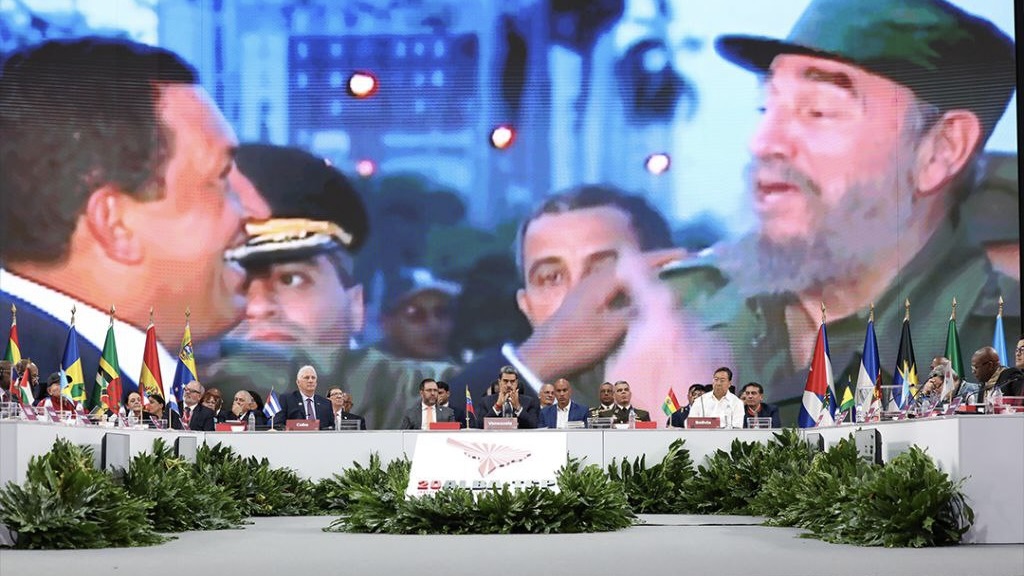
Heads of State Summit of ALBA-TCP in Caracas, Venezuela. Photo: ALBA-TCP

ALBA-TCP was founded in 2004 in an attempt to counter the US proposal of creating a “free trade zone of the Americas

December 14 marked the 20th anniversary of the creation of the Bolivarian Alliance for the Peoples of Our America-People’s-Trade Agreement (ALBA-TCP). ALBA-TCP was created in 2004 as a geopolitical alternative to the devastating advance of neoliberalism in the region.

The project was founded on December 14, 2004, in Havana by Cuban President Fidel Castro and Venezuelan President Hugo Chávez. Currently, the organization has 10 member countries and four countries considered “special guests.” In 2006, Bolivia signed its membership; in 2007, Nicaragua; in 2008, Dominica; in 2009, Antigua and Barbuda and St. Vincent and the Grenadines; in 2014, St. Kitts and Nevis and Grenada; and in 2021, St. Lucia. The special invited countries are Syria, Haiti, Suriname, and now Palestine.

To commemorate the 20 years, social movements, political parties, and heads of state gathered in Caracas, Venezuela for the 24th Heads of State Summit as well as parallel meetings. The event was attended by the host, Venezuelan President Nicolás Maduro; Bolivian President Luis Arce; Cuban President Miguel Díaz-Canel; Nicaraguan President Daniel Ortega; Prime Minister of St. Vincent and the Grenadines, Ralph Gonsalves; Prime Minister of Dominica, Roosevelt Skerrit; and the Prime Minister of Antigua and Barbuda, Gaston Browne.

Independence and solidarity among countries

In their addresses during the Summit on December 14, the heads of state and invited countries stressed the importance of solidarity among countries seeking alternative ways of development and the need for unrestricted solidarity among people struggling against imperialist attacks. They also demonstrated their support for Nicolás Maduro and his victory in the last presidential elections.

Miguel Díaz-Canel said “We reiterate the strongest support for the Bolivarian revolution, led by President Nicolás Maduro…We also call for the elimination of the blockade against Cuba …We cry out for a free Puerto Rico and declare our solidarity with Haiti, our Cuban doctors are there…We reiterate our demand for a ceasefire in Gaza and condemn the attacks perpetrated by Israel against Lebanon, Syria, and Iran.”

The Bolivian President, Luis Arce, highlighted the historical importance of ALBA in its fight against economic projects promoted by the United States such as the FTAA (Free Trade Area of the Americas): “The embrace of Hugo Chávez and Fidel Castro not only marked history but also manifested the defeat of the hegemonic project of the FTAA. ALBA was born, ALBA placed the human being at the center, promoting that a better world is possible. Bolivia reaffirms, once again, its commitment to ALBA-TCP, because it is a resistance that raises its voice against the unjust and criminal blockade against Cuba…ALBA is also a firm voice against the arbitrary and unilateral measures imposed against Venezuela and Nicaragua, which affect the welfare of our peoples.”

Nicolás Maduro said, “We must win the battle of life and truth in the streets, networks, media, and walls, as well as in the conscience and spirituality of the people.” He also added the importance of the struggle of the people to be masters of their destiny without imperial impositions or impositions of any kind. In the same line of discourse, Nicaraguan President Daniel Ortega said “From Nicaragua we reaffirm our commitment to ALBA. We will continue to fight the battle.”

The Prime Minister of Dominica, Roosevelt Skerrit stated “We congratulate the electoral triumph of President Nicolas Maduro on July 28. We wish him all the best…We also want to reaffirm our solidarity with the people of Cuba, a brave people for whom we have our greatest respect and love; we will never cease to lend our voice against the United States to eliminate the blockade against Cuba.”

Ralph Gonsalves, Prime Minister of St. Vincent and the Grenadines, harshly criticized US interference in the development of the past Venezuelan elections “Perhaps [the US government] thinks it is superior,” he said in this regard. He also stressed that the creation of ALBA-TCP was a fundamental invention for the emancipation of the American people, “ALBA is the product of the geniuses of our peoples.”

Inclusion of Palestine to ALBA-TCP

At the current summit, it was announced that Palestine had been included as a “brotherly country” and was included as a “permanent guest”. According to the resolution of the Heads of State, ALBA-TCP condemns the attacks against the Palestinian population and the “illegally occupied territories” and rejects “the merciless and inhuman genocide committed by the State of Israel, the occupying power, as well as its plan of spoliation, invasion, and domination.” Likewise, they denounced the support of several governments currently collaborating with the actions of the Israeli army and called for an “immediate ceasefire…From the heart of the peoples and governments of this alliance, we declare Palestine a brother country of the ALBA-TCP, and reaffirm our commitment to the defense of the Palestinian cause, which is the defense of humanity,” reads the resolution.

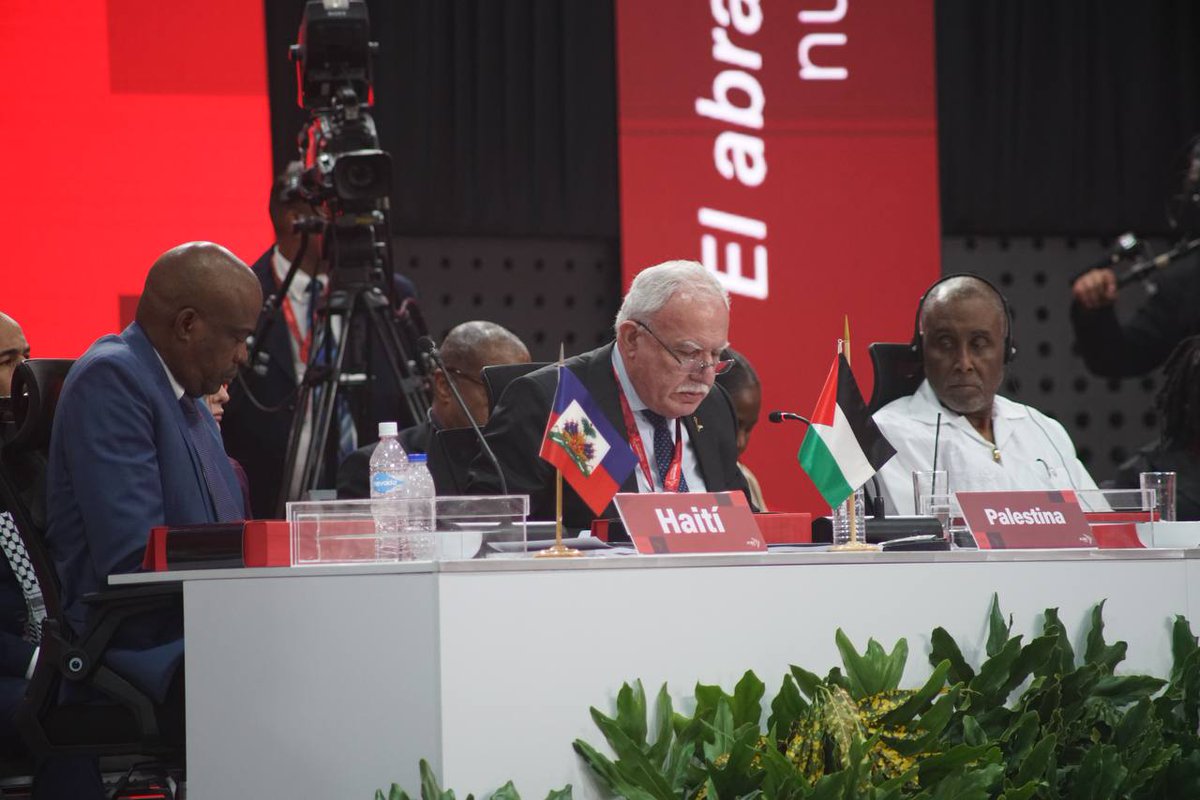
Riyad al-Malki addressing ALBA-TCP Summit. Photo: ALBA-TCP

In this regard, Riyad al-Malki, advisor to the President of State for International Affairs of Palestine said “History will remember those who stood on the side of justice, ALBA’s lasting solidarity with Palestine is a testimony of freedom and collective resistance.” Furthermore, Malki added “This Alliance is a living testimony of collective integration to challenge imperialism and ensure a just world. These values resonate with the Palestinian struggle, an end to the illegal occupation.”

A call for counter-hegemonic struggle

The joint document signed by all the countries highlights the historical importance of ALBA-TCP in the struggle for a more equitable world: “Twenty years after this giant step, we pay homage to the founding leaders, Hugo Chávez Frías and Fidel Castro Ruz, who adopted that December 14, 2004, in Havana, Cuba, the vision of the future embodied in the founding documents of ALBA, which have allowed us to walk united until the present, animated by the ancestral force that led our peoples to be free and that encourages us to continue integrated in this Alliance for Life.”

Similarly, it was stressed that the existence of this multilateral organization operates as a possibility to create a region that resists the impositions of the most developed countries: “Today, we want to ratify before our peoples, the counter-hegemonic, democratic, anti-imperialist and anti-fascist nature of our Alliance and renew our commitment to help and protect each other, to continue building together a future of shared goals under the founding principles of complementarity, cooperation, social justice, defense of our sovereignty and solidarity.”

In this sense, Luis Arce stressed that “In the face of the challenges of a world threatened by fascism and neo-fascism, ALBA is not an option, ALBA is a necessity that must continue with firm steps, reaffirming the founding principles of solidarity, justice, and cooperation…ALBA is not only an alliance, it is a promise for the future, a living resistance, an instrument for the most dispossessed, and a reminder that together, as peoples, we are invincible.”

Objectives and principles of ALBA-TCP

According to ALBA’s official website, the fundamental objective of the project is “to achieve integral development, ensure social equality and contribute to guaranteeing the quality of life, good living, independence, self-determination and identity of the peoples.” For this very reason, the principles of ALBA-TCP propose that political decisions be made horizontally and take into account the economic differences of its members without meaning that the importance of each of the members is underestimated.

The principles shared by the countries are “trade and investment should not be ends in themselves, but instruments to achieve sustainable development; special and differentiated treatment, according to the level of development of the various countries; economic complementarity and cooperation; cooperation and solidarity; the creation of the Social Emergency Fund; the integrative development of communications and transportation; the sustainability of development; energy integration; the promotion of investments of Latin American capital in the region; the defense of Latin American and Caribbean identity and culture; respect for intellectual property; and the agreement of multilateral positions and in negotiations with countries and blocs in other regions.”

Original article by Pablo Meriguet republished from peoples dispatch under a Creative Commons Attribution-ShareAlike 4.0 (CC BY-SA) license.

Continue Reading20 years of ALBA-TCP