Article by Belén Fernández republished form FAIR under a Creative Commons Attribution-NonCommercial-NoDerivs 3.0 Unported License.

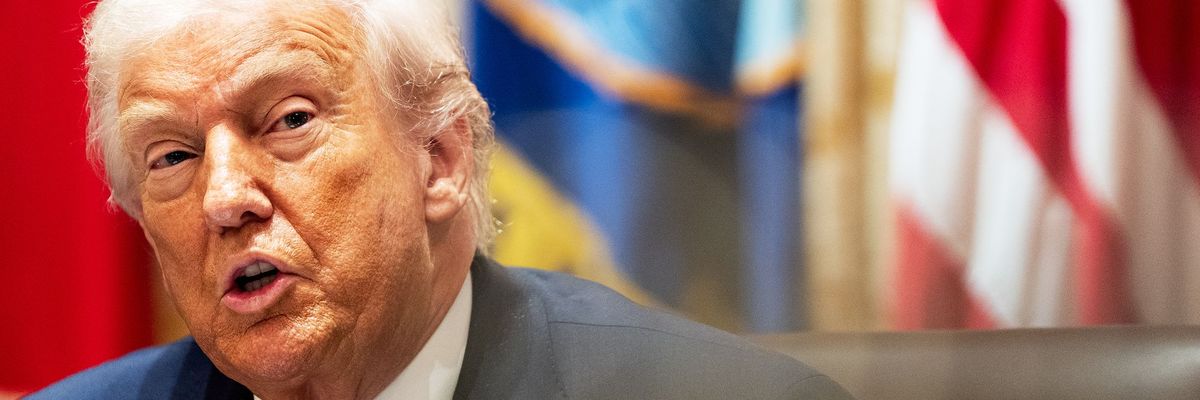
Addressing the UN General Assembly in September, Donald Trump gloated about his strategy toward “narcoterrorist” cartels, the menace du jour in the United States’ self-declared backyard. Pulling numbers out of his ass per usual, Trump claimed that the manic bombing campaign against alleged seafaring narcoterrorists (read: fishermen) in Central and South America has cut maritime drug trafficking by 97%, and called drug cartels the “ISIS of the Western Hemisphere.”
While it was by no means the president’s intention, he accidentally hit the nail on the head with the ISIS comparison. Both the Islamic State and Latin American drug trafficking outfits are a direct result of US policy—as well as a convenient excuse for the Americans to continue terrorizing people under the pretext of combating the very phenomena they caused in the first place. Just as ISIS owes its origins to the US invasion of Iraq, drug traffickers wouldn’t be in big business if not for—what else?—the US’s so-called “war on drugs” that renders the international movement of illicit substances so lucrative.
‘Same effect on land’
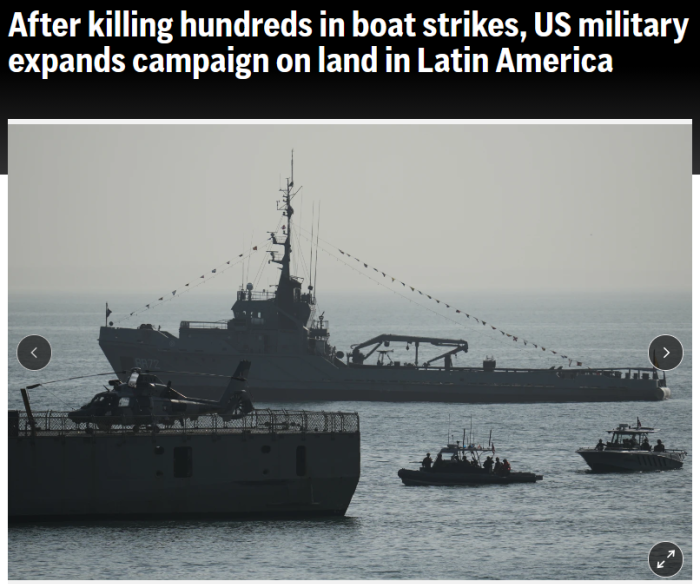
AP (8/17/26) describes the US military’s role in Latin America as “supplying allies with weapons, intelligence and training to fight drug trafficking”—while acknowledging “a fraught legacy of support for military coups and dictatorships.”
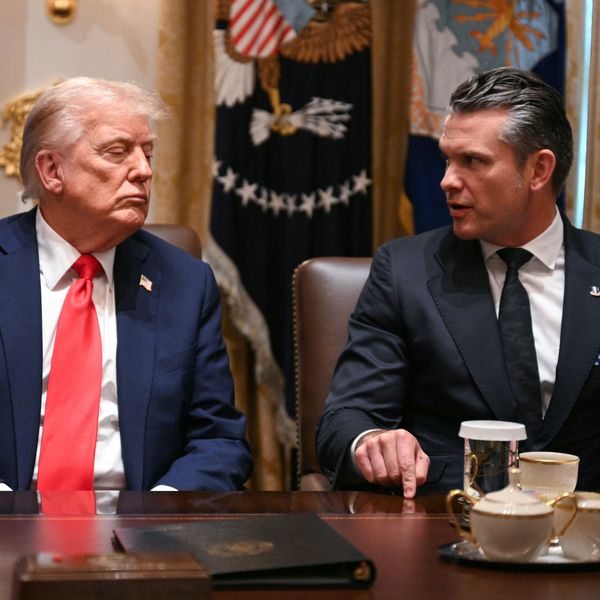
This year, the Trump administration has significantly ramped up its drug war beyond just randomly blowing people up in the ocean. In August, the Associated Press (8/17/26) reported on the government’s plans to expand operations to terra firma, quoting Secretary of War Pete Hegseth:
It will be “like you saw with the strikes on the drug boats,” Hegseth said during a military drill in the jungle in Panama. “Same effect on land.”
But since there are generally more people on land than in the middle of the sea, there will no doubt be far greater opportunities for extrajudicial execution in this new terrestrial phase of operations.
The escalated campaign takes place against the backdrop of the US-led “Shield of the Americas,” a hemispheric “anti-cartel coalition” inaugurated in March that now boasts the participation of 19 countries. Ecuador has been among the most gung-ho about joining forces with the US to launch “anti-cartel” raids, with such impressive feats to show for it as the joint bombing of a drug trafficking compound that turned out to be a dairy farm.
‘Long and bloody history’
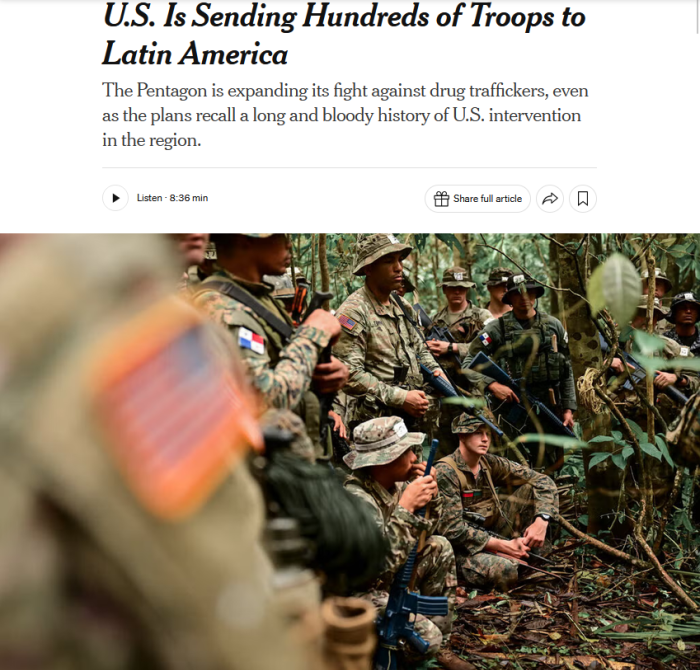
The New York Times (10/14/26) describes the US sending hundreds of combat troops to Latin America as “expanding its fight against drug traffickers.”
This month, the New York Times (10/14/26) was the first to report that the US had begun deploying a shit ton of troops to Latin America, and that a “new jungle training facility” in Panama was receiving “the first elements of a 600-soldier battalion from the 10th Mountain Division at Fort Drum, NY.” The Times also mentioned the Defense Department’s “recent movement of several MQ-9 Reaper drones from Africa to Colombia and Ecuador.”
The article’s subhead—“The Pentagon is expanding its fight against drug traffickers, even as the plans recall a long and bloody history of US intervention in the region”—leaves us with the expectation that we might be hearing something about, I dunno, the long and bloody history of US intervention in the region. And yet the only reference to that history in the body of the article occurs in a single sentence that is a modified replica of the subhead: “But the prospect of US operations on Latin American soil has raised concerns about sovereignty, and has recalled a long and bloody history of US intervention in the region.”
Surely an example or three of “intervention” wouldn’t have taken up too much space on the pages of the Times; the authors could have mentioned that time in 1989 the US military bombed to smithereens an impoverished neighborhood in Panama City, killing as many as several thousand civilians, in a bid to capture Panamanian leader Manuel Noriega. A longtime US buddy who had been on the CIA payroll for decades despite common knowledge of his involvement in the drug trade, Noriega had outlived his usefulness, and his drug dealings were suddenly so wrong and horrible as to necessitate the psychotic bombardment of poor Panamanians living in wooden shacks.
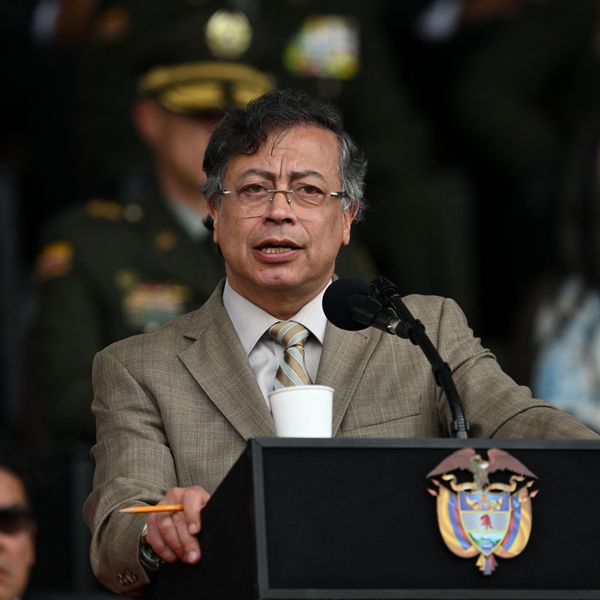
Or the Times could have delved into disproportionate US financial and moral support for the homicidal regime of Colombia’s far-right President Alvaro Uribe during the first decade of this century. Uribe himself appeared on a 1991 US Defense Intelligence Agency list of the “more important Colombian narco-traffickers contracted by the Colombian narcotic cartels”—but that was no reason he couldn’t be promoted to the role of America’s Super Drug War Ally and vanquisher of narcoterrorists.
As president, Uribe oversaw what came to be known as the “false positives” scandal, in which potentially more than 10,000 Colombian civilians were slaughtered by members of the Colombian army, who disguised the corpses as left-wing guerrillas in order to accrue promotions and vacation time. The Uribe administration then used these ostensible battlefield achievements to petition the US for yet more aid.
Last but not least, the Times could have brought up the Contra war on Nicaragua in the 1980s, when CIA-backed mercenaries unleashed terror on that nation while overseeing a profitable side hustle trafficking drugs to the US. The ensuing crack cocaine epidemic devastated Black communities across the country, but, hey, it was all in the name of saving the world from Communism.
Indeed, not only would such details give the Times’ readers an idea of the extent to which the US has traditionally been up to no good in Latin America (and at home), they would also soundly obliterate the official “drug war” narrative and expose it for what it is: a façade for imperial domination that really has nothing to do with stopping the flow of drugs at all.
‘Fight against drug traffickers’
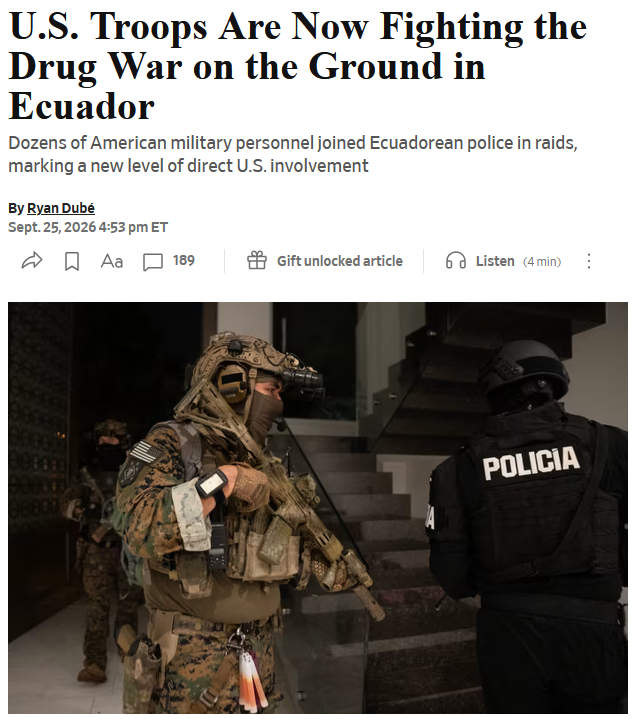
The Wall Street Journal headline (9/25/26) called the US military carrying out assassinations in Ecuador “Fighting the Drug War on the Ground.”
But for the New York Times and other corporate media, speaking truth to power is not part of the job description. While they may critique the methods or effectiveness of the “war on drugs,” these media stop far short of questioning its entire premise, and time and again the US government is allowed to set the terms of the discourse. Thus we have the Times droning on about the “fight against drug traffickers,” the “war against drugs,” the “escalating US-led military campaign against drug traffickers,” and the move “to target cartels.”
In a typical example from September, the Wall Street Journal (9/25/26) announced that “US Troops Are Now Fighting the Drug War on the Ground in Ecuador.” This month, the Washington Post (10/16/26) reported on shifting tactics in US “anti-drug strikes at sea.” The Hill’s Filip Timotija (10/7/26) observed that “the Pentagon is expanding the US military’s multifront war against drug cartels in South America.” And so on.
For its part, Reuters (9/22/26) has described Trump’s escalation as an “expanding campaign against drug cartels,” even while diplomatically cautioning that “rights groups” have said the US boat strikes “amount to extrajudicial killings.” This sort of diplomatic maneuver is another hallmark of a corporate media that can never come right out and say that spontaneously pulverizing people on fishing vessels actually counts as extrajudicial killing, whether you’re a “rights group” or not.
Mechanism for control
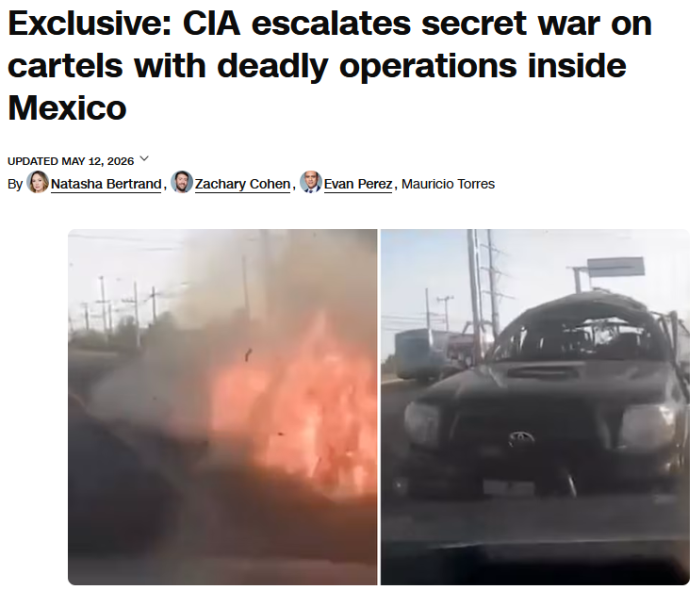
CNN (5/12/26) reported on an alleged CIA assassination in Mexico as being part of an effort “to dismantle the entrenched cartel networks.”
In May, CNN (5/12/26) published an exclusive report titled: “CIA Escalates Secret War on Cartels With Deadly Operations Inside Mexico.” This is the same CIA, of course, that has been up to its ears in drug trafficking since the Korean war—including, as it so happens, in Mexico. (For a rundown on CIA narco-exploits over the decades, see the 1993 article “The CIA Drug Connection Is as Old as the Agency,” which somehow made it onto the New York Times website. It begins with a “recent news item: The Justice Department is investigating allegations that officers of a special Venezuelan anti-drug unit funded by the CIA smuggled more than 2,000 pounds of cocaine into the United States with the knowledge of CIA officials.”)
The CNN piece details the targeted assassination of alleged Sinaloa Cartel operative Francisco Beltrán, whose car was blown up in March on a highway outside Mexico City. According to CNN:
The Beltrán operation was part of an expanded, and previously unreported, CIA campaign inside Mexico—spearheaded by the agency’s elite and secretive Ground Branch—to dismantle the entrenched cartel networks.
On the surface, at least, CNN is thus being insubordinate by publishing information that the US government does not want people to know; as the article specifies, the news outlet even gets dramatically accused by the CIA spokesperson of “false and salacious reporting that serves as nothing more than a PR campaign for the cartels and puts American lives at risk.”
And yet the apparent defiance of the government only goes so far. At the end of the day, the CNN exposé simply reinforces the narrative that the US is in fact fighting against drug cartels—and not using the “drug war” apparatus as a politico-economic weapon and mechanism for control.
No reference is made to the history of US government agencies collaborating with Mexican drug trafficking groups, including the Sinaloa Cartel itself, or to the preponderant role of US weapons manufacturers in arming criminal organizations in Mexico. (Recall that brilliant experiment during the Barack Obama presidency when the US Bureau of Alcohol, Tobacco, Firearms and Explosives facilitated the illegal purchase of thousands and thousands of guns on the off chance the trail would lead them to Mexican cartel leaders.)
‘Politics of extermination’
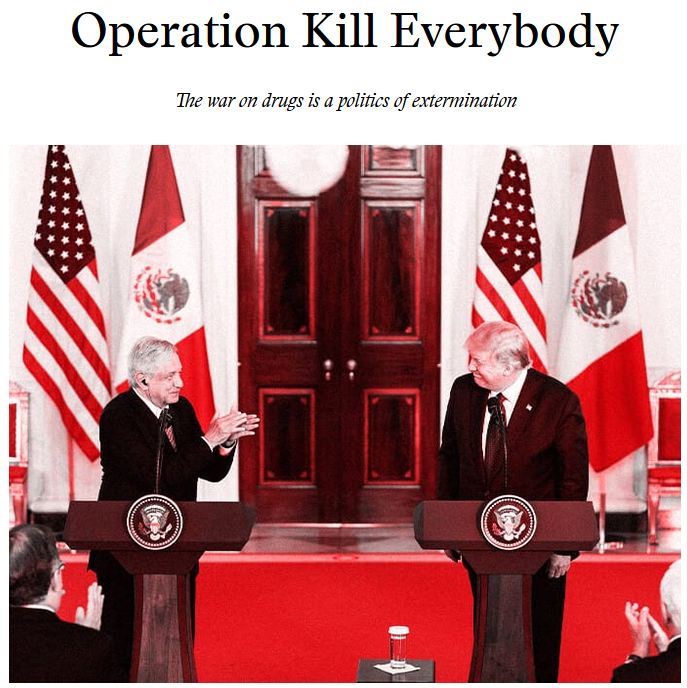
Oswaldo Zavala (Baffler, 6/18/26): “Government-sanctioned extrajudicial murders have been part of US military operations across the planet for several decades.”
Many corporate media interventions do take care to note that the current US approach in Latin America has not had any apparent effect on the drug trade; the New York Times (10/14/26), for instance, notes that “experts say that killing members of trafficking groups—even top leaders—does little to stem the flow of drugs.”
But media are never compelled to entertain the idea that stemming the flow of drugs may not even be the point—not even when, after using the drug war as a pretext, Trump straight-up admits that he attacked Venezuela and kidnapped its president for oil, plain and simple.
Since President Richard Nixon launched the “war on drugs” in 1971, the US still hasn’t managed to stem the flow, but the war has provided a whole lot of opportunities for the US militarization of Latin America and alliances with an array of regional right-wing nutjobs who are only too happy to facilitate imperial intrusion and neoliberal corporate assault at the expense of their populations.
The scholar Oswaldo Zavala, author of Drug Cartels Do Not Exist, contends in a recent essay for the Baffler (6/18/26) that “the ‘war on drugs’ is an overt politics of extermination.” It’s part of a panorama in which
from the Middle East to Latin America, a transnational military use of force has consistently been deployed against impoverished people in developing countries and sold as a war against “narcos,” “terrorists,” the artificial hybrid “narco-terrorists.”
Mexico, Zavala writes, has hosted the “most devastating such campaign in Latin America”; since the launch of the US-imposed war on drugs in 2006, more than 460,000 people have been killed and more than 134,000 disappeared, “a disproportionate number [of whom] have been poor, young, brown, uneducated men living in the outskirts of major cities.”
In their book Cocaine, Death Squads and the War on Terror: US Imperialism and Class Struggle in Colombia, Oliver Villar and Drew Cottle illustrate how the US-backed drug war in Colombia has traditionally not been against drugs, but rather for the control of the drug trade, which in the 1980s became a significant “source of profit for US capital.” To this day, the overwhelming majority of profits from the ongoing drug trade remain in the US.
‘Failed to curb cocaine supply’
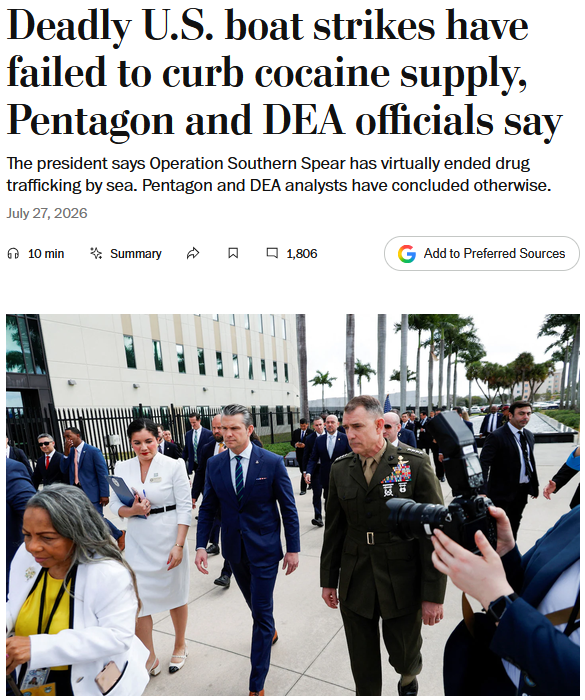
Washington Post (7/27/26): “Trump has transformed traditional US drug enforcement into a military campaign that fuses the legal and strategic approaches of the war on drugs and the war on terror.”
But corporate media continue to portray the “war on drugs” as just that, casting hints to the contrary as mere failures of drug war tactics and strategy. In an article headlined “Deadly US Boat Strikes Have Failed to Curb Cocaine Supply, Pentagon and DEA Officials Say,” the Washington Post (7/27/26) speculates that “there might, in fact, now be more cocaine circulating in the United States.” But for the Post, it’s still all ultimately part of a “decades-long war on drugs”—and no need to turn the entire concept on its head.
It should be quite clear, after 250 years of the United States of America, that the government is very often lying through its teeth. But corporate media outlets just can’t bring themselves to integrate the mass of incriminating material on the political expedience of the “drug war” into one cohesive anti-systemic analysis that would upend the government narrative.
Forty years ago, in September 1986, then-President Ronald Reagan solemnly addressed the nation about the dangers of drugs, even as he was funding the drug-running Contras: “Drugs are menacing our society. They’re threatening our values and undercutting our institutions. They’re killing our children.”
And judging from the behavior of the media, it seems that defying the government line might be equally menacing to society.
Featured Image: Secretary of Defense Pete Hegseth speaks at a forum of the Americas Counter Cartel Coalition in Panama City, August 12, 2026 (AP Photo: Matias Delacroix).
FAIR’s work is sustained by our generous contributors, who allow us to remain independent. Donate today to be a part of this important mission.

Belén Fernández
Belén Fernández is the author of The Darién Gap: A Reporter’s Journey through the Deadly Crossroads of the Americas and Inside Siglo XXI: Locked Up in Mexico’s Largest Immigration Center, among other titles. She is an opinion columnist at Al Jazeera.
Article by Belén Fernández republished form FAIR under a Creative Commons Attribution-NonCommercial-NoDerivs 3.0 Unported License.