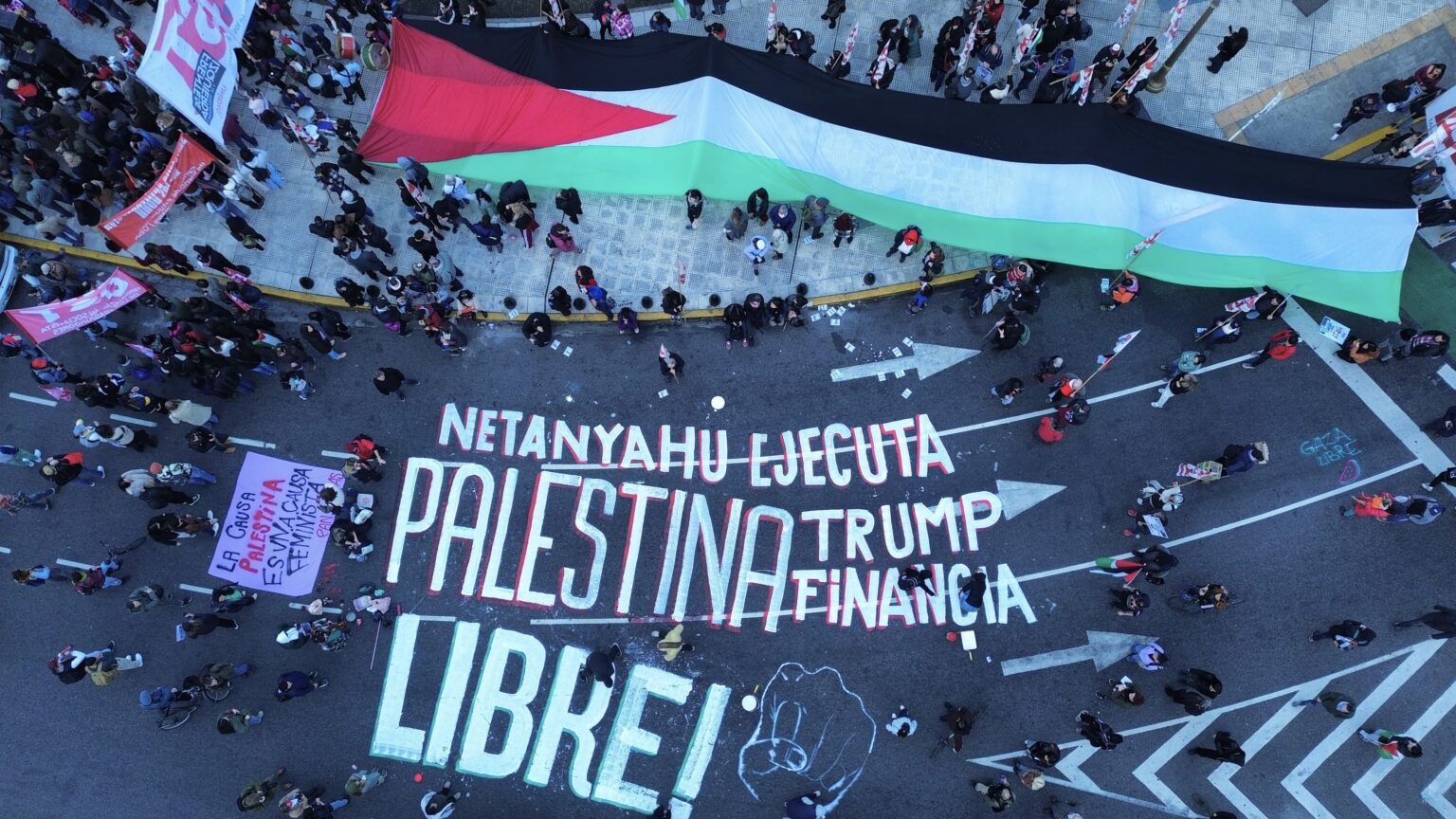
Buenos Aires march on Saturday, August 9. Photo: Argentine Committee for Solidarity with the Palestinian People
Protesters on Saturday also denounced the very close relationship between the governments of Milei and Netanyah
On August 9, thousands of Argentines took to the streets of the capital, Buenos Aires, demanding an end to the genocide being committed in Gaza, Palestine Israel. The slogan of the march was “We are all children of Gaza”.
The protesters denounced the indiscriminate attacks and forced starvation that, they claimed, Israeli forces are perpetrating against the civilian population.
The demonstration ended at Plaza de Mayo, where, according to some media outlets, more than 10,000 people demanded an end to the repressive actions in Palestine: “ Gaza is starving, time is up!” and “Palestine will prevail from the river to the sea” were some of the slogans chanted by the protesters as they waved Palestinian flags.
The march brought together human rights organizations, left-wing political parties, and various social movements, which declared that the only solution to any conflict in Palestine is peace, respect for sovereignty, and a dignified life for those who live there.
“We are facing genocide, which is confirmed by Israeli leaders themselves when they openly say that it is lawful to starve and dehydrate the entire population of Gaza, including its children. This genocide must be denounced relentlessly,” said Gabriel Solano, one of the leaders of the Left Front, during the mobilization.
For its part, the Palestinian Embassy in Argentina posted on X: “THANK YOU ARGENTINA, WE WILL NEVER FORGET! An impressive demonstration took place on Saturday, August 9, in Buenos Aires to denounce the genocide being carried out by the state of Israel against the Palestinian people.”
A close relationship between the governments of Argentina and Israel?
The demonstration also criticized the close ties between the Argentine and Israeli governments, which Argentine President Javier Milei (who recently traveled to the occupied Palestinian territories) has never denied. One of the slogans heard at the march was: “Milei, Zionist, you are the terrorist”.
Milei has announced that in 2026, he will relocate the Argentine embassy in Israel from Tel Aviv to Jerusalem, a move that Palestinians and several governments around the world have heavily criticized. For his part, Israeli Prime Minister Benjamin Netanyahu confirmed that he will soon come to Argentina on an official visit, a move that various Argentine political movements and parties have strongly denounced.
In addition to Buenos Aires, demonstrations against the genocide in Palestine took place in other Argentine cities, such as San Carlos de Bariloche, El Bolsón, Trelew, Comodoro Rivadavia, Ushuaia, Río Grande, San Salvador de Jujuy, Salta, San Miguel de Tucumán, San Juan, La Rioja, Catamarca, Mendoza, Santa Fe, Concepción del Uruguay, Córdoba, Cosquín, Alta Gracia, Villa Dolores, La Plata, Bahía Blanca, Mar del Plata, Neuquén, and Viedma.
Solidarity with Palestine continues to grow
“The last three demonstrations have grown due to the news about the genocide taking place in Gaza,” Gabriela B., an activist with Nuestramérica and member of the Argentine Committee for Solidarity with the Palestinian People, told Peoples Dispatch. For her, there is a significant increase in support for the cause, “If there was ever a belief that people could ignore the situation in Palestine without it affecting their humanity or without their stance being noticed, that idea has been shattered.”
She also pointed out the importance of Israel in Argentina: “In Argentina, the situation is very difficult. As a colleague mentioned, Argentina is considered the capital of Zionism [in Latin America], which means that the mainstream media only broadcasts voices that cover up the genocide. Furthermore, any action or complaint related to Palestine is framed within the concept of anti-Semitism, making solidarity and questioning of the situation even more difficult. The silence is already unsustainable, and Netanyahu’s possible visit, as well as the famine in Gaza, have triggered acts of repudiation. This resulted in posts on the accounts of famous artists during the week and in the large march that took place not only in Buenos Aires but in 30 other locations throughout the country, including cities and provinces.”
Regarding the demands made by the protesters, Gabriela said: “The main demand was a call to stop the genocide and famine, and to reject the possible visit to Argentina by Israeli Prime Minister Benjamin Netanyahu.” Other demands included:
The withdrawal of Israeli troops from Palestine, Syria, and Lebanon.
Ending diplomatic relations with Israel. Cancelling the Mercosur-Israel agreement (a Free Trade Agreement between Israel and a bloc of South American countries).
Stop the persecution of those who show solidarity with the Palestinian people.
In Argentina, two prominent political figures are currently being persecuted for tweeting about the genocide in Gaza: Vanina Biasi and Alejandro Bodart.
When asked about the criticisms raised during the march against Milei’s close relationship with Netanyahu, Gabriela B. said that in the last month, key political and progressive movements have begun to join the movement in support of Palestine and rejecting Israel’s actions. After Saturday’s march, momentum has continued to build, “various complaints were filed after Saturday by trade unions and human rights organizations, demanding Netanyahu’s arrest if he visits Argentina. The same complaint alleges that Netanyahu committed ‘genocide and war crimes’ against the Palestinians (presented by the secretary general of ATE Buenos Aires, Daniel ‘Tano’ Catalano, and the representative of the H.I.J.O.S. group, Verónica Castelli).”
She added: “However, as far as Milei and the ruling party are concerned, nothing has happened. No media outlet, except for alternative ones, has reported on the large march. The only news that managed to break through the media blockade and name Israel as a murderer was the news of the six journalists who were killed on Sunday. This march has served to denounce the Zionist alliance that the government maintains and to continue raising awareness among our people.”
Genocide denier and Current UK Prime Minister Keir Starmer is quoted that he supports Zionism without qualification. He also confirms that UK air force support has been essential in Israel’s mass-murdering genocide. Includes URLs https://www.declassifieduk.org/keir-starmers-100-spy-flights-over-gaza-in-support-of-israel/ and https://youtu.be/O74hZCKKdpAKeir Starmer objects to criticism of the IDF. He asks how could anyone object to them starving people to death, forced marches like the Nazis did, bombing Gaza’s hospitals and universities,mass-murdering journalists, healthworkers and starving people queuing for food, killing and raping prisoners and murdering children. He calls for people to stop obstructing his genocide for Israel.
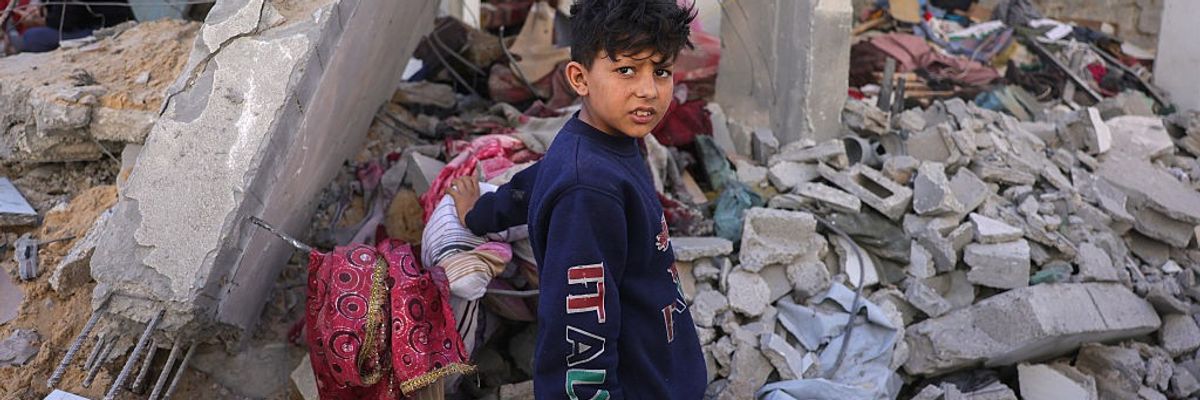
A Palestinian boy walks among the rubble of a home destroyed by Israeli bombing in Jabalia, Gaza, Palestine on May 29, 2025. (Photo: Bashar Taleb/AFP via Getty Images)
“The pattern suggests not an effort to neutralize a threat, but a deliberate campaign to dismantle and depopulate Gaza—a process of forced displacement which is a war crime.”
Israel’s U.S.-backed mass displacement of Palestinians in the Gaza Strip “is entirely erasing Gaza,” a leading international charity said Thursday as the United Nations’ Middle East peace envoy warned that ongoing airstrikes, forced starvation, and general despair have plunged the embattled coastal enclave into “an abyss.”
Since unilaterally breaking a cease-fire on March 2, “Israel issued nearly one displacement order every two days, strangling people into isolated areas covering less than 20% of the Gaza Strip,” Nairobi, Kenya-based Oxfam International noted.
“Combined with deliberate deprivation, this reveals a strategy not of targeting militants, but of dismantling and erasing Gaza itself,” Oxfam added. Some Israeli leaders have explicitly called for Gaza’s “erasure” to avenge the Hamas-led October 7, 2023 attack on Israel.
“People are so exhausted, many would rather face death than flee again.”
“For over 600 days, Israel has been saying it’s targeting Hamas, but it is civilians who have been corralled, bombed, and killed en masse every day,” said Bushra Khalidi, Oxfam’s policy lead in the Occupied Palestinian Territory.
“The displacement orders follow a clear and calculated pattern: using the threat of violence to herd civilians into ever-shrinking zones of confinement,” Khalidi added. “This isn’t counterterrorism, as Israel alleges—it’s the systematic clearing of Gaza through militarized force into enclaves of internment.”
📽️ WATCH: This map visualizes #Gaza’s systematic erasure. Since breaking the ceasefire, Israel issued nearly one displacement order every two days, strangling people into isolated areas covering less than 20 percent of the Gaza Strip. Find out more: oxf.am/3Hbshlz
Oxfam analyzed Israel’s more than 30 displacement orders, which, combined with Israel Defense Forces (IDF)-designated “no-go zones,” cover more than 80% of the 141-square mile Gaza Strip.
“The sheer scale and relentless frequency of these orders have made it virtually impossible for people to find refuge,” the charity said. “The pattern suggests not an effort to neutralize a threat, but a deliberate campaign to dismantle and depopulate Gaza—a process of forced displacement which is a war crime.”
As Oxfam noted:
In just the last week (15–20 May), over 160,000 people were displaced—part of a broader total of nearly 600,000 people displaced since March 18, many of them repeatedly. One of the most significant recent orders, issued on 20 May, covered 34.9 square kilometers, roughly 10% of Gaza’s land area, that affected 150,000–200,000 people in North Gaza’s Beit Lahia and Jabalia. The effect of such orders on already-displaced populations has been devastating.
“Imagine trying to move with four children or an elderly parent in the middle of the night, with no transport and nowhere to go,” said Oxfam gender adviser Fidaa Alaraj, who has been displaced with her family several times. “People are so exhausted, many would rather face death than flee again.”
Fugitive Israeli Prime Minister Benjamin Netanyahu—who is wanted by the International Criminal Court for alleged war crimes and crimes against humanity in Gaza, including extermination and forced starvation—recently said that Israel will control all of Gaza after Operation Gideon’s Chariots, a campaign to conquer, ethnically cleanse, and indefinitely occupy the strip.
Far-right members of Netanyahu’s Cabinet and the Israeli Knesset want to permanently seize Gaza and reestablish Jewish-only apartheid colonies in the coastal enclave, which U.S. President Donald Trump has proposed taking over and turning into the “Riviera of the Middle East.”
“There is one essential condition: We must not reach a situation of famine, both from a practical standpoint and a diplomatic one,” Netanyahu said on May 19. “People simply won’t support us.”
While 82% of Israelis surveyed in a recent poll said they supported the ethnic cleansing of Gaza—and nearly half backed a biblical genocide of Palestinians—much of the world is aghast at Israel’s annihilation of the strip, which has left more than 191,000 people dead, maimed, or missing and around 2 million others forcibly displaced, often more than once.
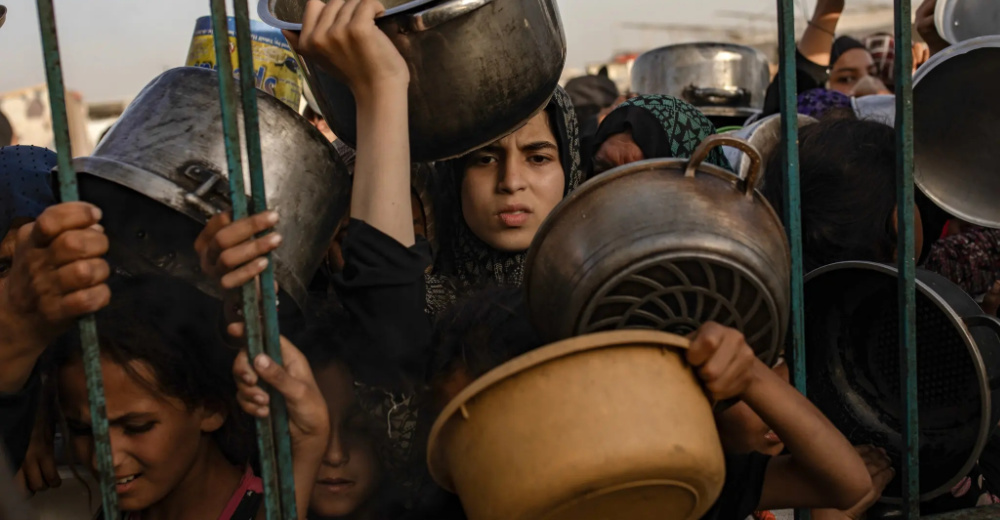
Meanwhile, the famine against which Netanyahu warned looms larger than ever as hundreds of Gazans, mostly children and the elderly, have recently died from malnutrition and lack of medical care, according to local officials.
On Thursday, Sigrid Kaag, the interim U.N. Special Coordinator for the Middle East Peace Process, warned that Gazans are “being starved and denied the very basics” by Israel, which in March tightened an already crippling “complete siege” of Gaza. The blockade has been cited in the South Africa-led genocide case against Israel currently before the International Court of Justice.
“The entire population of Gaza is facing the risk of famine,” she warned, likening the trickle of aid allowed into the strip by Israel to offering “a lifeboat after the ship has sunk.”
Kaag highlighted the despair pervasive among Gazans, who she said bid farewell not by saying, “Goodbye, see you tomorrow,” but rather with the words “see you in heaven.”
“Death is their companion. It’s not life, it’s not hope,” she said.
“Since the collapse of the ceasefire in March, civilians have constantly come under fire, confined to ever-shrinking spaces, and deprived of lifesaving relief,” Kaag added. “Israel must halt its devastating strikes on civilian life and infrastructure.”
“This annihilation campaign and the bloodshed must end.”
Echoing Kaag’s remarks, Oxfam’s Khalidi said that “this annihilation campaign and the bloodshed must end. It is long past time for Western governments and other influential powers to move beyond statements and apply meaningful pressure on Israel to lift the siege and abandon any designs on annexing Gaza.”
“Peace cannot be brokered on the ruins of Gaza nor the theft of Palestinian land,” she stressed. “Ahead of the Two-State Solution Summit planned in New York next month, world leaders must urge Israel to lift the siege and abandon any annexation plans of Gaza or the West Bank.”
“What’s at stake is not only Palestine’s future,” Khalidi argued, “but the integrity of every nation that claims to uphold international law.”
Genocide denier and Current UK Prime Minister Keir Starmer is quoted that he supports Zionism without qualification. He also confirms that UK air force support has been essential in Israel’s mass-murdering genocide. Includes URLs https://www.declassifieduk.org/keir-starmers-100-spy-flights-over-gaza-in-support-of-israel/ and https://youtu.be/O74hZCKKdpAUK Labour Party Shadow Foreign Secretary repeatedly heckled at a speech to the Fabian Society over his and the Labour Party’s support for and complicity in Israel’s genocide of Gaza.
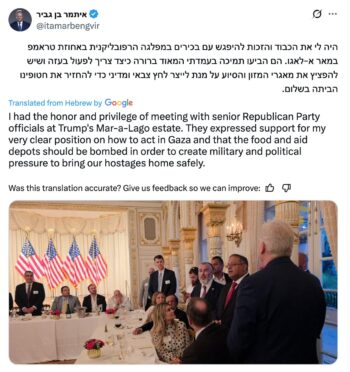
Israeli National Security Minister Itamar Ben-Gvir tweeted that Republican officials at Mar-a-Lago “expressed support for my very clear position on how to act in Gaza and that the food and aid depots should be bombed in order to create military and political pressure to bring our hostages home safely.”
Israeli Prime Minister Benjamin Netanyahu announced on March 2 that “Israel has decided to stop letting goods and supplies into Gaza,” where the ongoing Israeli genocide, with the loyal backing of the United States, has officially killed more than 51,000 Palestinians since October 2023. The announcement regarding the total halt of humanitarian aid amounted to yet another explicit declaration of the starvation policy that Israel is pursuing in the Gaza Strip, a territory that—thanks in large part to 17 consecutive years of Israeli blockade—has long been largely dependent on such aid for survival.
Of course, this was not the first time that senior Israeli officials had advertised their reliance on the war crime of forced starvation in the current genocidal assault on Gaza. On October 9, 2023, two days after the most recent launch of hostilities, then–Defense Minister Yoav Gallant ordered a “complete siege” of the Gaza Strip: “There will be no electricity, no food, no fuel, everything is closed.” Two days after that, Foreign Minister Israel Katz boasted of cutting off “water, electricity and fuel” to the territory.
And just this month, Israeli National Security Minister Itamar Ben-Gvir proclaimed that there was “no reason for a gram of food or aid to enter Gaza.” Following an April 22 dinner held in his honor in Florida at US President Donald Trump’s Mar-a-Lago resort, Ben-Gvir reported that US Republicans had
expressed support for my very clear position on how to act in Gaza and that the food and aid depots should be bombed in order to create military and political pressure to bring our hostages home safely.
Never mind that the hostages would have been brought home safely as scheduled had Israel chosen to comply with the terms of the ceasefire agreement with Hamas that was implemented in January, rather than definitively annihilating the agreement on March 18. It is no doubt illustrative of Israel’s modus operandi that the March 2 decision to block the entry of all food and other items necessary for human existence took place in the middle of an ostensible ceasefire.
‘Starved, bombed, strangled’
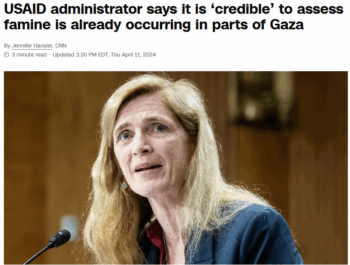
A year ago, USAID administrator Samantha Power (CNN, 4/11/24) said it was “likely that parts of Gaza, and particularly northern Gaza, are already experiencing famine.”
While Ben-Gvir’s most recent comments have thus far eluded commentary in the US corporate media, the roundabout media approach to the whole starvation theme has been illuminating in its own right. It has not, obviously, been possible to avoid reporting on the subject altogether, as the United Nations and other organizations have pretty much been warning from the get-go of Israel’s actions causing widespread famine in Gaza.
In December 2023, for example, just two months after the onset of Israel’s blood-drenched campaign, the Integrated Food Security Phase Classification initiative, or IPC scale, determined that “over 90% of the population in the Gaza Strip (about 2.08 million people) was estimated to face high levels of acute food insecurity, classified in IPC Phase 3 or above (Crisis or worse).” The assessment went on: “Among these, over 40% of the population (939,000 people) were in Emergency (IPC Phase 4) and over 15% (378,000 people) were in Catastrophe (IPC Phase 5).”
A full year ago, in April 2024, even Samantha Power—then the administrator of the US Agency for International Development—conceded that it was “credible” that famine was already well underway in parts of the Gaza Strip. And the UN Office for the Coordination of Humanitarian Affairs now warns that Gaza is “likely facing the worst humanitarian crisis in the 18 months since the escalation of hostilities in October 2023”—its population being “starved, bombed, strangled” and subjected to “deprivation by design.”
Disappearance of agency
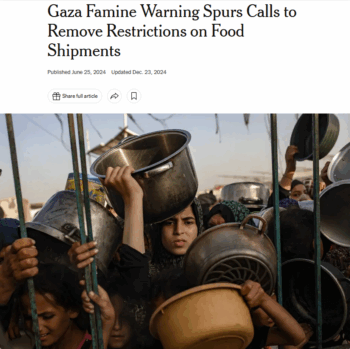
Typically, even when outlets report sympathetically on hunger in Gaza, they fail to state clearly that it is the deliberate result of Israeli policy, as in this New York Times headline (6/25/24).
None of these details have escaped the pages and websites of corporate media outlets, although the media’s frequent reliance on ambiguous wordiness tends to distract readers from what is actually going on—and who is responsible for it. Take, for instance, the New York Times headline “Gaza Famine Warning Spurs Calls to Remove Restrictions on Food Shipments” (6/25/24), or the CBS video “Hunger Spreads Virtually Everywhere in Gaza Amid Israel/Hamas War” (12/5/24). Even news outlets that intermittently undertake to spotlight the human plight of, inter alia, individual parents in Gaza losing their children to starvation remain susceptible to long-winded efforts to disperse blame. (As of April of last year, Save the Children confirmed that 27 children in northern Gaza had already died of starvation and disease.)
In an era in which news consumption often consists of skimming headlines, the phrasing of article titles is of utmost import. And yet many headlines manage to entirely excise the role of Israel in Gaza’s “hunger crisis”—as in CNN’s report (2/24): “‘We Are Dying Slowly:’ Palestinians Are Eating Grass and Drinking Polluted Water as Famine Looms Across Gaza.” Or take the Reuters headline (3/24/24): “Gaza’s Catastrophic Food Shortage Means Mass Death Is Imminent, Monitor Says.” Or this one from ABC News (11/15/24): “Famine ‘Occurring or Imminent’ in Parts of Northern Gaza, Experts Warn UN Security Council.”
It’s not that these headlines are devoid of sympathy for Palestinian suffering. The issue, rather, is the dilution—and even disappearance—of agency, such that the “catastrophic food shortage” is rendered as transpiring in a sort of vacuum and thereby letting the criminals perpetrating it off the hook. Imagine if a Hamas rocket from Gaza killed an infant in Israel and the media reported the event as follows: “Israeli Baby Perishes as Rocket Completes Airborne Trajectory.”
‘No shortage of aid’
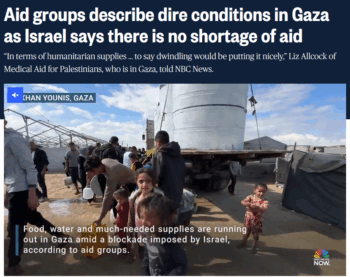
NBC‘s headline (4/17/24) gives Israel’s denial of a problem equal weight with aid workers’ description of Gazans’ desperate situation.
Then there is the matter of the media’s incurable habit of ceding Israeli officials a platform to spout demonstrable lies, as in the April 17 NBC Newsheadline “Aid Groups Describe Dire Conditions in Gaza as Israel Says There Is No Shortage of Aid.” The fact that Israel is permitted to make such claims is particularly perplexing, given Israeli officials’ own announcements that no aid whatsoever may enter the territory, while the “dire conditions” are made abundantly clear in the text of the article itself: “The Global Nutrition Cluster, a coalition of humanitarian groups, has warned that in March alone, 3,696 children were newly admitted for care for acute malnutrition” in Gaza.
Among numerous other damning statistics conveyed in the dispatch, we learn that all Gaza bakeries supported by the UN World Food Programme closed down on March 31, “after wheat flour ran out.” Meanwhile, the WFP calculated that Israel’s closure of border crossings into Gaza caused prices of basic goods “to soar between 150% and 700% compared with prewar levels, and by 29% to as much as 1,400% above prices during the ceasefire.”
Against such a backdrop, it’s fairly ludicrous to allow Israeli officials to “maintain there is ‘no shortage’ of aid in Gaza and accuse Hamas of withholding supplies.” If the press provides Israel with space to spout whatever nonsense it wants—reality be damned—where is the line ultimately drawn? If Israel decides Hamas is using wheat flour to build rockets, will that also be reported with a straight face?
Lest anyone think that thwarting the entry of food into the Gaza Strip is a new thing, recall that Israel’s blockade of Gaza long predated the present war—although the details of said blockade are generally glossed over in the media in favor of the myth that Israel unilaterally “withdrew” from the territory in 2005. In 2010, the BBC (6/21/10) listed some basic foodstuffs—pardon, potential “dual-use items”—that Israel had at different times in recent history blocked from entering Gaza, including pasta, coffee, tea, nuts and chocolate. In 2006, just a year after the so-called “withdrawal,” Israeli government adviser Dov Weissglas outlined the logic behind Israel’s restriction of food imports into Gaza: “The idea is to put the Palestinians on a diet, but not to make them die of hunger.”
Fast forward almost two decades, and it’s safe to say that the “idea” has evolved; this is a genocide, after all—even if the corporate media refuse to say the word—and starvation is part and parcel of that. But on account of Israel’s extra-special relationship with the United States, US media have institutionalized the practice of beating around the bush when it comes to documenting Israeli crimes. This is how we end up with the aforementioned long-winded headlines instead of, say, the far more straightforward “Israel is starving Gaza,” a Google search of which terms produces not a single corporate media dispatch, but does lead to a January 2024 report by that very name, courtesy of none other than the Israeli human rights organization B’Tselem.
‘Starving as negotiation tactic’
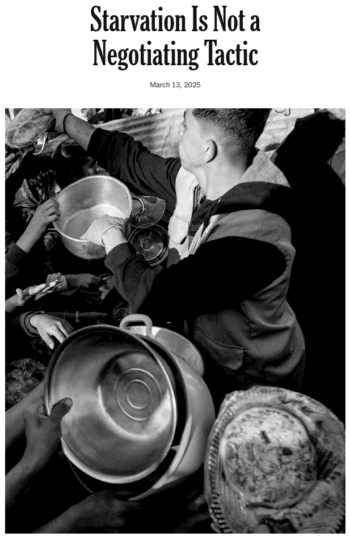
Megan Stack (New York Times, 3/13/25): “Lately it feels as if the human beings in Gaza are increasingly lost from our understanding.”
That said, there have been a few surprises. The New York Times (3/13/25), for example, took a short break from its longstanding tradition of unabashed apologetics for Israeli atrocities in allowing the following sentence to appear in a March opinion article by Megan Stack: “Israeli officials are essentially starving Gaza as a negotiation tactic.” In the very least, this was a vast improvement, in terms of syntactic clarity and assignation of blame, over previous descriptions of Israeli behavior immortalized on the pages of the US newspaper of record—like that time the Israeli military slaughtered four kids playing by the sea in Gaza, and the Times editors (7/16/14) went with the headline “Boys Drawn to Gaza Beach, and Into Center of Mideast Strife.”
In the end, Israel’s starvation of the Gaza Strip is multifaceted. It’s not just about physically blocking the entry of food into the besieged enclave. It’s also about Israel’s near-total decimation of Gaza’s healthcare system: the bombardment of hospitals, the targeting of ambulances, the massacres of medical personnel (FAIR.org, 4/11/25). It’s about Israeli military attacks on humanitarian aid convoys and workers, including the April 2024 massacre of seven international employees of the food organization World Central Kitchen.
It’s about Israel razing agricultural areas, wiping out food production, devastating the fishing industry and depleting livestock. It’s about Israel bombing water infrastructure in Gaza. And it’s about Israeli troops slaughtering at least 112 desperate Palestinians queuing for flour on February 29, 2024 (FAIR.org, 3/22/24)—which was at least a quicker way of killing starving people than waiting for them to starve.
In his 2017 London Review of Books essay (6/15/17) on the use of famine as a weapon of war, Alex de Waal referenced the “physical debilitation of groups as a technique of genocide,” noting that “forced starvation was one of the instruments of the Holocaust.” It’s worth reflecting on the essay’s opening paragraph:
In its primary use, the verb “to starve” is transitive: It’s something people do to one another, like torture or murder. Mass starvation as a consequence of the weather has very nearly disappeared: Today’s famines are all caused by political decisions, yet journalists still use the phrase “man-made famine” as if such events were unusual.
As for the current case of the Gaza Strip, US establishment journalists appear to be doing their best to avoid the transitive nature of the verb in question—or any subject-verb-object construction that might too overtly expose Israeli savagery. And by treating famine in Gaza as a subject unto itself, rather than a “technique of genocide,” to borrow de Waal’s words, the media assist in obscuring the bigger picture about this very man-made famine—which is that Israel is not just starving Gaza. Israel is exterminating Gaza.
FAIR’s work is sustained by our generous contributors, who allow us to remain independent. Donate today to be a part of this important mission.
Vote For Genocide Vote Labour.Genocide denier and Current UK Prime Minister Keir Starmer is quoted that he supports Zionism without qualification. He also confirms that UK air force support has been essential in Israel’s mass-murdering genocide. Includes URLs https://www.declassifieduk.org/keir-starmers-100-spy-flights-over-gaza-in-support-of-israel/ and https://youtu.be/O74hZCKKdpAUK Foreign Minister David Lammy confirms that UK government and military are active participants in Israel’s genocides and that the F-35 parts that they suspended from supplying to Israel are instead simply diverted via the United States. He says see https://youtu.be/QILgUHrdWRE
Forbidden Stories and its Gaza Project partners investigated Israel’s killing of journalists in Gaza and elsewhere. (Illustration: Forbidden Stories/The Gaza Project)
“This is one of the most flagrant attacks on press freedom that I can remember,” said one campaigner. “The impact on press freedom in Gaza, in the region, and the rest of the world is something we cannot accept.”
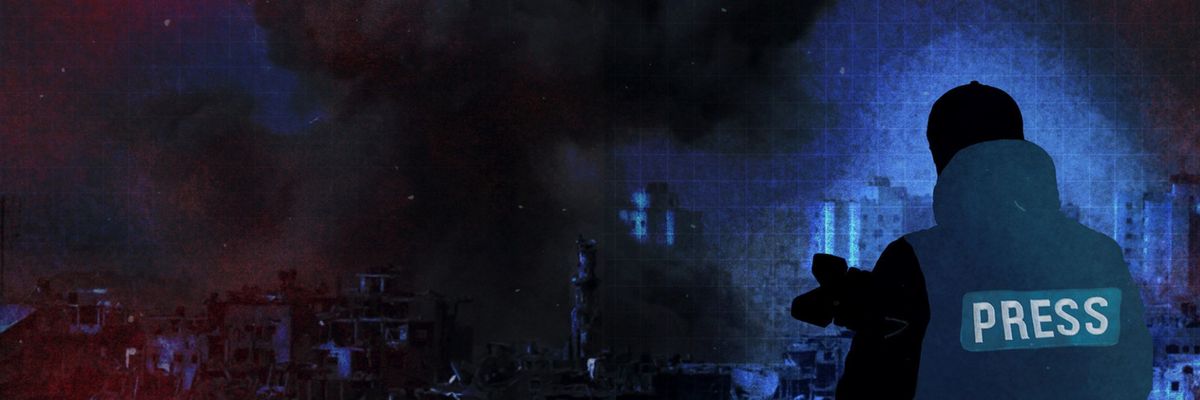
With more than 100 media professionals—nearly all of them Palestinian—killed in Gaza since October, a group of 50 reporters from 13 international organizations this week shared the results of a new investigative journalism initiative aimed at exposing the deadly toll Israel’s onslaught has taken on those reporting it to the world.
The Gaza Project—led by the Paris-based nonprofit Forbidden Stories—”analyzed nearly 100 cases of journalists and media workers killed in Gaza, as well as other cases in which members of the press have been allegedly targeted, threatened, or injured since October 7,” when Hamas-led attacks on Israel left more than 1,100 people dead and over 240 others kidnapped.
“Faced with what is being reported as the record number of journalists killed, Forbidden Stories, whose mission is to pursue the work of journalists who are killed because of their work, set out to investigate the targeting of journalists,” the group said
“For four months, Forbidden Stories and its partners investigated the circumstances of their killings, as well as those who have been targeted, threatened, and injured in the West Bank and Gaza,” it added. “These investigations point to a chilling pattern and suggest some journalists may have been targeted even though they were identifiable as press.”
🔴 How are Israeli drones killing journalists in Gaza?
Gaza Project member Committee to Protect Journalists (CPJ) has condemned what it called an “apparent pattern of targeting journalists and their families,” noting cases in which media workers were killed while wearing press insignia and after being threatened by Israeli officials.
“This is one of the most flagrant attacks on press freedom that I can remember,” CPJ program director Carlos Martínez de la Serna said of the ongoing war. “The impact on press freedom in Gaza, in the region, and the rest of the world is something we cannot accept.”
Basel Khair Al-Din, a Palestinian journalist in Gaza who believes he was targeted by a drone strike while wearing a press vest, said, “Whereas this press vest was supposed to identify and protect us, according to international laws, international conventions, and the Geneva Conventions, it is now a threat to us.”
“It’s this vest that almost got us killed, as has happened to so many of our fellow journalists and media workers,” he added.
Groups like Human Rights Watch (HRW) and Amnesty International have called for official investigations into Israeli killing of journalists including an October 13 attack that killed 37-year-old Lebanese Reuters videographer Issam Abdallah and wounded half a dozen other journalists who were covering cross-border clashes between Israeli troops and Hezbollah fighters in southern Lebanon.
Dylan Collins, an American deputy editor at Al Jazeera English, was wounded while administering first aid to Christina Assi, an Italian Agence-France Presse journalist whose legs were blown off in the attack.
Reuters determined that an Israeli tank crew “fired two shells in quick succession” at the journalists, who HRW said were “clearly identifiable as members of the media, and had been stationary for at least 75 minutes.” HRW “found no evidence of a military target near the journalists’ location.”
Amnesty International, meanwhile, asserted that the Israel Defense Forces (IDF) strike was “likely a direct attack on civilians that must be investigated as a war crime.”
Asa Kasher, the lead author of the IDF’s Code of Ethics, told Forbidden Stories that “no member of the press should have been killed under normal circumstances of hostilities in Gaza.”
“It shouldn’t happen, even a single one,” he added. “It’s illegal. It’s unethical. The person who does it should be brought to court.”
Israel’s alleged deliberate targeting of journalists is part of the evidence presented in a South Africa-led genocide case against Israel being reviewed by the International Court of Justice in The Hague.
Separately, the chief prosecutor at the International Criminal Court (ICC), also located in the Dutch city, is seeking arrest warrants for Israeli Prime Minister Benjamin Netanyahu, Israeli Defense Minister Yoav Gallant, and three Hamas leaders for alleged war crimes and crimes against humanity including extermination and forced starvation in the case of the Israelis and extermination, rape, and torture in the case of Hamas.
The international press freedom group Reporters Without Borders last month filed a third ICC complaint alleging “war crimes against journalists in Gaza.”
According to Palestinian and international officials, at least 37,718 Palestinians—mostly women and children—have been killed during Israel’s 264-day assault on Gaza, which has also left more than 86,300 people wounded and 11,000 others missing and feared dead and buried beneath the rubble of hundreds of thousands of homes and other bombed-out buildings.
Around 90% of Gaza’s 2.3 million people have also been forcibly displaced, and the Israeli siege on Gaza has caused widespread—and deadly—starvation and what the head of the United Nations food agency called a “full-blown famine” in northern parts of the strip.
Zionist Keir Starmes is quoted “I support Zionism without qualification.” He’s asked whether that means that he supports Zionism under all circumstances, whatever Zionists do.