Fossil fuels benefited from record subsidies of $13m (£10.3m) a minute in 2022, according to the International Monetary Fund, despite being the primary cause of the climate crisis.
The IMF analysis found the total subsidies for oil, gas and coal in 2022 were $7tn (£5.5tn). That is equivalent to 7% of global GDP and almost double what the world spends on education. Countries have pledged to phase out subsidies for years to ensure the price of fossil fuels reflects their true environmental costs, but have achieved little to date.
Explicit subsidies, which cut the price of fuels for consumers, doubled in 2022 as countries responded to the higher energy prices resulting from Russia’s war in Ukraine. Rich households benefited far more from these than poor ones, the IMF said. Implicit subsidies, which represent the “enormous” costs of the damage caused by fossil fuels through climate change and air pollution, made up 80% of the total.
Ending the subsidies should be the centrepiece of climate action, the IMF said, and would put the world on track to restrict global heating to below 2C, as well as preventing 1.6 million air pollution deaths a year and increasing government revenues by trillions of dollars. The researchers acknowledged that subsidy reform was politically difficult, but said carefully designed policies that supported poorer households could work, especially if coordinated internationally.
Scaling back subsidies would reduce air pollution, generate revenue, and make a major contribution to slowing climate change
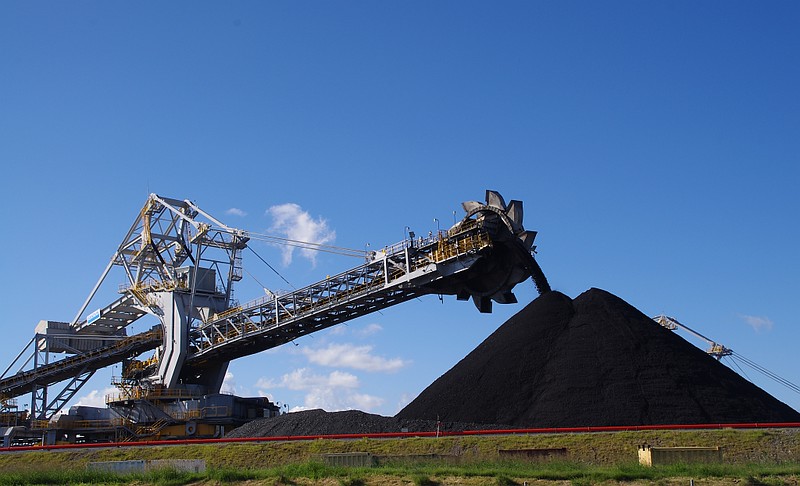
Coal loader P4393. Part of the coal loading facility at Kooragang Island, NSW Australia. Image by eyeweed, Attribution-NonCommercial-NoDerivs 2.0 Generic (CC BY-NC-ND 2.0).
Fossil-fuel subsidies surged to a record $7 trillion last year as governments supported consumers and businesses during the global spike in energy prices caused by Russia’s invasion of Ukraine and the economic recovery from the pandemic.
As the world struggles to restrict global warming to 1.5 degrees Celsius and parts of Asia, Europe and the United States swelter in extreme heat, subsidies for oil, coal and natural gas are costing the equivalent of 7.1 percent of global gross domestic product. That’s more than governments spend annually on education (4.3 percent of global income) and about two thirds of what they spend on healthcare (10.9 percent).
Our findings come as the World Meteorological Organization says July was the hottest month on record, underscoring the urgent need to curb human-induced climate change.
As the Chart of the Week shows, fossil-fuel subsidies rose by $2 trillion over the past two years as explicit subsidies (undercharging for supply costs) more than doubled to $1.3 trillion. That’s according to our new paper, which provides updated estimates across 170 countries of explicit and implicit subsidies (undercharging for environmental costs and forgone consumption taxes). Download detailed data for different countries and fuels here.
…
If governments removed explicit subsidies and imposed corrective taxes, fuel prices would increase. This would lead firms and households to consider environmental costs when making consumption and investment decisions. The result would be cutting global carbon-dioxide emissions significantly, cleaner air, less lung and heart disease, and more fiscal space for governments.
We estimate that scrapping explicit and implicit fossil-fuel subsidies would prevent 1.6 million premature deaths annually, raise government revenues by $4.4 trillion, and put emissions on track toward reaching global warming targets. It would also redistribute income as fuel subsidies benefit rich households more than poor ones.
…
With global energy prices receding and emissions rising, it’s the right time to phase out explicit and implicit fossil-fuel subsidies, for a healthier and more sustainable planet.
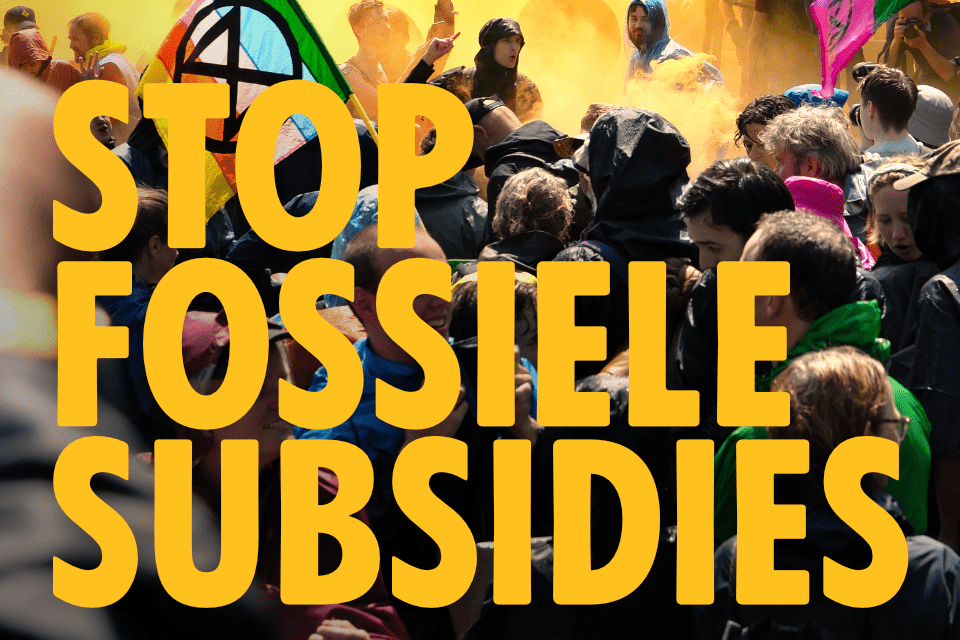
Saturday, September 9 at 12:00 noon is the moment of the Big One: we will demonstrate for the eighth time on the A12. And also for the last time. Because no matter what the Hague municipal council allows the police to do, we will stay or come back day in and day out. Until the government meets our demand: an immediate end to all fossil subsidies. Together we can do this. Get involved and join us!
The most recent IPCC report is clear: continuing on the current path will lead to between 2.2 and 3.5 degrees of warming. Even now, the situation in the Global South is extreme: hundreds of thousands of people die every year as a result of the climate and ecological crisis. In 2022, 43,000 people died in Somalia alone due to drought. Yet our government stimulates the fossil industry with up to 30 billion euros in fossil subsidies every year . Bizarre policy with devastating consequences!
Participate? Which can! Good preparation is important. Take an Action Training so that you know how to take peaceful civil disobedience action and join the Telegram group A12StopSub
Around 2,000 arrests during first day of A12 blockade, new A12 blockade tomorrow at 12:00 noon
09/09/2023
Extinction Rebellion will keep coming back, every day at 12:00 noon, until fossil subsidies are abolished
Today, on Saturday September 9, about 25,000 people demonstrated on and next to the A12 , in the blockade and the support demo . From 1:30 p.m., the police deployed water cannons and peaceful demonstrators were also frequently beaten with batons. Around 2,000 people were arrested for demonstrating peacefully on the A12 between the Ministry of Economic Affairs and Climate Policy and the temporary House of Representatives building. A large number of these demonstrators will be back on the A12 tomorrow at 12:00 noon to demand an immediate end to all fossil subsidies. If they are removed again by the police, they will return the next day and every day after that, always at 12:00 noon.
Tessel Hofstede, spokesperson for Extinction Rebellion and recently sentenced to 30 hours of community service for ‘incitement’: “On the first day of the permanent A12 blockade, many thousands of people showed that all fossil subsidies must now end. Every day around the world, and especially in the Global South, people die from climate disasters that our government helps pay for. This must stop now. That is why we will keep coming back, every day at 12:00 until all fossil subsidies are abolished.”
37.5 billion euros annually: the amount is correct
On Tuesday, September 5, Rob Jetten admitted to the Financieel Dagblad that ‘the amount is correct’.[1] He was referring to the annual 37.5 billion euros in fossil subsidies from research by SOMO, Oil Change International and Milieudefensie.[2] He further indicated that the government is still busy ‘mapping’ the size. A striking fact since the Balkenende cabinet already determined in 2009 that fossil subsidies had to be phased out[3], a process that should have been completed in 2025.
Mozart on the A12
XR Musicians was present with 180 musicians and a choir. They opened the demonstration with the Dies Irae from Mozart’s Requiem. Dies Irae means ‘Day of anger’. Cellist Sanne Bijker: “Anger is appropriate today, because the government is still investing in fossil subsidies at the expense of the Global South and future generations. Anger is also an emotion that sets you in motion, anger makes you get up and take action. We hope to get more people moving with this music.”
Professors in gowns [Scientists’ white coats?]
Scientist Rebellion demonstrated with dozens of scientists, including a number of professors, many of whom were wearing gowns. “Climate change requires radical system change towards a society that does everything it can to keep this planet livable and healthy for people, animals and nature,” said Patrick Huntjens, professor of governance of Sustainability Transitions, Maastricht University. “As long as there are 37.5 billion euros in fossil subsidies, the government is part of the problem and the main obstacle on the way to a sustainable and just society.”
“This is the fourth time I have participated in the A12 blockade with Scientist Rebellion,” said Julia Schaumburg, professor of Econometrics, VU Amsterdam. “I am here as a scientist, but also, more importantly, as a citizen terrified of a future of continued global warming and environmental degradation.”
Broad support for professional groups
All kinds of professional groups also demonstrated on the A12, including XR Civil Servants, XR Teachers, XR Healthcare Professionals, XR Therapists and the green farmers of
Spokesperson Margarita Vossen of XR Zorgprofessionals: “This is bad news, further health damage must be prevented urgently. An emergency in the hospital is also not postponed, our planet is in need and we must take action now.”
The Dutch government misses out on 37.5 billion euros in income every year due to schemes that favor using fossil fuels. Researchers from SOMO, Oil Change International, and Milieudefensie arrived at this amount in a study into how the government “subsidizes” the fossil fuel industry.
Researcher Boris Schellekens of the Foundation for Research on Multinational Enterprises (SOMO) called the estimate conservative. He and his colleagues ignored all costs of environmental damage. “We purely looked at missed state revenues.” The researchers are convinced that their overview is the most complete to date.
The report published on Monday describes 31 regulations that, in one way or another, make the use of fossil fuels more economical. That usually does not concern money that the government transfers to companies’ accounts but mainly tax discounts and exemptions. For example, major natural gas consumers do not have to pay energy tax on most of their consumption, and aviation and shipping are exempt from excise duty on kerosene and fuel oil. Oil refineries, coal-fired power stations, and the steel industry also enjoy such tax benefits.
The biggest hit, 13.5 billion euros per year, is in the energy tax, which is degressive in the Netherlands. That means that companies that use more energy have to pay relatively less tax on their consumption. The researchers call this “a perverse incentive.”
Painting by Lady Frieda Harris used as the Hermit card in the Thoth tarot. It includes an image of Cerberus, the three-headed dog from Greek mythology..
“This support perpetuates the world’s reliance on fossil fuels, paving the way for yet more energy crises due to market volatility and geopolitical security risks.”
An analysis released this week by the International Institute for Sustainable Development shows that G20 countries spent at least $1 trillion on fossil fuel subsidies in 2022, running afoul of recent pledges to curb financial support for the sector most responsible for the global climate emergency.
IISD’s report estimates that G20 governments provided a record $1.4 trillion in support for fossil fuels last year, including subsidies and loans from public financial institutions.
“This support perpetuates the world’s reliance on fossil fuels, paving the way for yet more energy crises due to market volatility and geopolitical security risks,” researchers with IISD and other organizations wrote in a detailed analysis of the new findings.
“It also severely limits the possibilities of achieving climate objectives set by the Paris Agreement by incentivizing greenhouse gas (GHG) emissions while undermining the cost-competitiveness of clean energy,” they added. “G20 governments need to shift their financial resources away from fossil fuels to instead provide targeted, sustainable support for social protection and the scaling-up of clean energy. Maintaining fossil fuel prices that reflect the cost these fuels impose on society will be necessary to reduce fossil fuel use.”
The researchers noted that the surge in fossil fuel subsidies—which quadrupled in 2022 compared to the previous year—was “largely due to a dramatic expansion in consumer support in response to peaking fossil fuel prices.”
“Helping households and businesses during an energy crisis is understandable and necessary, but there are better ways to do it than subsidizing fossil fuels, which keeps consumers locked into emissions-intensive, polluting, and price-volatile energy sources,” the researchers wrote. “Shifting support from fuels to people is fundamental for the sustainable implementation of G20 governments’ pledges to phase out fossil fuel subsidies.”
G20 governments also provided financial support for fossil fuel production.
As the researchers explained, “these subsidies are problematic because they influence larger private investment flows, lock in higher fossil fuel production and emissions, and take up scarce fiscal resources that are needed to catalyze investments in clean energy transition solutions.”
Global investment in renewable energy reached a record high last year, according to IISD, but it still amounted to just half the total worldwide investment in fossil fuels.
The analysis calls on G20 nations to establish a firm deadline for completely eliminating fossil fuel subsidies, which disproportionately benefit wealthy households that contribute far more to the climate crisis than lower-income households.
At the 2021 COP26 summit in Glasgow, 197 countries agreed to phase out “inefficient” fossil fuel subsidies—but they did not agree on a timeframe for action, nor did they clearly define “inefficient.”
The IISD analysis notes that “more than half of the signatories with significant international financing have implemented their Glasgow commitment with integrity, including Canada, France, and the United Kingdom.”
“However, several developed G20 countries have not yet delivered on implementation: Italy’s policy is not aligned with the Glasgow statement, nor is Germany’s draft policy, and the United States has not published its regulation,” the analysis says. “These countries are among the most responsible for historical CO2 emissions and should take greater responsibility for preventing further emissions by shifting financing from fossil fuels to clean energy.”