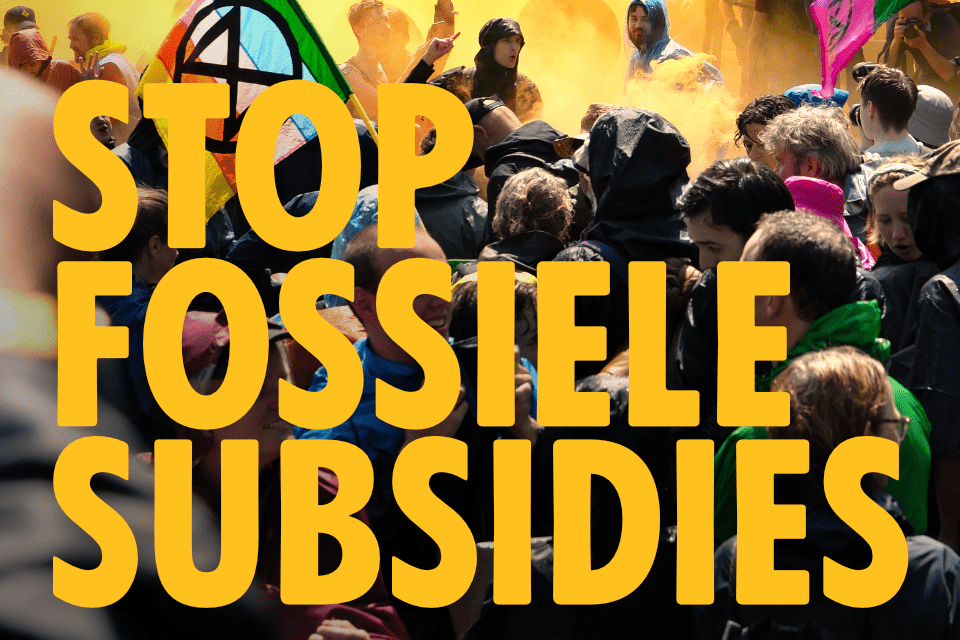
Extinction Rebellion (XR) is suspending the blockades on the Utrechtsebaan (A12) in The Hague. The group of activists will await a vote in parliament on Tuesday on a motion in which Suzanne Kroger (GroenLInks) and Raoul Boucke (D66) asked for a phase-out plan for fossil fuel subsidies. The Hague mayor, Jan van Zanen, called it a relief.
…
Fossil subsidies are schemes like tax discounts and excise duty exemptions for the fossil fuel industry. If the motion is not adopted, the daily blockades will resume, XR said. The climate activists consider the motion “recognition that politicians also see that 39.7 to 46.4 billion euros in fossil subsidies annually cannot be defended.”
In the motion, the two parliamentarians ask the government to draw up scenarios before the Christmas recess for ending the subsidies “in the term of 2, 5, and 7 years.” For each scheme, the government must also indicate how many negative consequences can be mitigated and which “national measures” can be taken if subsidies are fixed in a European context. Kroger and Boucke called fossil subsidies an “obstacle in the transition to a climate-neutral society.”
The UK government has approved the Rosebank oil field in the North Sea. I’ll have a lot to say on this but for a start while it blows any remaining pretence that UK is committed to net zero, the UK government will be massively subsidising a foreign company to extract and take the oil abroad …
… [N]ew estimates by the campaign group Uplift show that Rosebank, expected to cost £4.1bn to develop, could receive an effective taxpayer subsidy worth £3.75bn through tax breaks and the loophole in the government’s windfall tax that spares oil and gas investment.
This would mean that Equinor, the Norwegian state-owned company behind the potential field, would pay only £350m to develop Rosebank, which is three times the size of the Cambo oilfield. Equinor made £62bn last year, and about 80% of the oil from Rosebank is likely to be exported, rather than bolstering the UK’s energy security.
The police arrested 552 climate activists on Saturday who had partially blocked the A12 highway in The Hague. This is more than during the roadblocks of previous days: on Friday, more than 200 protesters were arrested, compared to around 100 the two days before.
Liefde en woede. Zo groeten wij elkaar. Liefde voor het leven, woede over het onrecht dat het leven wordt aangedaan. Onrecht dat door de overheid wordt gevoed met jaarlijks 39,7 tot 46,4 mld euro fossiele subsidies.
The road was open to traffic again at 2:15 p.m. Around noon, protesters from Extinction Rebellion blocked the road for the fifteenth consecutive day to reiterate their demand to the government to stop projects that support the fossil fuel industry. [It’s more accurate that XR NL are demanding an end to fossil fuel subsidies by NL government.]
…
XR spokesperson Lucas Winnips claimed in a press statement that the climate action group is “not asking for police involvement. That is a political choice. It is now clear that Extinction Rebellion will continue as long as necessary and that we are expanding. I would like to ask the police not to intervene in our peaceful demonstration anymore because that is pointless. We will come back the next day.”
Extinction Rebellion has been demonstrating daily on the A12 since September 9.
Image of InBedWithBigOil by Not Here To Be Liked + Hex Prints from Just Stop Oil’s You May Find Yourself… art auction. Featuring Rishi Sunak, Fossil Fuels and Rupert Murdoch.
FFS Fossil Fuel Subsidies continue to be huge in UK and globally despite the urgent need to move away from the use of fossil fuels since they are the main cause of the climate crisis. Current estimates of FFS are 4% of GDP globally and 2% of GDP in UK. FFS that’s huge FFS. We only have estimates of FFS because FFS are not specifically acknowledged with governments disguising FFS by selecting definitions that hide their FFS FFS. Please publish your own article if you know FFS better than me FFS.
… the UK continues to offer a number of tax reliefs for both domestic production and consumption of fossil fuels. In the last 5 years, the value of UK support to fossil fuels mounted to approximately £12bn annually on average.
…
In the face of the climate and environmental crises, and the short timeframe left to avert breakdown, it is increasingly clear that the current rate and scale of action will not deliver a safe future. In place of this we need a deep transformation of design and operation of the economy. This will require structural policy shifts, as well as a step-change in public investment. Tax revenues can play an important role in sustainably servicing this increased borrowing. Crucially though, by bringing together the twin goals of a Green New Deal – securing economic and climate justice — a reimagined UK tax system can play a central role in driving a more equitable distribution of wealth while reorienting economic activity away from high-carbon production and consumption. Phasing out UK fossil fuel support needs to be part of a coherent strategy to ensure an orderly, just, and rapid transition.
Under a new plan, oil and gas firms can access a “super-deduction” investment allowance which means for £1 spent in “UK extraction” up to 91% of the costs will be covered by the tax saving.
This deduction is covered from the point of investment, rather than at the point the project starts producing. Many green experts have noted that “UK extraction” is a vague term, but one that points to major tax reliefs for energy giants that invest in the extraction of more UK-based oil and gas fields.
…
That’s a huge incentive for fossil fuel companies to extract from previous Chancellor and current Prime Minister Rishi Sunak FFS: It will cost them only 9p for a £ of investment.
Today the outgoing Dutch Minister for Climate and Energy Policy, Rob Jetten, published an analysis of the Netherlands’ fossil fuel subsidies, estimating these at between €39.7 and €46.4 billion a year, more than 4% of the Netherlands’ GDP. According to campaigners the analysis underlines the importance of an urgent phase-out plan, in line with the Dutch government’s long-standing promise to end these subsidies by 2025.
Recent research by Dutch research and environmental organizations shows that this would allow the Netherlands to reduce its CO2 emissions by up to 20% by 2030, while creating space for innovative and sustainable businesses and freeing up billions that can be reinvested in climate justice and social protection measures. The conclusions of the impact analysis for companies of subsidy removal that were also covered in today’s government publication mainly emphasize the short-term impacts for a select group of large energy-intensive companies that run on cheap fossil energy. Researchers and campaigners say this is too limited a perspective and should not stand in the way of an urgent phase-out plan.