Who Should Pay for Climate Damage? Majority of the World Agrees: Big Oil

Spread the love

Original article by Brett Wilkins republished from Common Dreams under Creative Commons (CC BY-NC-ND 3.0).
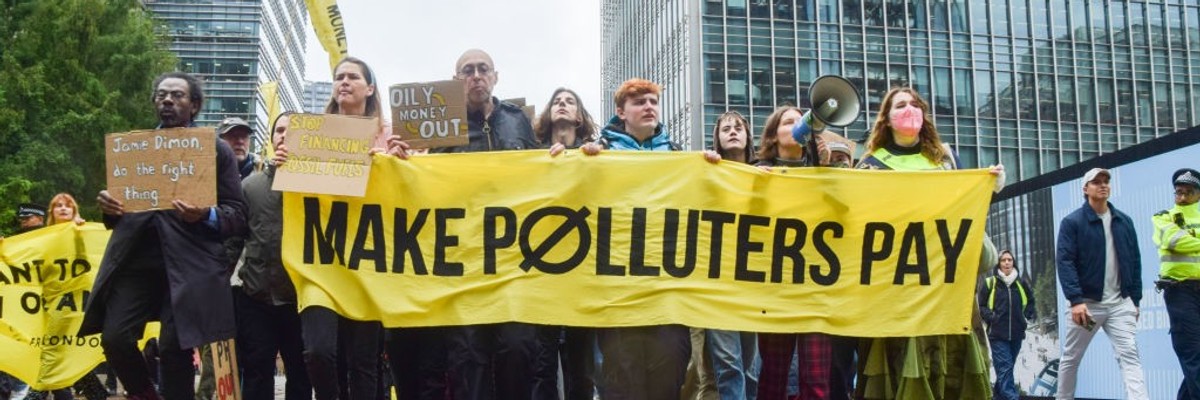
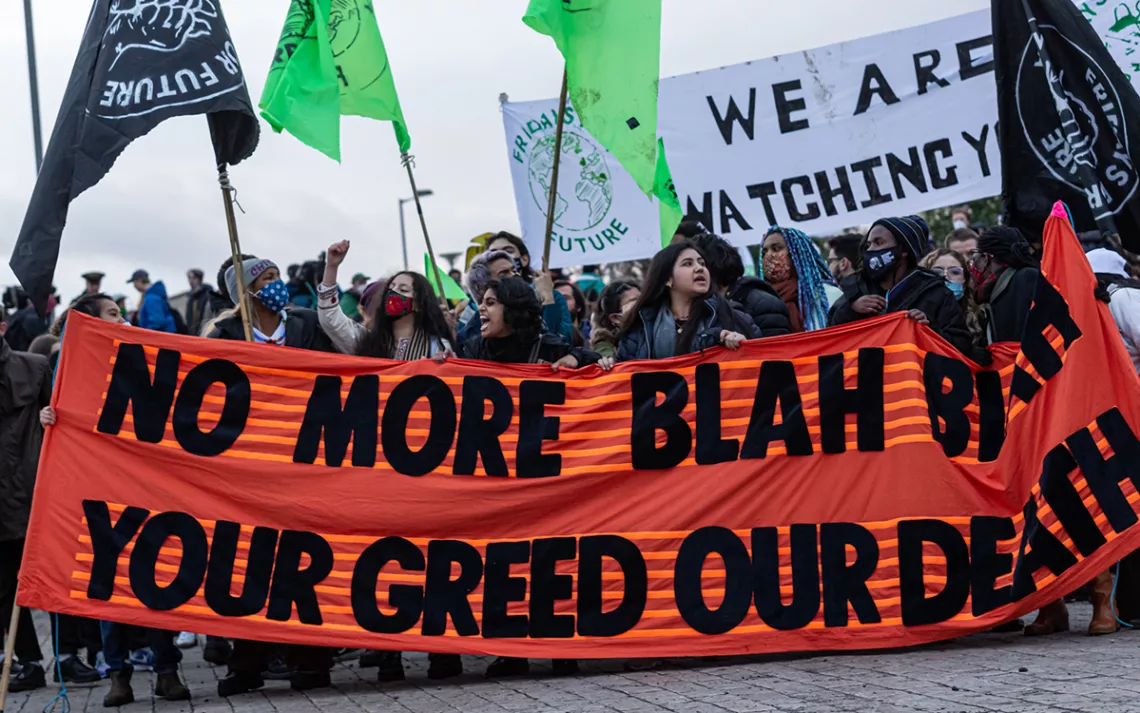
Climate campaigners march in London on October 19, 2023 to demand that fossil fuel corporations pay for their climate damage. (Photo: Vuk Valcic/SOPA Images/LightRocket via Getty Images)

“As governments debate how to finance climate action, they can be confident that making polluters pay is not only fair, but also far more popular and effective than placing the burden on ordinary citizens.”

A multinational survey commissioned by Greenpeace International and published Monday revealed that a majority of respondents favor making fossil fuel companies pay for being the main cause of the climate emergency.

Greenpeace International’s Stop Drilling, Start Paying campaign commissioned the strategic insight agency Opinium Research to survey 8,000 adults in eight countries—Australia, Argentina, France, Morocco, Philippines, South Africa, the United Kingdom, and the United States—ahead of this month’s United Nations Climate Change Conference, also known as COP29, in Baku, Azerbaijan.

“Asked about who should bear the most responsibility for climate change impacts, the most popular option across all eight countries in the survey was making oil and gas companies pay, with high-emitting countries and global elites ranked second and third,” Greenpeace International said in a summary of the survey, adding that “60% of all surveyed countries see a link between profits of the oil and gas industry and rising energy prices.”

https://twitter.com/greenpeacepress/status/1853356717926481993?ref_src=twsrc%5Etfw%7Ctwcamp%5Etweetembed%7Ctwterm%5E1853356717926481993%7Ctwgr%5E761d0bdb552a2b4dbb41e146b433941b655cef2d%7Ctwcon%5Es1_c10&ref_url=https%3A%2F%2Fwww.commondreams.org%2Fnews%2Fmake-polluters-pay-climate

Sorry, this content could not be embedded.

X

The survey also found that two-thirds or more of respondents are angry about Big Oil CEOs getting huge bonuses even as their products exacerbate the planetary emergency; fossil fuel expansion; industry disinformation; and the “historic and ongoing role of oil and gas companies in conflict, war, and human rights violations.”

Eight in 10 respondents said they were worried about climate change. However, more than twice as many people surveyed in the Global South said the climate emergency has personally affected them than respondents in the Global North.

According to Greenpeace International:

Imposing a fair climate damages tax on extraction of fossil fuels by OECD countries—proposed by the charity Stamp Out Poverty and supported by 100 NGOs, including Greenpeace International—is one example of a tax on big polluters. This could generate $900 billion by 2030… This would be key for annual climate-related loss and damage costs, estimated to be between $290-$580 billion by 2030 in low-income countries, as well as for reducing the emission of heat-trapping greenhouse gases and adapting to the impacts of the climate crisis in all countries.

“This research shows how taxing the wealthy polluters-in-chief—companies like Exxon, Chevron, Shell, Total, Equinor, and Eni—has become a mainstream solution among people, cutting across borders and income levels,” said Stop Drilling, Start Paying co-chair Abdoulaye Diallo. “As governments debate how to finance climate action, they can be confident that making polluters pay is not only fair, but also far more popular and effective than placing the burden on ordinary citizens for a crisis for which they bear little or no responsibility.”

The Opinium survey was published on the same day that Amnesty International called on the richer countries most responsible for the climate emergency to “fully pay for the catastrophic loss of homes and damage to livelihoods” in Africa.

https://twitter.com/AmnestySARO/status/1853339282225692914?ref_src=twsrc%5Etfw%7Ctwcamp%5Etweetembed%7Ctwterm%5E1853339282225692914%7Ctwgr%5E761d0bdb552a2b4dbb41e146b433941b655cef2d%7Ctwcon%5Es1_c10&ref_url=https%3A%2F%2Fwww.commondreams.org%2Fnews%2Fmake-polluters-pay-climate

Sorry, this content could not be embedded.

X

“African people have contributed the least to climate change, yet from Somalia to Senegal, Chad to Madagascar, we are suffering a terrible toll of this global emergency which has driven millions of people from their homes,” said Samira Daoud, Amnesty’s regional director for West and Central Africa. “It’s time for the countries who caused all this devastation to pay up so African people can adapt to the climate change catastrophe.”

Original article by Brett Wilkins republished from Common Dreams under Creative Commons (CC BY-NC-ND 3.0).
Continue ReadingWho Should Pay for Climate Damage? Majority of the World Agrees: Big Oil

‘Very Fabric of Life’ at Risk Without Urgent Action to End Fossil Fuel Era

Spread the love

Original article by Jessica Corbett republished from Common Dreams under Creative Commons (CC BY-NC-ND 3.0).

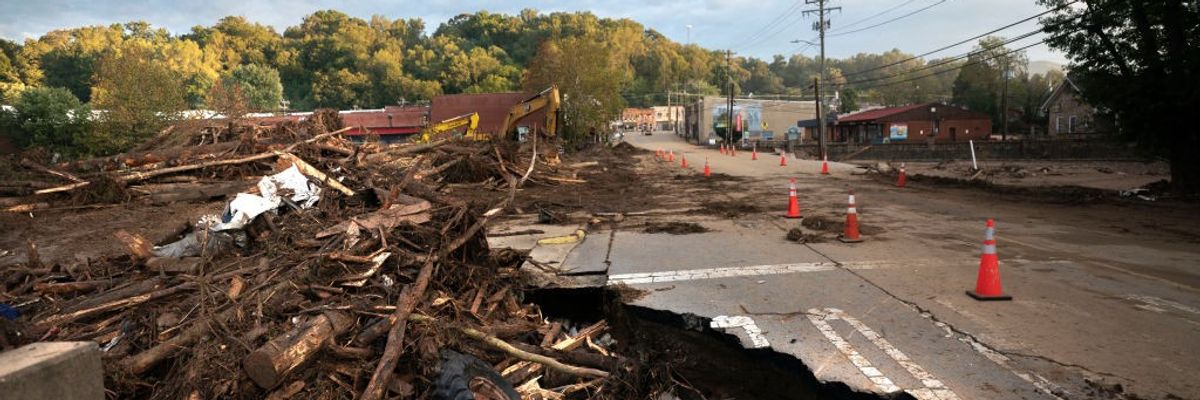
Flood damage is shown at a bridge across Mill Creek in the aftermath of Hurricane Helene on September 30, 2024 in Old Fort, North Carolina.
 (Photo: Sean Rayford/Getty Images)

“We are on the brink of an irreversible climate disaster. This is a global emergency beyond any doubt.”

As Hurricane Milton barreled toward Florida’s Gulf Coast, demonstrating the dangers of global warming, international scientists on Tuesday published a terrifying annual analysis that highlights the need to swiftly phase out planet-heating fossil fuels.

“Our aim in the present article is to communicate directly to researchers, policymakers, and the public,” the coalition wrote in BioScience. “As scientists and academics, we feel it is our moral duty and that of our institutions to alert humanity to the growing threats that we face as clearly as possible and to show leadership in addressing them.”

“We are on the brink of an irreversible climate disaster. This is a global emergency beyond any doubt. Much of the very fabric of life on Earth is imperiled. We are stepping into a critical and unpredictable new phase of the climate crisis,” warned the 14 experts from Australia, Brazil, China, Denmark, Germany, Switzerland, the United Kingdom, and the United States.

Their latest edition, “The 2024 State of the Climate Report: Perilous Times on Planet Earth,” shows that 25 of the 35 “planetary vital signs” the team uses to track the climate emergency are at record extremes. They include U.S.-heat related mortality, fossil fuel subsidies, coal and oil consumption, carbon dioxide equivalent emissions, per capita meat consumption, global tree cover loss due to fires, ocean acidity and heat content change, glacier thickness change, and ice mass change in Antarctica and Greenland.

“Ecological overshoot, taking more than the Earth can safely give, has pushed the planet into climatic conditions more threatening than anything witnessed even by our prehistoric relatives.”

The report emphasizes that “human-caused carbon dioxide emissions and other greenhouse gases are the primary drivers of climate change. As of 2022, global fossil fuel combustion and industrial processes account for approximately 90% of these emissions, whereas land-use change, primarily deforestation, accounts for approximately 10%.”

“For many years, scientists, including a group of more than 15,000, have sounded the alarm about the impending dangers of climate change driven by increasing greenhouse gas emissions and ecosystem change,” the publication notes. “For half a century, global warming has been correctly predicted even before it was observed—and not only by independent academic scientists but also by fossil fuel companies.”

“Despite these warnings, we are still moving in the wrong direction; fossil fuel emissions have increased to an all-time high, the three hottest days ever occurred in July of 2024, and current policies have us on track for approximately 2.7°C peak warming by 2100,” the article adds. “Tragically, we are failing to avoid serious impacts, and we can now only hope to limit the extent of the damage. We are witnessing the grim reality of the forecasts as climate impacts escalate, bringing forth scenes of unprecedented disasters around the world and human and nonhuman suffering.”

Oregon State University professor William Ripple, who led the team with Christopher Wolf of Terrestrial Ecosystems Research Associates, said in a Tuesday statement that “ecological overshoot, taking more than the Earth can safely give, has pushed the planet into climatic conditions more threatening than anything witnessed even by our prehistoric relatives.”

“We’re already in the midst of abrupt climate upheaval,” Ripple stressed. “For example, Hurricane Helene caused more than 200 deaths in the southeastern United States and massive flooding in a North Carolina mountain area thought to be a safe haven from climate change.”

“Since the publication of our 2023 report, multiple climate-related disasters have taken place, including a series of heatwaves across Asia that killed more than a thousand people and led to temperatures reaching 122°F in parts of India,” he continued. “Climate change has already displaced millions of people, with the potential to displace hundreds of millions or even billions. That would likely lead to greater geopolitical instability, possibly even partial societal collapse.”

To avoid that dark future, the article argues, “we need bold, transformative change: drastically reducing overconsumption and waste, especially by the affluent, stabilizing and gradually reducing the human population through empowering education and rights for girls and women, reforming food production systems to support more plant-based eating, and adopting an ecological and post-growth economics framework that ensures social justice.”

The assessment—whose authors include Michael Mann of the University of Pennsylvania, Naomi Oreskes of Harvard University, and Stefan Rahmstorf and Johan Rockström of the Potsdam Institute for Climate Impact Research—comes just over a month away from the next United Nations Climate Change Conference, COP29, which is scheduled for November 11-22 in Azerbaijan.

Pointing to previous summits, Wolf said Tuesday that “despite six reports from the International Panel on Climate Change, hundreds of other reports, tens of thousands of scientific papers, and 28 annual meetings of the U.N.’s Conference of the Parties, the world has made very little headway on climate change.”

“Humanity’s future depends on creativity, moral fiber, and perseverance,” he warned. “If future generations are to inherit the world they deserve, decisive action is needed, and fast.”

Original article by Jessica Corbett republished from Common Dreams under Creative Commons (CC BY-NC-ND 3.0).
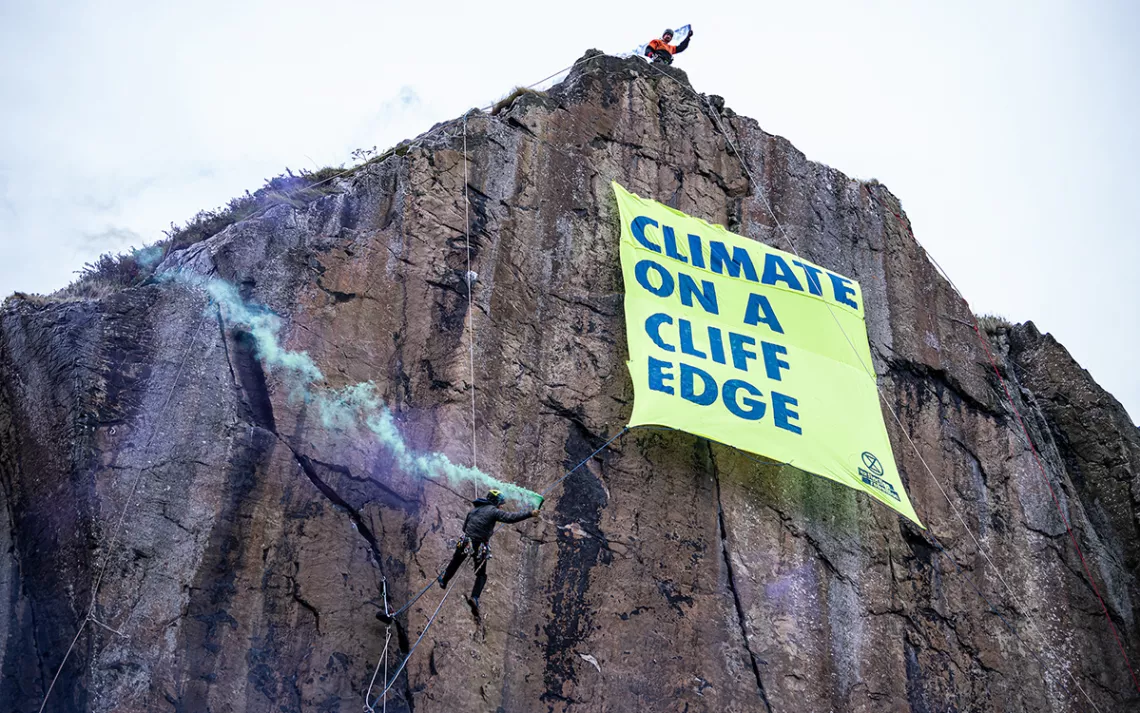
Experienced climbers scale a rock face near the historic Dumbarton castle in Glasgow, releasing a banner that reads “Climate on a Cliff Edge.” One activist, dressed as a globe, symbolically looms near the edge, while another plays the bagpipes on the shores below. | Photo courtesy of Extinction Rebellion and Mark Richards
Continue Reading‘Very Fabric of Life’ at Risk Without Urgent Action to End Fossil Fuel Era

Labour just gave a TOP government JOB to someone from its £4m hedge fund donor, Quadrature

Spread the love
Keir Starmer commits to play the caretaker role for Capitalism through the "hard times".
Keir Starmer commits to play the caretaker role for Capitalism through the “hard times”.

https://www.thecanary.co/uk/analysis/2024/09/25/labour-quadrature-rachel-kyte

As predictable as night following day, there WAS some backscratching involved in the £4m donation the Labour Party got from offshore tax-registered hedge fund Quadrature. The pay off? The co-chair of a board of its charitable foundation arm – Rachel Kyte – is now the UK government’s climate envoy.

Thanks to openDemocracy doing the journalism the corporate media consistently fail to, we now know that the Labour Party accepted a huge donation just after Rishi Sunak called July’s general election from Quadrature Capital.

We also know that the company behind it invest themselves in the worst of the worst. However, for a final sting in the tail, look no further than what this hedge fund does with some of the cash it makes.

Labour Party: £4m in slush funding…?

As openDemocracy revealed:

The Labour Party’s largest-ever donation came from a Cayman Islands-registered hedge fund with shares worth hundreds of millions of pounds in fossil fuels, private health firms, arms manufacturers and asset managers.

While the £4m donation by Quadrature Capital is the sixth-largest in British political history, it is noteworthy not just for its size, but also its timing.

Of course, no one should really be surprised that Keir Starmer’s Labour Party is accepting donations from hedge funds registered in tax havens. However, there were further revelations from openDemocracy. These include the fact that Quadrature had investments in fossil fuel, arms, and private healthcare companies.

However, the donation got its reward for Quadrature.

Now we know what Quadrature’s £4m was for

As journalist Michael Crick revealed on X, the Labour government’s new climate envoy is Rachel Kyte – who just happens to sit on the advisory board of Quadrature Charitable Foundation:

Article continues at https://www.thecanary.co/uk/analysis/2024/09/25/labour-quadrature-rachel-kyte

dizzy: The on-the-take shower of sihts that currently govern us probably see nothing wrong with a rich offshore hedge fund buying a plump government role to promote it’s own interests. Years ago it was called corruption.

Continue ReadingLabour just gave a TOP government JOB to someone from its £4m hedge fund donor, Quadrature

More than £494bn subsidies a year are harmful to the climate, says report

Spread the love
People march through Glasgow, a demonstration led by Fridays for Future. | Photo courtesy of Extinction Rebellion Scotland and Simone Rudolphi

https://www.theguardian.com/environment/2024/sep/18/more-than-494bn-subsidies-a-year-are-harmful-to-the-climate-says-report

ActionAid says ‘parasitic behaviour’ is fuelling the climate crisis and represents ‘corporate capture’ of public finance

More than $650bn (£494bn) a year in public subsidies goes to fossil fuel companies, intensive agriculture and other harmful industries in the developing world, new data has shown.

The subsidies entrench high greenhouse gas emissions and are fuelling the destruction of the natural world, according to a report from the charity ActionAid.

Developed countries are also actively subsidising such harmful activities. The UK, for instance, devotes about $7.3bn a year to effective subsidies for fossil fuels.

Taken altogether, the sums involved in the developing world would be enough to pay for the education of all children in sub-Saharan Africa three and a half times over, each year.

https://www.theguardian.com/environment/2024/sep/18/more-than-494bn-subsidies-a-year-are-harmful-to-the-climate-says-report

Continue ReadingMore than £494bn subsidies a year are harmful to the climate, says report

‘Big Win’: UK Won’t Defend Fossil Fuel Projects in North Sea

Spread the love

Original article by Jessica Corbett republished from Common Dreams under a CC licence.

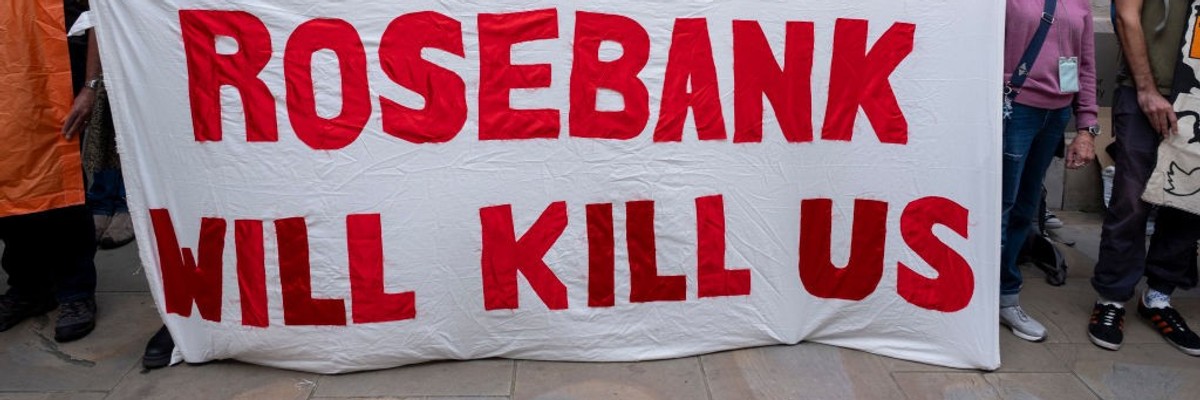
Activists hold a white sign reading “Rosebank will kill us” on September, 27, 2023 in London, United Kingdom. (Photo: Mike Kemp/In Pictures via Getty Images)

Oceana U.K.’s leader called the decision “a massive win for campaigners and another step towards… a cleaner, greener future for our seas, planet, and climate.”

Climate campaigners celebrated Thursday after the United Kingdom’s new Labour government announced it will not legally defend decisions to allow controversial offshore drilling in a pair of areas in the North Sea.

The two sites are Shell’s Jackdaw gas field and the Rosebank oil field, owned by Equinor and Ithaca Energy. Both projects have been loudly criticized by international green groups as well as U.K. opponents.

“This is amazing news and a BIG WIN for the climate. The government must now properly support affected workers and prioritize investment in green jobs,” declared Greenpeace U.K., which along with the group Uplift had demanded judicial reviews.

The approvals for both North Sea sites occurred under Conservative rule—in 2022 for Jackdaw and last year for Rosebank, the country’s biggest untapped oil field. Voters handed control of the government back to the Labour Party in May.

Then, as The Guardian detailed, “in June, the cases against the oil and gas fields received a boost when the Supreme Court ruled in a separate case that ‘scope 3’ emissions—that is, the burning of fossil fuels rather than just the building of the infrastructure to do so—should be taken into account when approving projects.”

“Now we need to see a just transition plan for workers and communities across the U.K. and an end extraction in the North Sea for good!”

The U.K. Department for Energy Security and Net Zero, led by Secretary Ed Miliband, cited the “landmark” Supreme Court ruling in a Thursday statement that highlighted the government’s decision not to defend the approvals “will save the taxpayer money” and “this litigation does not mean the licences for Jackdaw and Rosebank have been withdrawn.”

“Oil and gas production in the North Sea will be a key component of the U.K. energy landscape for decades to come as it transitions to our clean energy future in a way that protects jobs,” the department claimed, while also pledging to “consult later this year on the implementation of its manifesto position not to issue new oil and gas licenses to explore new fields.”

Welcoming the U.K. government’s acceptance of the recent high court ruling, Uplift founder and executive director Tessa Khan said on social media that “the immediate consequence… is that the Scottish Court of Session is very likely to quash the decision approving Rosebank, although we’re likely to have to wait a while before that’s confirmed.”

“If Equinor and Ithaca Energy decide they still want to press ahead with developing the field,” Khan explained, “then the next step will be for them to submit a new environmental statement to the [government] and regulator… that includes the scope 3 emissions from the field.”

“If you need reminding, those emissions are massive: the same as 56 coal-fired power plants running for a year or the annual emissions of the world’s 28 poorest countries,” she added. “If Equinor and Ithaca try to push Rosebank through again, the U.K. [government] must reject it.”

Greenpeace similarly stressed that “Rosebank and Jackdaw would generate a vast amount of emissions while doing nothing to lower energy bills,” and “the only real winners from giving them the greenlight would be greedy oil giants Shell and Equinor.”

“To lower bills, improve people’s health, upgrade our economy,” the group argued, the government must: increase renewable energy; better insulate homes; and boost support for green jobs.

Celebrations over the government’s decision and calls for further action weren’t limited to the groups behind the legal challenges.

Oceana U.K. executive director praised the “incredible work” by Greenpeace and Uplift, and called the government dropping its defense “a massive win for campaigners and another step towards… a cleaner, greener future for our seas, planet, and climate.”

Oil Change International also applauded the government’s “incredibly important and correct decision.”

“There is no defending more fossil fuel extraction,” the organization said. “Now we need to see a just transition plan for workers and communities across the U.K. and an end extraction in the North Sea for good!”

Global Witness similarly celebrated the government’s move, declaring on social media that “this is brilliant news!”

“New oilfields are an act of climate vandalism,” the group added. “Governments must prioritize people, not polluters’ profit.”

Original article by Jessica Corbett republished from Common Dreams under a CC licence.

Continue Reading‘Big Win’: UK Won’t Defend Fossil Fuel Projects in North Sea