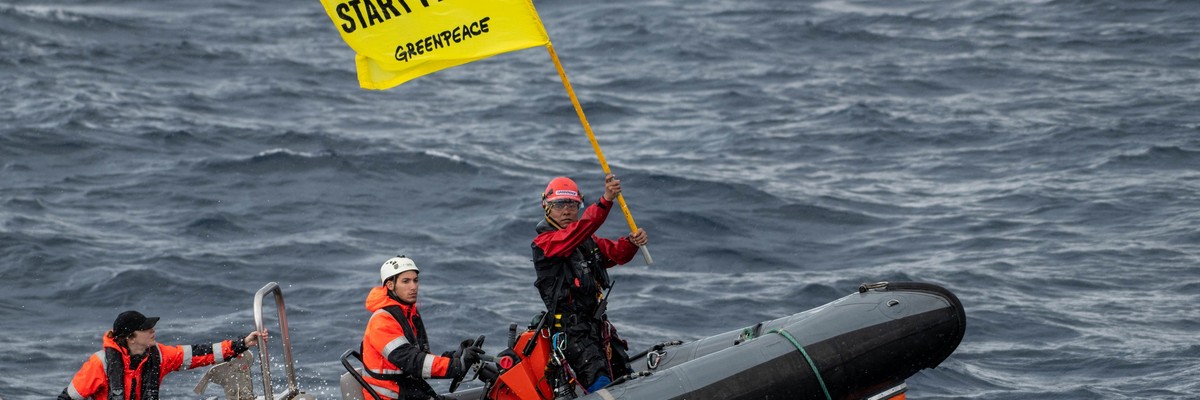
Greenpeace climate justice activists approaching Shell platform en route to major oilfield (Photo: Chris J Ratcliffe / Greenpeace)
“It has become clear: Eni is trying to silence anyone who dares to speak up and denounce the company’s contribution to the fueling of the climate crisis,” says Chiara Campione of Greenpeace Italy.
Greenpeace Italy revealed Wednesday that the Italian multinational energy company Eni is threatening a libel suit against it over reports the organization published about oil and gas companies.
Greenpeace said the potential lawsuit is related to a report on temperature-related premature deaths that may be caused by emissions from oil and gas companies like Eni and a report on the concept of “climate homicide.”
“We face yet another act of intimidation by Eni; it seems that threatening defamation lawsuits is the new sport which the company has decided to pursue most enthusiastically. But we won’t be silenced,” said Chiara Campione of Greenpeace Italy. “This new potential defamation lawsuit follows a similar case initiated by Eni against Greenpeace Italia only a few months ago.”
OOOPS ENI DID IT AGAIN! It seems that threatening defamation lawsuits is the new sport which the company has decided to pursue most enthusiastically. https://t.co/zZjhRdCa0f
Eni was given an opportunity to respond to the findings of the Greenpeace reports, but the group said Eni offered “no substantive rebuttal” and threatened legal action. The organization claimed other oil and gas companies mentioned in these reports have not threatened legal action.
Greenpeace Italy and the climate advocacy group ReCommon are currently suing Eni over its alleged contributions to the climate crisis. The first hearing for that case occurred last month.
“It has become clear: Eni is trying to silence anyone who dares to speak up and denounce the company’s contribution to the fueling of the climate crisis,” Campione said.
The multinational oil giant Shell sued Greenpeace in November for alleged damages related to Greenpeace activists boarding one of the company’s oil platforms. Shell is trying to get as much as $8.6 million in damages, which Greenpeace says would greatly threaten its ability to campaign.
The French multinational oil and gas company TotalEnergies is also suing Greenpeace France over a report that claimed it underestimated its 2019 greenhouse gas emissions.
Greenpeace said Wednesday that these companies are trying to “stop Greenpeace and other organizations from denouncing the damage the fossil fuel industry is causing to people and the planet.”
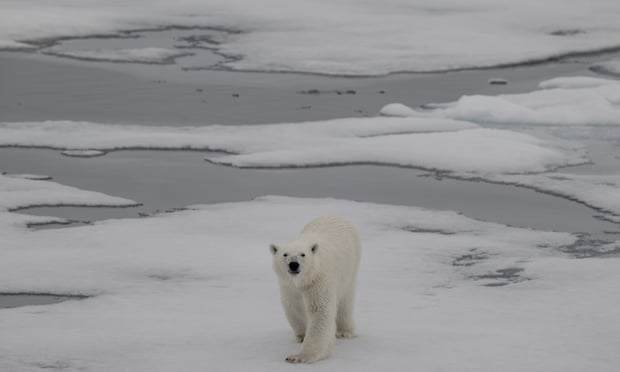
The first ice-free day in the Arctic could occur more than 10 years earlier than previous projections, the study finds. Photograph: Anadolu Agency/Getty Images
Home of polar bears, seals and walruses could be mostly water for months as early as 2035 due to fossil fuel emissions
The Arctic could have summer days with practically no sea ice within the next decade due to emissions from burning fossil fuels, a study has found.
This would transform the unique habitat, home to polar bears, seals and walruses, from a “white Arctic” to a “blue Arctic” during the summer months, scientists said. The calculation used for “ice free” means less than 1m sq km, in which case the Arctic would be mostly water.
The authors said consistently ice-free Septembers could be expected by 2035 to 2067. The exact year within that period is dependent on how quickly the world reduces the amount of fossil fuels burned.
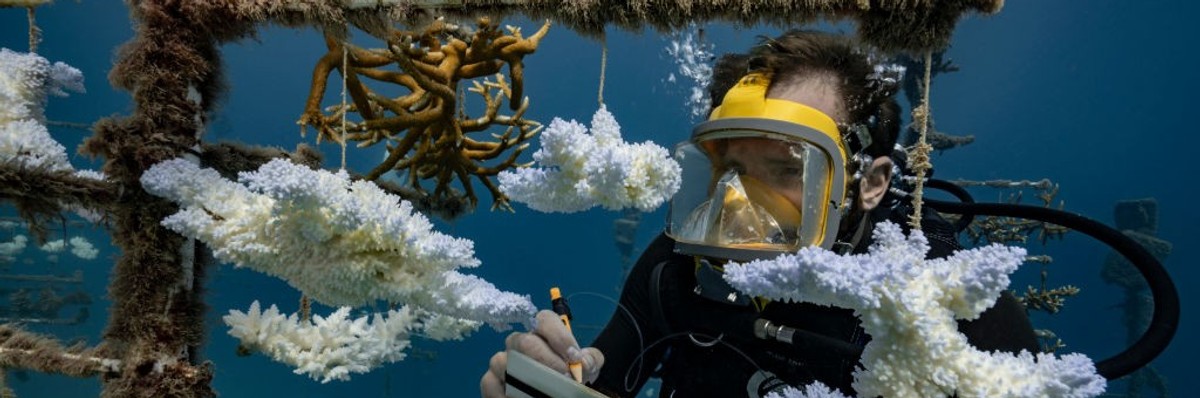
A diver looks at one of the coral nurseries on the reefs of the Society Islands in French Polynesia, where major bleaching is occurring, on May 9, 2019. (Photo: Alexis Rosenfeld/Getty Images).
After 2023 was the hottest year in human history, experts warn that 2024 “has strong potential to be another record-breaking year.”
While global policymakers continue to drag their feet on phasing out planet-heating fossil fuels, scientists around the world “are freaking out” about high ocean temperatures, as they told The New York Times in reporting published Tuesday.
A “super El Niño” has expectedly heated up the Pacific, but Times reporter David Gelles spoke with ocean experts from Miami to Cambridge to Sydney about record heat in the North Atlantic as well as conditions around the poles.
“The sea ice around the Antarctic is just not growing,” said Matthew England, a University of New South Wales professor who studies ocean currents. “The temperature’s just going off the charts. It’s like an omen of the future.”
Rob Larter, a marine geophysicist with the British Antarctic Survey who watches polar ice levels, told the paper that “we’re used to having a fairly good handle on things. But the impression at the moment is that things have gone further and faster than we expected. That’s an uncomfortable place as a scientist to be.”
…for almost a year now,” McNoldy said. “It’s just astonishing. Like, it doesn’t seem real.” Across the unusually warm Atlantic, in Cambridge, England, @rdlarter , a marine scientist who tracks polar ice levels, is equally perplexed. “It’s quite scary, partly because…
— Sierra Club Climate Adaptation & Restoration Team (@ClubAdaptation) February 28, 2024
Last week, Jeff Berardelli, WFLA‘s chief meteorologist and climate specialist, also highlighted the warm North Atlantic and that “all signs are pointing to a busy hurricane season” later this year.
Noting that in the middle of this month, sea surface temperatures in the North Atlantic were around 2°F higher than the 1990-2020 normal and nearly 3°F above the 1980s, Berardelli explained:
That may not sound like a lot, but consider this is averaged over the majority of the basin shown in the red outline in the image above. A deviation like that is unheard of… until now.
To put it into more relatable terms, considering what’s been normal for the most recent 30 years, the statistical chance that any February day would be as warm as it is right now is 1-in-280,000. That’s not a typo. This is according to University of Miami researcher Brian McNoldy…
And that 1-in-280,000 is compared against a recent climate, which had already been warmed substantially by climate change. If you tried to compare it against a climate considered normal around the year 1900, the math would become nonsensical. Meaning an occurrence like this simply would not be possible.
McNoldy also stressed the shocking nature of current conditions to the Times, telling Gelles that “the North Atlantic has been record-breakingly warm for almost a year now… It’s just astonishing. Like, it doesn’t seem real.”
The new comments from McNoldy and other scientists come on the heels of various institutions and experts worldwide recently confirming that 2023 was the hottest year in human history. Research also showed that it was the warmest year on record for the oceans, which capture about 91% of excess heat from greenhouse gases.
As Common Dreams reported last month, Adam Scaife, a principal fellow at the United Kingdom’s Met Office, said that “it is striking that the temperature record for 2023 has broken the previous record set in 2016 by so much because the main effect of the current El Niño will come in 2024.”
That’s the warm phase of the El Niño Southern Oscillation, a climate phenomenon that also has a cool phase called La Niña expected later this year. Still, Scaife warned that “the Met Office’s 2024 temperature forecast shows this year has strong potential to be another record-breaking year.”
Throughout the record-shattering 2023, experts also expressed alarm. After an April study showed that the ocean is heating up faster than previously thought, the BBC revealed that some scientists declined to speak about it on the record, reporting that “one spoke of being ‘extremely worried and completely stressed.'”
In July, when a buoy roughly 40 miles south of Miami recorded a sea surface temperature of 101.1°F just after a “100% coral mortality” event at a restoration site, Florida State University associate professor Mariana Fuentes told NPR that “if you have several species that are being impacted at the same time by an increase in temperature, there’s going to be a general collapse of the whole ecosystem.”
The following month, the European Union’s Copernicus Climate Change Service announced that the average daily global ocean surface temperature hit 69.7°F, and deputy director Samantha Burgess said, “The fact that we’ve seen the record now makes me nervous about how much warmer the ocean may get between now and next March.”
“The more we burn fossil fuels, the more excess heat will be taken out by the oceans, which means the longer it will take to stabilize them and get them back to where they were,” Burgess emphasized at the time.
Last year ended with a United Nations climate summit that scientists called “a tragedy for the planet,” because the final deal out of the conference—led by an Emirati oil CEO—did not demand a global phaseout of fossil fuels.
Azerbaijan, which is set to host this year’s U.N. conference in November, has similarly selected a former fossil fuel executive to lead the event. The country also plans to increase its gas production by a third during the next decade.
Rishi Sunak offers huge fossil fuel subsidies to develop fossil fuel extraction in UK.
Rishi Sunak awards a huge tax break to further destroy the climate.
It’s called a windfall tax – it’s a further windfall for fossil fuel companies on top of their windfall of higher prices following the invasion of Ukraine.
Back in May 2022, the UK government announced the energy profits levy, as a response to the growing pressure for a ‘windfall tax’ on the massive profits being generated by companies pumping oil and gas in the North Sea. These profits were fuelled by skyrocketing fossil fuel prices in the wake of the Russian invasion of Ukraine. The levy raised the effective rate of corporation tax paid on oil and gas profits from 40% to 65%, and again to 75% in November 2022.
But, it came with a caveat. Despite the UK’s urgent need to kick its addiction to expensive fossil fuels, this government didn’t want to discourage investment in more oil and gas extraction. So they included a tax loophole to ensure that companies investing in new projects to pump fossil fuels out from under the North Sea would see their tax relief (already generous by most standards) rise to 91%. In other words, fossil fuel companies could deduct 91% of their capital investment costs from their corporation tax bill. The ‘windfall tax’ may have, on the surface, attempted to tackle the grotesque profits being raked in by massive companies in the midst of the cost of living crisis – but it also made it cheaper for these companies to extract the fossil fuels contributing to the sky-high cost of living in the first place.
At NEF, we analysed last week’s new OBR data, and found that the loophole included in the energy profits levy has massively increased the amount of tax relief which fossil fuel companies will potentially receive. We estimate that oil and gas extractors could receive up to £18.1bn in tax relief between 2023 and 2026. That’s a massive increase of £10.5bn, or 136%, from the £7.6bn they were expected to receive before the energy crisis. This is an enormous amount of lost revenue that could go to the government to be spent on lowering our energy bills or improving our public services. The OBR expects the UK oil and gas industry to pay £24.3bn in tax between 2024 and 2027, meaning that closing the tax loophole in the energy profits levy could almost double the amount of tax revenue our government could receive – and the businesses in question would still walk away with billions.
…
Even if you accept the government’s warped logic, which seeks to encourage greater North Sea extraction, the policy appears to be failing. While total potential for tax relief has risen by £10.5bn, total forecast investment has risen by just £3.4bn. This would represent an abysmal return on a government tax measure. Relief has largely been extended to investments which were expected to occur anyway, suggesting the policy is (intentionally or not) little more than a vehicle for oil and gas companies to keep most of their explosive profit growth, while the windfall tax sustains an illusion of fairness.
The energy profits levy helped pay for the government’s emergency cost of living support measures – in theory. But our energy bills remain extortionate, costing 50% more than they did in early 2022, prior to the Russian invasion of Ukraine. With the poorest households over £200 a week short of the amount they need for an acceptable standard of living, this government has still not provided enough support. Looking forward, removing the perverse tax reliefs extended to the oil and gas industry could free up almost £13bn of tax revenue between 2024 and 2026: enough to give every household in the country three £150 annual payments to help cover their energy costs.
…
It’s reasonable to compare the so-called windfall tax to Norway’s windfall tax since they are both taxing fossil fuel activities in the North Sea. The Uk’s Labour party has repeatedly said that it intends to impose a “proper windfall tax”. There was further brief mentions of this during the Labour Party’s reformulation and massive restriction of it’s green policies yesterday 8th February 2024 but it remains unclear what is intended.
What’s obviously clear is that Norway’s windfall tax has made and continues to raise huge sums for Norway. There is still a disguised fossil fuel subsidy for exploration and extraction – from what I can see it appears to be 78%. That’s a long way from Sunak’s 91% and since we’re dealing with vast sums of money, 91 – 78 = 13% of vast sums of money is still vast sums of money (as any Chancellor should realise).
Investment in an offshore operating asset in Year 1 is 100.
In the ordinary tax base (22%), 100 must be capitalized and depreciated linearly over 6 years. The depreciation in Year 1 is 100 / 6 = 16.7, i.e., a deduction of 16.7. This results in a tax amount in Year 1 of -16.7 * 22% = -3.7.
In the special tax base (56%), the entire amount of 100 can be deducted directly. The special tax base will therefore initially be -100. However, we must deduct the tax amount from the ordinary tax base of -3.7 from the -100. The special tax base will thus be -100 – (-3.7) = -96.3. To calculate the special tax amount, we must use the technical special tax rate of 71.8%. The special tax will thus be -96.3 * 71.8% = -69.3.
Hence, total tax on the investment of 100 in the offshore operating asset in Year 1 is
-3.7 + (-69.3) = -73, i.e., a tax deduction of 73.
In Years 2 – 6, the linear depreciation continues in the ordinary tax base. For each of these years, the tax on the investment of 100 in Year 1 is thus -3.7 in the ordinary tax base. At the same time, this tax is treated as “income” in the calculation of special tax, as the amount must be deducted in the special tax base. The special tax will thus be 3.7 * 71.8 = 2.7 in each of the years. Total tax per year will therefore be -3.7 + 2.7 = -1.
Looking at the entire period Year 1 – Year 6 as a whole, the total nominal tax for the investment of 100 in Year 1 is the sum of -73 in Year 1 and -1 for each of Years 2 – 6 (5 years), i.e., -73 + (-5) = -78, resulting in a total deduction of 78 over the period.
Despite windfall tax and record profits, Shell paid just £15 million to UK, 22p per Brit last year
By comparison Norway received £6.3 billion from Shell, over a grand per Norwegian
28th March 2023, London – Energy giant Shell paid just £15 million in taxes and fees to the UK last year on their drilling, compared to over £6.3 billion to the Norwegian government over the same period, according to Global Witness analysis of Shell’s latest tax reporting, released today.
This means Shell paid around just 22p per UK citizen, compared to the £1,171 it paid for every citizen of Norway. This £15 million is much closer to the £9.7 million it awarded its CEO in 2022, than the considerably more it paid to most other countries in which it drills.
The UK ranks 19th out of 25 countries for taxes received by Shell last year, with the likes of the USA, Germany, Qatar and Italy all receiving far more from Shell than the UK. It comes despite the introduction of a UK windfall tax that Rishi Sunak, as Chancellor, described as a “significant set of interventions”.
…
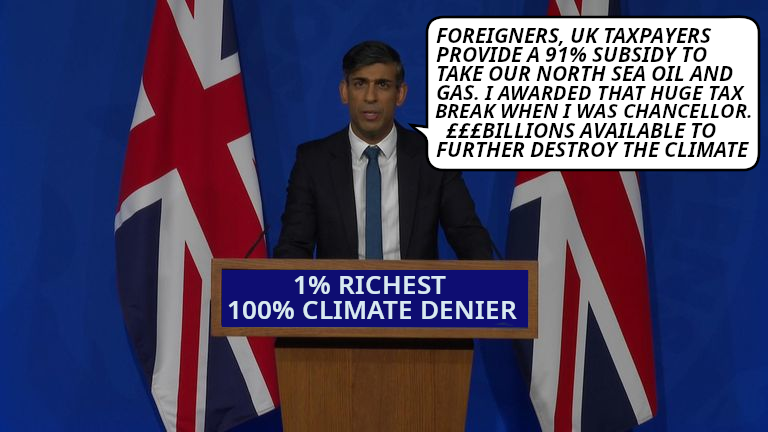
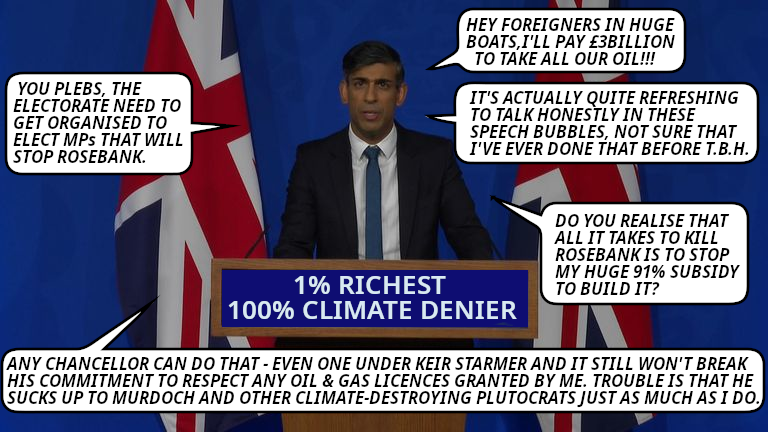
Rishi Sunak on stopping Rosebank says that any chancellor can stop his huge 91% subsidy to build Rosebank, that Keir Starmer is as bad as him for sucking up to Murdoch and other plutocrats and that we (the plebs) need to get organised to elect MPs that will stop Rosebank. [3rd version of image has same text].
“This is a massive backward step – for the climate, for the economy and for good quality jobs. Both the security of our planet for future generations and the UK’s future prosperity is dependent on greening our economy and that requires large scale investment.
“Labour have chosen to wear their fiscal rules as a millstone around their neck. A different approach through tax reforms, in particular by introducing a wealth tax on the super-rich, could help pay for the green transition. There is more than enough money in the economy to pay for this. Indeed, the Green Party would go further and faster, investing at least double what Labour originally pledged, so we can turbo charge the transition to a green economy.
“Greens recognise that investing in a green future will provide people with economic, social and environmental security. By decarbonising industry, insulating buildings, and ramping up renewable energy infrastructure, the UK can drastically reduce emissions, cut household bills and create new, good quality, well-paid and secure jobs in every corner of the country.
“Investing in this secure future is a political choice. By ditching its green investment plan, and making a series of other U-turns, Labour has clearly signalled that it is turning its back on a fairer, greener future.
The Labour party is expected to make a further announcement today.