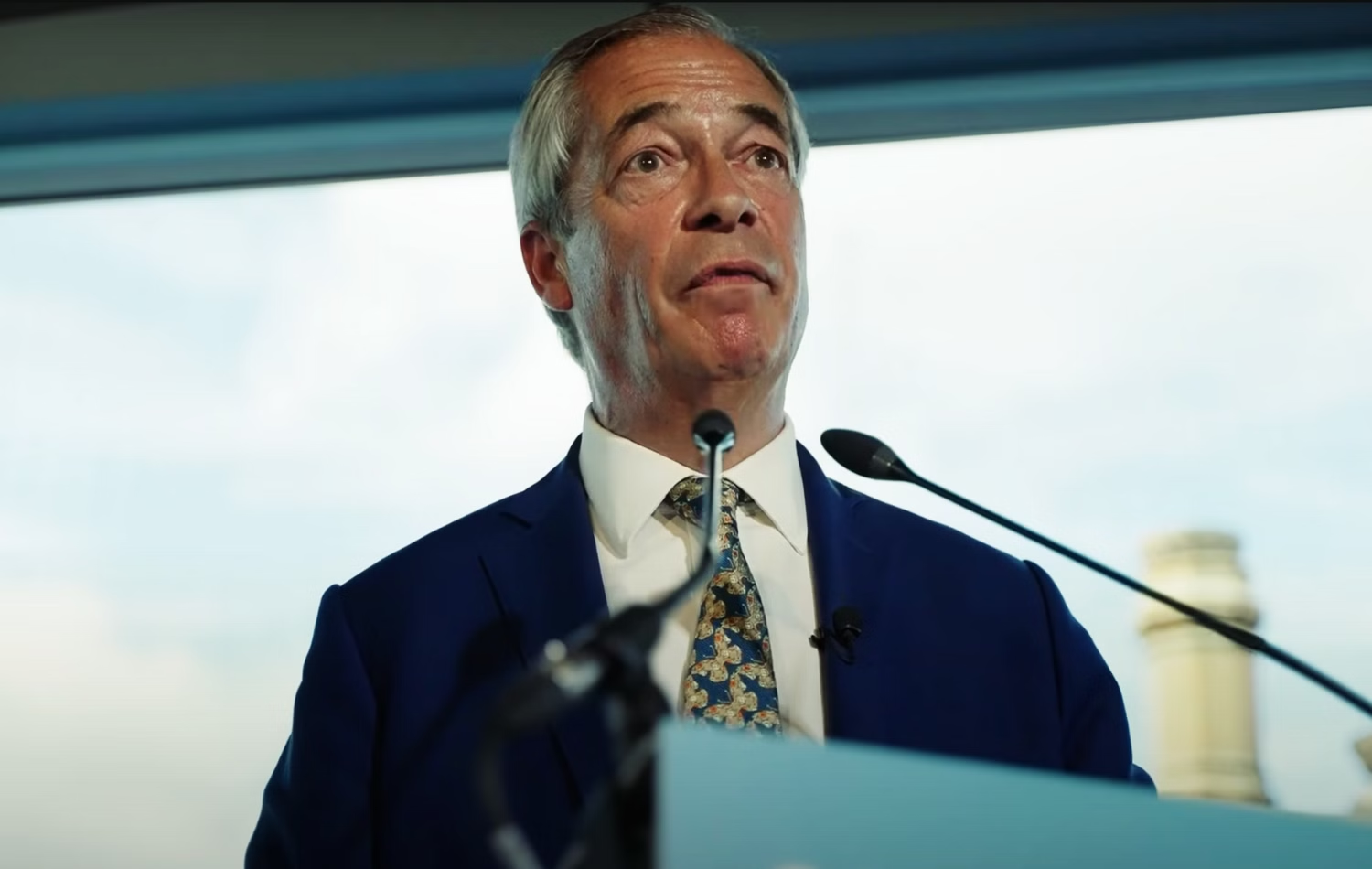
Reform UK leader Nigel Farage speaking in Aberdeen. Credit: Reform UK / YouTube
Nigel Farage’s party was told by Offshore Energies UK to rethink its plan to thwart clean energy.
LIVERPOOL – The UK’s largest oil and gas trade body has criticised Reform UK’s plans to “turn off the tap” on renewable energy.
Nigel Farage’s party has tried to present itself as the oil and gas industry’s closest ally, vowing to “drill, baby, drill” in the North Sea and scrap the windfall tax on excess profits, while meeting with oil executives, and courting donations from the sector.
However, on a panel at the Labour Party’s annual conference in Liverpool on Monday (29 September), a spokesperson for Offshore Energies UK (OEUK) criticised Reform’s plans to end state support for clean energy.
Natalie Coupar, communications and marketing director at OEUK – members of which include fossil fuel giants BP, Shell, ExxonMobil, TotalEnergies, and Equinor – said the group is “apolitical” but gives “hard truths to all parties”.
She said: “One of the things we’ve been saying to Reform very much is, you know, if you’re going to turn on the taps for oil and gas, there’s almost really no point if you’re just going to turn off the taps to renewables.
“That doesn’t help. We need to keep both those streams open.”
According to the Confederation of British Industry (CBI), the UK’s net zero economy grew by 10 percent in 2024, employing almost a million people in full-time jobs.
Coupar also said it was essential to “hold the consensus on tackling climate change and growing our energy future”.
A panel at 2025 Labour Party conference sponsored by Offshore Energies UK (OEUK). Credit: DeSmog
Reform’s Oil Campaign
Reform has vowed to stop all government subsidies for renewable energy, and has pledged to block solar and onshore wind farms in the local authorities it controls.
In May, the party’s deputy leader Richard Ticesaid: “Whether it’s planning blockages, whether it’s judicial reviews, whether it’s lawsuits, whether it’s health and safety notices, we will use every available legal measure to an extreme way in order to frustrate these people.”
Tice – who has said “there’s no evidence that man-made CO2 is going to change the climate” – met with senior oil executives in May and promised to approve new drilling licences “on day one” of a Reform government.
Last month, he pledged to overturn the UK’s ban on fracking for shale gas, which he calls “treasure beneath our feet”, and told the industry to “get ready”.
In April, Reform party treasurer and a billionaire property developer Nick Candy said he was trying to secure donations from oil and gas executives, claiming to have raised £100,000 from one, though this has yet to appear on Reform’s donations register.
As DeSmog has reported, 92 percent of Reform’s funding between the 2019 and 2024 general elections came from climate science deniers or those with highly polluting interests – a total of £2.3 million.
Since his election as an MP last year, Farage has spoken at a string of events in the U.S. organised by radical groups backing U.S. President Donald Trump’s pro-fossil fuel agenda. Last December, Farage launched the UK-EU branch of the Heartland Institute, a U.S. climate denial think tank.
Speaking at the Alliance for Responsible Citizenship conference in London in February, Farage claimed it was “absolutely nuts” for CO2 to be considered to a pollutant. However, he added: “I’m not a scientist. I can’t tell you whether CO2 is leading to warming or not, but there are so many other massive factors.”
Climate scientists at the UN’s Intergovernmental Panel on Climate Change (IPCC), the world’s leading climate science body, have stressed that “it is a statement of fact, we cannot be any more certain; it is unequivocal and indisputable that humans are warming the planet”.
Nigel Farage urges you to ignore facts and reality and be a climate science denier like him and his Deputy Richard Tice. He says that Reform UK has received £Millions and £Millions from the fossil fuel industry to promote climate denial and destroy the planet.Elon Musk urges you to be a Fascist like him, says that you can ignore facts and reality then.Nigel Farage reminds you that he’s the man that brought you Brexit and asks what could possibly go wrong.
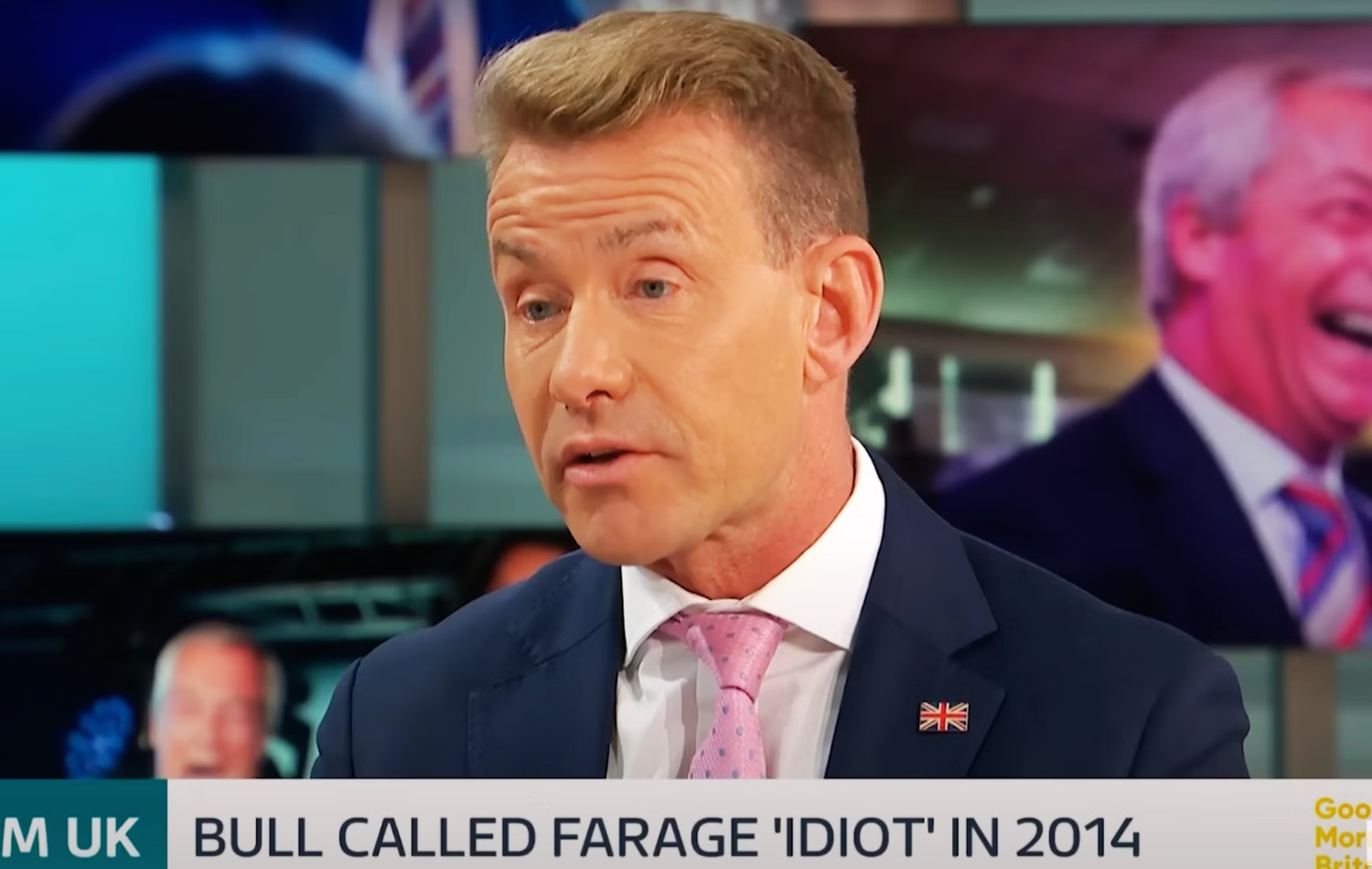
Reform UK chair David Bull[…]. Credit: Good Morning Britain / YouTube
Farage’s latest chairman is a TV presenter who has attacked climate “madness” and called for the ban on fracking to be lifted.
Reform UK’s new chairman has repeatedly attacked climate targets as “madness” and “a killer”, supported fracking, and falsely dismissed the role of carbon emissions on heatwaves.
David Bull, a TalkTV presenter and former doctor, was appointed as the chair of Nigel Farage’s right-wing populist party this week following the resignation of its previous chair Zia Yusuf.
Yusuf, a luxury lifestyle entrepreneur, said that working to achieve a Reform government was no longer a good use of his time, before returning two days later in a new role.
Bull is now loyal Farage supporter, despite having called the Reform leader a “dangerous, prejudiced idiot” in 2014. He was a member of the European Parliament in 2019 for the Brexit Party, the predecessor to Reform UK, and served as Reform’s deputy leader from March 2021 to July 2024.
In a series of social media posts, Bull has repeatedly attacked the UK’s target to cut carbon emissions to net zero by 2050, which climate scientists have said is needed to limit global warming to 1.5C.
On the eve of the 2024 general election, Bull posted on Elon Musk’s website X.com: “Net Zero is a killer. It’s killing British jobs, communities and the economy. Only Reform UK will scrap Net Zero.”
In reality, according to risk management experts the Institute and Faculty of Actuaries (IFoA), 50 percent could be wiped off the global economy between 2070 and 2090 if runaway temperature increases are not halted, while there could be more than 4 billion deaths.
In January of this year, he shared a Telegraph story about a lull in wind power and claimed that it made “a complete mockery” of Labour’s net zero chief Ed Miliband and his “religious obsession” with renewable energy.
As revealed by DeSmog, Reform’s constitution gives sweeping powers to its chairman, who cannot be formally sacked by the party leader.
Reform wants to scrap the UK’s net zero target entirely, stop subsidies for renewable energy, impose a “windfall tax” on wind and solar companies, approve new oil and gas extraction, and open new coal mines. The party’s leaders have also repeatedly made false statements about climate change.
As DeSmog has reported, Reform received £2.3 million between the 2019 and 2024 general elections from climate deniers, fossil fuel investors, and polluting interests. It is also openly seeking donations from oil executives.
David Bull’s Climate Stance
In May 2023, Bull hosted a TalkTV segment called “the madness of net zero”. He began by saying: “I think all of us feel that the climate is changing and that we want to go to net zero”. This is out of step with Reform’s position, and the title of his segment.
But he went on to claim, of the UK’s record heatwave the previous summer, “we don’t know whether that is a result of man-made emissions”.
In the same segment, Bull suggested net zero was “subjecting people in this country to become poorer”. In reality, according to the Confederation of British Industry (CBI), the UK’s net zero economy grew by 10 percent in 2024, employing almost a million people in full-time jobs with an average wage of £43,000 – £5,600 higher than the national average.
In October 2021, Bull endorsed a campaign by climate denial pressure group CAR26 for a Brexit-style referendum on net zero, and shared a poll commissioned by the group, adding: “We absolutely MUST have a referendum on the Government’s net zero policy. Retweet if you agree.”
CAR26 director Lois Perry now runs the UK-EU branch of the Heartland Institute, a notorious U.S. climate denial think tank. The UK-EU branch was launched in December by Reform’s leader Farage.
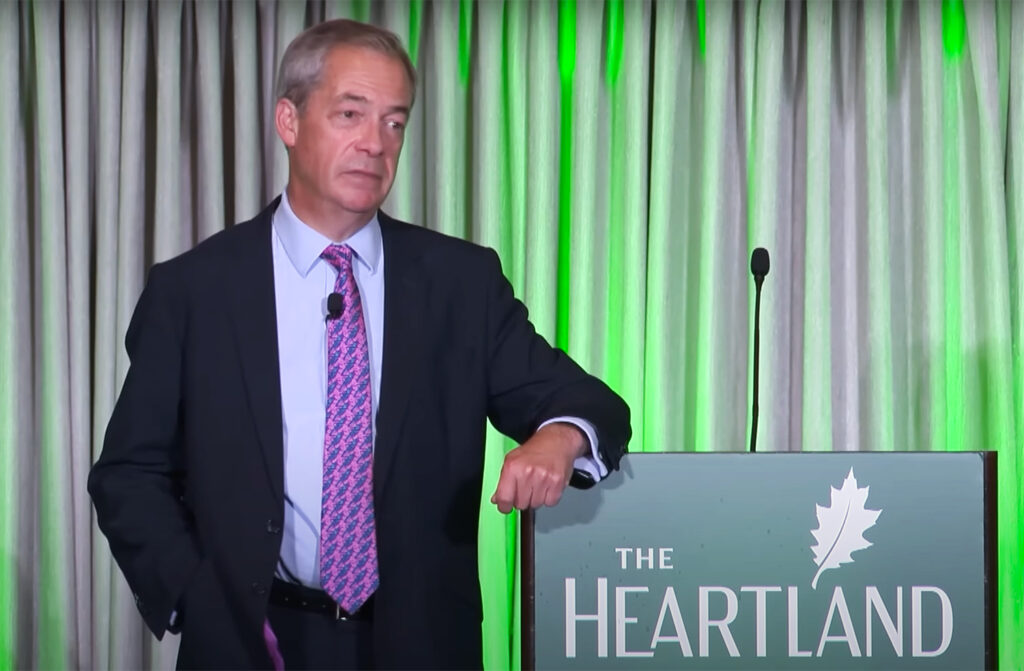
Reform UK leader Nigel Farage speaking at the Heartland Institute’s 40th anniversary fundraiser in September 2024. Credit: Heartland Institute / YouTube
In November 2021, while the UK hosted the flagship UN COP26 climate summit, Bull attacked what he called “the hypocrisy of COP26”. He told TalkTV: “It is obscene. The hypocrisy that they [world leaders] fly in on private jets. People are sick and tired of being told what to do.”
In April 2022, Bull posted on X.com predicting that “Net Zero will be the new Brexit. It will be the most defining issue at the next general election”. Despite Reform’s best efforts, the pro-net zero Labour Party won a historically large majority.
Bull has also supported overturning the UK’s ban on fracking for shale gas.
In October 2022, when prime minister Rishi Sunak reversed the decision by his predecessor Liz Truss to lift the ban, Bull posted: “MASSIVE MISTAKE. We need cheap energy NOW. Fracking has allowed the US to have 100-200 years of cheap energy.”
Aside from the pollution caused by burning shale gas, fracking is environmentally controversial due to its triggering of earth tremors, and the vast amount of water that it uses. The House of Commons Environmental Audit Committee – a body of MPs that advises the government on climate matters – concluded in 2019 that fracking was incompatible with the UK’s climate goals.
TalkTV was launched in 2022 by Rupert Murdoch’s News UK as a rival to GB News, but in 2024 it switched to an online streaming service.
As DeSmog has reported, TalkTV presenters have frequently attacked climate action. In the COP26 segment, Bull was interviewed by fellow TalkTV host Mike Graham, who has declared on social media that “climate change is a load of old bollocks”.
Bull has resigned as a TalkTV presenter, following his appointment as Reform’s chair.
Nigel Farage reminds you that he’s the man that brought you Brexit and asks what could possibly go wrong.Nigel Farage explains the politics of Reform UK: Racism, Fake anti-establishmentism, Deregulation, Corporatism, Climate Change Denial, Mysogyny and Transphobia.
Even now, decades after we first began trying to avert the worst of global warming, more than 80% of the world’s total energy comes from fossil fuels.
You might think this would make fossil fuel production extremely profitable. But it’s not always the case. Much of the most accessible oil has already been extracted and burned. Many countries want to shore up domestic sources of fossil fuels to boost energy security. Energy price fluctuations and competition from new energy sources such as solar, wind and fossil gas have made it harder for some fossil fuel companies to make money, especially in coal.
You might have wondered – why would some of the largest companies on Earth need subsidies? Here’s why.
Australia’s surging liquefied natural gas industry has been boosted by government funding. KDS Photographics/Shutterstock
Private companies, public money
Globally, private companies dominate fossil fuel production, though fossil fuel-rich nations often have state-owned companies, such as Saudi Arabia’s Aramco and Russia’s Rosneft.
Why would governments give fossil fuel companies money? Many reasons. But the most important is that wealthy countries have historically needed huge volumes of fossil fuels for manufacturing, transport and power. Many countries have some sources of fossil fuels inside their borders, but only a few are self-sufficient. This has enabled fossil fuel giants such as Saudi Arabia to become wealthy beyond belief.
Many governments have used subsidies to boost their energy security and encourage local producers to seek out new sources of coal, gas and oil. These subsidies can make all the difference in making fossil fuel companies competitive internationally. For instance, Canada spent billions on subsidies to boost its oil sands and fracking projects.
Subsidies were essential in the United States’ fracking revolution. Novel approaches to extracting fossil gas and oil – boosted by major tax incentives – turned the US from a major importer of oil and gas into a net exporter by 2019.
You can see why the US did this. At a stroke, it went from being dependent on energy provided by foreign nations to being independent.
Once subsidies are in place, they become very hard to remove. Indonesia’s lavish fuel subsidies now account for 2% of the nation’s GDP. When the national government tried to walk these back, there were riots.
And there’s another reason, too. Fossil fuels are still playing an important role in boosting the economy in most nations. Subsidising them has long been seen as a way to maintain economic growth and stability.
Globally, these subsidies are estimated at a staggering $10.5 trillion each year.
This figure has grown sharply in recent years, after Russia’s invasion of Ukraine. As European nations tried to wean themselves off Russia’s gas, energy prices surged worldwide. In response, some countries introduced new subsidies to support businesses and consumers.
The top-line figure of $10.5 trillion includes two types of subsidy – explicit (meaning real dollars change hands) and implicit (for example, governments building roads and railways to encourage crude oil transport).
Explicit subsidies
Explicit fossil fuel subsidies are direct financial incentives from governments to fossil fuel producers and consumers. These incentives come in different forms, such as tax breaks, direct payments, grants and price controls. All of them aim to reduce the financial burden associated with fossil fuel production and use.
In Australia, explicit subsidies include fuel tax credits and exploration tax reductions. Fossil fuel companies can get subsidies to offset the losses they make during the years it takes to find and begin extracting new fossil fuels.
In the US, oil and gas companies benefit from the oil depletion allowance, which permits them to deduct a percentage of their gross income from oil and gas sales as an expense. They can also claim tax deductions for intangible drilling costs, such as the wages of workers and material needed to find new sources of oil and gas.
China, too, uses direct subsidies, discounted land-use fees, and preferential loans as explicit subsidies to boost coal production and consumption. The national government also supports fossil fuel consumption through direct payments to consumers.
China has used subsidies to encourage exploitation of its large coal resources. zhaoliang70/Shutterstock
Implicit subsidies
Implicit subsidies are often described as “imaginary”. That doesn’t mean they don’t exist, just that they’re not a direct transfer to directly paid to fossil fuel producers.
For instance, the cost of burning fossil fuels is borne by the global community and the natural world, in the form of climate change, damage to human health and other harms. Most fossil fuel companies don’t have to pay a cent for the pollution their products cause – so in effect, they are being granted an indirect subsidy.
Implicit incentives also include government investment in facilities such as transport networks, pipelines, oil refineries and port infrastructure, which will accelerate fossil fuel production and delivery. Think of the Middle Arm development in Darwin, funded by both the federal and territory government.
Why are these subsidies still being paid?
As the world grapples with a worsening climate crisis, fossil fuel subsidies are under great scrutiny.
It’s politically difficult to withdraw subsidies once given. This is why governments around the world have instead begun to give subsidies and tax incentives to green energy developers, including the enormous $500 billion Inflation Reduction Act in the US, the European Union’s Green Deal, and China’s massive subsidies of green technologies such as electric vehicles and solar panels.
The goal here is to make renewable energy and electrified transport steadily more affordable and competitive – just as fossil fuel subsidies did for oil, gas and coal.
One expert called Nigel Farage’s policies a contract to “bankrupt Britain and condemn future generations to climate catastrophe”.
Nigel Farage’s Reform UK, which is funded by climate science deniers and fossil fuel interests, has launched its manifesto with a pledge to expand oil and gas exploration and open new coal mines.
The document repeats the party’s policy to “scrap net zero”, the UK’s legally-binding target to reduce greenhouse gas emissions. It says Reform would “fast-track licences of North Sea gas and oil” and introduce two-year “test sites” for the controversial practice of fracking for shale gas, followed by “major production when safety is proven”.
It says Reform would “increase and incentivise UK lithium mining for electric batteries, combined cycle gas turbines, clean synthetic fuel and clean coal mining”.
Coal emits the most carbon dioxide (CO2) of any fossil fuel. The world’s foremost climate science body, the UN’s Intergovernmental Panel on Climate Change (IPCC), has stated that stated that carbon dioxide “is responsible for most of global warming” since the late 19th century, which has increased the “severity and frequency of weather and climate extremes, like heat waves, heavy rains, and drought”.
The International Energy Agency (IEA) has said that any new fossil fuel projects would be incompatible with limiting warming to 1.5°C.
Earlier this month, DeSmog revealed that Reform had received more than £2.3 million from oil and gas interests, highly polluting industries, and climate science deniers since December 2019 – amounting to 92 percent of the party’s donations during that period.
Reform’s manifesto also says it would impose billions of pounds’ worth of taxes on renewable energy, claiming that renewables have increased energy bills. The party says that scrapping net zero would save the UK £30 billion a year – a claim that contradicts the views of scientists and economists.
The Climate Change Committee, which advises the government on its net zero policies, has estimated that the cost of achieving net zero will be less than 1 percent of the UK’s annual economic output. The government independent spending watchdog – the Office for Budget Responsibility – has said that, “the costs of failing to get climate change under control would be much larger than those of bringing emissions down to net zero”.
Ed Matthew, campaigns director at the energy think tank E3G, said: “Nigel Farage’s pitch to obliterate net zero investment would damage the UK’s economic recovery and keep UK households hooked on high-cost gas.
“Net zero is the economic opportunity of the century. Farage is a climate change denier, in the pocket of fossil fuel vested interests, and he has presented a ‘contract’ to bankrupt Britain and condemn future generations to climate catastrophe.”
Dirty Donors
Reform has received a fortune from wealthy donors who either deny climate science or have interests in polluting industries.
Since 2019, Reform has received more than £1.1 million in donations from Richard Tice, the party’s former leader and current chairman, plus more than 50 loans collectively worth around £1.4 million from a Tice-owned company called Tisun Investments.
Tice is one of the UK’s most prominent climate science deniers, using his presenting role on the right-wing broadcaster GB News to attack net zero policies and the science behind them. Tice has claimed that “there is no climate crisis” and expressed the view that “CO2 isn’t a poison. It’s plant food”.
Reform has received more than £500,000 since the last general election from Jeremy Hosking, whose investment firm Hosking Partners had more than $134 million (around £108 million) invested in the energy sector at the close of 2021, two thirds of which was in the oil industry, along with millions in coal and gas.
Hosking previously told DeSmog: “I do not have millions in fossil fuels; it is the clients of Hosking Partners who are the beneficiaries of these investments.”
Farage also has a history of denying the science of climate change and attacking green policies. Speaking on GB News in August 2021, he said that he was “very much an environmentalist” and that he couldn’t “abide things like plastics in our seas, pollution in our rivers.” However, on the issue of climate change, he added: “What annoys me though, is this complete obsession with carbon dioxide almost to the exclusion of everything else, the alarmism that comes with it, based on dodgy predictions and science.”
The IPCC has stated that it is “unequivocal that human influence has warmed the atmosphere, ocean and land”.
Reform has also received £200,000 from First Corporate Consultants, a firm owned by Terence Mordaunt, a director and former chair of the Global Warming Policy Foundation (GWPF), the UK’s leading climate science denial group.
‘Problematic’ Policies
Reform’s previous manifesto, which was on the party’s website as of last week, said the government’s windfall tax on oil and gas companies should be “scrapped”. It is not clear whether this is still Reform policy, as it does not appear in the new manifesto.
“Everyone can see that the oil and gas companies have raked in billions in profits since the start of the energy crisis and that it is the soaring price of gas – and our high dependency on it – that lies at the root of our high energy bills”, said Tessa Khan, executive director of environmental campaign group Uplift.
She added: “Our energy system is broken, but the only way to fix it is to phase out gas, not double down on new drilling, while scrapping support for insulation and renewables, as Reform is proposing.”
Analysis by the independent research group, the Institute for Fiscal Studies (IFS), today called the numbers in Reform’s manifesto “problematic”, adding: “Spending reductions would save less than stated, and the tax cuts would cost more than stated, by a margin of tens of billions of pounds per year.”
In May, a Reform spokesperson told DeSmog: “Climate change is real, Reform UK believes we must adapt, rather than foolishly think you can stop it.
“We are proud to be the only party to understand that economic growth depends on cheap domestic energy and we are proud that we are the only party that are climate science realists, realising you can not stop the power of the sun, volcanoes or sea level oscillation.”
In May, DeSmog revealed that the Conservative Party had received £8.4 million from fossil fuel interests, highly polluting industries, and climate science deniers since the 2019 election. The party received an additional £225,000 from fossil fuel interests during the first week of the 2024 campaign – equivalent to 40 percent of its funding during this period.
An investigation last week mapped the Conservatives’ ties to a network of climate denial and fossil fuel interests, and the party last week launched its manifesto by promising to issue more oil and gas licences.
The former prime minister attacks flagship climate deals and makes false claims about electric vehicles, Russia’s influence on energy policies, and net zero.
The new book by former Prime Minister Liz Truss urges the UK, U.S. and EU to drop their landmark climate change laws, spreads falsehoods about green policies, and fondly recalls an attempt to cancel a major climate conference.
Truss, who is the Conservative MP for South West Norfolk, resigned as prime minister in October 2022 after just 49 days in office.
Since leaving 10 Downing Street, Truss has attempted to expose the “deep state” forces that allegedly brought down her premiership, while advocating for “free market” ideas within the Conservative Party, helping to launch the Popular Conservatives group.
In her book, Ten Years to Save the West, which she is promoting widely this week, Truss writes that “the zealous drive to net zero”, the UK’s legally binding 2050 climate target, amounts to “unilateral economic disarmament” and is “a drag on economic growth”. She also claims that, while serving in the Treasury, she attempted to cancel the 2021 COP26 climate summit in Glasgow.
Truss writes: “We should abolish the Climate Change Act and instead adopt a new Climate Freedom Act that enables rather than dictates technology”. She adds that “the U.S. should reverse the Inflation Reduction Act, and the EU should abandon its equivalent measures”.
The Climate Change Act legalised the UK’s commitment to reducing carbon dioxide emissions by at least 80 percent by 2050 from 1990 levels. The Inflation Reduction Act is a $369 billion package of grants and subsidies by the U.S. government to spur green technology investment.
Scientists at the Intergovernmental Panel on Climate Change (IPCC) have said that without “immediate and deep emissions reductions across all sectors” limiting global heating to 1.5C is beyond reach.
Restricting global temperatures to this threshold – the target agreed by the UK as part of the 2015 Paris Agreement – would prevent the worst and most irreversible effects of climate change, including floods, droughts, heatwaves, and wildfires.
In the book, Truss also attacks climate advocates, writing that “the environmental movement is fundamentally driven by the radical left”, adding: “This ‘watermelon’ tendency is green on the outside, red on the inside – a modern rebranding of socialism. It features the same instincts of collectivism and authoritarianism.”
Truss writes that “we should cancel” the United Nations annual COP climate summit, and falsely claims that electric vehicles are worse for the environment than those powered by fossil fuels.
“In recent years, more radical forms of climate misinformation and disinformation have become mainstreamed”, said Jennie King, director of climate research and policy at the Institute of Strategic Dialogue think tank. “Such content continues to grow in virality and engagement online, but its impacts are vastly increased when platformed in the media or by politicians.”
King said “the normalisation of wild and outlandish claims”, with climate action “being framed through a conspiratorial, tribalist and anti-scientific lens”, can lead to “real-world harm”.
“When such ideas are conveyed from the very corridors of power, it sets a dangerous precedent”, she added.
The IPCC warned in 2022 that efforts to tackle climate change were being delayed by “rhetoric and misinformation that undermines climate science and disregards risk and urgency”.
Truss Claims ‘Couldn’t be Further from the Truth’
Truss’s book is published by Biteback Publishing, a company owned by former Conservative deputy chair and major party donor Michael Ashcroft.
The former prime minister dedicates a chapter to green policies, titled ‘A Hostile Environment’, apparently a play on the term used by the Conservative government about its anti-immigration policies.
Truss writes that current environmental policies should be scrapped in favour of a “free market” approach. On energy, she calls for more fossil fuel extraction, advocating a mix of “oil and gas as well as nuclear and renewables”, adding: “The use of North Sea oil and gas is crucial, so there needs to be investment in that too. There also should be fracking in the UK.”
Fracking for shale gas is a controversial practice that risks causing air, water, and noise pollution.
She fails to mention that oil and gas firms receive major subsidies and tax breaks from the government, which would logically be removed in a “free market” energy system. The UK government has given £20 billion more in support to fossil fuel producers than renewables companies since 2015.
Truss’s book also attacks the multilateral UN COP process, which has seen agreements on transitioning away from fossil fuels, and financial support for poorer countries suffering the worst effects of climate change.
Truss writes that “we should cancel the COP gravy train”. She claims that, in 2018, when she was chief secretary to the Treasury, she made “11th-hour attempts to ditch COP26”, the UN climate summit hosted by the UK in 2021, arguing that it was not a spending priority.
At COP26, nearly 200 countries agreed to ramp up efforts to cut emissions, also calling on wealthy countries to double their funding to poorer nations that have contributed the least to climate change. More than 40 countries also pledged to quit coal, the dirtiest fossil fuel and the world’s largest source of carbon dioxide emissions.
The book also spreads false claims about climate policies. Truss writes that “in the UK and Europe, Russia has funded anti-fracking campaigns”, a claim which is not supported by any evidence.
Truss claims that policies like “the switch from petrol to diesel in cars or the use of electric vehicles, have either harmed the environment in other ways or empowered our polluting adversaries elsewhere in the world”.
Colin Walker, head of transport at the Energy and Climate Intelligence Unit think tank, told DeSmog: “The notion that the switch to electric vehicles will have little discernible environmental impact, and make us dependent on imported gas and coal, couldn’t be further from the truth.
“The total lifetime CO2 emissions of an electric vehicle, from being built to being driven, are three times lower than a petrol vehicle – a figure that will only get higher as our grid becomes cleaner. And while older technologies like petrol cars and gas boilers rely on fossil fuels imported from abroad, EVs and heat pumps can be powered by electricity generated by British wind and solar farms.”
Truss also writes of “ludicrous claims that pursuing a net zero agenda … will boost the economy and drive growth”.
Walker added: “The UK’s net zero economy is now worth £74 billion, and grew by nine percent in 2023. The wider economy grew just 0.1 percent. Talking down the economic opportunities net zero has to offer the UK is at odds with a growth agenda when the U.S., EU and China are all competing for clean industries.”
Truss’s Climate Denial Ties
Truss has a long history of opposing climate policies. In the 2022 Conservative Party leadership contest, she attacked solar farms on agricultural land and, during her brief time in 10 Downing Street, she overturned the UK’s ban on fracking. (A policy reversed by her successor, Rishi Sunak.)
As DeSmog reported at the time, Truss’s leadership campaign received £30,000 from a pro-fracking lobby group, £10,000 from a climate denial activist, and £100,000 from the wife of a former BP oil executive. Truss received a further £5,000 from Lord Vinson, a Tory peer who has provided funding to the UK’s leading climate science denial group, the Global Warming Policy Foundation.
Since leaving office, Truss has received £250,000 in speaking fees, including £7,600 last April from the Heritage Foundation, a right-wing U.S. think tank that has long promoted climate science denial. Heritage President Kevin Roberts provides a long and glowing blurb for Truss’s book.
Earlier this year, Truss helped to launch the Popular Conservatives (PopCon), a new initiative run by Truss-ally Mark Littlewood, the former director general of the Institute of Economic Affairs, a think tank which received funding from oil major BP for at least 50 years.
At the PopCon launch, Truss attacked “net zero zealotry”, claiming voters “don’t like the net zero policies which are making energy more expensive”