Banners of various G20 leaders are displayed along a Johannesburg freeway, in Johannesburg, South Africa, November 20, 2025
WORLD leaders from the Group of 20 rich and developing economies broke with tradition and adopted a declaration at the start of their summit in South Africa on Saturday despite opposition from the United States.
The US is boycotting the two-day talks in a diplomatic rift with the host country and had put pressure on South Africa not to adopt a leaders’ declaration in the absence of a US delegation, South African officials said.
Vincent Magwenya, the spokesperson for South African President Cyril Ramaphosa, said that a leaders’ declaration was adopted unanimously by the other members at the start of the talks in Johannesburg.
Declarations are usually adopted at the end of G20 summits.
The 122-point declaration urged more global action on issues that specifically affect poor countries, like climate-related disasters and sovereign debt levels, and was promoted by the hosts as a victory for the first G20 summit to be held in Africa.
…
While President Ramaphosa’s spokesperson said the declaration was unanimous, Argentina said it did not endorse it.
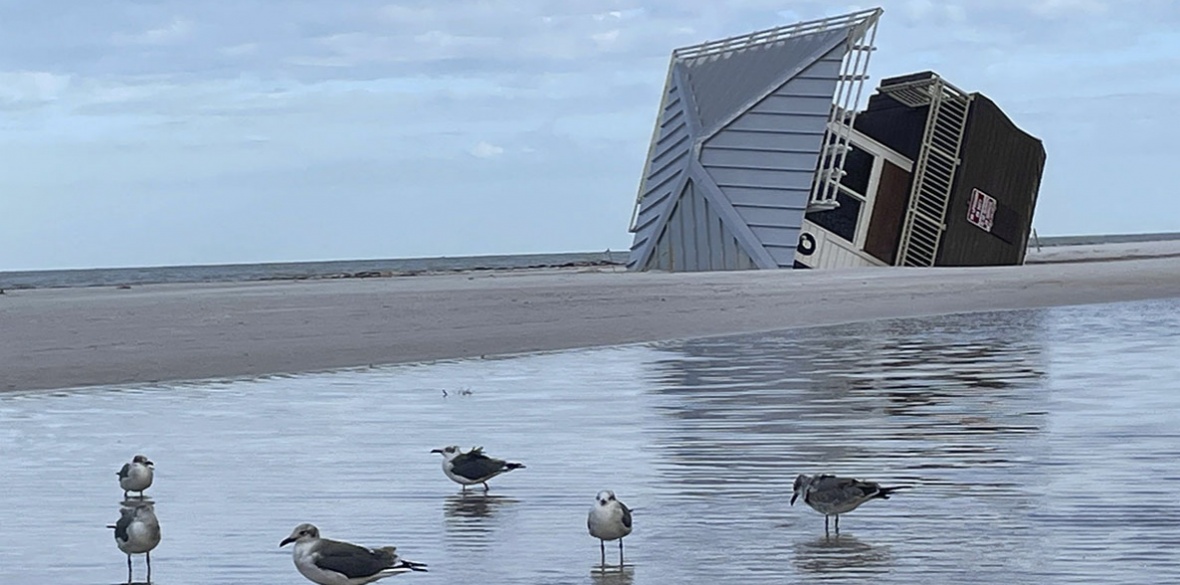
A lifeguard hut rests on its side after Hurricane Milton, October 11, 2024, at Clearwater Beach, Fla.
RICH countries received strong criticism at the Cop29 conference in Azerbaijan today for wanting to spend more on wars and weapons than on preventing climate change.
“Global military spending stands at $2.5 trillion (£1.9trn) annually,” Panamian climate envoy Juan Carlos Monterrey Gomez told delegates at the faltering annual talks sponsored by the United Nations.
“For some, $2.5trn dollars to kill each other, it’s not enough, but $1trn to save lives is unreasonable.”
“Causing our own extinction is the most ridiculous thing. At least the dinosaurs had an asteroid. What is our excuse?”
Palestinian Environment Quality Authority chairwoman warned that Israel is committing “ecocide” after over a year of bombardments in Gaza.
“Protection of the environment is actually not an ancillary issue, it is not a secondary option, it is a basic right that is related to all of us as human beings,” she said.
…
Brazilian President Luiz Inacio Lula da Silva urged developed nations to consider moving their 2050 emission goals forward to 2040 or 2045.
“The G20 is responsible for 80 per cent of greenhouse-effect emissions,” he said. “Even if we are not walking the same speed, we can all take one more step.”
Meanwhile, a new scientific study has found that climate change has made Atlantic hurricanes about 18mph stronger in the last six years.
Demonstrators demand higher taxes on the rich in Paris, France on June 23, 2024. (Photo: Laure Boyer/Hans Lucas/AFP via Getty Images)
“The richest 1% of humanity continues to fill their pockets while the rest are left to scrap for crumbs.”
The richest sliver of the global population hauled in more than $40 trillion in new wealth over the past decade as countries around the world cut taxes for those at the very top, supercharging inequality that poses a dire threat to democracy and the planet.
An Oxfam analysis released Thursday ahead of a meeting of G20 finance ministers estimated that over the past 10 years, the global 1% has accumulated $42 trillion in new wealth. That’s “nearly 34 times more than the entire bottom 50% of the world’s population,” the group observed.
“That is disgusting,” Michael Taylor, founder of the Australian Independent Media Network, wrote in response to the new figures.
The analysis comes amid a growing push by current and former world leaders for rich countries to enact a global tax on billionaire wealth that would begin to reverse the damage done by decades of regressive policy. Oxfam found in a separate analysis released earlier this year that economic and political elites’ global “war on fair taxation” has slashed taxes for the rich by 32% since 1980.
Oxfam said Thursday that global billionaires “have been paying a tax rate equivalent to less than 0.5% of their wealth.”
“Inequality has reached obscene levels, and until now governments have failed to protect people and planet from its catastrophic effects,” Max Lawson, Oxfam’s head of inequality policy, said in a statement Thursday. “The richest 1% of humanity continues to fill their pockets while the rest are left to scrap for crumbs.”
“Momentum to increase taxes on the super-rich is undeniable, and this week is the first real litmus test for G20 governments,” Lawson added. “Do they have the political will to strike a global standard that puts the needs of the many before the greed of an elite few?”
A recent report by renowned economist Gabriel Zucman of the University of California, Berkeley outlined how nations could go about implementing a 2% minimum tax on the wealth of global billionaires—a policy change that he shows would raise up to $250 billion in annual revenue that could be used to support a range of priorities, from climate investments to education and healthcare programs.
“Thanks to recent progress in international tax cooperation, a common taxation standard for billionaires has become technically possible,” said Zucman. “Implementing it is a question of political will.”
The economist’s report was commissioned by the government of Brazilian President Luiz Inácio Lula da Silva, who has championed a global billionaire tax in the face of resistance from powerful nations, including the United States—which has more billionaires than any other country. In 2018, U.S. billionaires paid a lower effective tax rate than working-class Americans.
But reporting indicates that the leaders of G20 nations—which are home to roughly 80% of the world’s billionaires—are likely to rebuff Lula’s push for billionaire wealth tax, opting instead to pursue what Bloombergdescribed as “research on taxation and inequality that could take years to deliver results.”
Reuters similarly reported Wednesday that G20 finance ministers meeting in Brazil “are preparing a joint statement for Thursday in support of progressive taxation that will stop short of endorsing the hosts’ proposal for a global ‘billionaire tax.'”
The global billionaire wealth surge comes in the context of growing misery for large swaths of the world’s population. A report released Wednesday by the United Nations’ Food and Agriculture Organization (FAO) estimated that one out of 11 people around the world—or up to 757 million people—”may have faced hunger” last year.
“The world’s poorest people are paying the highest price of hunger,” Eric Munoz, Oxfam’s food policy expert, said in response to the FAO report. “We need deeper, structural policy and social change to address all of the drivers of hunger, including economic injustice, climate change, and conflict.”

 Banners of various G20 leaders are displayed along a Johannesburg freeway, in Johannesburg, South Africa, November 20, 2025