A worker collects engine oil as he works at a degassing station in Zubair oil field near Basra, Iraq
ENERGY firms raked in an excess of £6 billion in Iran war windfall profits this year, it was revealed today as households brace for yet another bill rise at the end of the month.
Campaigners said profits generated in Britain by these companies equate to over £200 for every household in the country, while a further increase in gas prices is expected in the next Ofgem price cap announcement on August 26.
Financial results posted by the world’s top energy firms revealed their British profits are only one part of their global profits, totalling £95bn in 2026.
Analysis from the End Fuel Poverty Coalition (EFPC) revealed the excess profits linked to global energy market disruptions as a result of the US war on Iran, which has increased cost pressures on households in Britain, as well as other countries.
Researchers looked at financial results posted by BP, Centrica, Chevron, Equinor, ExxonMobil, Iberdrola, Shell and Total.
EFPC co-ordinator Simon Francis said windfall profits must be considered alongside previous findings saying a third of households are “on the brink of, or are in energy debt.”
“These price shock profiteers are doing very well out of the Iran conflict, but they are doing little to solve the underlying problems,” Mr Francis said.
“As people brace for the next price cap announcement on August 26 and a third of households are on the brink of or in energy debt, the energy industry watches the profits climb.”
This work by Middle East Monitor is licensed under a Creative Commons Attribution-NonCommercial-ShareAlike 4.0 International License.
The United States announces that the amphibious assault ship USS Tripoli, carrying 3,500 U.S. troops, has reached the area of responsibility of U.S. Central Command in the Middle East on March 2026. [US CENTCOM/Handout – Anadolu Agency]
Washington has a favourite word for moments like this: options. It sounds sober. Responsible, even. It suggests prudence, flexibility, a commander-in-chief keeping every door open. But in practice, “options” is often just the polite way this town avoids saying what it is really doing. It is preparing itself, step by step, to go further than it said it would.
That is what makes the talk around Iran so unsettling. The administration keeps insisting that it does not need a ground war. Senior officials have said the United States can achieve its aims in Iran without ground troops, even as thousands more U.S. forces are being moved into the region to preserve “maximum optionality.” Read that sentence twice. If ground troops are unnecessary, why is Washington still so determined to keep the idea alive?
Americans know where this language usually leads. First, the war is limited. Then the deployment is precautionary. Then the mission expands by degrees, never quite enough at any one moment to trigger a national reckoning, but enough in aggregate to wake up one morning and realise the country is in another war it was told it would not have to fight.
That is not cynicism. It is memory.
One month into this conflict, even sympathetic observers would struggle to say with confidence what success is supposed to look like. The White House now appears to face only hard choices: escalate further, possibly even on the ground, or try to negotiate an exit from a war whose aims have become harder to define the longer it has gone on. That is often how trouble announces itself in Washington—not with one catastrophic decision, but with a series of smaller ones made in the fog of wanting not to look weak.
And whatever this war is, it is not cost-free. That much is already obvious at home. The Strait of Hormuz is one of those places Americans only hear about in a crisis, but they pay for it almost immediately. In 2024, roughly 20 million barrels of oil a day moved through the strait—about one-fifth of global petroleum liquids consumption—and there are very few practical alternatives if traffic is badly disrupted. In plain English: when that waterway is in trouble, so are gas prices, shipping costs, and household budgets.
That is no abstraction now. Public approval for this war is weak. Polling shows broad disapproval of the strikes on Iran, with a clear majority of Americans also opposed to deploying US ground troops there.
Those numbers matter not because public opinion should dictate strategy minute by minute, but because they show something important: the country is not in the mood for another war sold in the language of control and finished in the language of sacrifice.
There is also a basic military question that should be asked more often and answered more honestly. If Iranian retaliation has already shown that American forces and facilities in the region are vulnerable, what exactly is the theory behind putting more Americans within range? A ground war is not just “more pressure.” It is more funerals. More catastrophic injuries. More families being told that the mission changed after the mission had supposedly already been defined. It is one thing to posture about resolve in a briefing room. It is another thing to ask young Americans to bear the cost of that posture with their bodies.
Some advocates of escalation seem to think the mere possibility of a ground operation strengthens Washington’s hand. Maybe, in a narrow tactical sense, it does.
But wars are not played on whiteboards. They are lived in real time, by real people, and they have a way of refusing the tidy logic that got them started. If the United States crosses from air and naval pressure into a land war, the result will not be a cleaner version of this crisis. It will be a different crisis altogether—larger, bloodier, and much harder to contain.
America’s allies seem to understand that. European officials have made clear, in public and in diplomatic language, that they see the United States as increasingly unpredictable and insufficiently clear about where this war is headed. Calls for restraint, for protecting civilians, and for restoring safe navigation through Hormuz are not diplomatic noise. They are signals of deep unease. The war already looks wider, messier, and more economically dangerous than Washington’s original rhetoric suggested.
Trump, of all people, should understand the political trap here. He returned to power promising not to repeat the old bipartisan habit of turning the Middle East into a graveyard of American credibility, money, and lives. A ground war with Iran would do exactly that. It would not look like strength. It would look like Washington falling back into its oldest reflex: when the first use of force fails to produce clarity, answer with more force and pretend clarity is right around the corner.
It rarely is.
There is still time to avoid the worst version of this. But avoiding it requires a little more than saying “no plans at this time.” It requires shutting the door on a ground invasion, not theatrically, not temporarily, but decisively. It requires admitting that a policy can be costly even before it becomes catastrophic. And it requires remembering that the most dangerous wars are often the ones launched by leaders who insist, all the way through, that they remain in control.
America does not need another war of drift. It does not need another “limited” mission that expands because nobody in power wants to be the first to say enough. And it certainly does not need to send more Americans into a conflict whose boundaries are already harder to see than its costs.
This work by Middle East Monitor is licensed under a Creative Commons Attribution-NonCommercial-ShareAlike 4.0 International License.
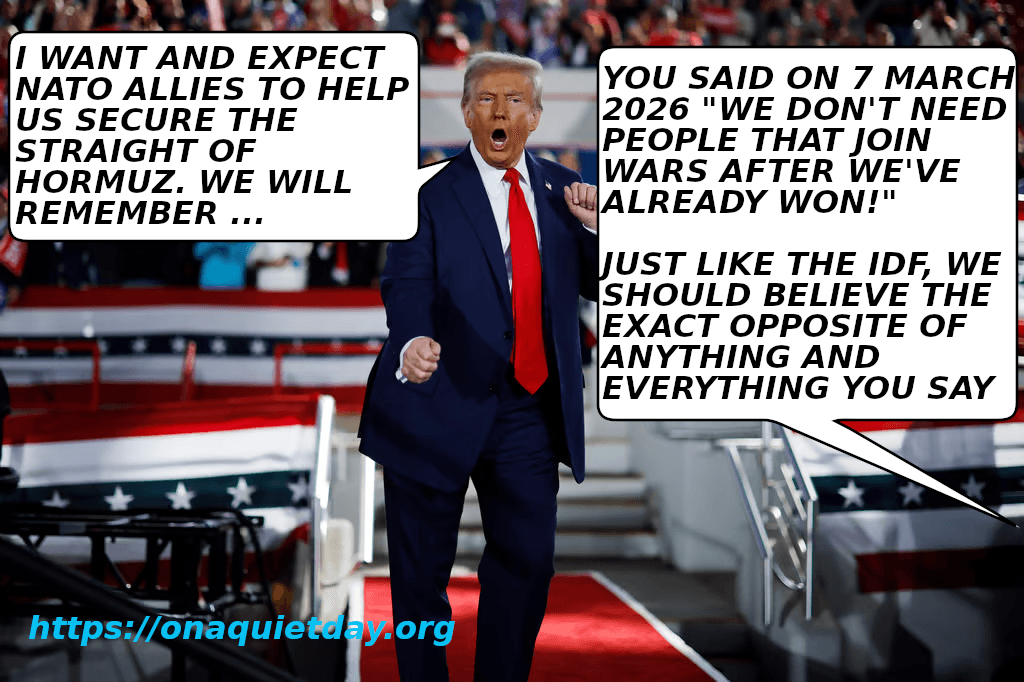
Keir Starmer explains that UK is actively supporting Israel’s genocidal expansion and repeats his previous quotation that he supports Zionism “without qualification”. Keir Starmer said “I said it loud and clear – and meant it – that I support Zionism without qualification.” here: https://www.jewishnews.co.uk/keir-starmer-interview-i-will-work-to-eradicate-antisemitism-from-day-one/Donald Trump calls for help from NATO allies in securing the Straight of Hormuz despite saying on 7 March 2026 that they don’t need people to join wars after they’ve already won. He’s challenged with the claim that he lies as much as the IDF.
“£129 off energy bills will be felt as a welcome relief to families up and down the country who are struggling with the cost of living crisis. However, this reduction won’t scratch the surface for many who will still be worrying about how they will heat their houses over the winter ahead. It also highlights the folly of coupling our energy prices to the volatile gas market. Research shows that breaking this market mechanism that ties our energy bills to gas markets added £43 billion to UK energy bills. That’s £367 per household. This one step would allow us to utilise cheap renewable power to provide cheap renewable energy for British homes. Clean, green, renewable power not tied to the old fossil gas market is what we need to bring down bills sustainably.”
Last week the UK energy regulator, Ofgem, announced that the energy price cap will rise by 54% in April, pushing up bills for millions of households by £693 per year. On the same day, fossil fuel company Shell reported that its annual profits had quadrupled, largely due to the very same soaring gas prices that are responsible for fuelling recent spikes in inflation.
In other words: not everyone is feeling the pinch of the ‘cost of living’ crisis. As household budgets are squeezed even further, fossil fuel company shareholders are laughing all the way to the bank.
…
Energy is far from the only sector where one person’s pain is another’s gain. In recent decades, many of our most essential services have become engines of extractive redistribution – taking wealth away from workers and funnelling it upwards to asset owners.
…
Perhaps the largest expense for many households is housing costs. For much of the past half-century, housing has served two conflicting functions in the economy. On the one hand, housing is a basic need – providing shelter, security and warmth. From this perspective, it is desirable for house prices and rents to stay low to ensure that housing is affordable. On the other hand, housing has become one of the primary vehicles for accumulating wealth. From this perspective, it is desirable for house prices and rents to increase, enabling those who own property to grow their wealth over time. These two roles are in direct conflict with each other: housing can not simultaneously be affordable and lucrative as an investment at the same time, as much as politicians like to pretend otherwise. In recent decades, government policy has sought to promote the latter role at the direct expense of the former – with dire consequences for the millions of households that are locked out of homeownership.
While economists and politicians hail a booming housing market as a sign of wealth creation, in reality it’s one of the most powerful forms of wealth redistribution. When the price of a house goes up, the total productive capacity of the economy is unchanged, because nothing new has been produced: it merely constitutes an increase in the value of an existing asset. While this increases the net wealth of individual homeowners and landlords, for everyone else it often means facing higher rents in the rental market, and having to save for a deposit and pay more interest on larger mortgages. The reality is that the housing ladder is rather like a zero-sum game: the wealth enjoyed by some is mirrored by the deprivation and exclusion of others.
…
There can be no doubt that the ‘cost of living crisis’ is a real concern. But it is not new, and it is not simply the result of rising gas prices. For decades, British households have been squeezed by a pincer movement of persistently low incomes on the one hand, and extractive business models on the other. Unless urgent action is taken on both fronts, another ‘lost decade’ looks all but inevitable.
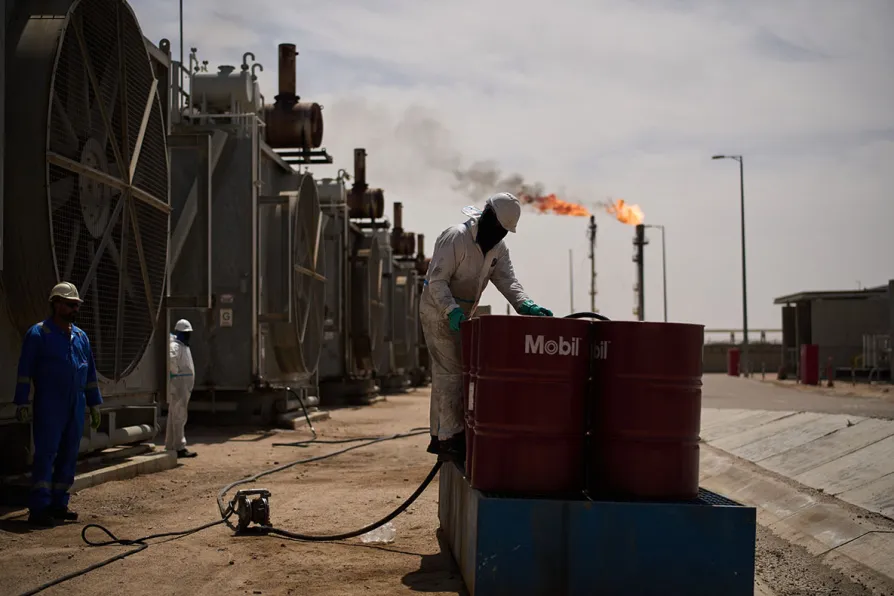
 A worker collects engine oil as he works at a degassing station in Zubair oil field near Basra, Iraq