Federal immigration agents in the city of Minneapolis are accused of having wrestled a 37-year-old intensive care nurse called Alex Pretti to the ground and then shooting him dead. The killing took place just over a mile from where another American citizen, Renee Good, was allegedly fatally shot by federal agents weeks earlier.
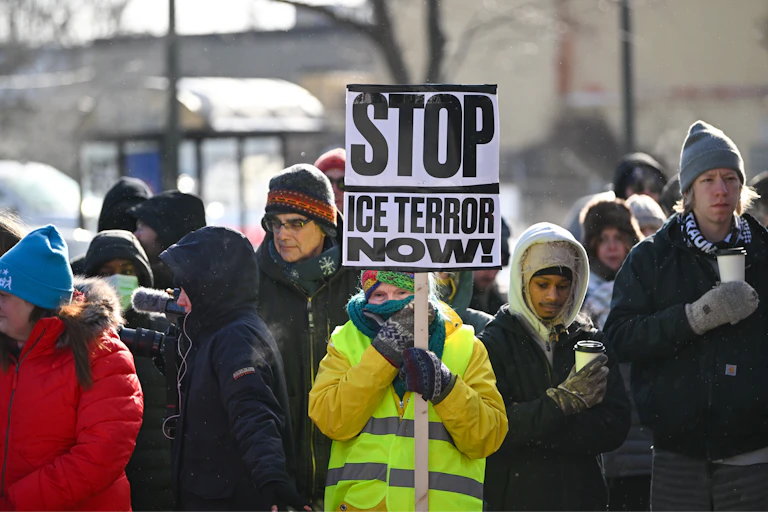
The latest incident prompted angry protests from people in Minneapolis who want the immigration enforcement operation in their city to end. We spoke to Mark Shanahan, an associate professor of political engagement at the University of Surrey, to address several key issues.
Why has sending in federal immigration agents caused such trouble in Minnesota?
Since returning to the White House in January 2025, the national guard has been deployed to several US cities to quell what have generally been Donald Trump-inflated crises, with illegal migration among the most prominent. However, in December, the Supreme Court ruled that Trump did not have authority for such deployments.
So, since then we have seen federal agents with US Customs and Border Protection and Immigration and Customs Enforcement taking the battle largely to minorities in cities with Democratic party leadership as part of the president’s violent attack on illegal immigration, a situation he has described as “the greatest invasion in history”.
Minneapolis is a Democrat-run city in a Democrat-led state. The governor is Tim Walz who ran for vice-president on the Kamala Harris ticket against Trump in the 2024 election. Walz has faced allegations, which he denies, of overlooking alleged widespread fraud in the financing of public safety net programmes, supposedly involving segments of the Somali-American community.
While most of these allegations have been refuted, they gave Trump reason to send in federal agents. This has ramped up tensions between state officials and the administration, causing brutal and unnecessary deaths in the community and pitting ordinary Minnesotans against federal government officials.
How does the situation in Minnesota reflect the second amendment right to bear arms?
It’s a reversal of virtually all of the second amendment debates that have been seen in recent years. The second amendment was introduced to the US constitution in 1791 through the Bill of Rights due to a deep mistrust of centralised military power and a desire to ensure that the newly formed federal government could not disarm the populace.
The founding fathers envisaged a “natural right of resistance and self-preservation”. Trump’s actions in sending in armed federal agents to conduct enforcement operations in various states appear to fulfil the founding fathers’ concerns.
The agents are trampling all over not only citizens’ second amendment right to bear arms (officials seemingly connected Pretti’s killing to him carrying a weapon) but also their first amendment right to freedom of assembly.
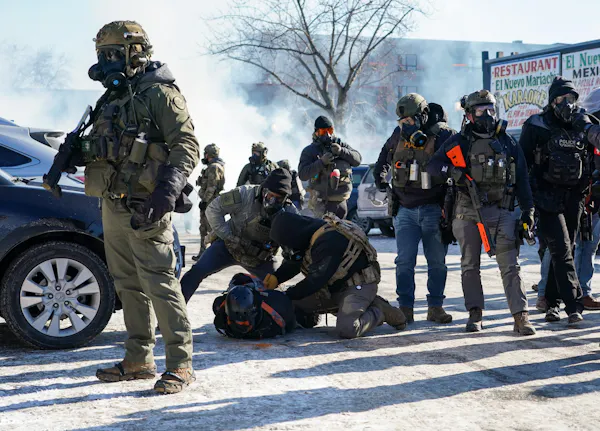
Federal officers detain a protester in Minneapolis, Minnesota, on January 24. Craig Lassig
How have the fatal shootings affected Trump’s popularity?
Trump’s popularity is on the decline. His failure to deliver on the economic promises outlined in his election campaign, scatter-gun approach to international relations and the widening gulf between rhetoric and achievement have all damaged his standing in the polls.
In a CNN poll published on January 16, almost six in ten respondents described Trump’s first year back in office as a failure with the president focused on the wrong priorities.
And what support he does have is ebbing rapidly as federal immigration agents appear out of control, targeting many more documented citizens than illegal migrants, spreading fear and operating as if they are above the law.
With what looks like high levels of gaslighting coming from Homeland Security officials, voters are turning against the increasing autocracy of this administration, believing in the evidence widespread across the media rather than highly contentious statements from Trump’s lieutenants.
Is it unusual for former presidents to speak out the way Barack Obama and Bill Clinton have?
It certainly is. There is a longstanding tradition in the US of, and implicit agreement among, former presidents to avoid public criticism of the incumbent. Such reticence to speak is generally a sign of respect for the office and an acknowledgement of the unique and difficult challenges of the presidency.
But Trump 2.0 is no normal presidency. The 47th president’s style is both combative and retributive, and there seems to be an increasing feeling of it being out of step with the desires and best interest of the country he leads.
Trump’s march to autocracy creates crises where he regards himself as the hero the country needs to overcome its ills. His predecessors take a different view.
Whether it’s Obama calling out the assault on core American values or Clinton’s condemnation of the “horrible scenes” in Minneapolis as “unacceptable” and avoidable, Democrat past presidents have not held back. Notably, the only living previous Republican president, George W. Bush, has so far kept his own counsel.
What can be done to prevent further violence?
Most simply, Trump could end the deployment of federal immigration agents to Minneapolis and refrain from similar actions in the future. He is clearly looking for an off-ramp and sending his “border czar”, Tom Homan, to Minneapolis to direct operations could be the first step to de-escalation. But Trump abhors being called out as wrong and, at least beyond Minneapolis, is far more likely to double down on the immigration enforcement activities.
Realistically, the most likely de-escalator is Congress showing some teeth and refusing to fund further federal immigration enforcement activity. Democrats could force another government shutdown over the issue, and need just a handful of Republicans to flip in order to refuse to sanction a 2026 budget for the Department of Homeland Security.
At a public level, the greater the scrutiny of immigration enforcement agencies, the closer the fact-checking of official statements and the more cohesive the opposition to Trump’s deportation policy, the greater the chance of effectively opposing it.
It is midterm year – and the greater the public pressure, the more likely Republican legislators are to cleave away from the Trump line. While he currently controls the levers of power, that control remains fragile. Even Trump may soon realise that overt, violent, coercive autocracy is not a vote winner.
Elon Musk urges you to be a Fascist like him, says that you can ignore facts and reality then.Donald Fuhrump says that Amerikkka doesn’t bother with crimes or charges anymore, not being 100% Amerikkkan and opposing his real estate intentions is enough.Orcas discuss how Trump was re-elected and him being an obviously insane, xenophobic Fascist.
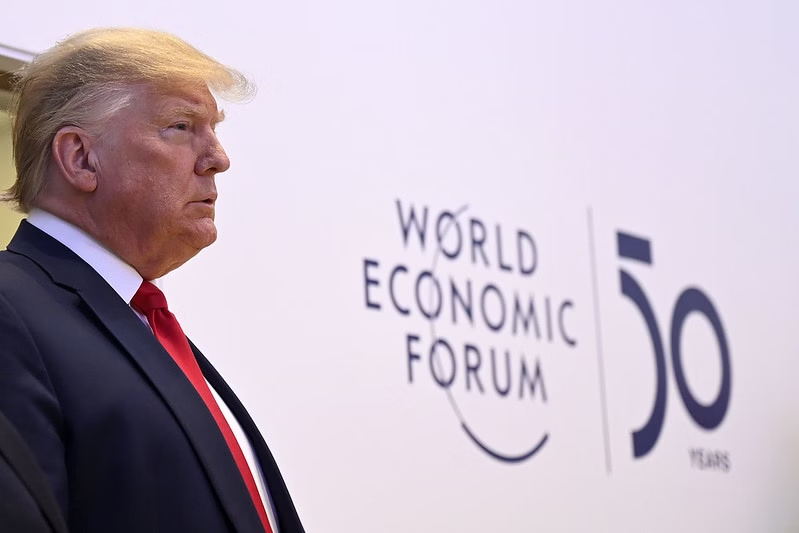
U.S. President Donald Trump and corporate image-crafter the World Economic Forum have perfected the tactic of creating “pseudo-realities” to help avoid accountability for damaging actions. Credit: World Economic Forum/Valeriano Di Domenico .
This week, the EU agreed to 15% tariffs with the United States, half of President Donald Trump’s threatened rate, before the August 1 deadline. With Mexico and Brazil trade deals on the horizon, Trump appears to have the world’s pocketbooks, supply chains, and eyeballs precisely where he wants them: in a state of uncertainty, and focused on him.
“We didn’t believe him,” a Wall Street executive told the Financial Times. “We assumed that someone in the administration that had an economic background would tell him that global tariffs were a bad idea.” Trump seemed surprised by the executives’ surprise: “I said this would exactly be the way it is,” he noted, correctly.
But perhaps CEOs can be forgiven for assuming that the self-proclaimed “Tariff Man” was bluffing. Perhaps it’s understandable that some of the world’s most powerful and highly compensated executives, including fossil fuel leaders, filed Trump’s campaign pledges — “tariffs are the greatest thing ever invented,” he declared last fall — in the category of “things politicians say.”
After all, making high-profile promises on which they have no intention of following through — promises that are based largely on what they want people to think is true, or simply what is convenient to say in the moment — is how corporations operate every day.
Indeed, with the help of well-paid public relations firms, prestigious consultants, and elite conveners like the World Economic Forum, executives and their organizations construct what might be considered “pseudo-realities”: alternative portrayals of the world that serve a company’s interests but have little bearing on how the company actually makes money.
In the digital age, in fact, operating in the space between word and deed, between image and action, between theater and reality, has become the modus operandi of the corporate world, especially fossil fuel companies.
The Big Oil Autocratic Playbook
Big Oil has honed this playbook to near perfection. For decades, the industry has enlisted PR agencies to construct elaborate narratives so polished and pervasive that they’ve managed to stave off meaningful climate action while painting the oil and gas giants as working toward — in what might be a first in the history of modern capitalism — its own obsolescence.
Take Saudi Arabia’s state-backed oil giant Aramco, which is one of the most profitable companies in the world. As DeSmog’s TJ Jordan has pointed out, the company’s relentless advertising constructs a narrative of responsibility and green innovation. Aramco frames its advanced fuels and F1 motorsport sponsorship as a credible pathway to decarbonization — part of a broader Saudi push for a clean energy transition.
That argument omits a key piece of reality: not just that the kingdom is a major fossil fuel producer, but that it has stated its commitment to this extractive business model for years to come. (McCann, Publicis, and Hill+Knowlton, which is now part of Burson, are among the PR firms that have worked for Aramco.)
Or consider DeSmog’s deeply researched investigation into how Edelman, one of the world’s largest PR firms, polished the image of the United Arab Emirates, creating an alternate reality that convinced the public and heads of state that it was a leader on climate action, obscuring its oil-producing legacy.
The PR campaign helped propel oil baron Sultan Ahmed Al Jaber to the top levels of climate diplomacy as host of COP28, the UN’s annual climate gathering, even as the UAE was pumping more and more oil — a case study in manifesting an effective pseudo-reality.
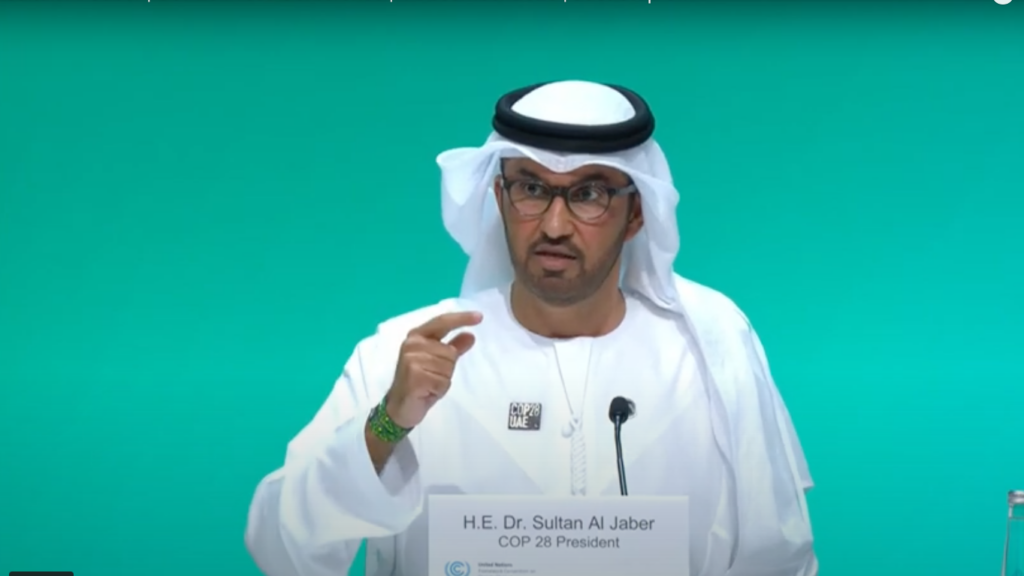
Sultan Ahmed Al Jaber addresses a news conference in Dubai, December 4, 2023. Credit: Just Stop Oil YouTube Channel.
Meanwhile, this July, barely a year after Edelman won an “eight-figure” contract with Shell, one of the world’s leading oil and gas producers, the agency signed an agreement to manage PR for the upcoming COP30 climate conference in Brazil.
The goal of campaigns like these does not appear to be to convince everyone, everywhere, forever. Instead, like an authoritarian propagandist (or an aspiring one), these efforts seek to flood society’s information channels with alternate visions of how the world might be.
As long-serving autocrats have discovered, the resultant mixture of true belief, skepticism, and confusion creates doubt that the truth — in this case, about the severity of climate change, and the complicity of those responsible for it — can ever really be known. Such doubt helps prevent the emergence of public consensus and stalls momentum for accountability and change.
A Performative Ally
In pursuit of these efforts, fossil fuel companies have found an ally in an organization that is ostensibly committed to tackling the climate crisis and transitioning the world to clean energy.
Indeed, few organizations demonstrate the performative nature of corporate image-crafting as transparently as the World Economic Forum (WEF), the nonprofit that hosts the annual gathering of corporate and political elites of the same name in Davos, Switzerland, each January.
“The big issues in the world, like climate change, cannot be solved by governments alone,” said WEF’s founder and former CEO Klaus Schwab in 2019. “We need new technologies, so business has a role to play. Civil society has a big role to play. We are all stakeholders in our global future. And the World Economic Forum acts as a kind of catalyst for this process.”
(Earlier this year, Schwab resigned from the WEF following allegations that included misappropriating funds and creating a toxic work environment rife with racial discrimination and sexual harassment.)
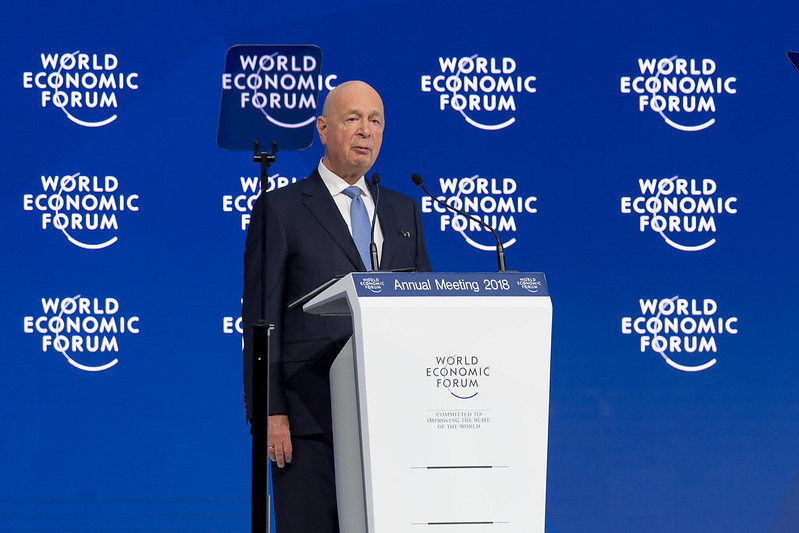
WEF CEO Klaus Schwab speaks at the group’s 2018 annual meeting. Credit: World Economic Forum/Remy Steinegger
The WEF is decidedly inaccessible to the public: Membership can cost companies more than $650,000 a year, with individual attendees paying upwards of $30,000 for top-tier access to the four-day Davos conference. But it is nevertheless a performance for the public. WEF elites want to be seen and think of themselves as “using their powers for good,” as one of my former bosses in the corporate world used to say.
To that end, the organization publishes a steady stream of content, including reports, white papers, articles, podcasts, YouTube videos, and social media posts. Most of this corporate “thought leadership” shares two distinct but related goals: to position the organization that publishes it as an expert in a problem being discussed (such as climate change), and to portray the company — and “business” more generally — as critical to addressing that problem.
The WEF did not respond to an emailed request for comment.
For instance, in a January 2023 paper published with the consulting firm (and WEF “strategic partner”) PwC, the WEF outlined a “business case” for corporations to pursue climate adaptation strategies. One recommendation: “Capitalize on opportunities” created by the climate crisis. “These adaptation efforts will generate demand for products and services and open new markets,” the report noted.
The language in these publications is typically grandiose. “The future of our planet depends on it,” its foreword concluded, referring to the corporations taking action — of which authoring a report is presumably one part.
The business models of, say, a consulting firm like McKinsey & Co. that is determined, in the words of its boss, to continue “[doing] business with greenhouse-gas emitters,” or of a global nonprofit like the WEF, which brought in more than $500 million in revenue last year, much of it from extractive corporations and oil-reliant governments, do not include concrete actions that would make fossil fuel production less lucrative. (McKinsey, Chevron, Aramco, BP, and Rio Tinto are among WEF’s other “strategic partners.”)
‘Organized Lying’
A revealing example of how companies use thought leadership to spin pseudo-realities into existence comes from a PR firm with close ties to Schwab and the WEF.
The late 2010s and early 2020s marked a short-lived era in which executives decided that their workers, customers, and other “stakeholders” — such as politicians and regulators — wanted to hear that businesses were solving global challenges like climate change, inequality, and racism. This self-serving notion was called “stakeholder capitalism,” which also became the title of a 2021 book by Klaus Schwab.
Edelman, one of the largest PR firms in the world, helped drive this corporate reimagining. “CEOs expected to lead on change” was among the findings of the agency’s 2019 “trust barometer,” a survey it releases in Davos every January.
The following year, company CEO Richard Edelman highlighted the “stunning” finding that employees “expect their employer’s CEO to speak up on one or more issues.” In 2021, Richard Edelman proclaimed that “the events of this past year reinforced business’ responsibility to lead on societal issues.” Citing the trust survey, the CEO wrote in a 2023 blog post titled “Companies Must Not Stay Silent,” that, “Business leaders must not only speak out on incidents of injustice and the pressing issues of the day, but they must take action.”
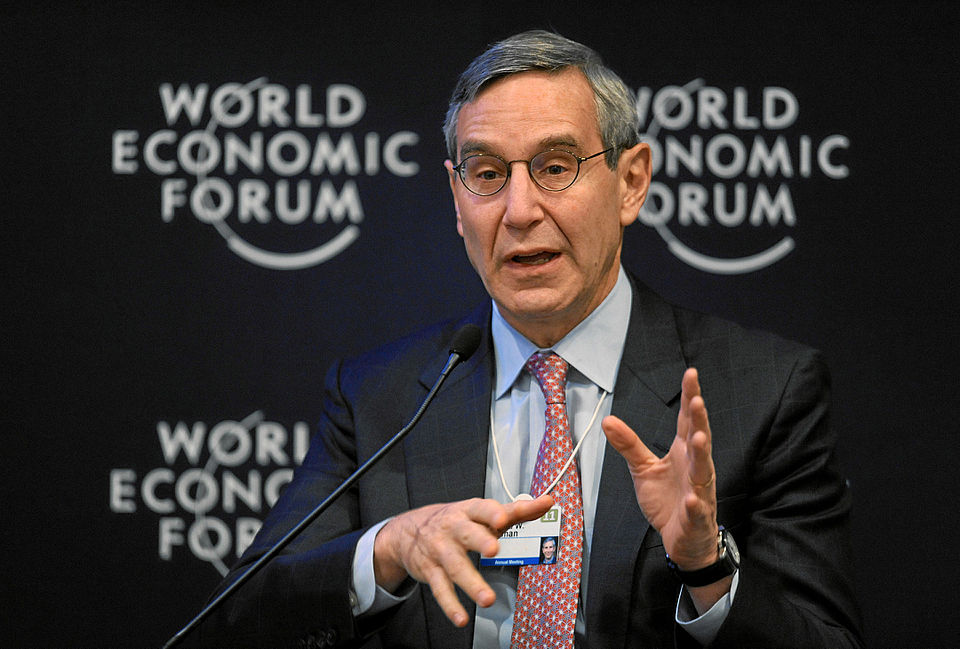
PR firm CEO Richard Edelman writes an annual trust survey that a researcher said “consistently paints the picture that best served the interests” of Edeman and its clients. Credit: Wikimedia Commons
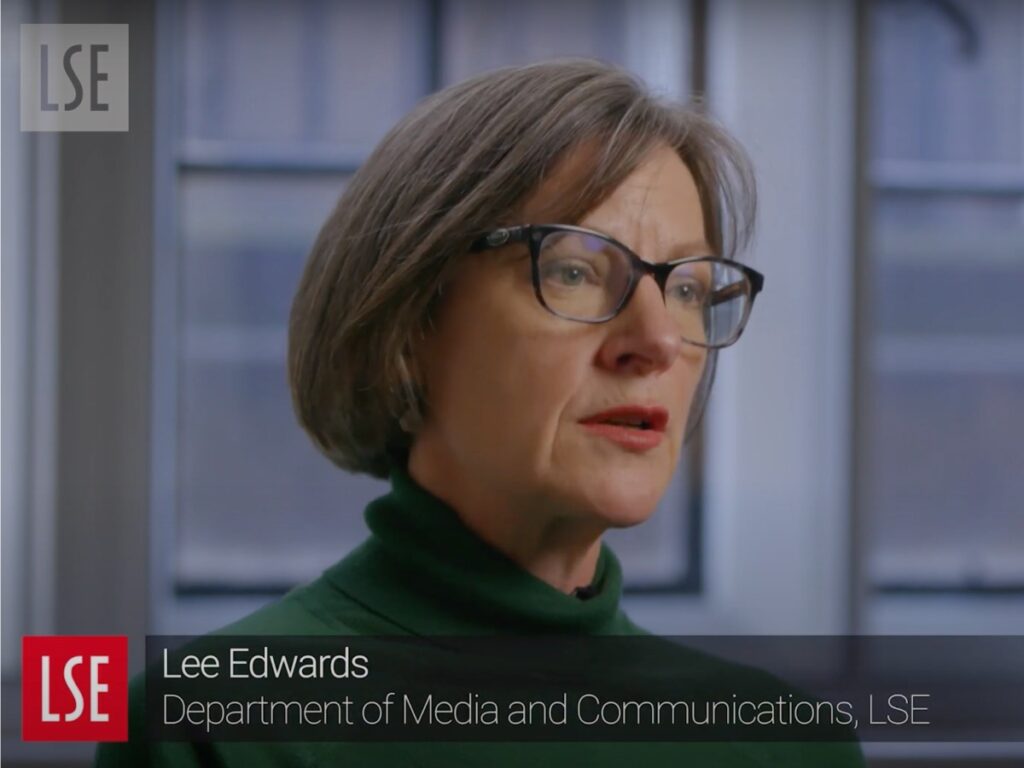
In a 2024 paper, Lee Edwards, a professor of strategic communications and public engagement at the London School of Economics, looked closely at the surveys Edelman published between 2018 and 2022. She studied not only their findings and conclusions, but the entire package — the headlines, the imagery, the tone, the formatting, the branding.
Edwards found that Edelman consistently painted the picture that best served the interests of the firm and its clients: that public trust in governments, nonprofit organizations, and the media was collapsing — meaning, in turn, that businesses had an obligation to step into the breach.
In a nod to Hannah Arendt, the late philosopher and scholar of totalitarianism, Edwards described the trust barometer as an example of “organized lying,” which “reconstitutes … reality on the basis of whatever the organization deems necessary to achieve their goals.” Corporate thought leadership “might be based on deception,” Edwards argued, “but the appearance of truth is what matters most for its value in the production of trust.”
In short, you do not need to convey what is true. You only need convince people to believe that something is true, a tactic that Trump and his Maga movement specialize in.
Corporate Trust Narratives as Alternative Realities
Edwards concluded that “the production of trust narratives by the public relations industry is not a commentary on a pre-existing reality, but a construction of an alternative reality, that in many ways obscures — intentionally or otherwise — many inconvenient but factual truths about the role of business in society.”
Because these alternative realities are driven by what is most useful for companies to portray as the truth at a given moment in time, their conclusions can shift quickly. The rhetorical emergence of stakeholder capitalism was promptly followed by a right-wing backlash that saw furious pundits and political parties in the United States and elsewhere, especially the MAGA movement and its emulators around the world, gain momentum — and sometimes win elections — in part by decrying what they called “woke capitalism.”
In turn, as the cheery narrative that companies would use market forces to fight injustice and solve climate change began to incur reputational and political risks from the right, companies did not hesitate to pivot to a different message — one that, in many ways, appeared incompatible with what they had been touting widely only months before.
“My advice to all of you for your companies is stay out of politics,” Richard Edelman told the WEF in January 2024, less than a year after advising that “this is not the time for CEOs and the companies they lead to remain silent or stand down.”
One organization that appeared to follow Edelman’s change of heart was the WEF itself. In 2024, Semafor reported that Richard Edelman was among the executives counseling the WEF to shift its politics rightward to avoid alienating conservative politicians and governments reliant on oil and gas extraction.
“The Gulf monarchies, whose oil money flows down the [Davos] Promenade and helps underwrite the forum, have also grown weary of criticism of fossil fuels and signaled to the forum that, ‘we can do this elsewhere,’” Semafor wrote. A few months later, in April 2024, WEF hosted a “special meeting” in Riyadh, Saudi Arabia, where a panel about “an equitable energy transition” featured the Saudi energy minister, the CEO of Occidental Petroleum, and the CEO of ExxonMobil.
In an emailed statement, an Edelman spokesperson said: “The guardrails on speaking out have changed because public expectations of business have evolved. The broad permission once granted to business leaders to speak freely has become more selective, requiring careful consideration of when and where to engage. Our recent data shows that there are specific instances where people expect business leaders to engage on a societal issue such as when the issue harms their employees, customers, or communities.”
Boorstin’s ‘Pseudo-events’
In her 2024 book Invisible Rulers: The People Who Turn Lies Into Reality, Georgetown University professor Renée DiResta discusses what the late historian Daniel J. Boorstin called “pseudo-events”: events manufactured specifically for the purpose of generating media coverage. Like a news conference that announces the formation of a task force that will produce a non-binding report, pseudo-events have no significance in and of themselves; they exist to create the illusion of significance.
Once a pseudo-event has been hallucinated into existence — such as an announcement in a news release or, these days, a mention in an Instagram influencer’s story — its significance cascades outward as more news outlets and social media influencers and online scrollers report on it and cite it and share it. This “narrative laundering,” as DiResta calls it, helps transform a pseudo-event into reality — or, at least, pseudo-reality.
“Once a pseudo-event has been hallucinated into existence — such as an announcement in a news release or, these days, a mention in an Instagram influencer’s story — its significance cascades outward as more news outlets and social media influencers and online scrollers report on it and cite it and share it.”
The WEF and its corporate members are master crafters of pseudo-events. Indeed, the gatherings of the WEF high in the Swiss Alps, or at June’s “Summer Davos” in Tianjin, China, are themselves pseudo-events.
They attract legions of wealthy and powerful people, alongside their PR teams and journalists. From behind closed doors emerge plenty of headlines and pledges, endless content and commitments — but no new laws, no binding emissions reductions, no new taxes to help pay for the climate adaptation that “the future of our planet depends on.” And, crucially, their high-profile pronouncements and publications can say whatever they deem most helpful for them to say in that moment.
Out of nothing emerges a pseudo-reality that portrays corporations as they wish to be seen. And in this alternate reality, the real world — in which companies operate as they always have, capitalizing on the sociopathicimperatives of capitalism — is mostly irrelevant.
Trump, Tariffs, and Pseudo-Realities
Of course, what validated, to some extent, the disbelief of the executives and Wall Street analysts on “Liberation Day” is the fact that Trump is a serial fabricator. Over the past decade, no one has been more successful than this president of the United States in spinning up and cashing in on pseudo-realities largely untethered from what he is actually doing.
Shamelessly promising whatever is convenient in the moment, with no intention of following through; profiting off the manipulation of supporters while condescending to them; acquiring power by constructing an alternative narrative of how the world is; performing that pseudo-reality into existence by repeating it over and over again: This is the Trump playbook. But it is also the corporate playbook.
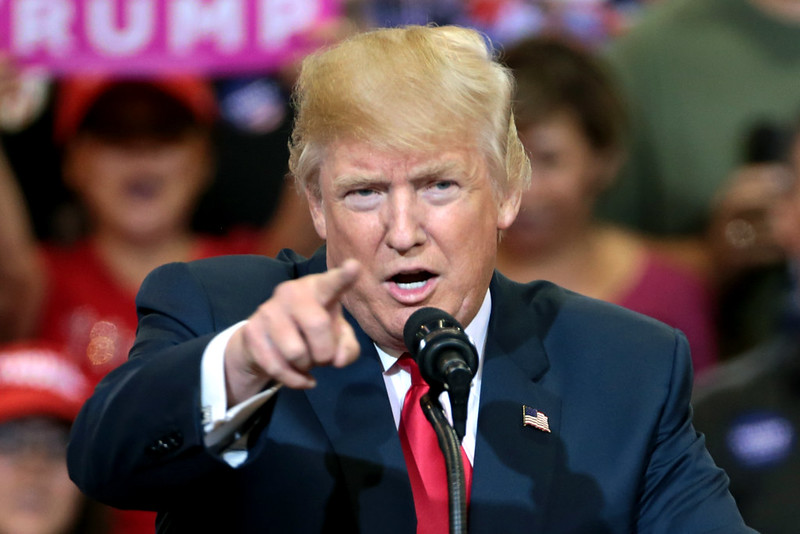
Many say that President Trume aquired power by constructing an alternative narrative of how the world really is. Credit: Public Domain
Despite their initial shock, companies quickly found that there was value in the tariff narrative. Reports are already documenting executives explaining how the expectation of tariff-driven price increases provided an ideal cover for increasing prices — even on products not impacted by tariffs.
In April, asked on CNBC whether corporations were “raising their prices…just because they can,” one oil executive responded, “Exactly. Yes. … It gives them room to move prices up,” as The Lever’s Luke Goldstein noted.
Whether price-gouging under the cover of tariffs, or offering tired-but-effective national security justifications for doubling down on fossil fuels, predicting something and then using your prediction to justify what you already wanted and/or planned to do is a key two-step in what LSE’s Edwards called “organized lying.”
Only in an alternative reality could the PR and influence industry, whose business model includes laundering the reputations of autocrats and creating astroturf front groups to generate the illusion of broad public support, be seen as an authority on public trust. Yet it seems not to matter whether the pseudo-realities they manufacture are genuinely believable — only that they are just believable enough to serve a purpose.
And that purpose is often as simple as preventing the coherence of an alternative narrative, like the fact that corporate profiteering, which rose during the COVID crisis, is exacerbating tariff consequences for consumers. Or that the fossil fuel industry is (still) exploiting public anxieties to preserve its lucrative business model as long as possible, as Amy Westervelt discussed recently for Drilled.
Were narratives like these to cohere, they might generate broad public enthusiasm for new taxes or regulations or consumer protections or unions or even popular movements. As long as a pseudo-reality prevents the truth from cohering, it serves its purpose.
In Invisible Rulers, DiResta notes a consequence of living in a world of pseudo-realities, one in which it becomes difficult for ordinary people to be certain about what is true and what is not (which is also a defining characteristic of authoritarian propaganda states).
“People are simply overwhelmed,” DiResta writes. “The world feels unimaginably complex, and millions believe that they are being manipulated — they’re just not sure by whom and to what end.”
Those millions are often correct.
Donald Trump urges you to be a Climate Science denier like him. He says that he makes millions and millions for destroying the planet, Burn, Baby, Burn and Flood, Baby, Flood.Neo-Fascist Climate Science Denier Donald Trump says Burn, Baby, Burn.
Labour Party leader Keir Starmer, at the launch event for Labour’s campaign bus at Uxbridge College, while on the General Election campaign trail, June 1, 2024
CAMPAIGNERS accused Labour leader Sir Keir Starmer of “gaslighting” on Palestinian statehood recognition today.
According to sources cited in the Guardian, Sir Keir is expected to make a pledge to “recognise Palestine before the end of any peace process.”
They also claimed he would commit to ensuring such a move is not vetoed by neighbouring countries.
But Momentum slammed it as a weakening of Labour’s previous commitments.
A spokesperson said: “The manifesto Starmer stood on pledged to recognise a Palestinian state immediately. Labour reiterated this in 2022.
“Now, it’s just ‘at some point’ — this is not good enough.
“Spain, Ireland and other countries have already recognised a Palestinian state. But the Starmer leadership rows back on Labour’s policy, then gaslights Palestinians and their supporters that they have somehow advanced.”
Jewish Voice for Labour co-chairwoman Jenny Manson said: “An offer to recognise Palestinian statehood before the end of any peace process, is at the current time, with absolutely no prospect of a peace process, a non-commitment.
“A commitment would be to recognise Palestine now, along with Norway, Ireland, Spain, and Slovenia, to give a chance for the peace process to start.”
And Palestinian Solidarity Campaign director Ben Jamal said: “The reports of the Labour Party manifesto containing a policy to recognise Palestine at some point in the future is a weakening of its position since the 2019 election commitment to immediate recognition.
“The recognition of Palestinian statehood by itself can only be a stepping stone to full implementation of the Palestinian right to self-determination including the right of refugees to return.
“If Labour claims to be committed to recognising the Palestinian right of self-determination, then there are no grounds not to recognise the state immediately, as countries such as Ireland and Spain have recently done.”
Labour’s move could be seen as an attempt to claw back voters who have backed away from the party over its stance on Israel’s war on Gaza.
Zionist Keir Starmes is quoted “I support Zionism without qualification.” He’s asked whether that means that he supports Zionism under all circumstances, whatever Zionists do.
The assault on Gaza, the great crime of our age, adds moralindecency to the pile of dishonesty and vacuity. When Starmer declared Israel had the right to cut off energy and water to Palestinian civilians, he did so as a human rights lawyer who understands the Geneva conventions. After letting shadow cabinet ministers defend him, he claimed it “has never been my view that Israel had the right to cut off water, food, fuel or medicines”. We all have political red lines: mine is supporting what would amount to war crimes against innocent civilians, toddlers and newborn babies among them, then gaslighting the public over doing so.
Where is my gratitude for Starmer delivering a now inevitable landslide victory, you may ask? Well, he didn’t force Boris Johnson and his cronies to violate their own pandemic rules, or to trash the NHS, or oversee the worst squeeze in living standards in history. Nor did he propel to power Liz Truss, whose unhinged economic experiment crashed the economy – the moment when the electorate turned on this Tory party for good.
The absolute power a landslide victory will give Labour should scare you. When Starmer allies deployed antisemitic tropes – with one joking about a “run on silver shekels” when two Jewish businessmen missed out on peerages, and another calling a Jewish Tory donor a “puppet master” – an apology was deemed to be sufficient. When another racially abused a journalist and had a sexual harassment complaint upheld, they were reinstated after investigation.
Contrast this with Diane Abbott, Britain’s first Black female MP, who was suspended after immediately apologising for an Observer letter in which she argued that Irish, Jewish and Traveller people are not subject to racism “all their lives”. She has been left in limbo for 10 months and counting while the party investigates – only for Labour to use the racist abuse directed at her by a Tory donor for political capital, while still refusing to reinstate her.
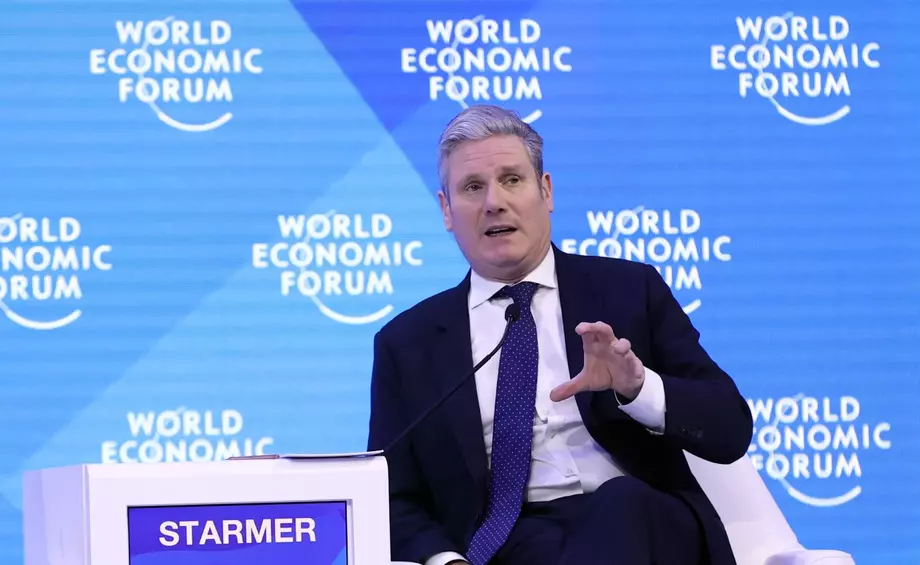
Keir Starmer sucking up to the rich and powerful at World Economic Forum, Davos.
Beyond each Labour U-turn is a well of suffering and poverty that has no justifiable reason to exist, says trade union case worker Kasmira Kincaid
…
Our politicians invariably speak of “fiscal responsibility”; of “balancing the budget” and “living within our means”. The Keir Starmer of today – as opposed to the Keir Starmer who was elected to lead the Labour Party in 2020 – is no different. But these words just serve to obscure the obscenity of what is actually being said: that we can’t afford to feed the poor, to house the homeless, and to allow people to live in dignity and comfort.
But the thing is we can. We know we can. We know it when we see government funds used to drop bombs on foreign countries. We know it when we see sweeping tax cuts to the wealthy, and tax evaders let off the hook. And we know it when we walk past empty tower blocks, full of investment properties, while homeless people die on the streets.
It’s a supreme form of gaslighting to suggest otherwise, asking us to deny the evidence of our senses and experiences. Making sure everyone gets what they need is a logistical challenge, for sure. But there is enough to make sure everyone gets what they need.
…
As a new Labour government comes to feel inevitable, many of us are taking stock of what such a government would mean. Over the last four years, Keir Starmer has U-turned on practically every anti-austerity policy in his 2020 leadership bid: from abolishing universal credit and what he once called “the Tories’ cruel sanctions regime”; to scrapping work capability assessments and the two-child limit on benefits; to re-nationalising key public services.
Today I live a life where few of these policies would directly affect me. Yet I haven’t forgotten what it felt like to be in the firing line for government decisions. The material conditions of people’s lives should be the beginning and end of politics. As we voice our opposition to continued austerity we’d do well to remember that. To remember that beyond each of these U-turns is a well of human suffering that has no justifiable reason to exist.
Kasmira Kincaid is a trade union case worker and former benefits claimant.