Met police confirm protesters held on suspicion of public order offences, including one related to placard
Four people were arrested on Saturday on suspicion of public order offences while attending a pro-Palestinian march in central London, including one relating to a placard.
The Metropolitan police confirmed on X that three people were held on suspicion of breaching Public Order Act conditions imposed on the march, with a fourth man detained on suspicion of a racially aggravated public order offence relating to a placard.
Organised by the Palestine Solidarity Campaign, tens of thousands of protesters took to the streets on the first day of a new Labour government to call for an immediate ceasefire in Gaza.
…
This latest protest comes after the health ministry in Gaza confirmed that at least 38,098 Palestinians have been killed and 87,705 others injured since Israel’s military offensive in Gaza began on 7 October.
Jeremy Corbyn, the independent MP for Islington North, joined pro-Palestine march in London. Photograph: Yann Tessier/Reuters [Jeremy Corbyn 2nd from right is joined by Andrew Feinstein, far right, former ANC Member of the National Assembly of South Africa who stood as an independent candidate against Starmer because of Starmer’s support for Israel’s Gaza genocide.]
In attendance was the re-elected independent MP for Islington North, Jeremy Corbyn, who told protesters that “a change in government doesn’t change the facts that the people of Gaza are still being murdered in their sleep”.
“We said it to the Tories, and now we will say it to Labour: a government that sells arms to Israel is a government that is complicit in crimes against humanity.”
Zionist Keir Starmer is quoted “I support Zionism without qualification.” He’s asked whether that means that he supports Zionism under all circumstances, whatever Zionists do.
Relief workers distribute food in Gaza City, Gaza on March 14, 2024. (Photo: Dawoud Abo Alkas/Anadolu via Getty Images)
Providing aid to Gaza and ensuring the reconstruction of the strip must not be a political item for negotiations. It is a basic human right that must be honored under any circumstance.
Humanitarian aid should never be politicized though, quite often, the very survival of nations is used as political bargaining chips.
Sadly, Gaza remains a prime example. Even before the current war, the Gaza Strip suffered under a 17-year hermetic blockade, which has rendered the impoverished area virtually “unlivable.”
That very term, “unlivable” was used by the then-United Nations Special Rapporteur for the Situation of Palestine, Michael Lynk, in 2018.
Scenes and images of thousands of starving Palestinians chasing after boxes of aid parachuted into Gaza will remain etched in the collective memory of humanity as an example of our failed morality.
As of mid-December of last year, “nearly 70% of Gaza’s 439,000 homes and about half of its buildings have been damaged or destroyed,” The Wall Street Journal reported, citing experts who conducted a thorough analysis of satellite data.
As tragic as the situation was in December, now it is far worse.
Sixty-seven percent of Gaza’s water, sanitation facilities, and infrastructure have been destroyed or damaged, according to a statement by the United Nations Agency for Palestinian Refugees, UNRWA, on June 19, leading to the spreading of infectious diseases, which has ravaged the beleaguered population for months.
The spread of disease is also linked to the accumulation of garbage everywhere in Gaza. Earlier, the refugees agency reported that “as of June 9, over 330,000 tons of waste have accumulated in or near populated areas across Gaza, posing catastrophic environmental (and) health risks.”
The situation was already disastrous. Indeed, three years before the war, the Global Institute for Water, Environment, and Health (GIWEH) said, in a joint statement with the Euro-Mediterranean Human Rights Monitor, that 97% of Gaza water was undrinkable and unfit for human consumption.
Yet, so far, any conversation on allowing aid to Gaza, or the rebuilding of Gaza after the war, has been placed largely within political contexts.
By shutting down all border crossings, including the Egypt-Gaza Rafah Crossing—which, on June 17, was set ablaze—Israel has politicized food, fuel, and medicine as tools in its war in the strip.
This is not a mere inference, but the actual statement made by Israeli Minister of Defense Yoav Gallant, who on October 9 declared that he had ordered a “complete siege” and that “there will be no electricity, no food, no fuel, no water” entering Gaza.
The timing of the statement, which has indeed been put into action from the first day of the war, suggests that Israel did not apply the strategy as a last resort. It was one of the most important pieces in the war stratagem, which remains in effect to this day.
Instead of pressuring Israel, Washington tried to obtain its own political leverage, also by politicizing aid. On March 2, the U.S. Air Force started airdropping aid into northern Gaza. A far more conducive and less humiliating option for Palestinians, however, would have been direct U.S. pressure on Israel to allow access to aid trucks arriving through Rafah, Karem Abu Salem Crossing, or any other.
Scenes and images of thousands of starving Palestinians chasing after boxes of aid parachuted into Gaza will remain etched in the collective memory of humanity as an example of our failed morality.
News reports spoke of people who were killed under the weight of the dropped “aid,” much of which had fallen in the Mediterranean, never to be retrieved.
Even the Gaza pier, constructed by the U.S. military on the Gaza shore in May, did little to alleviate the situation. It merely transported 137 aid trucks, according to the U.S.’ own estimation, enough to cover Gaza’s need for food for a few hours only.
During the years of siege, an average of 500 trucks arriving daily in Gaza has kept the 2.3 million population of the strip alive, though malnourished.
To deal with the outcome of the war, and to stave off current starvation, especially in the north, the number of aid trucks would have to be much higher. Yet, whole days would pass without a single truck making its way to the suffering population. This is unacceptable.
Not only did the international community fail at ending the war, it has also failed in delinking humanitarian aid from political and military objectives.
The problem with politicizing aid is that innocent civilians become a bargaining chip for politicians and military men. This goes against the very foundation of international humanitarian law.
According to the International Committee of the Red Cross, citing the Hague Regulations, “international humanitarian law is the branch of international law that seeks to impose limits on the destruction and suffering caused by armed conflict.” In Gaza, no such “limits” have been “imposed” by anyone.
Providing aid to Gaza and ensuring the reconstruction of the strip must not be a political item for negotiations. It is a basic human right that must be honored under any circumstance.
Meaningful pressure must be placed on Israel to end the Gaza siege, and urgent plans must be drafted, starting today, by representatives of U.N. humanitarian institutions, the Arab League, and Palestinian and Gaza authorities to be the entities responsible for delivering aid to Gaza.
Humanitarian aid to Gaza must not be used as political leverage, or a tool in a cruel war, whose primary victims are millions of Palestinian civilians.
Zionist Keir Starmes is quoted “I support Zionism without qualification.” He’s asked whether that means that he supports Zionism under all circumstances, whatever Zionists do.
Displaced Palestinians from areas in east Khan Younis, Gaza flee after the Israel Defense Forces issued a new evacuation order for parts of the city on July 2, 2024. (Photo: Eyad Baba/AFP via Getty Images)
“It means yet another day, week, chapter of misery for these hundreds of thousands of people,” said one United Nations worker.
Hearing once again from the Israel Defense Forces that they must evacuate to a so-called “humanitarian zone,” hundreds of thousands of Palestinian people in the southern Gaza city of Khan Younis on Tuesday were forced to search for safety ahead of a likely ground offensive in the city.
The United Nations Relief and Works Agency for Palestine Refugees in the Near East (UNRWA) said that roughly 250,000 people are living and seeking shelter in the evacuation zone—more than 10% of Gaza’s population of 2.3 million.
The evacuation order, which was posted on social media on Monday, also includes nearby localities including al-Qarara and Bani Suhaila.
The IDF said after the order was announced that patients and healthcare providers at European Hospital, the largest operating medical facility in Gaza, were not required to evacuate, but the hospital director told the Associated Press that most had already been relocated.
“The hospital staff and the patients decided to already evacuate themselves,” said Rik Peeperkorn, World Health Organization representative for the occupied Palestinian territories, in a press briefing. “We plea the European Gaza hospital will be spared, will be non-damaged.”
Peeperkorn said three patients remained at the hospital.
Since Israel began its assault on Gaza and its near-total blockade on humanitarian aid in retaliation for a Hamas-led attack in October, the IDF has attacked hospitals across the enclave, even as they have served as shelters for forcibly displaced people.
The IDF has ordered evacuations from places including northern Gaza and the southern city of Rafah—only to bomb so-called “safe” zones after displacing people.
In late May, at least 46 people were killed when Israel bombed a tent encampment in a “humanitarian area” in Rafah after beginning a full-scale ground invasion of the city, where more than a million people had been displaced. At least 25 people were killed in another attack on an encampment in the area last month.
Sam Rose, a planning director for UNRWA, told Al Jazeera that the latest evacuation order put a quarter of a million people in a “harrowing, horrific, and incredibly difficult” situation.
“It means yet another day, week, chapter of misery for these hundreds of thousands of people,” said Rose. “Most of them have been displaced several times. Some had just returned from Rafah where they were displaced a few weeks ago… They go without knowing precisely where they will end up because this evacuation order told people to go urgently—they know that if they don’t go out within 24 hours the worst is to come.”
Just weeks after people were forced to return to a devastated Khan Younis, Israeli authorities have issued new evacuation orders for the area.
Yet again, families face forced displacement. We estimate 250,000 people will have to flee. Even though nowhere is safe in #Gaza. pic.twitter.com/OReO4D5E0d
Soon after the evacuation order, at least nine people were killed in an Israeli strike on a home near European Hospital in Khan Younis.
Rose noted that the coastal area of al-Mawasi, where many people will likely go, is “already so overcrowded. There is no room to pitch a tent, there is no water, no infrastructure, no sanitary services. Many spend the night in vehicles or they sleep on their donkey carts.”
Louise Wateridge, a spokesperson for UNRWA, told The Washington Post that the forced displacement is taking place amid temperatures over 86°F “every day.”
“Even the healthiest people will struggle to make a move in this heat with lack of food, with lack of water,” she said. “And then where do they go? That’s the next question.”
Ahmed al-Najjar, a 26-year-old resident of the Bani Suhaila neighborhood, told Agence France Presse that with nowhere to flee, his family has been forced to stay in the area after first attempting to leave.
“We did not know where we would go and we do not have enough money to buy a new tent,” he said. “We had to spend the night on the street and that has increased our stress. This morning we decided to go home again. There is nowhere else… Whatever happens, happens. We have nothing to lose now.”
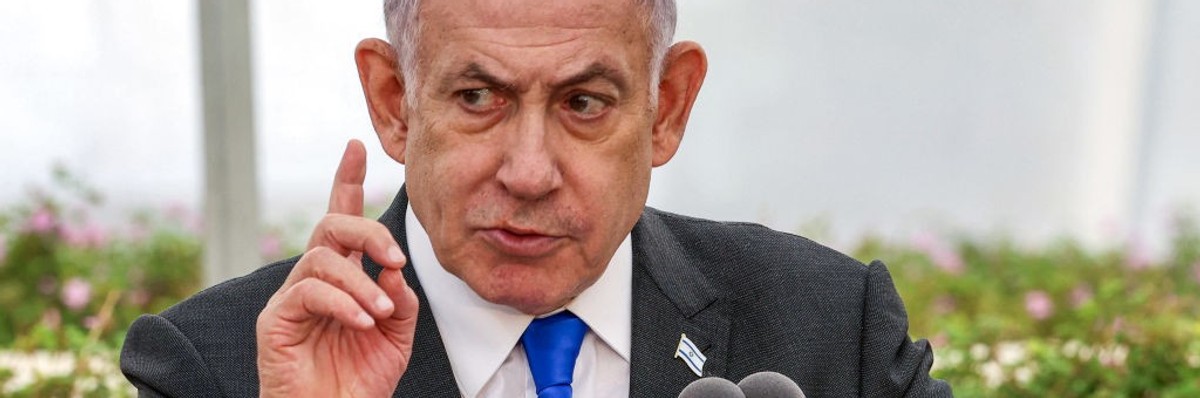
The IDF’s apparent plan to expand its assault on Khan Younis came as The New York Times reported that security leaders in Israel are pushing for a cease-fire in Gaza, objecting to Prime Minister Benjamin Netanyahu’s plan to continue the assault until Hamas is eliminated—an objective even some top Israeli military officials believe is impossible—and all Israeli hostages are released.
The Times reported that senior military officials believe a cease-fire is the “swiftest way” to free captives remaining in Gaza.
Vote For Genocide Vote Labour.UK Labour Party Shadow Foreign Secretary repeatedly heckled at a speech to the Fabian Society over his and the Labour Party’s support for and complicity in Israel’s genocide of Gaza.
Footage shows a Palestinian man being used by the Israel Defense Forces as a human shield. (Photo: Al Jazeera)
“These crimes, and dozens of similar cases, require urgent intervention from the international justice system,” said one human rights group.
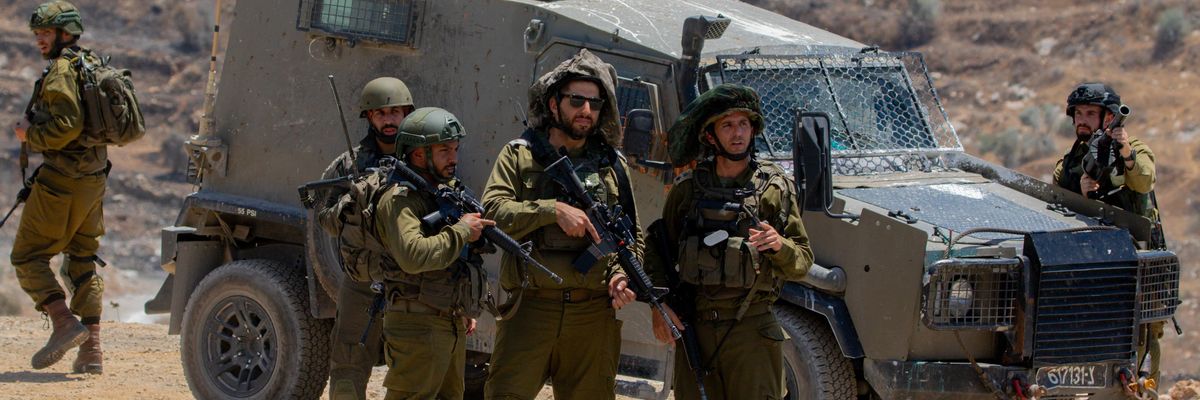
The latest video evidence of Israel’s use of Palestinians as “human shields” during combat was condemned by one human rights advocate on Monday as “horrifying but not surprising,” as campaigners emphasized that the Israel Defense Forces has long used civilians in Palestine to shield their own soldiers from harm while bombarding Gaza and the West Bank.
Footage released by Al Jazeera on Sunday night showed Israeli forces attaching body cameras to handcuffed Palestinians who they had detained, dressing them in IDF uniforms, and sending them into buildings and tunnels to ensure the locations weren’t rigged with explosives.
The footage presented “evidence of a systematic tactic of the army,” said the Euro-Mediterranean Human Rights Monitor.
I translated Al Jazeera’s exclusive report on footage showing Palestinians being used as human shields
The footage reveals instances such as forcing men to search for explosives, tying them with ropes & throwing them into tunnels, and using injured to search for fighters pic.twitter.com/hEla1ZFoq1
“The leaked horrific scenes that were obtained and published by Al Jazeera reveal how the Israeli army uses civilians, including injured detainees, as human shields and forces them into hazardous combat zones after installing cameras on their bodies and binding them with rope,” said Euro-Med. “Each of the aforementioned acts of criminal, brutal, and inhumane behavior constitutes a grave violation of the rules of international humanitarian law, and is a full-fledged war crime. These crimes, and dozens of similar cases, require urgent intervention from the international justice system to ensure the protection of civilians, prevent their use as human shields, and hold the Israeli political and military perpetrators.”
The Israeli government has long blamed Hamas’ use of “human shields” for deaths in Gaza, which now number at least 37,900, saying the group operates out of civilian infrastructure and places Palestinians in harm’s way.
Journalist Dan Cohen pointed out that the IDF has used what it calls “the neighbor procedure” for decades, forcing Palestinian “messengers” to approach the homes of suspected fugitives alone and unarmed while Israeli soldiers announce over a loudspeaker that they are surrounding the building.
The procedure “is so commonplace that the military tried to justify it as a lifesaving measure in use since the 1980s,” said Cohen. “The images… show the reality of this criminal practice.”
In its statement on the new footage, Euro-Med detailed numerous instances in which Israel has appeared to use human shields as defined by the Geneva Conventions: “cases where persons were actually taken to military objectives in order to shield those objectives from attacks.”
As Euro-Med reported:
During the Shifa Medical Complex raid in March 2024, Israeli forces used civilians, including patients and displaced individuals sheltering inside the complex, as human shields. To protect their military operations within the hospital and its vicinity, Israeli forces exploited Palestinian civilians by making them form human barriers to surround Israeli soldiers and military vehicles, or sending them under threat to residential homes and buildings to either help arrest or forcibly evacuate other civilians before army raids and the subsequent destruction of many of these buildings.
[…]
Furthermore, several families residing near the Shifa Medical Complex reported that Israeli forces arrested young men from inside the medical facility, then used them to enter the families’ homes and demand that they immediately evacuate to the central and southern Strip.
The group also cited a recent example from June 22 in the Jenin refugee camp in the West Bank, where Israeli forces placed a wounded Palestinian man on the hood of a military vehicle and drove through the Jabariya neighborhood, and “a compound and comprehensive crime” against a civilian family in Gaza City on June 27.
“A family comprising an elderly woman and her four children, including three young women and a one-and-a-half-year-old granddaughter, was attacked with gunfire and bombs by Israeli forces who stormed their house in the Gaza City neighborhood of Al-Shujaiya,” said the group. “They were later taken outside and detained for over three hours near Israeli tanks in a dangerous combat zone, despite the injuries they sustained in the initial attack on their home, and were used as human shields. The 65-year-old mother, identified as Safiya Hassan Musa Al-Jamal, was run over by an Israeli tank and killed in front of her son.”
On Monday, the Council on American-Islamic Relations (CAIR) condemned the footage released Sunday from the incident in Gaza while noting that Israeli Minister of National Security Itamar Ben-Gvir was recorded over the weekend calling for Palestinian prisoners to be executed and fed reduced food rations as a “deterrence” tactic.
Almost 10,000 Palestinians have been arrested by Israeli forces, including women and children, CAIR said, demanding that the U.S. end its military support for Israel.
“Israeli war crimes, and calls for more war crimes, are occurring daily in Gaza and the West Bank, while the Biden administration rushes more American bombs to Israel to complete the genocide,” said CAIR communications director Ibrahim Hooper. “The U.S.-Israeli partnership in genocide, ethnic cleansing, and forced starvation will shape the international community’s image of America for generations to come. The Biden administration must change course to uphold universal human rights and recognize Palestinian humanity.”
Al-Shifa hospital director Muhammad Abu Salmiya is welcomed by relatives as he arrives in the Gaza Strip on July 1, 2024, after being detained by Israel for more than seven months. Abu Salmiya said that he and his fellow detainees were subjected to torture and terrible conditions. (Photo: Bashar Taleb/AFP via Getty Images)
The hospital director, who’d been held without trial since Israeli forces detained him in November, said that he and others were subjected to torture, psychological humiliation, and severe undernourishment.
The director of Gaza’s main hospital said at a press conference on Monday that he was tortured while being held without charges for the last seven months at an Israeli detention center.
Muhammad Abu Salmiya, director of the Al-Shifa hospital, once Gaza’s main medical center, made the claims after he and 54 other Palestinian detainees were released and arrived back to the Gaza Strip.
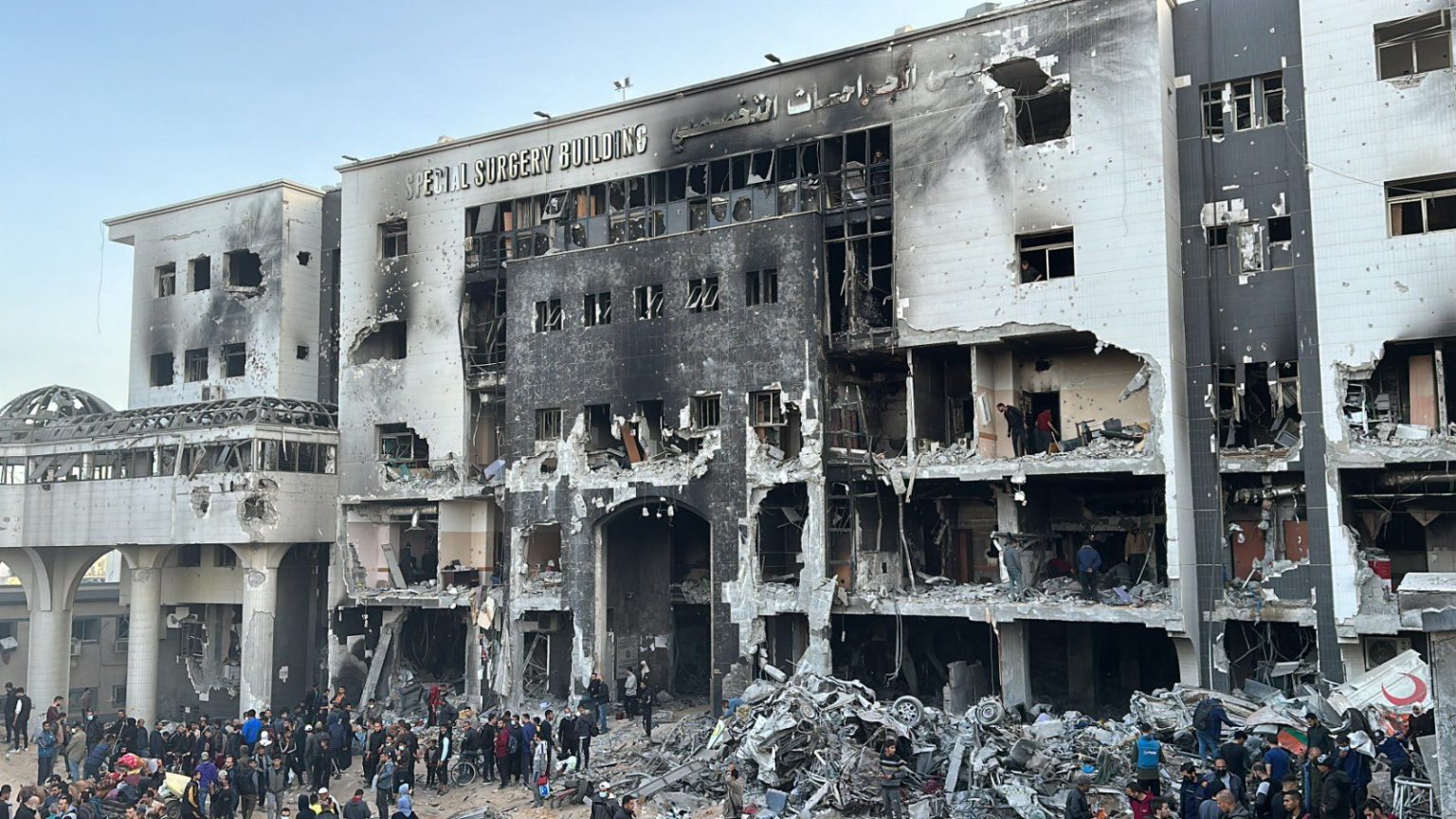
Israeli forces had raided the hospital in November and alleged that Abu Salmiya was involved in making it a Hamas command center. They later destroyed the hospital.
Abu Salmiya said detention guards broke his finger and beat him to the point that his head bled—and that he wasn’t the only one.
“Our detainees have been subjected to all kinds of torture behind bars,” Abu Salmiya said. “There was almost daily torture.”
There was “daily physical and psychological humiliation,” he added.
He also said that they were severely underfed, surviving on nothing more than a loaf of bread per day. He said that all of the detainees had lost at least 30 kilograms (66 pounds).
“Our detainees have been subjected to all kinds of torture behind bars. There was almost daily torture.”
Israeli forces seized Abu Salmiya from a United Nations convoy on November 22. They took him to court three times while in detainment but brought no charges and allowed him no lawyer, Abu Salmiya said.
His detention in November followed an Israeli siege of Al-Shifa hospital, which Israeli officials said had become a Hamas control center. Though weapons were found at the hospital, an investigation by The Washington Post in December showed that the evidence fell short of revealing a command center, and that key claims the Israelis had made to justify the siege turned out to be incorrect.
Israeli forces attacked the hospital again in late March, killing hundreds and leaving the facility mostly destroyed. Several mass graves were discovered near the hospital site in the weeks that followed.
Israel has detained thousands of Palestinians since the war started, leading to “intolerable overcrowding” of its facilities, as Haaretz reported in February. Many detainees are held without charges in what is called “administrative detention.”
At least 40 Palestinians have died in Israeli detention during the war, according to Addameer, a Palestinian watchdog group. Salmiya said Monday that some had been killed in interrogation cells, Al Jazeera reported.
At least one other doctor was among those released on Monday: Bassam Miqdad, head of the orthopedic unit at Gaza European hospital in Khan Younis.
In April, Adnan Ahmad Albursh, a 50-year-old Palestinian surgeon, died in Israeli detention, according to Palestinian officials and rights groups. He had been the head of orthopedics at Al-Shifa hospital. Overall, hundreds of healthcare workers have been killed during the war.
Israeli officials and political figures from various parties denounced the release of the 55 detainees, which was reportedly done to make space in the overcrowded detention centers.
Itamar Ben-Gvir, a far-right minister in charge of Israel’s police and prison service, called the release of the detainees a case of “security negligence” and blamed another ministry. Benny Gantz, an opposition figure who recently resigned from the war cabinet, said whoever released the detainees should be fired and that government offices should be made available to “free up space and budget for prisoners,” according to Al Jazeera.