Years ago, probably 20 years or more I saw this couple probably in their early twenties in a pub. The guy was pretending to be me to mount the woman. That quite amused me. ;)
ALL TO PLAY FOR: Jeremy Corbyn poses outside Islington Town Hall, north London, after handing in his nomination papers for the general election
WILL Jeremy Corbyn win? It is the anxious question asked thousands of times a day by men and women on the left across Britain.
Across the world, come to that. The Islington North MP is recognised globally as one of the foremost champions for peace and social justice.
…
Five years ago he was leading Labour’s charge for office. His period as party leader did one thing the Establishment can never forgive — it gave them a fright. Keir Starmer is the instrument of their vengeance.
Interviewed by the Star in a cafe in the shadow of Finsbury Park station, near his campaign headquarters, he is invited to reflect on what has become of his party of nearly 60 years.
“It’s very sad. When I stepped down as leader it had 600,000 members, it was developing community organising, delayed for two years by officialdom.
“That was the direction we were going in — a broad, community-based grassroots campaigning party. Now it is a very centralised party. Local parties like Islington North have been treated with absolute disdain by the national party.”
His campaign has focused heavily on the local and has not really attacked his former party.
Prompted, Corbyn acknowledges that “if Labour loses that social milieu of people fighting for social justice and peace it just becomes a vehicle with no soul.”
That is the price of the consensus which Corbynism briefly shattered and is now in advanced restoration. Nationally, it is an arid campaign.
“The duopoly of the economic offer, both parties promise the same spending plans, same taxation regime, means the inequalities of the past 15 years are hard-wired into economic plans for the future.”
…
As ever, Jeremy Corbyn is most fluent, most at ease when discussing either the social problems on the ground, in his own constituency above all, or the dangers facing the world as a whole. I put to him George Galloway’s recent warning that Britain could be at war within six months.
“George is not wrong about that. We are moving towards a very very dangerous situation. Defence spending is by consensus to rise to 2.5 per cent and there are pretty loud voices saying it should go even more, to 3 per cent.”
He slates the bipartisan obsession “with Britain’s global military role — for what? We are building up to a cold war with China,” incurring vast spending on the Aukus nuclear submarine pact ”and not doing anything to bring about peace, not in the Ukraine war, not in Palestine.”
Re-elected, “I will be that voice for peace,” he pledges, a rare politician’s commitment that you can be absolutely sure will be honoured.
…
“The Gaza crisis has sorted a lot of people out. I think that the opportunity for politics coming back offered by the peace movement is going to be the future. People who come together for social justice.
“If you want to know what the future looks like, look at the demonstrations, people from all walks of life, communities, religions, races; all of this is a way forward.
“It includes a lot of people in the Labour Party who have radical political demands” but also the wave of independent candidates challenging Labour in this election.
“I would expect after the election to see a political grassroots movement, a community of activity from the grassroots.” In Islington, he pledges to establish a people’s assembly to render account to.
Zionist Keir Starmes is quoted “I support Zionism without qualification.” He’s asked whether that means that he supports Zionism under all circumstances, whatever Zionists do.
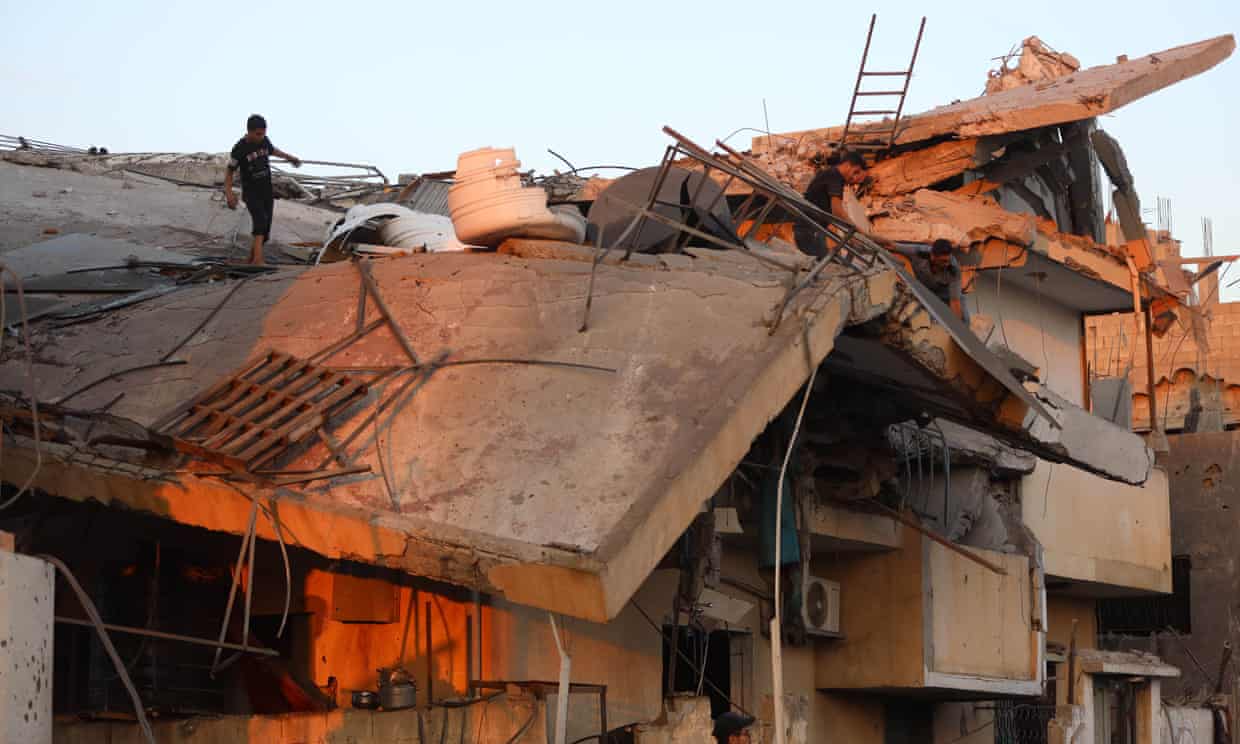
Gazans, including children, walk past rubble and leaked sewage at Bureij camp after Israeli attacks in Deir al Balah, Gaza on June 20, 2024. (Photo by Hassan Jedi/Anadolu via Getty Images)
As the IDF stepped up attacks in Gaza City, one resident said, “We are being starved… with no hope that this war is ever ending.”
Residents of Gaza City’s Shujayea neighborhood found themselves on Thursday among the main targets of new Israeli military operations, with thousands of people fleeing as they were “hunted by tanks and planes,” as one Palestinian man told Reuters—even as Israel claimed the “intense” phase of the war was over.
Al Jazeera reported that the Israel Defense Forces targeted five residential homes in the Shujayea and Sabra neighborhoods in the early morning hours of Thursday, killing at least five people in the former area and three in the latter.
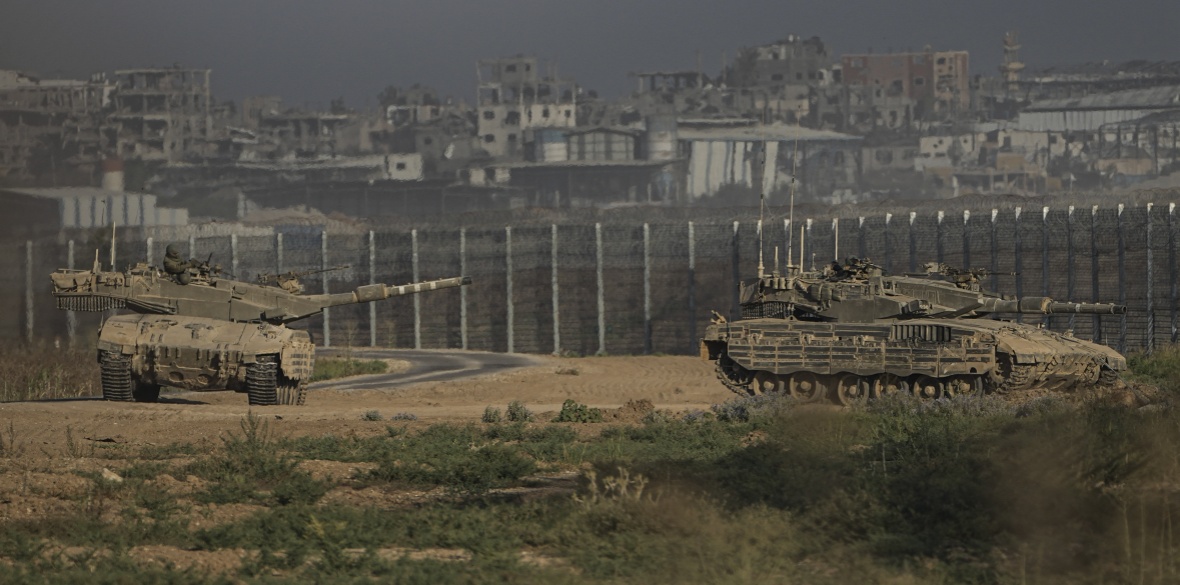
Evacuation orders from the IDF came about 30 minutes after the shelling began in Shujayea, according to Al Jazeera, with families rushing to move west after receiving text messages and leaflets from the military. The IDF published a map showing that certain blocks of the residential neighborhood were now part of a combat zone where tanks were moving in.
“We were suddenly and intensively bombarded by Israel,” one man fleeing the area on foot told Al Jazeera. “We came out and we don’t know where to go.”
Artillery attacks were also reported in the Zeitoun, Hawa, and Sheikh Ijlin neighborhoods of Gaza City. Shujayea was a key target of the IDF in the first weeks of Israel’s bombardment of Gaza last October.
As Israel claims to be drawing down its attacks while rejecting a permanent cease-fire agreement, “the world must not stay silent” about the ongoing assault on Gaza, said researcher and academic Nour Naim.
🚨Breaking: Brutal massacres are occurring now in #Gaza City due to intense and sudden attacks by the Israeli army, leaving many injured and trapped under the rubble.
The Gaza Health Ministry reported Thursday that the people who were killed in Gaza City overnight were among 47 Palestinians killed across the enclave in the past 24 hours. Fifty-two people were reported wounded in the same time period—the latest of dozens each day who are taken to hospitals where doctors struggle to treat people with severely limited supplies due to continued humanitarian aid delays and blockades.
“There are moments when anesthesia is not available, but in order to save the lives of citizens, we resort to amputation, and this causes severe pain for the wounded,” a surgeon at al-Ahli Arab Hospital in Gaza City, told AFP. “Every day, there are attacks that result in amputations of legs or arms for children, adults, and women.”
Six people were killed overnight in an Israeli attack in Jabalia, northern Gaza, and an attack on a family home killed one person in the northern town of Beit Lahiya.
In southern Gaza, women and children were among those killed in an attack on a school where displaced people have been staying, and Israeli ground forces “systematically demolished residential buildings in the west of the city” of Rafah, Al Jazeera reported.
As the IDF has stepped up attacks in Gaza City and continued its bombardment of other areas across the enclave, doctors, humanitarian workers, and civilians described the realities of daily life in Gaza, where aid blockades and the disruption of sanitation services and water treatment have all contributed to “grim living conditions” and heightened health risks.
Joanne Perry, a doctor working with Doctors Without Borders (MSF), described to the Associated Press living conditions that have caused concern that a cholera outbreak could soon take hold.
“The crowded conditions, the lack of water, the heat, the poor sanitation—these are the preconditions of cholera,” Perry told the AP.
Israeli attacks since October have destroyed Gaza’s wastewater treatment plants, water desalination plants, sewage pumping facilities, and wells, and have killed government workers who have tried to repair the infrastructure, leading Palestinians to rely on contaminated and “salty” water.
“We found worms in the water. I had been drinking from it,” 21-year-old Adel Dalloul told the AP. “It was salty, polluted, and full of germs… I had gastrointestinal problems and diarrhea, and my stomach hurts until this moment.”
The World Health Organization has reported 485,000 cases of diarrhea—the third-leading cause of death in young children worldwide—since October, and has warned of at least one outbreak of Hepatitis A, which is spread through the consumption of water and food contaminated with fecal matter.
A mother of six in Khan Younis told Reuters that her family is relying on a charity kitchen’s daily visits to their U.N.-run shelter, as 12 million pounds of food aid and other supplies have been held up since June 9, according to U.S. officials.
“If the charity kitchen did not come here for one day, we would wonder about what we will eat that day,” Umm Feisal Abu Nqera told Reuters. “We are living the worst days of our lives in terms of famine and deprivation… Today, your son looks at you and you bleed from within, because you cannot provide him with his most basic rights and the simplest needs for his life.”
A girl died of malnutrition on Thursday at Kamal Adwan Hospital in Beit Lahia, bringing the official death toll from malnutrition and dehydration among children to 31. “We are being starved in Gaza City,” 25-year-old Mohammad Jamal toldReuters as the renewed Israeli offensive took hold, “with no hope that this war is ever ending.”
Zionist Keir Starmes is quoted “I support Zionism without qualification.” He’s asked whether that means that he supports Zionism under all circumstances, whatever Zionists do.
JEREMY Corbyn has claimed he was once asked to give a “blanket undertaking” that he would automatically support any military action Israel undertakes while Labour leader.
Corbyn – who is running as an independent candidate at the General Election – said during an interview with Declassified UK co-founder Matt Kennard that he was confronted with the request at an “extremely hostile” meeting of the Parliamentary Labour Party Committee and declined.
He said: “During one extremely hostile meeting of the Parliamentary Labour Party Committee they confronted me and said will you give a blanket undertaking that you, as party leader and potentially prime minister, will automatically support any military action Israel undertakes?
“And I said no, I will give no such undertaking, because the issue of Palestine has to be resolved and Palestinian people do not deserve to live under occupation, and the siege of Gaza has created such incredible stress.
“By the way I’ve been there on nine occasions in Israel, Palestine and the West Bank.”
Jeremy Corbyn says during a meeting with the Parliamentary Labour Party Committee he was confronted and asked to give assurances that as Labour leader – and potentially prime minister – he would automatically support any military action Israel undertakes👇 pic.twitter.com/RIN13HkHpF
Jeremy Corbyn makes the claim in this interview (50 min long)
Zionist Keir Starmes is quoted “I support Zionism without qualification.” He’s asked whether that means that he supports Zionism under all circumstances, whatever Zionists do.
Forbidden Stories and its Gaza Project partners investigated Israel’s killing of journalists in Gaza and elsewhere. (Illustration: Forbidden Stories/The Gaza Project)
“This is one of the most flagrant attacks on press freedom that I can remember,” said one campaigner. “The impact on press freedom in Gaza, in the region, and the rest of the world is something we cannot accept.”
With more than 100 media professionals—nearly all of them Palestinian—killed in Gaza since October, a group of 50 reporters from 13 international organizations this week shared the results of a new investigative journalism initiative aimed at exposing the deadly toll Israel’s onslaught has taken on those reporting it to the world.
The Gaza Project—led by the Paris-based nonprofit Forbidden Stories—”analyzed nearly 100 cases of journalists and media workers killed in Gaza, as well as other cases in which members of the press have been allegedly targeted, threatened, or injured since October 7,” when Hamas-led attacks on Israel left more than 1,100 people dead and over 240 others kidnapped.
“Faced with what is being reported as the record number of journalists killed, Forbidden Stories, whose mission is to pursue the work of journalists who are killed because of their work, set out to investigate the targeting of journalists,” the group said
“For four months, Forbidden Stories and its partners investigated the circumstances of their killings, as well as those who have been targeted, threatened, and injured in the West Bank and Gaza,” it added. “These investigations point to a chilling pattern and suggest some journalists may have been targeted even though they were identifiable as press.”
🔴 How are Israeli drones killing journalists in Gaza?
Gaza Project member Committee to Protect Journalists (CPJ) has condemned what it called an “apparent pattern of targeting journalists and their families,” noting cases in which media workers were killed while wearing press insignia and after being threatened by Israeli officials.
“This is one of the most flagrant attacks on press freedom that I can remember,” CPJ program director Carlos Martínez de la Serna said of the ongoing war. “The impact on press freedom in Gaza, in the region, and the rest of the world is something we cannot accept.”
Basel Khair Al-Din, a Palestinian journalist in Gaza who believes he was targeted by a drone strike while wearing a press vest, said, “Whereas this press vest was supposed to identify and protect us, according to international laws, international conventions, and the Geneva Conventions, it is now a threat to us.”
“It’s this vest that almost got us killed, as has happened to so many of our fellow journalists and media workers,” he added.
Groups like Human Rights Watch (HRW) and Amnesty International have called for official investigations into Israeli killing of journalists including an October 13 attack that killed 37-year-old Lebanese Reuters videographer Issam Abdallah and wounded half a dozen other journalists who were covering cross-border clashes between Israeli troops and Hezbollah fighters in southern Lebanon.
Dylan Collins, an American deputy editor at Al Jazeera English, was wounded while administering first aid to Christina Assi, an Italian Agence-France Presse journalist whose legs were blown off in the attack.
Reuters determined that an Israeli tank crew “fired two shells in quick succession” at the journalists, who HRW said were “clearly identifiable as members of the media, and had been stationary for at least 75 minutes.” HRW “found no evidence of a military target near the journalists’ location.”
Amnesty International, meanwhile, asserted that the Israel Defense Forces (IDF) strike was “likely a direct attack on civilians that must be investigated as a war crime.”
Asa Kasher, the lead author of the IDF’s Code of Ethics, told Forbidden Stories that “no member of the press should have been killed under normal circumstances of hostilities in Gaza.”
“It shouldn’t happen, even a single one,” he added. “It’s illegal. It’s unethical. The person who does it should be brought to court.”
Asked about the al-Aqsa network casualties, a senior IDF spokesperson told us there was “no difference” between working for the media outlet and belonging to Hamas’s armed wing, a sweeping statement legal experts described as alarming. #Israel#Gazahttps://t.co/iD2pnrTmp6
Israel’s alleged deliberate targeting of journalists is part of the evidence presented in a South Africa-led genocide case against Israel being reviewed by the International Court of Justice in The Hague.
Separately, the chief prosecutor at the International Criminal Court (ICC), also located in the Dutch city, is seeking arrest warrants for Israeli Prime Minister Benjamin Netanyahu, Israeli Defense Minister Yoav Gallant, and three Hamas leaders for alleged war crimes and crimes against humanity including extermination and forced starvation in the case of the Israelis and extermination, rape, and torture in the case of Hamas.
The international press freedom group Reporters Without Borders last month filed a third ICC complaint alleging “war crimes against journalists in Gaza.”
According to Palestinian and international officials, at least 37,718 Palestinians—mostly women and children—have been killed during Israel’s 264-day assault on Gaza, which has also left more than 86,300 people wounded and 11,000 others missing and feared dead and buried beneath the rubble of hundreds of thousands of homes and other bombed-out buildings.
Around 90% of Gaza’s 2.3 million people have also been forcibly displaced, and the Israeli siege on Gaza has caused widespread—and deadly—starvation and what the head of the United Nations food agency called a “full-blown famine” in northern parts of the strip.
Zionist Keir Starmes is quoted “I support Zionism without qualification.” He’s asked whether that means that he supports Zionism under all circumstances, whatever Zionists do.