Humanitarian aid trucks belonging to the World Food Programme (WFP) arrive in the Gaza via Erez border crossing as the Israeli attacks continue in Gaza City, Gaza on September 26, 2024 [Hasan Zaain – Anadolu Agency]
The UN World Food Programme said, on Monday, that Israeli forces had opened fire on one of its convoys in the besieged Palestinian enclave of Gaza in what it called a “horrifying incident”, Reuters reports.
The Agency said the convoy of three vehicles carrying eight staff members from central Gaza to Gaza City in the north was struck by 16 bullets near the Wadi Gaza checkpoint on Sunday, causing no injuries but immobilising the convoy.
The vehicles were clearly marked and had received prior security clearances from Israeli authorities, a WFP statement said.
“The World Food Programme (WFP) strongly condemns the horrifying incident on January 5,” it said.
“This unacceptable event is just the latest example of the complex and dangerous working environment that WFP and other agencies are operating in today,” WFP said, calling for improvements in security conditions to allow aid to continue.
The Israeli military did not immediately respond to a request for comment on the incident.
International aid agencies working to alleviate the humanitarian crisis in Gaza have frequently accused Israeli forces of hampering or threatening their operations amid Israel’s campaign to wipe out Hamas fighters.
Injured Palestinians, including children, are brought to Al-Aqsa Martyrs Hospital in Deir Al-Balah for treatment aftermath of Israeli attack on a school sheltering displaced Palestinians in Bureij Camp, Gaza on January 4, 2025. (Photo: Ashraf Amra/Anadolu via Getty Images)
“The Biden administration is ending its tenure as it has acted throughout it,” said A New Policy co-founder Josh Paul, “with a complete disregard for Palestinian humanity, American laws, and American interests.”
Human rights advocates in the United States and around the world on Monday condemned outgoing U.S. President Joe Biden for continuing to fuel Israel’s genocidal assault on the Gaza Strip with a pending $8 billion weapons package.
Since Axoisrevealed late Friday that his administration had notified Congress of the deal, Biden has faced a fresh flood of outrage, with critics calling the president “morally bankrupt” and his decision to keep arming Israel “willful madness.”
“Too many kids still alive in Gaza for Joe Biden’s liking,” Yousef Munayyer, a Palestinian American political analyst, said on social media. “This is an administration of cowards and criminals and will go down as a historic worst.”
Two men who resigned from the Biden administration over U.S. support for Israel’s assault on Gaza—which has killed at least 45,854 Palestinians and led to a genocide case at the International Court of Justice—shared sharp critiques on Monday.
“The Biden administration is ending its tenure as it has acted throughout it,” said ex-U.S. State Department official Josh Paul, “with a complete disregard for Palestinian humanity, American laws, and American interests.”
“The precedent set by the Biden administration will surely haunt our nation for many years to come.”
Paul and former Education Department official Tariq Habash launched the lobbying group A New Policy in October. Habash also took aim at Biden’s new effort to arm Israel with missiles for fighter jets and attack helicopters, 155 mm artillery shells, small-diameter bombs, 50-pound warheads, bomb fuzes, and kits used to convert “dumb bombs” into precision-guided munitions.
“Americans continue to struggle here at home, so the notion that the Biden administration would push another $8 billion in weapons to Israel on the backs of American [taxpayers] demonstrates how unmoored this administration has become from its values and its commitments to the American people,” said Habash. “The precedent set by the Biden administration will surely haunt our nation for many years to come.”
Win Without War executive director Sara Haghdoosti also denounced the effort, saying in a Monday statement that “these weapon sales won’t bring hostages home and don’t get us closer to a viable long-term solution that ensures Israelis and Palestinians can live with dignity without the threat of violence.”
“Many of the types of weapons reported to be part of this $8 billion package have been used—or are likely to be used—to kill and wound Palestinian civilians in Gaza, in a war that drags on because the president and his advisers refused to exercise real leverage to end it,” she noted. “This new tranche of weapons will surely be used to the same horrific ends.”
Haghdoosti highlighted that “President Biden and his senior advisers continue skirting U.S. laws that should prohibit the sale of deadly weapons while Israeli officials restrict humanitarian aid and seek to make Gaza uninhabitable.”
Violating U.S. and international law one last time on their way out. https://t.co/ZCShUa807B
Despite attempts by progressives in Congress such as U.S. Sen. Bernie Sanders (I-Vt.) to block some arms to Israel, Democratic and Republican lawmakers have repeatedly voted to send more—including with the $895 billion National Defense Authorization Act for fiscal year 2025 that they sent to Biden’s desk last month.
News of the $8 billion package comes just two weeks away from the inauguration of U.S. President-elect Donald Trump.
Paul said that “there is no need to rush these sales to completion, but it is clear President Biden and his appointees at the State Department do not have confidence in the Trump administration to follow through on their decision to rush arms to Israel with no questions asked, which is why they are pushing through these sales now.”
While the current administration is clearly aiming to push the package through ahead of the looming transition of power in the United States, Trump is widely expected to serve as an ally to Israel, as he did in his first term. Haghdoosti sounded the alarm about the Republican’s return to the White House with a GOP-controlled Congress.
“These latest sales mark a bleak handoff to the incoming Trump administration, whose senior nominees openly ally with far-right Israeli government ministers who plan to settle Gaza and annex the West Bank, all but guaranteeing another generation of displacement and deprivation that will undermine security for Palestinians and Israelis alike,” she said.
Trump and far-right leaders in Israel—including Prime Minister Benjamin Netanyahu, Finance Minister Bezalel Smotrich, and National Security Minister Itamar Ben-Gvir—”will use these sales to advance that violent project,” Haghdoosti added. “It is an utter shame that President Biden has chosen to abet it during his final days in office.”
CHORUS:
I'm Genocide Joe, Genocide Joe
Genocide is my name
Genocide is my game
I'm Genocide Joe, Genocide Joe
Just so you know
Do you know?
I'm Genocide Joe, Genocide Joe

Anything Bibi wants
I'm there every time
As soon as I can
There every time
CHORUS

There at his beck and call
All that Bibi wants
200lb feck off bombs?
Sure you don't want some more?
CHORUS

I bend the rules, bend the rules
Get away with mass murder, Genocide
Get away with mass murder, Genocide
I'm Genocide Joe, Genocide Joe
CHORUS
8.10 GMT 7/1/25. I posted this originally at approx 23.30 GMT 6/1/25. This blog was immediately disabled with a “we are checking your connection” endless loop. I’ve since disabled Cloudflare CDN and need to fully disengage it. Please be inspired by the song – it can be developed in so many ways. Son with a gun … Pardon?
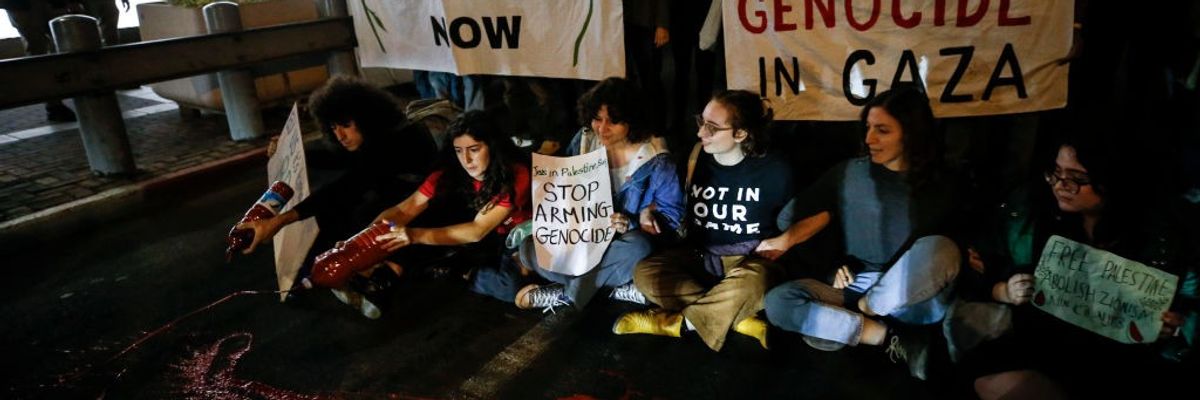
People demonstrate outside the U.S. Consulate in Tel Aviv, Israel, on November 20, 2024, ahead of a vote by the U.S. Senate on legislation to block offensive U.S. weapons sales to Israel. Photo by Saeed Qaq/NurPhoto via Getty Images
Multiple human rights organizations and international bodies have accused Israel of committing genocide in Gaza
The administration of US President Joe Biden announced on Saturday an arms sale to Israel valued at $8 billion, just ahead of President-elect Donald Trump’s return to the White House.
Biden has repeatedly rejected calls to suspend military backing for Israel because of the number of civilians killed during the war in Gaza. Israel has killed more than 45,000 people in Gaza, primarily women and children.
The sale includes medium-range air-to-air missiles, 155mm projectile artillery shells for long-range targeting, Hellfire AGM-114 missiles, 500-pound bombs, and more.
Human rights groups, former State Department officials, and Democratic lawmakers have urged the Biden administration to halt arms sales to Israel, citing violations of US laws, including the Leahy Law, as well as international laws and human rights.
The Leahy Law, named after former Sen. Patrick Leahy, requires the US to withhold military assistance from foreign military or law enforcement units if there is credible evidence of human rights violations.
The Council on American-Islamic Relations (CAIR), the nation’s most significant Muslim civil rights and advocacy organization, today called Biden’s new $8 billion arms deal “racist” and “sociopathic.”
Multiple human rights organizations and international bodies have accused Israel of committing genocide in Gaza. The International Criminal Court (ICC) issued arrest warrants for Israeli Prime Minister Benjamin Netanyahu and former Defense Minister Yoav Gallant for committing war crimes.
The US is, by far, the biggest supplier of weapons to Israel, having helped it build one of the most technologically sophisticated militaries in the world.
CAIR National Executive Director Nihad Awad said on Saturday:
“We strongly condemn the Biden administration for its unbelievable and criminal decision to send another $8 billion worth of American weapons to the government of indicted war criminal Benjamin Netanyahu instead of using American leverage to force an end to the genocide in Gaza.
“Only racists who do not view people of color as equally human, and sociopaths who delight in funding mass slaughter, could send Netanyahu even more bombs while his government openly kidnaps doctors, destroys hospitals, and exterminates the last survivors in northern Gaza.
“If President Biden is actually the person who approved this new $8 billion arms sale, then he is a war criminal who belongs in a cell at The Hague alongside Netanyahu. But if Antony Blinken, Brett McGurk, Jake Sullivan, and other aides are making these unconscionable decisions as shadow presidents, then anyone with a conscience in the administration should speak up now about their abuses of power.”
According to the Stockholm International Peace Research Institute (SIPRI), the US accounted for 69% of Israel’s imports of major conventional arms between 2019 and 2023.
On the other hand, incoming President-elect Donald Trump has also pledged unwavering support for Israel and has never committed to supporting an independent Palestinian state.
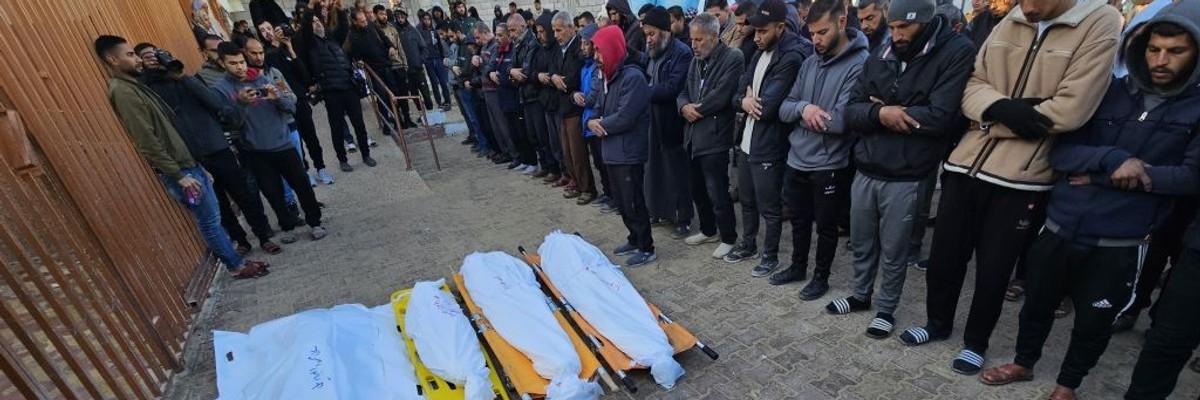
The bodies of the Palestinian adults and children killed in an Israeli attack on the al-Mawasi “safe zone” are brought to al-Nasser Hospital in Khan Younis, Gaza, Palestine for funeral procedures on January 2, 2025. (Photo: Hani Alshaer/Anadolu via Getty Images)
The analysis was published a day before Israeli forces bombed yet another “safe zone,” killing at least 12 Palestinians, including children.
A report published on Wednesday details how Israel forcibly expels Palestinians in the Gaza Strip in order to facilitate—and hide—genocidal attacks in evacuated areas, while forcing refugees into alleged humanitarian “safe zones” that are “intentionally designed to ensure the destruction of all life sheltering there.”
The Palestinian human rights group Al-Haq published the report, titled How to Hide a Genocide, which examines “the role of evacuation orders and safe zones in Israel’s genocidal campaign in Gaza.”
Since the very first week of its genocide, Israel has methodically cleared vast stretches of the Gaza Strip of its inhabitants through its unlawful issuance of evacuation orders. Israel presents these evacuation orders to the public as proof of its efforts to minimize civilian casualties and to support its alleged compliance with fundamental principles of international humanitarian law. However, they achieve the direct opposite. Over 90% of Gaza’s population… has been forcibly displaced from their homes and temporary shelters, the majority of them multiple times, to alleged safe zones.
Contrary to their label, these zones are anything but safe. With insufficient space, shelter, sanitation facilities, food, or water sources, and medical care, these safe zones are intentionally designed to ensure the destruction of all life sheltering there. What’s more, the safe zones—despite their unilateral establishment by Israel—are routinely targeted by Israeli occupying forces (IOF) by air, land, and sea. Crowded together with nowhere to flee, Palestinians in Gaza are either killed by Israeli strikes, severely physically and mentally injured by the IOF’s physical and psychological warfare, or subject to a slow death as a result of starvation, dehydration, a complete lack of crucial medical care, or the rampant spread of infectious diseases in the densely populated, unsanitary zones.
Al-Haq said: “As shown throughout the report, by applying humanitarian terms to its practice of forcibly transferring Palestinians, without any legal basis and in a manner that breaches international law, and labeling areas as safe zones despite being constantly attacked and lacking in all essentials for survival, Israel argues that it is acting in accordance with its legal obligations when in fact it is providing further evidence of its genocidal intent as it uses these measures to commit and contribute to the genocidal acts of killing, causing serious bodily and mental harm, and creation of conditions calculated to destroy Palestinians in Gaza.”
The Al-Haq report was published shortly after Sila Mahmoud Al-Faseeh, a 3-week-old baby girl, died from hypothermia in the al-Mawasi safe zone in southern Gaza. She is one of at least eight people—seven of them infants or children—who have reportedly frozen to death in Gaza in recent weeks.
The report was also published a day before Israeli forces bombed a tent encampment in al-Mawasi, killing at least 12 Palestinians including three children and wounding at least 15 others.
It was one of numerous Israeli strikes on the al-Mawasi safe zone, which have killed or wounded at least hundreds of Palestinians. In the deadliest of these, at least 90 Palestinians including many women and children were killed—some of them burned alive in their tents—and hundreds of others were injured when eight 2,000-pound bombs, at least one of which was supplied by the United States, were dropped on the humanitarian zone on July 13, 2024 in order to assassinate Hamas leader Mohammed Deif. Israeli forces then attacked and killed rescue workers arriving at the site of the strike.
U.S. Secretary of State Antony Blinken called the death toll from the strike “unacceptably high.” However, just weeks later, the Biden administration approved approximately $20 billion worth of new U.S. weapons for Israel.
The International Court of Justice in The Hague, Netherlands is currently weighing whether Israel is committing genocide in Gaza.