
Protests in 18 cities and hunger strikes planned to reform Britain’s repressive terror laws


PROTESTS in 18 towns and cities and Britain’s biggest hunger strike since the Troubles were announced today amid intensifying calls to reform Britain’s repressive terror laws behind the ban on Palestine Action.
Organisers said around 1,500 people could take part in the demonstrations next month, while others will begin rolling hunger strikes this Sunday.
More than 2,000 people have been arrested for allegedly supporting Palestine Action during mass events where protesters held placards saying “I oppose genocide. I support Palestine Action,” after it was proscribed as a terrorist group in July.
Suspects face up to two years in jail without charge.
…
The demonstrations come ahead of a legal hearing against former home secretary Yvette Cooper’s decision to proscribe the group under anti-terror laws.
Defend Our Juries spokesman Dr Clive Dolphin said: “This is about here in the UK, people having the right to protest, the right to speak up to government when they think the government has got something wrong, and fundamentally this is about the fact that the British people oppose genocide.
“They do not want to be complicit in war crimes. They do not want to see people starved to death in an artificial famine. British people oppose genocide.”
…


Keir Starmer’s Labour is a lost cause. But there’s still hope for the left
Original article by Paul Rogers republished from openDemocracy under a Creative Commons Attribution-NonCommercial 4.0 International licence.

| Ben Montgomery/Stringer / Leon Neal/Staff / Kristian Buus/Contributor / Getty Images / Composition by James Battershill
In choosing big business over ordinary people, the PM has sacrificed the heart of the Labour Party. So what next?
Labour’s political position is increasingly the reverse of the ‘for the many, not the few’ policy pursued under former leader Jeremy Corbyn. The party has embraced corporate capture and the main features of neoliberalism, albeit with incredibly poor timing, as the neoliberal economic model drives runaway wealth that increases dissent across much of the world.
It is no coincidence that, at the same time, when it should be coasting along on a huge parliamentary majority won less than 18 months ago, Labour has been plunged into political disarray and seen its lead disappear in the polls.
By cosying up to big business and failing to offer anything to substantially improve the lives of ordinary people up and down the country, Keir Starmer’s New-New Labour has seen a collapse in its general support and, more significantly, its membership.
The Labour Party has lost 300,000 of the 550,000 members it had in the Corbyn era. While it has been able to recoup the financial support offered by these ordinary members from a few big donors, it has in the process lost the heart of the party.
Many issues demonstrate this, but a few stand out. The government’s repeated refusal (now rumoured to be U-turned on at next month’s Budget) to lift the two-child benefit cap. Its flagship welfare bill (already U-turned on), which would have cut Universal Credit and Personal Independence Payments for millions of vulnerable people. The decision, announced in February of this year, to cut the foreign aid programme to increase military spending.
And then came perhaps the biggest problem of all for Starmer’s Labour: Gaza, where the UK government’s continuing support for Israel as it engages in genocide still beggars belief for many. There have been 32 mass demonstrations in London in the past two years, the most recent being one of the largest protests ever held in the UK. That level of political activity will continue, given Israeli prime minister Binyamin Netanyahu seems determined to avoid a peaceful outcome, and Starmer is unlikely to stand up to him or, by extension, the US.
Widespread dismay and depression on the backbenches may ebb and flow, but at this point, it feels like even a change of leadership may not be enough for a real change in fortune.
The government’s current predicament is the main reason why Westminster politics is so uncertain. Looking at the UK-wide parties, the far-right Reform UK is leading polls with vote shares that vary but are typically over 30%, having soaked up plenty of support as a substantial protest vote. If that persists through to the next general election in 2029, it will likely put Nigel Farage into Downing Street.
Labour’s support, meanwhile, is hovering at around 20%, the Tories more like 15% and the Liberal Democrats rather less.
And until three months ago, the Greens were still weak in polling terms – despite having made some progress since last year’s election – and millions on the left were still disenfranchised, having been disillusioned with Starmer’s Labour leadership.
Two things have changed; the first being Zack Polanski winning the Green Party leadership at the start of September. He has brought a more radical and left-wing perspective to the party, which has led to a jump in the polls and an 80% increase in new members. The Greens announced this week that its membership now stands at 126,000 – more than either the Conservatives or the Lib Dems.
The second change is in the fortunes of the new Your Party group, fronted by Corbyn and former Labour MP Zarah Sultana. While the party’s initial request for expressions of interest received a massive 800,000 responses – at which point it appeared likely to provide a serious challenge to Starmer’s Labour – it ran into internal disagreements six weeks ago that knocked it right back and led to a period of utter dismay and anger among supporters.
Those feelings have eased somewhat over the past two weeks, as Your Party has published draft versions of its constitution, standing orders and an organisational strategy, all of which are to be discussed and developed before being decided at a large national conference in Liverpool at the end of November. The documents, including a draft political statement, are open to all and will no doubt be subject to intense debate and plenty of disagreement, but they do appear to be a genuine attempt at accountability that is a very long way from the opacity of the Labour Party.
A typical meeting of supporters, of which there are hundreds around the country, still sees some of the anger of a few weeks ago, but now also more determination to see things through. If the new party can recapture the mood of three months ago – and particularly if it and the Greens are willing to work with one another – then there may be some hope for the disenfranchised left.
One of the most interesting aspects of these rapid political changes is the potential for the three figureheads of these two parties to have a substantial impact.
Zarah Sultana, with an often combative style, appeals particularly to younger and frustrated audiences, while Zack Polanski’s normal and measured approach is persistently disarming for Reform’s far-right politicians. Then there is Jeremy Corbyn, who is already a national figure known for a long-term commitment to a progressive agenda and a remarkable personal following.
These are very early days in a time of rapid political change. Reform is still on the up, but compared with just three months ago, there is now a lot more reason for hope on the left.
Sign up to openDemocracy’s free Daily Email


Nearly Half of Dems in Competitive Primary Districts Say They ‘Could Never’ Support a Candidate Backed by AIPAC
Original article by Stephen Prager republished from Common Dreams under Creative Commons (CC BY-NC-ND 3.0).
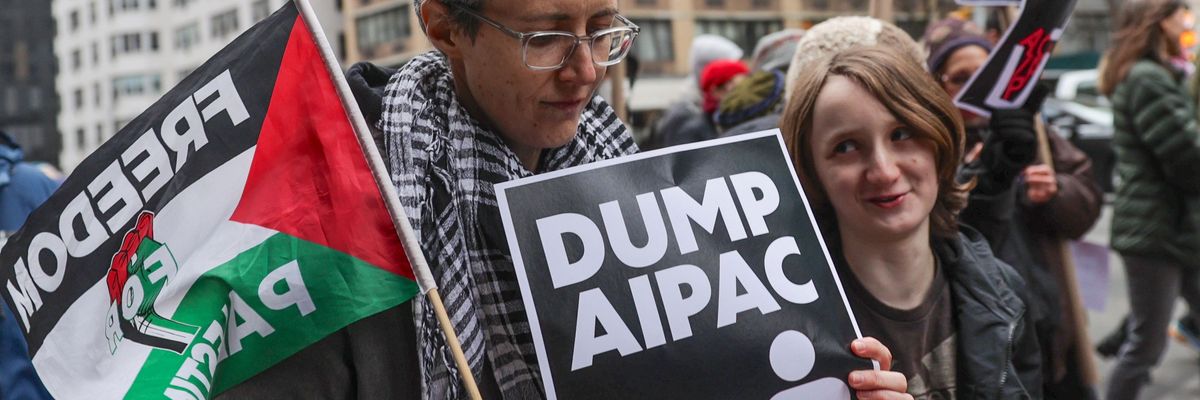
“The political rules of the last almost half-century are changing before our eyes,” said Jewish Currents editor Peter Beinart.
As voters sour on Israel after over two years of genocide in Gaza, an internal poll suggests that backing from the pro-Israel lobby may be a liability for Democrats seeking to win their primaries.
The Democratic polling firm Upswing Strategies canvassed 850 Democratic voters in congressional districts across Illinois, Michigan, Minnesota, and Pennsylvania. The survey asked voters for some of the most competitive Democratic primaries in the 2026 election cycle a number of questions about their sympathies in the Israel-Palestine conflict.
It also zeroed in on their feelings about pro-Israel lobbying groups, including the American-Israel Public Affairs Committee (AIPAC), which supported 152 Democrats who received more than $28 million in total during the 2024 election and had a role in toppling several House progressives, including then-Reps. Cori Bush (D-Mo.) and Jamaal Bowman (D-NY).
The poll found that nearly half of voters in these competitive districts (48%) agreed with the statement that they “could never support” a candidate for Congress that was funded by AIPAC or the pro-Israel lobby more generally. Over a quarter of voters, 28%, said they strongly felt they could never support a candidate backed by AIPAC.
Just 40% said they “could see” themselves supporting a candidate backed by AIPAC, “especially if I agreed with them on most other issues,” but just 10% expressed that belief strongly, while the other 30% said they only agreed with it somewhat.
The poll was posted to social media by Matthew Eadie, a reporter for the Illinois news outlet Evanston Now,on Saturday. He said that since it was conducted in early September, its results have been “circulating among Democrats in over a half-dozen competitive primaries in mostly Illinois.”
With Democratic Sen. Dick Durbin’s seat coming open in 2026, several current Illinois congresspeople have signaled their intent to run, leaving their own House seats up for grabs. Among them are some AIPAC favorites, including Rep. Raja Krishnamoorthi (D-Ill.), who received over $63,000 from pro-Israel groups during the 2023-24 election cycle and nearly $269,000 since his first campaign in 2016; and Rep. Robin Kelly (D-Ill.), who received over $17,000 last cycle and nearly $109,000 since her first campaign in 2012.
Pro-Israel groups will also likely seek to hold off yet another primary challenge to Rep. Danny Davis (D-Ill.) from the progressive community organizer Kina Collins, who has run against him during the last three cycles. During the 2024 election, an AIPAC affiliate, the United Democracy Project, spent approximately half a million dollars running ads attacking Collins, who had described Israel’s actions against Palestinians, including its blockade of food and water supplies, as “war crimes.”
Rep. Delia Ramirez (D-Ill.), a progressive who has referred to Israel’s actions as a “genocide” and sponsored a bill to halt military aid to the nation, was targeted with more than $157,000 worth of digital ads and mailers in 2022 by the AIPAC ally Democratic Majority for Israel. However, in 2024, while blitzing other races, the groups held off on targeting Ramirez, whose support was deemed to be too strong.
Other districts in the survey included that of Rep. Ilhan Omar (D-Minn.), who has weathered multiple challenges from AIPAC, which likewise held off in 2024 due to her popularity.
On the flip side, it also included the district of one of Israel’s strongest soldiers, the self-described “centrist” Rep. Haley Stevens (D-Pa.), whom AIPAC and other pro-Israel groups armed with more than $5.4 million in 2024 to take down the progressive Jewish incumbent Rep. Andy Levin, whom AIPAC’s former president called “the most corrosive member of Congress to the US-Israel relationship.”
While the poll’s results were not broken down by congressional district, they do show that in a political era defined by the Gaza genocide, the Israel lobby’s influence within the party may be on the wane. Last week, Rep. Seth Moulton (D-Mass.), a centrist challenger to the progressive Sen. Ed Markey (D-Mass.), seemed to exemplify this when he pledged to return the money he’d received from AIPAC, saying, “I’m a friend of Israel, but not of its current government, and AIPAC’s mission is to back that government.”
This wane is partially due to the collapse of support for Israel among Democrats over the past two years. Affirming what past polls have shown, the Upswing poll found that Democratic voters overwhelmingly have a wildly positive view of not only Palestine, but international organizations that have shown support to Palestinians like the United Nations and Doctors Without Borders, while having overwhelmingly negative views of Israel and especially its prime minister, Benjamin Netanyahu.
And while it was less salient to voters than holding President Donald Trump accountable and lowering the cost of living, 53% of voters in the poll said “putting pressure on the Israeli government to end the humanitarian crisis in Gaza” was a 10 out of 10 issue on the scale of importance for Democrats to focus on, while 72% said it was at least an 8 out of 10.
Peter Beinart, the editor-at-large of the progressive magazine Jewish Currents, said, “It’s astonishing how quickly the politics are moving.”
Democratic politicians, he continued, now “don’t fear AIPAC. They fear being associated with AIPAC. The political rules of the last almost half-century are changing before our eyes.”
Original article by Stephen Prager republished from Common Dreams under Creative Commons (CC BY-NC-ND 3.0).
Secret UK-Israel military deal in place throughout genocide
https://www.declassifieduk.org/secret-uk-israel-military-deal-in-place-throughout-genocide

A military agreement Britain and Israel signed in 2020 has not been modified despite Israel’s attacks on Gaza, the Ministry of Defence admits.
In December 2020, the Israel Defense Forces (IDF) tweeted that it had signed a military agreement with the UK.
It said British and Israeli military chiefs had agreed to “formalise and enhance the defence partnership and support the growing Israel-UK partnership.”
In Britain, the government gave the new agreement no publicity. Months passed in silence, with no press release or mention by the Ministry of Defence, together with no noticeable interest from the national media.
The silence was broken in May 2021 when Kenny MacAskill MP questioned the government in parliament, requesting it to publish the accord.
But Conservative defence minister James Heappey said the agreement was “being kept at a higher security classification and therefore it will not be made public”.
Heappey said the accord “strengthens the defence relationship between Britain and Israel” and was “an important piece of defence diplomacy”.
…
Now, a response by the MoD to a freedom of information request states that “no amendments or modifications to this agreement exist”, confirming it is still active.
The admission is significant, showing that UK ministers have been content to keep a military accord alive with a state engaged in genocide.
…
See the original article at https://www.declassifieduk.org/secret-uk-israel-military-deal-in-place-throughout-genocide
