This work by Middle East Monitor is licensed under a Creative Commons Attribution-NonCommercial-ShareAlike 4.0 International License.
Hebrew-language Channel 7 revealed on Thursday evening that the Israeli far-right Minister of National Security, Itamar Ben-Gvir, visited the leader of the Fatah movement, prisoner Marwan Barghouti, inside his prison cell in Ganot, and made direct death threats to him, saying: “Whoever kills our children or women, we will erase him.” You will not defeat us.”
The incident provoked angry Palestinian reactions. The Palestinian Prisoners’ Information Office said in a statement that Ben Gvir’s assault on Barghouti inside his cell “reveals the mentality of revenge and incitement that drives the Israeli prison system.”
Palestinian Deputy President Hussein Al-Sheikh described Ben Gvir’s threat as “the height of psychological, moral and physical terrorism practised against prisoners,” adding that what happened was “an unprecedented breakdown in the occupation’s policy towards Palestinian prisoners and a violation of international and humanitarian conventions.”
Barghouti, who has been serving five life sentences in Israeli prisons since 2002, is one of Fatah’s most prominent leaders and a key symbol of the Palestinian prisoners’ movement.
Genocide denier and Current UK Prime Minister Keir Starmer is quoted that he supports Zionism without qualification. He also confirms that UK air force support has been essential in Israel’s mass-murdering genocide. Includes URLs https://www.declassifieduk.org/keir-starmers-100-spy-flights-over-gaza-in-support-of-israel/ and https://youtu.be/O74hZCKKdpAKeir Starmer objects to criticism of the IDF. He asks how could anyone object to them starving people to death, forced marches like the Nazis did, bombing Gaza’s hospitals and universities,mass-murdering journalists, healthworkers and starving people queuing for food, killing and raping prisoners and murdering children. He calls for people to stop obstructing his genocide for Israel.UK Labour Party government ministers Keir Starmer, Angela Rayner and Rachel Reeves explain that they are partners complicit in Israel’s Gaza genocide. The UK has provided Israel with arms, military and air force support. They explain that they don’t do gas chambers but do do forced marches, starvation, destroy hospitals, mass-murders of journalists and healthcare workers.
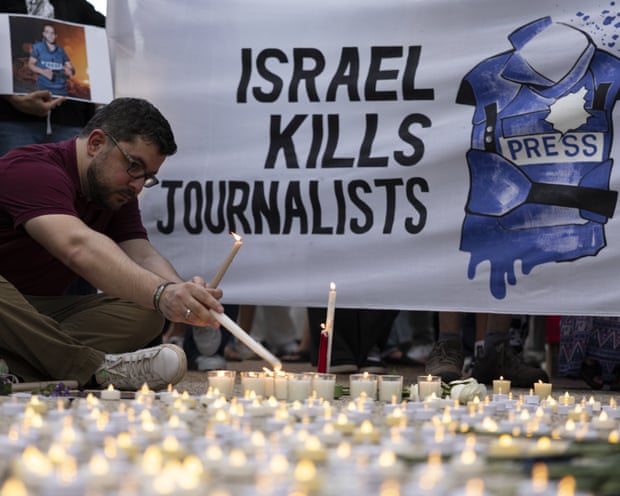
Candles being lit at a vigil on Monday outside the Fox News and NBC News headquarters in Washington DC for journalists killed in Gaza. Photograph: Mehmet Eser/Zuma Press Wire/Shutterstock
Israeli-Palestinian magazine says IDF ‘legitimisation cell’ set up to blunt global outrage over killing of media staff
A special unit in Israel’s military was tasked with identifying reporters it could smear as undercover Hamas fighters, to target them and to blunt international outrage over the killing of media workers, the Israeli-Palestinian outlet +972 Magazine reports.
The “legitimisation cell” was set up after the 7 October 2023 Hamas attack to gather information that could bolster Israel’s image and shore up diplomatic and military support from key allies, the report said, citing three intelligence sources.
According to the report, in at least one case the unit misrepresented information in order to falsely describe a journalist as a militant, a designation that in Gaza is in effect a death sentence. The label was reversed before the man was attacked, one of the sources said.
Earlier this week, Israel killed the Al Jazeera journalist Anas al-Sharif and three colleagues in their makeshift newsroom, after claiming Sharif was a Hamas commander. The killings focused global attention on the extreme dangers faced by Palestinian journalists in Gaza and Israel’s efforts to manipulate media coverage of the war.
Genocide denier and Current UK Prime Minister Keir Starmer is quoted that he supports Zionism without qualification. He also confirms that UK air force support has been essential in Israel’s mass-murdering genocide. Includes URLs https://www.declassifieduk.org/keir-starmers-100-spy-flights-over-gaza-in-support-of-israel/ and https://youtu.be/O74hZCKKdpAKeir Starmer objects to criticism of the IDF. He asks how could anyone object to them starving people to death, forced marches like the Nazis did, bombing Gaza’s hospitals and universities,mass-murdering journalists, healthworkers and starving people queuing for food, killing and raping prisoners and murdering children. He calls for people to stop obstructing his genocide for Israel.UK Labour Party government ministers Keir Starmer, Angela Rayner and Rachel Reeves explain that they are partners complicit in Israel’s Gaza genocide. The UK has provided Israel with arms, military and air force support. They explain that they don’t do gas chambers but do do forced marches, starvation, destroy hospitals, mass-murders of journalists and healthcare workers.
Original article by Alan Macleod republished from MPN under a Creative Commons Attribution-NonCommercial-ShareAlike 3.0 International License.
Amid an ongoing assault on its neighbors, the Israeli Defense Forces (IDF) is attempting to improve its image by posting highly sexually suggestive content featuring its soldiers, changing the prevailing emotion of onlookers from outrage to lust.
A wide range of IDF thirst trap accounts—many with hundreds of thousands, if not millions, of followers—proliferate on social media. These accounts are quietly sanctioned by the Israeli government, in an attempt, in its own words, to “appeal” to a young male demographic.
MintPress News explores the phenomenon of Israel using sex to whitewash its actions.
Babes Carrying Out Massacres
Since the October 7, 2023, attacks, virtually every user on social media has been exposed to images of Israeli attacks on civilian infrastructure. But a large subsection of the internet—particularly young males—also see another side of the Israeli military. A myriad of IDF thirst trap accounts also pepper the internet. Pages like “IDF Babes,” “Hot IDF Girls,” and “Girls Defense,”—each with hundreds of thousands of followers across different platforms—post content sexualizing and lionizing female Israeli soldiers in equal measures.
The images and videos often come with explicit political messages. This weekend, for example, IDF babes posted a picture of an IDF soldier in nothing but a bikini, with the caption, “Corporal Dina stumbled across a Syrian T-34/85 tank in our Golan Heights,” thereby explicitly claiming the Golan Heights—Syrian territory illegally occupied since 1968—as Israeli.
Another common template for posting is the “on/off” format, featuring two pictures of the same woman, side by side: one in a combat uniform and another wearing little or nothing.
Some Israeli soldiers have their own thirst trap accounts. The best-known of these is Natalia Fadeev, a military police reservist also known as Gun Waifu. Posting highly sexually suggestive content alongside passionate defenses of Israel, Fadeev is the undisputed queen of Israeli military social media, racking up millions of followers across social media. (This included 2.7 million on TikTok alone, before her account was suspended).
Her content mixes open hostility for Muslims with not-so-subtle denial of Israeli atrocities. “Get in loser, we’re going to capture some Mohammads!” reads one caption. Another asks her young male audience, “Look me in the eyes, do you really think I could commit war crimes?”
Horny For The Dead
The practice of publishing images of scantily clad female Israeli soldiers is not limited to thirst trap accounts. Established media regularly do the same, even when announcing the deaths of said women. In July, pro-Israel journalist Mazelit Airaksinen wrote a memorial for an Israeli woman killed on October 7. “Karin Vernikov had just finished her time in the IDF and had just got home from a horse riding trip to South Africa, when Hamas attacked on October 7. She was only 22,” she wrote, adding words from her mother: “My little girl won’t come back, I can’t hug you. How can I go on, how can I breathe without you?”
The image Airaksinen used to illustrate the deceased Vernikov, however, was so inappropriately suggestive that it caused the note to go viral. In the photo, Vernikov is wearing extremely tight-fitting orange yoga pants and looking over her back, down at the photographer, exposing her rear to the camera. “Using her ass cheeks to get sympathy is a new low,” replied one user. “What is with this soft core porn obituary like what even is this?” read another top-rated reply.
Airaksinen is far from the only journalistic source to use images more appropriate for an OnlyFans account in their obituaries, however. The Times of Israel illustrated their article on the killing of Romi Eliyahu Bernat with a highly suggestive back shot. And for the obituary of Liraz Nisan, who died while fleeing the Supernova Music Festival, they chose a picture of the 20-year-old wearing only a bra.
This sort of posting is evidently state-endorsed, as the government of Israel regularly partakes in it itself. A prominent case in point is that of Shani Louk, another young Israeli woman killed on October 7, 2023. Israel has posted multiplesuggestiveimages of Louk on its official Instagram page, even as it announced her death. It has also commented on the looks of other Israeli women killed in the violence.
Moreover, the idea to post thirst traps and to explicitly present IDF women as a sexualized force was a creation of the Israeli government itself. In 2017, it initiated a public relations campaign to enhance the country’s image within the United States. It began looking for U.S. partners to distribute semi-pornographic photos of its soldiers. The result was a series of collaborations with men’s magazineMaxim, with the headlines: “Meet the Sexy Israeli Army Soldier Who’s Got the Internet All Fired Up,” “Check Out the Smoking Hot Instagram of This Israeli Army Girl Turned Swimsuit Model,” “Behold, 12 More Smoldering Soldiers From the ‘Hot Israeli Army Girls’ Instagram Account,” and, “Gal Gadot, Bar Refaeli and 14 More Smoldering-Hot Israeli Women.”
Explaining the rationale behind the campaign, David Dorfman, a media adviser with the Israeli Consulate of the United States, told the BBC: “Males that age have no feeling toward Israel one way or another, and we view that as a problem, so we came up with an idea that would be appealing to them.”
Other attempts to improve the IDF’s image have included inviting American celebrities to spend time with all-female units. In 2017, comedian Conan O’Brien traveled to Israel and filmed a segment where he trained with female IDF soldiers. Two years later, actress and singer Hailee Steinfeld also went there on a state-funded PR trip.
Birthright as Sex Tourism
Under Israeli law, all Jews have the right to an Israeli passport and to move to Israel. To encourage this process, the government provides free trips to Israel costing thousands of dollars each to all diaspora Jews (once they have been screened for pro-Palestine views). Nearly one million young people have gone on these Birthright trips.
On these trips, sex between local (Jews) and visitors is, according to staffers, actively “encouraged.” Birthright organizers facilitate what they call “hormonal encounters” by employing good-looking IDF soldiers to accompany the groups wherever they go. These soldiers understand their role very well. Many groups do not stay in hotels, but together in Bedouin-style tents, “a setup conducive to first kisses,” one report notes. Many visitorsreport feeling pressured into fornication on what is commonly described as a free, ten-day “sex vacation.”
For the government, the utility of all this is clear. It has calculated that impressionable teens who lose their virginity in Israel are much more likely to develop a deeper, emotional connection to the State of Israel. Birthright alumni move to Israel in greater numbers than those who did not receive a free trip, and are 160% more likely to marry a Jewish spouse. This helps alleviate the country’s demographic problem, i.e., building a Jewish supremacist state in a region where they are still a minority. To that end, then, Birthright employs open-minded individuals whose services allow the job to be done.
Between these hormonal encounters, visitors are shown a sanitized history of the country, brought to key buildings and monuments, and often have the chance to meet Prime Minister Netanyahu, who has pledged over $100 million in government funding to support the project.
War Crimes as Dating App Profile Pics
Another way in which Israeli soldiers have associated military life with sex is in their dating profiles. Images of soldiers serving in Gaza proliferate on Israeli dating apps. One estimate suggests that over one-third of all profiles feature men and women in IDF uniforms.
The pictures on these profiles range from smiling faces in uniforms, brandishing weapons, to soldiers displaying stolen Palestinian property, posing in bombed-out buildings, reveling in the destruction of Gaza, and even some in which individuals openly desecrate mosques.
While this phenomenon has shocked many international onlookers, in the Israeli dating market, soldiers are hot commodities. “I feel that girls are throwing themselves at me since I started my reserve duty,” one reservist told Israeli newspaper, Haaretz. “After I uploaded photos of myself in uniform, girls seemed more attracted and interested in me… I feel that a photo in my uniform is like standing next to a Ferrari. It’s a status symbol,” he added.
Israel is not the only country attempting to shore up support for its military by sanctioning the posting of thirst traps; the United States does it, too. Yet it has strongly and very publicly leaned into this portrayal of itself, in a way that the U.S. Army has not.
Realizing that Western support is crucial for its project of colonization, the Israeli government oversees an enormous public relations operation. The Ministry of Foreign Affairs’ PR budget has increased by over 2,000%, now standing at $150 million. Part of this goes towards targeting young people, with campaigns to sexualize its soldiers.
It is far from clear, however, how effective this campaign is. Only nine percent of Americans aged under 35 years old approve of Israel’s actions in Gaza, compared to 49% of those 55 and older. This aversion to Israel extends to young American Jews, a plurality of whom believed that, even before October 7, 2023, it was an Apartheid state. This massive disparity in opinion can be partially explained by the different media the generations consume. Older Americans, still reliant on newspapers and cable news, continue to support Israel. Younger generations, exposed to a wider variety of viewpoints on social media, however, have abandoned Israel. As Jonathan Greenblatt, CEO of the pro-Israel group, the Anti-Defamation League, explained, “we have a major TikTok problem.” It was this perceived anti-Israel bias that, in March, led American lawmakers to ban the platform.
Israel and its supporters have been forced into creative methods to defend their actions and change the subject. One method has been to push highly sexualized images of its military into the social media feeds of young men worldwide. Yet these thirst traps have not managed to stem the tide of negative sentiment towards Israel and its policies in Palestine, Syria, Lebanon, and beyond. Despite Israel’s best efforts to do so, it turns out that you can’t whitewash a genocide with cum.
Genocide denier and Current UK Prime Minister Keir Starmer is quoted that he supports Zionism without qualification. He also confirms that UK air force support has been essential in Israel’s mass-murdering genocide. Includes URLs https://www.declassifieduk.org/keir-starmers-100-spy-flights-over-gaza-in-support-of-israel/ and https://youtu.be/O74hZCKKdpAKeir Starmer objects to criticism of the IDF. He asks how could anyone object to them starving people to death, forced marches like the Nazis did, bombing Gaza’s hospitals and universities,mass-murdering journalists, healthworkers and starving people queuing for food, killing and raping prisoners and murdering children. He calls for people to stop obstructing his genocide for Israel.Vote Labour for Genocide.UK Labour Party government ministers Keir Starmer, Angela Rayner and Rachel Reeves explain that they are partners complicit in Israel’s Gaza genocide. The UK has provided Israel with arms, military and air force support. They explain that they don’t do gas chambers but do do forced marches, starvation, destroy hospitals, mass-murders of journalists and healthcare workers.
Parachutes drop supplies into the Gaza Strip as seen from southern Israel, August 12, 2025
Gaza’s collective sumud has proven more powerful than one of the world’s best-equipped militaries, but the change in international attitudes isn’t happening fast enough to save a starving population from Western-backed genocide, argues RAMZY BAROUD
THE consequences of the Israeli genocide in Gaza will be dire. An event of this degree of barbarity, sustained by an international conspiracy of moral inertia and silence, will not be relegated to history as just another “conflict” or a mere tragedy.
The Gaza genocide is a catalyst for major events to come. Israel and its benefactors are acutely aware of this historical reality. This is precisely why Israeli Prime Minister Benjamin Netanyahu is in a race against time, desperately trying to ensure his country remains relevant, if not standing, in the coming era. He pursues this through territorial expansion in Syria, relentless aggression against Lebanon and, of course, the desire to annex all occupied Palestinian territories.
But history cannot be controlled with such precision. However clever he may think he is, Netanyahu has already lost the ability to influence the outcome. He has been unable to set a clear agenda in Gaza, let alone achieve any strategic goals in a 365-square-kilometre expanse of destroyed concrete and ashes. Gazans have proven that collective sumud can defeat one of the most well-equipped modern armies.
Indeed, history itself has taught us that changes of great magnitude are inevitable. The true heartbreak is that this change is not happening fast enough to save a starving population, and the growing pro-Palestinian sentiment is not expanding at the rate needed to achieve a decisive political outcome.
…
History does not take its cues from Israel or Western powers. Gaza will indeed result in the kind of global shifts that will affect us all, far beyond the Middle East. For now, however, it is most urgent that we use our collective will and action to influence one single historical event: ending the genocide and the famine in Gaza.
The rest will be left to history, and to those who wish to be relevant when the world changes again.
Ramzy Baroud is a journalist, author and the editor of the Palestine Chronicle (www.palestinechronicle.com).
Genocide denier and Current UK Prime Minister Keir Starmer is quoted that he supports Zionism without qualification. He also confirms that UK air force support has been essential in Israel’s mass-murdering genocide. Includes URLs https://www.declassifieduk.org/keir-starmers-100-spy-flights-over-gaza-in-support-of-israel/ and https://youtu.be/O74hZCKKdpAKeir Starmer objects to criticism of the IDF. He asks how could anyone object to them starving people to death, forced marches like the Nazis did, bombing Gaza’s hospitals and universities,mass-murdering journalists, healthworkers and starving people queuing for food, killing and raping prisoners and murdering children. He calls for people to stop obstructing his genocide for Israel.






 Parachutes drop supplies into the Gaza Strip as seen from southern Israel, August 12, 2025