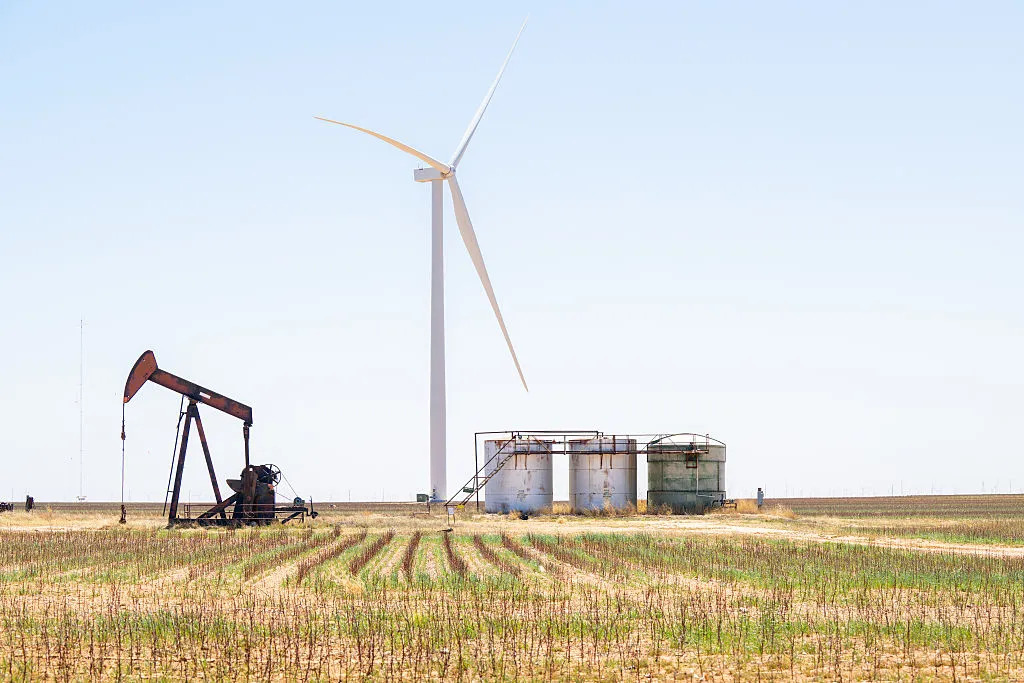
The price of eggs has more than doubled in the past eight years, which isn’t great, but at least you can eat eggs. The price of US government subsidies for the fossil-fuel industry has also more than doubled in that time, which is far, far less great. Welfare for an industry that makes billions of dollars in profits and pollutes the climate is worse than useless. It’s self-destructive.
The federal government gives oil, gas and coal producers at least $34.8 billion in subsidies each year, according to a new study by the research and advocacy nonprofit Oil Change International. In 2017, OCI estimated these gifts at $14.7 billion annually. This doubling in federal largesse has taken place under both Democratic and Republican political administrations, highlighting the difficulty of stopping its growth, much less reversing it.
In fact, some of the most recent extensions of federal aid have made it possible for these subsidies to explode in the future, threatening to reach trillions of dollars. When the world needs exponential growth in clean-energy investments to avoid the most catastrophic effects of global heating, the US government will be bankrolling fossil-fuel expansion and stoking the emergency.
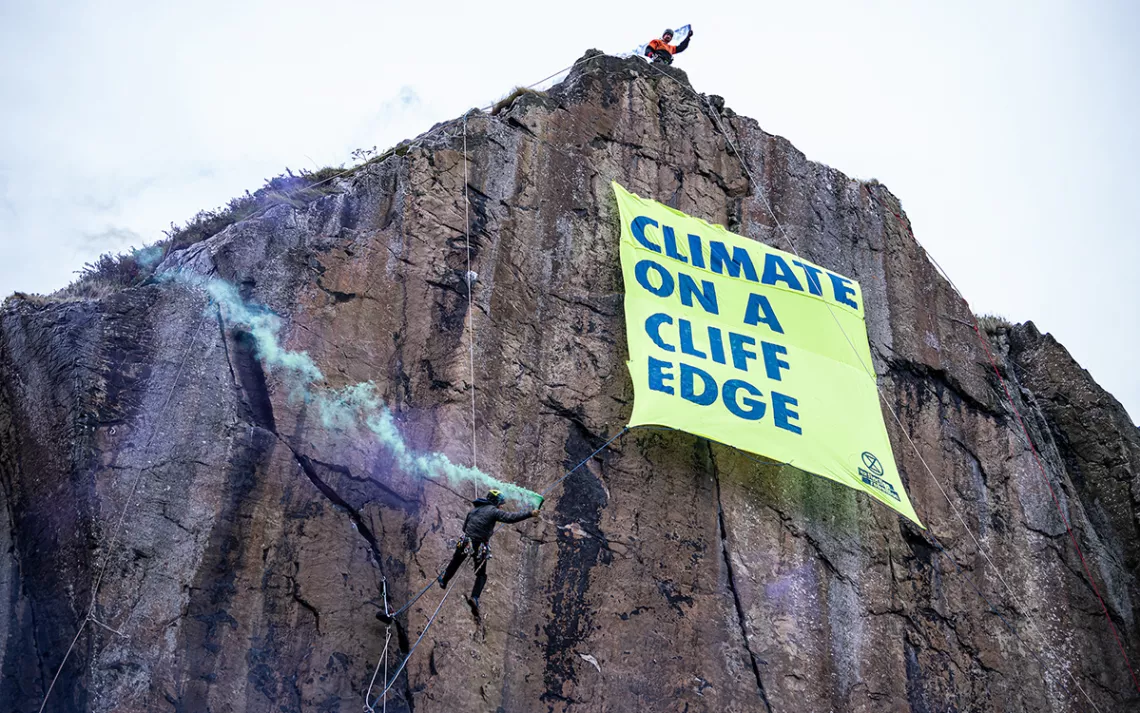
Donald Trump urges you to be a Climate Science denier like him. He says that he makes millions and millions for destroying the planet, Burn, Baby, Burn and Flood, Baby, Flood.Greenpeace activists display a billboard during a protest outside Shell headquarters on July 27, 2023 in London. (Photo: Handout/Chris J. Ratcliffe for Greenpeace via Getty Images)Experienced climbers scale a rock face near the historic Dumbarton castle in Glasgow, releasing a banner that reads “Climate on a Cliff Edge.” One activist, dressed as a globe, symbolically looms near the edge, while another plays the bagpipes on the shores below. | Photo courtesy of Extinction Rebellion and Mark Richards
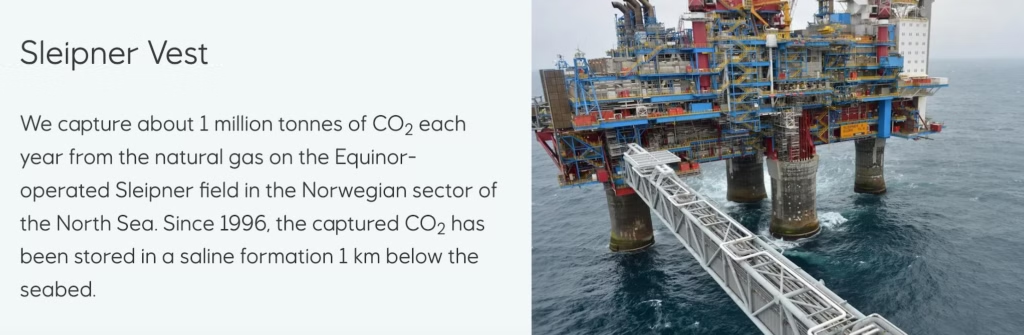
Equinor has retracted a claim that it stores about a million tonnes of carbon dioxide annually at its flagship carbon capture project after DeSmog obtained data showing the real figure was as little as a tenth of that amount.
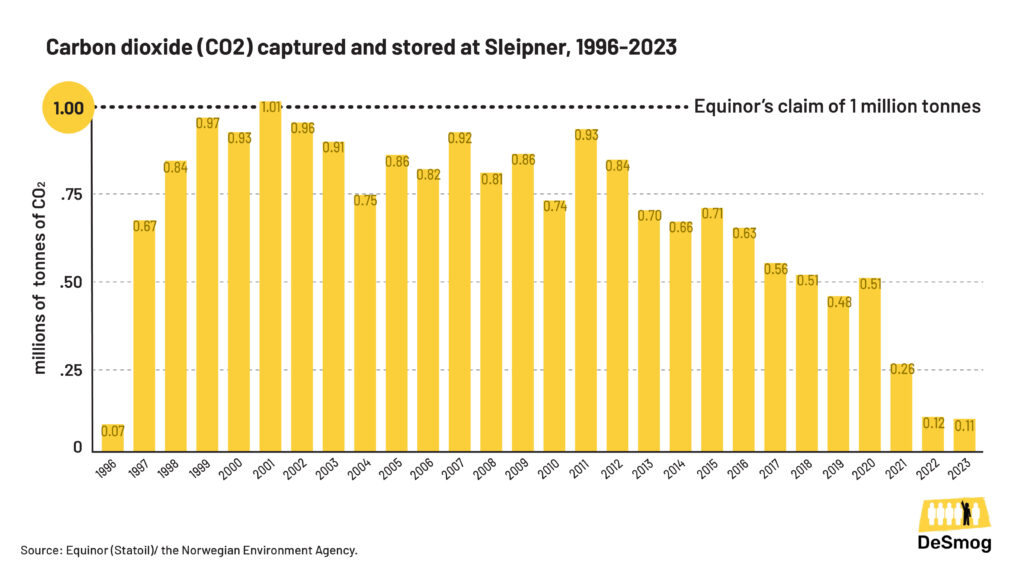
The Norwegian oil company scrubbed the estimate from its website in November, when presented with official figures showing that it captured 106,000 tonnes of carbon dioxide (CO2) at its Sleipner carbon capture and storage (CCS) facility in 2023.
Equinor has not captured 1 million tonnes of CO2 per year at the site since 2001, according to the data, provided by the Norwegian Environment Agency.
The company put the reason for the discrepancy between the official figures and its public-facing claim to be capturing “about 1 million” tonnes of CO2 a year down to a failure to update a “static” webpage.
“We have now removed this error from our website and updated this section with the correct information,” Equinor spokesman Gisle Ledel Johannessen said via email.
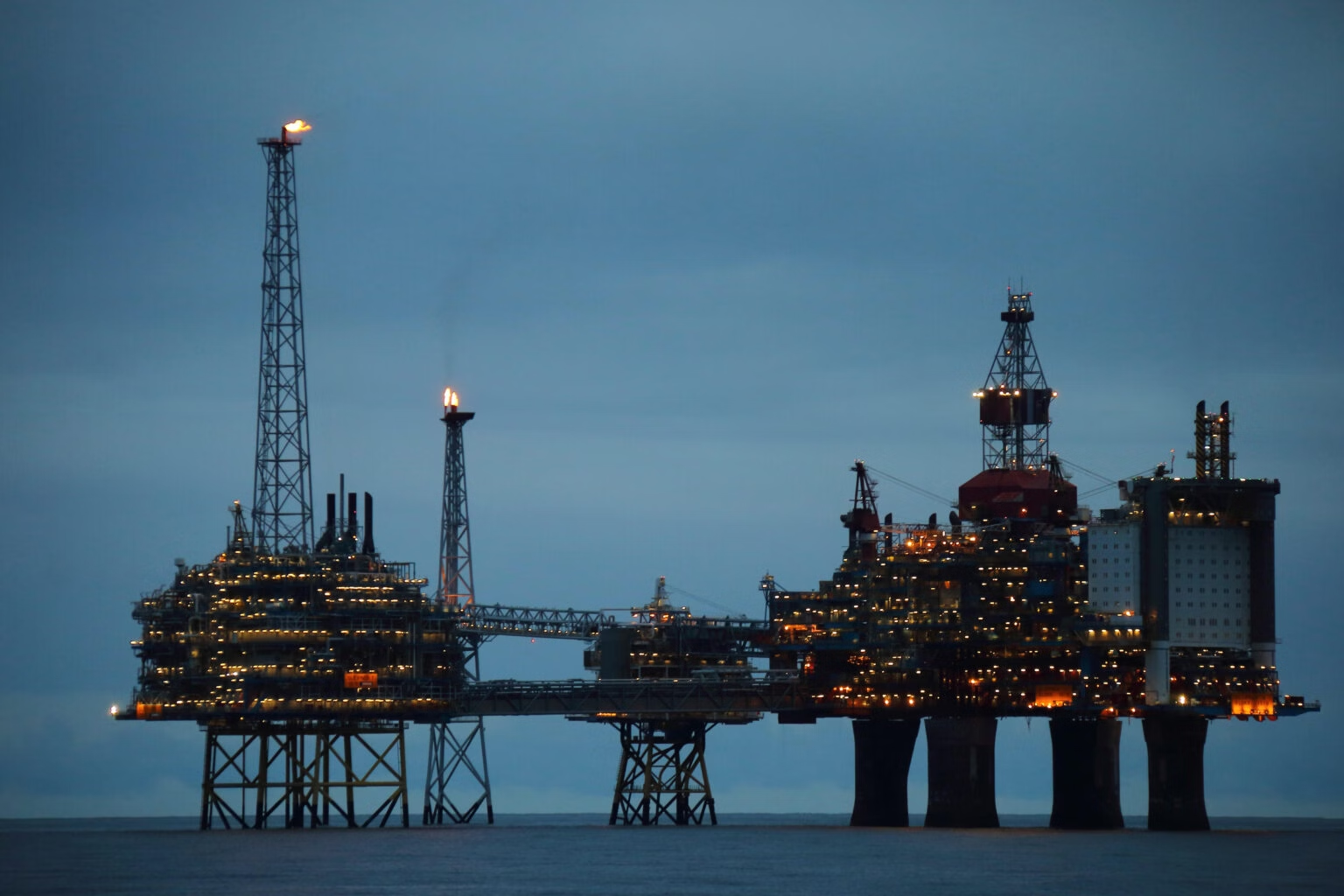
Equinor has been capturing CO2 from a gas processing plant at the Sleipner gas field in the North Sea since 1996. The field has particularly high concentrations of CO2, which Equinor filters out during the gas purification process and then injects below the seabed.
The project has been cited by carbon capture advocates, and Equinor itself, as evidence that the technology is reliable enough to help meet global climate goals, despite its long history of cost-overruns and failed targets.
A screenshot of Equinor’s website, taken on 13 October, 2024 Credit: Edward Donnelly. The claim has since been removed.
Expansion Plans
Equinor is positioning itself to play a key role in the European Union’s plans to massively increase carbon capture. The bloc has adopted an official target to deploy an annual 50 million tonnes of CO2 storage capacity by 2030 from roughly three million tonnes available across the continent today, though the pace of the existing roll-out is nowhere near on track to achieve that goal.
Norway, not an EU member, is home to almost all of Europe’s operational carbon capture capacity, which is comprised of Sleipner and a similar project also operated by Equinor at its Snøhvit gas field in the Barents Sea. The two sites stored a total of 763,000 tonnes of CO2 in 2023, according to the Norwegian Environment Agency figures, less than half of their combined capacity of 1.7 million tonnes of CO2.
Equinor’s statement that it was capturing “about 1 million tonnes of CO2 each year” at Sleipner alone appears to have first been published on the company’s “carbon capture and storage (CCS)” webpage in 2022, according to archived internet data. That year, the Sleipner field captured 260,000 tonnes of CO2, according to the Norwegian Environment Agency, which regulates the oil and gas industry.
DeSmog asked Equinor for its data on carbon capture at Sleipner in October. When the company declined to provide it, DeSmog obtained the figures from the Norwegian Environment Agency, which collates companies’ self-reported data.
Equinor spokesman Johannessen said that Sleipner had been capturing less CO2 in recent years because of declining gas production at the site.
Credit: Sabrina Bedford.
Broken Equipment
Equinor had previously acknowledged that faulty monitoring equipment at Sleipner caused it to over-estimate the amount of CO2 it was capturing at the field for several years, as DeSmog reported in October. During a more than four-year period from January 2017 through March 2021, the company said that it had captured a cumulative total of about 2.7 million tonnes of CO2 at the site. Equinor later amended the figure to 2.1 million tonnes, about a 28-percent decrease.
The gulf between Equinor’s public claims and Sleipner’s actual performance underscores concerns among climate advocates that the oil industry is hyping the potential of carbon capture as a climate solution to deflect pressure to cut production of fossil fuels.
At least 480 carbon capture lobbyists attended the latest annual UN climate conference in Azerbaijan in November, according to the nonprofit Center for International Environmental Law. In October, DeSmog revealed that Equinor had been holding more meetings with ministers to lobby the UK government over CCS than any other company, part of its plans to play a leading role in the country’s carbon capture plans.
Equinor suggested that carbon capture could be the “best-kept secret” for climate action in a 2019 video, concluding that renewable energy sources such as wind and solar were “not enough.” In sponsored content currently viewable on the Financial Times website, Equinor says that CCS “has emerged as one of the key technologies in mitigating global warming” and addresses “misconceptions,” such as concerns over high costs and links to continued oil and gas production.
Ketan Joshi, an Oslo-based climate consultant, said that the way Equinor presents its CCS operations as a climate solution is “misleading” because its existing projects only capture a small proportion of emissions, while total fossil fuel emissions in Norway remain high.
“Equinor uses ‘ambitious’ CCS targets as a way of simulating action without actually performing it,” Joshi said. “They report the amount of CO2 they capture each year and it does not increase.”
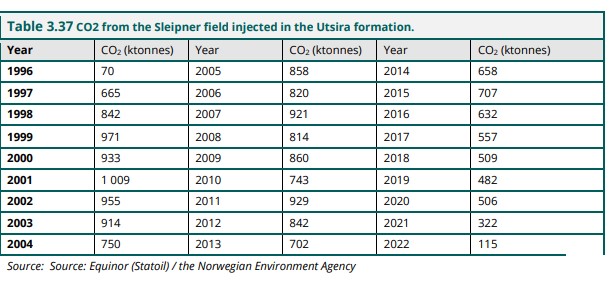
*A screenshot of a table showing the amount of CO2 captured at Sleipner provided to DeSmog by the Norwegian Environment Agency. The agency noted in an email that the 2021 volume should be 260 kilotonnes and not 322 kilotonnes, and that it will correct the figure in the next edition. The 106 kilotonne figure (106,000 tonnes) for 2023 was provided separately by email.
CO2 Tax
The Sleipner CCS project was devised by Equinor (then Statoil) in the mid-1990s as a way to reduce its exposure to Norway’s newly implemented CO2 emissions tax. The company established its CCS project at Snøhvit in 2008 also to reduce its tax burden from CO2 released during gas processing.
“Sleipner and Snøhvit are CCS projects with high quality that rightly enjoy worldwide recognition from academia, industry, governmental bodies and science institutions as proven and safe CO2 storages over decades where Equinor and our partners so far have stored over 25 million tonnes of CO2 since 1996,” said Equinor spokesman Johannessen.
He added that over the past five years, the company has “injected 99.7 percent of the CO2 that has been captured on Sleipner into the ground.”
The amount of CO2 captured by Equinor’s two CCS projects is dwarfed by the emissions released by burning the oil and gas sold by the company. In 2023, Equinor recorded a total of 262 million tonnes of CO2 emissions — including the emissions produced by its operations, and the emissions from burning the oil and gas those operations extracted, according to company sustainability data.
In contrast, the company captured and stored a total of about 0.8 million tonnes of CO2 at Sleipner and Snøhvit, more than 300 times less than the amount emitted into the atmosphere by burning its products.
And even with a functioning carbon capture facility onsite, net CO2 emissions at Sleipner far exceeded the amount of the gas that was stored.
The Sleipner offshore platform provides power to several nearby gas fields by burning gas in turbines — a process that released 658,000 tonnes of CO2 into the atmosphere in 2023, according to the company’s sustainability reporting. That’s more than six times the 106,000 tonnes of CO2 that Equinor captured and stored from gas processing at Sleipner that year.
To reduce the offshore platform’s CO2 footprint, Equinor announced last April that it would introduce an electrification plan for Sleipner, rather than opting to expand CCS operations at the field. The company is also planning an electrification project to reduce emissions from the gas export facility at Snøhvit.
Government Subsidies
In September, Equinor and partners Shell and TotalEnergies inaugurated the Northern Lights CO2 transport and storage facility near the Norwegian port of Bergen, which the companies say will store 1.5 million tonnes of CO2 a year from industrial sources on the Norwegian mainland at full capacity when it starts operations.
The project is mostly financed by $1.2 billion in Norwegian government subsidies, with an additional $141 million pledged by the European Union.
By 2035, Equinor says it aims to store 30 to 50 million tonnes of CO2 a year from new projects announced in Norway, Denmark, the UK, and the United States — an exponential increase from its current capacity.
While Equinor has signalled that it will need substantial subsidies to go forward with its CCS plans, the company continues to direct most of its investments into extracting more fossil fuels. In August, chief executive Anders Opedal announced up to $6.7 billion a year to fund new Norwegian oil and gas drilling until 2035.
In contrast, Equinor said in November that it will cut its renewable energy division’s workforce by 20 percent — about 250 jobs — citing economic headwinds in the sector.
“At the most basic level, Equinor presents CCS in a similar way to many other major oil and gas companies: a ‘necessary’ part of the climate solutions mix,” said Joshi, the climate consultant. “This is presented alongside the company’s aggressive expansionist agenda: opening many new oil and gas fields.”
Exclusive: Energy firm making ‘misleading’ claims about ‘neutralising’ gas with carbon credits
The Labour Party’s biggest corporate donor has been accused of “greenwashing” after an investigation by openDemocracy.
Ecotricity Ltd, which has given almost £3.4m to Labour since Keir Starmer became leader in 2020, claims to be “Britain’s greenest energy supplier”.
Yet 99% of the gas it supplies comes from fossil fuels. The company claims this gas is “carbon-neutralised” because it invests in “carbon reduction programmes to cancel out the carbon burned”.
But openDemocracy has learned that Ecotricity has no active carbon credits – despite listing four environmental projects on its website that it says it supports.
When questioned about the company’s claims that “carbon emissions from our fossil fuel gas are offset by investing in carbon reduction schemes”, a spokesperson admitted that some of the schemes it previously supported had not done “as promised” – and said that information on its website would be “refreshed”.
But experts warned that even if the company held active carbon credits, its claims that these “neutralise” its fossil fuel gas would still be misleading.
“It is highly misleading for a company to claim that its product – or itself – is carbon- or climate-neutral,” said Lindsay Otis Nilles from Carbon Market Watch. “These false claims are based on heavily flawed scientific principles and lead to consumer confusion.”
The company has not broken any laws, but it will be illegal to claim that carbon offsets can “neutralise” fossil fuel products in the EU from 2026, as the bloc looks to crack down on greenwashing. An EU directive says these claims create a “false impression to consumers that the consumption of that product does not have an environmental impact”.
Analysis by openDemocracy shows that some of the carbon offset projects that Ecotricity previously pumped money into have been linked to environmental concerns and human rights abuses.
In some cases, records cast doubt on whether the company’s offsetting credits actually helped to reduce emissions at all – since the projects it invested in were already fully funded.
For example, two years ago, Ecotricity purchased credits in the Soubré hydropower plant, the largest hydroelectric dam in Ivory Coast, which was completed in 2017.
The project cost around £452m, 85% of which had already been secured by January 2017, with a loan from EXIM Bank of China. The remaining 15% was covered by the Ivory Coast government.
The Soubré powerplant previously came under fire in a 2019 report that accused it of having an “irresponsible” approach to monitoring its potential environmental impact.
The report, which was published by American environment and human rights organisation International Rivers, also included complaints by workers at the dam of instances of “discrimination and physical abuse” and “threats from the government” when they spoke out.
Meanwhile, the project’s main contractor, Chinese firm Sinohydro – which is responsible for its engineering, procurement and construction – has faced allegations of fraud elsewhere.
The company is currently excluded from projects financed by the European Investment Bank, following an investigation into “misconduct”. And in 2018, another investigation by the African Development Bank found that Sinohydro had “engaged in a fraudulent practice”.
Ecotricity has also held carbon credits in another hydroelectric power plant in Indonesia, called Asahan 1. Reports from as far back as 2012 say the company behind it, PT Bajradaya Sentranusa, had already secured funding from a bank “to take over the entire existing project loans for the construction” when Ecotricity bought the credits.
A spokesperson for Ecotricity said: “The information on the website about carbon reduction projects is being refreshed.”
They added: “We used carbon credits to entirely offset our gas supply for the financial year 2024 which is now closed and our offsetting programme for the financial year 2025 is currently under review which is why we do not currently hold any credits. Any suggestion that we do not or will not offset our gas in the future is false and misleading.”
“Offsetting is an annual accounting period practice and can take place at any point in that [financial year] – that is standard practice. Our offsetting programme for the financial year 2025 is currently under review. Any suggestion that we do not or will not offset our gas is wrong.”
The spokesperson added that Ecotricity is looking at “more direct carbon capture methods”, adding: “Carbon offsetting has been a bridge. We have always been clear about that.”
‘Greenwashing’
Ecotricity not only boasts about its own climate credentials, it also actively warns customers about “greenwashing” by rival energy suppliers.
“A number of energy companies claim green credentials for themselves or for some of their tariffs,” it says, “but are their claims genuine?”
But Ecotricity has itself now been accused of greenwashing. Responding to the company’s claims about carbon offsets, Nilles of Carbon Market Watch told openDemocracy: “It is a fallacy to think that purchasing carbon credits on the voluntary carbon market can magically ‘cancel out’ or ‘offset’ climate harm. Greenwashing practices like this must stop once and for all.”
Ecotricity’s founder, Dale Vince, recently joined Labour’s campaign in Bristol. His involvement in the constituency is controversial because it is seen as one of the few seats the Green Party has a genuine chance of winning in this week’s general election. But Vince tweeted: “Labour has a green manifesto and can make it happen.”
The self-styled “green industrialist” is the outright owner of Ecotricity’s parent company, Green Britain Group Limited. According to the latest accounts filed with Companies House, this firm made £38m profit in the year ending 30 April last year, after bringing in more than £550m turnover.
Responding to openDemocracy, Vince repeated the claim that carbon credits were used to achieve “net neutrality”.
He said: “Ecotricity bought carbon credits from the Asahan and Soubre schemes two years ago – we no longer do so. We’ve been reducing our carbon footprint annually for decades and only recently used carbon credits to achieve net neutrality, for our green gas while we built new gasmills.
“It’s important to reduce as far as possible before using credits, but that world is full of uncertainty, risk and projects that don’t do as promised, which these two schemes appear to be an example of. We welcome the EU move to clamp down on all forms of greenwashing.”
Vince accused openDemocracy of a “smear attack” with a “rather distorted presentation of facts”.
Prior to this response, openDemocracy had repeatedly asked Ecotricity to provide a complete and up-to-date list of its carbon credit portfolio, but it failed to do so.
Last week, Vince told the Financial Times that he was not seeking support for his own energy projects from Labour. “I don’t want support for my projects,” he said, “I’m not interested, life’s too short to be chasing money.”
The latest accounts filed by Green Britain Group Limited show it received £123m in “government grants” in the year ending April 2023. The financial support was designed to pay energy firms to cap prices for consumers.
The previous year, the company received a £9.4m Covid “business interruption” loan to support large companies in the pandemic.
However, Vince told openDemocracy: “Ecotricity hasn’t had any government subsidies.”