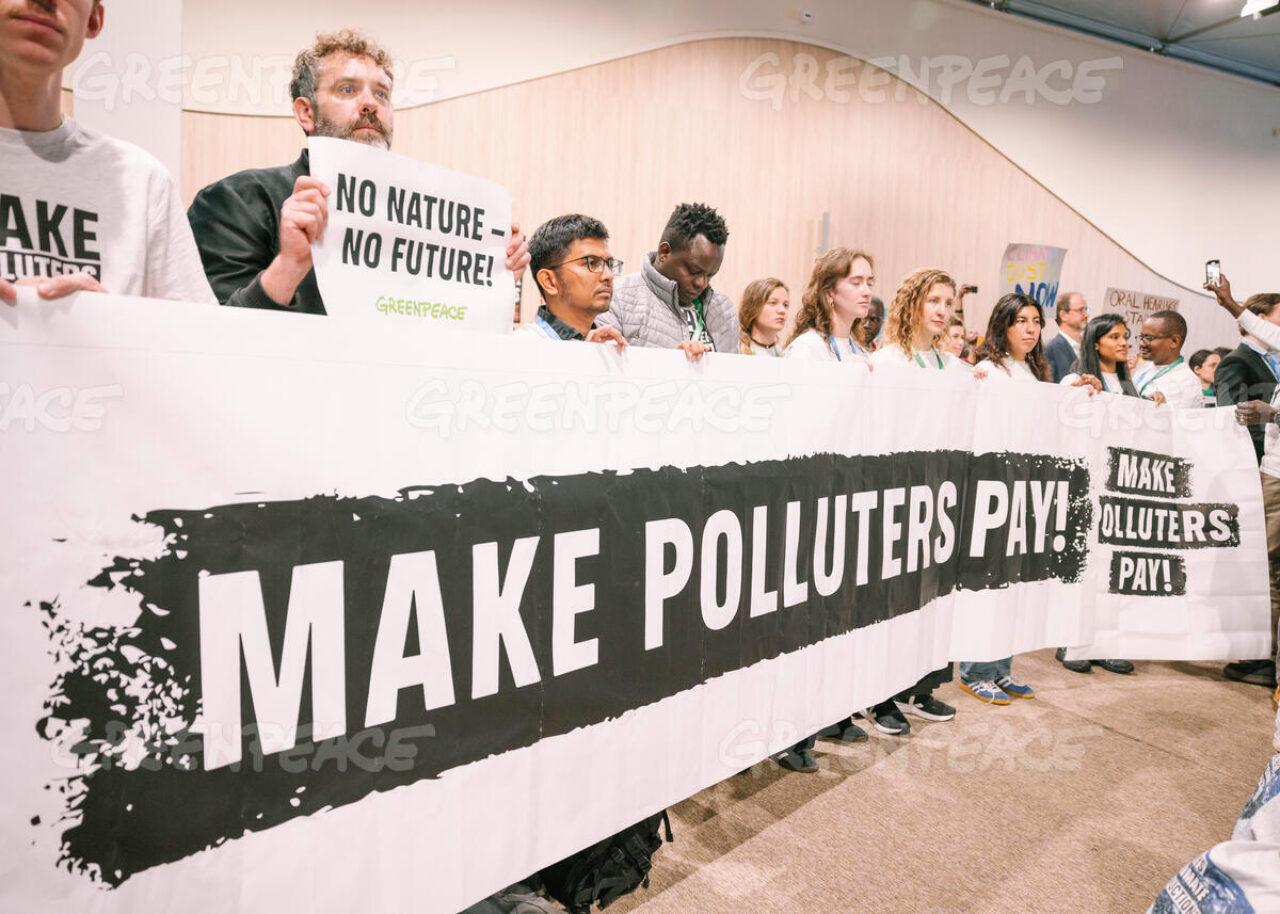
Greenpeace responds to UNEP warning that 1.5°C will be passed

Spread the love
Neo-Fascist Climate Science Denier Donald Trump says Burn, Baby, Burn.

Amsterdam, Netherlands – Greenpeace demands world leaders agree on a global response plan at COP30 as a new major UN report warned the global temperature is projected to rise to 2.3-2.5°C above pre-industrial era global temperatures, putting the Paris Agreement limit of 1.5°C at risk in the short-term.

The UNEP Emissions Gap Report 2025 warned the world is heading towards “a serious escalation of climate risks and damages” due to a lack of ambition and action, and reports the multi-decadal average of global temperature rise will exceed 1.5°C, at least temporarily, requiring faster and bigger cuts in emissions to minimise the overshoot.

Jasper Inventor, Deputy Programme Director, Greenpeace International said: “How many warnings do we need? The time is now, but our leaders are asleep at the wheel, on a collision course to more devastating storms like Hurricane Melissa, human suffering, economic damages and climate injustice.”

“Warnings of a 1.5°C overshoot must be a rallying call for action and yet 2035 climate action plans have failed to bridge the ambition gap. We’re still only inching forward on cutting our emissions despite the demands of people and communities around the world.” 

“We have the renewable energy solutions and we are making progress, but emissions are still rising, the transition away from fossil fuels is too slow, and national climate action plans are barely moving the needle. It’s time for G20 countries, above all developed countries, to grab the wheel and really lead the transition, starting at COP30, where a global response plan to accelerate action must be agreed.”

The Emissions Gap Report 2025 predicted global temperatures to reach 2.3-2.5°C by the end of the century, down from 2.6-2.8°C last year. Since the adoption of the Paris Agreement 10 years ago, temperature predictions have fallen from 3-3.5°C, but faster action is required.

Similar to the UNFCCC’s NDC synthesis report, the UNEP also warned new 2035 climate action plans will have insufficient impact in reducing emissions, especially due to the intended US withdrawal from the Paris Agreement, and called on G20 nations to display climate leadership.

Elon Musk urges you to be a Fascist like him, says that you can ignore facts and reality then.
Donald Trump urges you to be a Climate Science denier like him. He says that he makes millions and millions for destroying the planet, Burn, Baby, Burn and Flood, Baby, Flood.
Nigel Farage urges you to ignore facts and reality and be a climate science denier like him and his Deputy Richard Tice. He says that Reform UK has received £Millions and £Millions from the fossil fuel industry to promote climate denial and destroy the planet.
Continue ReadingGreenpeace responds to UNEP warning that 1.5°C will be passed

Taxing Big Oil would grow UN climate loss & damage fund twentyfold, analysis finds

Spread the love

A small tax on just seven of the world’s biggest oil and gas companies could grow the UN Fund for Responding to Loss and Damage by more than 2000% and help address the costs of extreme weather events, according to new analysis published today by Greenpeace International and Stamp Out Poverty. The organisations are calling for a long term global tax on fossil fuel extraction, with year-on-year increases, combined with taxes on excess profits and other levies.

A ‘Climate Damages Tax’ would put a cost on every tonne of carbon emitted by the coal, oil and gas extracted – starting at $5 per tonne and rising each year thereafter. If it was imposed on ExxonMobil, Shell, Chevron, TotalEnergies, BP, Equinor and ENI it could raise $15 billion in the first year alone to help the world’s most climate-vulnerable countries pay for the escalating cost of damage caused by climate change. Currently, just $702 million has been pledged to the loss and damage fund, while the combined profits of those fossil fuel companies exceeds $148 billion.

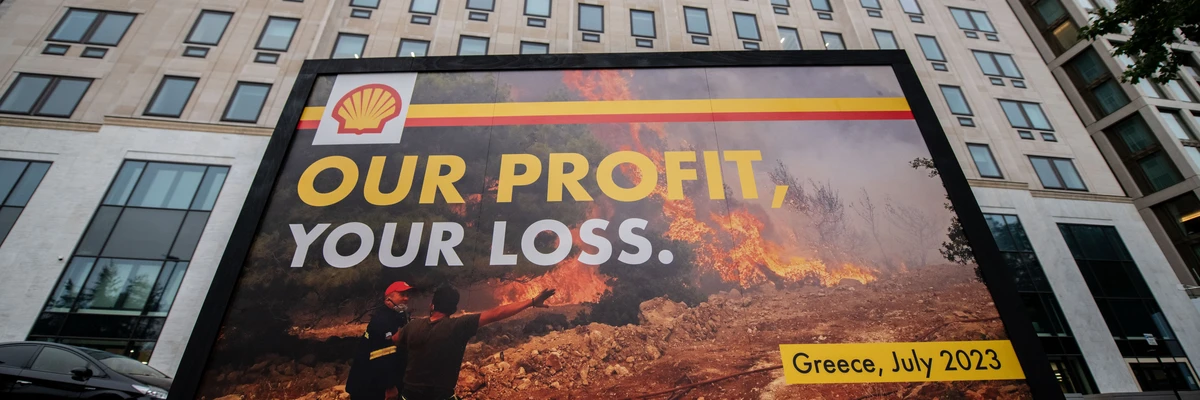
Greenpeace activists display a billboard during a protest outside Shell headquarters on July 27, 2023 in London.
Greenpeace activists display a billboard during a protest outside Shell headquarters on July 27, 2023 in London. (Photo: Handout/Chris J. Ratcliffe for Greenpeace via Getty Images)

Earlier this month, Barbados Prime Minister Mia Mottley, French President Emmanuel Macron and Kenyan President William Ruto stated their support for a Climate Damages Tax.

The briefing also highlights the financial costs of some of this year’s worst weather events that have been attributed to climate change, totalling over $64bn. These include Hurricane Beryl, Hurricane Helene, the heatwave in India in May, Typhoon Carina/Gaemi, the floods in Brazil in May, and the floods in Kenya and Tanzania in April. The costs of damage from the disasters surveyed range from US$2.9bn (Typhoon Carina) to US$ 25bn (heatwaves in India), and present just a fraction of the total cost of loss and damage globally over the last year. 

A Climate Damages Tax imposed only on wealthy OECD countries could play an essential role in helping the poorest and most vulnerable to rebuild after climate-related disasters. Increasing annually by US$5 per tonne of CO2-equivalent based on the volumes of oil and gas extracted, the tax could raise an estimated US$900 billion by 2030 to support governments and communities around the world as they face growing climate impacts.

“While oil and gas giants keep raking in grotesque levels of profit from exploiting resources, the damages resulting from the industry’s operations are disproportionately borne by people who did not cause the crisis,” said David Hillman, Director of Stamp Out Poverty. “A climate damages tax – along with other levies on fossil fuels and high-emitting sectors – will make polluters pay for the cost of climate impacts, as well as supporting workers and affected communities in the transition to clean energy, jobs, and transport.”

“Who should pay? This is fundamentally an issue of climate justice and it is time to shift the financial burden for the climate crisis from its victims to the polluters behind it,” said Abdoulaye Diallo, Co-Head of Greenpeace International’s Stop Drilling Start Paying campaign. “Our analysis lays bare the scale of the challenge posed by climate loss and damage and the urgent need for innovative solutions to raise the funds to meet it. We reject Big Oil’s assault on people and democracy and call on governments worldwide to adopt the Climate Damages Tax and other mechanisms to extract revenue from the oil and gas industry.” 

The Loss and Damage Fund was announced at COP27 in Egypt to help developing countries pay for impacts of natural disasters caused by climate change. Recently renamed the Fund for Responding to Loss and Damage (FRLD), it currently has US$702 million in pledged funds. According to Greenpeace International and Stamp Out Poverty’s calculations, a Climate Damages Tax levied on seven major international oil and gas companies would add in the first year alone US$15.02 billion, corresponding to over 21 times what is currently pledged to the fund. 

Paying the price: The economic impacts of seven extreme weather events in 2024 make the case for why climate polluters should pay”.

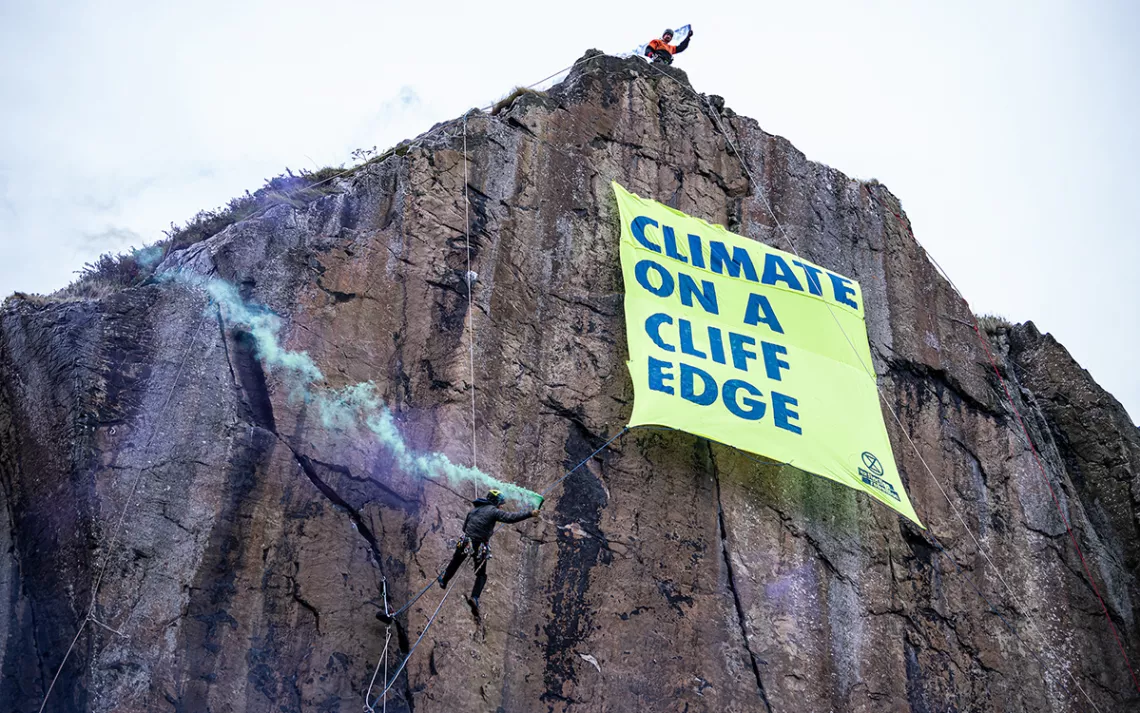
Experienced climbers scale a rock face near the historic Dumbarton castle in Glasgow, releasing a banner that reads “Climate on a Cliff Edge.” One activist, dressed as a globe, symbolically looms near the edge, while another plays the bagpipes on the shores below. | Photo courtesy of Extinction Rebellion and Mark Richards

Continue ReadingTaxing Big Oil would grow UN climate loss & damage fund twentyfold, analysis finds

Environment groups condemn Norway’s move to open its waters to deep sea mining

Spread the love

https://www.euronews.com/green/2023/06/21/environment-groups-condemn-norways-move-to-open-its-waters-to-deep-sea-mining

Norway’s government signalled its intention to open up the country’s waters to deep sea mining, but environmental groups have slammed the move.

Environmental groups have condemned Norway’s proposal to open up parts of the country’s continental shelf for commercial deep sea mining.

The Norwegian government announced its intentions on Tuesday, although the move still has to be formally debated by parliament later this year.

https://www.euronews.com/green/2023/06/21/environment-groups-condemn-norways-move-to-open-its-waters-to-deep-sea-mining

Continue ReadingEnvironment groups condemn Norway’s move to open its waters to deep sea mining

COP26 News review day 9

Spread the love

Gender day today at the COP26 summit. Alexandria Ocasio-Cortez and Nancy Pelosi arrived today.

COP26 Report Reveals ‘Massive’ Credibility Gap Between Climate Commitments and 1.5°C Target

Climate policy experts on Tuesday called for the final days of the United Nations Climate Change Conference to be spent with world leaders focusing on closing the “credibility, action, and commitment” gap that has emerged as countries put forward their goals for reaching net-zero fossil fuel emissions, with current targets on track to allow global heating far above the 1.5°C limit.

The climate policy organizations Climate Analytics and NewClimate Institute released their annual Climate Action Tracker (CAT) on Tuesday, showing that even with full implementation of emissions targets set for 2030, the planet is expected to heat up by 2.4°C by the end of the century.

[Comment by dizzy: I can’t see humans surviving anything like an increase of 2.4C. Apparently we’re at 1.1 or 1.2C increase currently and look at the problems that we have already …]

First Draft of COP26 Decision Text Slammed as ‘Love Letter’ to Fossil Fuel Industry

As a new analysis revealed Monday that fossil fuel industry lobbyists have a larger presence at the COP26 than any country, global campaigners criticized the first draft of the final decision text for the United Nations climate summit for failing to even mention phasing out coal, gas, and oil.

Greenpeace International, in a statement, highlighted that “this glaring omission” comes despite expert warnings about the need to keep fossil fuels in the ground that have mounted in the leadup to the ongoing summit in Glasgow, Scotland.

“What’s very concerning here in Glasgow is that the first draft of the climate pact text is already exceptionally weak. Usually, the text starts with some ambition, which then gets watered down,” said Greenpeace International executive director Jennifer Morgan.

UN ‘guilty’ of failing to act on climate change say activists and experts from the Global South

Sunday was an official break day for proceedings at COP26 – but that doesn’t mean that climate events weren’t still happening across Glasgow.

Organised by the COP26 Coalition, the People’s Summit for Climate Justice was one of those events. And as negotiators and COP attendees took a well-deserved rest, a People’s Tribunal took place. This is a simulated trial with the aim of holding the UN accountable for failing to act on climate change.

Made up of activists, experts, NGOs and even a former COP negotiator from the Global South, the tribunal heard four hours of evidence against the UNFCCC, the UN organisation behind these climate talks.

Climate change is a far bigger problem than coronavirus, Sir Patrick Vallance warns

The climate crisis poses a far greater threat to humanity than Covid, the UK’s Chief Scientific Advisor Sir Patrick Vallance has said.

In a stark warning, Sir Patrick Vallance said global warming could kill more people than the pandemic and pose a threat that could last a hundred years.

Jeremy Corbyn hits out at COP26 ‘greenwashing’

Former Labour leader Jeremy Corbyn has told The Big Issue there is too much greenwashing and “chat” at COP26, and not enough action.

“I’m concerned that there’s an awful lot of greenwash. There’s an awful lot of chat going on, there seems to be very few concrete agreements that have been reached so far. That worries me,” he said.

Boris Johnson to return to Cop26 for one-day visit

Continue ReadingCOP26 News review day 9