Chancellor Rachel Reeves and the rest of the Labour cabinet have been captured by corporate interests | Joe Giddens – WPA Pool/Getty Images
The party is steamrolling ahead with deregulation that will benefit big businesses at the expense of consumers. Why?
It’s no secret that Keir Starmer, Rachel Reeves, and the rest of the Labour cabinet have been captured by corporate interests.
Health secretary Wes Streeting has received at least £372,000 in donations from sources with links to private healthcare since 2015, equivalent to around £10,000 per month. The international lobbying and PR firm FGS Global, which is owned by the private equity firm that pulled out of buying Thames Water in June, sent a member of staff to work in Reeves’ office during the election campaign. And the party has received over £1m in donations from firms tied to the gambling industry in the past two years.
Labour’s links to big business and wealthy donors are concerning in themselves, but we now have direct evidence that they are being used to influence policy.
As openDemocracy reported this week, the party has defanged the Competition and Markets Authority, the regulator responsible for enforcing competition law, to appease business interests – at the expense of consumers.
The government’s deregulatory efforts began back in January, when it ousted Marcus Bokkerink as the CMA’s chair and replaced him with Doug Gurr, Amazon’s former UK boss. Appointing a former executive of one of the world’s most powerful monopolies as the head of a competition authority is so on the nose it defies satire; unions referred to the move as a “slap in the face”.
If this wasn’t enough, the business secretary, Jonathan Reynolds, instructed Gurr to deliver “pro-business decisions” in the role. The message from Labour is clear: we will not stand in the way of anti-competitive behaviour, regardless of the impact on people and planet.
Then, in May, the government issued a new “strategic steer to the CMA”, ordering the watchdog to prioritise “growth and investment” – a barely veiled instruction to wave through mergers and acquisitions that consolidate corporate power.
And just this week, the Financial Times reported that the chancellor plans to pursue a “blitz on bureaucracy” at the CMA by changing the way it reviews anti-competition investigations, which would likely make it easier for ministers to nudge outcomes in favour of big business. The move may come from Reeves, but its intellectual and political architect is reportedly Varun Chandra, one of Starmer’s most powerful advisers.
Chandra is a former managing partner at Hakluyt, the shadowy corporate intelligence firm founded by ex-MI6 officers, which counts among its clients many of the world’s biggest corporations and private equity funds. He retains a multimillion-pound stake in the company and deep relationships across the City and Silicon Valley. In government, he has pushed for a “pro-growth” deregulatory agenda.
This is how corporate capture works in the Labour Party today. There is a revolving door between corporate boardrooms and the highest offices of state. Ministers fall over themselves in their desperate attempts to gain the approval of the City and the Confederation of British Industry, an influential business lobby group. The party has demonstrated it is willing to take donations and gifts from almost anyone, and that it will happily return the favour by amending legislation or cutting regulation.
Ulterior motives
This corporate capture is, in part, a structural problem.
The state is not some neutral tool that political parties can pick up and use as they wish when they enter power. As Marxist theorist Nicos Poulantzas argued back in the 1970s, it is a social relation: a set of institutions that crystallise the balance of class power in society. In capitalist societies, capital is both better resourced and more organised than labour, and this imbalance of power is reflected within state institutions.
When a party severs its links with the working-class organisations that once anchored it in social struggle – from trade unions, to protest movements, to community organisers – it doesn’t float above class conflict; instead, it must fill the gap left by the mass base by deepening its links to capital. This reorganisation of the relationship between party and base is exactly what’s happened to Starmer’s Labour. Absent a mass movement capable of holding politicians to account, his government takes its cues from the boardroom rather than workers and communities.
But there’s also a more cynical dynamic at play, too. Everyone knows this government’s days are numbered, including Starmer himself. Nigel Farage’s Reform UK has cannibalised the Conservative Party and is now tearing ahead in the polls. Labour was probably hoping to rely on haranguing its disgruntled left-wing voters over the need to stop the rise of Reform, but with Starmer increasingly echoing Farage’s talking points, the Greens now seem like a more natural home for those people.
In short, Labour is toast – and it knows it. Ministers and advisers are already looking beyond government to the well-paid, cushy corporate positions they all want to take up when they leave office.
For the Tories who lost their seats at the last election, this transition was pretty easy thanks to the long-standing links between their party and big business and finance. Labour politicians have had to work harder to cultivate strong relationships with the private sector. In this context, the push for ‘pro-business’ policies isn’t just ideological – it’s personal.
Keir Starmer explains that he feels no shame or guilt benefitting personally from gifts from the rich and powerful while insisting on policies of severe austerity causing suffering and death.Keir Starmer says that the Labour Party under his leadership all feel a small part of Scunthorpe.
The Green Party has voted to make party policy a motion that seeks to “abolish landlords”.
…
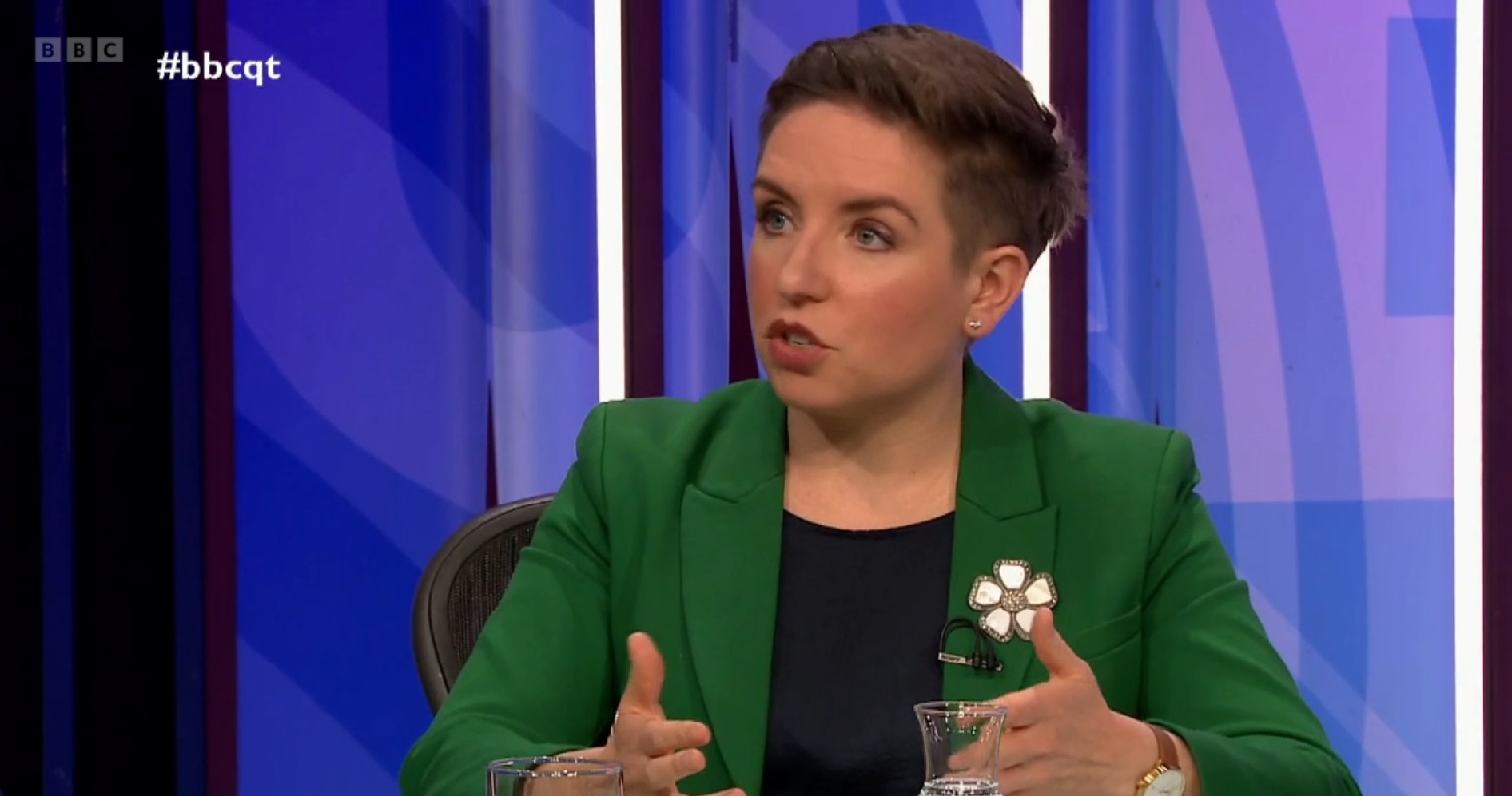
Carla Denyer, Green MP for Bristol Central, sought to stress that despite the motions “eye-catching” title, “it does not actually ‘abolish’ landlords”.
“It does, however, address the housing crisis, empowers tenants and improves their wellbeing. It contains a range of policies which, over time, would reduce the proportion of the housing market that is privately rented, and increase the proportion of socially rented homes.
“The policies, many of which were contained in our 2024 manifesto, include the introduction of rent controls and giving councils powers to buy properties when landlords sell,” she said.
Denyer added: “The motion also calls for the mass building of council homes, which was another manifesto commitment, and adds a proposal for a state-owned housing manufacturer to support these efforts and innovate on housing design and manufacture.”
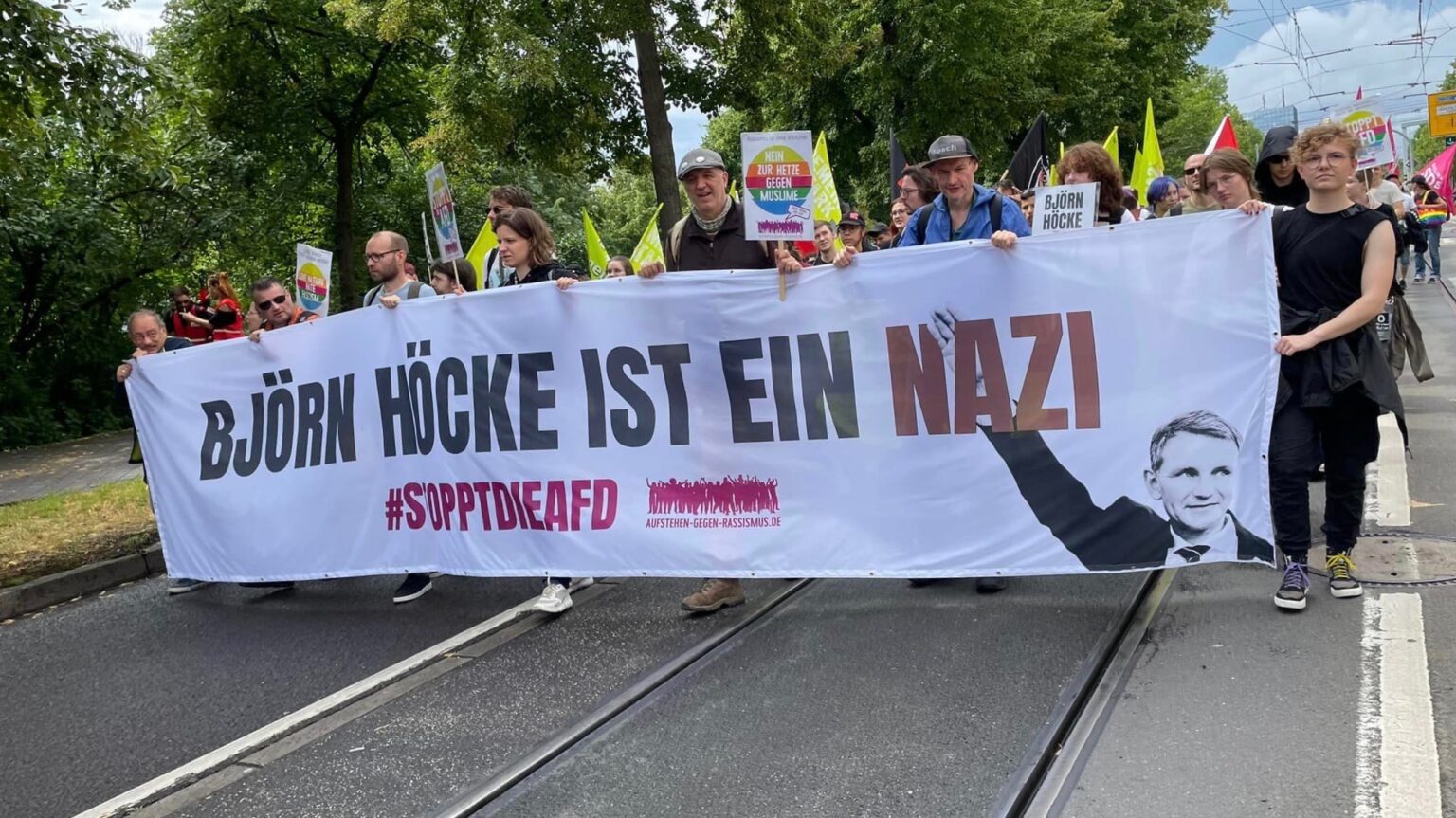
Anti-AfD protest in Magdeburg. (Photo: via Standing Up Against Racism)
The German government has defied EU law by imposing border controls, while Green politicians decry “the poison of Islam” in parliament. Meanwhile, the far-right AfD has surged in recent state elections. What’s driving Germany’s sharp shift to the right?
Germany is entering a period of reaction. This is not only evident from the rise of the far-right Alternative for Germany (Alternative für Deutschland, AfD), but also from the hardline policies of the governing coalition’s so-called centrist parties. The Social Democrats (SPD), Greens, and Liberal Democrats (FDP) have introduced unprecedented measures against migrants and critics of state policies. In September 2024, Federal Interior Minister Nancy Faeser (SPD) imposed border controls, defying European criticism and undermining the EU’s Schengen Agreement. Political scientist Christopher Wratil of the University of Vienna said that Berlin can “no longer claim others are not complying with EU law,” adding that the government is acting “as if the AfD were already in power.” Soon after Faeser’s announcement, Green parliamentary leader Katharina Dröge referred to “the poison of Islam” (das Gift des Islams) during a Bundestag session.
Germany challenged on multiple fronts
To explain this drastic rightward shift, it is necessary to understand the international situation confronting Germany’s ruling class. There are three main fronts on which the German state is currently bogged down.
Firstly, in Ukraine, where NATO’s confrontation with Russia is stalling, if not collapsing entirely. As the second-largest backer of the Zelensky regime, Berlin remains fully committed to winning the war. The government’s July 2024 decision to approve the stationing of US Tomahawk cruise missiles on German soil confirms this. Sanctions on Russia have strained the German economy, especially energy-intensive industries, but the state has absorbed much of the burden through subsidies. The Federation of German Industries, representing 100,000 companies, continues to back the government’s policies. However, popular support for the war is crumbling, as recent EU and state elections show. The two parties most critical of arms deliveries to Ukraine – the AfD and the Sahra Wagenknecht Alliance for Reason and Justice (Bündnis Sahra Wagenknecht, BSW) – made record gains, while the governing coalition suffered heavy losses.
The second front, not yet erupted into open conflict, is East Asia, in the confrontation with China. German capital faces the same dilemma as its US counterpart: while business with China remains lucrative, Chinese producers are outpacing American and European competitors, challenging Western hegemony. Germany has been more reserved than the US in taking a confrontational stance, but the government’s plan to invest 10 billion euros into a 30-billion-euro Intel chip production project in Germany shows its intent to reduce reliance on China. Meanwhile, the Green foreign minister, who called Xi Jinping a “dictator” in 2023, has led a cross-party effort to instrumentalize Taiwan against Beijing. The Ministry of Defense’s recent decision to send a warship through the Taiwan Strait is the latest move in this confrontational policy.
The third front is West Asia, where Germany remains the most outspoken advocate of Israel’s genocidal offensive in Gaza. Unlike the other fronts, there are no economic concerns holding German capital back from fully supporting Israel. This unified stance on Zionism and opposition to the so-called axis of resistance has allowed the government to swiftly implement policies against the Palestinian solidarity movement. While smearing protesters as antisemitic, basic rights such as freedom of assembly and speech are thrown out of the window. Homes are raided, activists arrested, solidarity organizations banned, and laws tightened—most recently with the liberal FDP calling to strip non-EU citizens of the right to assembly. Yet, the Western-backed offensive in Gaza has also stalled, with Israel unable to eliminate Hamas. Domestically, Germany uses force to suppress dissent, but it cannot do so internationally. States from the Global South are openly challenging Germany’s unconditional support for Israel. Namibia accused Berlin of supporting genocide while shirking responsibility for colonial crimes. Nicaragua has filed a case against Germany in the International Court of Justice, accusing it of violating the 1949 Genocide Convention. Others, like Malaysian Prime Minister Anwar Ibrahim, have directly confronted German politicians: “Where have we thrown away our humanity? Why this hypocrisy?”
The escalations on these fronts, along with rising domestic discontent, are fueling insecurity among Germany’s ruling class. A shift to the right is seen as necessary to capture broad sections of the population, keep them integrated into the system, and conjure scapegoats. The consistent messaging around the “Russian threat” and “Islamic terrorism” is used to justify massive military spending, cuts to social programs, and sweeping surveillance laws, including the right to secretly invade private homes. Meanwhile, migrants are blamed for housing shortages and the collapse of the healthcare system.
The collapse of the governing parties in eastern Germany
Elections for two state governments in eastern Germany made international headlines in August 2024 after the far-right AfD made massive gains, even becoming the strongest political force in Thuringia, where it led by almost 10%. There are several reasons for the far-right’s success.
Firstly, there is the historical trajectory of the post-1989 era. Over 30 years have passed since the socialist German Democratic Republic (GDR) was incorporated into the Federal Republic, yet West German promises of “blossoming landscapes” remain unfulfilled. The privatization of the East German economy was the largest wealth transfer in European history: millions lost their jobs and were deprived of their rightful shares in the public property they had built. This left East Germans with little to pass to their children. Almost all key positions in the state and economy were taken by West Germans. Deindustrialization led to higher unemployment, lower incomes, and longer working hours compared to the West. The result was a mass exodus, with nearly 4 million people moving westward since 1989 to escape the bleakness.
The East German population has essentially been relegated to second-class citizens in the Federal Republic. This has fostered a general distrust of Western political parties, whose approach has often been to “educate” rather than represent the East: “Your system lost, you have lost, so we will show you how it’s done.” The natural rejection of this condescending, paternalistic attitude has long been reflected in voter support for anti-establishment parties like The Left (Die Linke) and, more recently, the far-right AfD.
While The Left enjoyed broad support in the early 2000s for opposing the neoliberalization of the labor market, it gradually fell out of favor after joining regional and city governments, where it helped implement the same neoliberal policies it once opposed (such as the privatization of public housing in Berlin). This created a political vacuum in which the AfD was able to present itself as the only oppositional force, despite being a neoliberal party. The AfD taps into the economic and social challenges people face, blaming migrants or incompetent politicians in Berlin rather than the economic system itself. It has been especially successful among skilled laborers and small business owners—those most threatened by, or fearful of, social degradation.
This dynamic, which had already been unfolding for several years – was accelerated by the escalation of the Ukraine war in 2022. The question of arms deliveries to Kiev now played a central role in political debates.
The EU elections in June 2024 – in which the whole country participated – showed that Germans are dissatisfied with the governing coalition (SPD, Greens, and liberal FDP). Voters are now turning to the conservative CDU and far-right AfD, both of which call for tougher social cuts in response to current crises. The AfD gained nearly 5%, becoming the second-largest German party in the EU parliament, surpassing even the SPD. While the AfD has criticized further arms deliveries to Ukraine, it does not oppose NATO or the ongoing militarization in Germany. Many likely voted for the AfD due to its demagoguery on Ukraine, particularly calls to end the war with Russia. Polls from September 2024 show more Germans now oppose further arms deliveries to Ukraine (51%) than support them (38%), and 52% believe diplomatic efforts for peace have been insufficient. The BSW, a new party that split from The Left in 2023, centered this issue in its campaign and secured 6% of the national vote in the EU elections.
The two state elections in August 2024 further revealed that consensus around the Ukraine war effort is breaking down, especially in eastern Germany. All three governing parties lost votes, while the AfD and BSW made record gains. The Left, which had been the strongest party in Thuringia and supported arms deliveries to Ukraine, lost nearly 18% and was overtaken by the BSW. The AfD is now the largest party in Thuringia, winning almost a third of the vote. In Saxony, the AfD came close, with 30.6% compared to the CDU’s 31.9%. Notably, the CDU leader in Saxony has broken from the party’s line, calling for an end to arms deliveries and diplomatic negotiations with Russia.
The successes of the AfD and BSW have left the two eastern German states without a clear path forward. All parties currently refuse to form coalitions with the far-right AfD. While mainstream parties have derided the BSW as the “long arm of the Kremlin,” they also acknowledge the need to contend with this new party. Wagenknecht has stated that the BSW will only join coalitions with parties that oppose the stationing of US Tomahawk cruise missiles in Germany—a largely symbolic stance, as state governments have no control over this decision. More concerning for centrist parties is the disintegration of the political landscape, which could allow the opposition to block decisions requiring a two-thirds majority, including the election of constitutional judges. There is a palpable angst that minority parties in federal and state parliaments could “shut down” Germany’s constitutional courts.
Dark prospects
The upsets in eastern Germany are driven, at least in part, by dissent over NATO’s war effort against Russia. Both the AfD and BSW, from different perspectives, argue that supplying more weapons to Ukraine is not in Germany’s “national interest.” This domestic dissent, coupled with military setbacks in Donbass, is clearly causing doubts within the governing coalition. Just days after the elections in Thuringia and Saxony, Chancellor Olaf Scholz (SPD) expressed support for diplomatic negotiations with Moscow to “discuss how we can move from this war situation towards peace more quickly.”
While the German ruling class grapples with the Ukraine dilemma, its commitment to militarizing society remains strong. In this endeavor, the AfD does not stand in its way. Although the far-right party differs on issues like the war against Russia, relations with the USA, and the future of the EU, it poses no threat to German capital. On the contrary, centrist parties can mask themselves as an anti-fascist bulwark, rallying much of the population (including many on the left) around the slogan of “stopping the AfD,” while simultaneously enacting similarly racist and inflammatory policies toward migrants.
Asylum seekers are once again being deported back to Afghanistan, in flagrant disregard of the EU’s own human rights convention. Even “liking” certain social media posts warrants deportation, according to Interior Minister Nancy Faeser (SPD). At the same time, the German government is ramping up its “brain drain” strategy against the Global South. Just a few days after ordering controls on all of Germany’s borders, Faeser signed an agreement with the Kenyan government to make it easier for Germany to poach Kenyan professionals. A similar agreement with Uzbekistan followed a week later.
Germany’s increasingly aggressive neo-colonial policies abroad and its ever-more repressive policies at home are thus two sides of the same coin.
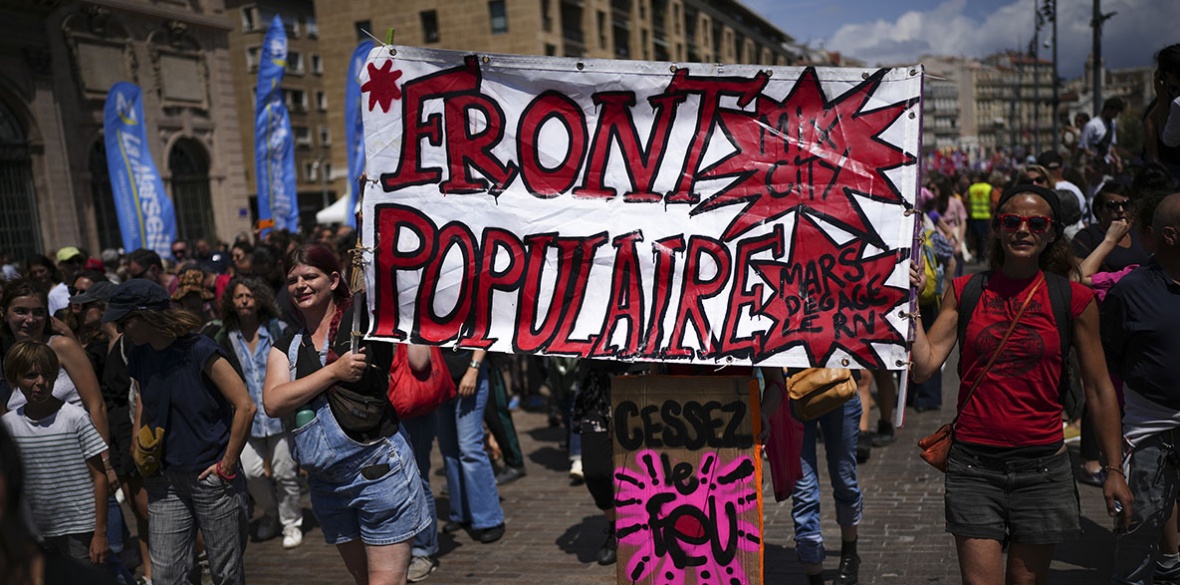
Protesters march with a banner that reads “Popular Front”, during a demonstration in Marseille, southern France, June 15, 2024
HUNDREDS of thousands of people marched against the far right in Paris and other French cities at the weekend.
Trade unionists and supporters of the quickly assembled Popular Front — an alliance of left forces announced on Friday to contest snap elections called by President Emmanuel Macron — chanted “Liberty for all, equality for all, fraternity for all” in a variant of France’s famous revolutionary motto.
Police estimated 250,000 marchers through a rain-swept Paris on Saturday and deployed more than 20,000 officers to watch them. Thousands marched in dozens of other locations, with placards denouncing not just Marine Le Pen’s far-right National Rally — which leads in polls for the first round of parliamentary elections — but Mr Macron’s anti-refugee legislation. Cries of “Free Palestine” echoed through the streets.
The Popular Front brings together the revolutionary left in Jean-Luc Melenchon’s France Unbowed and the French Communist Party with the Greens and the Socialist Party. Its founding statement calls for “rupture” with the status quo in the first 100 days of government and declares that “the arrival of the National Rally in power is no longer inevitable.”
The Greens have kicked off their conference with a call for taxes on wealth and “dirty profits” to finance the transition to renewable energy – and a condemnation of Labour’s plans, unveiled last week, as woefully insufficient.
At the gathering in Harrogate, days after a Labour conference based heavily around clean power initiatives, the Green party in England and Wales – the Scottish Greens are separate – repeatedly stressed policy differences not just over renewables but also areas such as support for strikers and public ownership.
The party’s co-leaders, Carla Denyer and Adrian Ramsay, pledged in a joint speech that they would introduce an emergency tax package to fund renewable energy and a scheme for mass domestic insulation.