A ground war with Iran risks another Vietnam for America

Spread the love

This work by Middle East Monitor is licensed under a Creative Commons Attribution-NonCommercial-ShareAlike 4.0 International License.

The United States announces that the amphibious assault ship USS Tripoli, carrying 3,500 U.S. troops, has reached the area of responsibility of U.S. Central Command in the Middle East on March 2026. [US CENTCOM/Handout – Anadolu Agency]

by Jenny Williams  @Jenny9Williams

Washington has a favourite word for moments like this: options. It sounds sober. Responsible, even. It suggests prudence, flexibility, a commander-in-chief keeping every door open. But in practice, “options” is often just the polite way this town avoids saying what it is really doing. It is preparing itself, step by step, to go further than it said it would.

That is what makes the talk around Iran so unsettling. The administration keeps insisting that it does not need a ground war. Senior officials have said the United States can achieve its aims in Iran without ground troops, even as thousands more U.S. forces are being moved into the region to preserve “maximum optionality.” Read that sentence twice. If ground troops are unnecessary, why is Washington still so determined to keep the idea alive?

Americans know where this language usually leads. First, the war is limited. Then the deployment is precautionary. Then the mission expands by degrees, never quite enough at any one moment to trigger a national reckoning, but enough in aggregate to wake up one morning and realise the country is in another war it was told it would not have to fight.

That is not cynicism. It is memory.

One month into this conflict, even sympathetic observers would struggle to say with confidence what success is supposed to look like. The White House now appears to face only hard choices: escalate further, possibly even on the ground, or try to negotiate an exit from a war whose aims have become harder to define the longer it has gone on. That is often how trouble announces itself in Washington—not with one catastrophic decision, but with a series of smaller ones made in the fog of wanting not to look weak.

And whatever this war is, it is not cost-free. That much is already obvious at home. The Strait of Hormuz is one of those places Americans only hear about in a crisis, but they pay for it almost immediately. In 2024, roughly 20 million barrels of oil a day moved through the strait—about one-fifth of global petroleum liquids consumption—and there are very few practical alternatives if traffic is badly disrupted. In plain English: when that waterway is in trouble, so are gas prices, shipping costs, and household budgets.

That is no abstraction now. Public approval for this war is weak. Polling shows broad disapproval of the strikes on Iran, with a clear majority of Americans also opposed to deploying US ground troops there.

Those numbers matter not because public opinion should dictate strategy minute by minute, but because they show something important: the country is not in the mood for another war sold in the language of control and finished in the language of sacrifice.

There is also a basic military question that should be asked more often and answered more honestly. If Iranian retaliation has already shown that American forces and facilities in the region are vulnerable, what exactly is the theory behind putting more Americans within range? A ground war is not just “more pressure.” It is more funerals. More catastrophic injuries. More families being told that the mission changed after the mission had supposedly already been defined. It is one thing to posture about resolve in a briefing room. It is another thing to ask young Americans to bear the cost of that posture with their bodies.

READ: Israel says it will not join any US ground operation in Iran

Some advocates of escalation seem to think the mere possibility of a ground operation strengthens Washington’s hand. Maybe, in a narrow tactical sense, it does.

But wars are not played on whiteboards. They are lived in real time, by real people, and they have a way of refusing the tidy logic that got them started. If the United States crosses from air and naval pressure into a land war, the result will not be a cleaner version of this crisis. It will be a different crisis altogether—larger, bloodier, and much harder to contain.

America’s allies seem to understand that. European officials have made clear, in public and in diplomatic language, that they see the United States as increasingly unpredictable and insufficiently clear about where this war is headed. Calls for restraint, for protecting civilians, and for restoring safe navigation through Hormuz are not diplomatic noise. They are signals of deep unease. The war already looks wider, messier, and more economically dangerous than Washington’s original rhetoric suggested.

Trump, of all people, should understand the political trap here. He returned to power promising not to repeat the old bipartisan habit of turning the Middle East into a graveyard of American credibility, money, and lives. A ground war with Iran would do exactly that. It would not look like strength. It would look like Washington falling back into its oldest reflex: when the first use of force fails to produce clarity, answer with more force and pretend clarity is right around the corner.

It rarely is.

There is still time to avoid the worst version of this. But avoiding it requires a little more than saying “no plans at this time.” It requires shutting the door on a ground invasion, not theatrically, not temporarily, but decisively. It requires admitting that a policy can be costly even before it becomes catastrophic. And it requires remembering that the most dangerous wars are often the ones launched by leaders who insist, all the way through, that they remain in control.

America does not need another war of drift. It does not need another “limited” mission that expands because nobody in power wants to be the first to say enough. And it certainly does not need to send more Americans into a conflict whose boundaries are already harder to see than its costs.

OPINION: Trump disappointed, Iran resolute: Leadership amid war

This work by Middle East Monitor is licensed under a Creative Commons Attribution-NonCommercial-ShareAlike 4.0 International License.

Keir Starmer explains that UK is actively supporting Israel's genocidal expansion and repeats his previous quotation that he supports Zionism "without qualification". Keir Starmer said “I said it loud and clear – and meant it – that I support Zionism without qualification.” here: https://www.jewishnews.co.uk/keir-starmer-interview-i-will-work-to-eradicate-antisemitism-from-day-one/
Keir Starmer explains that UK is actively supporting Israel’s genocidal expansion and repeats his previous quotation that he supports Zionism “without qualification”. Keir Starmer said “I said it loud and clear – and meant it – that I support Zionism without qualification.” here: https://www.jewishnews.co.uk/keir-starmer-interview-i-will-work-to-eradicate-antisemitism-from-day-one/
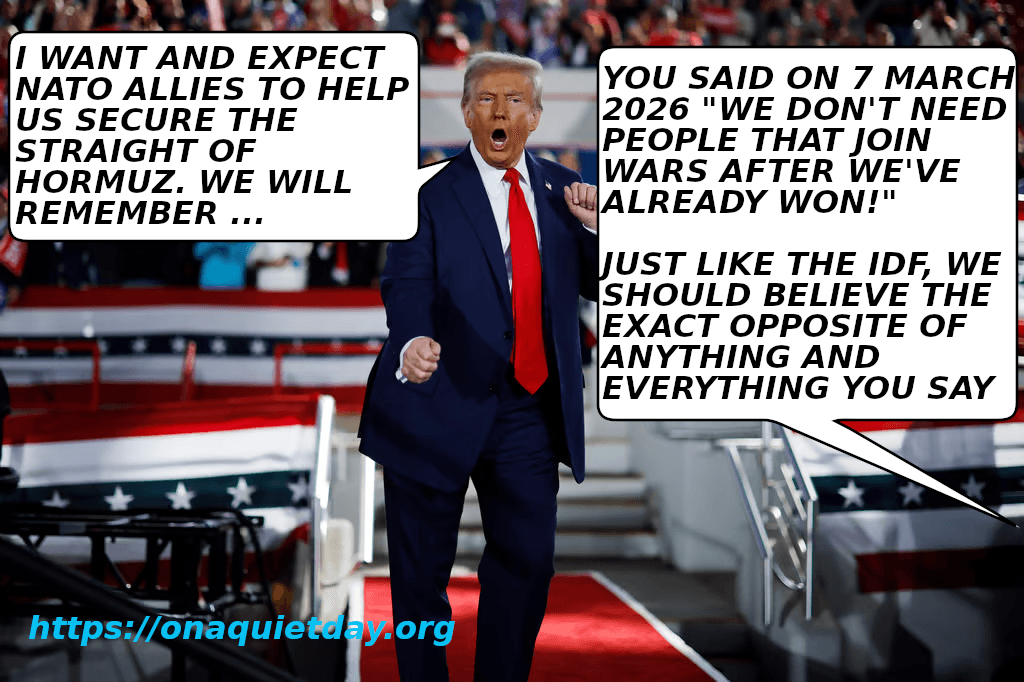
Donald Trump calls for help from NATO allies in securing the Straight of Hormuz despite saying on 7 March 2026 that they don't need people to join wars after they've already won. He's challenged with the claim that he lies as much as the IDF.
Donald Trump calls for help from NATO allies in securing the Straight of Hormuz despite saying on 7 March 2026 that they don’t need people to join wars after they’ve already won. He’s challenged with the claim that he lies as much as the IDF.
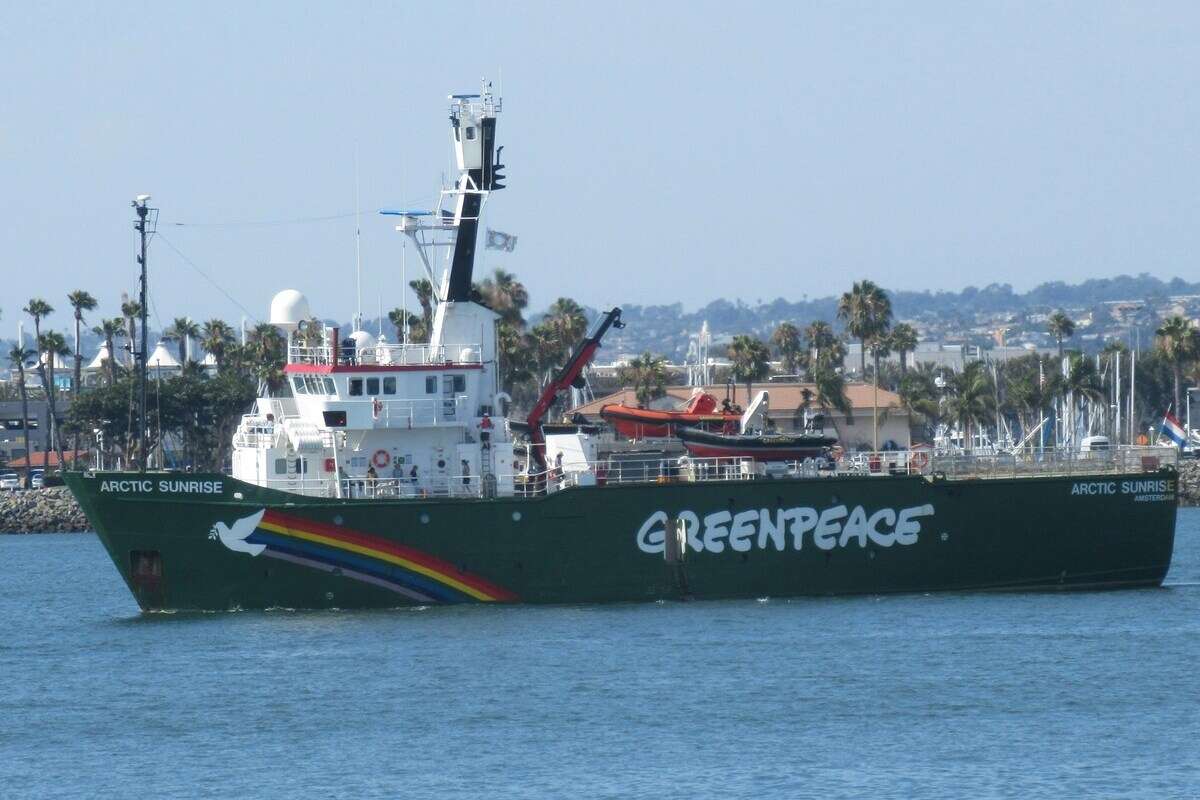
Greenpeace ship Arctic Sunrise. [Photo by Steve Sharp on Unsplash]
Orcas discuss rotting brain. Front Orca says "Wish someone would lock him up".
Orcas discuss rotting brain. Front Orca says “Wish someone would lock him up”.
Continue ReadingA ground war with Iran risks another Vietnam for America

Washington says it wants a deal. Its actions point to a ground war

Spread the love

This work by Middle East Monitor is licensed under a Creative Commons Attribution-NonCommercial-ShareAlike 4.0 International License

A view of the US aircraft carrier USS Gerald R. Ford at a US Navy base in Souda Bay, Crete, where it is set to undergo repairs on March 23, 2026. [Stefanos Rapanis – Anadolu Agency]

Americans have heard this script before. A president says he wants a deal, insists he does not want a wider war, and then quietly builds the military architecture for one anyway. That is where the United States now stands in its war with Iran. Even as Donald Trump talks about a possible settlement and claims there are “major points of agreement,” the Pentagon is preparing to send thousands more troops from the 82nd Airborne Division to the Middle East, adding to a military buildup that already looks less like leverage and more like preparation for a deeper phase of the war. A government serious about winding down a conflict does not keep expanding the force package behind it.

The gap between Washington’s words and Washington’s actions is no longer small enough to dismiss as ordinary diplomatic theater. Trump says contacts with Iran are promising. Tehran has publicly denied direct talks, and Reuters has reported that Iran’s negotiating position has hardened during the war, with demands for guarantees against future attacks and refusal to place new limits on its missile program. That does not look like a near-term diplomatic breakthrough. It looks like an administration using the language of negotiation to buy time while keeping military options open. The question is no longer whether Washington prefers a deal in the abstract. The question is whether “talks” are becoming political cover for continued escalation.

That matters because coalition reluctance does not usually restrain Washington. More often, it leaves Washington compensating with more American assets, more American risk, and eventually more American ownership of a war that was sold as limited.

There is another sign that this war is moving in a more dangerous direction: America is having trouble persuading others to own it. When Trump asked allies to help keep the Strait of Hormuz open, several of them declined to send ships. Japan and Australia publicly said they had no immediate plans to participate, and Reuters reported similar hesitation from other partners. That matters because coalition reluctance does not usually restrain Washington. More often, it leaves Washington compensating with more American assets, more American risk, and eventually more American ownership of a war that was sold as limited. A conflict that begins as a joint project can become an overwhelmingly American burden simply because nobody else wants to get pulled in deeper.

This is how mission creep actually happens. It rarely arrives with a formal declaration that the United States is entering a ground war. It comes in pieces: reinforcements to protect bases, troops to secure shipping lanes, special operations contingencies for sensitive sites, and a standing insistence that “all options remain on the table.” Reuters reported last week that U.S. officials were weighing reinforcements that could support operations connected to Hormuz and other possible next steps, while experts warned that securing Iran’s uranium stockpiles would be highly complex and risky even for special operations forces. That is not the language of a conflict staying neatly contained. It is the language of a war searching for its next rationale.

When power becomes a trap: America’s strategic deadlock in Iran

The American public, importantly, is not asking for this. A Reuters/Ipsos poll published last week found that 65 percent of Americans believe Trump will order troops into a large-scale ground war in Iran, but only 7 percent support such an idea. An AP-NORC poll published found that most Americans believe recent U.S. military action against Iran has gone too far, and about six in ten oppose deploying U.S. ground troops to fight there. Those numbers matter because they expose the fiction that a deeper war would rest on any real democratic consensus. Washington is not moving toward a broader conflict because the public has embraced one. It is moving there in spite of the public’s clear warning.

That should disturb Americans even if they have no sympathy at all for the Iranian government. One does not have to romanticise Tehran to see the danger of what Washington is doing. The United States and Israel may share the current war effort, but any ground phase would be paid for primarily by Americans, fought primarily by Americans, and politically owned in Washington long after today’s rhetoric about quick outcomes has faded. That is the part of “supporting an ally” that the White House prefers to leave vague. Air campaigns can be sold as controlled and temporary. Ground commitments are different. They create their own logic, their own momentum, and their own excuses for staying longer than promised.

Even now, after weeks of US-Israeli strikes, the Strait of Hormuz remains a live strategic problem, negotiations remain uncertain, and military planners are still talking in terms of options rather than outcomes.

Nor is there any reason to think a ground phase would solve the political problem that air power has failed to solve. Iran is not a target that can simply be bullied into strategic surrender by adding more American bodies to the region. Even now, after weeks of US-Israeli strikes, the Strait of Hormuz remains a live strategic problem, negotiations remain uncertain, and military planners are still talking in terms of options rather than outcomes. That is usually a sign that the advertised strategy has stalled. When that happens, Washington has a long habit of treating escalation not as proof of failure but as the remedy for failure. That is how bad wars become bigger wars.

What makes this moment especially dangerous is that the administration still wants the political benefits of sounding restrained while preparing for the military benefits of going further. It wants to say “deal” and move troops at the same time. It wants to claim this is not another open-ended American war while creating precisely the conditions from which open-ended American wars emerge. For Middle East Monitor readers, this should be understood clearly: Washington is not standing outside this conflict trying to calm it. It is deep inside it, helping shape the next phase while pretending the next phase may never come. If the White House truly wanted to prevent a ground war, it would stop building one. Until then, Americans should call this what it is—not prudence, not deterrence, but a familiar and dangerous drift toward a war the country has not chosen and does not want.

The views expressed in this article belong to the author and do not necessarily reflect the editorial policy of Middle East Monitor.

Donald Trump calls for help from NATO allies in securing the Straight of Hormuz despite saying on 7 March 2026 that they don't need people to join wars after they've already won.
Donald Trump calls for help from NATO allies in securing the Straight of Hormuz despite saying on 7 March 2026 that they don’t need people to join wars after they’ve already won.
Keir Starmer explains that UK is participating defensively in Trump and Israel's criminal war for Israel's genocidal expansion in Iran and states that he supports Zionism "without qualification". Keir Starmer said "I said it loud and clear – and meant it – that I support Zionism without qualification.” here: https://www.jewishnews.co.uk/keir-starmer-interview-i-will-work-to-eradicate-antisemitism-from-day-one/
Keir Starmer explains that UK is participating defensively in Trump and Israel’s criminal war for Israel’s genocidal expansion in Iran and states that he supports Zionism “without qualification”. Keir Starmer said “I said it loud and clear – and meant it – that I support Zionism without qualification.” here: https://www.jewishnews.co.uk/keir-starmer-interview-i-will-work-to-eradicate-antisemitism-from-day-one/
Orcas discuss how Trump was re-elected and him being an obviously insane, xenophobic Fascist.
Continue ReadingWashington says it wants a deal. Its actions point to a ground war