Hundreds of Thousands Join London March to Demand ‘Cease-Fire Now’ in Gaza

Spread the love

Original article by JAKE JOHNSON republished from Common Dreams under Creative Commons (CC BY-NC-ND 3.0). 
People take part in the National March for Palestine in London on Saturday November 11, 2023.  (Photo: Victoria Jones/PA Images via Getty Images)

“In our thousands, in our millions, we are all Palestinians,” demonstrators chanted at Saturday’s march, described as one of the largest political protests in U.K. history.

Hundreds of thousands of people took to the streets of London on Saturday to demand an immediate cease-fire in Gaza as Israeli forces ramped up their aerial and ground assault on the Palestinian enclave’s hospitals and other civilian infrastructure, intensifying the territory’s humanitarian crisis.

Described as one of the largest political demonstrations in U.K. history, the march moved ahead despite criticism from British Home Secretary Suella Braverman and Tory Prime Minister Rishi Sunak, who suggested earlier in the week that the protest should have been banned by London police given that it coincided with Armistice Day. Braverman accused the police of giving favorable treatment to “pro-Palestinian mobs.”

“I am horrified by the tone, language, and incitement our own government is using to whip up hatred against its own citizens—citizens who are standing up in solidarity with the besieged and bombed citizens of Gaza,” British Army veteran and march participant Nadia Mitchell wrote for OpenDemocracy. “Personally, I cannot think of a more appropriate day to demand a cease-fire than on the day we remember the mother of all cease-fires, to remember and honor those who sacrificed their lives in pursuit of peace and an end to war.”

Some U.K. lawmakers, including former Labour leader Jeremy Corbyn and Labour MP John McDonnell, joined Saturday’s march alongside hundreds of thousands of peace activists, union members, and people of all faiths.

“In our thousands, in our millions, we are all Palestinians,” demonstrators chanted.

(Photo: Henry Nicholls/AFP via Getty Images)

Reuters reported that “police said far-right groups opposing the march were present in central London in ‘significant numbers,’ leading to skirmishes with officers near the Cenotaph war memorial, close to the Houses of Parliament and in Westminster.”

“Officers in riot gear sought to contain the far-right protesters, some of whom threw bottles at them, and police vehicles sped around the city to respond to reports of tensions in the streets,” the outlet added.

Participants in the mass demonstration, meanwhile, marched from London’s Hyde Park to the U.S. Embassy to protest the Biden administration’s unwavering military and political support for the Israeli government as the death toll in Gaza continues to climb.

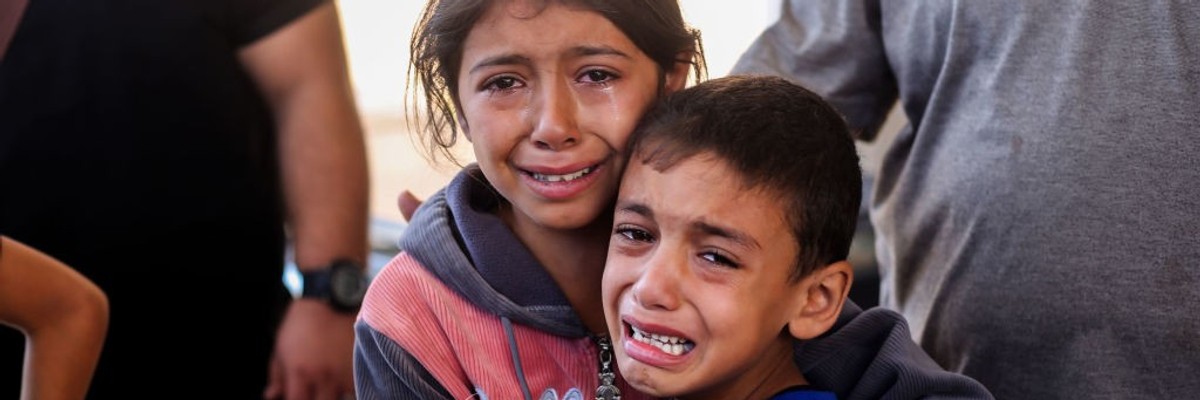
The head of the World Health Organization told the United Nations Security Council on Friday that Israel’s bombing and siege are killing one child on average every 10 minutes in Gaza.

“Nowhere and no one is safe,” said WHO Director-General Tedros Adhanom Ghebreyesus.

Mohammed Abu Mughaisib, deputy medical coordinator for Doctors Without Borders in Gaza, toldThe Washington Post on Saturday that hospitals in northern Gaza have become “a graveyard” due to mounting Israeli attacks.

Medical workers at al-Nasr pediatric hospital were forced to leave babies in incubators behind as they evacuated south, Abu Mughaisib said.

“The medical staff evacuated because of the shelling on the pediatric hospital, and they couldn’t save the babies to take them out, so they left five babies alone in the intensive care on the machines and the ventilators,” he told the newspaper. “That’s the situation: leaving babies now alone on the ventilators.”

(Photo: Victoria Jones/PA Images via Getty Images)

Saturday’s march was organized by the Palestine Solidarity Campaign (PSC), Stop the War Coalition, Campaign for Nuclear Disarmament, and other advocacy groups.

“We march to call for an end to the indiscriminate bombing of civilians and a #CeasefireNOW,” PSC director Ben Jamal wrote on social media. “We march in respect of the rights of all to live in freedom and with dignity.”

The demonstration is part of a growing international movement supporting a cease-fire in the Gaza Strip as Western leaders, including Sunak and U.S. President Joe Biden, refuse to demand an end to Israel’s siege and relentless bombing campaign.

Earlier this week, as Israeli forces encircled northern Gaza, Biden told reporters that there is “no possibility” of a cease-fire. Israeli Prime Minister Benjamin Netanyahu reportedly rejected a proposed five-day cease-fire in exchange for the release of some of the hostages held by Hamas.

(Photo: Henry Nicholls/AFP via Getty Images)

Video footage of Saturday’s march shows the streets of central London packed with demonstrators expressing solidarity with the people of Gaza and demanding an end to Israel’s assault, which began after a deadly Hamas-led attack in southern Israel last month.

An estimated 300,000 people took part in Saturday’s march, according to London authorities.

“This footage shows the true will of the British people,” wrote Ahmed Alnaouq, a London-based Palestinian journalist and co-founder of the nonprofit We Are Not Numbers. “Hundreds of thousands are protesting peacefully despite rounds of vicious smear campaigns and intimidation. “All say in one word: CEASE-FIRE NOW!”

Original article by JAKE JOHNSON republished from Common Dreams under Creative Commons (CC BY-NC-ND 3.0). 
Continue ReadingHundreds of Thousands Join London March to Demand ‘Cease-Fire Now’ in Gaza

Germany bans public grieving and solidarity with Palestine

Spread the love

Original article republished from peoples dispatch under a Creative Commons Attribution-ShareAlike 4.0 (CC BY-SA) license.

Demonstrators in Berlin take the streets in solidarity with Palestine (Photo: Montecruz Foto)

Germany is home to Europe’s largest Palestinian community, with roughly 80,000 Palestinians living in the country. For years, German authorities have tried to stifle Palestinian activism in the country, viewing it as a nuisance to its explicit policy of “unconditional support for Israel.” Demonstrations, such as one earlier this year to mark the 75th anniversary of the Nakba, have been sporadically banned in recent years and organizations, like the Palestinian prisoner solidarity network Samidoun, have also come under increasing scrutiny.

Yet the criminalization of solidarity with Palestine on a national level has taken on entirely new dimensions since October 7. After a small demonstration on Berlin’s busy Sonnenallee street on the evening of October 7, the German media and body politic have been up in arms about Palestinians supposedly celebrating terrorism and antisemitism on German streets.

Talking points that were two weeks ago only uttered by far-right AfD politicians are now being openly expressed by politicians from all parliamentary parties in Germany. Playing off the idea of “imported antisemitism,” the social democratic Chancellor Olaf Scholz is now arguing that “we must finally deport on a large scale” residents who do not hold German citizenship and openly protest against Israel. The Christian Democrats (CDU) are even demanding that the recognition of Israel’s right to exist must become a precondition for German citizenship.

Samidoun has been made into public enemy number one, as the media presents the group as a bastion for “sympathizers of terror” that poses “a particular danger, because as a secular organization, they are building bridges between Islamists and radical leftists.” In a speech before parliament on October 12, Chancellor Scholz personally announced a ban on Samidoun along with a ban on the activities of Hamas in Germany. 

In Berlin specifically, which is home to one of the largest Palestinian diaspora communities outside the Arab world, the authorities have been particularly hostile towards any signs of solidarity with Palestine. Since October 7, every demonstration explicitly or implicitly referring to Palestine has been banned, leaving the roughly 30,000 Palestinians living in Berlin with no means of expressing their anguish at the siege and bombardment of Gaza.

Solidarity groups have been trying to bypass this censorship by avoiding political statements and focusing on humanitarian campaigning, yet even demonstrations and slogans such as “Children in Gaza need help” and “Solidarity with the civilian population in the Gaza Strip” were banned. On October 13, the police went so far as to ban a demonstration registered by the group “Jewish Voice for a Just Peace in the Middle East” entitled “Jewish Berliners against violence in the Middle East.” 

Sonnenallee, a busy street in the district in which many Arab migrants live, has become a focal point of dissent against Israel’s attack on Gaza. The police patrol Sonnenallee every evening with tight controls on the public squares. Racial profiling and brutal arrests are commonplace and often recorded and posted to social media. One particular video shows police officers stomping out a candle-lit vigil with their boots.

In a letter to all Berlin schools, the city’s Department for Education, Youth and Family set out strict guidelines on how to discuss the situation in Palestine with students. “Any demonstrative action or expression of opinion that can be understood as advocating or approving of the attacks against Israel or support for the terrorist organizations carrying them out, such as Hamas or Hezbollah, constitutes a threat to school peace in the current situation and is prohibited.” According to the letter, these may include the following: “visibly wearing relevant clothing (for example, the kuffiyeh known as the Palestinian scarf), displaying stickers and patches with inscriptions such as ‘free Palestine’ or a map of Israel in the colors of Palestine (white, red, black, green), and shouting ‘free Palestine!’ and demonstrating verbal support for Hamas and its terrorism.”

At one high school on Sonnenallee, a 61-year-old teacher attempted to confiscate a Palestinian flag from a 14-year-old student and ended up in a physical altercation with a second 15-year-old student. The parents’ association of the school tried to organize a demonstration under the slogan “No place for racism, no place for violence” as a reaction to the incident, yet it was promptly banned by the police, ostensibly as a “a precautionary measure”. The Central Council of Palestinians in Germany has since sent a letter in response to Berlin’s Department for Education, expressing their “great concern about the psychological and educational development [of their children]” in Berlin schools.

As other European states are witnessing mass protests in solidarity with Palestine, the German state has been able to use force and violence to prevent such scenes on German streets. Yet it is unlikely that the government will be able to ban these sentiments of solidarity indefinitely, especially as the images of Israel’s brutal attack on Gaza continue to circulate around the world.

Original article republished from peoples dispatch under a Creative Commons Attribution-ShareAlike 4.0 (CC BY-SA) license.

Continue ReadingGermany bans public grieving and solidarity with Palestine

Government has ‘no plans’ to stop arms sales to Israel despite civilian deaths

Spread the love

Original article by Adam Bychawski republished from OpenDemocracy under a Creative Commons Attribution-NonCommercial 4.0 International licence.

Human rights groups say UK is ignoring its own rules on arms exports after hundreds of Palestinians killed

Campaigners block the road in East London outside the DSEI arms fair Photo: @CAATuk / Twitter

The UK government has no plans to suspend arms sales to Israel, despite human rights campaigners warning its exports have been used to kill civilians, openDemocracy has been told.

The UK has approved millions of pounds worth of licences for military equipment to Israeli forces since 2015. They include components for F-35 fighter jets, which can deliver ground strikes and have been recently pictured in social media posts from the Israeli Air Force.

In response to Hamas’ attack on Israel which killed hundreds of civilians, Israeli forces have fired thousands of bombs into Gaza since 7 October. As of yesterday, 2,750 Palestinians have been killed and 9,700 wounded in Israeli air strikes on the Gaza strip, according to the Palestinian health ministry. This figure was given before an attack on al-Ahli Arab hospital that reportedly killed 500 people.

Francesca Albanese, the UN’s special rapporteur on the situation of human rights in the Palestinian territories, warned last week that “Palestinians are in grave danger of mass ethnic cleansing”.

openDemocracy asked the Department of Business and Trade if it would suspend and review its export licences for arms to Israel in light of the reported civilian killings. In response, the department said the licences were “under continual review” but there were “no immediate plans to stop arms export licences to Israel”.

Emily Apple, media coordinator for the Campaign Against the Arm Trade, said: “It is disgusting that the Department for Business and Trade is refusing to suspend and review arms licences to Israel given the mounting evidence of war crimes committed by Israel in Gaza.

“UK industry is responsible for 15% of the components used in the F35 stealth combat aircraft that are being used in airstrikes, and the UK is therefore complicit in war crimes committed by the Israeli government.”

Any UK company wishing to export military goods to other nations must apply for a licence to do so. The government has a number of criteria that must be met before licences can be granted. 

One of the criteria is to “not grant a licence if [the department] determines there is a clear risk that the items might be used to commit or facilitate a serious violation of international humanitarian law”.

Officials are also told not to grant licences if there is a “likelihood that the items would be used in the territory of another country other than for legitimate purposes including national or collective self defence”.

The campaign group Palestine Action, which has taken direct action in the UK against Israeli arms company Elbit, said it was “no surprise” that the UK government is continuing to allow arms exports.

“Numerous weapons factories, including ones owned by Israel’s largest weapons firm, continue to operate on our doorsteps, who market their weapons as “battle-tested” on the captive population of Gaza,” a spokesperson for the group said.

The UK has in the past paused export licences in response to reports that its criteria may have been breached.

In 2019, the then foreign secretary Dominic Raab suspended arms exports to NATO ally Turkey after it invaded Syria, on the grounds that it risked worsening the humanitarian crisis in the country.

The UK revoked some arms licences to Israel in 2009 after hundreds of Palestinians were killed in airstrikes by Israeli forces. During the 2o14 conflict, the government warned it would suspend licences again if hostilities continued, but ultimately did not go-ahead with the decision.

The decision to continue supplying arms to Israel comes after MPs and campaign groups raised concerns about a growing lack of transparency from the government over exports licences.

In October, an enquiry led by MPs found that despite pledges from the government to improve transparency “progress has been limited” and that “there is a worrying lack of openness and data on compliance”.

The Campaign Against the Arms Trade told openDemocracy that there is a “disturbing lack of transparency over arms sales to Israel”.

“The UK government has hidden behind exemptions and refused to supply CAAT with data regarding recent exports by Elbit subsidiaries, and a large proportion of UK sales are hidden by open export licences where it is impossible to monitor the amount of weapons sold,” it said. 

Sacha Deshmukh, Amnesty International UK’s chief executive, urged the government to reverse its decision to continue supplying Israel with arms.

“The UK’s arms export system is based on the principle of avoiding a clear risk of British weapons being used to commit serious violations of international law. There’s mounting evidence that Israel’s military conduct in Gaza during the last week has included indiscriminate attacks which have killed and injured large numbers of Palestinian civilians.

“The government needs to follow its own rules and urgently suspend export licences for all arms transfers to Israel that risk being used to commit further unlawful attacks.”

Original article by Adam Bychawski republished from OpenDemocracy under a Creative Commons Attribution-NonCommercial 4.0 International licence.

Continue ReadingGovernment has ‘no plans’ to stop arms sales to Israel despite civilian deaths

The UK establishment is using war to attack protest at home

Spread the love

Original article by Benny Hunter republished from Open Democracy under a Creative Commons Attribution-NonCommercial 4.0 International licence

The conflict in the Middle East has led British political actors to try and redefine what is ‘acceptable speech’

Police and protesters at the March for Palestine in London on Saturday | Mark Kerrison/In Pictures via Getty Images

As a humanitarian crisis unfolds in the Middle East, the UK government and its backers in the media have sought to marginalise and silence dissenting voices by targeting protest movements showing solidarity with the Palestinian cause.

Hundreds of people in Israel were killed, just over a week ago, in a brutal attack by Hamas. In response, Israel has moved swiftly against Hamas and the Palestinian population living in the Gaza strip. It has cut off their electricity and prevented the entry of food, water and medical supplies as it commences a devastating bombardment of homes and civilian infrastructure, leaving hundreds dead.

The reaction to these unfolding events in Britain has been one of shock and anger. Amongst the political class, a closing of the ranks has occurred, shoring up support for Israel as it strikes against the Palestinian population. And as part of this, political actors have sought to demarcate new boundaries on what is acceptable speech in the UK.

Foreign secretary James Cleverly on Tuesday urged pro-Palestinian protesters to stay at home. And home secretary Suella Braverman wrote to police chiefs asking them to take action against acts of protest that – in whose eyes it was not clear – might indicate support for Hamas.

She singled out the waving of the Palestinian flag in particular as being illegitimate “when intended to glorify acts of terrorism”, and asked that the police “consider whether chants such as: ‘From the river to the sea, Palestine will be free’ should be understood as an expression of violent desire to see Israel erased from the world” and therefore a “racially aggravated” crime.

The Telegraph has also reported that Robert Jenrick, the immigration minister, has commissioned officials in the Home Office to consider how they could revoke visas and expel foreign students who “praise Hamas”.

There are undoubtedly circumstances in which the use of particular chants or imagery could be inflammatory or even threatening. But the purpose of these statements is not to protect British communities (that much is clear from Braverman’s failure to issue a similar letter warning against attacks on Muslim or pro-Palestinian groups). The purpose is rather to intimidate would-be protestors and delegitimise criticism of Israel by aligning it with criminality.

The government’s views on acts of protest are mirrored by the official opposition: a diktat sent out by Labour Party general secretary David Evans warned members, councillors and MPs against attending pro-Palestine demonstrations. Labour has gone further still by also forbidding debate on Israel-Palestine in local party branches – a censorship not even attempted by Tony Blair during the lead-up to the Iraq war.

The results of Braverman’s provocation can already be seen. On Wednesday, Greater Manchester Police arrested four people for breaching the peace “during events… marking the Hamas-Israel conflict”, later de-arresting three of them. A video taken at the scene of the arrest and posted online shows a young man being led into a police van, a Palestine flag wrapped around his shoulders, as concerned onlookers shout at officers: “He has done nothing wrong,” and: “Freedom of speech.”

The Metropolitan Police Service itself appears to have ruled out any crackdown on people waving the Palestinian flag. But on Thursday night, the Palestinian Literature Festival was forced to cancel a book launch for Jewish American journalist Nathan Thrall’s latest book ‘A Day in the Life of Abed Salama: A Palestine Story,’ “after the Metropolitan Police Service contacted the host organisation and asked that it be cancelled ‘due to security concerns’.”

And at London’s ‘March for Palestine’ demonstration on Saturday, legal observers from Black Protest Legal Support witnessed the police make arrests of protesters who had refused to remove the ‘keffiyeh’ – a chequered black and white scarf that is symbolic of Palestinian nationalism and is traditionally worn around the head. In a statement, the Met Police confirmed four arrests for failing to remove face coverings that concealed the arrestee’s identity – at least one person has been subsequently charged, whilst others have been referred to youth offending teams.

These events (and the statements that preceded them) should be of concern not just to advocates of the Palestinian cause, but to anyone concerned about the erosion of democratic norms: here is the government using the murder of Israeli civilians abroad to attack free speech and the right to protest here in the UK.

One lawyer who spoke to openDemocracy this week linked Braverman’s crackdown on Palestinian flag-waving to the Public Order Act. That piece of legislation (which received royal assent in May 2023) was intended to break the backs of the climate movement, making it far easier for police forces to deem acts of protest illegal and criminalise those in attendance or organisers, for even minor disruption.

And last year, the Met Police used the spectre of Covid to target and criminalise those protesting against police brutality at a vigil for Sarah Everard, who was murdered by police officer Wayne Couzens.

Each crisis – climate, Covid, war – is seized upon by the state, government and media, as an opportunity to stifle dissent and curtail free speech. And it is through this framing that we can understand the response of the political and media establishment in the UK to Israel-Palestine: not simply as solidarity with the Israeli people but as an opportunity to attack our rights.

Attacks on freedom of speech relating to Palestine are not new. Palestinians in Britain have long experienced marginalisation and silencing, especially when giving voice to views on the “Palestinian experience of colonialism”.

This has been seen in particular within academia, which has become a battleground over acceptable speech on Israel-Palestine. In British schools, pupils have been sanctioned for expressing vocal support for Palestine, including with detentions and suspensions. Fear about reprisals, including referrals to the government anti-extremism programme Prevent, has been described as having a ‘chilling effect’ on engagement of students with the topic of Palestine.

This is part of a broader effort by the UK Home Office to identify protest movements and left-wing struggles as being outside of acceptable debate, with recent changes to the training on Prevent categorising “socialism” and “anti-fascism” under the heading “terrorist ideologies”. This process of delegitimisation is often backed by the media. In recent days attacks on free speech on Palestine have intensified.

On Wednesday, a report in the Times was published that “identified a dozen academics at Oxbridge and Russell Group universities who have posted statements appearing to justify the weekend’s attacks on Israel”. In one case, an academic had simply called for solidarity with the Palestinian struggle.

Much of the right-wing press has also chosen this moment to campaign for the BBC to refer to Hamas as a terrorist organisation, a term the BBC says does not meet impartiality rules – with the front page headline of Thursday’s Daily Mail eschewing proclamations on the outbreak of war and instead asking: “The King Calls Them Terrorists, Why Can’t The BBC?”. Defence secretary Grant Shapps also criticised the BBC on Radio 4 over the decision in a combative interview. The prominence this demand has been given raises questions about the priorities of the British press at such a high stakes moment.

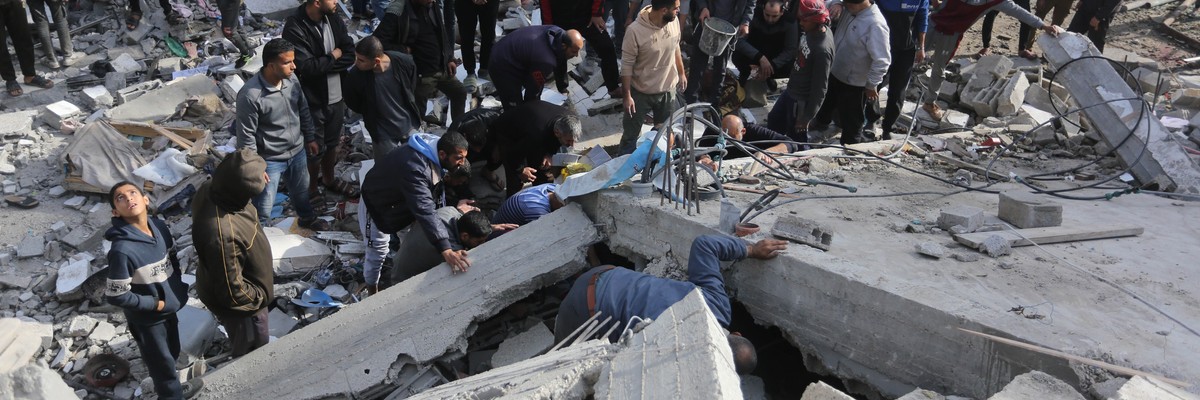
Gaza is already partially reduced to rubble by Israeli airstrikes. More than two million people are experiencing total siege, bombardment and the removal of all basic human rights. Chemical weapons have now been confirmed as being in play and preparations are underway for a ground offensive by Israeli troops, with the 1.1 million Palestinians living in the most populated area of Gaza given 24 hours to move further south. This will almost certainly mean further atrocities.

The government and opposition both stand steadfastly behind Israel. Number 10 has said the UK will send surveillance aircraft and two Royal Navy ships to the eastern Mediterranean in plans “to support Israel”. The foreign secretary, James Cleverly, has himself travelled to Israel to “underline UK’s unwavering solidarity in the face of terror”. And both the leader of the opposition, Keir Starmer, and his shadow attorney general, Emily Thornberry, have refused to criticise Israel’s actions in Gaza or describe the “collective punishment” of civilians as a war crime.

This shocking complicity must be loudly challenged. Yet, as with the arrival of any shocking event, the political class moves quickly to turn the dial down ever further on legitimate speech.

If a ceasefire does arrive, without dissenting voices, the missing context – the dislocation of Palestinians in 1948, the occupation of the West Bank since 1967 and the 16-year blockade of Gaza – will continue not to be heard. As long as this silencing act continues, both the Palestinian and Israeli people will continue to suffer.

Original article by Benny Hunter republished from Open Democracy under a Creative Commons Attribution-NonCommercial 4.0 International licence

Continue ReadingThe UK establishment is using war to attack protest at home

UN relief chief says ‘humanity is failing’ in response to conflict in Palestine and Israel

Spread the love

https://leftfootforward.org/2023/10/un-relief-chief-says-humanity-is-failing-in-response-to-conflict-in-palestine-and-israel/

A UN official in charge of relief efforts has said that ‘humanity is failing’ in regards to the violence in Israel and the Palestinian territories.

“Civilians in Israel and the Occupied Palestinian Territory are suffering from a week of utter anguish and devastation,” Martin Griffiths, humanitarian affairs undersecretary general and emergency relief coordinator, said in a statement.

“I fear that the worst is yet to come”, he added.

1300 Israelis were killed in Hamas’ terrorist attack on October 7. An estimated 150 people, including children, were captured by Hamas and taken as hostages into Gaza. Gaza is home to around 2 million people ― roughly half of which are children.

In response to the attack, Israel has carried out airstrikes on Gaza, saying it wants to crush Hamas. The Israeli Defence Forces said that it had already dropped more than 6,000 bombs on Gaza.

Earlier today, Gaza’s Health Ministry said that at least 2,750 Palestinians have been killed and 9,700 wounded in Israeli air strikes on the Gaza Strip since Oct. 7.

https://leftfootforward.org/2023/10/un-relief-chief-says-humanity-is-failing-in-response-to-conflict-in-palestine-and-israel/

Continue ReadingUN relief chief says ‘humanity is failing’ in response to conflict in Palestine and Israel