UN Chief Invokes Article 99 to Spur Security Council Action on Gaza

Spread the love
United Nations Secretary-General António Guterres discusses climate change at U.N. headquarters in New York City on July 27, 2023.

“Facing a severe risk of collapse of the humanitarian system in Gaza, I urge the council to help avert a humanitarian catastrophe and appeal for a humanitarian cease-fire to be declared.”

With over 16,000 Palestinians dead just two months into Israel’s war on the Gaza Strip, United Nations Secretary-General António Guterres on Wednesday demanded immediate action by the U.N. Security Council.

For the first time since becoming secretary-general nearly seven years ago, Guterres invoked Article 99, a rarely used section of the U.N. Charter empowering him to bring to the attention of the council “any matter which in his opinion may threaten the maintenance of international peace and security.”

U.N. spokesperson Stéphane Dujarric said that Guterres was invoking Article 99 “given the scale of the loss of human life in Gaza and Israel, in such a short amount of time.”

“I think it’s arguably the most important invocation,” Dujarric told reporters at U.N. headquarters, “in my opinion, the most powerful tool that he has.”

“The international community has a responsibility to use all its influence to prevent further escalation and end this crisis.”

Guterres wrote to José Javier De la Gasca Lopez Domínguez, the Ecuadorian president of the Security Council, that “more than eight weeks of hostilities in Gaza and Israel have created appalling human suffering, physical destruction and collective trauma across Israel and the occupied Palestinian territory.”

The U.N. chief reaffirmed his condemnation of the October 7 Hamas-led attack on Israel—in which around 1,200 people were killed and over 200 others were captured—that led to the war. He called accounts of sexual violence “appalling” and stressed that the remaining hostages “must be immediately and unconditionally released.”

He also emphasized that “civilians throughout Gaza face grave danger,” with the Israeli airstrikes and raids damaging more than half of all homes and displacing about 80% of the 2.3 million residents. Over a million of them have sought shelter at U.N. facilities, “creating overcrowded, undignified, and unhygienic conditions,” while others “find themselves on the street.”

“The healthcare system in Gaza is collapsing,” he noted, pointing out that only 14 of 36 hospitals are operating at all. “I expect public order to completely break down soon due to the desperate conditions, rendering even limited humanitarian assistance impossible. An even worse situation could unfold, including epidemic diseases and increased pressure for mass displacement into neighboring countries.”

Already, conditions in Gaza are making “it impossible for meaningful humanitarian operations to be conducted,” Guterres added. “The capacity of the United Nations and its humanitarian partners has been decimated by supply shortages, lack of fuel, interrupted communications, and growing insecurity.”

“The situation is fast deteriorating into a catastrophe with potentially irreversible implications for Palestinians as a whole and for peace and security in the region. Such an outcome must be avoided at all cost,” the U.N. leader warned. “The international community has a responsibility to use all its influence to prevent further escalation and end this crisis.”

“I urge the members of the Security Council to press to avert a humanitarian catastrophe,” he wrote. “I reiterate my appeal for a humanitarian cease-fire to be declared. This is urgent. The civilian population must be spared from greater harm.”

The United States—a supporter of Israel’s war and one of the U.N. Security Council’s five permanent members—vetoed a mid-October resolution condemning violence against civilians in Israel and Gaza and urging “humanitarian pauses” for aid delivery.

Roughly a month later, the Security Council approved a Gaza resolution that calls on all parties to abide by their obligations under international law and advocates for “urgent and extended humanitarian pauses and corridors.”

Dr. Christos Christou, international president of Médecins Sans Frontières, or Doctors Without Borders, said at the time that “the unacceptably jumbled and sluggish process finally led to the adoption of a text that does not come close to reflecting the severity of the humanitarian catastrophe in Gaza.”

Continue ReadingUN Chief Invokes Article 99 to Spur Security Council Action on Gaza

‘Nightmarish Situation’ as Israel Resumes Assault on Gaza

Spread the love

Original article by JAKE JOHNSON republished from Common Dreams under Creative Commons (CC BY-NC-ND 3.0). 
Search and rescue teams and civilians gather among the rubble of buildings in Deir Al Balah, Gaza on December 1, 2023. (Photo: Ashraf Amra/Anadolu via Getty Images)

“Anything other than sustained peace and at-scale emergency aid will mean catastrophe for the children of Gaza,” said a UNICEF spokesperson.

Israel resumed its assault on the Gaza Strip Friday morning just minutes after the pause with Hamas officially expired, ending a fragile seven-day truce that created conditions for the release of hundreds of Israeli and Palestinian captives and allowed additional—but still inadequate—humanitarian aid to enter the besieged territory.

Gaza’s health ministry said that Israel’s post-pause airstrikes killed more than 30 people and wounded dozens more, hitting a multi-story residential building and other civilian infrastructure in the southern part of the strip, where many Gazans sought refuge as Israeli forces targeted the north in earlier stages of its attack.

The Associated Press reported that Israeli forces “dropped leaflets over parts of southern Gaza urging people to leave their homes, suggesting it was preparing to widen its offensive.”

“The Israeli military also released a map carving up the Gaza Strip into hundreds of numbered parcels, and asked residents to learn the number associated with their location in case of an eventual evacuation,” AP added. “It said the map would eventually be interactive, but it was not immediately clear how Palestinians would be updated on their designated parcel numbers and calls for evacuation.”

Robert Mardini, director general of the International Committee of the Red Cross, toldAgence France-Presse that the resumption of bombing drags Gazans “back to the nightmarish situation they were in before the truce took place,” with millions of people in desperate need of food, medicine, clean water, and sanitary living conditions.

“People are at a breaking point, hospitals are at a breaking point, the whole Gaza Strip is in a very precarious state,” said Mardini. “There is nowhere safe to go for civilians. We have seen in the hospitals where our teams have been working, that over the past days, hundreds of severely injured people have arrived. The influx of severely wounded outpaced the real capacity of hospitals to absorb and treat the wounded, so there is a massive challenge.”

James Elder, spokesperson for the United Nations International Children’s Emergency Fund (UNICEF), warned Friday that “the humanitarian situation in Gaza is so perilous that anything other than sustained peace and at-scale emergency aid will mean catastrophe for the children of Gaza.”

“To accept the sacrifice of the children in Gaza is humanity giving up,” said Elder. “This is our last chance, before we delve into seeking to explain yet another utterly avoidable tragedy.”

Israeli Prime Minister Benjamin Netanyahu, who is clinging to his job amid plummeting approval ratings, had pledged to continue assailing Gaza following the end of the truce, which marked the first pause in fighting since the war began in the wake of a Hamas-led attack on southern Israel in early October.

The Financial Times reported Friday that Israel’s government is preparing for a war that “will stretch for a year or more, with the most intensive phase of the ground offensive continuing into early 2024.”

“The multi-phase strategy envisages Israeli forces, who are garrisoned inside north Gaza, making an imminent push deep into the south of the besieged Palestinian enclave,” FT reported, citing unnamed sources familiar with the planning. “The goals include killing the three top Hamas leaders—Yahya Sinwar, Mohammed Deif, and Marwan Issa—while securing ‘a decisive’ military victory against the group’s 24 battalions and underground tunnel network and destroying its ‘governing capability in Gaza.'”

An investigation published Thursday by +972 Magazine and Local Call found that Israeli forces have used “expanded authorization for bombing non-military targets” and “the loosening of constraints regarding expected civilian casualties,” as well as “an artificial intelligence system to generate more potential targets than ever,” to wage its devastating war on Gaza, killing more than 14,500 people in less than two months and displacing 70% of the territory’s population.

In one case that anonymous Israeli sources described to the two outlets, Israel’s military command “knowingly approved the killing of hundreds of Palestinian civilians in an attempt to assassinate a single top Hamas military commander.”

“Another reason for the large number of targets, and the extensive harm to civilian life in Gaza, is the widespread use of a system called ‘Habsora’ (‘The Gospel’), which is largely built on artificial intelligence and can ‘generate’ targets almost automatically at a rate that far exceeds what was previously possible,” +972 and Local Call found. “This AI system, as described by a former intelligence officer, essentially facilitates a ‘mass assassination factory.'”

U.S. Secretary of State Antony Blinken reportedly urged Israel to do more to protect civilians in Gaza during a meeting with the nation’s leaders on Thursday, but the Israeli government has repeatedly brushed aside public and private concerns expressed by the Biden administration, which continues to provide unconditional support for the assault.

“Blinken suggested that his call for protecting Palestinian civilians had reached receptive ears, at least in general terms,” The New York Times reported. “He did not cite any specific commitments by Israel, however.”

Original article by JAKE JOHNSON republished from Common Dreams under Creative Commons (CC BY-NC-ND 3.0). 

Continue Reading‘Nightmarish Situation’ as Israel Resumes Assault on Gaza

Demands grow for a permanent ceasefire

Spread the love

Original article republished from people dispatch under a Creative Commons Attribution-ShareAlike 4.0 (CC BY-SA) license.

Palestine solidarity and anti-imperialist organizations raise demands following the announcement of a 4-day pause in aggression in Gaza

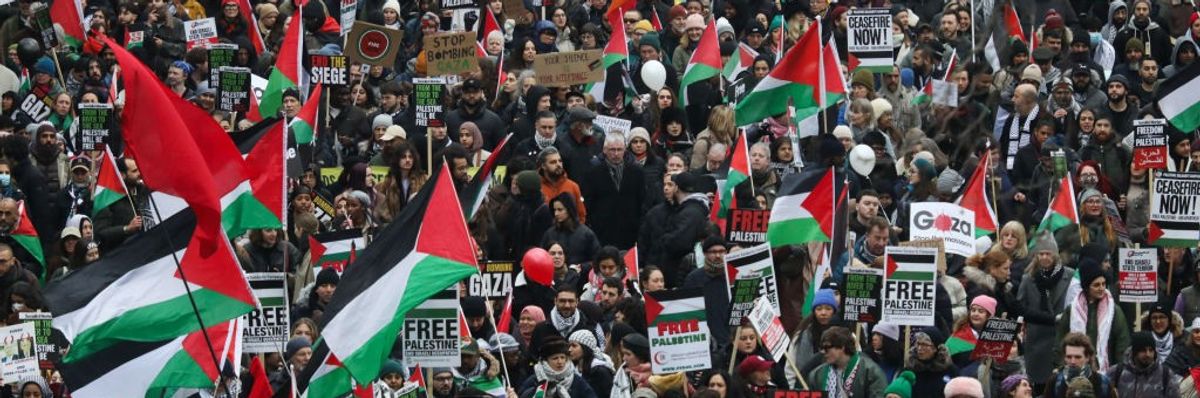
Thousands gather outside of the Pennsylvania Station in New York City on November 17 (Photo: Wyatt Souers/ANSWER Coalition)

In the early hours of November 22, Israeli and Hamas officials announced that they accepted the agreement brokered by Qatar, Egypt, and the United States for a 4-day pause in aggression in the Gaza Strip, which includes the exchange of 150 Palestinian political prisoners for 50 non-military Israeli hostages, as well as the entry of 300 trucks of humanitarian aid into the besieged Gaza Strip. 

This temporary pause comes after Israel has slaughtered over 14,500 Palestinians in Gaza, with 7,000 still trapped under the rubble and over 35,000 wounded. Israel’s airstrikes on hospitals and civilian infrastructure as well as the complete blockade on the enclave means that the thousands of injured have limited access to care and the population overall has restricted access to medicine, water, food, fuel, and electricity. The Government Media Office in Gaza reports that 1.5 million Palestinians have been displaced, with 233,000 homes partially damaged and 45,000 completely damaged. 266 schools have been damaged, and 67 are now out of service. Israel has completely destroyed 85 mosques, and significantly damaged three churches. 

“The steadfast resilience and resistance of the Palestinian people has delivered a 4-day pause in the ongoing genocide while securing the imminent release of 150 Palestinian political prisoners,” read a statement signed by the Palestinian Youth Movement, National Students for Justice in Palestine, The People’s Forum, ANSWER Coalition, and the International Peoples’ Assembly. 

The groups have called on people to remain in the streets around the world, to ensure that a permanent ceasefire is reached: “We must intensify our commitment and efforts until every single one of our demands is fulfilled: a permanent ceasefire, an end to the siege on Gaza, and an end to all US, Canadian, and European aid to Israel.” 

“We call on people of conscience everywhere to Shut it Down on November 24th and to continue protesting, planning and implementing direct actions, and drive campaigns focused on our primary demands,” the statement read, referring to the 3rd announced day of “shut downs” for strategic actions for Palestine. 

International NGOs are also pushing for a more permanent ceasefire. In a press briefing on “Ceasefire, Pauses and Safe Corridors” held on November 22, hours after the deal was reached, Joel Weiler, executive director of Médecins du Monde, said “for a medical organization, four days of pause is….band aid, not health care,” arguing it would be insufficient time for treatment of serious injuries. Danila Zizi, Handicap International director for Palestine, said “it’s a kind of drop in the ocean if we don’t have fuel and we don’t have access,” complaining about the lack of clarity around the agreement.

“The only way to meet all these needs,” or respect for human rights and access to healthcare, “is a permanent, sustained cessation of humanitarian law violations and a cease fire long enough to restore human rights to millions of people,” said Paul O’Brien, Executive Director of Amnesty International USA. “That’s why we’re joining this call for an immediate and sustained ceasefire.”

Regarding the announcement of the agreement, Hamas stated, “The terms of this agreement were formulated according to the vision of the resistance and its determinants, which aim to serve our people and enhance their steadfastness in the face of aggression, constantly mindful of their sacrifices, suffering, concerns, and managing these negotiations from a position of steadfastness and strength in the field, despite the occupation’s attempts to prolong and procrastinate the negotiations.”

Israeli newspaper Haaretz reported that this exact same deal was put forward to Prime  Minister Benjamin Netanyahu previously, but was rejected. According to an analysis piece in the Israeli paper of record, Netanyahu caved under pressure from the families of Israelis held hostage in Gaza as well as the IDF, Shin Bet, and the Mossad. Multiple reports indicate that Israeli airstrikes in Gaza have killed many of their own hostages.

On Wednesday, Lieutenant Colonel Richard Hecht, the IDF’s international spokesperson, said in a press briefing that, “our terminology is not ceasefire, our terminology is an operational pause,” implying that Israel could resume violence once the hostage exchange is complete. Hecht also suggests that the pause might not begin in over 24 hours. 

Wounded and hospitalized Gazans continue to be targeted by the IOF, with convoys evacuating the wounded obstructed by Israeli forces at checkpoints or Israelis launching further airstrikes near hospitals, such as the Al-Aqsa Martyrs Hospital and the Al-Yemen Al-Saeed Hospital. 

“As medical humanitarians, we reassert that hospitals should never, under any circumstances be a target,” asserted Avril Benoît, Executive Director of Doctors Without Borders/Médecins Sans Frontières in the United States, in Wednesday’s press briefing. She added, “It’s dangerous and terrifying to think what is happening to the norms, to the laws of war. It’s like this dystopian reality now where all the normal scaffolding of what is the conduct of responsible parties in a conflict are being completely perverted.”

Original article republished from people dispatch under a Creative Commons Attribution-ShareAlike 4.0 (CC BY-SA) license.

Continue ReadingDemands grow for a permanent ceasefire

Amid War Crimes Charges, Human Rights Watch Says Israel Must ‘End Attacks on Hospitals’

Spread the love

Original article by JAKE JOHNSON republished from Common Dreams under Creative Commons (CC BY-NC-ND 3.0). 

Wounded people receive treatment at the Aqsa Indonesia Hospital after an Israeli attack on the Jibalia refugee camp on November 13, 2023. (Photo: Fadi Alwhidi/Anadolu via Getty Images)

“Israel’s broad-based attack on Gaza’s healthcare system is an attack on the sick and the injured, on babies in incubators, on pregnant people, on cancer patients. These actions need to be investigated as war crimes.”

Human Rights Watch on Tuesday demanded that the Israeli government immediately cease its deadly attacks on Gaza’s hospitals, arguing they’re part of a far-reaching and unlawful assault on the territory’s crumbling healthcare system.

In a new report, HRW examines the impacts of the Israeli bombing campaign, ground invasion, and siege on Gaza’s medical personnel and facilities, a majority of which have stopped functioning due to airstrike damage or lack of critical supplies, from fuel to anesthetics.

“Israel’s repeated attacks damaging hospitals and harming healthcare workers, already hard hit by an unlawful blockade, have devastated Gaza’s healthcare infrastructure,” said A. Kayum Ahmed, special adviser on the right to health at Human Rights Watch. “The strikes on hospitals have killed hundreds of people and put many patients at grave risk because they’re unable to receive proper medical care.”

Over the past week, Israeli forces have surrounded and intensified their bombardment of several hospitals in northern Gaza including al-Shifa, the enclave’s largest medical facility. Israel has also bombed ambulances and people desperately attempting to flee hospitals as they’ve come under attack.

“On November 3, the Israeli military struck a marked ambulance just outside of Gaza City’s al-Shifa hospital,” HRW said. “Video footage and photographs taken shortly after the strike and verified by Human Rights Watch show a woman on a stretcher in the ambulance and at least 21 dead or injured people in the area surrounding the ambulance, including at least 5 children.”

“An IDF spokesperson said in a televised interview that day: ‘Our forces saw terrorists using ambulances as a vehicle to move around. They perceived a threat and accordingly we struck that ambulance,'” the group added. “Human Rights Watch did not find evidence that the ambulance was being used for military purposes.”

HRW similarly questioned Israeli assertions that Hamas is using Gaza’s hospitals, including al-Shifa, for military operations.

Targeting hospitals is a war crime under international law, but medical facilities can lose their protected status if they’re used to commit an “act harmful to the enemy,” according to the International Committee of the Red Cross (ICRC).

HRW argued that Tuesday that “no evidence put forward” by the Israeli government thus far “would justify depriving hospitals and ambulances of their protected status under international humanitarian law.”

“When a journalist at a news conference showing video footage of damage to the Qatar Hospital sought additional information to verify voice recordings and images presented, the Israeli spokesperson said, ‘Our strikes are based on intelligence,'” HRW said. “Even if accurate, Israel has not demonstrated that the ensuing hospital attacks were proportionate.”

The group said Israel “should end attacks on hospitals” and urged the United Nations’ Independent International Commission of Inquiry on the Occupied Palestinian Territory and the International Criminal Court to investigate.

“Israel’s broad-based attack on Gaza’s healthcare system is an attack on the sick and the injured, on babies in incubators, on pregnant people, on cancer patients,” said Ahmed. “These actions need to be investigated as war crimes.”

The new analysis came amid horrific reports of the impact that Israel’s assault is having on healthcare workers, patients, and displaced people seeking refuge from near-constant airstrikes.

Reuters reported that people trapped inside al-Shifa Hospital “plan to start burying bodies within the hospital compound” on Tuesday “because the situation has become untenable.” The World Health Organization said over the weekend that the facility is “not functioning as a hospital anymore” due to power outages and a lack of supplies, which have caused the deaths of a number of patients—including premature babies.

Dr. Ahmed Al Mokhallalati, a surgeon at al-Shifa, told Reuters that “the bodies were generating an unbearable stench and posing a risk of infection.”

“Unfortunately there is no approval from the Israelis to even bury the bodies within the hospital area,” he said. “Today … civilians started digging within the hospital to try and bury the bodies on their own responsibility without any arrangements by the Israeli side. Burying 120 bodies needs a lot of equipment, it can’t be by hand efforts and by single-person efforts. It will take hours and hours to be able to bury all these bodies.”

Doctors Without Borders, known internationally as Médecins Sans Frontières (MSF), said that on Tuesday morning, “bullets were fired into one of three MSF premises located near al-Shifa hospital and sheltering MSF staff and their families—over 100 people, including 65 children, who ran out of food last night.”

“Thousands of civilians, medical staff, and patients are currently trapped in hospitals and other locations under fire in Gaza City; they must be protected and afforded safe passage if they wish to leave,” the group added. “Above that, there must be a total and immediate cease-fire.”

Original article by JAKE JOHNSON republished from Common Dreams under Creative Commons (CC BY-NC-ND 3.0). 

Continue ReadingAmid War Crimes Charges, Human Rights Watch Says Israel Must ‘End Attacks on Hospitals’

Over 50 Bodies Pulled From Rubble of Gaza School Bombed Amid Israeli Assault

Spread the love

Original article by BRETT WILKINS republished from Common Dreams under Creative Commons (CC BY-NC-ND 3.0).

Men check the bodies of people killed in bombardment that hit a school housing displaced Palestinians, as they lie on the ground in the yard of al-Shifa hospital in Gaza City on November 10, 2023.  (Photo: Khoder al-Zaanoun/AFP via Getty Images)

As the death toll from Israel’s obliteration of Gaza topped 11,000, U.S. Secretary of State Antony Blinken said “far too many Palestinians have been killed”—while the United States’ armed aid to Israel continues.

Palestinian civil defense officials said Friday that more than 50 bodies were recovered from the rubble of a school in northern Gaza where civilians were sheltering when it was destroyed during overnight Israeli bombardment.

Palestine’s WAFA News Agency reported civil defense and ambulance rescue teams removed the blasted and crushed remains of victims of Thursday night’s missile and artillery strikes on the al-Buraq School in the al-Nasr neighborhood of Gaza City. The outlet said that most of those killed were women, children, and elders.

The Times of Israel reports that Israel Defense Forces (IDF) officials have not yet commented on the attack.

Injured survivors of the attack were rushed to al-Shifa Hospital, which was hit by Israeli airstrikes at least four times over the past 24 hours.

https://twitter.com/PalestineChron/status/1722988640320516470?ref_src=twsrc%5Etfw%7Ctwcamp%5Etweetembed%7Ctwterm%5E1722988640320516470%7Ctwgr%5Eb7a1a887a55b4dcb904301bcc9c73e5116d2a6e4%7Ctwcon%5Es1_c10&ref_url=https%3A%2F%2Fwww.commondreams.org%2Fnews%2Fisrael-bombing-schools-and-hospitals

As Common Dreams reported earlier Friday, Israeli strikes targeted the courtyard and obstetrics department of the hospital, where doctors have been forced to operate on patients without anesthesia after running out of critical supplies to treat an overwhelming number of wounded victims. Gaza officials said 13 people died in the attacks on al-Shifa.

In an interview with Al Jazeera, al-Shifa general director Muhammad Abu Salmiya called Friday “a day of war against hospitals.”

Israeli officials have made unsubstantiated claims of Hamas fighters operating from inside or under al-Shifa and other Gaza hospitals.

On Friday Israeli warplanes bombed in the vicinity of the Indonesian Hospital in Bait Lahia—where doctors announced a cessation of surgeries—while Mustafa al-Kahlout, director of the al-Nasr hospital and al-Rantisi Children’s Hospital in northern Gaza, told CNN that Israeli tanks had “surrounded” the complex.

Jens Laerke, spokesperson for the U.N. Office for the Coordination of Humanitarian Affairs, said Friday that northern Gaza resembles “hell on Earth” due to Israel’s bombardment and a lack of aid.

Nearly 200 health workers, over 100 United Nations personnel, and dozens of journalists have been killed by Israeli forces during the war.

The Gaza Health Ministry said Friday that at least 11,078 Palestinians—including more than 3,000 women and over 4,500 children—have been killed and upward of 27,000 injured by Israeli bombs and bullets since October 7, when Hamas-led attacks on Israel killed around 1,200 civilians and soldiers, with another 240 or so people taken hostage. Israeli officials on Friday revised down their death toll, which they previously said was higher than 1,400.

According to Gaza officials, around 70% of Gaza’s 2.3 million people have been forcibly displaced, while half the homes in the besieged strip have been destroyed. Officials also said 238 schools, 67 mosques, and 88 government buildings have been wiped out by Israeli attacks.

In the illegally occupied West Bank and East Jerusalem—whose residents were already suffering the deadliest year since the second intifada, or uprising, a generation ago—Israeli soldiers and settlers have killed at least 182 Palestinians while wounding thousands more since October 7.

A growing number of legal expertsactivists, and other observers are calling Israel’s war on Gaza “genocidal”—a characterization rejected by Israeli and U.S. leaders, with a handful of exceptions.

(Image: Andalou via Getty Images)

After 35 days of relentless and indiscriminate bombing—an IDF spokesperson acknowledged early in the war that “the emphasis is on damage and not on accuracy”—U.S. Secretary of State Antony Blinken said Friday during a visit to India that “far too many Palestinians have been killed.”

However, the U.S. continues to stand staunchly behind its number one Middle Eastern ally, with the Biden administration and Congress working on a $14.3 billion military aid package to Israel, atop the nearly $4 billion the country already receives from Washington annually. The U.S. also provides diplomatic cover for Israel, including a recent veto of a Brazil-led United Nations Security Council cease-fire resolution.

While Israel on Thursday agreed to daily four-hour humanitarian pauses for at least three days so that civilians have a chance to flee the constant bombardment and advancing IDF ground forces, Israeli officials—and U.S. President Joe Biden—stress that no cease-fire is imminent.

Israeli leaders have said a cease-fire is off the table until all hostages held by Gaza-based militants are freed. Abu Hamza, the military spokesperson of the al-Quds Brigades, the armed wing of Palestinian Islamic Jihad, said Thursday that the group was preparing to release an elderly woman and teenage boy in its custody.

United Nations Relief and Works Agency for Palestine Refugees in the Near East Commissioner-General Philippe Lazzarini wrote in an opinion piece published Thursday by The Washington Post that “the present course chosen by the Israeli authorities will not bring the peace and stability that both Israelis and Palestinians want and deserve.”

“Razing entire neighborhoods to the ground is not an answer for the egregious crimes committed by Hamas,” Lazzarini asserted. “To the contrary, it is creating a new generation of aggrieved Palestinians who are likely to continue the cycle of violence. The carnage simply must stop.”

Original article by BRETT WILKINS republished from Common Dreams under Creative Commons (CC BY-NC-ND 3.0).

Continue ReadingOver 50 Bodies Pulled From Rubble of Gaza School Bombed Amid Israeli Assault