Following Pattern Set by Venezuela and Iran Assaults, US Surveillance Flights Off Cuba Surge

Spread the love

Article by Jake Johnson republished from Common Dreams under Creative Commons (CC BY-NC-ND 3.0).
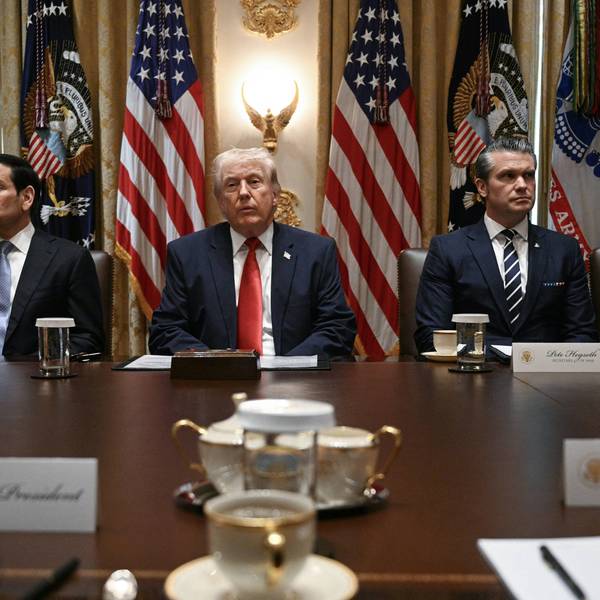
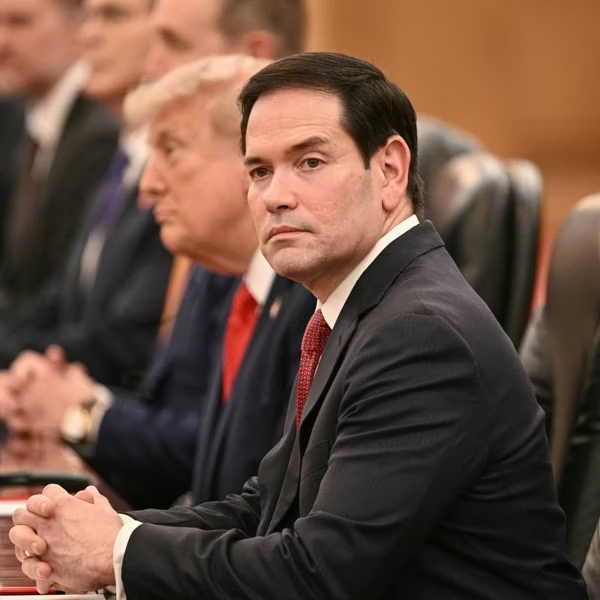
Pentagon Secretary Pete Hegseth and Secretary of State Marco Rubio speak in Washington, DC on January 7, 2026. (Photo by Brendan Smialowski/AFP via Getty Images)

The Trump administration has conducted more than two dozen surveillance and reconnaissance flights off Cuba’s coast since early February, according to CNN.

US surveillance and reconnaissance flights off the coast of Cuba have surged in recent months as President Donald Trump has issued increasingly belligerent threats to seize the island nation by force.

CNN reported Sunday that the US Navy and Air Force have conducted more than two dozen surveillance flights—mostly of them near Havana and Santiago de Cuba, the country’s largest cities—since early February, after the Trump administration invaded Venezuela and kidnapped its president. The outlet noted that “similar patterns, in which ramped-up rhetoric by the Trump administration coincided with an uptick in publicly visible surveillance flights, occurred in the lead-up to US military operations in both Venezuela and Iran.”

RECOMMENDED…

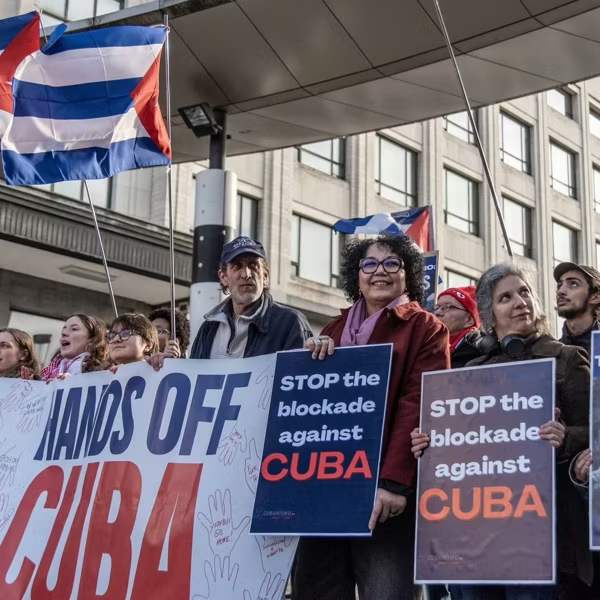
People protest against Trump aggression against Cuba with signs reading "Stop the Blockade Against Cuba"

‘This Is Insane’: Alarm Bells Follow New Report of Looming US Plan to Attack Cuba

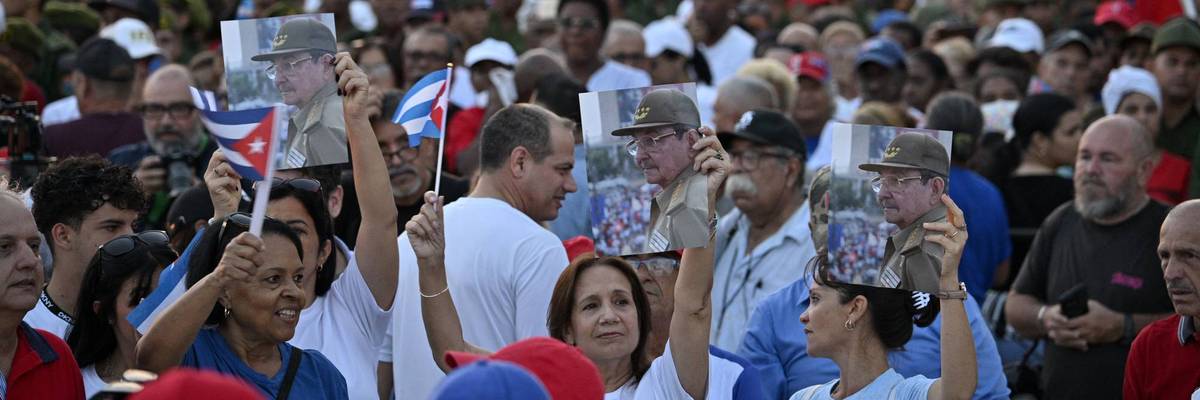
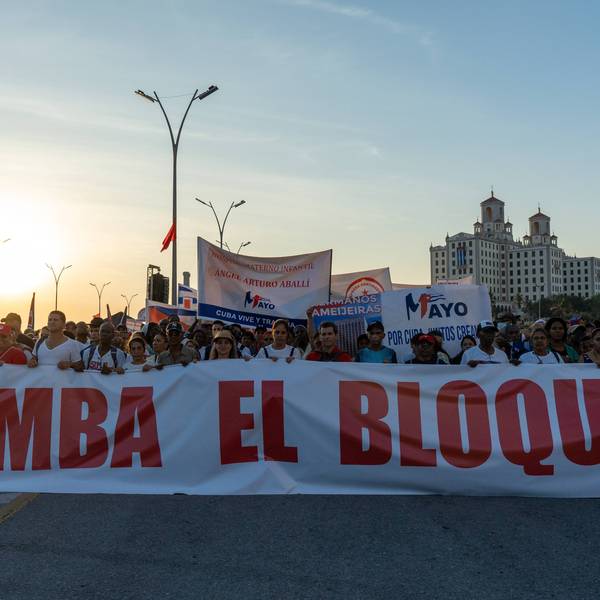
May Day celebrations mark annual workers parade in Havana

Citing Bogus ‘Threats’ to US, Trump Expands Already Devastating Sanctions on Cuba

“The flights are notable not only for their proximity to the coast, which puts them well within range of gathering intelligence, but for the suddenness of their appearance—prior to February, such publicly visible flights were exceedingly rare in this area—and for their timing,” CNN reported.

CNN published its story days after US Secretary of State Marco Rubio announced new sanctions targeting a conglomerate operated by Cuba’s military and a natural resources firm, intensifying the United States’ decades-long economic war against the island nation.

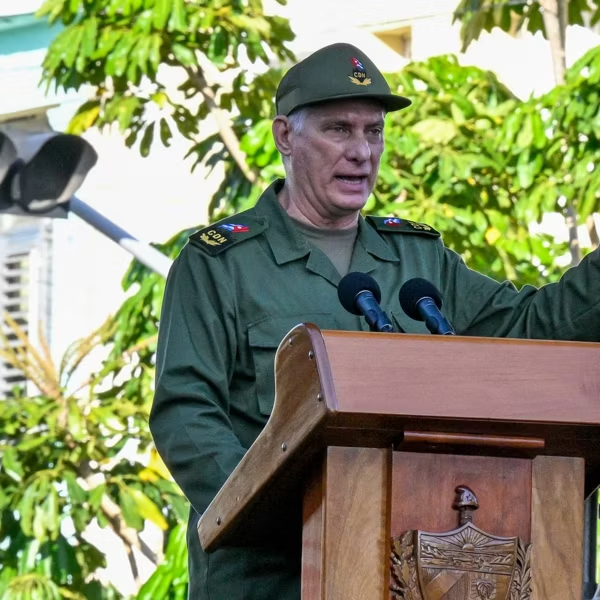
“Our people already know the cruelty behind the actions of the US government and the viciousness with which it is capable of attacking us,” Cuban President Miguel Díaz-Canel said in response to the sanctions. “They understand, just as the rest of the world does, that this is a unilateral aggression against a nation and a population whose sole ambition is to live in peace, masters of their own destiny and free from the pernicious interference of US imperialism.”

In a New York Times op-ed on Monday, US Reps. Pramila Jayapal (D-Wash.) and Jonathan Jackson (D-Ill.) wrote that the Trump administration’s “blockade of fuel to Cuba, on top of the longest embargo in modern US history, defies the norms of international law that provide for state sovereignty, nonintervention in domestic affairs and the right of nations to trade freely.”

“It amounts to an economic assault on the basic infrastructure of Cuba, designed to inflict collective punishment on the civilian population by manufacturing a humanitarian crisis in which healthcare, running wateragriculture and transportation are no longer available,” wrote Jayapal and Jackson, who visited Cuba in April and witnessed firsthand the devastating impact of US economic warfare.

“During our visit, we spoke with a wide range of Cuban citizens—political dissidents, religious leaders, entrepreneurs, and members of civil society organizations and humanitarian aid groups,” the Democratic lawmakers wrote. “We also met with the families of Cuba’s political prisoners. Everywhere, there was agreement: America’s blockade must end, and a US invasion must not take place.”

Trump has repeatedly threatened a military assault on Cuba in the months since his administration illegally attacked Venezuela and abducted its president.

“Cuba is next, by the way,” Trump declared at a Saudi-backed investment summit in Miami in late March. “Pretend I didn’t say that, please.”

Citing unnamed US officials, The Associated Press reported last week that the Trump administration “is not looking at imminent military action against Havana” as the two sides continued to negotiate a diplomatic agreement.

AP added that the administration officials cautioned “that Trump could change his mind at any time and that military options are still on the table.”

Article by Jake Johnson republished from Common Dreams under Creative Commons (CC BY-NC-ND 3.0).

Climate science denier Donald Trump confirms that he knows nothing about democracy and that more liquid gold is being secured according to his policy of global privateering.
Orcas discuss rotting brain, front Orca says disinhibition and swearing are typical and common symptoms
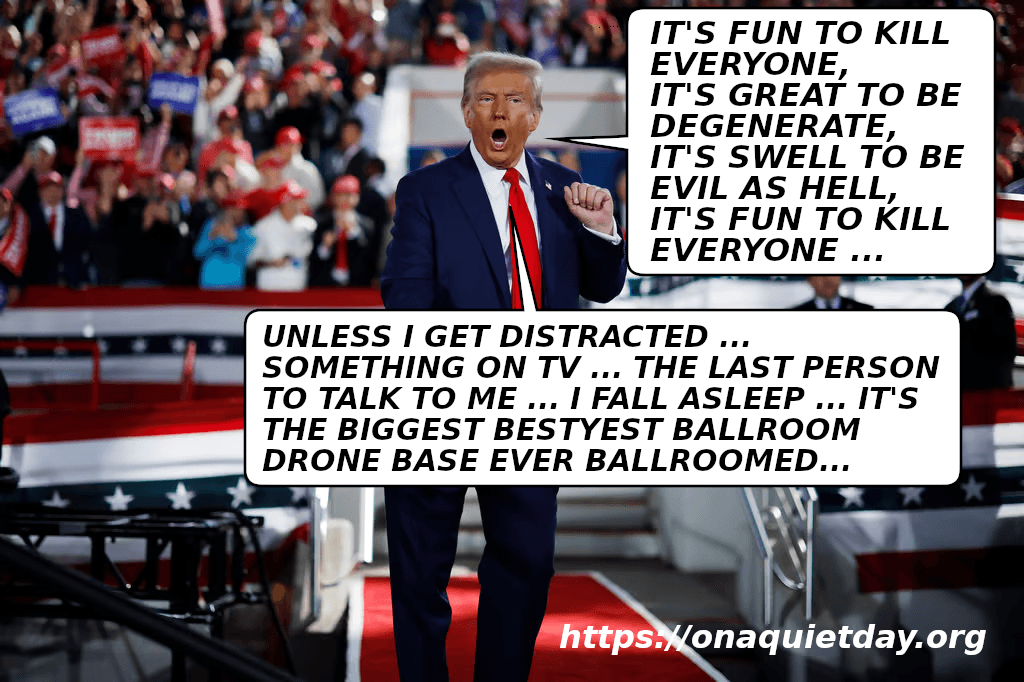
Donald Trump sings and dances, says that it's fun to kill everyone ...
Donald Trump sings and dances, says that it’s fun to kill everyone …
Continue ReadingFollowing Pattern Set by Venezuela and Iran Assaults, US Surveillance Flights Off Cuba Surge

Tens of thousands of Cubans march in support of Venezuela’s sovereignty amid US aggression

Spread the love

This article by Pablo Meriguet republished from peoples dispatch under a Creative Commons Attribution-ShareAlike 4.0 (CC BY-SA) license.

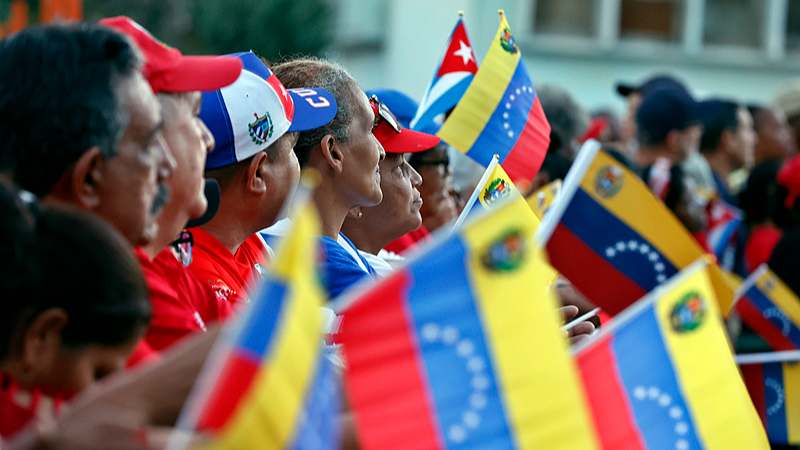
People hold up Cuban and Venezuelan national flags during a rally in support of Venezuela, in Havana, Cuba, October 17, 2025. Photo: CGTN

The demonstration rejected US interference in Venezuela’s internal affairs as US military operations in the Caribbean Sea increase.

On October 17, tens of thousands of Cubans took to the streets of Havana to show their support for Venezuela in the face of a potential intervention by the United States following its recent military deployment in the Caribbean Sea.

Under anti-imperialist and pro-sovereignty slogans, nearly 50,000 participants gathered in front of the statue of Simón Bolívar, the Venezuelan military leader and independence politician. The event was led by the country’s president, Miguel Díaz-Canel.

The event was also attended by Pedro Infante Aparicio, vice president of the United Socialist Party of Venezuela and the National Assembly, who told those present that both Cuba and Venezuela are victims of the supremacism and warmongering of the White House. He added: “From this platform, we join President Nicolás Maduro in calling for an end to the xenophobic attempts to compare the dignity of Venezuelans with criminal groups, and we demand an end to the policy of terrorism against our people.”

For his part, Díaz-Canel wrote on X: “At a time when the empire and its misguided leader are approving covert CIA operations against Venezuela, we express our solidarity with that brotherly people and, especially, with its President Nicolás Maduro. Today, Cuba is more mindful than ever of the words of [José] Martí: ‘Give me Venezuela to serve, she has in me a son,’ and of Fidel [Castro]: ‘For Venezuela, we must give everything. We are confident that Venezuela and its popular, military, and police forces will once again overcome the threats and actions of the empire.”

Read More: Trump’s military escalation against Venezuela repeats the Iraq War blueprint

In addition, Díaz-Canel presented a book containing more than 4 million signatures from Cubans who support the Bolivarian Revolution and condemn attempts to destabilize the government of Nicolás Maduro. 

For his part, Roberto Morales Ojeda, secretary of organization of the Central Committee of the Communist Party of Cuba, stated: “We are one soul, which does not give up. Receive these signatures as the greatest and most eloquent show of love that can be offered to a sister nation, led by constitutional President Nicolás Maduro and with an admirable military-popular fusion, which is preparing to face and defeat any aggression that may occur.”

For its part, the official newspaper of the Communist Party of Cuba, Granma, wrote in an editorial: “Because the sister nation of Venezuela is not alone and because its resistance symbolizes the history of all peoples who believe in sovereignty, more than 50,000 Havana residents, representing all Cubans, gathered today in front of the statue of liberator Simón Bolívar in solidarity with that country.

Military pressure against Venezuela intensifies

Several weeks ago, the United States deployed a large number of ships and troops to the Caribbean Sea to supposedly stop drugs from entering the United States. In addition, Washington declared the Cartel of the Suns an international terrorist organization and claimed that Maduro and other senior Chavista leaders were running the cartel.

Read More: Trump chooses war over diplomacy in the Caribbean

The United States is offering a USD 50 million reward for information leading to Maduro’s arrest and conviction. These accusations have been categorically denied by Venezuelan authorities, who see them as an attempt to legitimize a possible armed invasion of the South American country.

Under this premise, which many have questioned, Washington has claimed that it has sunk five small boats allegedly carrying drugs, killing 27 people on board. This type of pressure is in addition to the economic sanctions and trade blockades imposed by Washington for several years.

In addition, it was revealed a few days ago that Donald Trump had authorized secret CIA operations in Venezuela, according to the New York Times. Among the covert operations are lethal actions carried out in coordination with or independent of the US military.

This article by Pablo Meriguet republished from peoples dispatch under a Creative Commons Attribution-ShareAlike 4.0 (CC BY-SA) license.

Donald Fuhrump says that Amerikkka doesn't bother with crimes or charges anymore, not being 100% Amerikkkan and opposing his real estate intentions is enough.
Donald Fuhrump says that Amerikkka doesn’t bother with crimes or charges anymore, not being 100% Amerikkkan and opposing his real estate intentions is enough.
Orcas discuss how Trump was re-elected and him being an obviously insane, xenophobic Fascist.

Continue ReadingTens of thousands of Cubans march in support of Venezuela’s sovereignty amid US aggression

Fidel Castro: a life of revolution

Spread the love

Original article by Pablo Meriguet republished from peoples dispatch under a Creative Commons Attribution-ShareAlike 4.0 (CC BY-SA) license.

Fidel Castro in the Sierra Maestra with Guillermo García, Ernesto “Che” Guevara, Universo Sánchez, Raúl Castro, Crescentio Pérez, Jorge Sotus, and Juan Almeida. Photo: Wikimedia Commons

August 13 marks the anniversary of the birth of Marxist and communist revolutionary Fidel Castro, one of the most influential political leaders of the 20th century. Read our series of articles about the political life of the revolutionary leader.

Fidel Castro was born in Biran, in the east of the island of Cuba, in 1926, and died in Havana on November 25, 2016. His historical figure however, transcends the time in which he lived. Even when historians study the period in the region before the Cuban Revolution, they always keep in mind that, during the 1950s, on a Caribbean island, social, economic, and political changes would take place that would transform the entire history of the continent.

In this case, Fidel’s name cannot be detached from a process that shook the foundations of the entire Latin American and Caribbean society. Although the “Comandante” himself disavowed the simplification of revolutionary and historical processes to a few names, it seems that human memory prefers to engrave in its memory certain individuals rather than economic forces, cultural disputes, or political ideas. At least this has been the case with Fidel, whose figure is tied to the destiny of a country, just as Bolívar is tied to Venezuela, Juarez to Mexico, and Martí to Cuba.

The young student

Fidel studied at a Jesuit school, and perhaps because of this he always maintained an unyielding intellectual discipline, as well as an almost stoic confidence in the unity of any political group that has clear general objectives. At university, he studied law and social sciences. There he began to read several books on politics while presiding over the Federation of University Students (FEU), a space which he was active in during the struggle against the government of Ramón Grau San Martín, and in which he began to denounce the bloody dictatorship of the infamous Rafael Trujillo in the Dominican Republic.

As president of the FEU, he traveled to Colombia to attend the Inter-American Student Conference and meet personally with Jorge Eliecer Gaitan, the Colombian politician, whose assassination, a few hours before his meeting with the young Fidel, would set off a historical process in Colombian society that began with the famous “Bogotazo”.

Once he finished his university studies, he tried to enter national politics by running for the House of Representatives in 1952, but the disastrous coup d’état of Fulgencio Batista overthrew the government of Carlos Prío Socarrás and prohibited future elections. Fidel tried to denounce Batista before the courts for violating the constitution, but the denunciation was denied. Faced with this adversity, the young Fidel understood that elections and legal denunciations were not an adequate way to engage in political struggle at that time in Cuba.

The beginning of the revolutionary struggle

That is how several young revolutionaries decided to follow the path of armed struggle. On July 26, 1953, they attacked two military bases (the “Moncada” in Santiago de Cuba and the “Carlos Manuel de Céspedes” in Bayamo) which stored thousands of weapons and were located in areas where the people were mostly opposed to the Batista dictatorship. They had hoped that the attack would provoke sympathy among the population and the young military who doubted the dictatorship. But all plans, including the escape plans, failed. More than 80 young revolutionaries were tortured and killed by the repressive forces.

Fidel quickly understood that not every military failure necessarily implies a political failure. In the trial against him, he gave a famous and brilliant self-defense in which he defended two fundamental theses. In the first place, he said that the intellectual author of the attack was named José Martí, implying that the Cuban independence hero, who had died more than 50 years ago, inspired the sovereign ideals of the young revolutionaries. This implied that the revolutionary struggle in Cuba had not ended with Independence from Spain, but continued, thus establishing a political thesis to be followed by the various revolutionary movements in Latin America and the Caribbean during the sixties and seventies of the 20th century: the struggle for independence has not ended because there is still imperialist subjugation. Secondly, he concluded that, although they had been defeated and imprisoned, they were right to act in that way, and that historical time would know how to judge better what at that time seemed a risky adventure of a few young people: “History will absolve me,” Castro said before the judge.

He was imprisoned for almost two years on the Isla de Pinos before being acquitted and banished from Cuba on May 15, 1955. Batista thus hoped to get rid of an uncomfortable political prisoner, although in reality, by doing so, he sentenced himself (in the not-too-distant future) to be defeated militarily and to die in exile in the Spain of fellow dictator Francisco Franco.

After prison, Fidel Castro traveled to the United States and Mexico. In Mexico, he trained (under an ex-combatant of the Spanish Civil War named Alberto Bayo) and organized an expedition of fighters, among them Ernesto “Che” Guevara. The emerging political-military group was called the “26th of July Movement”, in honor of the attack on the military bases. The purpose was clear: to defeat the Batista dictatorship and create a more equitable country. Several months earlier Fidel said in the Palm Garden Hotel in New York City that “In the year 1956 we will be free or we will be martyrs. This struggle began for us on March 10, has lasted almost four years and will end on the last day of the dictatorship or on our last day.”

The Cuban Revolution

Aboard the now revered yacht Granma, a group of 82 expedition members left the coast of Veracruz for Cuba on November 25, 1956. They arrived in Cuba on December 2. Fidel imitated Martí’s military strategy, which consisted of disembarking in the eastern part of the country and approaching the capital from the extreme east of Cuba, passing through the Sierra Maestra, a slight mountain range on the island.

At first, it seemed that the new revolutionary struggle would fail…again. Batista’s army had discovered Castro’s plans and attacked the revolutionary troops with all its might. In Santiago de Cuba, the dictatorship managed to suppress the urban uprising commanded by Frank País, also a member of the Movement 26 of July, in support of the landing of the Granma (which, however, was several days late in arriving). They also quickly discovered the place of arrival of Castro and the rest of the combatants, attacking the guerrillas by air and sea.

After several combats, dispersions, persecutions, and regroupings, only 17 of the 82 original expedition members survived. Despite the obvious adversity, Fidel exclaimed upon meeting with the few survivors: “Now we will win the war!”, which shows a position of historical certainty that Che Guevara would explain years later: “Fidel was certain that, if we left Mexico, we would reach Cuba. If we arrived in Cuba, we would disembark. If we disembarked, we would fight. And if we fight, we will win.

During the coming months, hundreds of new fighters joined Castro’s troops, which were eventually divided into five columns commanded by him, his brother Raul, Camilo Cienfuegos, Che Guevara, and Juan Almeida. However, Batista’s army had more than 70,000 soldiers, so the Movement 26 of July launched a guerrilla war in various parts of the country. Batista launched a military offensive called “Operation Summer”, in which he sent 17 battalions to destroy the Rebel Army, but they were surprised with a series of victories by the revolutionary forces.

Fidel’s popularity began to increase. The Revolutionary Directory, another anti-Batista armed group, attacked the Presidential Palace in Havana to assassinate Batista but were defeated. Despite this, Batista’s invincible image began to be demystified. In addition, the dictatorship increased extrajudicial assassinations and torture against political opponents (the most famous case is the death of Frank País), which eroded the government’s public image. On September 5, the Cienfuegos naval base revolted along with several members of the Movement 26 of July. The government responded to the uprising with a bombing in which more than 400 people died. The majority of the Cuban people repudiated the cruelty with which Batista’s troops acted. The government’s repression only made the revolutionaries more popular.

In addition, after several interviews with international media, Fidel and his followers began to gain support outside Cuba, while denouncing the horrendous crimes of the Batista dictatorship.

During several months of armed struggle, Fidel proved to be the only leader capable of uniting the different factions opposing the dictatorship. The most important political movements recognized that he was the only figure capable of commanding the overthrow of Batista. In addition, Fidel proved to be a very astute military strategist, withdrawing his troops in difficult moments and counter attacking fearlessly when he found the slightest opportunity to gain territory. In this way, he managed to conquer most of the East and Center of the country by the end of 1958. Guevara and his troops managed to take the city of Santa Clara, the last strategic defense of Havana.

Despite the attempt of several military men to carry out an orderly withdrawal of Batista and his troops, Fidel ordered a final attack against the forces of the dictatorship. In this way, Castro sought to curtail the installation of a puppet government and assure the establishment of a truly revolutionary government. “Revolution yes, military coup no!” was Fidel’s phrase repeated by radio throughout the Caribbean island. Batista managed to flee Cuba with the support of US Ambassador Earl T. Smith.

Despite the apparent impossibility of the geopolitical situation, the Cuban Revolution triumphed on January 1, 1959 just to the south of the United States.

Fidel was right: victory was possible in Cuba despite all possible disadvantages. It was a matter of finding the right strategy. The Cuban Revolution inspired dozens of political groups to fight to seize power throughout Latin America and across the Global South, often with Cuban support. Thus began a new era in the history of the Caribbean island, which will never forget the name of Fidel Castro.

Original article by Pablo Meriguet republished from peoples dispatch under a Creative Commons Attribution-ShareAlike 4.0 (CC BY-SA) license.

Continue ReadingFidel Castro: a life of revolution

This May Day, workers mobilized for Palestine

Spread the love

Original article by Natalia Marques republished from peoples dispatch under a Creative Commons Attribution-ShareAlike 4.0 (CC BY-SA) license.

Student workers of Columbia organized in UAW 2710 participate in May Day rally. Photo: Wyatt Souers

On International Workers’ Day, workers around the world continued to join hands with the student movement to stand with Palestine

On May Day, workers around the world mobilized for the liberation of Palestine. “This May Day, workers of the world are called to declare their solidarity with Palestine, to denounce the Israeli Genocide, and to call for an end to all aggressions in the region and to all wars,” wrote the International People’s Assembly.

“Beyond the call for a ceasefire we must say no to the transportation of arms and arms caches to Israel. Workers in all industries – especially workers in the transport sector – that can withhold their labor in order to halt the continued slaughter of the people of Palestine are emphatically called to do so!”

The National Union of Metalworkers of South Africa released a statement calling on workers around the world to mobilize for Palestine. “The working class are the creators of wealth, and it is the united power of the working class that has the power to overthrow hateful, brutal regimes like Apartheid Israel,” wrote the union. “On this Workers Day, we call on workers of the world to unite in defense of Palestine so that its people can be free, from the river, to the sea!”

“The working class in South Africa must celebrate the defeat of Apartheid, because its destruction was due, largely to the unity of workers, who used their labor power to collapse the system through rolling mass action, strikes and protest,” the union added.

Several Palestinian union formations have called the people in the world to action against the ongoing Israeli genocide in Gaza. This includes the Palestinian General Federation of Trade Unions, which in March called on US unions in particular to “be our voice and advocate inside and outside America.”

“What our people are experiencing and what workers and unions in particular, are exposed to is the most horrific catastrophe known to humanity in recent decades,” the PGFTU wrote. “We ask that you convey our message and give voice to the suffering of hungry, starving workers and their families—not just to the American people, not just to your unions, but to the entire world.”

Palestinian trade unions have also responded in support of the student movement for Palestine that has taken the world by storm. “The Union of Agricultural Work Committees (UAWC) in Palestine extends our deepest solidarity to you, the revolutionary youth who are changing the world,” reads a statement of support from a prominent Palestine farmworkers’ union, addressed to the students movement around the world that is taking action in solidarity with Gaza. “We write to you from Palestine to tell you that your actions are resonating across oceans. In you, we see the echoes of our struggle, the echoes of our resistance, and the echoes of our hope.”

“Our people, along with all the workers and free people of the world, commemorate the first of May this year, at a time when they are subjected to the most brutal and fierce campaign of genocide and ethnic cleansing, surpassing in savagery and bloodiness the fascists and the Nazis, at the hands of a group of murderers calling themselves an army for an invasive replacement entity, under the leadership, partnership, support, cover, and complicity of the American administration and the colonial Western imperial powers, the enemies of humanity,” wrote the Popular Front for the Liberation of Palestine in a pre-May Day statement. “We send a salute of respect and pride to the university students all over the world, especially to the students at American universities, who are protesting against the crimes of the occupation and the support of the American administration for it, and who demand a halt to the aggression against the Palestinian people.”

Within the student movement in the US, university workers are mobilizing their unions to stand with their students in solidarity with Gaza. On April 29, within the Gaza Solidarity Encampment at the City College of New York in New York City, university workers organized under the Professional Staff Congress (PSC-CUNY) held a town hall meeting to deliberate on how to use their labor power to support the five demands of the student encampment. The members attending the town hall organized a wildcat sick-out, in which union members will call in sick en masse to disrupt business as usual at the larger City University of New York (CUNY) system. Workers in the United States face a variety of strike prohibitions, including a nationwide ban on striking for political reasons rather than economic issues such as wages and benefits under the Taft-Hartley Act of 1947.

Nevertheless, the PSC faculty at the town hall voted overwhelmingly to stage a sick-out. “At UT Austin, faculty did a one day job action in support of their students. Palestinian trade unions, National SJP, and National Faculty for Justice in Palestine have called for a mass job action on May 1st,” faculty wrote in a statement. “Our students are taking incredible risks to support the Palestinian people. They have asked for our help. We must stand ready to struggle alongside them, and to take these risks.”

Workers organized with the United Auto Workers, which also represents many graduate student workers across the country, staged a rally in Washington Square Park on April 26 in support of their students staging Gaza Solidarity Encampments at NYU, Columbia, and the New School.

Workers engaged in mass mobilizations around the world on May 1.

Thousands took to the streets in major US cities including Washington, DC and Los Angeles. In DC, demonstrators marched to the Gaza Solidarity Encampments at George Washington University.

‼️🇵🇸A massive May Day march in Los Angeles takes the streets for Palestine! pic.twitter.com/YfDrwNiBis

— Party for Socialism and Liberation (@pslnational) May 1, 2024

✊🏽🇵🇸RIGHT NOW: A massive May Day march is en route to the Gaza Solidarity Encampment at George Washington University pic.twitter.com/esXOVUrhqv

— Party for Socialism and Liberation (@pslnational) May 2, 2024

In New York City, unions such as the United Auto Workers and the New York Taxi Workers Alliance expressed explicit support for the Palestinian cause in a march of 20,000, which ended at the New York University Gaza Solidarity Encampment.

Havana, like every year, was flooded with huge crowds on May Day as President Miguel Diaz-Canel sent an explicit message in support of Palestine and the pro-Palestine student movement. “All our solidarity with the students in the United States, who have taken the side of justice, have come out to support the cause of the Palestinian people, and are brutally repressed on their own university campuses. Today our [May Day] is also going through Palestine,” Diaz-Canel wrote.

In Bogota, President Gustavo Petro made a special announcement during the May Day celebration in front of thousands of Colombians: the nation would officially cut all diplomatic ties with Israel.

Original article by Natalia Marques republished from peoples dispatch under a Creative Commons Attribution-ShareAlike 4.0 (CC BY-SA) license.

Continue ReadingThis May Day, workers mobilized for Palestine