An Arriva bus in north London (Photo: Wikimedia Commons)
Arriva North London bus drivers will be on strike on 26 dates from August to October
An amber heat health alert came into force across most of England as Socialist Worker went to press on Tuesday.
The impact of the soaring temperatures on workers’ health and safety has been staggering, with many employers failing to make adjustments for the heat or provide air conditioning in workplaces.
But bus drivers in north London are refusing to roast for corporate greed.
…
A bus driver and Unite rep at Arriva North told Socialist Worker that workers were effectively “working in a mobile greenhouse”.
He explained that the air cooling systems installed on buses only managed to reduce temperatures by around two or three degrees because they take air from outside and circulate it.
“Driver cab temperatures can be more than 40 degrees, sometimes up to fifty degrees. The systems are just blowing hot air.”
How do you measure climate change? One way is by recording temperatures in different places over a long period of time. While this works well, natural variation can make it harder to see longer-term trends.
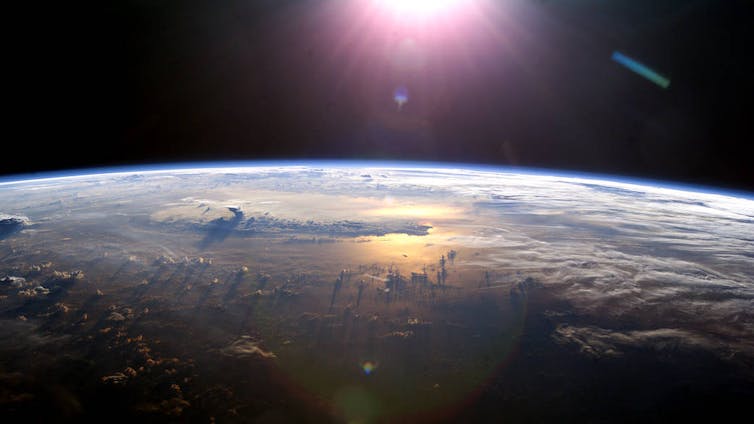
But another approach can give us a very clear sense of what’s going on: track how much heat enters Earth’s atmosphere and how much heat leaves. This is Earth’s energy budget, and it’s now well and truly out of balance.
Our recent research found this imbalance has more than doubled over the last 20 years. Other researchers have come to the same conclusions. This imbalance is now substantially more than climate models have suggested.
In the mid-2000s, the energy imbalance was about 0.6 watts per square metre (W/m2) on average. In recent years, the average was about 1.3 W/m2. This means the rate at which energy is accumulating near the planet’s surface has doubled.
These findings suggest climate change might well accelerate in the coming years. Worse still, this worrying imbalance is emerging even as funding uncertainty in the United States threatens our ability to track the flows of heat.
Energy in, energy out
Earth’s energy budget functions a bit like your bank account, where money comes in and money goes out. If you reduce your spending, you’ll build up cash in your account. Here, energy is the currency.
Life on Earth depends on a balance between heat coming in from the Sun and heat leaving. This balance is tipping to one side.
Solar energy hits Earth and warms it. The atmosphere’s heat-trapping greenhouse gases keep some of this energy.
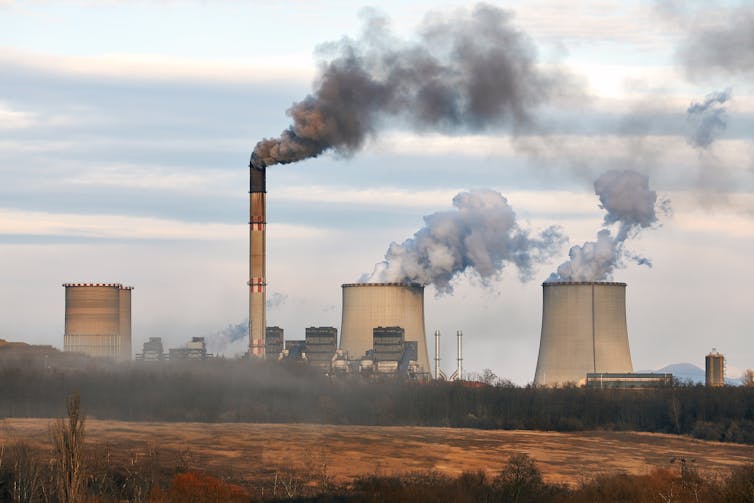
But the burning of coal, oil and gas has now added more than two trillion tonnes of carbon dioxide and other greenhouse gases to the atmosphere. These trap more and more heat, preventing it from leaving.
Some of this extra heat is warming the land or melting sea ice, glaciers and ice sheets. But this is a tiny fraction. Fully 90% has gone into the oceans due to their huge heat capacity.
Earth naturally sheds heat in several ways. One way is by reflecting incoming heat off of clouds, snow and ice and back out to space. Infrared radiation is also emitted back to space.
From the beginning of human civilisation up until just a century ago, the average surface temperature was about 14°C. The accumulating energy imbalance has now pushed average temperatures 1.3-1.5°C higher.
Ice and reflective clouds reflect heat back to space. As the Earth heats up, most trapped heat goes into the oceans but some melts ice and heats the land and air. Pictured: Icebergs from the Jacobshavn glacier in Greenland, the largest outside Antarctica. Ashley Cooper/Getty
Tracking faster than the models
Scientists keep track of the energy budget in two ways.
First, we can directly measure the heat coming from the Sun and going back out to space, using the sensitive radiometers on monitoring satellites. This dataset and its predecessors date back to the late 1980s.
Second, we can accurately track the build-up of heat in the oceans and atmosphere by taking temperature readings. Thousands of robotic floats have monitored temperatures in the world’s oceans since the 1990s.
Both methods show the energy imbalance has grown rapidly.
The doubling of the energy imbalance has come as a shock, because the sophisticated climate models we use largely didn’t predict such a large and rapid change.
Typically, the models forecast less than half of the change we’re seeing in the real world.
Why has it changed so fast?
We don’t yet have a full explanation. But new research suggests changes in clouds is a big factor.
Clouds have a cooling effect overall. But the area covered by highly reflective white clouds has shrunk, while the area of jumbled, less reflective clouds has grown.
It isn’t clear why the clouds are changing. One possible factor could be the consequences of successful efforts to reduce sulfur in shipping fuel from 2020, as burning the dirtier fuel may have had a brightening effect on clouds. However, the accelerating energy budget imbalance began before this change.
Natural fluctuations in the climate system such as the Pacific Decadal Oscillation might also be playing a role. Finally – and most worryingly – the cloud changes might be part of a trend caused by global warming itself, that is, a positive feedback on climate change.
Dense blankets of white clouds reflect the most heat. But the area covered by these clouds is shrinking. Adhivaswut/Shutterstock
What does this mean?
These findings suggest recent extremely hot years are not one-offs but may reflect a strengthening of warming over the coming decade or longer.
This will mean a higher chance of more intense climate impacts from searing heatwaves, droughts and extreme rains on land, and more intense and long lasting marine heatwaves.
This imbalance may lead to worse longer-term consequences. New research shows the only climate models coming close to simulating real world measurements are those with a higher “climate sensitivity”. That means these models predict more severe warming beyond the next few decades in scenarios where emissions are not rapidly reduced.
We don’t know yet whether other factors are at play, however. It’s still too early to definitively say we are on a high-sensitivity trajectory.
Our eyes in the sky
We’ve known the solution for a long time: stop the routine burning of fossil fuels and phase out human activities causing emissions such as deforestation.
Keeping accurate records over long periods of time is essential if we are to spot unexpected changes.
Satellites, in particular, are our advance warning system, telling us about heat storage changes roughly a decade before other methods.
But funding cuts and drastic priority shifts in the United States may threaten essential satellite climate monitoring.
Protesters on Whitehall in London, as Chancellor of the Exchequer Rachel Reeves delivers her spring statement to MPs in the House of Commons, March 26, 2025
Government must take action, union warns: ‘We can’t go on with billionaires getting ever richer whilst working people suffer’
CASH-STRAPPED Britons will be squeezed for an extra £66 every month from April as a barrage of bill hikes sees the cost-of-living crisis bite.
Millions of hard-up households, already paying what MPs said were “world-beatingly” high bills, will be forced to shell out even more for essentials from Tuesday.
GMB union urged ministers to take bold steps to help working people facing across-the-board price rises for energy, water, council tax, internet, road tax and the TV licence.
“Households have been struggling with the cost-of-living crisis for several years now,” said the union’s national secretary Andy Prendergast. “This latest set of increases shows there still isn’t any light at the end of the tunnel.
“The government must take bold steps to put money in people’s pockets,” he thundered. “We can’t go on with billionaires getting ever richer whilst working people suffer.”
…
Cat Hobbs, founder and director of public service campaign group We Own It, said: “With bill hikes across many essential services this spring, it looks like the cost-of-living crisis is sadly here to stay.
“The word ‘essential’ is important here. Heat, shelter, water — these are all things that we need to survive and none of them are getting cheaper.
“Water is the poster-child for the failed privatisation experiment, with companies on the brink of collapse scrambling for more of our money.
“Companies that have racked up huge debts to pay dividends are now running out of other people’s cash.
“Decades of underinvestment has killed our rivers and put the whole water network at risk.
“Modern, publicly owned services must be the goal for any progressive government.”
Keir Starmer, Angela Rayner and Rachel Reeves wear the uniform of the rich and powerful. They have all had clothes bought for them by multi-millionaire Labour donor Lord Alli. CORRECTION: It appears that Rachel Reeves clothing was provided by Juliet Rosenfeld.
A 13-month streak of record-breaking global warmth has ended.
From June 2023 until June 2024, air and ocean surface water temperatures averaged a quarter of a degree Celsius higher than records set only a few years previously. Air temperatures in July 2024 were slightly cooler than the previous July (0.04°C, the narrowest of margins) according to the EU’s Copernicus Climate Change Service.
July 2023 was in turn 0.28°C warmer than the previous record-hot July in 2019, so the remarkable jump in temperature during the past year has yet to ease off completely. The warmest global air temperature recorded was in December 2023, at 1.78°C above the pre-industrial average temperature for December – and 0.31°C warmer than the previous record.
Global warming has consistently toppled records for warm global average temperatures in recent decades, but breaking them by as much as a quarter of a degree for several months is not common. The end of this streak does not diminish the mounting threat of climate change.
So what caused these record temperatures? Several factors came together, but the biggest and most important is climate change, largely caused by burning fossil fuels.
What caused the heat streak
Temperatures typical of Earth 150 years ago are used for comparison to measure modern global warming. The reference period, 1850–1900, was before most greenhouse gases associated with global industrialisation – which increase the heat present in Earth’s ocean and atmosphere – had been emitted.
July 2024 was 1.48°C warmer than a typical pre-industrial July, of which about 1.3°C is attributable to the general trend of global warming over the intervening decades. This trend will continue to raise temperatures until humanity stabilises the climate by keeping fossil fuels in the ground where they belong.
But global warming doesn’t happen in a smooth progression. Like UK house prices, the general trend is up, but there are ups and downs along the way.
Behind much of the ups and downs is the El Niño phenomenon. An El Niño event is a reorganisation of the water across the vast reaches of the Pacific Ocean. El Niño is so important to the workings of worldwide weather as it increases the temperature of the air on average across all of Earth’s surface, not only over the Pacific. Between El Niño events, conditions may be neutral or in an opposite state called La Niña that tends to cool global temperatures. The oscillation between these extremes is irregular, and El Niño conditions tend to recur after three to seven years.
The warm El Niño phase of this cycle began to kick in a year ago, reached its peak around the end of 2023 and is now trending neutral, which is why the record-breaking streak has ended.
The 2023/2024 El Niño was strong, but it wasn’t super-strong. It doesn’t fully explain the remarkable degree to which the past year broke temperature records. The exact influence of other factors has yet to be fully untangled.
We know there is a small positive contribution from the Sun, which is in a phase of its 11-year sunspot cycle in which it radiates fractionally more energy to the Earth.
Methane (also a byproduct of the fossil fuel industry, alongside cattle and wetlands) is another important greenhouse gas and its concentration in the air has risen more rapidly in the past decade than over the previous decade.
Scientists are also assessing how much measures to clean up air pollution might be adding to warming, since certain particulate air pollutants can reflect sunlight and influence the formation of clouds.
A temperature ratchet
Across the global ocean, 2023 was a devastating summer for coral reefs and surrounding ecosystems in the Caribbean and beyond. This was followed by heavy bleaching across the Great Barrier Reef off Australia during the southern hemisphere summer. While it is El Niño years that tend to see mass mortality events on reefs around the world, it is the underlying climate change trend that is the long-term threat, as corals are struggling to adapt to rising temperature extremes.
Corals stressed by hot water eject nourishing algae and can die without swift relief. Damsea/Shutterstock
As the Pacific Ocean is now likely to revert towards La Niña conditions, global temperatures will continue to ease back, but probably not to the levels seen prior to 2023/24.
El Niño acts a bit like a ratchet on global warming. A big El Niño event breaks new records and establishes a new, higher norm for global temperatures. That new normal reflects the underlying global warming trend.
A plausible scenario is that global temperatures will fluctuate near the 1.4°C level for several years, until the next big El Niño event pushes the world above 1.5°C of warming, perhaps in the early 2030s.
The Paris agreement on climate change committed the world to make every effort to limit global warming to 1.5°C, because the impacts of climate change are expected to accelerate beyond that level.
The good news is that the shift away from fossil fuels has started in sectors such as electricity generation, where renewable energy meets a growing share of rising demand. But the transition is not happening fast enough, by a large margin. Meeting climate targets is not compatible with fully exploiting existing fossil-fuel infrastructure, yet new investment in oil rigs and gas fields continues.
Headlines about record breaking global temperatures will probably return. But they need not do so forever. There are many options for accelerating the transition to a decarbonised economy, and it is increasingly urgent that these are pursued.