Tony Blair hosted Hugo Chávez at Downing Street months before the coup. (Photo: Gerry Penny / Alamy)
Exclusive: UK embassy feared backlash from “wealthier residents of Caracas” if it helped save Venezuelan president’s life in 2002
Britain’s embassy in Caracas rebuffed appeals to help Venezuela’s democratically elected president during a right-wing coup, newly unearthed documents reveal.
The coup that ousted Hugo Chávez on 11 April 2002 was orchestrated by dissident military officers and opposition figures, with support from Washington.
After 47 hours, however, Chávez had been reinstated as Venezuela’s president following massive popular mobilisations against his removal.
Newly released documents reveal how, during those two tumultuous days, Chávez appealed to the British embassy in Caracas to help save his life.
…
[T]he British embassy in Caracas was reluctant to help him during the coup.
UK officials worried about the possible reaction from Venezuela’s upper classes, who had overwhelmingly supported the coup against Chávez.
…
After appealing for Britain’s help, Chávez was arrested and taken to a military base during the early hours of 12 April.
“As Chavez is now under arrest”, the Foreign Office noted later that day, “the question” of helping him travel safely to the airport “no longer arises”.
The Revolution Will Not Be Televised: Venezuela 2002
The Revolution Will Not Be Televised  is a 2003 film focusing on events in Venezuela leading up to and during the April 2002 coup d'état attempt, which saw President Hugo Chávez removed from office for two days.

While the makers of this film are scrupulous in avoiding attributing the origins of the coup against the popular and progressive, democratically elected, Venezuelan President Hugo Chávez and his constitutional government, this contemporary film footage makes it abundantly clear that the imperialist government  and state agencies of the United States of America are behind this illegal and anti-democratic coup.

It is particularly important and timely to relive and remember this anti Chávez coup, at the present moment in early 2019, as the US is again attempting to remove the democratically elected president, and close comrade of Chavez, Nicholas Maduro.

There is no crime that capital will not commit to secure a high profit margin, and Venezuelan proven oil reserves are the largest on Earth. Larger even than Saidi Arabia's, and they are in Uncle Sam's back Yard.

The arrogant Monroe doctrine, that the American hemisphere 'belongs' to the US imperialists is the living creed of the billionaire parasites who grow fat by ensuring the poverty of the masses of the Latin American people.

They are aided and abetted by local elites throughout Latin America and accross the world. This documentary footage is a primary source that reveals the truth of their shady and conspiratorial dealings to cheat humanity of our rights - a share of the wealth that our labour generates, and the beautiful and harmonious society it could bring to the benefit of all.

The Venezuelan people deliver a mighty popular lesson that is recorded live in this film: that the people when organised and united hold real power, but require courageous and revolutionary leadership. This film is a tribute to the Venezuelan masses, and to Hugo Chávez! It is compelling viewing. Watch it and share. Be inspired to fight for a better world.

"The people, united, will never be defeated!"

With particular emphasis on the role played by Venezuela's private media, the film examines several key incidents: the protest march and subsequent violence that provided the impetus for Chávez's ousting; the opposition's formation of an interim government headed by business leader Pedro Carmona; and the Carmona administration's collapse, which paved the way for Chávez's return.
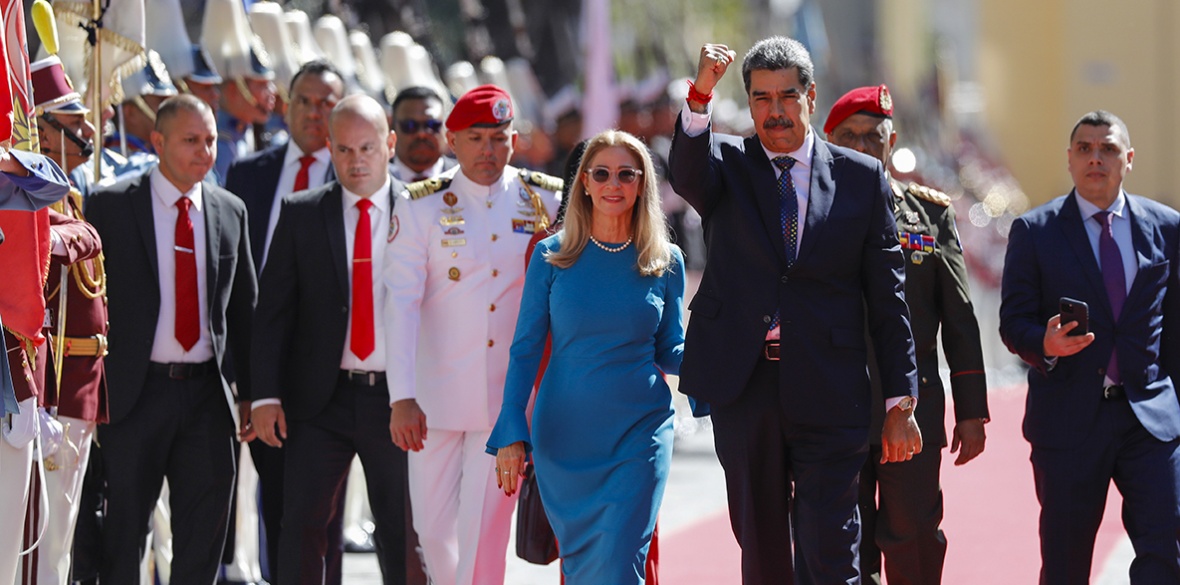
Venezuelan President Nicolas Maduro and his wife Cilia Flores arrive at the National Assembly for his swearing-in ceremony for a third term in Caracas, Venezuela, January 10, 2025
VENEZUELAN President Nicolas Maduro was sworn in for a third term of office today.
The occasion was marked by the US government saying that it had increased the reward for information leading to Mr Maduro’s arrest, with $25 million (around £20.4m) now being offered.
During the swearing-in ceremony in the capital Caracas, the president highlighted his loyalty to the legacy of his legendary predecessor Hugo Chavez.
“If anything characterises the 500-year history of the people of this land called Venezuela, it is the history of heroic, wonderful resistance against all forms of domination, against all forms of colonialism and against all imperialisms,” Mr Maduro said.
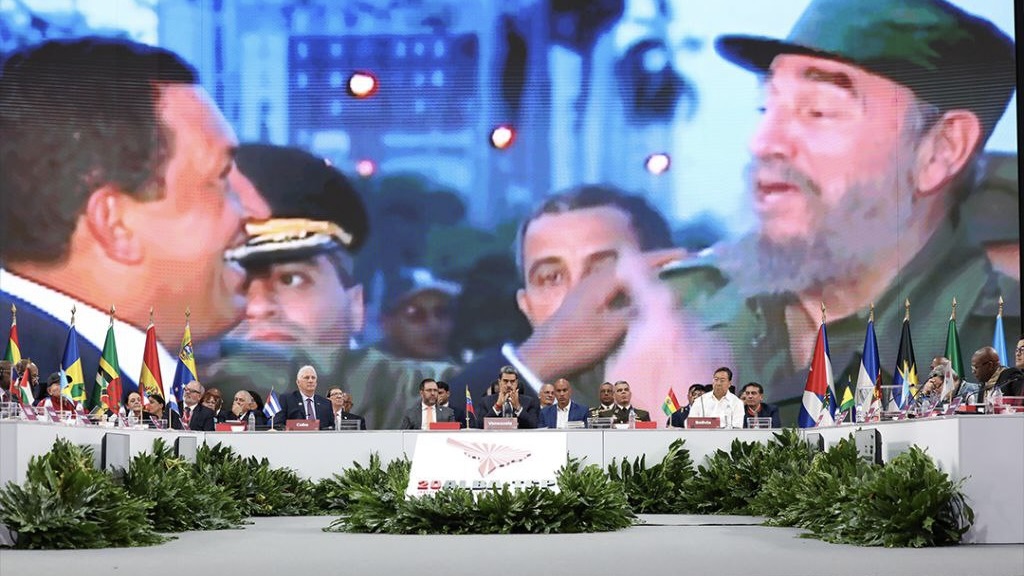
Heads of State Summit of ALBA-TCP in Caracas, Venezuela. Photo: ALBA-TCP
ALBA-TCP was founded in 2004 in an attempt to counter the US proposal of creating a “free trade zone of the Americas
December 14 marked the 20th anniversary of the creation of the Bolivarian Alliance for the Peoples of Our America-People’s-Trade Agreement (ALBA-TCP). ALBA-TCP was created in 2004 as a geopolitical alternative to the devastating advance of neoliberalism in the region.
The project was founded on December 14, 2004, in Havana by Cuban President Fidel Castro and Venezuelan President Hugo Chávez. Currently, the organization has 10 member countries and four countries considered “special guests.” In 2006, Bolivia signed its membership; in 2007, Nicaragua; in 2008, Dominica; in 2009, Antigua and Barbuda and St. Vincent and the Grenadines; in 2014, St. Kitts and Nevis and Grenada; and in 2021, St. Lucia. The special invited countries are Syria, Haiti, Suriname, and now Palestine.
To commemorate the 20 years, social movements, political parties, and heads of state gathered in Caracas, Venezuela for the 24th Heads of State Summit as well as parallel meetings. The event was attended by the host, Venezuelan President Nicolás Maduro; Bolivian President Luis Arce; Cuban President Miguel Díaz-Canel; Nicaraguan President Daniel Ortega; Prime Minister of St. Vincent and the Grenadines, Ralph Gonsalves; Prime Minister of Dominica, Roosevelt Skerrit; and the Prime Minister of Antigua and Barbuda, Gaston Browne.
Independence and solidarity among countries
In their addresses during the Summit on December 14, the heads of state and invited countries stressed the importance of solidarity among countries seeking alternative ways of development and the need for unrestricted solidarity among people struggling against imperialist attacks. They also demonstrated their support for Nicolás Maduro and his victory in the last presidential elections.
Miguel Díaz-Canel said “We reiterate the strongest support for the Bolivarian revolution, led by President Nicolás Maduro…We also call for the elimination of the blockade against Cuba …We cry out for a free Puerto Rico and declare our solidarity with Haiti, our Cuban doctors are there…We reiterate our demand for a ceasefire in Gaza and condemn the attacks perpetrated by Israel against Lebanon, Syria, and Iran.”
The Bolivian President, Luis Arce, highlighted the historical importance of ALBA in its fight against economic projects promoted by the United States such as the FTAA (Free Trade Area of the Americas): “The embrace of Hugo Chávez and Fidel Castro not only marked history but also manifested the defeat of the hegemonic project of the FTAA. ALBA was born, ALBA placed the human being at the center, promoting that a better world is possible. Bolivia reaffirms, once again, its commitment to ALBA-TCP, because it is a resistance that raises its voice against the unjust and criminal blockade against Cuba…ALBA is also a firm voice against the arbitrary and unilateral measures imposed against Venezuela and Nicaragua, which affect the welfare of our peoples.”
Nicolás Maduro said, “We must win the battle of life and truth in the streets, networks, media, and walls, as well as in the conscience and spirituality of the people.” He also added the importance of the struggle of the people to be masters of their destiny without imperial impositions or impositions of any kind. In the same line of discourse, Nicaraguan President Daniel Ortega said “From Nicaragua we reaffirm our commitment to ALBA. We will continue to fight the battle.”
The Prime Minister of Dominica, Roosevelt Skerrit stated “We congratulate the electoral triumph of President Nicolas Maduro on July 28. We wish him all the best…We also want to reaffirm our solidarity with the people of Cuba, a brave people for whom we have our greatest respect and love; we will never cease to lend our voice against the United States to eliminate the blockade against Cuba.”
Ralph Gonsalves, Prime Minister of St. Vincent and the Grenadines, harshly criticized US interference in the development of the past Venezuelan elections “Perhaps [the US government] thinks it is superior,” he said in this regard. He also stressed that the creation of ALBA-TCP was a fundamental invention for the emancipation of the American people, “ALBA is the product of the geniuses of our peoples.”
Inclusion of Palestine to ALBA-TCP
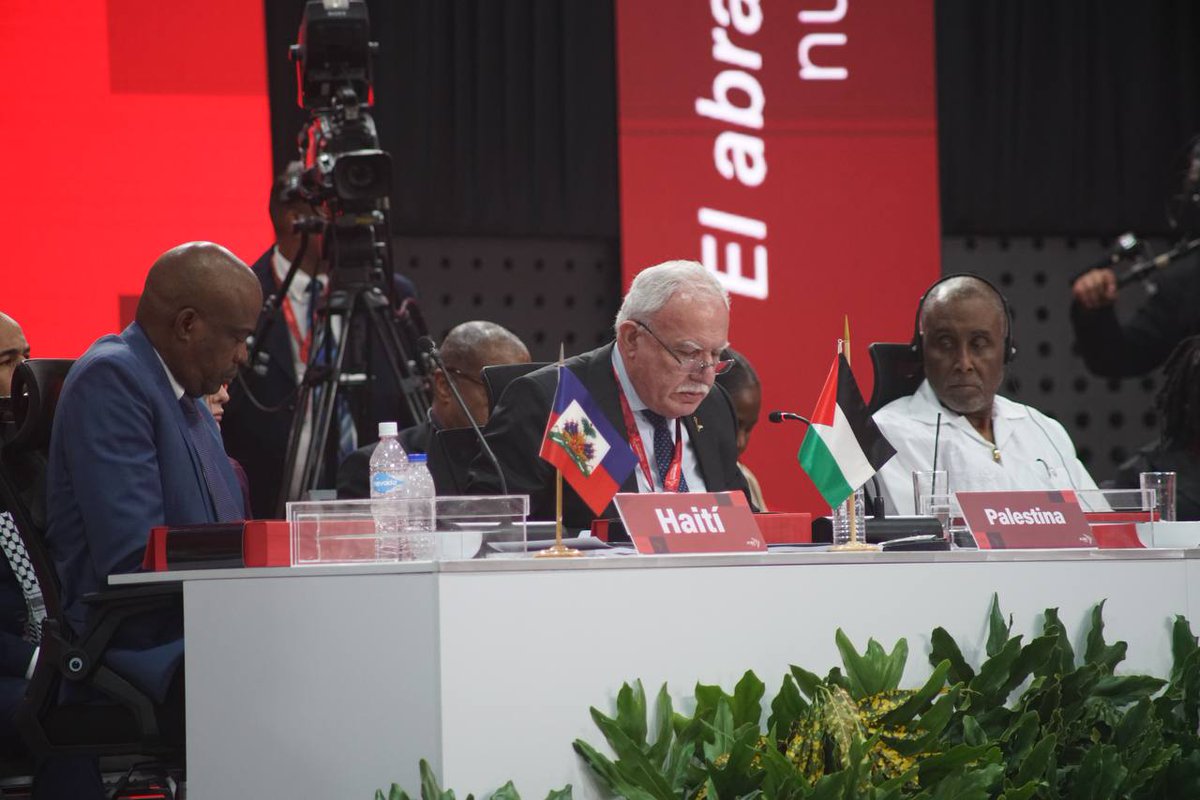
At the current summit, it was announced that Palestine had been included as a “brotherly country” and was included as a “permanent guest”. According to the resolution of the Heads of State, ALBA-TCP condemns the attacks against the Palestinian population and the “illegally occupied territories” and rejects “the merciless and inhuman genocide committed by the State of Israel, the occupying power, as well as its plan of spoliation, invasion, and domination.” Likewise, they denounced the support of several governments currently collaborating with the actions of the Israeli army and called for an “immediate ceasefire…From the heart of the peoples and governments of this alliance, we declare Palestine a brother country of the ALBA-TCP, and reaffirm our commitment to the defense of the Palestinian cause, which is the defense of humanity,” reads the resolution.
In this regard, Riyad al-Malki, advisor to the President of State for International Affairs of Palestine said “History will remember those who stood on the side of justice, ALBA’s lasting solidarity with Palestine is a testimony of freedom and collective resistance.” Furthermore, Malki added “This Alliance is a living testimony of collective integration to challenge imperialism and ensure a just world. These values resonate with the Palestinian struggle, an end to the illegal occupation.”
A call for counter-hegemonic struggle
The joint document signed by all the countries highlights the historical importance of ALBA-TCP in the struggle for a more equitable world: “Twenty years after this giant step, we pay homage to the founding leaders, Hugo Chávez Frías and Fidel Castro Ruz, who adopted that December 14, 2004, in Havana, Cuba, the vision of the future embodied in the founding documents of ALBA, which have allowed us to walk united until the present, animated by the ancestral force that led our peoples to be free and that encourages us to continue integrated in this Alliance for Life.”
Similarly, it was stressed that the existence of this multilateral organization operates as a possibility to create a region that resists the impositions of the most developed countries: “Today, we want to ratify before our peoples, the counter-hegemonic, democratic, anti-imperialist and anti-fascist nature of our Alliance and renew our commitment to help and protect each other, to continue building together a future of shared goals under the founding principles of complementarity, cooperation, social justice, defense of our sovereignty and solidarity.”
In this sense, Luis Arce stressed that “In the face of the challenges of a world threatened by fascism and neo-fascism, ALBA is not an option, ALBA is a necessity that must continue with firm steps, reaffirming the founding principles of solidarity, justice, and cooperation…ALBA is not only an alliance, it is a promise for the future, a living resistance, an instrument for the most dispossessed, and a reminder that together, as peoples, we are invincible.”
Objectives and principles of ALBA-TCP
According to ALBA’s official website, the fundamental objective of the project is “to achieve integral development, ensure social equality and contribute to guaranteeing the quality of life, good living, independence, self-determination and identity of the peoples.” For this very reason, the principles of ALBA-TCP propose that political decisions be made horizontally and take into account the economic differences of its members without meaning that the importance of each of the members is underestimated.
The principles shared by the countries are “trade and investment should not be ends in themselves, but instruments to achieve sustainable development; special and differentiated treatment, according to the level of development of the various countries; economic complementarity and cooperation; cooperation and solidarity; the creation of the Social Emergency Fund; the integrative development of communications and transportation; the sustainability of development; energy integration; the promotion of investments of Latin American capital in the region; the defense of Latin American and Caribbean identity and culture; respect for intellectual property; and the agreement of multilateral positions and in negotiations with countries and blocs in other regions.”
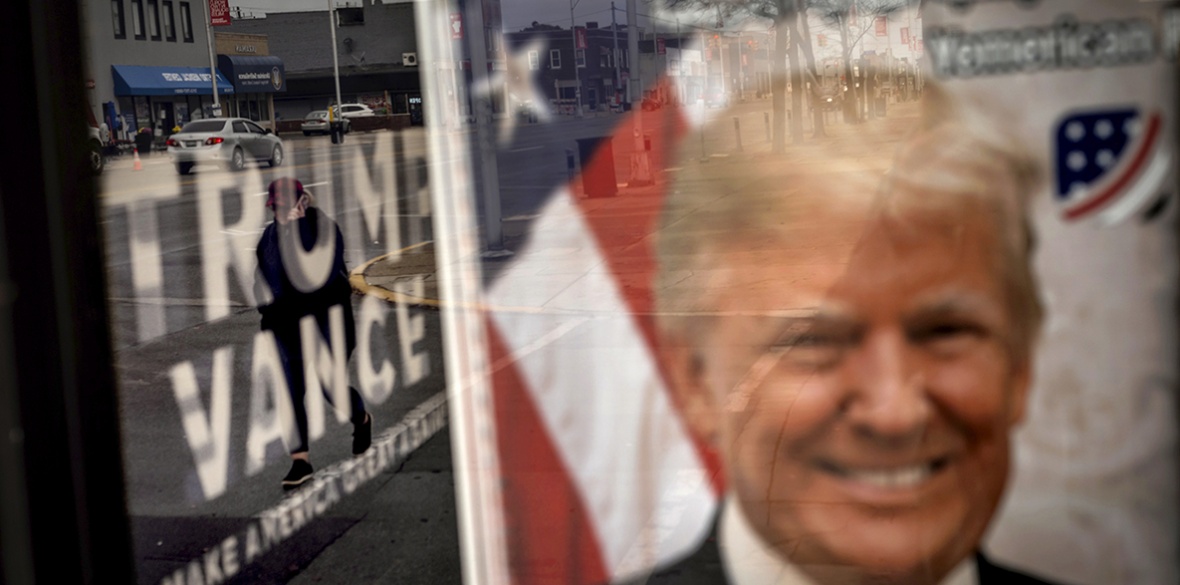
An image of Republican presidential nominee former President Donald Trump hangs in the window of a campaign office in Hamtramck, Michigan, November 4, 2024
TIM YOUNG warns that the president-elect’s record of economic and political interference from his last stint in the White House show dangerous potential for escalated aggression against the Bolivarian government from 2025
THE US election result raises the spectre of Trump renewing the assault on Venezuela that his loss to Biden interrupted in 2020.
In office between 2016 and 2020, Trump’s approach to Latin America showed an implacable hostility towards Venezuela, as well as other governments in the region determined to advance their population’s interests, not those of the US.
Venezuela has been subjected to US extraterritorial intervention and interference for over two decades. From the early days of Hugo Chavez’s election as president in 1998, the US has sought, in conjunction with Venezuela’s economic and political elites, to topple the Venezuelan government and re-establish its control and influence over the country and its oil wealth.
…
While the global situation has changed since 2020, with wars in Ukraine and the Middle East and the US’s developing aggressive strategy towards Russia and China, there is no reason to believe the US’s long-standing desire to destabilise the Venezuelan government and achieve “regime change” is off the table.
For his part, Trump made it plain when campaigning this year in North Carolina what motivated his drive to unseat Maduro: “When I left, Venezuela was ready to collapse. We would have taken it over; we would have gotten all that oil.”
The solidarity movement in Britain must be prepared to defend Venezuela’s sovereignty against any renewed offensive by Trump when he assumes the presidency in 2025 — as well as continuing to campaign for Britain to give Venezuela back its gold.
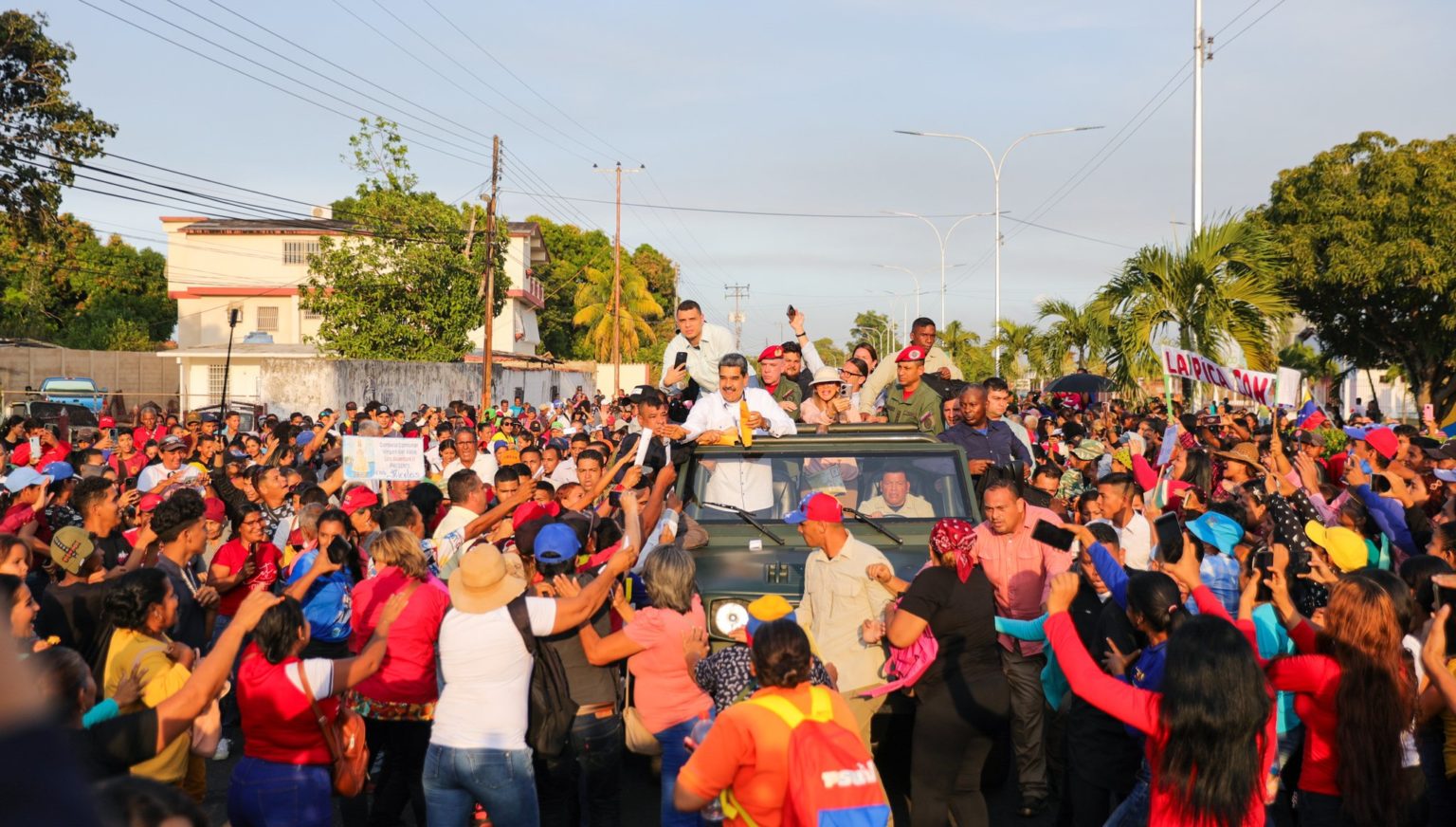
Nicolás Maduro received by thousands in the city of Maturín. Photo: Nicolás Maduro/ X
As Venezuela prepares to head to the polls in July, the US has already started drumming up suspicion and doubt around the electoral process.
Twenty-five years after Hugo Chávez took office and began the Bolivarian Revolution in Venezuela, US officials have still not tired of dreaming up new plots to overthrow the country’s government. Five years ago, following the last presidential election, they attempted to install Juan Guaidó—a politician most Venezuelans had never even heard of—as the country’s head of state. And now, with the date for the next presidential election officially set for July 28, the Biden administration is gearing up for the biggest regime-change push since the Guaidó coup attempt.
Venezuela has long been a target for US intervention because of its efforts to build an alternative model to the neoliberal capitalism pushed by institutions like the IMF and World Bank. First theorized and implemented under the leadership of Chávez, the Bolivarian Revolution in Venezuela puts forward a new model that emphasizes using the country’s resources, such as its oil revenue, to fund crucial missions. These then guarantee rights such as education, food, housing, transportation, culture, and sports to historically excluded majorities, to decrease longstanding socioeconomic inequality. A central part of the Bolivarian Revolution is the political and cultural transformation of the people through the promotion of Venezuelan national culture, internationalism, anti-imperialism, and the empowerment of all people as political subjects with rights and responsibilities. It is a project in direct contradiction to US interests in the oil-rich country and the region Washington considers its backyard.
The 2024 elections
President Nicolás Maduro is running for re-election as the candidate of the United Socialist Party of Venezuela (PSUV) and the broader Great Patriotic Pole coalition. He has built his campaign around a program referred to as the “Seven Transformations,” proposing major new initiatives in the fields of economic modernization, asserting national sovereignty, safety and security, ensuring social rights, political participation, the environment, and geopolitics. These aim to maintain the pro-poor, socialist orientation of the country’s development model while enacting reforms to stimulate greater economic activity and counteract the impact of crippling US sanctions.
The opposition is divided into several different camps. The largest coalition of opposition parties is called the Unitary Platform and consists of parties or factions of parties controlled by the Venezuelan elite who were displaced from positions of power as a result of the Bolivarian Revolution. The Unitary Platform has taken part in several rounds of negotiations with the government over the past year leading up to the elections and signed an agreement last October known as the “Barbados Agreement.”
In this agreement, the opposition was granted concessions on issues related to the organization of the electoral process, and in exchange, the United States agreed to loosen some sanctions relating to Venezuela’s oil and mining industries. The Barbados Agreement stipulated that only opposition figures who are eligible according to existing laws would be permitted to run. At this stage, the Unitary Platform has not chosen a candidate.
The specifics of how the electoral process will be carried out, regulations on campaigning on media platforms, participation of electoral observers, and the updating of electoral rolls were outlined in an agreement signed on February 28. The agreement was the product of dialogue among over 150 political and social organizations and was based on over 500 proposals. Ninety-seven percent of the political parties registered with the National Electoral Council participated.
Nonetheless, US officials have presented this electoral process, subject to such extensive deliberation and approved with such wide support, as an attack on democracy.
María Corina Machado and the fraud narrative
The approach of the US government follows a familiar script—wage a campaign in the media and through international organizations to cast doubt on the integrity of the electoral process so relentlessly that the result can be presented as fraudulent no matter what the actual evidence is on election day.
The key piece of the “electoral fraud” narrative is already in place and revolves around the disqualification of the opposition figure María Corina Machado.
Machado is the oldest daughter of Henrique Machado Zuloaga, who was an executive of Sivensa. One of Venezuela’s largest steel companies, Sivensa was nationalized in 2008 under Hugo Chávez. Since the start of the Bolivarian Revolution, Machado has been active in the right-wing opposition and has gone so far as to support destabilization campaigns and attempts to overthrow Venezuela’s democratically elected governments. She served as a member of Venezuela’s National Assembly from 2011-2014.
In July 2015, the Venezuelan comptroller general’s office announced that Machado was barred from holding public office for a period of one year after neglecting to disclose the extent of her earnings while she held public office.
The investigations into Machado continued. In July 2023, opposition deputy José Brito requested an update on Machado’s eligibility for holding public office given the upcoming presidential election and her stated intention to run. The comptroller general’s office responded, confirming that the disqualification of Machado was maintained and constituted a 15-year ban due to her support of regime change plots.
Though she initially refused to participate in the process, Machado appealed her ban through the Barbados Agreement procedure, which also stated that all candidates must defend Venezuela’s independence and reject violent actions against the government. In January 2024, the Supreme Court of Venezuela issued a sentence rejecting Machado’s appeal of the ban.
The Biden administration immediately sought to use economic coercion to undermine this decision by an institution of Venezuela, a sovereign state. As part of the Barbados Agreement, the US government issued licenses to certain oil companies permitting them to resume operations in Venezuela despite the sanctions. At the end of January, the State Department announced that the sanctions waivers issued to these companies would not be renewed once they expire on April 18.
At the same time, there is endless media reinforcement of the position that an election without Machado cannot be considered legitimate. On January 30, a few days after the Supreme Court rejected her appeal, Machado went on the television network CNN and was presented to viewers as “Venezuela’s main opposition leader.” An earlier Washington Post article is also typical of this narrative, headlined, “She’s the front-runner in the race to oust Maduro. He’s out to block her.” This combination of economic and political pressure is what has led to explosions in right-wing street violence in the past, following the 2013 presidential election when Maduro was first elected.
Machado: Regime change operative?
In 2002, following the short-lived coup d’état against Chávez, Machado signed the decree which established an unelected government under chamber of commerce head Pedro Carmona. In 2005 she met with former US president George W. Bush at the White House to discuss “democracy” (i.e., the overthrow of the Venezuelan government) More recently, she has been a key supporter and leader of the numerous right-wing plots to overthrow the democratically elected President Nicolás Maduro. These include the 2014 and 2017guarimba protests which saw extreme violence against security forces and chavista supporters, as well as the destruction of infrastructure.
In 2014, Machado was removed from her post in the National Assembly after she attended a meeting of the Organization of American States (OAS) in the place of the Panamanian representative in order to testify about 2014 protests, to speak out against the government, and to call for foreign support for her cause. The move was widely condemned as a violation of both the Venezuelan constitution and Panamanian law, and in response, Panamanian civil society and movement organizations filed a lawsuit against her for usurping a public post.
Machado has also celebrated the effectiveness of the illegal sanctions regime imposed on Venezuela in applying political pressure for regime change, and on several occasions, has called for even more sanctions. The sanctions have had devastating consequences for the Venezuelan people, well documented by different UN bodies and rapporteurs, human rights organizations, and think tanks. United Nations special rapporteur Alena Douhan noted that “[t]he announced purpose of the ‘maximum pressure’ campaign—to change the Government of Venezuela—violates the principle of sovereign equality of states and constitutes an intervention in the domestic affairs of Venezuela that also affects its regional relations.”
In 2019, Machado supported the push by Juan Guaidó’s parallel, fictitious government to request that the OAS apply the Inter-American Treaty of Reciprocal Assistance (TIAR) against Venezuela to end the “usurpation of power” by Maduro. The activation of TIAR would have provided a legal justification for foreign military intervention, (more) economic sanctions, and a commercial blockade.
An examination of the actual facts of Machado’s political career shows how the truth is much more complicated than the mainstream narrative about a government baselessly repressing an opponent.
After years of political instability caused by right-wing plots to overthrow the democratically elected government and even assassinate the leader, the Venezuelan government has pursued a straight-forward principle: political forces of any ideological variety can participate in elections as long as they do not conspire with foreign powers to undermine the independence of Venezuela or its sovereign institutions. This is in line with practices around the world. In the United States, for instance, there has been a great deal of public attention to the clause of the 14th Amendment that bars those guilty of insurrection from public office.
As the July 28 elections approach, tensions between the disparate elements of the Venezuelan political scene are bound to intensify. But the Biden administration is bound to be guided by the same overarching goal that has animated the policy decisions of Democratic and Republican administrations alike—remove from power one of the most long-standing opponents of Washington’s dominant role in the western hemisphere.
Zoe Alexandra is the co-editor of Peoples Dispatch.