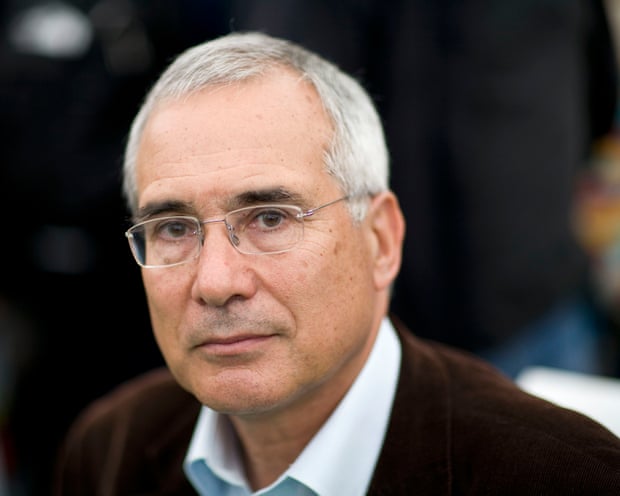
Nicholas Stern, pictured, led a review that concluded climate action would cost less than the damage caused by inaction. Photograph: David Levenson/Getty Images
Lord Stern says fossil-fuelled growth is futile as the damage it causes ends in economic self-destruction
Investment in climate action is the economic growth story of the 21st century, while growth fuelled by fossil fuels is futile because the damage it causes ends in self-destruction, the economist Nicholas Stern has said.
The plummeting costs of clean technologies, from renewable energy to electric cars, plus the healthier and more productive societies they enable, meant investments could simultaneously tackle the climate crisis and faltering economic growth, and bring millions of people out of poverty, he said.
This requires big changes in policies and levels of investment and Stern, at the London School of Economics, acknowledged that the geopolitical environment was currently difficult but he said making the rational argument was vital. The US president, Donald Trump, recently called climate change a “con job” and is backing fossil fuel companies to “drill, baby, drill”.
“I’d say to Trump: ‘You’ve got children and grandchildren – think about the science, think about the risks,’ and I’d give examples about the wildfires in California,” said Stern. “I’d point out to him that his place in Florida is going to be extremely vulnerable to more intense hurricanes, sea level rise and storm surges. The people and places he loves are under severe risk.
Neo-Fascist Climate Science Denier Donald Trump says Burn, Baby, Burn.Orcas comment on killer apes destroying the planet by continuing to burn fossil fuels.Nigel Farage urges you to ignore facts and reality and be a climate science denier like him and his Deputy Richard Tice. He says that Reform UK has received £Millions and £Millions from the fossil fuel industry to promote climate denial and destroy the planet.
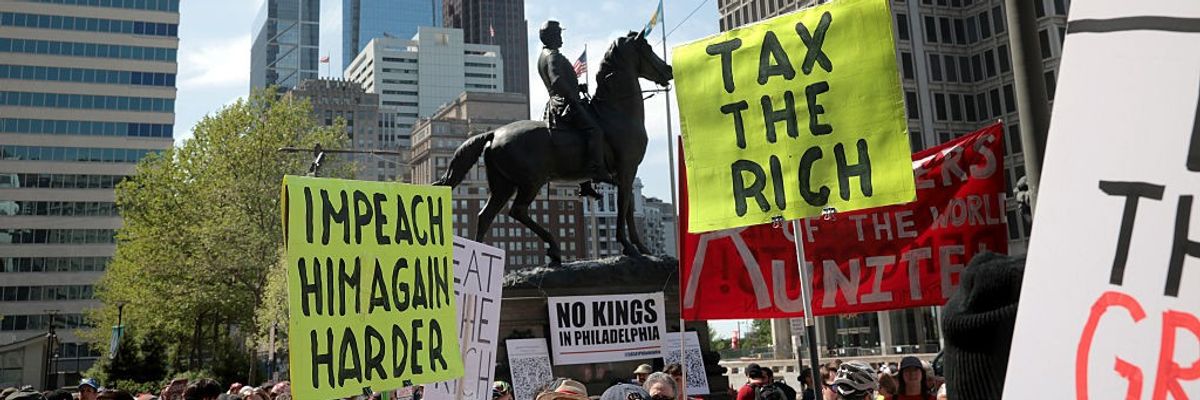
Supporters rally ahead of a Sen. Bernie Sanders (I-Vt.) May Day rally at City Hall on May 1, 2025 in Philadelphia, Pennsylvania. (Photo by Kayla Bartkowski/Getty Images)
“As the US braces for more extreme heat, wildfires, and hurricanes, the Trump administration has been systematically defunding our communities to give handouts to billionaires,” said one organizer.
A broad coalition of progressive organizations on Thursday announced that they are uniting for a mass mobilization event aimed at taking on the billionaire class.
The upcoming Make Billionaires Pay marches, scheduled to occur nationwide on September 20, link together multiple crises—ranging from authoritarianism to the climate emergency to US President Donald Trump’s mass deportations—by pointing the finger at the ultra-wealthy oligarchs who have been supporting them all.
Candice Fortin, US campaign manager for climate action organization 350.org, said that billionaires are the connective tissue that links together the major problems currently facing the United States and the world.
“This isn’t a new story—billionaires have always prioritized profit over people,” Fortin said. “This is a system working exactly as it was designed, but now without even the pretense of justice. As the US braces for more extreme heat, wildfires, and hurricanes, the Trump administration has been systematically defunding our communities to give handouts to billionaires. They’re dismantling our democracy, attacking immigrants, and feeding the war profiteers.”
Tamika Middleton, managing director for Women’s March, also emphasized that today’s crises are closely linked together.
“Women, migrants, queer and trans people, and communities of color have long been at the center of overlapping crises, from climate disaster to economic injustice to gender-based violence and forced displacement,” she said. “These are not separate struggles; they stem from a global system designed by billionaires who exploit our struggles to maintain power.”
Organizers said that these planned actions will focus on advocating for taxing extreme wealth, ending Trump’s mass deportation program, and transitioning from fossil fuels to renewable energy.
The marches are being convened by Desis Rising Up and Moving (DRUM), Women’s March, Climate Defenders, and 350.org, and more than 100 other organizations have endorsed them so far.
The flagship march is set to take place in New York City at the same time the 2025 United Nations General Assembly will be taking place. Other marches are set to occur simultaneously across the country.
Orcas discuss Donald Trump and the killer apes’ concept of democracy. Front Orca warns that Trump is crashing his country’s economy and that everything he does he does for the fantastically wealthy.Donald Trump urges you to be a Climate Science denier like him. He says that he makes millions and millions for destroying the planet, Burn, Baby, Burn and Flood, Baby, Flood.Elon Musk urges you to be a Fascist like him, says that you can ignore facts and reality then.
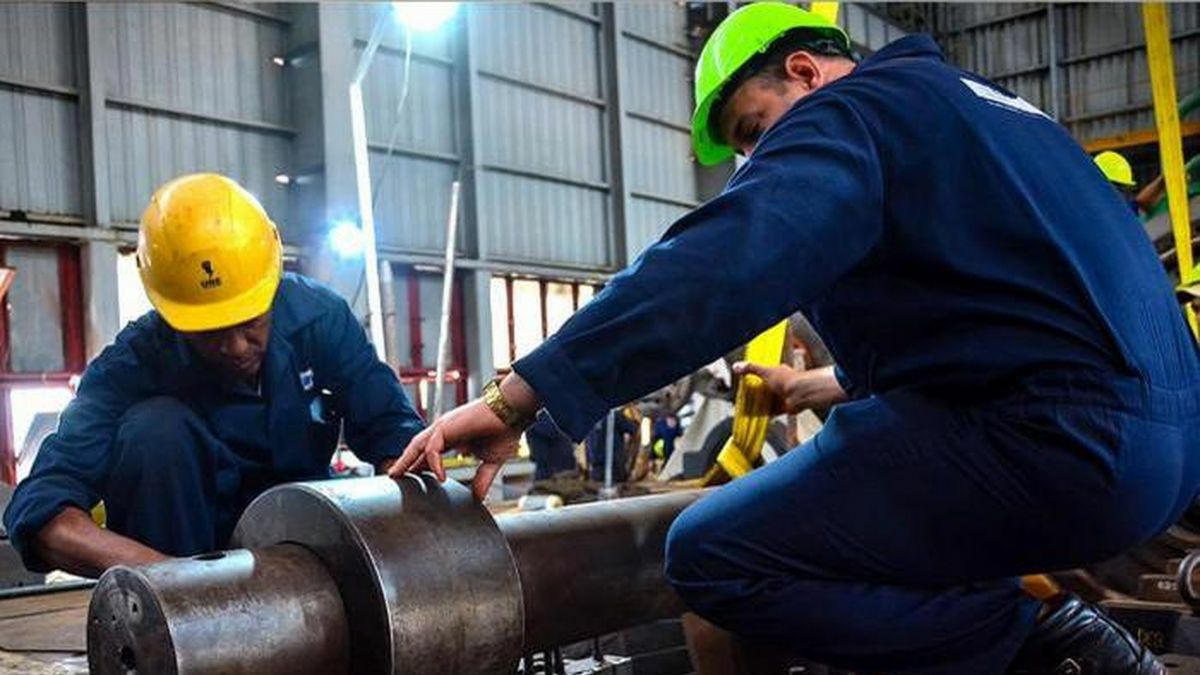
Workers in Cuba have worked to gradually restore the power grid. Photo: Minister of Energy and Mines
After several false starts over the weekend, the efforts to recover Cuba’s electrical system began to make headway on October 21. Meanwhile, authorities have declared that Oscar has become a tropical storm.
In this regard, President Miguel Dïaz-Canel said “We were at the National Load Dispatch since very early in the morning. The microsystems in the country are being strengthened and Havana is gradually receiving energy. It is a complex job, but we are taking sure steps. We said that we will not rest until the total reestablishment.”
In other parts of the country, reconnections continue while attempts are made to repair the damages suffered by the thermoelectric power plants, which, due to the difficulties of access to spare parts and technological elements that help to repower the system (caused fundamentally by the criminal economic blockade suffered by Cuba on the part of the US government), the repair tasks are very complicated.
Tropical Storm Oscar
Amid the critical situation with the collapse of the power grid, Hurricane Oscar made landfall on the Caribbean Island late on Sunday. Fortunately for the inhabitants of eastern Cuba, the storm downgraded its intensity and hit the island as a tropical storm, though still unleashing heavy rains and wind in the eastern region. The level of damage that Oscar can produce is still uncertain.
La tormenta tropical Oscar transita lentamente por el Oriente de #Cuba. Se trabajan intensamente para proteger al pueblo y minimizar las afectaciones. Son múltiples las muestras de solidaridad entre nuestra gente. Como se explicó existe un grupo de recursos para la recuperación. pic.twitter.com/26LzX5Qhqw
According to experts, the storm is now headed to the Bahamas, though authorities have called on the population to not lower their guard and to be alert to official communication channels.
The world stands with Cuba
Amid Cuba’s blackout, the member states of the Bolivarian Alliance of the Peoples of Our America (ALBA-TCP), expressed in a communiqué their support to the Cuban government and offered their help to overcome the difficult times the island is going through: “The complex situation that [Cuba] is experiencing today is a consequence of the economic war, financial persecution and [the refusal to sell] fuel supplies by the US administration, which seeks to asphyxiate Cuba in its commitment to the well-being of the Cuban people”.
Furthermore, the communiqué adds “The policy of maximum pressure through unilateral coercive measures and the blockade against the nation is cruel and inhuman and has been categorically rejected by the majority of the countries of the world, since […] it only seeks a change of regime, in open violation of the purposes and principles of the United Nations Charter and the norms of International Law.”
In a press conference on October 21, the spokesperson of the Ministry of Foreign Affairs of China, Lin Jian, also expressed support to Cuba as it faces unprecedented challenges, “[The] US blockade on Cuba has been catastrophic for Cuba’s socioeconomic development and people’s lives. China once again calls on the US to fully lift the blockade and sanctions on Cuba at once and remove Cuba from the list of ‘state sponsors of terrorism.’”
In a statement, the platform of social movements of Latin America and the Caribbean, ALBA Movimientos, categorized the current situation on the island as one of “anguish and tension, a product of the suffering induced by the criminal blockade.” ALBA Movimientos argues that the US-imposed blockade ultimately seeks to “undermine the role of the Cuban State in satisfying the basic needs of the population, while trying to privilege an incipient private sector, incapable by its condition of providing the levels and extent of social justice achieved by the Revolution.”
In the statement, the movements also warn that this latest episode of blockade-induced hardship on the island could be seized upon by reactionary, counter-revolutionary forces. “At this moment, all the psychological pressure apparatus is being used to induce a social outburst of unforeseeable consequences, using as a basis and pretext the legitimate expressions of social unrest resulting from the current situation, its accumulated and possible solutions,” it warns.
The only viable solution which would respect the sovereignty of Cuba and guarantee the possibility of dignified life, is the immediate and irreversible lifting of the blockade on Cuba, concludes ALBA.
Meanwhile, the White House spokesperson Karine Jean-Pierre claimed in a press conference on October 21, that the US is “not to blame for the blackouts on the island or the overall energy situation in Cuba.”
You probably missed it, but a few months ago a report was published that inspected how the UK government prepared for major emergencies. What it found has profound implications for the whole country.
The report was written by the UK’s public inquiry into the COVID-19 pandemic and explained how the pandemic was an example of what’s called a “non-malicious threat”. These are major threats to our collective security that arise not from hostile intent – like terrorism or war – but as a result of human error, structural failure, or natural disasters. In this instance it was a novel virus that jumped from animals to humans and then rapidly spread.
The pandemic affected everything. Its impact was so severe that it created what the government calls a “whole-system civil emergency”, a rapidly escalating crisis that significantly affected multiple dimensions of the UK’s security, from the health system, through economic stability, to public trust. This was the UK’s greatest security crisis since the second world war. Yet it had nothing to do with armed conflict.
The inquiry found that successive governments grossly underestimated pandemic threats. They were not given the same priority as security threats coming from hostile action, like Russian aggression or terrorism. The subsequent tragedy proved how much of a mistake this was. When it came to planning and responding to whole-system civil emergencies, the UK government “failed their citizens”, the inquiry said, before concluding that “fundamental reform” was needed.
We have worked on a new report that finds worrying similarities to another, even greater “non-malicious threat” to security: climate change.
Compounding climate risks
Two weeks ago Hurricane Helene crashed into Florida and proceeded to cut a chaotic swathe north. By the time it dissipated over Tennessee two days later, over 200 people were dead and losses amounted to tens of billions of dollars.
Now Florida has been battered by Hurricane Milton too, which may prove to be more destructive in part because it came in the wake of Helene. Much of the region’s road, rail, and power infrastructure was still damaged. Many of the buildings still standing had been seriously weakened. Piles of debris from the clean up quickly became dangerous projectiles in Milton’s powerful winds. Hurricanes such as Helene and Milton are now twice as likely given climate change.
From hurricanes to deadly heatwaves, crippling droughts to crop failures – the consequences of climate change are potentially catastrophic. And while we have improved our resilience to individual extreme weather events, increasing climate change makes it more likely that impacts will pile up with the sum of loss and damages being much higher than the parts. It is these cascading and compounding impacts that not only threaten local communities, but add up to destabilise the security of entire countries and the globalised systems that connect them.
Yet many governments do not routinely consider extreme climate scenarios in their security plans, and instead continue to assume that climate risks will gradually evolve over the long term.
This approach is proving to be grossly insufficient. Take food security for example. Cascading climate effects are estimated to have caused a third of UK food price inflation in recent years, an impact compounded by rising energy prices. Spiking energy prices were the result of our reliance on fossil fuels, which became far more expensive after Russia invaded Ukraine.
These episodes show us how the causes and consequences of climate change supercharge the world’s security problems.
Tipping towards catastrophe
These climate risks create the potential for further “whole-system civil emergencies”. One example is tipping points. For instance, one of the Earth’s key ocean current systems is the Atlantic meridional overturning circulation (Amoc), which transports vast amounts of heat from the tropics to the northern hemisphere. Yet climate change is weakening the Amoc, a process that could lead it to pass a tipping point and collapse at some point this century, though there is still much debate among climate scientists over exact dates and probabilities.
Collapse would effectively wipe out crop growing in the UK, and devastate food production over much of Europe and North America, while disrupting key weather patterns across the globe. This would be a planetary-scale cataclysm with unmanageable security outcomes. A collapse this century cannot be ruled out without urgent international action to reduce emissions.
Meanwhile, the collapse of a northern section of the Amoc – in the North Atlantic subpolar gyre – could happen much sooner. While less severe, a collapse would upend weather in the UK, destabilising food production, public health, and infrastructure. Evidence suggests that the likelihood of this collapse is alarmingly high – up to a 45% chance of occurring this century – and that it could happen as early as 2040, if not before.
Inadequate assessment
Yet these risks do not appear in the UK government’s national register of security threats. In fact, there isn’t even a dedicated security risk assessment of climate change. The government’s existing climate change risk assessment is not set up to assess broader security threats in the round and is not intended for high level security decision-makers.
There are also important analytical flaws, such as inadequate consideration of cascading and interacting risks like successive hurricanes or a flood that also spreads diseases or disrupts food supplies months later. Individually, these risks might be bearable; together, they could prove unbearable.
Meanwhile, responsibility for climate risks is currently siloed away in non-security departments, marginalising climate change from the top table of decision-making on security.
Thankfully, the new UK government is undertaking a review of its national resilience and security policies. Climate change should be at the heart of its plans. The pandemic inquiry’s findings could represent a warning from a future in which the threat posed by climate change is still not taken seriously in key parts of government.
We face a choice. We can wait until climate impacts spiral out of control, and panicked governments resort to false solutions like more border walls and militarisation. Worryingly, the chances of this are growing as governments continue to effectively fly blind into an increasingly dangerous future. Alternatively, the institutions of government that are intended to protect us against major emergencies can finally act and begin to turn us away from the gathering storm.
CounterSpin interview with Derek Seidman on insurance and climate
Janine Jackson interviewed writer/researcher Derek Seidman about insurance and climate for the October 4, 2024, episode of CounterSpin. This is a lightly edited transcript.
Janine Jackson: As we watch images of devastation from Hurricane Helene, it’s hard not to hold—alongside sadness at the obvious loss—anger at the knowledge that things didn’t have to be this way. Steps could have been, still could be taken, to mitigate the impact of climate change, and making weather events more extreme, and steps could be taken that help people recover from the disastrous effects of the choices made.
As our guest explains, another key player in the slow-motion trainwreck that is US climate policy—along with fossil fuel companies and the politicians that abet them—is the insurance industry, whose role is not often talked about.
Derek Seidman is a writer, researcher and historian. He contributes regularly to Truthout and to LittleSis. He joins us now by phone. Welcome to CounterSpin, Derek Seidman.
Home Insurers Cut Natural Disasters From Policies as Climate Risks Grow:
Some of the largest US insurance companies say extreme weather has led them to end certain coverages, exclude natural disaster protections and raise premiums.
I think that drops us right into the heart of the problem you outline in that piece. What’s going on, and why do you call it the insurance industry’s “self-induced crisis”?
DS: Thank you. Well, certainly there is a growing crisis. The insurance industry is pulling back from certain markets and regions and states, because the costs of insuring homes and other properties are becoming too expensive to remain profitable, with the rise of extreme weather. And so we’ve seen a lot of coverage in the past few months over this growing crisis in the insurance industry.
Derek Seidman: “The insurance industry itself is a main actor in driving the rise of extreme weather, through its very close relationship to the fossil fuel industry.”
But one of the critical things that’s left out of this is that the insurance industry itself is a main actor in driving the rise of extreme weather, through its very close relationship to the fossil fuel industry. And in this narrative in the corporate media, the insurance industry on the one hand and extreme weather on the other hand, are often treated like they’re completely separate things, and they’re just sort of coming together, and this “crisis” is being created, and it’s a real problem that the connections aren’t being made there.
So I guess a couple things that should be said, first, are that the insurance industry is the fossil fuel industry, and its operations could not exist without the insurance industry.
We can look at that relationship in two ways. So first, of course, is through insurance. The insurance giants, AIG, Liberty Mutual and so on and so on, they collectively rake in billions of dollars every year in insuring fossil fuel industry infrastructure, whether that’s pipelines or offshore oil rigs or liquified natural gas export terminals. This fossil fuel infrastructure and its continued expansion, this simply could not exist without underwriting by the insurance industry. It would not get its permit approvals, it would just not be able to operate, it couldn’t attract investors and so on. So that’s one way.
Another way is that, and this is something a lot of people might not be aware of, but the insurance industry is an enormous investor in the fossil fuel industry. Basically, one of the ways the insurance industry makes money is it takes the premiums, and it pools a chunk of it and invests those. So it’s a major investor. And the insurance industry, across the board, has tens of billions of dollars invested in the fossil fuel industry.
And this is actually stuff that anybody can go and look up, because some of it’s public. So, for example, the insurance giant AIG, because it’s a big investor, it has to disclose its investments with the SEC. And earlier this year, AIG disclosed that, for example, it had $117 million invested in ExxonMobil, $83 million invested in Chevron, $46 million in Conoco Phillips, and so on and so on.
So, on the one hand, you have this hypocritical cycle where the insurance industry is saying to ordinary homeowners, who are quite desperate, we need to jack up the price on your premiums, or we need to pull away altogether, we can’t insure you anymore—while, on the other hand, it’s driving and enabling and profiting from the very operations, fossil fuel operations, that are causing this extreme weather in the first place, that the insurance industry is then using to justify pulling back from insuring just regular homeowners.
JJ: This is a structural problem, clearly, that you’re pointing to, and you don’t want to be too conspiratorial about it. But these folks do literally have dinner with one another, these insurance executives and the fossil fuel companies. And then I want to add, you complicate it even further by talking about knock-on effects, that include making homes uninsurable. When that happens, well, then, that contributes to this thing where banks and hedge funds buy up homes. So it’s part of an even bigger cycle that folks probably have heard about.
DS: Yeah, absolutely. This whole scenario, it’s horrible, because it impacts homeowners and renters. If you talk to landlords, they say that the rising costs of insurance are their biggest expense, and they are, in part, taking that out on tenants by raising rents, right?
But it also really threatens this global financial stability. I mean, with the rise of extreme weather, and homes becoming more expensive to insure, or even uninsurable, home values can really collapse. And when they collapse, aside from the horrific human drama of all that, banks are reacquiring foreclosed homes that, in turn, are unsellable because of extreme weather, and they can’t be insured.
The big picture of all this is that it leads to banks acquiring a growing amount of risky properties, and it can create a lot of financial instability. And we saw what happened after 2008, as you mentioned, with private equity coming in and scooping up homes. And so, yeah, it creates a lot of systemic financial instability, opens the door for financial predators like private equity and hedge funds to come in.
JJ: And it seems to require an encompassing response, a response that acknowledges the various moving pieces of this. I wonder, finally, is there responsive law or policy, either on the table now or just maybe in our imagination, that would address these concerns?
DS: There are organizers that are definitely starting to do something about it, and there are some members of Congress that are also starting to do something about it.
For this story, I interviewed some really fantastic groups. One of them is Insure Our Future, and this is sort of a broader campaign that is working with different groups around the country, and really demanding that insurers stop insuring new fossil fuel build-out, that they phase out their insurance coverage for existing fossil fuels, for all the reasons that we’ve been talking about today.
At the state level, there’s groups that are doing really important and interesting things. So one of the groups that I interviewed was called Connecticut Citizen Action Group, and they’ve been working hard, in coalition with other groups in Connecticut, to introduce and pass a state bill that would create a climate fund to support residents that are impacted by extreme weather. (Connecticut has seen its fair share of extreme weather.) And this fund would be financed by taxing insurance policies in the state that are connected to fossil fuel projects. So it’s also a disincentive to invest in fossil fuels.
In New York, a coalition of groups and lawmakers just introduced something called the Insure Our Communities bill. And this would ban insurers from underwriting new fossil fuel projects, and it would set up new protections for homeowners that are facing extreme weather disasters.
I spoke to organizers in Freeport, Texas, with a group called Better Brazoria, and these are people that are on the Gulf Coast, really on the front lines. And Better Brazoria is just one of a number of frontline groups along the Gulf Coast that are organizing around the insurance industry, and they’re trying to meet with insurance giants, and say to them, “Look, what you’re doing is, we’re losing our homeowner insurance while you’re insuring these risky LNG plants that are getting hit by hurricanes, and fires are starting,” and trying to make the case to them that this is just not even good business for them.
And then, more recently, you’ve seen Bernie Sanders and others start to hold the insurance industry’s feet to the fire a little more, opening up investigations into their connection to the fossil fuel industry, and how this is creating financial instability.
So I think this is becoming more and more of an issue that people are seeing is a real problem for the financial system, and it’s something that we should absolutely think about when we think about the climate crisis, and the broader infrastructure that’s enabling the fossil fuel industry to exist, and continue its polluting operations that are causing the climate crisis and extreme weather. So I think we’re going to see only more of this going forward.
JJ: All right, then, we’ll end it there for now.
We’ve been speaking with Derek Seidman. You can find his article, “As Florida Floods, Insurance Industry Reaps What It Sowed Backing Fossil Fuels,” on Truthout.org. Thank you so much, Derek Seidman, for joining us this week on CounterSpin.
DS: Thank you.
FAIR’s work is sustained by our generous contributors, who allow us to remain independent. Donate today to be a part of this important mission.