OUTRAGE: Protesters hold signs calling for the release of Venezuelan President Nicolas Maduro outside Manhattan Federal Court before his arraignment in New York, on Monday January 5
When Russia invaded Ukraine in 2022, Western outrage was absolute. Yet today, the tone is markedly more subdued regarding US aggression against Venezuela. The manner in which the media and politicians frame this invasion exposes a profound ideological double standard, writes MARC VANDEPITTE
… During the invasion of Ukraine, Volodymyr Zelensky was immediately crowned the ultimate champion of democracy. Pre-war criticisms of his policies were airbrushed from the Western press as if they had never existed.
It became taboo to mention the banning of opposition parties or the relentless war in the Donbass, which claimed 14,000 lives between 2014 and 2022. The tragedy in Odessa, where some 40 trade unionists were burned alive, did not fit the heroic narrative and was subsequently filtered out of the coverage.
In Venezuela’s case, the opposite is happening. Media attention is focused almost exclusively on how “evil” Maduro supposedly is.
Every report on the US invasion is accompanied by a litany of his alleged failures. The narrative relies entirely on interpretations and exaggerations regarding the lack of democracy under his rule.
The White House attempts to justify the abduction by linking Maduro to drug cartels. However, this argument holds no water: the primary cocaine routes run through Colombia and Ecuador. Yet the media frequently “forgets“ to mention this, thereby legitimising military aggression in the eyes of the public.
…
Through this euphemistic framing and the constant demonisation of Maduro, a brutal military aggression is being de facto legitimised.
Following the double standards applied to Ukraine and Gaza, the West is losing its last shred of credibility with the global South. The “rules-based order” is being definitively unmasked as a selective instrument of power.
But there is more at stake. With this attack, Trump is testing the limits of his imperial ambitions. Because of Europe’s appallingly weak stance, Washington has received the signal that it can act with total impunity.
Elon Musk urges you to be a Fascist like him, says that you can ignore facts and reality then.Donald Fuhrump says that Amerikkka doesn’t bother with crimes or charges anymore, not being 100% Amerikkkan and opposing his real estate intentions is enough.Orcas discuss how Trump was re-elected and him being an obviously insane, xenophobic Fascist.
This work by Middle East Monitor is licensed under a Creative Commons Attribution-NonCommercial-ShareAlike 4.0 International License.
A protester seen with a “Stop Arming Israel” placard during the demonstration. Tens of thousands of people marched in Berlin under the slogans “All Eyes on Gaza” and “Stop the Genocide,” demanding a ceasefire, peace talks, and an end to German arms exports to Israel, on 27 September 2025 [Vasily Krestyaninov/SOPA Images/LightRocket via Getty Images]
On 29 February 2024, US Defense Secretary Lloyd Austin sent shockwaves when he informed lawmakers in the House Armed Services Committee that over 25,000 Palestinian women and children had been killed by Israel in Gaza up to that date. Austin, the military chief of the Biden Administration, delivered a fact that immediately subverted his own government’s rhetoric.
The announcement was shocking for two main reasons. First, Austin himself had orchestrated the relentless flow of US arms to Israel, directly enabling the very campaign that liquidated those innocent people. Second, the figure provided was noticeably higher than the casualty tally reported by the Palestinian Health Ministry in Gaza for the same period — 22,000 women and children in the first 146 days of the war.
The crux of the contradiction, however, is that Austin’s detailed account of the US-funded Israeli atrocities in Gaza directly subverted the official narrative regularly disseminated by the White House.
In fact, as early as 25 October 2023 — barely two weeks into the war — President Joe Biden himself began doubting the Palestinian Ministry of Health’s death toll estimates. “(I have) no confidence in the number that the Palestinians are using,” he flatly declared.
Naturally, Austin’s declaration neither eroded his unwavering endorsement of Israel nor softened Biden’s patronising attitude toward the Palestinians. To the contrary, US military and political backing for Israel surged exponentially after that congressional hearing. US military and financial support for the Israeli genocide during the Biden administration in the first year of the war is estimated to be at least $17.9 billion.
These apparent contradictions, however, are not inconsistencies at all, but a perfectly calibrated, deliberate policy. Historically, this approach grants the US license to consistently flout its own declared principles. Iraq was invaded, at a horrific cost of life and societal destruction, under the banner of ‘good intentions’: democracy, human rights, and the like. Afghanistan’s protracted agony of war and instability endured for two decades in the name of fighting terror, exporting democracy, and women’s rights.
The operational part of the equation satisfies military and political strategists. Meanwhile, the hollow rhetoric of democracy and human rights keeps intellectuals, both on the right and the left, mired in a protracted, perpetually unproductive debate that serves to conceal rather than influence policy.
While the US government may have perfected the craft of deliberate contradictions, it is not the original architect. In modern history, this phenomenon has been owned almost entirely by the West: colonialism was advanced as a solution to slavery, and forced conversions were brazenly justified as civilising missions.
The West’s stance on the Israeli genocide in Gaza, however, offers the most blatant and current example of this deliberate contradiction. A concise examination of Germany’s conduct in the last two years suffices to illustrate the point.
Germany is the world’s second-largest supplier of weapons to Israel, after the US. Not only did it refuse to accept the genocide definition recognised by many countries, and eventually by the International Court of Justice (ICJ), but it also fought ferociously to shield Israel from the mere accusation.
Domestically, it brutally suppressed pro-Palestinian protests, detained countless activists, and outlawed the use of the Palestinian flag, among numerous other draconian measures. Yet, in the same breath, Germany continued to champion freedom of speech and democracy, and criticise Global South nations that allegedly curtailed these same values.
Predictably, Germany continued to arm Israel, concocting every conceivable justification for its support of Tel Aviv, even after the International Criminal Court (ICC) issued arrest warrants for top Israeli leaders for the crime of extermination in Gaza. Only under immense pressure did Berlin finally yield and agree to stop approving weapons exports to Israel.
Fast forward to recent days. The BBC, among other outlets, reported on 17 November that Germany would reinstate its weapons exports to Israel, rationalising the decision with the 10 October announcement of a Gaza ceasefire—one that Israel has flagrantly violated hundreds of times.
“Germany’s decision to lift its partial suspension of weapons shipments to Israel is reckless, unlawful and sends entirely the wrong message to Israel,” Amnesty International declared in a press release—a condemnation that, naturally, was utterly ignored.
A week later, new research conducted by two top, highly regarded academic institutions showed that the number of Palestinians killed as a result of the Israeli genocide is substantially higher than the Gaza Ministry of Health figures. Worse, life expectancy in Gaza has plummeted by nearly half because of the Israeli war.
Of the two institutions, the Max Planck Institute for Demographic Research (MPIDR) is German. The globally leading research organization is largely funded by public money coming directly from the federal government—the very entity that ships the weapons that, along with US support, have fueled Gaza’s escalating death toll.
In all these scenarios, the West serves as the simultaneous judge and executioner, the honest researcher and the weapons manufacturer, the violator and the self-appointed defender of human rights.
But the rest of us in the Global South must not simply yield to the role of the victim, whose lives are taken but precisely counted. To reclaim our collective agency, however, we must begin with a unified realisation that the West’s calculated contradictions are specifically engineered to perpetuate the iniquitous relationship between Western powers and the rest of us for as long as possible.
Only by rigorously exposing and forcefully rejecting this hypocrisy can we finally liberate ourselves from the historic delusion that the solution to our problem is a Western one.
The views expressed in this article belong to the author and do not necessarily reflect the editorial policy of Middle East Monitor.
This work by Middle East Monitor is licensed under a Creative Commons Attribution-NonCommercial-ShareAlike 4.0 International License.
Genocide denier and Current UK Prime Minister Keir Starmer is quoted that he supports Zionism without qualification. He also confirms that UK air force support has been essential in Israel’s mass-murdering genocide. Includes URLs https://www.declassifieduk.org/keir-starmers-100-spy-flights-over-gaza-in-support-of-israel/ and https://youtu.be/O74hZCKKdpAOrcas discuss Genocide-supporting and complicit Zionists. Donald Trump, Keith Starmer, David Lammy, Rachel Reeves, Angela Rayner and Wes Streeting are acknowledged as evil genocide-complicit and supporting cnuts.Keir Starmer objects to criticism of the IDF. He asks how could anyone object to them starving people to death, forced marches like the Nazis did, bombing Gaza’s hospitals and universities, mass-murdering journalists, healthworkers and starving people queuing for food, killing and raping prisoners and murdering children. He calls for people to stop obstructing his genocide for Israel.
‘We are winning’, claims politician Enoch Powell to students at York University in 1969 following his notorious ‘rivers of blood’ speech. Alamy/PA Images
Prime Minister Keir Starmer thinks that racism is returning to British society. He has accused Nigel Farage’s Reform UK of sowing “toxic division” with its “racist rhetoric”.
Starmer’s comments follow a trend that has seen senior Labour party officials portray their political opponents on the far-right as sowing division with racist rhetoric.
Recently, Wes Streeting, the Labour health secretary, warned that an “ugly” racism is on the rise again, pointing to worrying figures showing an increase of race-based abuse of NHS staff.
And in October, senior Labour officials attacked Farage’s plans to strip millions of legal migrants of their Indefinite Leave to Remain status as a racist policy. Home Secretary Shabana Mahmood said that Farage’s plans sounded like a “very loud dog whistle to every racist in the country”.
Labour officials portray the rise in racist incidents and rhetoric as the return of attitudes that had all but disappeared from British society. Streeting expressed his worry that “1970s, 1980s-style racism has apparently become permissible again in this country”. Starmer similarly stated that “frankly I thought we had dealt with” the problem of racist abuse “decades ago”.
This is an appealing story because it conveys a neat and simple message: racism was defeated decades ago and it is now being revived by racist agitators. But in truth, the history of post-war racism is much more complex.
In my new book, I investigate how ideas of race and racism have changed since the second world war. History shows that racism never disappeared from public life. Rather, it assumed different shapes, some of which are harder to discern than others.
The experience of fascism
The defeat of Nazism in 1945 marked a key moment in the history of racism. Prior to the second world war, ideas of racial difference and even racial hierarchy were firmly entrenched in elite society.
In Victorian Britain, for example, a belief in the racial superiority of Europeans was decisive to maintaining colonial rule across large parts of central and east Asia, Africa, and the Caribbean. This sentiment was famously captured in Rudyard Kipling’s 1899 poem, The White Man’s Burden, which depicted colonial rule as the moral duty of white nations.
The Insights section is committed to high-quality longform journalism. Our editors work with academics from many different backgrounds who are tackling a wide range of societal and scientific challenges.
Likewise, pseudosciences like eugenics and physical anthropology enjoyed significant prestige among British elites well into the 20th century. The British Eugenics Society, dedicated to improving the genetic stock of the British population, flourished in the interwar period. At this time the eugenics movement was an ideological broad church, appealing to progressive as much as conservative elites.
But the second world war irrevocably changed this landscape. The experience of fascism made it clear for all to see just how dangerous the concept of racial superiority was. Ideas of racial purity, racial hierarchy, and eugenics had driven the Nazis to commit genocide. It had led to a world war that many experienced as a straightforward conflict between good and evil.
There was no Nazi atrocity – concentration camps, wholesale maiming and murder, defilement of women or ghastly blasphemy of childhood – which Christian civilization or Europe had not long been practicing against colored folk in all parts of the world in the name of and for the defense of a Superior Race born to rule the world [sic].
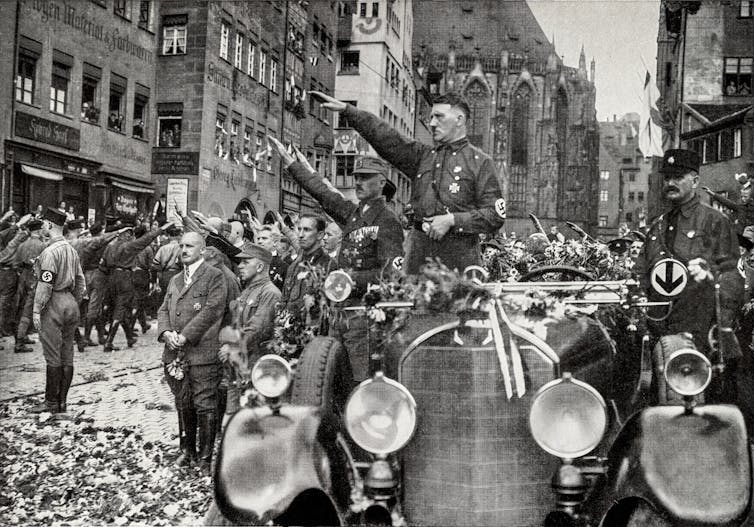
Adolf Hitler on the third day of the Nazi party conference Nuremberg, Germany, in 1929. Shutterstock/Andreas Wolochow
The cumulative effect of these experiences was that ideas of racial superiority came to be seen an unscientific relic of the past.
Squashing ‘scientific racism’
This was exemplified by the United Nations, which in November of 1945 established Unesco (United Nations Educational, Scientific and Cultural Organisation) with the explicit aim of battling racism. Unesco’s constitution, adopted on November 16 of that year, drew a direct connection between racism and the second world war:
The great and terrible war which has now ended was a war made possible by the denial of the democratic principles of the dignity, equality and mutual respect of men, and by the propagation, in their place, through ignorance and prejudice, of the doctrine of the inequality of men and races.
In 1949, Unesco appointed a panel of prominent scientists to formulate a critique of scientific racism. Reporting in 1950, the panel concluded that there is no scientific basis for any claims of racial superiority of one group over another. As the panel wrote, “the likenesses among men are far greater than their differences”.
While a small number of academics remained committed to race science and eugenics, they were forced into the margins of the academic world. The Eugenics Society, though it continued to exist, lost much of its prestige.
Going forward, race science or political appeals to racial superiority were no longer deemed acceptable, even among ruling elites. The language of race lost the scientific legitimacy and political purchase it once had.
This did not mean that racism disappeared, however. Rather, it changed shape.
Immigration and culture
Explicit appeals to race remained politically unacceptable for many decades after the war. This forced intellectuals and politicians on the right, especially those with divisive views about racial and ethnic differences, to develop an alternative language in which to express their ideas.
The backlash against these migration trends was exemplified by Enoch Powell, a Conservative MP and former Minister of Health. In the late 1960s, Powell developed a vocal critique of immigration numbers.
Powell’s rhetoric was inflammatory and racially charged. In his infamous ‘Rivers of Blood’ speech, delivered in 1968 in Birmingham, Powell claimed that unless immigration was restricted, people of colour would soon have “the whip hand over the white man”. In another speech, from 1970, Powell complained that it was no longer politically acceptable to say that “the English are a white nation”.
Powell made no appeal to the idea of biological difference. Instead, his emphasis was on cultural difference. He claimed that migrants and white British people were culturally too dissimilar for assimilation to be possible in large numbers.
Powell’s speeches on immigration cost him his political career. He was dismissed from the Shadow Cabinet following his “Rivers of Blood” comments. Yet his views were soon echoed by other political figures.
In 1976, Ivor Stanbrook, a Conservative MP, said in the House of Commons: “Let there be no beating about the bush. The average coloured immigrant has a different culture, a different religion and a different language. That is what creates the problem.”
And in 1978, Margaret Thatcher said in a TV interview that British “people are really rather afraid that this country might be rather swamped by people with a different culture”. Migration was a threat to Britain’s national identity.
Thatcher added: “We are a British nation with British characteristics. Every country can take some small minorities and in many ways they add to the richness and variety of this country. The moment the minority threatens to become a big one, people get frightened.”
In the 1979 general election, which Thatcher won with a landslide, the Conservative party manifesto pledged to tighten immigration controls and restrict citizenship. This pledge was enacted in 1981.
The denial of racism
The rhetoric of people like Powell, Stanbrook, and Thatcher represented a new kind of racial vocabulary. What is striking about this rhetoric is that it pretended not to concern race at all. Each of them explicitly denied that their rhetoric appealed to racist sentiment.
Powell often distanced his critique of immigration from concerns over race. In a 1970 interview, Powell said:
I’m not talking about race at all. I am talking about those differences, some of which are related to race, between the members of different nations which make the assimilation of the members of one nation into another nation more difficult or less difficult.
Stanbrook also denied that his comments about “coloured immigrants” were racist. In a parliamentary debate, he insisted that to highlight problems with cultural integration “is not racialism, if by that one means, as I do, an active hostility to another race”. This was because, in his view, “a preference for one’s own race is as natural as a preference for one’s own family”. A dislike of immigration, therefore, is not based on racist animosity. “It is simply human nature,” Stanbrook added.
Even Thatcher complained that whenever she tried to address concerns about immigration she was “falsely accused of racial prejudice” by her political opponents. She claimed that because mainstream political parties were not willing to talk about immigration, voters were instead turning to the far-right National Front. “If we do not want people to go to extremes, and I do not, we ourselves must talk about this problem and we must show that we are prepared to deal with it,” she said.
These denials of racism indicate that during this period, the language of race itself remained socially unacceptable. Powell, Stanbrook and Thatcher all felt the need to distance themselves from it.
This helps to explain why they preferred to focus on ideas of cultural difference and national identity. These ideas did not carry the same negative connotations as race, yet could be used to convey a similar message – namely that some groups did not belong in Britain.
The rise of inflammatory rhetoric surrounding immigration in the 1960s and 70s had an immediate impact on policy. During this period, successive governments responded to the growing clamour over immigration by selectively tightening migration controls and nationality legislation.
However, this rhetoric has also had a more gradual, long-term effect on racism’s place in society. Powell’s and Thatcher’s views on immigration have been echoed again and again, often framed in the same vocabulary. This continues to this day.
Last month, Katie Lam, the shadow home office minister, appeared to argue that Ukrainian and Gazan refugees should be treated differently because the former are better able to assimilate to British culture, as well as being more likely to go back to rebuild their country of origin.
And earlier this month, nationalist writer and academic Matthew Goodwin, who is formally linked to Reform, wrote in his personal newsletter that the “cultures that our hapless politicians are now importing into our country at speed are not just radically different and incompatible to our own; they are inferior, primitive, stuck in cultural codes and practices we moved on from centuries ago”.
The gradual normalisation of this kind of rhetoric has allowed it to re-enter mainstream public discourse. This has caused the erosion of the anti-racist norms established in the wake of the second world war. For many years after the war, these social norms meant that public figures who expressed views that were considered racist paid a high social or professional cost. Powell’s dismissal from the shadow cabinet following his Rivers of Blood speech is a forceful example of this.
Today, these anti-racist norms are under increasing pressure. To be sure, they have not fully disappeared. In recent years, anti-racist movements like the Black Lives Matter have enjoyed broad popular support in Britain and elsewhere.
Likewise, officials who express inflammatory rhetoric can still expect to be challenged. Politicians including Starmer, Robert Jenrick and Katie Lam have recently been met with criticism for divisive comments or policies on race, migration, and culture.
Starmer, for instance, was criticised for saying that migration numbers are turning Britain into an “island of strangers”. This comment was likened to Powell’s rhetoric on immigration, who also said that immigration left Britons feeling like “strangers in their own country”. When confronted with criticism, Starmer said he deeply regretted using that phrase.
Meanwhile, Farage has faced pressure to distance himself from racist comments he is alleged to have made in the past – allegations which he has strongly denied.
Yet, the prospect of a politician being dismissed from a cabinet role for racially inflammatory comments is very remote today. Neither Jenrick nor Lam has been dismissed from the shadow cabinet for their comments, with Conservative Party leader Kemi Badenoch expressly defending Jenrick.
Various forms of racism persist. Today, cultural racism is the most widespread and politically consequential kind. Derogatory and stereotyped views on cultural differences and national identity are now an everyday feature of public discourse, especially in debates over immigration.
Yet cultural racism remains poorly understood. In most media reporting and political discourse, the term “racism” continues to refer primarily to individual prejudice based on outward appearance or group belonging. When Streeting talks about “1970s, 1980s-style racism” he specifically means “abuse based on people’s skin colour”.
While it is undeniably a good thing that racist abuse is being vocally challenged by politicians, this narrow definition of racism obscures as much as it reveals. It fails to challenge forms of racism that do not appeal to physical traits but to cultural traditions. And it gives political agitators intent on sowing division on themes like immigration the opportunity to deflect criticism by denying that their ideas are racist.
At the structural level, racism causes certain individuals or communities to be more vulnerable to violence, exclusion, marginalisation, poverty, and other harmful outcomes on the basis of their membership of a particular racial, cultural, or religious group. Rhetoric that intensifies this vulnerability feeds racism, even when it is not expressed in the language of “race” or when there is no prejudicial intent.
So long as these structural factors are not taken into consideration, more subtle forms of racism will continue to hide in plain sight and exert a corrosive influence on the health and wellbeing of those it targets.
To hear about new Insights articles, join the hundreds of thousands of people who value The Conversation’s evidence-based news. Subscribe to our newsletter.
Elon Musk urges you to be a Fascist like him, says that you can ignore facts and reality then.A parody ‘Tesla – The Swasticar’ advert posted at a London bus stop. Photograph: People vs ElonKeir Starmer refuses to be outcnuted by Nigel Farage’s chasing the racist bigot vote.
dizzy: I tend to regard racism and misogyny as inherent and necessary to Capitalism, part of the divide and rule strategy providing an implied differentiation and continuum of perceived statuses. “No dogs, blacks or Irish”. It’s so ridiculously stupid and obviously transparent really.
I sometimes experience racism as a Welshman in England and as a perceived Englishman in Wales. It must be strange when I say the odd Welsh phrase “Diolch yn fawr” (most Welsh people will recognise and understand that). FM,(*1) an Englishman who’s learned Welsh, what’s the World coming to?
Strange hypocrisy that these Labour politicians can so readily condemn racism while supporting the explicitly racist and genocidal Israel apartheid regime …
*1
Orcas discuss the formation of UK’s new Socialist party and ask if the killer apes have finally come to their senses.
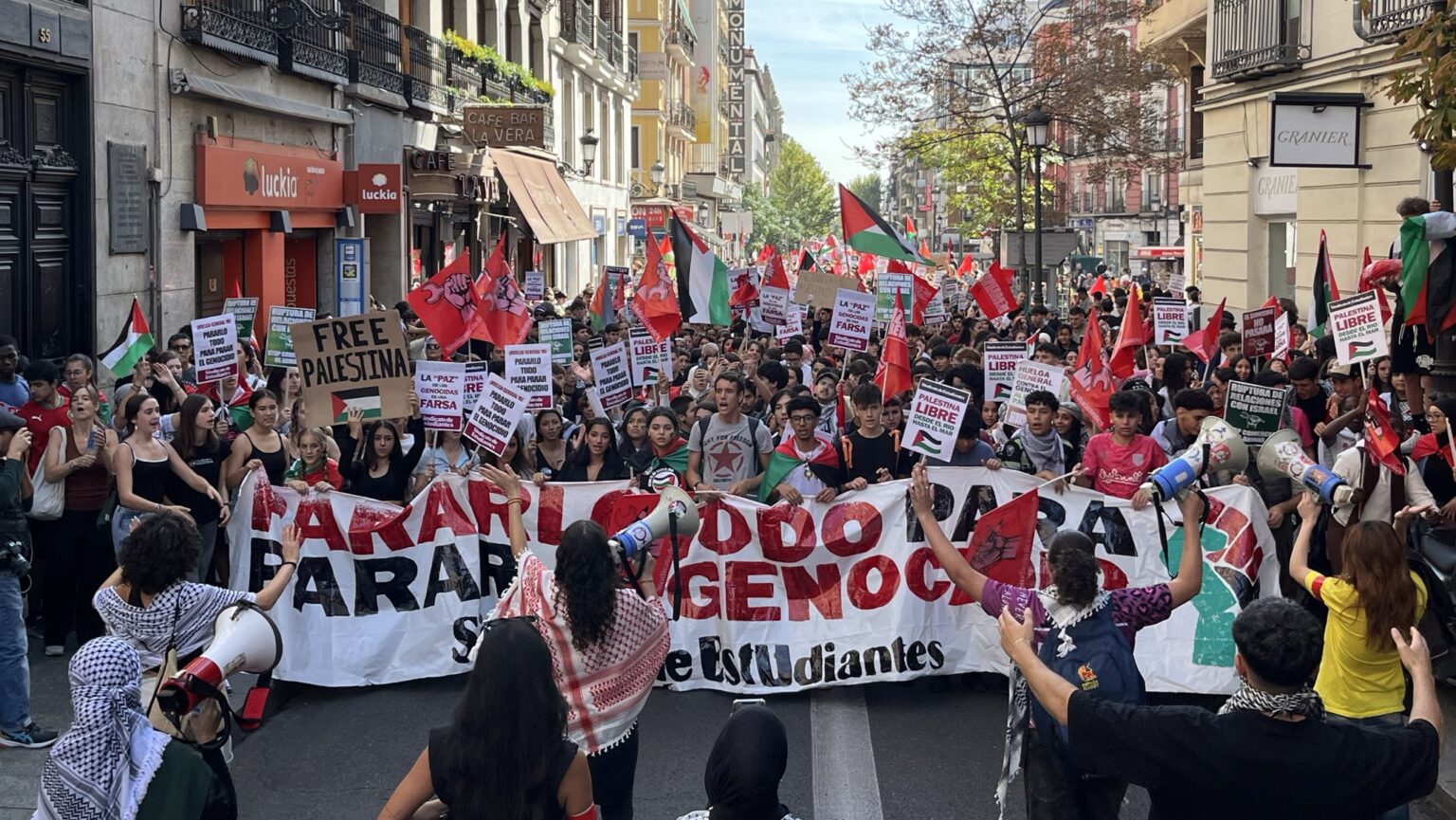
Trade unions and youth organizations in Spain held strikes and mass protests in solidarity with Palestine on October 15.
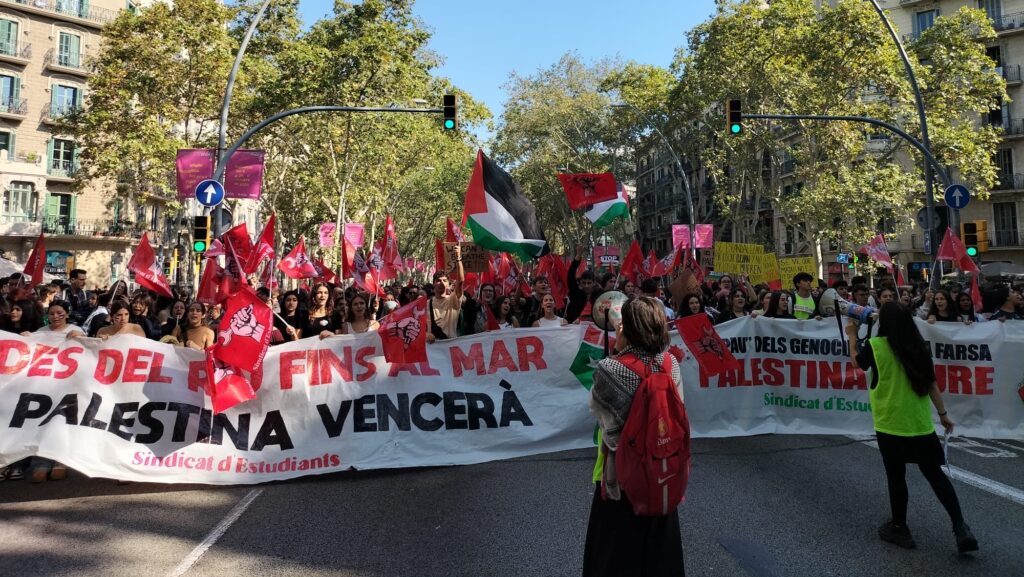
Trade unions and youth organizations across Spain held strikes and nationwide demonstrations in solidarity with Palestine on Wednesday, October 15. Tens of thousands of people joined rallies in major cities, demanding an end to ties with Israel, justice for Palestine, and expressing opposition to Europe’s militarization. They also criticized Prime Minister Pedro Sánchez’s administration for failing to take all necessary measures to sanction Israel despite formal condemnations of the genocide.
The actions in Spain came just weeks after two general strikes brought Italy to a halt over similar demands, underscoring that solidarity with Palestine remains a key moment for social movements in Europe.
Speaking at one of the rallies, Coral Latorre from the Students’ Union (Sindicato de Estudiantes) highlighted the crucial role of students and young people in sustaining the solidarity movement. Approximately 25,000 students participated in the demonstrations at Madrid’s Puerta del Sol, with thousands more joining protests in Barcelona, Tarragona, Valencia, and other cities following a wave of successful mobilizations earlier this month.
“Today we’re not only students [going on strike], but also workers,” Latorre said. “From the first hours of the morning, pickets, roadblocks, rallies in companies and factories, entire enterprises on strike… We said: we’ll block everything, and that’s what we’re doing with this day of general strike.”
October 15 rally in Barcelona. Source: Sindicato de Estudiantes/X
Frustration over the praise received by the recent ceasefire agreement announced by US President Donald Trump and Israeli authorities added fuel to the demonstrations. Protesters denounced the hypocrisy of European leaders congratulating Trump for his “peacemaking skills” while maintaining political, economic, and military cooperation with Israel and investing billions of euros in militarization.
“The ‘peace’ of the genocidal is not peace,” Latorre warned. “It is a farce to crown genocide, to turn Palestine into a colony, and to strip the Palestinian people of their right to exist […] This plan will bring neither justice nor freedom for Palestine.”
Workers’ organizations, including the General Confederation of Labor (CGT), contextualized European governments’ support for Israel under their broader programs of militarization and austerity. While workers have mobilized for peace and solidarity with Palestine since the beginning of the genocide, governments have instead chosen policies that fund arms manufacturers and eliminate social protections. “CGT bases the call for this day of strike in the fight for a redistribution of public spending in favor of workers, and against the rise of public investment in items aimed at defense and militarization,” the trade union wrote.
The CGT emphasized that ongoing trade relations with Israel and increased military expenditure both show “that public budgets are being used for interests far from the reality that workers live.”
In some cities, protesters reported police repression. According to the Students’ Union, attempts to suppress Palestine solidarity actions in Europe following the ceasefire announcement should be taken as a clear signal to intensify mobilization, not scale it back.
“The [Trump] plan is a scam made by the executioners of the Palestinian people,” Latorre said. “That is why mobilization must continue, and our efforts must be redoubled. They want us to leave the streets precisely because now we’re coming out in greater numbers than ever: we have to keep pushing and keep raising our voices.”
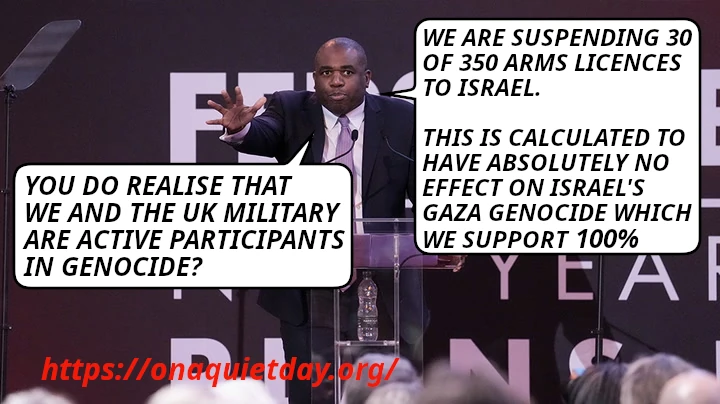
Genocide denier and Current UK Prime Minister Keir Starmer is quoted that he supports Zionism without qualification. He also confirms that UK air force support has been essential in Israel’s mass-murdering genocide. Includes URLs https://www.declassifieduk.org/keir-starmers-100-spy-flights-over-gaza-in-support-of-israel/ and https://youtu.be/O74hZCKKdpAKeir Starmer objects to criticism of the IDF. He asks how could anyone object to them starving people to death, forced marches like the Nazis did, bombing Gaza’s hospitals and universities, mass-murdering journalists, healthworkers and starving people queuing for food, killing and raping prisoners and murdering children. He calls for people to stop obstructing his genocide for Israel.Genocide denying UK Foreign Secretary David Lammy says that UK is suspending 30 of 350 arms licences to Israel. He also confirms the UK government’s support for Israel’s Gaza genocide and the UK government and military’s active participation in genocide.
MP Diane Abbott addressing the People’s Assembly Britain is Broken national demonstration in central London, November 5, 2022
SUSPENDING Diane Abbott on the same day a far-right mob attacked police and anti-racists reveals Labour’s “rank hypocrisy,” Stand Up To Racism (SUTR) said yesterday.
The campaign group slammed the party for censuring Britain’s first black woman MP and leading anti-racist while its leader, Prime Minister Sir Keir Starmer, stoked anti-immigrant sentiment with a speech implying Britain was becoming “an island of strangers.”
Anti-racists were surrounded by masked far-right thugs on Thursday night after staging a counter demonstration to an anti-immigration protest outside a hotel in Epping, Essex.
Riot police swarmed the streets after police vans were vandalised and officers assaulted by groups of men trying to reach the hotel.
SUTR co-convener Sabby Dhalu said: “On the same evening as a violent racist riot targeting asylum-seekers erupted outside the Bell Hotel in Epping Forest, Labour decided to suspend Diane Abbott, Britain’s first black woman MP and a leading anti-racist.

 OUTRAGE: Protesters hold signs calling for the release of Venezuelan President Nicolas Maduro outside Manhattan Federal Court before his arraignment in New York, on Monday January 5