A wildfire breaks out in a forested area in Antalya, Turkey on September 18, 2025. (Photo by Mustafa Kurt/Anadolu via Getty Images)
“At COP30, governments must reject this nightmare fantasy, uphold a just transition, and choose a fast, fair, and funded fossil fuel phaseout,” said one climate campaigner.
An International Energy Agency report published Wednesday underscores that world leaders are at a crossroads and must decide whether to embrace an ambitious transition to renewable energy or succumb to the agenda of US President Donald Trump and others bent on propping up the planet-wrecking fossil fuel industry.
The IEA said in its flagship World Energy Outlook that under a so-called “current policies scenario,” oil and fracked gas demand could continue to grow until the middle of the century, complicating the organization’s earlier projections that global fossil fuel demand could peak by 2030.
The change came amid pressure from the Trump administration and Republican lawmakers in the United States, the largest historical emitter of greenhouse gases. The New York Timesnoted Wednesday that “Republicans in Congress have been threatening to cut US government funding to the IEA if it does not change the way it operates.”
“In an essay posted online, the authors of this year’s report said they were restoring the current policies scenario because it was appropriate to consider multiple possibilities for the way the future might unfold,” the Times added. “They did not say they were responding to pressure from the United States.”
Fatih Birol, the IEA’s executive director, said in a statement that the scenarios outlined in the new report “illustrate the key decision points that lie ahead and, together, provide a framework for evidence-based, data-driven discussion over the way forward.”
Under all of the scenarios examined by the IEA, “renewables grow faster than any other major energy source” even as the Trump administration works to roll back clean energy initiatives in the US and promote fossil fuel production.
China, the report states, “continues to be the largest market for renewables, accounting for 45-60% of global deployment over the next ten years across the scenarios, and remains the largest manufacturer of most renewable technologies.”
The analysis was released as world leaders gathered in Belém, Brazil for the COP30 climate talks, which the Trump administration is boycotting while lobbing attacks from afar.
David Tong, global industry campaign manager at Oil Change International, said the IEA report “sets out a stark and simple choice: We can protect people and communities by safeguarding 1.5ºC [of warming], settle for a disastrous business-as-usual 2.5ºC, or choose to backslide into a nightmare future of much higher warming.”
“This year’s report also shows Donald Trump’s dystopian future, bringing back the old, fossil-fuel intense, high-pollution current policies scenario, charting an unrealistic pathway where governments drag their energy policies backwards and rates of renewable energy adoption stall, leading to high energy prices and unmitigated climate disaster,” said Tong. “At COP30, governments must reject this nightmare fantasy, uphold a just transition, and choose a fast, fair, and funded fossil fuel phaseout.”
Donald Trump urges you to be a Climate Science denier like him. He says that he makes millions and millions for destroying the planet, Burn, Baby, Burn and Flood, Baby, Flood.Elon Musk urges you to be a Fascist like him, says that you can ignore facts and reality then.Orcas discuss how Trump was re-elected and him being an obviously insane, xenophobic Fascist.
A DeSmog collage. The Institute of Economic Affairs has its headquarters on Lord North Street, Westminster. Credit: Des Blenkinsopp(CC BY-SA 2.0)
The regulator has opened a case against the Tufton Street group.
The Institute of Economic Affairs (IEA) pressure group, which campaigns against clean energy policies, is being investigated by the charities regulator.
The Good Law Project (GLP), a legal advocacy group, yesterday announced that it had been successful in forcing the Charity Commission to open a “regulatory compliance case” against the IEA.
A Charity Commission spokesperson told DeSmog: “We can confirm that, following an internal review, we have opened a regulatory compliance case to assess potential regulatory concerns about the Institute for Economic Affairs.
“Our case will examine the trustees’ management of perceptions of potential political bias, perceptions of a potential lack of transparency around funding, and perceptions that the charity may have pre-determined policy positions which would not be in keeping with its charitable purposes to advance education.”
The IEA is registered as a charity, and the regulator states that “political activity must not become the reason for the charity’s existence.”
In 2018, Greenpeace’s investigative journalism unit Unearthed revealed that the IEA had received funding from oil major BP every year since 1967. In response to the story, an IEA spokeswoman said: “It is surely uncontroversial that the IEA’s principles coincide with the interests of our donors.”
The IEA also received a £21,000 grant from U.S. oil major ExxonMobil in 2005.
However, the IEA does not publicly declare its donors, and it’s not known if the pressure group has received funding from BP or ExxonMobil in more recent years.
The IEA has extensive influence in politics and the media. It was pivotal to Liz Truss’s short-lived premiership as prime minister, and has boasted of its access to Conservative ministers and MPs.
The IEA is a prominent supporter of the continued and extended use of fossil fuels. The group has advocated for the ban to be lifted on fracking for shale gas, calling it the “moral and economic choice”. The IEA has also said that a ban on new North Sea oil and gas licences would be “madness”, has criticised the windfall tax imposed by the UK on fossil fuel firms, and said that the previous government’s commitment to “max out” the UK’s oil and gas reserves was a “welcome step”.
The IEA is part of the Tufton Street network – a cluster of libertarian think tanks and pressure groups that are in favour of more fossil fuel extraction and are opposed to state-led climate action. These groups are characterised by a lack of transparency over their sources of funding.
The Charity Commission initially rejected the GLP’s complaint about the IEA, which was lodged in March 2024 and backed by MPs from the Green Party, Liberal Democrats, and the Scottish National Party. The Charity Commission rejected the complaint after just 12 days.
However, after the GLP threatened formal legal action against the Charity Commission for failing to properly consider the evidence against the IEA, it has agreed to open a compliance case.
“We welcome this screeching u-turn from the Charity Commission who raced to clear the IEA last year,” said Good Law Project’s executive director Jolyon Maugham.
“It shouldn’t have taken the threat of legal action to force the regulator to do its job. The IEA’s activities are the polar opposite of public benefit and we’re now urging the Charity Commission to go further in its investigation.”
However, it’s unclear what action, if any, will be taken against the IEA if the regulator finds it in breach of charity rules. A previous case brought against the Global Warming Policy Foundation (GWPF) – the UK’s leading climate science denial group – didn’t lead to any meaningful sanctions against the Tufton Street group.
The GLP accused the GWPF of breaching charity law by spending hundreds of thousands of pounds on one-sided research attacking climate science, and by funding the lobbying activities of its campaign arm Net Zero Watch. However, the Charity Commission asked the GWPF to make only minor changes to its ownership structure and output.
An IEA spokesperson said: “We have received a letter from the Charity Commission and will be responding to them thoroughly in due course.”
Hintze, who has donated more than £4 million to the Conservatives since 2002, also donated £10,000 in August to leadership hopeful Priti Patel, who was voted out of the contest by Tory MPs this week. Tugendhat also received £3,000 from Hintze in December.
The GWPF actively campaigns against the government’s climate policies and rejects established science on rising temperatures, calling carbon dioxide a “benefit to the planet”.
Lord Hintze has said he believes “there is climate change” caused “in part due to human activity over the past century”, but “all sides must be heard” on climate change “to reach the right conclusion for society as a whole”.
Authors working for the world’s foremost climate science body, the UN’s Intergovernmental Panel on Climate Change (IPCC), have said that “it is a statement of fact, we cannot be any more certain; it is unequivocal and indisputable that humans are warming the planet”.
The IPCC has stated that we are in the midst of “widespread and rapid [changes] … unprecedented over many centuries, to many thousands of years”.
Between the 2019 general election and the start of the 2024 campaign, the Conservatives received £8.4 million from fossil fuel interests, highly polluting industries, and climate science deniers.
Cleverly, Tugendhat, Patel are not the only Tory leadership hopefuls to have received donations from figures associated with the GWPF. DeSmog revealed in August that Kemi Badenoch had received £10,000 towards her campaign from Neil Record, a millionaire Tory donor and chair of Net Zero Watch (NZW), the GWPF’s campaign arm.
Record is also a “life vice president” of the Institute of Economic Affairs (IEA) think tank, which he chaired until July 2023. The IEA, which supports new fossil fuel production, has received funding from the oil giant BP every year from 1967 to at least 2018.
Record has given money to both the IEA and the GWPF, which are part of the Tufton Street network of think tanks and lobbying groups based in Westminster campaigning for less government regulation, including on climate change.
The latest register of interests also shows that Record donated £2,000 to Tory MP Jesse Norman, who is publicly supporting Badenoch’s campaign.
As DeSmog has reported, Tugendhat also received donations and gifts worth £7,000 during the general election campaign from Tory donor and former party treasurer Lord Michael Spencer, who is a fossil fuel investor.
Spencer is the largest shareholder in Deltic Energy, which this year received licences to explore the North Sea for oil and gas. He also holds shares in Pantheon Resources, a UK company exploring for oil in Alaska.
Spencer, who has donated £6 million to the Conservatives since 2005, previously told DeSmog that oil and gas investments are less than two percent of his portfolio.
Views on Net Zero
Tugendhat, Badenoch, and Patel have vocally criticised the UK’s climate policies.
In a July interview on GB News, Tugendhat said the UK’s target of achieving net zero emissions by 2050 was “not realistic”. Badenoch said in 2022 that it was “arbitrary” and last year suggested she would back delaying it, which would contravene the UK’s legally-binding climate commitments. Patel shares this position, and told GB News last year that net zero targets should be “paused” because the “public are not ready”.
Polling by More in Common and E3G during the general election period found that a majority of people in every UK constituency are worried about climate change. Some 61 percent of 2024 Conservative voters said they are worried about climate change, matched by 76 percent of Labour voters, and 65 percent of the country overall.
In his GB News interview, Tugendhat also defended the previous government’s support for new oil and gas extraction, saying: “Drilling our own oil in the North Sea is more carbon efficient than bringing it in from anywhere else.”
The claim that UK oil and gas has a lower carbon footprint than imports is “misleading” and can only be achieved “by comparing UK gas production to the very dirtiest gas imports”, according to the research and campaign group Uplift.
Cleverly has supported the 2050 target but has said he would favour a “competition-based approach” rather than using the power and funding of the state. However, the private sector has often acted to delay climate action. According to the non-profits groups NewClimate Institute and Carbon Market Watch, which surveyed 51 major companies, their median goal is to cut emissions by 30 percent by 2030 – well below the 43 percent reduction identified by the IPCC.
Cleverly’s leadership campaign told DeSmog that “We thank all of our donors for their support for James Cleverly as the best candidate to unite the Conservative Party and win the next general election.”
Tugendhat, Patel, and Hintze have been approached for comment.
Democracy is a precious, and essential part of our society. Our leadership must always be accountable to the people, and if they are not, we risk oppression. We are, without a doubt, lucky to live in a liberal representational democracy, and when the time comes to vote, we should. So why then, are people acting politically, with civil resistance, outside of this mechanism?
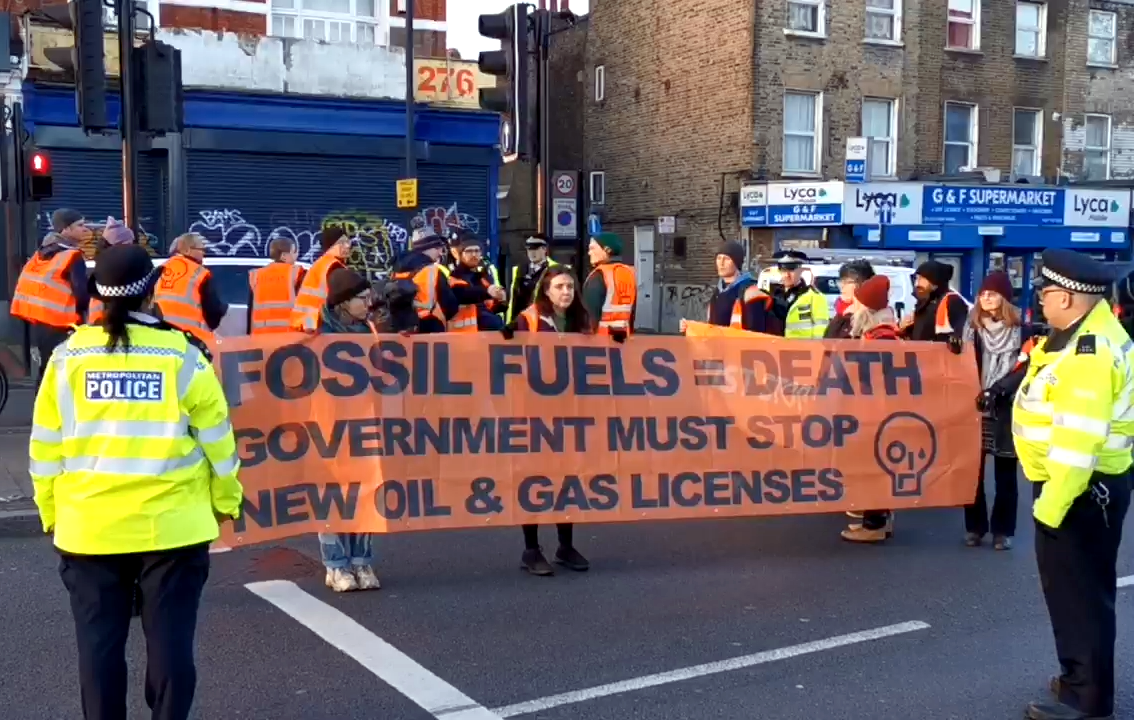
Over the last twelve months, thousands of people in the UK have engaged in peaceful resistance, and over a hundred (and counting) have been imprisoned. It’s not just in this country, in Canada ‘Save Old Growth’ are blocking motorways demanding no more felling of ancient trees. In France, Germany, Italy, Austria, Norway, the USA and Australia, ordinary people are resisting, disrupting transport and cultural activities – demanding that their states act to protect, not destroy, life.
They are ordinary people – coming together and acting out of love as much as fear and grief. Engaging in civil resistance, and defying a state, that while democratically elected, has proved deeply harmful. There’s no denying this harm – while the International Energy Agency has made it clear we can have no more new oil and gas development, the UK Government is ready to approve new oil fields and issue new exploration licenses, a death sentence for millions.
Our politicians say they are ‘committed to reaching net zero’. What they are actually committed to is kicking the can down the road and round the corner. Gambling on unproven or non-existent technology to reverse our dumping of CO2 into the atmosphere.
Instead of taking action, they’re making the problem worse for another 30 years, literally pouring fuel on the fire. The UK is the home of BP and Shell who are making eye-watering profits, and enjoying tax breaks to destroy life – because “pensions”, because “jobs”, because “economic growth”.
A stable climate is not a competing policy demand to be set against pensions, transport, or public sector funding. One provides the basis for everything else, there simply isn’t a contest. Our predicament is almost comically simple – either we stop the destruction of the global systems that enable ordered civil society to work or we lose everything we value, our traditions, our cherished landscapes and, crucially, democracy. There are no free and fair elections on a burning earth.
In 2019 the MoD published a report outlining what is coming if we don’t immediately reduce carbon emissions – “increased conflict over diminishing natural resources”. That’s code for war. War over food and water – and we know what war looks like, flattened cities, dictator warlords, child traffickers waiting on borders, tortured grandfathers – it’s being documented once again in Europe.
So what has happened in the UK to protect against this future? Traffic on the M25 has been disrupted, London bridges closed, oil terminals have been blockaded and occupied, football matches interrupted. Inept radio hosts have sparked viral memes about growing concrete and inspired themed stag nights. Just Stop Oil, Insulate Britain, XR and Stop HS2 have been painted on both the Left and Right as an eco-mob, eco-fascists, as selfish, naive and childish. But perhaps the most damaging criticism is that they are anti-democratic.
It’s as if every right and freedom we enjoy has been handed to us by a benign government. As if the Suffragettes never smashed windows, as if the race riots never happened, as if Stonewall simply wrote letters, as if those demanding disability rights didn’t chain themselves to railings and buses, as if the poll tax was scrapped due to reasonable debate and discussion or waiting politely for a chance to vote. Change requires citizens to stand up and resist harmful governments, it is part of democracy.
Resistance has nothing to do with “protest”. Protest is when you express your disapproval. You do not express disapproval when murderous governments engage in an act condemning the world to go over 1.5C in the 2030s – a death sentence for small island states and millions in the global south. Pakistan today demonstrates what we face – 33 million people impacted by floods and agriculture decimated.
We know what to do. It’s what the Suffragettes did, it’s what the Civil Rights movements did, it’s what everyone does when the inalienable right to life and a livelihood are violated. We engage in non-violent civil resistance.
What we must do now is block and disable the cogs of the machine. This is not a “tactic” – it is an act of self respect, an act of solidarity, an act of love and necessity.
We must resist now or we will look back with longing at all we have lost. The last 250 years of sacrifice and tears expended by generations to create decent societies is about to be snuffed out in the blink of an eye. The word betrayal does not cover the reality of what is going on. All our traditions, all our values, all that we claim to stand for is about to be lost.
It’s not about winning. It’s about doing what has to be done. Those who fought fascism in the 20th century, those who are fighting the oil companies across the global south, those fighting the Russians in Ukraine, they act because they know someone has to stand up.
The next generations are watching us. Can you feel the weight of billions of children yet to take their first breath? They are saying “Are you mad? Get out there, and stop this – or you condemn us forever”.
dizzy: 1. I submit that we exist in a plutocracy rather than a democracy. 2. I couldn’t find the MoD article containing the quotation “increased conflict over diminishing natural resources”. I suspect that it existed but is no longer published openly. There are plenty of official reports making similar points and it is a reasonable statement. For example the WORLD DEVELOPMENT REPORT 2011, ‘Resource Scarcity, Climate Change and the Risk of Violent Conflict’ Alex Evans, Center on International Cooperation, New York University, September 9, 2010 makes similar claims. Edit: Despite that article being a very wooly academic paper, I think that it does make that claim
Although the conflict risk posed by climate change and resource scarcity will almost always be better understood as a ‘threat multiplier’ than as a sole cause of violent conflict, a range of potential linkages between climate, scarcity and conflict risk can nonetheless be identified, whether through intensifying existing problems, or through creating new environmental problems that lead to instability.
USAID (2009). Climate Change, Adaptation and Conflict: A preliminary review of the issues. CMD Discussion Paper no. 1, October 2009
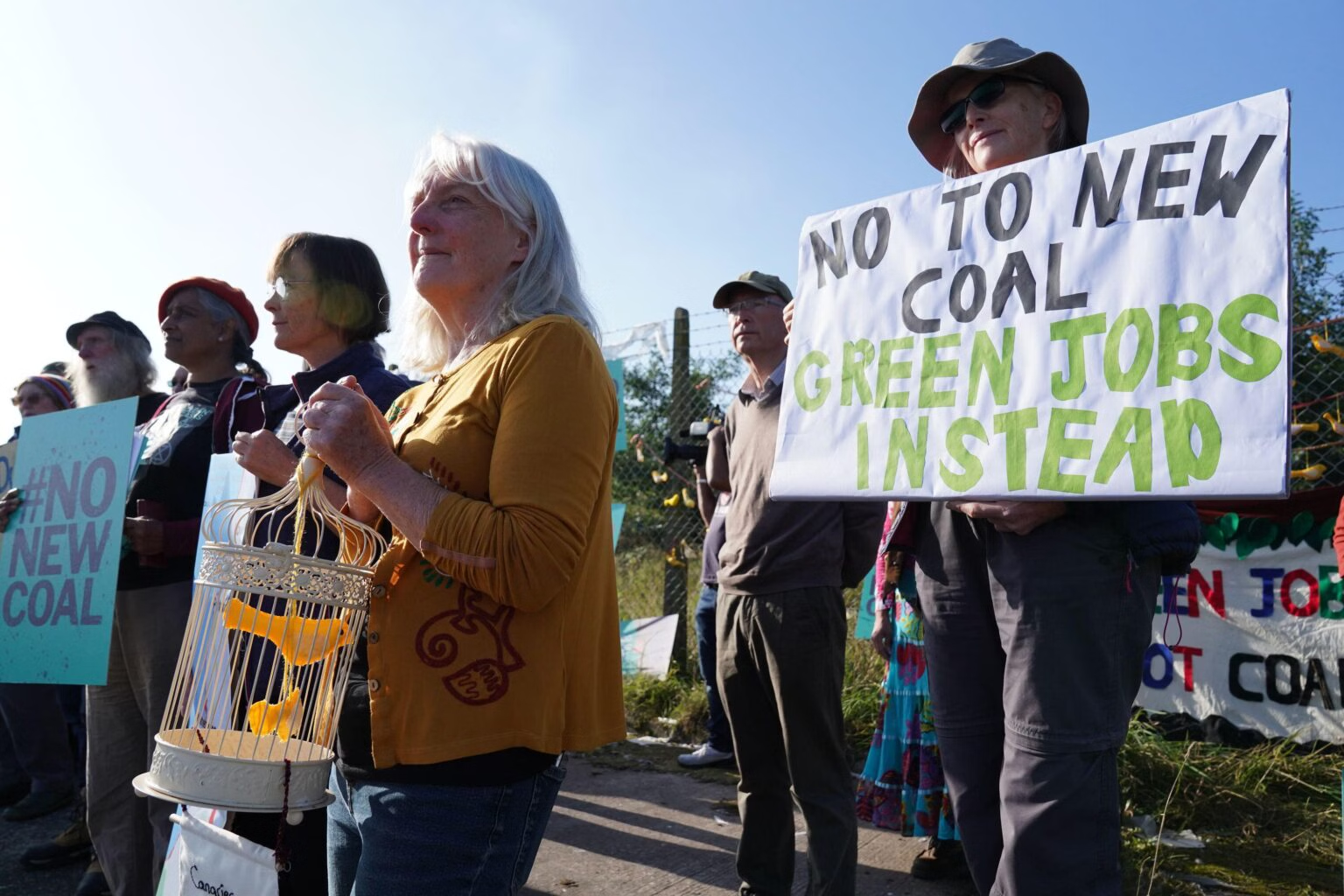
Demonstrators outside the proposed Woodhouse Colliery, south of Whitehaven, September 2021. Credit: PA Images / Alamy Stock Photo
Questions over compensation and employment could make it politically difficult for Labour to scrap the Whitehaven project, experts told DeSmog.
Labour has been urged to clarify its stance on the UK’s first deep coal mine in more than 30 years – as it fights an election campaign that has put clean energy at the fore.
The proposed mine in Whitehaven, Cumbria, would extract 2.8 million tonnes of coking coal a year from under the Irish sea to produce steel, emitting an estimated 220 millions tonnes of greenhouse gases over its lifetime.
The mine has become a political flashpoint in discussions over the UK’s commitment to reach net zero by 2050. In 2021, the International Energy Agency concluded that any new fossil fuel extraction was incompatible with global decarbonisation targets.
Ahead of a widely predicted victory at the 4 July election, Labour’s lack of clarity on the polluting mine poses awkward questions for a party that has based its manifesto on making Britain “a clean energy superpower”.
In the new manifesto, launched last week, Labour says it will not revoke existing oil and gas licences, but will also not grant any new licences. The party has explicitly ruled out issuing licences for new coal mines and says it will ban fracking for good.
The Woodhouse Colliery was granted planning permission by then Conservative levelling up secretary Michael Gove in December 2022, but has been plagued by controversy over its environmental impact and beset by legal delays.
So far, Labour has failed to address whether it would seek to overturn planning permission for the project, and has not responded to DeSmog’s requests for clarification.
In contrast, the party’s parliamentary candidate for the new Workington and Whitehaven constituency, where the mine would be built, has been vocal in his opposition.
Speaking to his local newspaper the News & Star last week, prospective MP Josh MacAlister said the mine was “a risky bet for new jobs”. “The easiest thing in the world would be to tell you the mine will solve our problems – but it won’t,” he said.
DeSmog understands that MacAlister has also addressed the issue at a number of local meetings, including to a mining heritage group in Whitehaven.
According to a source, he told dozens of residents in November that the area was better off without the mine. However, he reportedly stopped short of clarifying whether he would oppose the national party if it backed the scheme’s development.
When approached by DeSmog for comment, MacAlister’s team referred DeSmog to his views expressed in the News & Star, adding that they were “consistent with what he has said since being selected”.
A projection released by YouGov on 5 June shows that MacAlister is expected to win the seat in a landslide, with a predicted 53 percent of the vote to the Conservatives’ 25 percent.
Rebecca Willis, professor in energy and climate governance at the University of Lancaster, told DeSmog that “the mine has huge symbolic importance” both domestically and in terms of climate diplomacy.
“You can’t be a leading climate nation and provide consent for new coal mines,” she said. “Those two things are fundamentally incompatible.”
‘Non-Committal’
Despite Labour’s silence, MacAlister’s position appears to align with that of Ed Miliband, the party’s shadow climate change secretary.
Shortly after the mine was approved, Miliband co-authored an opinion piece for the News & Star with Cumberland’s council leader Mark Fryer. In the article, they argued that the mine would be “obsolete by the 2030s and 2040s at the latest, because of changes to the global steel industry which is rapidly moving towards clean steel production”.
Miliband reiterated this message at a March 2023 Cumberland Economic Summit event in west Cumbria.
Since then, the national Labour party has revealed little on its position.
Karl Conor, a former Labour councillor for Copeland, told DeSmog that given the controversies surrounding the scheme and the interest of the local community, MacAlister and Labour will be unable “to get through the campaign without having to nail their colours to the mast”.
In contrast to MacAlister, prospective Conservative MP Andrew Johnson has strongly backed the mine, telling the News & Star: “It offers the best prospect in years to create new jobs, attract significant investment into West Cumbria and help to deliver the upgrade to the coastal railway.
“If elected I will work tireless[ly] to fight for the mine to open and those jobs delivered”.
Claims by West Cumbria Mining that the project will create around 500 jobs have been strongly disputed.
Campaign group South Lakes Action on Climate Change (SLACC) group, which is bringing a legal challenge against the decision to greenlight the scheme, said that “no methodology” had been provided by the mining firm to support these claims.
A source in the new joint Cumberland authority told DeSmog they thought the local Conservative party would “try to make it [the local election campaign] about the mine”.
“In the same way they made the Uxbridge by-election all about ULEZ [London’s Ultra Low Emission Zone], Sadiq Khan’s flagship policy, the Tories’ electoral strategy will be to make it about the mine,” they said. “… If I was in their position, it’s what I’d be doing.”
Compensation Conundrum
Any new administration looking to block the Cumbria coal mine may be hit with a compensation claim that runs into the tens of millions, according to a well-placed legal expert.
Matthew McFeeley, a lawyer with Richard Buxton Solicitors, has been advising SLACC on its legal challenge. He told DeSmog that much will depend on the judicial review, which is scheduled to be heard on 16 July, less than a fortnight after the general election.
“If the court were to find that the planning permission had been unlawfully granted, then it would all have to go back to the secretary of state for a new decision,” McFeeley said.
In this scenario, he explained, a Labour administration could argue that the climate and environmental impacts of the project are too great, and refuse to grant permission.
If campaigners can successfully argue the mine’s planning permission is unlawful, the company behind the coaling scheme – West Cumbria Mining (WCM) – would not be able to issue any kind of compensation claim.
However, if the next government decided to revoke planning permission without a legal ruling, the taxpayer would be legally obliged to pay compensation, McFeeley said. The amount would depend on an assessment of how much WCM stood to lose from the permission being revoked.
The legal challenge is one of a number of hurdles WCM has to jump over before it can begin work at the site. McFeeley also indicated that the compensation claim could run into the tens of millions, or higher. “They’re investing their money at risk at this point,” he said.
WCM vacated its offices in west Cumbria on the eve of the 2021 public inquiry after the Singapore-based EMR Capital, one of the mine’s major financial backers, oversaw a “cost-saving” programme. The company has until the end of 2025 to get shovels in the ground.
Other hurdles also stand in the way of the mine’s construction – including approval of marine licences, habitat monitoring and a risk assessment.
Despite the many issues associated with the mine, Professor Willis, of the University of Lancaster, said that scrapping the plans may still prove awkward for an incoming government.
“There’s a timing issue for Labour here,” she said. “They’ve promised a lot in terms of green industrial policy through Great British Energy [Labour’s proposed state-owned energy company] and publicly-backed investment in green industries. But that will take a while to get going.
“So, at least over the next year, you’ll have the situation where they’ll be saying no to the mine but they’re not saying yes to anything else in the area. That’s quite difficult politically.
“Until the community actually sees a physical project with attached jobs being offered to them, they’re going to be pretty cynical about it.”
West Cumbria Mining did not respond to DeSmog’s request for comment.