Original article by Taylor Noakes republished from DeSmog.
Fossil fuel advocates argue Big Oil is being silenced by the consumer protection law.
The Macdonald-Laurier Institute (MLI) is calling to repeal Bill C-59 — commonly referred to as Canada’s anti-greenwashing law.
Calling the bill a “failure of process and policy,” an MLI paper advocating for abolishment states that it has had a “dramatic silencing effect” on many nationwide businesses and associations that want to communicate their environmental goals. It also says the amendment’s wording exposes companies to frivolous lawsuits.
Canada’s Parliament adopted the omnibus Bill C-59, officially known as the Fall Economic Statement Implementation Act, 2023, in June 2024. The bill included anti-greenwashing amendments to the Competition Act, which came about as a result of public meetings held in the spring of 2023.
The bill says that companies found deliberately misleading the public with false environmental claims could be fined up to $10 million.
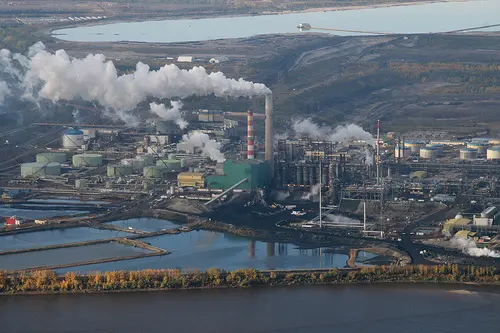
Shortly before the law was adopted, DeSmog reported that Pathways Alliance — a consortium representing six Canadian tar sands oil producers — scrubbed its website of all content. Not long after, Canadian oil companies, the Canadian Association of Petroleum Producers (CAPP), and third-party advertisers that run pro-oil propaganda on social media, removed mentions of carbon capture and storage (CCS) from their websites. Imperial Oil also removed statements quoting its CEO that were supportive of carbon capture as a climate change mitigation technology. Shell Canada dropped its 2050 climate goals from its website altogether.
While Canada’s oil industry argued that the new anti-greenwashing regulations necessitated the removal of advocating for carbon capture efforts as much as their Net-Zero goals, other major Canadian corporations did not have a similar reaction. In addition, major tar sands producers and Pathways Alliance partners, such as Cenovus and Canadian Natural Resources Ltd., blamed the regulations when they delayed environmental, social, and governance (ESG) reporting to investors.
Critics argue CCS is an ineffective climate change mitigation technology because it habitually underperforms at capturing carbon dioxide emissions. It’s also historically been used to extend the lifespans of otherwise derelict oil wells, and – irrespective of emissions captured during production – produces fossil fuels that create new emissions when combusted for energy or electricity. Because of these reasons, critics argue CCS’s only purpose is to provide the appearance of social acceptability while continuing fossil fuel production.
Carbon capture has been widely promoted by the Pathways Alliance, which is seeking to develop a massive carbon capture project in Alberta that would link 13 tar sands facilities with 400 kilometers of carbon dioxide pipelines to a centralized carbon capture hub. CCS projects have historically underperformed in Canada; a 2020 report by Global Witness found that Shell Canada’s Quest hydrogen facility — which uses carbon capture — was actually emitting more carbon than it captured.
Recent research from the Institute for Energy Economics and Financial Analysis (IEEFA) reveals that the Pathways project is not financially viable, and is likely to be subsidy-dependent with limited revenue potential. The IEEFA also notes that Canada’s carbon capture projects have struggled to keep up with projected capture rates.
On the Offensive
Though Bill C-59 is designed to protect Canadian consumers from fraudulent advertising, just as other industries do, fossil fuel advocates — from conservative Canadian newspapers to Koch Brothers-affiliated Canadian think tanks and conservative Alberta politicians — immediately went on the offensive shortly after the bill became law in June 2024.
Alberta Premier Danielle Smith described the new requirements as “draconian legislation that will irreparably harm Canadians’ ability to hear the truth about the energy industry and Alberta’s successes in reducing global emissions.” She also stated that the new law was “absurd authoritarian censorship.”
“Freedom for people to express themselves is crucial to a democracy,” said Emilia Belliveau, program manager, Energy Transition, Environmental Defence. “But giving businesses a free pass to spread disinformation and greenwashing isn’t.”
“Bill C-59 builds on the longstanding work of the Competition Bureau to protect fair business practices and ensure the public isn’t being lied to,” Belliveau said in a statement to DeSmog.
“People have a right to know the truth — whether it’s about a product, a service, or the companies behind them. That’s why it’s imperative that our democracy has rules in place to stop ultra-wealthy CEOs and multi-billion-dollar corporations from spreading misinformation and manipulating the public for their own profits,” she added.
Advocates of C-59 have good reason to demand greater accountability from the oil and gas sector. Not only have fossil fuel companies known about the dangers of fossil fuel pollution’s contribution to climate change for decades, they have actively engaged in disinformation campaigns as well. Legislators created C-59 as a direct response to the ongoing disinformation efforts by Canada’s oil and gas industry, which has included everything from blaming stalled pipeline projects on “foreign funded eco-radicals” to outright denial of climate change and funding astroturfing groups to oppose climate legislation.
The MLI paper contains its own inaccurate and misleading statements, including an assertion that there was no opportunity for discussions. Despite making this statement several times, and including it as a key talking point in the paper’s executive summary, the paper’s authors conceded that a consultation process did take place roughly a year earlier. They said greenwashing was addressed, but still argued that a last-minute amendment is much broader and therefore deserved its own, separate consultation process.
Efforts to contact Charlie Angus, the NDP MP who sponsored the bill, were unsuccessful, as were DeSmog’s efforts at contacting MLI for comment.
Chief among MLI’s concerns are that the wording of the amended competition law puts the onus of proof on the person or company making a representation (such as an oil company claiming carbon capture is a viable climate change mitigation technology). With the C-59 amendment, companies and individuals now have to demonstrate their claims based on an internationally recognized standard. The MLI paper further argues that this exposes companies — such as multi-billion-dollar oil and gas companies — to frivolous lawsuits. MLI also claims that the new regulations open the door to too many potential complainants, such as environmental activists and climate advocacy groups.
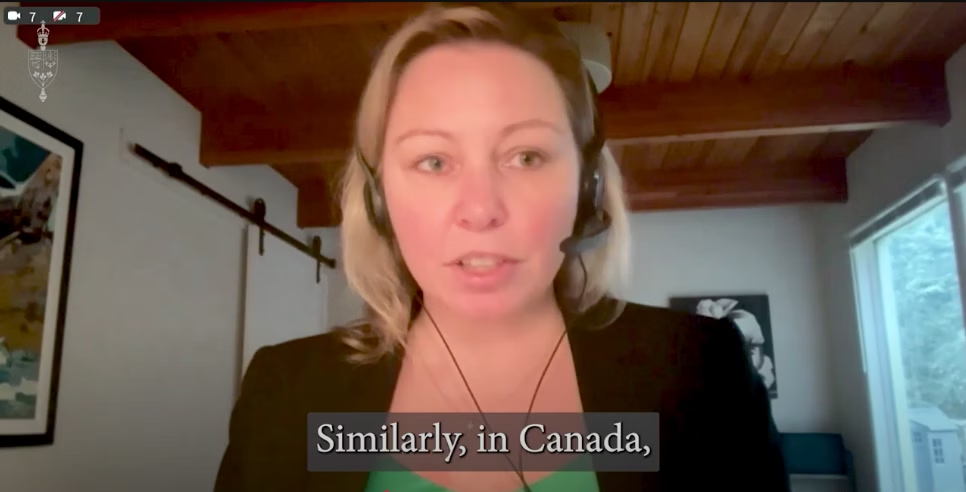
“Should companies be allowed to exaggerate, cherry-pick, or straight out lie to us in their advertising? No,” said Melissa Lem, family physician and president of the Canadian Association of Physicians for the Environment (CAPE) in a statement to DeSmog. “But this is exactly what companies have been doing with their environmental claims for too long.”
“This has had real impacts on our health due to unchecked pollution and escalating climate disasters,” she added.
“At its core, Bill C-59 is about truth in advertising — which ultimately protects us from corporate harm.”
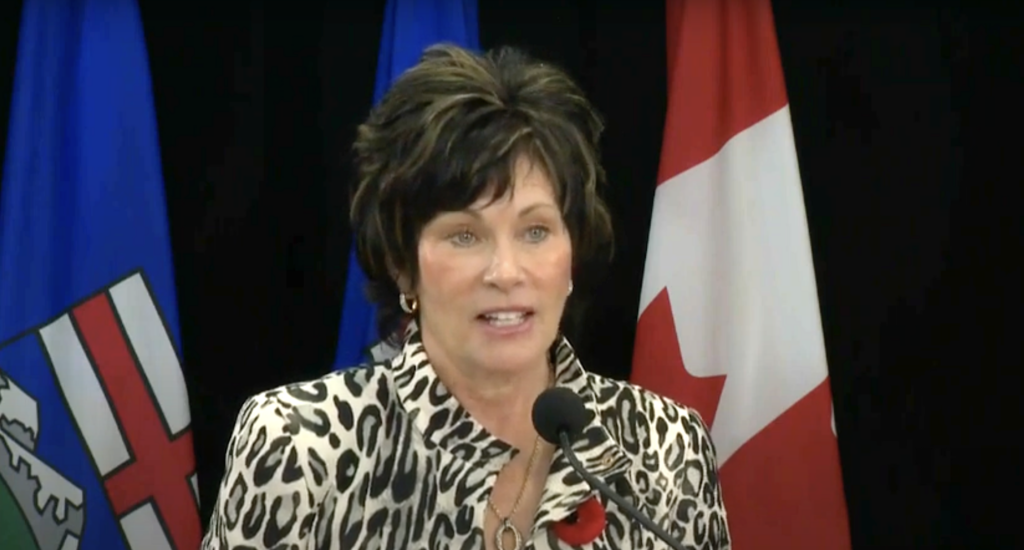
The MLI paper’s authors are former Alberta energy minister Sonya Savage and Heather Exner-Pirot, the institute’s director of Energy, Natural Resources and Environment.
DeSmog previously reported on Savage’s public statements about her belief that the anti-greenwashing law was “silencing” Canada’s oil and gas sector. Savage was formerly a senior executive with the Canadian Association of Petroleum Producers (CAPP), as well as Enbridge, a multinational pipeline company. Exner-Pirot is well-known for her fossil fuel advocacy as much as for her campaigns on behalf of the MLI against everything from an emissions cap to electric vehicles.
Both Savage and Exner-Pirot have made misleading statements in the past concerning various legislative efforts to control carbon emissions. For example, Exner-Pirot published op-eds criticizing the federal government’s electric vehicle (EV) mandate and characterized it as a quota, among several inaccurate statements about EVs in general. Savage has described C-59 as part of a global effort to silence Canada’s energy sector and that the regulations constituted an indirect ban on fossil fuel advertising, neither of which are true.
The Macdonald-Laurier Institute presents itself as a non-partisan and independent think tank, but is, in fact, part of the Atlas Network. Like Atlas, it has received funding from the Koch Brothers, and generally opposes government regulations — particularly on environmental issues or as they relate to the energy sector. MLI counts among its donors CAPP, Imperial Oil, Canadian Energy Pipeline Association and the Canadian Fuels Association, among others.
MLI has considerable access to mainstream Canadian media and routinely criticizes the environmental movement, attacking efforts to curb emissions as responding to climate change “alarmism.”
Original article by Taylor Noakes republished from DeSmog.