Tens of Thousands Rally in Havana Against US Aggression as Cuba Prepares Citizens for War

Spread the love

Article by Brett Wilkins republished from Common Dreams under Creative Commons (CC BY-NC-ND 3.0).
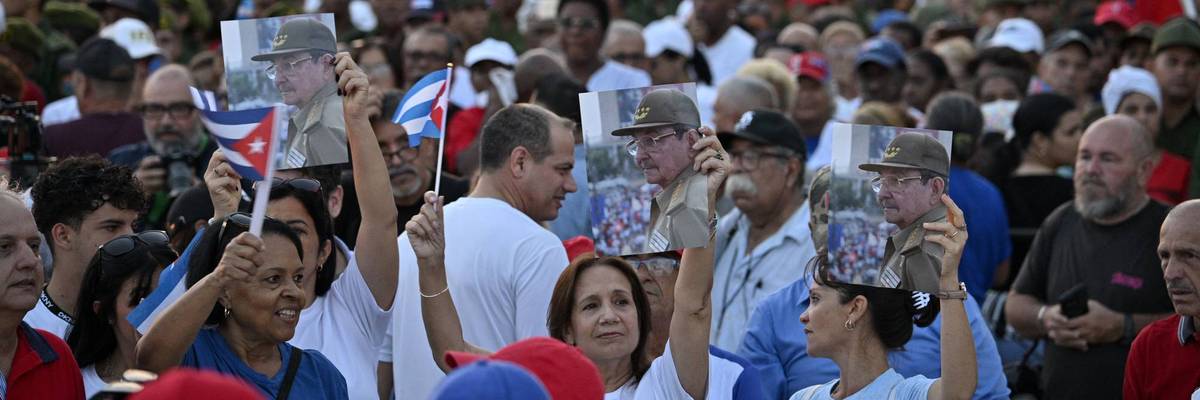
Cubans hold photos of revolutionary hero and former President Raúl Castro outside the US Embassy in Havana on May 22, 2026 amid threats of attack by the United States. (Photo by Adalberto Roque/AFP via Getty Images)

“Here we are prepared to fight imperialism,” said Cuban lawmaker Mariela Castro, daughter of Raúl Castro. “Cuba is a small and poor country, but one with experience confronting US imperialism.”

Tens of thousands of Cubans rallied Friday in Havana to denounce the Trump administration’s indictment of former President Raúl Castro and threats to attack the island nation, whose socialist government has been preparing its citizens to defend their homeland and revolution against US aggression.

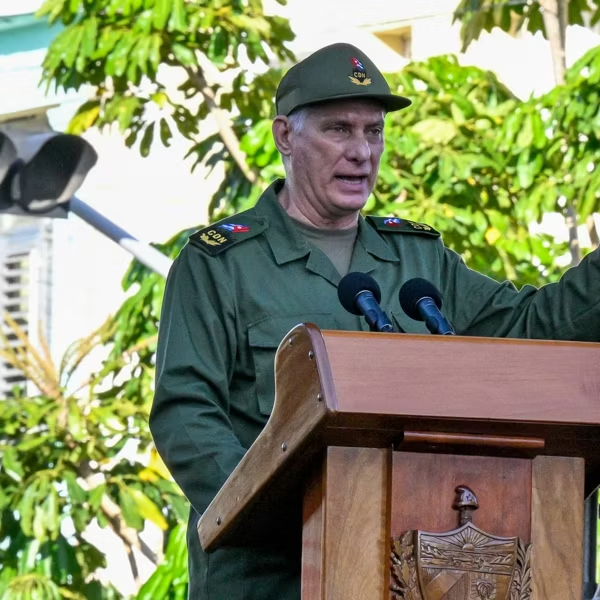
“No disrespect is shown to the heroes of the homeland!” Cuban President Miguel Díaz-Canel said as people flooded the streets outside the US Embassy in Havana. “History and traditions are not insulted without a response! That does not happen in Cuba!”

RECOMMENDED…
Marco Rubio

Trump Admin Claims of Cuban Plans for Drone Attacks Denounced as ‘Ludicrous Pretext’ for War
CUBA-POLITICS-ANNIVERSARY

Unlawful US Attack, Says Cuban President, ‘Would Trigger a Bloodbath With Incalculable Consequences’

The massive rally followed Wednesday’s US Department of Justice indictment of revolutionary hero Raúl Castro, who served as president for a decade after his older brother, Fidel Castro, stepped down in 2008. The DOJ indicted Castro for his alleged role in the 1996 shoot-down of planes operated by the counterrevolutionary group Brothers to the Rescue after repeated warnings that they had violated Cuban airspace.

Rallying under the slogan “Raúl is Raúl”—originally popularized during the transitional period of rule between the Castros to highlight the younger brother’s reforms—Cubans vowed to defend their revolution in the face of the latest US threats.

“This new aggression has united us more and elevated the honor, dignity, and anti-imperialist spirit of a people already recognized around the world for their brave resistance to any form of subordination to the empire,” Díaz-Canel said.

Cuban legislator Mariela Castro, Raúl’s granddaughter, told rallygoers that “we are prepared for combat.”

“No one is going to kidnap him. I can assure you of that,” she said, alluding to the US invasion and abduction of Venezuelan President Nicolás Maduro on dubious narco-terrorism charges earlier this year. “Neither him nor anyone else.”

“My father is very calm, watching and smiling,” Castro added. “Here, we are prepared to fight imperialism. Cuba is a small and poor country, but one with experience confronting US imperialism. We know that as long as there is an anti-imperialist revolution, there will be a gigantic and ruthless enemy.”

Critics noted the hypocrisy of the Castro indictment, given the ongoing illegal US bombing of boats that the Trump administration claims—without providing evidence—were smuggling drugs in the Caribbean Sea and Pacific Ocean.

“Washington has no moral authority to judge anyone,” Gerardo Hernández, coordinator of the Committees for the Defense of the Revolution, said, referring to the boat-bombing campaign, which has killed nearly 200 people in close to 60 reported attacks. “Cuba is a people of peace and reaffirms its legitimate right to self-defense.”

“Cuba does not constitute a threat to US security,” he continued. “On the contrary, Cuba is a state under attack by the United States.”

Observers have pointed to the decadeslong US-backed campaign of anti-Castro terrorism against the Cuban people, including the 1976 bombing of Cubana Flight 455, a commercial airliner with 73 people aboard, including 11 Guyanese nationals and 24 teenage members of Cuba’s junior Olympic fencing team. Perpetrators of the attack enjoyed safe haven in the United States, mainly in Miami, where the city celebrated a day in honor of one of the bombing’s alleged masterminds.

“The Cuban people reaffirm the unwavering decision to defend their homeland and revolution,” Hernández added. “With the greatest determination, they reaffirm their absolute and firm support for Army General Raúl Castro.”

Mariela Castro said that “my family, like all Cuban families, is waiting for instructions to know where we need to go” in the event of a US attack.

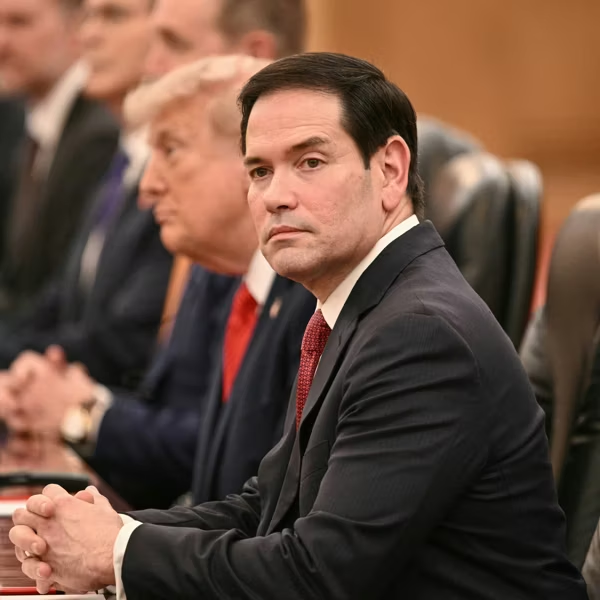
As US Secretary of State Marco Rubio—whose parents immigrated to the United States from Cuba during the US-backed dictatorship that preceded the Castro-led revolution—said Thursday that the chances of a “negotiated and peaceful agreement” with Havana are “not high,” Deputy Cuban Foreign Minister Carlos Fernández de Cossío acknowledged that his country is preparing for war, asserting that “we would be naive not to.”

Cuban officials have been circulating a pamphlet titled a “Family Guide for Protection Against Military Aggression.” The publication warns that the US is preparing “to launch a military assault and destroy our society with the aim of perpetuating capitalism… and annihilating the dream of our Commander-in-Chief, Fidel Castro.”

The pamphlet instructs Cubans to pack survival kits and seek shelter in the event of air-raid alerts. It also contains life-saving first aid instructions.

“Should the enemy attack, our Revolution will defend itself until victory is achieved and the aggressor is expelled,” the pamphlet states.

US President Donald Trump recently tightened the internationally condemned 65-year US economic embargo on Cuba, imposing a fuel blockade that has exacerbated an energy emergency characterized by blackouts and deadly suffering among the most vulnerable Cubans, including sick people and children.

Last month, Trump said that “we may stop by Cuba after we’re finished” with the illegal US-Israeli war of choice against Iran. The president has also stated he believes he’ll “be having the honor of taking Cuba,” language echoing the 19th-century US imperialists who conquered the island along with Puerto Rico, Guam, and the Philippines from Spain in another war waged on dubious pretense.

“Whether I free it, take it—I think I can do anything I want,” Trump said of the island and its 11 million inhabitants.

BreakThrough News interviewed Havana residents earlier this week about the specter of US attack.

“We Cubans have to protect ourselves,” elderly Havana resident Juan Hernández said. “We’re not going to hand any Cuban over to a foreigner, because that would be immoral. It would be treason.”

Hernández accused the US of “provocation” in order to “justify invading the country,” adding “that would only lead to bloodshed on both sides.”

“Besides,” he added, “Cuba isn’t a threat to them at all. What does Cuba have? Do we have atomic bombs? Do we have anything? We have nothing.”

Article by Brett Wilkins republished from Common Dreams under Creative Commons (CC BY-NC-ND 3.0).
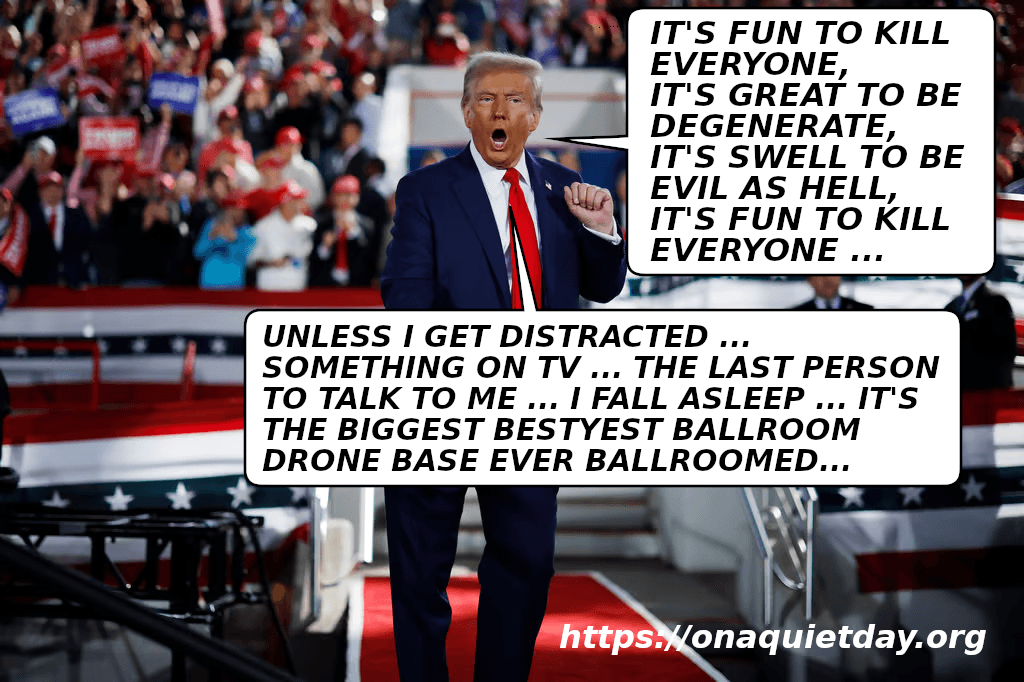
Donald Trump sings and dances, says that it's fun to kill everyone ... unless he gets distracted or falls asleep.
Donald Trump sings and dances, says that it’s fun to kill everyone … unless he gets distracted or falls asleep.
Orcas discuss how Trump was re-elected and him being an obviously insane, xenophobic Fascist.
Elon Musk urges you to be a Fascist like him, says that you can ignore facts and reality then.
Continue ReadingTens of Thousands Rally in Havana Against US Aggression as Cuba Prepares Citizens for War

Majority of UN Security Council rejects the US attack on Venezuela

Spread the love

Original article by Pablo Meriguet republished from peoples dispatch under Creative Commons Attribution-ShareAlike 4.0 (CC BY-SA) license.

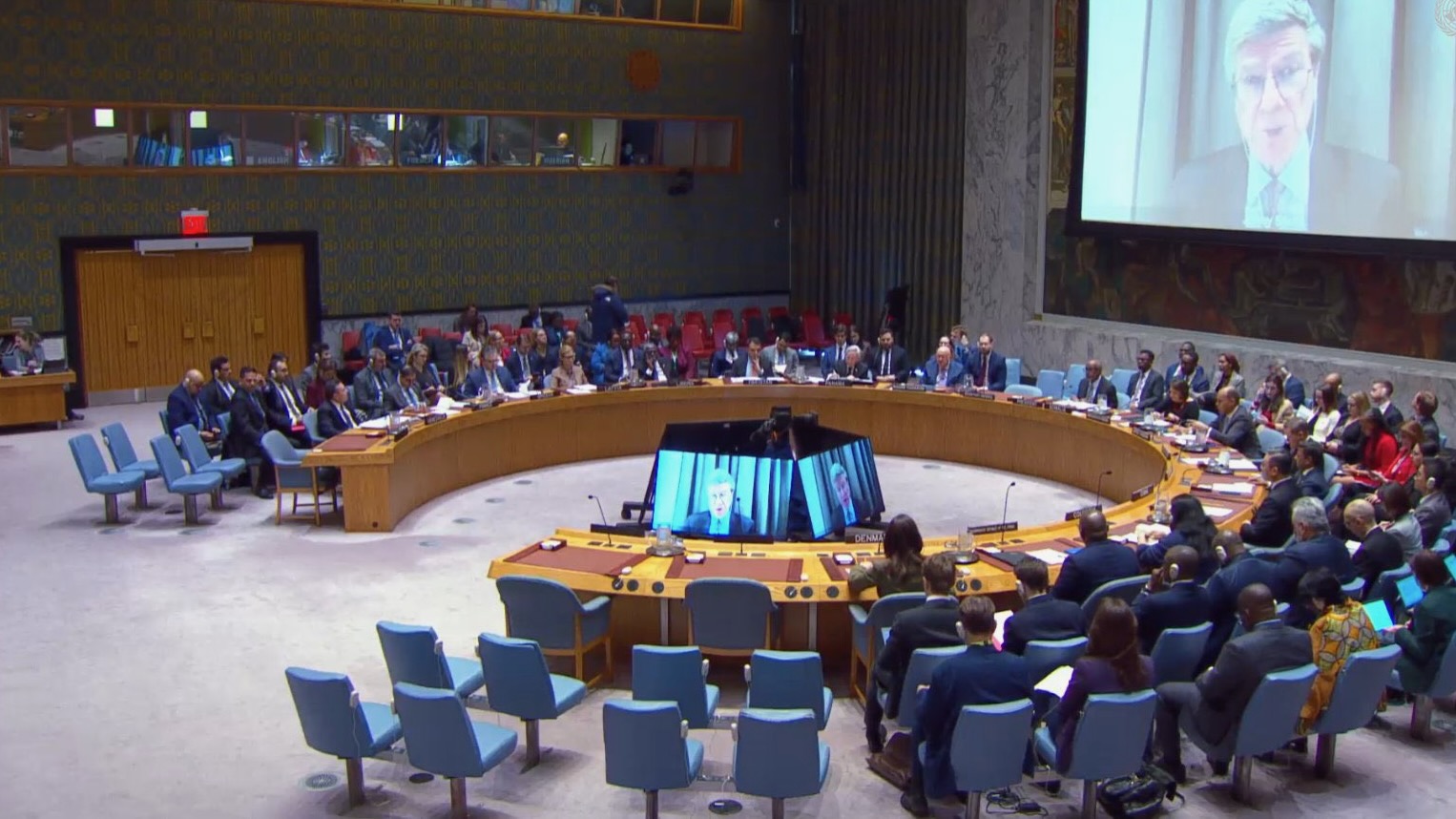
UNSC emergency session on US attack on Venezuela. Photo: X

In this piece, we review the arguments made by members of the United Nations Security Council regarding the US attack on Venezuela on January 3.

The UN Security Council held an emergency meeting on January 3 in response to the US attack on Venezuela, which resulted in the deaths of dozens of people and the capture of Venezuelan President Nicolás Maduro.

The high-level diplomatic meeting was marked by two clearly distinguishable positions: those who supported Washington’s actions and those who rejected them, claiming they violated international law and the South American country’s national sovereignty.

Rosemary DiCarlo, representative of the Secretary-General, said that the actions could generate greater instability in the nation: “We meet at a grave time following the January 3 United States military action in the Bolivarian Republic of Venezuela.” In addition, DiCarlo, following the statements of Secretary-General Antonio Guterres, emphasized that the attack constituted a military aggression that violates the UN Charter.

Future of the UN Charter at stake

Renowned scholar Jeffrey D. Sachs, president of the UN Sustainable Development Solutions Network, also addressed the session and highlighted that beyond the immediate violation of Venezuela’s sovereignty, the US actions constitute an existential threat to the entire UN system. “The issue before the Council today is not the character of the government of Venezuela. The issue is whether any Member State—by force, coercion, or economic strangulation—has the right to determine Venezuela’s political future or to exercise control over its affairs. This question goes directly to Article 2(4) of the United Nations Charter, which prohibits the threat or use of force against the territorial integrity or political independence of any state.”

Sachs implored the UNSC to take action and call on the US to end its military threats and attacks against Venezuela, end its naval blockade, and withdraw its military forces from the Caribbean which have been amassing since August.

Sachs affirmed that, “Peace and the survival of humanity depend on whether the United Nations Charter remains a living instrument of international law or is allowed to wither into irrelevance.”

Neocolonialism, illegality and imperialism: condemnation of the attack

Samuel Moncada, Venezuela’s representative to the Security Council, strongly condemned the US military actions against his country. He stated that what happened on January 3 constituted an “illegitimate armed attack” that lacked legal justification and violated the UN Charter, the Geneva Convention, and the principles of sovereignty. The situation also calls into question the “credibility of international law,” as it seems that “the law is optional” when it is one country and not another that “kidnaps a head of state”.

China

Along the same lines, Fu Cong, representative of China, said: “[China] strongly condemns the unilateral, illegal, and bullying acts against Venezuela.” “[The United States] wantonly tramples upon Venezuela’s sovereignty, security, and legitimate rights and interests,” he said. He also called on the United States to return to dialogue to reach a peaceful solution.

Cuba

Cuba, for its part, categorically rejected the “imperialist and fascist aggressions” of the United States and warned of “criminal and hegemonic plans” that Washington is carrying out. In addition, the Cuban representative stated that the United States commits acts of economic suffocation and maritime terrorism against the governments it seeks to overthrow, which is in flagrant contradiction with the UN Charter and international law. He asserted that the objective behind the “kidnapping” of Maduro and his wife, Cilia Flores, is to gain “control over Venezuela’s land and natural resources.”

Russia

Likewise, the representative of the Russian Federation, Vassily Nebenzia, condemned the “armed aggression” against Venezuela for violating international law and demanded the immediate release of the “legitimately-elected president”, Nicolás Maduro. He also called for an end to fear and hypocrisy in the face of US actions that seek to justify “such an egregious act of aggression [out of fear of the] American global gendarme.” Finally, he stated that the actions of the United States constitute new examples of “neocolonialism and imperialism”.

Colombia

For her part, Leonor Zalabata said that her country, Colombia, strongly condemns the actions of January 3, and affirmed that the use of force, according to the UN Charter, can only be used in exceptional situations, such as self-defense, but never to take political control of another state, as Trump said he would do with Venezuela. The attacks, she added, could lead to a large-scale migration that would require significant budget allocations to care for the migrants. Colombia shares thousands of kilometers of border with Venezuela, and Trump has directly threatened Colombian President Gustavo Petro with carrying out a similar attack on Colombian territory.

Mexico

Mexico also strongly criticized the military attack and stated that such actions “should not be allowed” because they jeopardize multilateralism and international law. It called on members to abandon double standards and “act decisively” in respect for the national sovereignty of the peoples of each country, who are the only ones authorized to decide “their destiny”.

Brazil

Brazil also joined in the criticism. Representative Sérgio França stated that “South America is a zone of peace,” and therefore his country rejects military intervention in Venezuela, which “crossed an unacceptable line”, and violates the UN Charter and international law.

Read more: “We’re going to run the country”: Trump hints at possible US occupation of Venezuela

The violation of international law: moderate criticism of the United States

Several members of the Security Council also criticized Washington’s actions, albeit indirectly or less forcefully. 

United Kingdom

Among them was the United Kingdom, whose representative, James Kariuki, stated that his country reaffirms its commitment to international law and the principles of the United Nations. However, he also criticized the actions of the Maduro government for allegedly increasing poverty, repressing the opposition, and the illegitimacy of his government.

Panama

Along the same lines, Panama’s representative, Eloy Alfaro de Alba, condemned the US attack. He stated that US military actions could have very serious consequences for peace in the Latin American region. He also stressed that his country, which suffered a US invasion between 1989 and 1990, reaffirms its respect for the sovereignty of nations. However, he also took the time to criticize what he called Maduro’s illegitimate and authoritarian government, which he said had eroded the democratic system after the 2024 elections.

Chile

Chile was another country that criticized the US military actions “unilaterally in Venezuela,” according to the South American country’s representative, Paula Narváez. “Chile does not recognize the Maduro regime, but serious human rights violations… cannot be resolved militarily and can only be addressed through peaceful, gradual, and incisive processes.”

“There is no war”: in defense of the US attack

For his part, US representative Michael Waltz defended his government’s actions and stated that “there is no war against Venezuela or its people”. On the contrary, Waltz argued that the attack was “a surgical law enforcement operation to apprehend two indicted fugitives, [the] narco-terrorist Nicolás Maduro and Celia Flores.”

Argentina

Another country that openly supported the attack was Argentina. Its representative, Francisco Tropepi, welcomed Trump’s “decisive action” and stated that it was justified by Maduro’s alleged involvement in drug trafficking. However, he called for the situation to be normalized and for institutional order to be restored as soon as possible.

Latvia

Along the same lines, Latvia’s representative, Sanita Pavļuta-Deslandes, indirectly justified the radical measure taken by the United States when she told the Security Council that Maduro’s government had violated human rights and encouraged drug trafficking and corruption.

The international community and international law are under threat

However, despite some direct and indirect support, the United States’ actions have not been well received by the majority of the United Nations Security Council. Several of its members understand that if such actions are not strongly condemned, they could pave the way for similar military actions in other parts of the world.

Asian and African countries fear a new wave of colonialism in their lands, and Europeans, many of whom do not support Maduro, see expansionist arguments looming over Greenland, which have not been heard in Europe for centuries.

Read more: Africa voices outrage against US invasion of Venezuela and kidnapping of President Maduro

Thus, the international community and international law (both structured after the defeat of the Axis in 1945) face an immense challenge following the attack on Venezuela. Whether they will emerge stronger or weakened will become clear in the coming months.

Original article by Pablo Meriguet republished from peoples dispatch under Creative Commons Attribution-ShareAlike 4.0 (CC BY-SA) license.

Elon Musk urges you to be a Fascist like him, says that you can ignore facts and reality then.
Donald Fuhrump says that Amerikkka doesn't bother with crimes or charges anymore, not being 100% Amerikkkan and opposing his real estate intentions is enough.
Donald Fuhrump says that Amerikkka doesn’t bother with crimes or charges anymore, not being 100% Amerikkkan and opposing his real estate intentions is enough.
Orcas discuss how Trump was re-elected and him being an obviously insane, xenophobic Fascist.

Continue ReadingMajority of UN Security Council rejects the US attack on Venezuela

New freedom flotilla to sail for Gaza in the spring

Spread the love

https://morningstaronline.co.uk/article/new-freedom-flotilla-sail-gaza-spring

 DESPERATE SITUATION: Mohammed al-Neder, 21, mourns over the body of his 4-month-old brother Ahmed, who was killed by Israeli fire, during his funeral at Shifa Hospital, in Gaza City

THE Global Sumud (steadfastness) Flotilla will launch its largest fleet yet in a bid to get aid into Gaza next spring, it has announced.

The group, which organised the 40-plus-vessel flotilla which earlier this year became the first to get within 70 nautical miles of Gaza since Israel began blockading the Palestinian territory in 2009, said it plans a new mission with over 100 ships and 1,000 participants.

Despite an official ceasefire agreed as of October 10, Gaza remains gripped by a humanitarian crisis, with insufficient food and shelter in a harsh winter. Israel insists it is meeting the ceasefire condition of allowing 600 lorryloads of aid in a day, but these are vetted by Israeli military agency Cogat and it admits 80 per cent are private-sector vehicles, many carrying commercial goods which residents of Gaza — where the economy has been destroyed by the war and the preceding 17-year illegal siege — cannot afford.

“This mission is also not only about those at sea. It is about the millions around the world who are ready to say ‘enough is enough’,” the flotilla organisers said.

“Together, we rise against apartheid, racism, imperialism, colonialism, ecocide, and all systems of oppression.”

https://morningstaronline.co.uk/article/new-freedom-flotilla-sail-gaza-spring

Experiencing issues with this image not appearing. I suspect because it's so critical of Zionist Keir Starmer's support of and complicity in Israel's genocides.
Genocide denier and Current UK Prime Minister Keir Starmer is quoted that he supports Zionism without qualification. He also confirms that UK air force support has been essential in Israel’s mass-murdering genocide. Includes URLs https://www.declassifieduk.org/keir-starmers-100-spy-flights-over-gaza-in-support-of-israel/ and https://youtu.be/O74hZCKKdpA
Keir Starmer objects to criticism of the IDF. He asks how could anyone object to them starving people to death, forced marches like the Nazis did, bombing Gaza's hospitals and universities, mass-murdering journalists, healthworkers and starving people queuing for food, killing and raping prisoners and murdering children. He calls for people to stop obstructing his genocide for Israel.
Keir Starmer objects to criticism of the IDF. He asks how could anyone object to them starving people to death, forced marches like the Nazis did, bombing Gaza’s hospitals and universities, mass-murdering journalists, healthworkers and starving people queuing for food, killing and raping prisoners and murdering children. He calls for people to stop obstructing his genocide for Israel.
Orcas discuss Genocide-supporting and complicit Zionists. Donald Trump, Keith Starmer, David Lammy, Rachel Reeves, Angela Rayner and Wes Streeting are acknowledged as evil genocide-complicit and supporting cnuts.
Continue ReadingNew freedom flotilla to sail for Gaza in the spring

Trump’s national security strategy is a blueprint for world domination – even if it denies it

Spread the love

Original article by Cameron Harrison and C.J. Atkins republished from People’s World under Attribution-NonCommercial-NoDerivs 3.0 United States licence.

The Trump administration’s new National Security Strategy claims to be rooted in ‘America First’ principles, but it is really ‘Imperialism First.’ | AP

Imperialism has a new mission statement. With the release of the Trump administration’s updated National Security Strategy (NSS), the campaign to keep U.S. capitalism in the global driver’s seat is signaling that those at the helm are ready to pick up the gun.

Since he returned to office, the president’s effort to shore up American corporations’ slumping economic dominance has largely focused on roping in trading partners with tariff threats or shutting out market competitors via sanctions and export restrictions.

As aggressive as those moves have been, they may end up looking like the proverbial carrot compared to the stick which the capitalist state now appears prepared to wield for the sake of ruling class profits.

Over a century ago, Marxist political economist Rosa Luxemburg observed that militarism is not just aggression for aggression’s sake but rather the “pre-eminent means for the realization of surplus value.” The new NSS proves her point.

Whose “security”?

The NSS is not a plan for “national security,” as the White House is marketing it, but rather a ruthless strategy for securing the global dominance of U.S. monopoly capital. Its main push is to crush rival powers, slow China’s growing international influence, and maintain U.S. global hegemony.

When the document trumpets “America First,” it really means “Imperialism First,” defining the “national interest” solely as the interest of the ruling class.

This imperial blueprint arrives amid a dangerous U.S. military build-up in the Caribbean and brazen extrajudicial strikes, signaling a violent escalation in Washington’s regime-change campaign against Venezuela. The NSS leaves little doubt that this aggression is part of a broader design.

The document’s top priority, it declares, is to “reassert and enforce the Monroe Doctrine to restore American pre-eminence in the western hemisphere.” This so-called “Trump Corollary,” announced on the doctrine’s 202nd anniversary, is a prescription for renewed U.S. domination, disguised as protecting the region from outside actors, primarily China.

It vows to “deny non-hemispheric competitors the ability…to own or control strategically vital assets,” using coded language for a determination to block Latin American cooperation with China on infrastructure and development. It boasts, for instance, of restoring U.S. “privileged access” to the Panama Canal.

Dispensing with (everyone else’s) sovereignty

What this will mean in practice is escalated hostility toward geopolitical alliances that the U.S. sees as rivals, like BRICS, and regime-change operations against the peoples of any country asserting their own sovereignty.

Thus, the NSS’s fraudulent rhetoric of “Sovereignty and Respect” is laid bare in the document. In it, U.S. imperialism asserts its own sovereignty as absolute while explicitly planning to violate that of nations in its declared “sphere of influence.” Venezuela is clearly first in line, but the independence of every state in the region is under threat.

The NSS’s imperial vision extends further around the world, too. Its supposed “Predisposition to Non-Interventionism” is a complete farce. The entire document outlines a strategy for aggressive economic, political, and military intervention.

The document stresses preventing Chinese reunification with Taiwan due to the island’s significance to U.S. naval domination and calls on Indo-Pacific countries to grant the U.S. military greater access. It dwells extensively on maintaining an edge over China, the “near peer” rival.

Anti-communism, the go-to of capitalist ideologues, also shines through in the document’s call for “disciplined economic action” to hem in China and its socialist-oriented economic policies—which are derisively dismissed as “predatory, state-directed subsidies and industrial strategies.”

The NSS demand that NATO states spend 5% of their GDP on militarization and directly confront China and Russia is a reaffirmation of the military alliance’s function to serve as an imperialist spearhead for aggression.

In Europe, U.S. imperialism’s goal is to “cultivate resistance” to EU independence by bolstering far-right, pro-U.S. nationalist parties in order to ensure Europe remains a subservient tool for Washington. This aim pitched in terms of “helping Europe correct its current trajectory.”

The “healthy nations of Central, Eastern, and Southern Europe”—i.e. those with right-wing governments friendly to the Trump administration—are to be built up “through commercial ties, weapons sales, political collaboration, and cultural and educational exchanges.”

Meanwhile, in a nod toward Moscow, the document says the Trump administration will work toward “ending the perception, and preventing the reality, of NATO as a perpetually expanding alliance.” This is a rhetorical tactic in the White House’s strategy of prying Russia loose from its ties with China—an effort to prevent cooperation between two countries seen as rivals.

The NSS aims for “energy dominance” and rejects the concept of “net zero” when it comes to fighting climate change. This of course signals a full, state-backed mobilization of U.S. fossil fuel capital to intensify extraction and sabotage global climate efforts.

Furthermore, the shift in Africa from “aid to investment” is explicitly about seizing the continent’s “critical minerals” for imperialist accumulation and plunder. The NSS favors partnerships with what it calls “capable, reliable states committed to opening their markets to U.S. goods and services.” Any countries who attempt to chart an independent path—like South Africa—earn themselves a place on Trump’s hit list.

Building a MAGA world

The document also reflects the administration’s domestic far-right politics, which of course serve its overall imperialist aims.

The call for “strong, traditional families,” pride in “past glories,” and rejection of “woke lunacy” is a right-wing cultural reaction designed to further split the working class along racial, gender, and national lines. It fosters the chauvinistic nationalism necessary to drum up support for impending imperialist wars.

The terroristic deportation campaign by ICE against immigrant workers is part and parcel of this project. It has its transatlantic reflection in the NSS’s declared goal of “restoring Europe’s civilizational self-confidence and Western identity.” Adapting the white supremacist ideology long deployed by the far-right at home, Trump says Europe must also unite to defend against “civilizational erasure”—racist code for immigration.

Similarly, the NSS’s critique of “misguided bets on globalism” that hollowed out industry acknowledges the devastation wrought by neoliberalism but instead of pinpointing this as the result of unleashing free market capitalism, it frames de-industrialization as a mere “strategic error.” Of course, the real cause is the logic of capitalism, in its imperialist stage, which seeks maximum profit through outsourcing, financialization, and wage depression.

Thus, Trump’s turn toward protectionism and trade wars is not a rejection of this logic but an attempt to reconfigure it under conditions of systemic crisis and heightened global economic competition.

Therefore, the claim to be “pro-American worker” is a cynical ploy. Policies like Trump’s tariffs and “re-shoring” are designed to wed a section of the U.S. working class to “national” capital against other countries and immigrant workers. Their weaponized concept of “competence and merit” attacks affirmative action by presenting inequality as “natural” to mask the brutal antagonisms of capitalist society.

Partitioning the globe

The NSS presents U.S. assets—the world’s largest economy, financial system, and military—as “natural” blessings. These comparative advantages were not born “naturally,” however; they were built on centuries of domestic class exploitation, slavery, colonial plunder, and global extraction. The “world’s most dynamic economy” is dynamic precisely because of its ruthless exploitation of labor and nature both at home and abroad.

This imperial blueprint arrives amid a dangerous U.S. military build-up in the Caribbean and brazen extrajudicial strikes, signaling a violent escalation in Washington’s regime-change campaign against Venezuela. The nuclear-powered aircraft carrier USS Gerald R. Ford heads up a military strike force currently being assembled off the coast of Venezuela. | AP

Beyond the U.S.’ largest immediate trading partners, Canada and Mexico, the nations of Latin America will be the first to find themselves in the crosshairs of this new strategy. Dominating this region is seen by the ruling class as the key in building a solid U.S. sphere of influence—a step toward holding onto global supremacy.

Building maximum resistance to U.S. aggression requires strengthening international solidarity campaigns with Venezuela, Cuba, Nicaragua, Colombia, and all countries facing the brunt of this offensive. It requires exposing the class essence of “America First” and uniting workers, and all forces for peace, against the common enemy: an imperialist system in crisis that is hurtling toward war and deeper exploitation in its desperate bid to maintain hegemony.

The document states quite clearly that the U.S. government’s objective must be “maintaining economic preeminence and consolidating our alliance system into an economic group.” On behalf of which sectors is this campaign to be waged? “AI, biotech, quantum computing,” “finance,” and “oil, gas, coal, and nuclear” are among the patron industries for whom the NSS was crafted.

So, it doesn’t take much reading between the lines when it comes to mapping the connections between Trump’s new NSS and the long-term decline of U.S. capitalism’s competitive advantage. Despite claims throughout of being “pro-worker,” the goal of this document—and the trade war that’s preceded its unveiling—is halting and reversing the erosion of U.S. monopoly corporate power via the construction of a U.S.-dominated bloc.

It has nothing to do with the real interests of the American people.

Original article by Cameron Harrison and C.J. Atkins republished from People’s World under Attribution-NonCommercial-NoDerivs 3.0 United States licence.

Orcas discuss Donald Trump and the killer apes' concept of democracy. Front Orca warns that Trump is crashing his country's economy and that everything he does he does for the fantastically wealthy.
Orcas discuss Donald Trump and the killer apes’ concept of democracy. Front Orca warns that Trump is crashing his country’s economy and that everything he does he does for the fantastically wealthy.
Continue ReadingTrump’s national security strategy is a blueprint for world domination – even if it denies it

Fidel Castro’s final reflections

Spread the love

Original article by Pablo Meriguet republished from peoples dispatch under a Creative Commons Attribution-ShareAlike 4.0 (CC BY-SA) license.

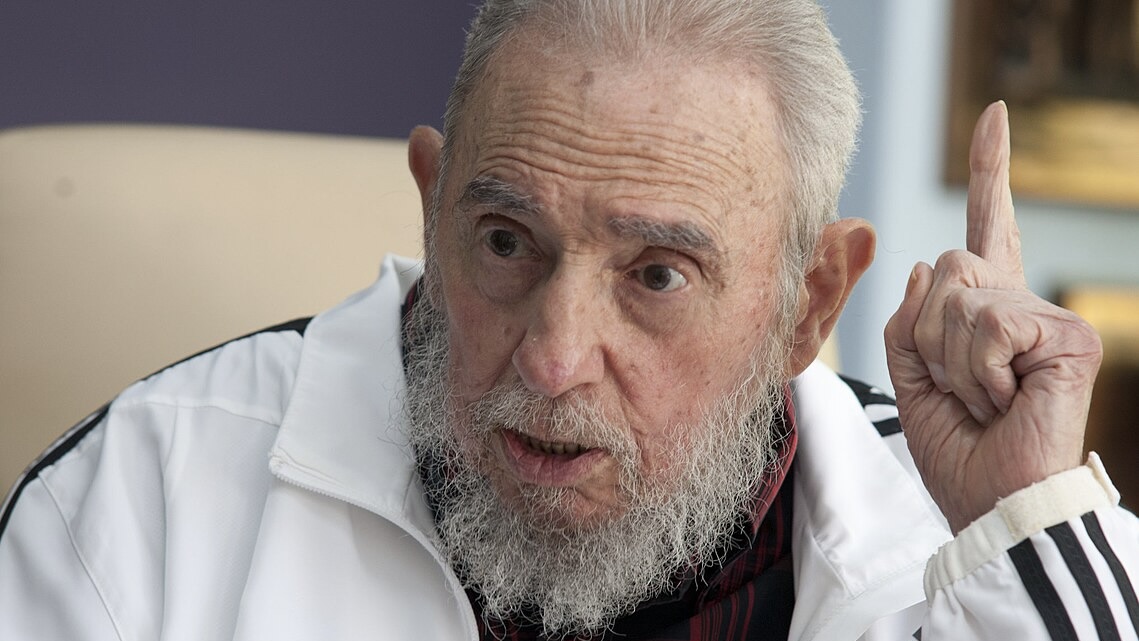
Cuban revolutionary leader Fidel Castro in 2014. Photo: Wikimedia Commons

Nine years after his death, we look back at some of the most relevant themes in Fidel Castro’s final writings after stepping down as President of Cuba.

Fidel Castro is often remembered as one of the most iconic leaders of the 20th century. Despite Washington’s unrelenting attempts to overthrow and even assassinate him, Fidel continued his rule and the development of the Cuban Revolution, which began in 1959 after the overthrow of Fulgencio Batista.

Much is written on his reflections on the development of the revolutionary struggle in the second half of the 20th century, his emblematic speeches, and his universal vision that combined the best of Leninist pragmatism with the sharpness of anti-colonial critical thinking. But Fidel’s vision of the future of humanity during his last years of life, an activity that demanded many hours of reading and writing, is often overlooked.

Read more: Fidel

In fact, Fidel resigned as President of Cuba in 2008, with the aim of ensuring that the transition to another leader would not jeopardize the existence of the Cuban Revolution; many believed that after his death, the Communist Party of Cuba’s government would collapse.

And while many said that Fidel continued to lead the country after his resignation, the truth is that his production of essays and articles increased exponentially. Foreign policy, ecology, coups d’état, and even reflections on baseball and sports were all topics that Castro covered in his copious written work, generally published in Cuban and international newspapers.

The right to live

Fidel insisted that if human beings continued down the path of savage capitalism, they would bring about the end of their own existence. For Fidel, climate change was not only a transformation of certain environmental aspects, but also the destruction of human existence: “Continuing the battle and demanding at all meetings, particularly those in Bonn and Mexico, the right of humanity to exist… is, in our opinion, the only way forward.”

Here Fidel took a stance far removed from any short- or medium-term ideological dispute to adopt a long-term vision, according to which human beings have been incapable of properly managing a legacy of billions of years once they appeared on Earth: “[Human beings] benefit from a fabulous legacy of 4 billion years provided by the Earth… They are only 200,000 years old, but they have already changed the face of the world.”

Furthermore, he found any kind of military spending deeply inappropriate in the face of the inexorable arrival of the end of humanity. “The world is suffering the consequences of climate change at the same time;… A war was the most inappropriate thing that could happen at this time.”

The nuclear danger

Few people knew more about an almost imminent nuclear war than Fidel Castro. During the Cuban Missile Crisis, the world was on the brink of self-destruction. This concern never left Castro, when he warned of the massacre that would take place years later in Palestine: “As soon as the warships of the United States and Israel take their positions… the terrible war will begin.”

Furthermore, he clearly understood that a large-scale war, especially a nuclear one, would not transform the balance of power between social classes. Thus, he warned that after such a war, only “the administration of goods and services” would remain, and it would be carried out by the same elites that currently exist.

Imperialism as a method of domination

Fidel never abandoned the idea that imperialism continued to be the capitalist system’s most refined method for extracting value and subjugating the peoples of the Third World. Militaristic policy, the essence of imperialism, could never abandon its development, even at the expense of other more pressing needs.

He emphasized that in 2008, 42% of global spending was on military expenses: “While USD 1.5 trillion is spent on defense, the number of hungry people in the world reaches 1 billion.” This disparity was no accident, but rather a strategy executed by the great powers, under the pretext of defense cooperation, to impose economic programs and projects that further dispossess Third World countries. Thus, he openly criticized Obama’s foreign policy for Latin America as a ploy to control the Amazon

Science and technology

Fidel’s Marxism could not ignore the impressive technological transformation that took place during the first decades of the 21st century. In this sense, his reflections often focused on the use that transnational companies were making, and could make, in the field of production.

“If robots in the hands of transnational corporations can replace imperial soldiers in wars of conquest… (they can) flood it with robots that displace millions of workers.” Thus, Fidel announced a new process of dispossession of labor, as carried out by the merchant bourgeoisie at the dawn of the Modern Age.

Thus, technology, climate change, imperialism, and so on, could give the impression of rampant pessimism. However, thinking that could be a mistake. It is true that there was a great deal of caution and concern in Fidel’s final reflections, but this should not be confused with a renunciation of collective struggle.

Castro’s final texts always called for organization, for not giving up the strength of will, for continuing to think and work toward another future, one that is not at the mercy of the designs of a few. In short, as Romain Rolland stated and Gramsci popularized, Fidel’s thinking perfectly executed the maxim “Pessimism of the intellect, optimism of the will.”

Original article by Pablo Meriguet republished from peoples dispatch under a Creative Commons Attribution-ShareAlike 4.0 (CC BY-SA) license.

Continue ReadingFidel Castro’s final reflections