In 1979, Fidel called it “genocide”: Cuba’s legacy of solidarity with Palestine

Spread the love

Original article by Pablo Meriguet republished from peoples dispatch under a Creative Commons Attribution-ShareAlike 4.0 (CC BY-SA) license.
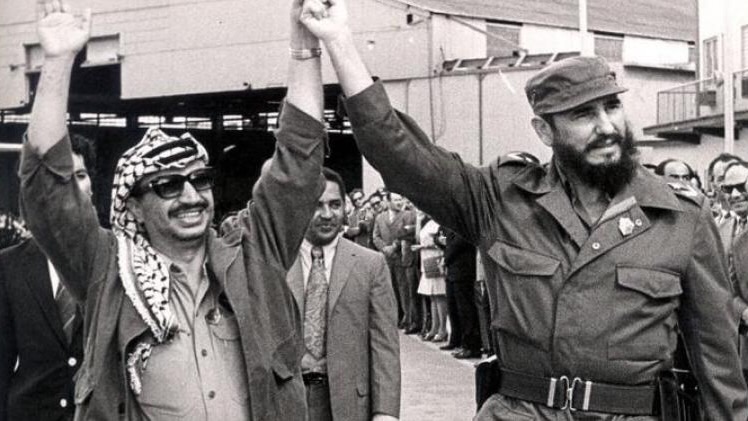
Palestinian leader Yasser Arafat and Cuban President Fidel Castro. Photo: Cuba Sí

On the 99th anniversary of Fidel Castro’s birth, we remember the revolutionary government’s support for Palestine, especially its condemnation of the genocide of the Palestinian people.

In a famous speech, Fidel Castro, the supreme leader of the Cuban Revolution, stated that medical, civil, and military support for the Angolan people was provided without expectation of any material reward. He pointed out that this way of thinking exposes an imperialist ideology, according to which one country supports another, always expecting to benefit materially in some way. “Revolutionaries expect nothing, which means that revolutionaries must devote themselves totally to a cause, to their ideas, to their noble goals, without expecting anything in return.”

This was the same principle that Fidel applied in supporting the Palestinian people’s struggle almost from the beginning of the revolutionary process he led since 1959. It is no coincidence that one of the most renowned Palestinian leaders, Yasser Arafat, visited the Caribbean Island eight times, on the personal invitation of Castro.

On October 12, 1979, at the United Nations Assembly, Fidel denounced before the world Israel’s process of territorial expansion, supported by the United States, at the expense of Palestinian territory. “The basis for a just peace in the region begins with Israel’s total and unconditional withdrawal from all occupied Arab territories and for the Palestinian people, the return of all their occupied territories and the restoration of their inalienable national rights, including the right of return to their homeland, self-determination, and the establishment of an independent state in Palestine, following General Assembly Resolution 3236,” Fidel said.

Castro acknowledged that this expansion was achieved through the killing of Palestinians, thus becoming one of the first world leaders to speak of “genocide” against the Palestinian people: “We repudiate with all our strength the ruthless persecution and genocide that Nazism unleashed against the Jewish people in its time. But I can think of nothing more similar in our contemporary history than the eviction, persecution, and genocide that imperialism and Zionism are carrying out today against the Palestinian people. Stripped of their lands, expelled from their homeland, scattered throughout the world, persecuted and murdered, the heroic Palestinians are an impressive example of self-sacrifice and patriotism, and they are the living symbol of the greatest crime of our time.”

Fidel also recognized that there are geopolitical interests that do not want peace to be established in the Middle East: “Can anyone be surprised that the Conference (of the Non-Aligned Movement) was forced, for reasons that do not stem from any political prejudice but from an objective analysis of the facts, to point out that US policy plays a fundamental role in preventing the establishment of a just and comprehensive peace in the region, by aligning itself with Israel, supporting it, and working to obtain partial solutions favorable to Zionist objectives and guaranteeing the fruits of Israeli aggression at the expense of the Arab people of Palestine and the entire Arab nation?”

“More than just rhetorical support, it was tangible support”

As historians point out, Fidel’s support for Palestine was not purely rhetorical, but also diplomatic. In 1974, Arafat arrived in Cuba and was received with the honors of a head of state, even though Palestine was not yet “officially” recognized as a state. Fidel’s message was clear: Palestine should be recognized by the international community as a state, and Arafat as its leader. In addition, Arafat was awarded the Playa Girón National Order, Cuba’s highest recognition for citizens “who have excelled in the struggle against imperialism, colonialism, and neo-colonialism, or who have done great deeds for peace and progress of mankind”.

The relationship between Cuban revolutionaries and the Palestine Liberation Organization (PLO) dates to the beginning of the Cuban Revolution. In 1959, Raúl Castro and Ernesto “Che” Guevara traveled to the Gaza Strip, disobeying the doctrine of hemispheric alignment whereby all Latin American countries, except for Cuba, supported Israel.

Thus, in 1964, thanks to Che Guevara’s tremendous efforts, Cuba recognized the PLO as soon as it was founded, becoming one of the first countries to do so. But its support went beyond official documents, according to Mansour Tahboub, former acting director of the Arafat Foundation: “Cuba has always been a strong supporter of Palestinians in all realms: political, military, vocational training. The Cubans trained Palestinian cadres, and Fidel himself was a staunch advocate of the Palestinian quest for freedom and independence.”

The truth is that one of the core principles of Castro’s administration was to support anti-imperialist and anti-colonialist struggles, wherever they took place. In a 1977 interview with French Weekly, Fidel stated: “The Palestinian movements have shown their ability to resist imperialist … aggression … [The Palestinian cause] will prevail sooner or later despite the betrayal by Arab reactionaries, imperialist maneuvers and Israeli aggression.”

That is why Cuba, along with Nicaragua, were the only two Latin American countries to condemn Israel’s actions after the Six-Day War. In 1973, Cuba severed diplomatic relations with Israel following the Non-Aligned Movement meeting in Algeria.

According to Abdel Majeed Sweilim, professor of political science at Al Quds University, the PLO also benefited from the relationship between Cubans and Palestinians, thanks to the political training of Palestinians on Cuban soil.

Today, despite the economic blockade imposed by the United States, which causes a perpetual economic crisis on the Caribbean Island, the Cuban government has reserved funding in the form of academic scholarships so that each year, 150 Palestinians can study medicine, engineering, and other professions at Cuban universities.

In his final years, Fidel continued to support the Palestinian cause. Thus, after resigning from his political posts, Castro signed an international manifesto in support of Palestine in 2014, which demanded Israel’s withdrawal from the Gaza Strip, the West Bank, and East Jerusalem, as well as respect for the resolutions passed by the United Nations regarding the conflict.

Arafat’s recognition of Cuban support

These and other measures have led countless Palestinians to see the revolutionary government of Cuba as an unwavering ally. Arafat himself acknowledged this when he stated: “I consider, Your Excellency President Fidel Castro, this demonstration of firmness and unwavering friendship that has taken place in Havana, as a strong and effective message from a beloved world leader who enjoys great international prestige among all the peoples and countries of the world, to mobilize them quickly to put an end to the suffering of the Palestinian people as a result of the Israeli occupation of their homeland, and the intensification of military, economic, and financial actions and blockades against our cities, villages, towns, farms, and water wells, and the closure of international border crossings by land, air, and water.”

In addition, the historic leader of the PLO said: “Every Palestinian today holds in their heart and conscience this glorious image of Your Excellency with the Palestinian hatta on your shoulders, which is irrefutable evidence of the justice of our cause and the magnitude of the injustice committed by the Israeli aggressors against our people. Have full confidence, Your Excellency President Castro, so beloved by our people and by all peoples, that our people, as resilient as the Palestinian mountains, take from your position and example, which makes us proud, more courage and determination to continue the struggle, the resistance, and the Intifada to remove the Israeli occupiers from our country, Palestine.”

In this way, Cuba continues to unreservedly support the demands for sovereignty, self-determination, and peace made by the Palestinian people in the face of the previous and most recent attacks by the Israeli government on their territory. This support, since 1959, is not given with the expectation of anything in return, but because of the anti-imperialist and anti-colonialist principles that guide the Cuban Revolution and that Fidel helped to establish as principles of the Cuban state itself.

Original article by Pablo Meriguet republished from peoples dispatch under a Creative Commons Attribution-ShareAlike 4.0 (CC BY-SA) license.

Experiencing issues with this image not appearing. I suspect because it's so critical of Zionist Keir Starmer's support of and complicity in Israel's genocides.
Genocide denier and Current UK Prime Minister Keir Starmer is quoted that he supports Zionism without qualification. He also confirms that UK air force support has been essential in Israel’s mass-murdering genocide. Includes URLs https://www.declassifieduk.org/keir-starmers-100-spy-flights-over-gaza-in-support-of-israel/ and https://youtu.be/O74hZCKKdpA
Keir Starmer objects to criticism of the IDF. He asks how could anyone object to them starving people to death, forced marches like the Nazis did, bombing Gaza's hospitals and universities,mass-murdering journalists, healthworkers and starving people queuing for food, killing and raping prisoners and murdering children. He calls for people to stop obstructing his genocide for Israel.
Keir Starmer objects to criticism of the IDF. He asks how could anyone object to them starving people to death, forced marches like the Nazis did, bombing Gaza’s hospitals and universities,mass-murdering journalists, healthworkers and starving people queuing for food, killing and raping prisoners and murdering children. He calls for people to stop obstructing his genocide for Israel.
Continue ReadingIn 1979, Fidel called it “genocide”: Cuba’s legacy of solidarity with Palestine

‘Imperialism’: Trump Threatens to Reclaim Panama Canal

Spread the love

Original article by Olivia Rosane republished from Common Dreams under Creative Commons (CC BY-NC-ND 3.0). 

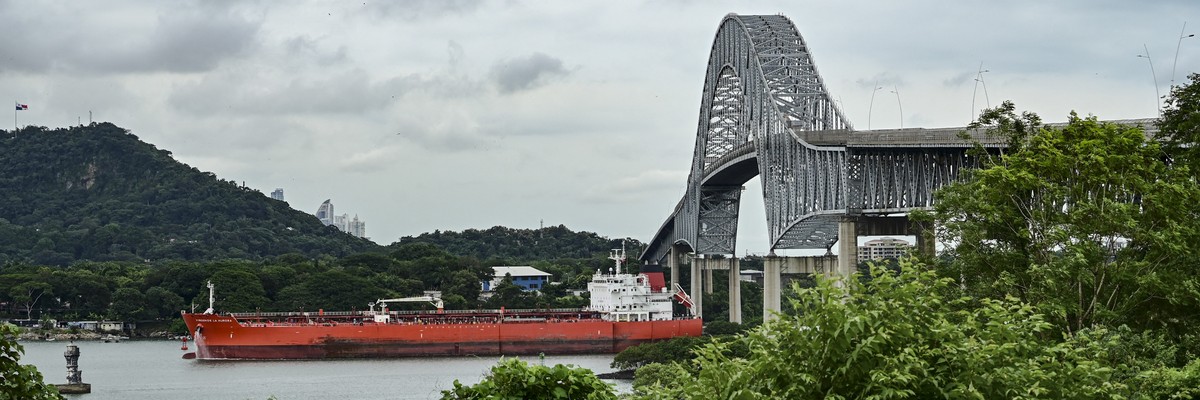
A tanker ship enters the Panama Canal from the Pacific side on October 25, 2024. (Photo: Martin Bernetti/AFP via Getty Images)

The U.S. president-elect’s remarks came a day after the 35th anniversary of the country’s invasion of Panama, which grassroots groups say killed thousands of civilians and displaced tens of thousands.

President-elect Donald Trump threatened over the weekend that the U.S. would retake control of the Panama Canal if Panama did not lower the fees it charges U.S. ships to access the waterway that connects the Atlantic and Pacific oceans.

Trump first issued the threat in two posts on Truth Social Saturday night. He then mentioned the canal again on Sunday while speaking at the conservative group Turning Point’s annual AmericaFest in Arizona, implying that Panama had allowed China to take control of the waterway.

“We will never, ever let it fall into the wrong hands,” Trump said.

“Trump is a tyrant threatening the sovereignty of Panama a day after the 35 year commemoration of a deadly and disproportionate U.S. invasion in which thousands of Panamanian civilians were killed.”

In response, Rep. Ritchie Torres (D-N.Y.), posted on Bluesky, “Donald Trump is openly advocating for imperialism against Panama and the seizure of the Panama Canal by the United States. He doesn’t seem to know that Panama is a sovereign country or doesn’t seem to care.”

The U.S. struck an agreement with Panama in 1904 to build the canal and take possession of the land on each side of it. However, former U.S. President Jimmy Carter negotiated a treaty with Panama in the late 1970s to return the canal to Panama by 1999.

In his initial Truth Social post, Trump wrote that “it was solely for Panama to manage, not China, or anyone else. It was likewise not given for Panama to charge the United States, its Navy, and corporations, doing business within our country, exorbitant prices and rates of passage.”

In the second post, Trump concluded that the canal “was not given for the benefit of others, but merely as a token of cooperation with us and Panama. If the principles, both moral and legal, of this magnanimous gesture of giving are not followed, then we will demand that the Panama Canal be returned to us, in full, and without question. To the officials of Panama, please be guided accordingly!”

Trump repeated many of the same arguments in his speech at AmericaFest.

When he first mentioned the canal, an audience member called out, “Take it back!”

Trump responded, “That’s a good idea.”

In reporting on Trump’s remarks, Reuters noted that China does not control any part of the canal. However, a subsidiary of Hong Kong-based CK Hutchison Holdings has managed two ports on either side for years. The outlet called Trump’s remarks “an exceedingly rare example of a U.S. leader saying he could push a sovereign country to hand over territory.”

“The government has the duty to defend our autonomy as an independent country,” Panamanian opposition deputy Grace Hernandez wrote on social media in response to Trump’s remarks. “Diplomacy demands steadfastness in the face of regrettable statements.”

The current leader of Panama, President José Raúl Mulino, is a pro-U.S. conservative, according to The Associated Press. The rising prices that Trump laments have less to do with any targeting of the U.S. and more to do with environmental conditions impacting all of the canal’s users, though the U.S. does use it more than any other nation. As AP explained:

The canal depends on reservoirs to operate its locks. It was heavily affected by droughts in Central America in 2023 that forced it to substantially reduce the number of daily slots for crossing ships. With fewer ships using the canal each day, administrators also increased the fees that are charged all shippers for reserving a slot.

With weather returning to normal in the later months of this year, transit on the canal has normalized. But price increases are still expected for next year.

Trump’s initial remarks came a day after the 35th anniversary of the U.S. invasion of Panama to oust President Manuel Noriega, which grassroots groups say killed thousands of civilians in Panama and displaced tens of thousands.

“Trump is a tyrant threatening the sovereignty of Panama a day after the 35 year commemoration of a deadly and disproportionate U.S. invasion in which thousands of Panamanian civilians were killed,” Panamanian architectural designer Luis Alfaro wrote on social media. “The canal is on Panamanian land, and will always be Panamanian.”

Original article by Olivia Rosane republished from Common Dreams under Creative Commons (CC BY-NC-ND 3.0). 

Continue Reading‘Imperialism’: Trump Threatens to Reclaim Panama Canal

Biden’s UNGA address espousing democracy and cooperation contrasts with reality

Spread the love

Original article by Natalia Marques republished from peoples dispatch under a Creative Commons Attribution-ShareAlike 4.0 (CC BY-SA) license.
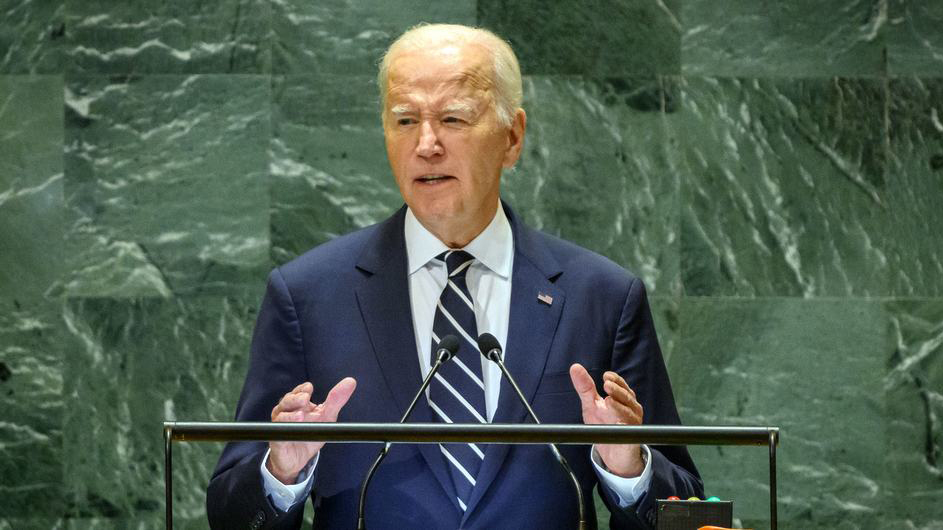
Biden addresses the general debate of the General Assembly’s 79th session (Photo: UN Photo/Loey Felipe)

Biden’s final address to the United Nations as president was riddled with falsehoods and hypocrisies typical of US foreign policy

When US President Biden ended his final address to the UN General Assembly with “my fellow leaders, there is nothing that’s beyond our capacity if we work together,” it can be easy to forget that the United States is the number one obstacle to mutual cooperation around the world.

Biden’s mention of the various conflicts and aggressions around the world—from Ukraine to Sudan to Gaza—of course made no mention of the US’s complicity in each of these conflicts.

Biden calls for “a ceasefire and hostage deal” for Gaza in order to “bring the hostages home, secure security for Israel, and Gaza free of Hamas’ grip, ease the suffering in Gaza, and end this war.”

But while Biden calls for an end to the war, the US continues to send weapons and other forms of aid to Israel as it carries out genocide in Gaza, aggression in the West Bank, and extends the war to Lebanon. Biden’s administration has ignored the popular demand for an arms embargo against Israel, supported by major labor unions which represent almost half of all unionized workers in the US as well as 61% of the US population. Instead, the US has only expanded its military support for Israel, approving a USD 20 billion dollar arms package to the Zionist state in August. 

The US has maintained its unconditional support of Israel, even as Israel floats a possible ground invasion of Lebanon. Yet ironically Biden said of the war in Sudan, “the world needs to stop arming the generals.” According to the Palestinian Youth Movement, an international Palestinian diaspora organization, “the Biden-Harris administration is responsible for the current massacres in Lebanon.”

The US’s support for Israeli genocide has received additional scrutiny after it was revealed that USAID and the State Department knew that Israel had deliberately blocked humanitarian aid to Gaza. US law requires the government to cut off weapons shipments to countries which block deliveries of US-backed aid, and so US Secretary of State Antony Blinken seems to have deliberately told Congress that Israel did not block aid so that weapons shipments to Israel would remain unaffected. 

Yet in his speech to the UNGA, Biden entreated Sudanese generals to “stop blocking aid to the Sudanese people.”

“We do not currently assess that the Israeli government is prohibiting or otherwise restricting the transport or delivery of US humanitarian assistance,” Blinken told Congress on May 10, despite being told the opposite by USAID and the State Department in April.

In Ukraine, not only were the US and NATO’s violations of Russian security red lines the chief cause of that war, but the West continues to be an obstacle to a peaceful settlement of the conflict. There has been no negotiation between Ukraine and Russia ever since the West allegedly forced Ukraine to withdraw from talks in April 2022, and the US in its usual fashion continues to supply billions of dollars in weapons to Ukraine to continue the war. 

And while Biden urged other UNGA member nations to “stand up” for the Ukrainian people, US military officials openly thirst for Ukrainian blood—complaining in a New York Times article from last year that the Ukrainian military has become too “casualty averse,” causing it to “race through precious [US-provided] ammunition supplies” as opposed to human lives.

Biden spent time lamenting the humanitarian situation in Sudan, and claiming that “the United States has led the world in providing humanitarian aid” to the war-torn country. But like many global conflicts, the war in Sudan has its roots in the savagery of US imperialism. According to Stephanie Weatherbee Brito of the International Peoples Assembly, “Through both military interventions and economic sanctions, the United States has shown its willingness to coerce any nation deviating from its interests. This has fostered a global environment where nations vie for power and influence. The US’s propensity to invade and punish perceived adversaries has spurred countries to bolster their military and geopolitical capabilities to safeguard their sovereignty in a world marked by violence and conflict, saturated with weaponry and lacking effective mechanisms to ensure peace.”

“This is essentially what is happening in Sudan today, where the conflict has resulted in more than ten million displaced persons. The conflict between the Sudanese Armed Forces and the Rapid Support Forces serves to thwart the democratic process the people have been struggling for since 2018, as rival military groups struggle to control the country and its resources,” Brito articulated. 

US hybrid wars remains chief obstacle to global cooperation

“Our task, our test, is to make sure that the forces holding us together are stronger than those that are pulling us apart,” Biden claimed in his address to the UN, despite his administration’s wielding of sanctions that cause economic devastation throughout the world.

For decades, the international community has been calling on the United States to lift deadly sanctions on Cuba that are part of an over 60-year-long blockade against the socialist nation. Most recently, a group of nearly 600 parliamentarians from 73 different countries penned a joint letter condemning the continued inclusion of Cuba on the list. And 35 former heads of state from across the globe penned a separate letter to Biden, urging him to remove Cuba from the US’s “State Sponsors of Terrorism” list. 

But when it comes to US sanctions and other violations of the sovereignty of other countries, Cuba is but one facet. Comprehensive US sanctions target and put a stranglehold on the economies of countries such as Iran, North Korea, Russia, Venezuela, and Syria. Other nations, such as China, are under constant attack on many fronts, whether through media fear mongering or military exercises near their territories. 

And yet in his speech to the UNGA, Biden seems to deny that his administration has deliberately stoked conflict with China. “We also need to uphold our principles as we seek to responsibly manage the competition with China so it does not veer into conflict,” Biden pontificated. “We stand ready to cooperate on urgent challenges for the good of our people and the people everywhere.”

According to Amanda Yee, journalist, anti-imperialist activist, and host of The China Report on BreakThrough News, Biden’s China strategy has nothing to do with managed competition. “In reality, it’s a belligerent policy which will only escalate toward war,” Yee told Peoples Dispatch

“What he calls ‘strengthening our network of alliances and partnerships across the Indo-Pacific’ really means the continuation of arming Taiwan, building more military bases on allies’ soil and in the South China Sea, sending cruise missiles to Japan, conducting war games exercises in South Korea—all to further build up the military encirclement of China.”

The future of US democracy

“I’ve made the preservation of democracy the central cause of my presidency,” Biden claimed during his address. And yet those in the US who have protested against their governments’ domestic and foreign policies have faced police violencemass arrests, and even deportation

As US presidential elections fast approach, whether the winner is Biden’s successor Kamala Harris or the ultra-conservative former president Donald Trump, anti-imperialist activists can expect more of the same repression.

Original article by Natalia Marques republished from peoples dispatch under a Creative Commons Attribution-ShareAlike 4.0 (CC BY-SA) license

Continue ReadingBiden’s UNGA address espousing democracy and cooperation contrasts with reality