City law firm sought ‘eye-watering’ £1.1m costs from climate protesters

Spread the love

Original article by Ed Siddons Billie Gay Jackson republished from TBIJ under Creative Commons Attribution-NonCommercial-NoDerivs 4.0.

DLA Piper’s demands from campaigners included £2,500 for a list of its own fees

The UK’s largest law firm sought £1.1m in legal fees from climate campaigners to cover the costs of preventing their protests, the Bureau of Investigative Journalism can reveal.

DLA Piper, a multibillion-pound law firm, tried to recoup eye-watering costs, including fees of £350 per hour for providing legal advice to its clients HS2 and National Highways Limited (NHL) – both publicly owned bodies. Other costs it tried to reclaim included £75,000 for a single hearing and £2,500 to prepare a document listing its own fees.

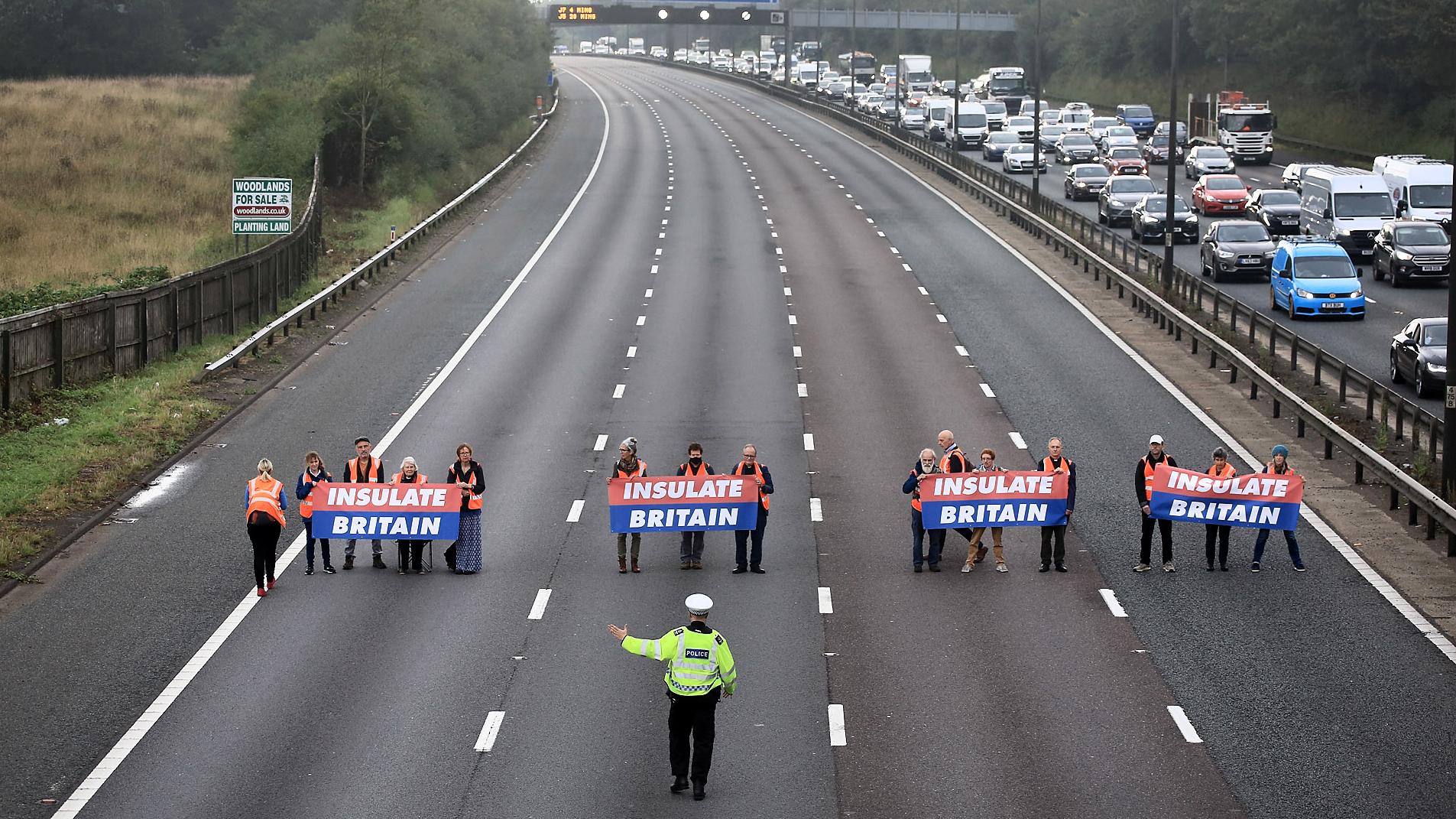
The firm brought injunctions – court orders prohibiting certain actions – against more than 200 campaigners, primarily from Just Stop Oil and Insulate Britain. Most obeyed the NHL injunction and did not take part in the prohibited protests, but still each faced bills of thousands of pounds.

In two of the cases, judges criticised the firm’s costs as “disproportionate” or “not … reasonable” and significantly reduced the amount it could claim, in one case by more than half.

Barristers told TBIJ that costs incurred by City law firms such as DLA Piper far exceed those incurred by in-house solicitors at public bodies or local authorities, ratcheting up the risk of large costs being foisted onto protestors.

DLA Piper has previously pledged to align its client work with “decisive action” on climate and committed to net zero by 2040.

The firm was hired by NHL and the HS2 rail project in 2021 to provide legal services that included securing injunctions against protesters.

Court files reviewed by TBIJ show that, on behalf of NHL and HS2, the firm sought costs from protesters totalling £1.1m. This figure, and the breakdowns below, include barristers’ fees – money paid to specialist external lawyers selected to argue the case in court.

One woman who broke the injunction told TBIJ that her income meant it would take her eight years to pay off the costs of around £5,000 that had been sought against her.

Another of those targeted was Louise Lancaster, who continued to protest and received a 42-day suspended sentence in 2022 alongside an order to pay £22,000 in costs. Last month, she was jailed for four years for coordinating protests on the M25.

The award of a portion of legal costs to the winning side is standard procedure in civil court cases.

But although the lengthy sentences handed down to a small group of protesters in July made headlines, the combination of criminal charges with civil injunction proceedings and potential costs orders was highlighted as a “grave concern” by the UN special rapporteur on environmental defenders.

Adam Wagner, a barrister at Doughty Street Chambers, said: “You might have a protester who, for the same action, is convicted of a criminal offence, has an injunction taken out against them with the risk of contempt-of-court proceedings if they breach it, and faces huge costs. It’s like triple jeopardy.

“We don’t take that approach to social ills like gang violence or drug dealing – they are dealt with through the criminal courts [alone] … Nobody’s looking at the wider picture and thinking, ‘Could this actually have gone too far?’”

“The threat of costs in injunction proceedings is one of, if not the, biggest chilling effects on protests in Britain at the moment,” said Paul Powlesland, a barrister at Garden Court Chambers and founder of the environmental pressure group Lawyers For Nature.

The use of injunctions has soared in recent years with the rise of civil disobedience groups such as Just Stop Oil and Insulate Britain. Analysis by the BBC found that 1,200 locations across the UK are now subject to injunctions banning protests.

They have also increased in scope. Traditionally, injunctions prevented named individuals from undertaking a course of action, but new “persons unknown” injunctions mean anyone can be punished for breaking them.

Proceedings take place in civil courts, where costs can be huge and initial injunction proceedings do not qualify for legal aid. The majority of campaigners subject to the National Highways injunctions had no legal representation and feared the potential costs. The result is that wealthy people who want to bully peaceful protesters “can do so with impunity,” Powlesland said.

The largest single sum sought by DLA Piper was £727,573.84, which covered multiple claims on behalf of NHL against around 140 protesters who blocked the M25 and surrounding roads. That sum was eventually reduced by a judge to £580,000, and a later settlement offer sought about £3,000 from each campaigner to end the case.

DLA Piper also pursued a further £75,891.84 from protesters who disputed the renewal of the injunction.

Banners at the Bluebell Woods Protection Camp, an anti-HS2 protest site, in Staffordshire in 2021. An injunction later made protest illegal along the length of the HS2 railway line
Martin Pope/Getty Images

In separate proceedings, at which NHL pursued 12 protesters for contempt of court after they broke the M25 injunctions, an offence that can mean jail time, DLA Piper listed £229,525.35 in costs, bringing the total to around £1m.

On behalf of Hs2, DLA Piper pursued £70,216 in costs against five defendants, all of whom broke injunctions.

Jodie Beck, policy and campaigns officer at Liberty, said: “Injunctions operate alongside an already expansive web of restrictions and criminal offences introduced in recent years, carrying hefty penalties for making your voice heard.

“When powerful companies and state-owned bodies use opaque legal processes and the threat of financial ruin with eye-watering costs being passed on, our fundamental right to protest is at risk.”

DLA Piper is not the only City law firm to have threatened protesters with costs orders. It is not known how much money it ultimately succeeded in recouping.

As well as its green pledges, the firm has boasted of its role as official provider of legal services to COP26 and highlighted its position as a founding member of the Legal Sustainability Alliance and the Net Zero Lawyers Alliance initiatives.

A DLA Piper spokesperson said: “The firm supports the right to protest lawfully and recognises the need to build a sustainable future. But any change must be brought around in compliance with the law, for the protection of the country and protestors.

The firm is one of the world’s largest legal advisers to the renewable energy industry and is recognised for advising on more renewable energy deals and projects than any other law firm.”

A NHL spokesperson said: “Protesting on motorways and major A-roads is extremely dangerous for both the protesters and motorists … These orders are intended to dissuade people from risking lives, not to prohibit lawful protest. As a government-owned company funded by public money, costs recovery is an important aspect of ensuring public funds are protected.”

A spokesperson for HS2 Ltd said: “We support the right to lawful protest. We have only taken legal action where there has been illegal direct action against HS2. Unlawful action against HS2 has cost taxpayers over £150m and put the lives of protestors, the public and our own workforce in great danger.

“Since the High Court granted a route wide injunction to protect the HS2 project from unlawful activity we have seen a significant decline in illegal activity.”

In June, DLA Piper was awarded a further contract worth more than £650,000 by NHL to provide legal services relating to injunctions against protestors.

Photo: Climate protesters block the M25 as part of a campaign intended to push the UK government to make significant legislative change to start lowering emissions. Credit: Mark Kerrison/Alamy Live News


Reporters: Ed Siddons and Billie Gay Jackson
Additional reporting: Simon Lock
Deputy editors: Katie Mark and Chrissie Giles
Enablers editor: Eleanor Rose
Impact producer: Lucy Nash
Editor: Franz Wild
Production editor: Frankie Goodway
Fact checker: Somesh Jha

Our Enablers project is funded by the Hollick Family Foundation, Sigrid Rausing Trust, the Joffe Trust, the Organized Crime and Corruption Reporting Project and TBIJ core funds. None of our funders has any influence over our editorial decisions or output.

Original article by Ed Siddons Billie Gay Jackson republished from TBIJ under Creative Commons Attribution-NonCommercial-NoDerivs 4.0.
Continue ReadingCity law firm sought ‘eye-watering’ £1.1m costs from climate protesters

Just Stop Oil supporters block the Royal Courts of Justice during injunction trial

Spread the love

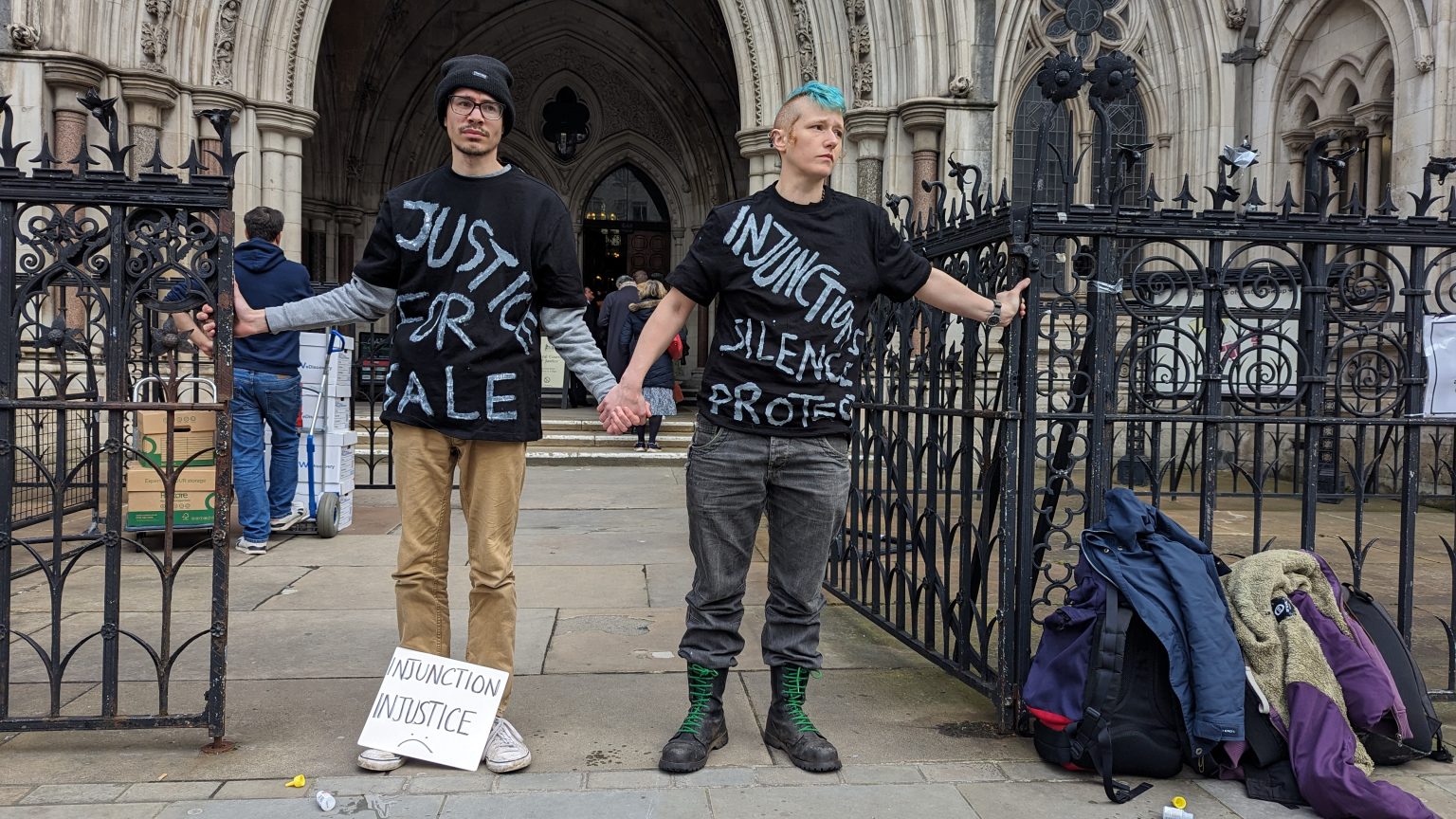
Two Just Stop Oil supporters have blocked the entrance to the Royal Courts of Justice. They took action to highlight the injustice of private injunctions being used to silence peaceful dissent in the UK, and are demanding the government end all new oil, gas and coal projects.

At around 10:10 am yesterday, Tez Burns, 35, and Callum Goode, 24, glued themselves to the entrance gates of the Royal Courts of Justice. The action comes after eighteen Just Stop Oil supporters have appeared at the Royal Courts of Justice over the past three days, facing trial over an alleged breach of a civil injunction taken out by National Highways Ltd in 2022.

On Tuesday, eleven Just Stop Oil supporters signed an undertaking committing them to no further action. In addition, six Just Stop Oil supporters, who were previously named on an injunction taken out against Insulate Britain supporters, were not offered an undertaking. Five of these have accepted the breach and will be sentenced today. Both Callum and Tez have refused to accept the breach and have pushed for the case to be heard at trial, which is currently ongoing. 

A Just Stop Oil spokesperson said:

“Injunctions are private laws bought by corporations and government agencies. Typically they are used to protect someone from harassment, and are intended as a remedy not a punishment, but since the Insulate Britain campaign began, they’ve been increasingly used by the State and private companies to silence dissent by climate resistors. They are being used to circumnavigate the usual rule of law, where defendants appear before a high court judge with no jury. They potentially expose defendants to ‘double jeopardy’ for the same action, where they may also be facing criminal charges. Typically injunctions result in astronomical legal costs which are applied to people named on an injunction, even if they have never broken it. Where defendants are offered an undertaking- which commits them to a certain action- and they choose to sign it, all costs are then divided equally amongst any remaining defendants. This is a divide and rule tactic being used to silence those speaking out about the criminality of politicians and business leaders.”

Callum Goode 24, a maths graduate from Ashbourne, said:

“I’m being taken to court for allegedly breaking a court order I wasn’t even aware of, granted just two days before I climbed a gantry over the M25 to demand an end to new oil and gas licences. Hidden away, a judge with no jury will be deciding what happens to me. I’ve already spent 11 weeks in prison without trial for the action I took that day and I will also face a criminal charge- this double jeopardy is obvious injustice. 

For this stand I’m likely to face tens of thousands of pounds in costs and potentially prison and I’m only one of hundreds facing the injustice of these injunctions. In court, I have told the truth as I have sworn to – that resisting a government that is knowingly taking actions that are killing countless people and risking hundreds of millions more lives, is the only moral option.”

The use of injunctions to silence climate defenders has received international condemnation. Michel Forst, the United Nations Special Rapporteur on Environmental Defenders under the Aarhus Convention recently said“I am deeply troubled at the use of civil injunctions to ban protest in certain areas, including on public roadways.” adding: “The repression that environmental activists who use peaceful civil disobedience are currently facing in Europe is a major threat to democracy and human rights.”

“The environmental emergency that we are collectively facing, and that scientists have been documenting for decades, cannot be addressed if those raising the alarm and demanding action are criminalised for it. The only legitimate response to peaceful environmental activism and civil disobedience at this point is that the authorities, the media, and the public realise how essential it is for us all to listen to what environmental defenders have to say.”

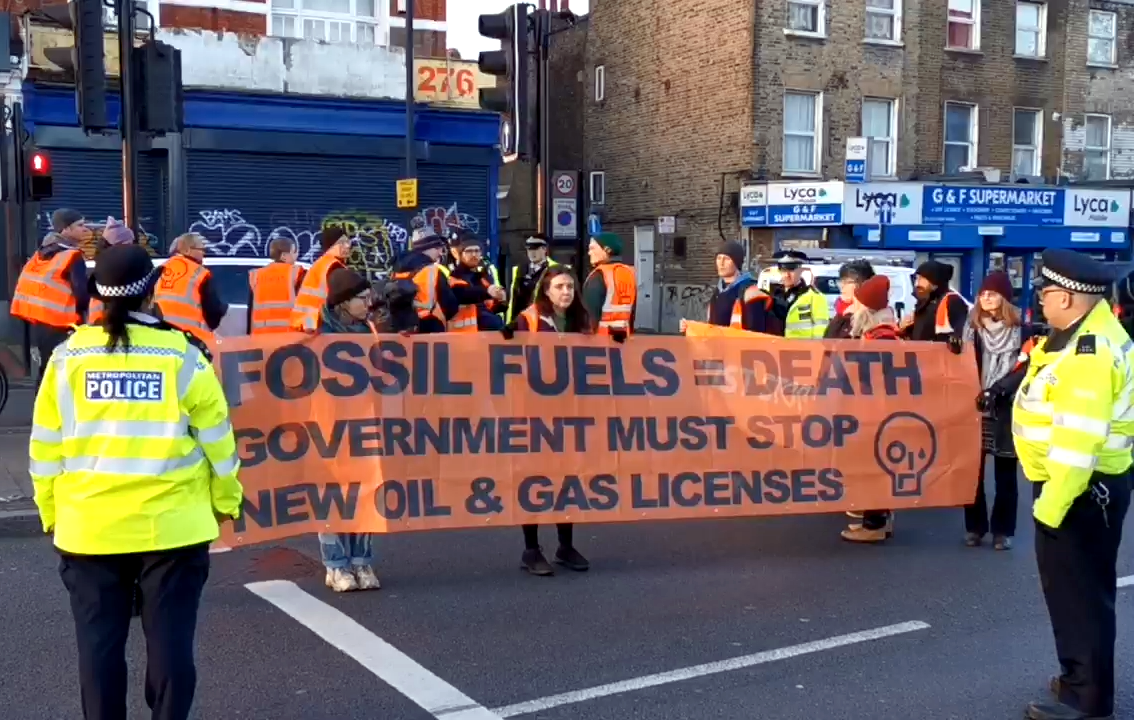
Just Stop Oil protesting in London 6 December 2022.
Continue ReadingJust Stop Oil supporters block the Royal Courts of Justice during injunction trial

Climate activists face ‘crippling’ legal fees for injunctions banning protest

Spread the love
Image of an Insulate Britain roadblock September 2021

Original article by Anita Mureithi repubished from Open Democracy under a Creative Commons Attribution-NonCommercial 4.0 International licence

Protesters facing criminal convictions are being punished twice as National Highways and TfL seek costly injunctions

Climate activists have told openDemocracy they are being hit with “crippling” bills totalling thousands of pounds because of legal action brought by government and public bodies to prevent protests.

Injunctions – orders issued through civil courts, usually to ban something – are increasingly being used to crack down on climate demonstrations, activists say, in what they believe is an attempt to silence dissent.

Both National Highways and Transport for London (TfL) have named supporters of environmental campaign groups Insulate Britain and Just Stop Oil on injunctions intended to stop protests on certain roads in recent years. One person named on a TfL injunction told openDemocracy they have never even protested in London.

Breaching an injunction can lead to a contempt of court conviction, which is punishable by up to two years’ imprisonment, an unlimited fine and the seizure of assets.

One Just Stop Oil protester said they had been warned by their lawyers that those who go to trial to fight an alleged breach and lose could be made to pay up to £150,000 to £200,000 in legal fees, while accepting a breach could incur costs of between £5,000 and £20,000.

The protester told openDemocracy that the costs could leave defendants vulnerable to “the kinds of debts which could cripple you and potentially make you homeless”.

Raj Chada, a partner at law firm Hodge Jones & Allen who represents a number of Insulate Britain supporters, said the way injunctions are now being used is “astonishing” and something he’s never seen before in 15 years of working with protesters.

“The injunctions that are currently being used have always been there but it has never been the case that National Highways Agency or TfL would seek injunctions to completely prevent protests in certain areas,” he said.

Yesterday, it was reported that Rishi Sunak is considering weakening the government’s net-zero commitments, including by delaying a ban on the sale of new petrol and diesel cars, watering down the phasing out of gas boilers, and scrapping plans for new energy-efficiency targets for private rented homes.

Such actions are likely to lead to increased environmental protests. Climate activists say the use of injunctions is one way the government has been cracking down on such protests in recent years, alongside new police powers to shut down demonstrations deemed too disruptive, and existing public nuisance laws that can see people imprisoned for up to ten years for taking part in civil resistance.

Chada agrees, saying: “This government in particular doesn’t like being challenged by groups such as Just Stop Oil or Extinction Rebellion.”

Hefty fees

National Highways is a government-owned company responsible for operating, maintaining and improving motorways and major A-roads in England.

According to a court document seen by openDemocracy, National Highways initially sought costs of £727,573 for legal fees incurred in securing injunctions blocking protests on and around the M25. Split between more than 130 climate activists it named on its injunctions, this would have worked out at more than £5,000 per person.

Those named in an interim injunction must go to court to negotiate its full terms, or to try to have their names removed or the injunction overturned. During this process, which can take years, the terms of the interim injunction – which can be harsher than the final parameters – are binding.

In the National Highways case, the court granted a final injunction against 24 people who were found in contempt of court for breaching the interim injunction. It also issued an anticipatory injunction against a further 109 people, meaning they were injuncted in anticipation of potential wrongdoing.

The court ruled that the 109 people who weren’t found in contempt of court should pay £1,500 in interim payments towards National Highways’ legal fees, while the remaining 24 will pay £3,000. The full extent of the costs will be determined at a later hearing.

Labour councillor Giovanna Lewis, an Insulate Britain supporter who has been fighting the National Highways injunction on behalf of all defendants, says the financial consequences are far-reaching. Some of the 133 people injuncted have had to set up payment plans to pay legal fees. Missed payments could result in a visit from bailiffs.

Annie, a 66-year-old retired grandmother from Dorchester, is among those paying off the £1,500 ordered by the court. She believes the government is “trying to squash” protesters.

After being left feeling “shocked” and “horrified” to hear of people dying of cold in their own homes, Annie took part in three road-blocking Insulate Britain protests in the south of England in September 2021. She was arrested and charged with wilful obstruction of the highway, a criminal offence. Thinking that was it, the injunction issued days later came as a shock.

“We were suddenly getting these people in black knocking on the door and trying to deliver massive letters to us,” she said. “This is both National Highways Ltd and TfL. I’ve kept everything, it’s all in a box and there’s between 10 kilograms and 12 kilograms of mail.”

Annie described feeling hounded by lawyers trying to deliver injunction documents. “It came to a point where if I knew that I was making arrangements with friends, I’d ask them not to knock on the front door and come around the back. I just stopped answering,” she said.

A spokesperson for National Highways said people were added to the injunction due to evidence that they “had previously been engaged in protests on or near our roads shortly before or after the injunction order was made, and therefore posed a risk of breaching the injunction in future”. They added that such evidence typically came from the police after arrests.

A spokesperson for TfL also said the names of protesters it included on an injunction that it sought due to “continuing threats of disruptive protests from Just Stop Oil and Insulate Britain” were disclosed by the Metropolitan Police.

‘Anxious and vulnerable’

Organisations applying for an interim injunction don’t have to prove any of the claims they make, according to Green and Black Cross, a grassroots project that helps protesters with legal matters. Companies can name specific people, wider groups, or ‘persons unknown’ who have protested against the organisation or are believed to be likely to do so.

Insulate Britain and Just Stop Oil supporters told openDemocracy that those who are named are being forced to front expensive legal fees to fight the injunction. The hourly rate for a solicitor in London with more than eight years’ experience is £512, according to government guideline figures.

If they lose the case and are injuncted against, the activists can also be made to pay the legal fees of the winning side. The court has discretion over how much they should pay.

They try to impoverish people so that they’re more concerned about earning to pay things off than campaigning on the climate crisis

Mya, who is also the subject of multiple injunctions, was arrested in November 2022 after attempting to climb a gantry over the M25 with Just Stop Oil. She told openDemocracy that costs for people who admit to breaching a National Highways injunction range from £5,000 to £20,000.

These figures were described as “broadly correct” by National Highways, though they said the amount would “vary from person to person, taking into consideration individual circumstances, the severity of the breach and the number of breaches”.

Mya said: “I think the injunctions are there to try and deter people. And then they’re there to also keep people caught up in all these legal proceedings and to try to impoverish people so that they’re more concerned about trying to earn money to pay things off, rather than trying to campaign on the climate crisis.”

As well as the hefty financial costs, Chada told openDemocracy that the human impact of the injunctions has left people feeling “concerned, anxious, vulnerable and fearful of what the cost of their actions will now be”.

“It really is just quite astonishing – the chilling effect of what all of this could be,” he said.

A National Highways spokesperson said: “Our primary concern is always safety – protesting on the strategic road network is extremely dangerous to the protesters and motorists.

“It’s right that dangerous and reckless protesters who disrupt our strategic road network should face the necessary consequences; anyone intending to protest on these roads should know that they run the risk of imprisonment and/or an unlimited fine. People rely on the strategic road network for so many things and they have a right to expect it to operate as it should.”

TfL said it is “doing all it can to ensure that London’s road network operates safely and efficiently and that vital emergency service vehicles are able to move freely through the city”.

Original article by Anita Mureithi repubished from Open Democracy under a Creative Commons Attribution-NonCommercial 4.0 International licence

Whatever you’re interested in, there’s a free openDemocracy newsletter for you. HAVE A LOOK

Continue ReadingClimate activists face ‘crippling’ legal fees for injunctions banning protest