Trump-GOP Law Slashes Amazon’s Tax Bill by 87% as Company Fires 30,000 Workers, Profits Soar

Spread the love

Original article by Jake Johnson republished from Common Dreams under Creative Commons (CC BY-NC-ND 3.0). 
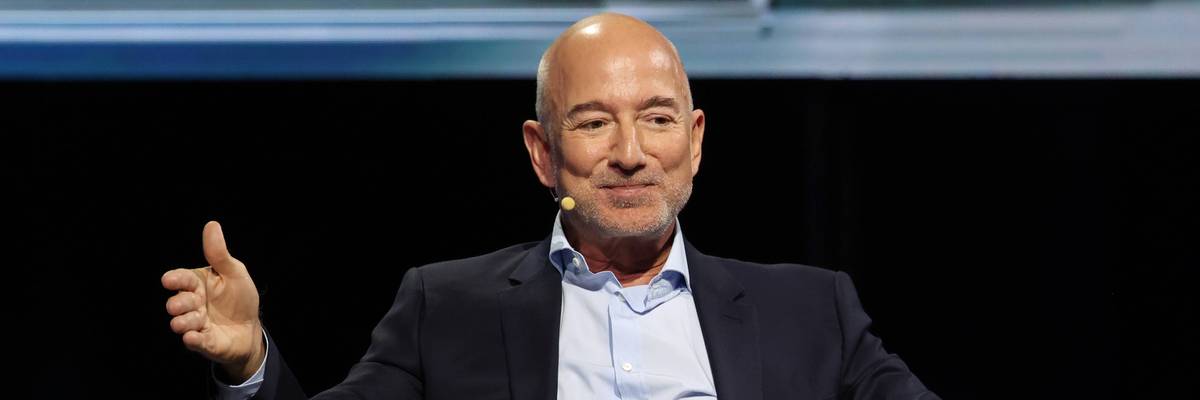
Jeff Bezos, founder and executive chairman of Amazon, speaks during an event on November 6, 2025 in Miami, Florida.(Photo by Alexander Tamargo/Getty Images for America Business Forum)

“Congress made a choice: cut assistance for the most vulnerable to double down on a tax code already favoring dominant firms,” said one progressive think tank.

The tax law that congressional Republicans and US President Donald Trump enacted last summer has proved to be a massive boon for Amazon, slashing the corporate behemoth’s 2025 tax bill even as its profits surged and it moved ahead with mass layoffs that have cost 30,000 workers their jobs since October.

Citing a new securities filing, the Wall Street Journal reported Friday that Amazon’s “current US taxes, an accounting measure of taxes incurred last year, declined to $1.2 billion from $9 billion” while the company’s “pretax US profit increased by 44.5%, to $89.5 billion. On a cash basis, the company paid $2.8 billion in federal income taxes last year after paying more than $7 billion in each of the prior two years.”

RECOMMENDED…
From Amazon to Home Depot and Beyond, Mass Layoffs Continue to Punish Working Class Under Trump

From Amazon to Home Depot and Beyond, Mass Layoffs Continue to Punish Working Class Under Trump

'So Much for the Golden Age of America': Layoffs Hit 17-Year High Under Trump

‘So Much for the Golden Age of America’: Layoffs Hit 17-Year High Under Trump

The 87% decline in Amazon’s federal tax bill for 2025 was largely attributable to the One Big Beautiful Bill Act’s corporate-friendly depreciation tax breaks.

The new securities filing comes just days after Amazon confirmed it axed 16,000 corporate jobs as part of what’s believed to be a sweeping effort to replace workers with robots and artificial intelligence models in the coming years.

The Roosevelt Institute, a progressive think tank, noted that the tax benefits that Amazon and other giant corporations are raking in “didn’t come free.”

“The same law slashed Medicaid and the [Affordable Care Act] and is now exacerbating our medical debt crisis,” the organization wrote on social media. “Congress made a choice: cut assistance for the most vulnerable to double down on a tax code already favoring dominant firms.”

In a statement on Friday, Amazon—founded by billionaire Jeff Bezos—said its dramatically lower tax bill “reflects… changes by Congress” purportedly aimed at encouraging “greater investment in the American economy, its innovation, and its workers.”

The Institute on Taxation and Economic Policy (ITEP) noted Friday that Amazon is one of four companies that “have now disclosed that they collectively received $51 billion in federal tax breaks in 2025, much of that likely from the so-called One Big Beautiful Bill Act (OBBBA) that was signed into law by Trump over the summer.”

“The annual financial reports recently released by Amazon, Alphabet, Meta, and Tesla disclose that these corporations collectively reported $315 billion in US profits for 2025, and collectively paid just 4.9% of that amount in federal corporate income taxes—with Tesla paying exactly zero,” wrote ITEP’s Matthew Gardner. “That amounts to a collective tax savings of $51 billion last year for these four giant multinational corporations, versus what they would have paid if they paid the full 21% federal corporate income tax rate.”

“ Tax cuts pushed through by the Trump administration last year and in 2017 have made it possible for the fastest-growing companies in the world to pay record-low federal income tax rates on their income,” Gardner added. “The tax avoidance of these four companies alone blew a $51 billion hole in the federal budget last year, and this is likely just the tip of the iceberg.”

Original article by Jake Johnson republished from Common Dreams under Creative Commons (CC BY-NC-ND 3.0). 

Donald Fuhrump says that Amerikkka doesn't bother with crimes or charges anymore, not being 100% Amerikkkan and opposing his real estate intentions is enough.
Donald Fuhrump says that Amerikkka doesn’t bother with crimes or charges anymore, not being 100% Amerikkkan and opposing his real estate intentions is enough.
Elon Musk urges you to be a Fascist like him, says that you can ignore facts and reality then.
Orcas discuss Donald Trump and the killer apes' concept of democracy. Front Orca warns that Trump is crashing his country's economy and that everything he does he does for the fantastically wealthy.
Orcas discuss Donald Trump and the killer apes’ concept of democracy. Front Orca warns that Trump is crashing his country’s economy and that everything he does he does for the fantastically wealthy.

Continue ReadingTrump-GOP Law Slashes Amazon’s Tax Bill by 87% as Company Fires 30,000 Workers, Profits Soar

In 41 US States, Richest 1% Pay Lower Tax Rates Than Everyone Else

Spread the love

Original article by JAKE JOHNSON republished from Common Dreams under Creative Commons (CC BY-NC-ND 3.0). 

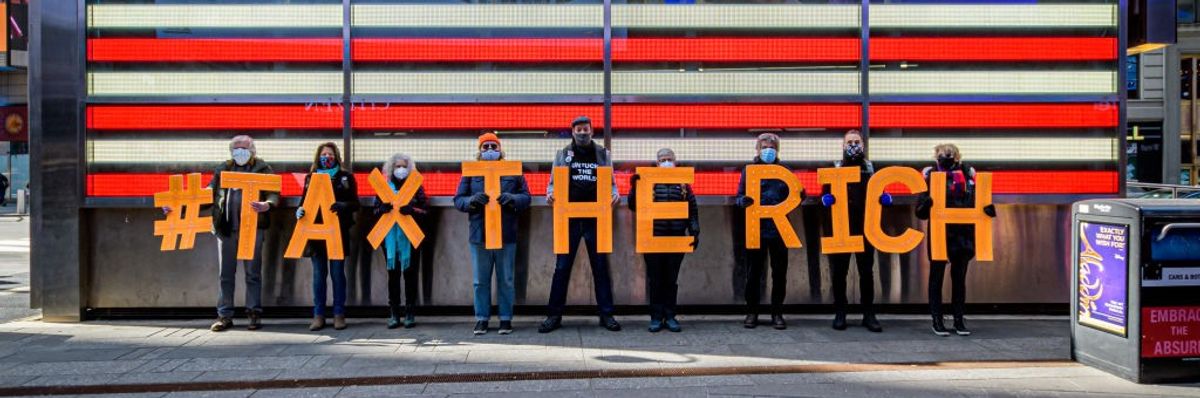
Protesters are pictured spelling out #TaxTheRich at Times Square on March 4, 2021. (Photo: Erik McGregor/LightRocket via Getty Images)

“Almost nobody says we should have the richest pay the least. And yet when we look around the country, the vast majority of states have tax systems that do just that.”

Nearly every state and local tax system in the U.S. is fueling the nation’s inequality crisis by forcing lower- and middle-class families to contribute a larger share of their incomes than their rich counterparts, according to a new study published Tuesday.

Titled Who Pays?, the analysis by the Institute on Taxation and Economic Policy (ITEP) examines in detail the tax systems of all 50 U.S. states, including the rates paid by different income segments.

In 41 states, ITEP found, the richest 1% are taxed at a lower rate than any other income group. Forty-six states tax the top 1% at a lower rate than middle-income families.

“When you ask people what they think a fair tax code looks like, almost nobody says we should have the richest pay the least,” said ITEP research director Carl Davis. “And yet when we look around the country, the vast majority of states have tax systems that do just that.”

“There’s an alarming gap here between what the public wants and what state lawmakers have delivered,” Davis added.

In recent years, dozens of states across the U.S. have launched what the Center on Budget and Policy Priorities recently called a “tax-cutting spree,” permanently slashing tax rates for corporations and the wealthy during a pandemic that saw billionaire wealth skyrocket and company profits soar.

A report released last week, as Common Dreamsreported, showed ultra-rich Americans are currently sitting on $8.5 trillion in untaxed assets.

According to ITEP’s new study, tax systems in just six states—California, Maine, Minnesota, New Jersey, New York, and Vermont—and the District of Columbia are progressive, helping to reduce the chasm between rich taxpayers and other residents.

Massachusetts, which has one of the more equitable tax systems in the nation, collected $1.5 billion in revenue last year thanks to its recently enacted millionaires tax, a measure that improved the state’s ranking by 10 spots in ITEP’s Tax Inequality Index. Minnesota has also ramped up its taxes on the rich over the past several years while expanding benefits for lower-income families, ITEP’s study observes.

“The regressive state tax laws we see today are a policy choice, and it’s clear there are better choices available to lawmakers.”

But the full picture of U.S. state and local systems is grim. In 44 states, tax laws “worsen income inequality by making incomes more unequal after collecting state and local taxes,” ITEP found.

Florida has the most regressive tax code in the U.S., with the richest 1% paying a mere 2.7% tax rate while the poorest 20% pay 13.2%.

Florida is among the U.S. states that don’t have personal income taxes, which forces them to rely on consumption and property taxes that are “nearly always regressive,” ITEP notes in the new analysis.

“Eight of the 10 most regressive tax systems—Florida, Washington, Tennessee, Nevada, South Dakota, Texas, Arkansas, and Louisiana—rely heavily on regressive sales and excise taxes,” the study says. “As a group, these eight states derive 52% of their tax revenue from these taxes, compared to the national average of 34%.”

Aidan Davis, ITEP’s state policy director, said that “we’ve seen a lot of states shift their tax systems to become even more regressive in recent years by enacting deep tax cuts for the wealthiest.”

The report points to Kentucky’s adoption of a flat tax and repeated corporate tax cuts, which “delivered the largest windfall to families in the upper part of the income scale and have been paid for in part through new or higher sales and excise taxes on a long list of items such as car repairs, parking, moving services, bowling, gym memberships, tobacco, vaping, pet care, and ride-share rides.”

Davis said that “we know it doesn’t have to be like this,” arguing there is a “clear path forward for flipping upside-down tax systems and we’ve seen a handful of states come pretty close to pulling it off.”

“The regressive state tax laws we see today are a policy choice,” said Davis, “and it’s clear there are better choices available to lawmakers.”

Original article by JAKE JOHNSON republished from Common Dreams under Creative Commons (CC BY-NC-ND 3.0). 

New Massachusetts ‘Tax the Rich’ Law Raises $1.5 Billion for Free School Lunch and More

1.4 Million Wealthy Americans Are Evading Nearly $66 Billion in Federal Taxes

With Funds Opposed by GOP, IRS to Target Ultrawealthy Tax Delinquents

The Lost Art (and Joy) of Taxing the Rich

300+ Economists, Millionaires, and Elected Officials to G20: ‘Tax Extreme Wealth’

Continue ReadingIn 41 US States, Richest 1% Pay Lower Tax Rates Than Everyone Else