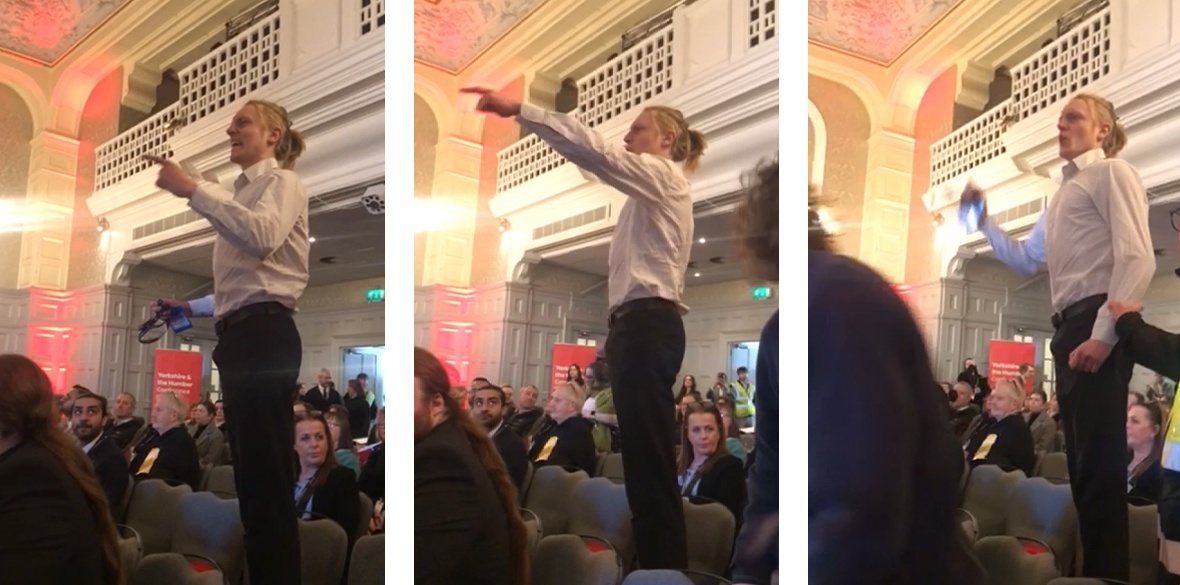
A climate activist interrupts Chancellor Rachel Reeves’s keynote speech at the Yorkshire Labour Party Conference in protest against new subsidies for Drax Power Station, March 1, 2025
CLIMATE activists disrupted Rachel Reeves’s speech to the Yorkshire Labour Party Conference on Saturday, condemning new subsidies for the tree-burning Drax power station.
As the Chancellor spoke, the two protesters stood up and condemned the environmental damage caused by Drax, which claims to be sustainable, allowing it to receive billions of pounds in green subsidies, but remains Britain’s biggest carbon emitter.
A BBC investigation previously exposed Drax for sourcing wood from rare forests, yet Labour has extended its subsidies until at least 2031 — costing taxpayers an estimated £2 billion.
Rosie, of campaigner group Axe Drax, said: “Labour has once again shown that they are on the side of the lobbyists, choosing to hand billions … to Drax, which has just announced over £1bn in earnings, while slashing winter fuel payments and presiding over yet another energy bill price hike.
“Rather than funding Drax’s shareholders profits, we desperately need investment in real green energy and climate action that will bring down emissions and bills — like home insulation.”
The disruption led to Ms Reeves pausing her speech while the protesters were ejected by security staff.
Keir Starmer says pensioners can freeze to death and poor children can starve and be condemned to failure and misery all their lives.Orcas comment on killer apes destroying the planet by continuing to burn fossil fuels.
British chancellor Rachel Reeves has backed ‘catastrophic’ plans to build a third runway at Heathrow | Ian Forsyth/Getty Images
Rachel Reeves and Keir Starmer appear happy to pursue growth at any cost – including the destruction of the planet
Last weekend the temperature at the North Pole was 20℃ above average, taking it above ice’s melting point in what was described as “a very extreme winter warming event” by Mika Rantanen of the Finnish Meteorological Institute.
Four days later, things got worse still. The Copernicus Climate Change Service reported that last month was the warmest January ever recorded at 1.75℃ hotter than pre-industrial times. This is especially worrying since scientists expected temperatures to fall this year as La Nina took over from the previous year’s El Nino. We now face the worrying possibility that the impact of cooling La Ninas might be declining.
Amid these developments, British chancellor Rachel Reeves has backed plans to build a third runway at Heathrow, which climate campaigners warn would be “catastrophic”, and reports have emerged that she is also poised to support the opening of the giant Rosebank oilfield in the North Sea, which energy secretary Ed Miliband has described as “climate vandalism”.
Reeves’ drive for economic growth at the expense of the planet is a far cry from the strong green agenda that the Labour Party seemed to favour ahead of last year’s general election.
Labour’s apparent change of heart unfortunately coincides with Donald Trump taking office in the US. The climate science community is now braced for the impact of Trump’s newly appointed Department of Government Efficiency, led by billionaire Elon Musk, running a coach and horses through the US foreign aid programme.
Trump’s administration has also already started removing or downgrading mentions of climate change from federal government web pages – a sign that we are in a worse position than a decade ago after the 2015 Paris climate summit, when there were indications that the dangers of climate breakdown were at last being appreciated at higher political levels.
Now, one of the world’s leading climate specialists, professor James Hansen of Columbia University, says that the international target agreed upon at the Paris summit of limiting global temperature rises to 2℃ is “dead”. The pace of global heating had been “significantly underestimated”, he explained.
The fossil carbon states and corporations with their coal, oil and gas markets, meanwhile, are more certain about their prospects and happy to promote their wares with enthusiasm. There were 2,500 oil, gas and coal lobbyists at the 2023 Dubai COP28 climate summit, four times as many as attended the previous year in Egypt.
If forced onto the defensive, fossil fuel giants have several options. One is to move the focus away from mitigation to adaptation, another is to boost the potential of carbon capture and storage, and yet another is geoengineering.
Then, if all else fails they can fall back on direct air capture; removing carbon from the air once it is dispersed in the atmosphere, rather than as it is emitted. In other words, we should accept the likelihood of an “overshoot” of carbon emissions and hope that future technologies can save the day!
None of these scenarios has any current relevance as none can be developed in anything remotely like the time available given the speed of climate breakdown. There has to be urgent political change at the highest level to engage in emergency decarbonisation.
At a lower level, there is some good news at least. The cost of producing electricity from renewable sources is continuing to fall and the whole process of embracing renewables could accelerate if just one or two countries demonstrated just how quickly change can come.
The UK is in a hugely favoured position to do so, having huge scope to expand land-based wind and solar power as well as offshore wind. That should be one of the British government’s two absolute priorities, the other being a rapid programme of home and workplace insulation.
Further moves would be an immediate tightening up of house building regulations requiring much higher levels of insulation together with grants and loans for home environmental improvements. Transition to electrical vehicles should be accelerated along with much expansion of public transport.
Changes in agriculture must be brought in to cut down on greenhouse gas emissions, with methane emission control frequently being overlooked. Air and marine transport must also be subject to far greater emissions control. Any plans to expand existing airports must be abandoned as nonsensical, and subsidies for oil and gas production should be transferred to renewables.
All this, and much more, would cost money, and a lot of it, but there is plenty of that around, readily available from many sources including rigorous control of tax evasion and avoidance, together with new wealth taxes. If climate breakdown is recognised for what it is, the greatest threat to UK security, then the entire ‘defence’ budget should be rethought in this light. More than this, any government that recognises the challenge facing every one of us would see the need to borrow to help fund the response.
So, what of Labour so far? Regrettably, there is little to applaud despite the efforts of a rather isolated few on the front benches and a handful of backbenchers such as Clive Lewis. The party’s brave words of a year ago are difficult to find and Labour is now about growth at almost any cost – destruction of the planet included. The lobby brigade is winning.
Even carbon capture and nuclear power are now hailed by the Labour government as part of the answer even though the first is unproven and the second will take decades to bring in while we only have years, not decades, to make the change.
Perhaps Labour will come to its senses as climate disasters accelerate but it is now a party that has lost any sense of mission. It has forgotten its history, how a Labour government of the late 1940s took on seemingly impossible tasks and succeeded in many respects against the odds. Can the party change now? Perhaps, but don’t hold your breath.
Keir Starmer, Angela Rayner and Rachel Reeves wear the uniform of the rich and powerful. They have all had clothes bought for them by multi-millionaire Labour donor Lord Alli. CORRECTION: It appears that Rachel Reeves clothing was provided by Juliet Rosenfeld.
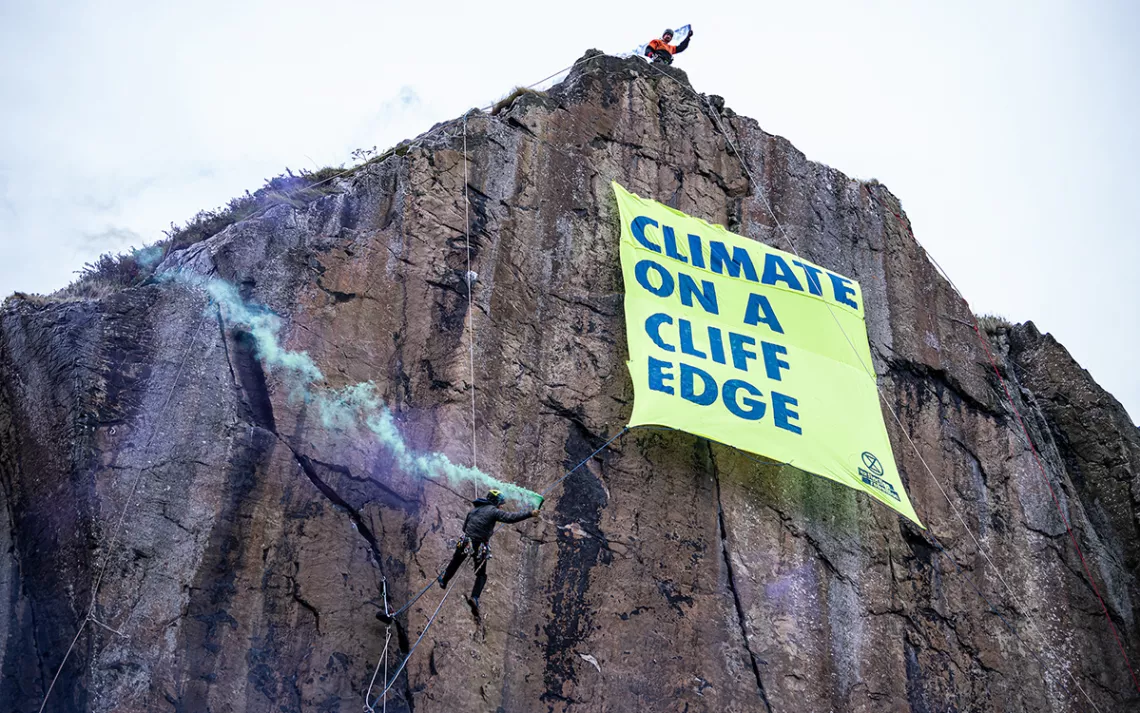
Experienced climbers scale a rock face near the historic Dumbarton castle in Glasgow, releasing a banner that reads “Climate on a Cliff Edge.” One activist, dressed as a globe, symbolically looms near the edge, while another plays the bagpipes on the shores below. | Photo courtesy of Extinction Rebellion and Mark Richards
Funds could insulate all draughty homes, fund free bus travel, and retrain millions of workers for a green future
A TEMPORARY tax on the super-rich could generate enough money to fix every poorly insulated home, fund free bus travel and retrain three million workers in green industries, Greenpeace revealed today.
A new report commissioned by the climate group proposes introducing an annual 2.5 per cent tax on all individual wealth above £10 million over the next five years.
This “national renewal tax” would impact less than 75,000 people — 0.1 per cent of the population — and raise up to £183 billion for the Treasury.
…
An analysis by Oxfam found that the richest 1 per cent emit as much carbon as two-thirds of all humanity.
Greenpeace UK’s climate campaigner Georgia Whitaker said: “The oversized carbon footprint of the super-rich is a clear rationale for ensuring that they play an oversized role in fixing the crisis that they have an oversized role in creating.
…
Patriotic Millionaires member Julia Davies, who wrote the report’s foreword, said: “This report highlights that a small, temporary tax on our wealth could transform the lives of millions, while tackling the greatest threat humanity has ever faced — the climate crisis — all while investing in a strong forward-facing economy with quality stable jobs for the British people.”
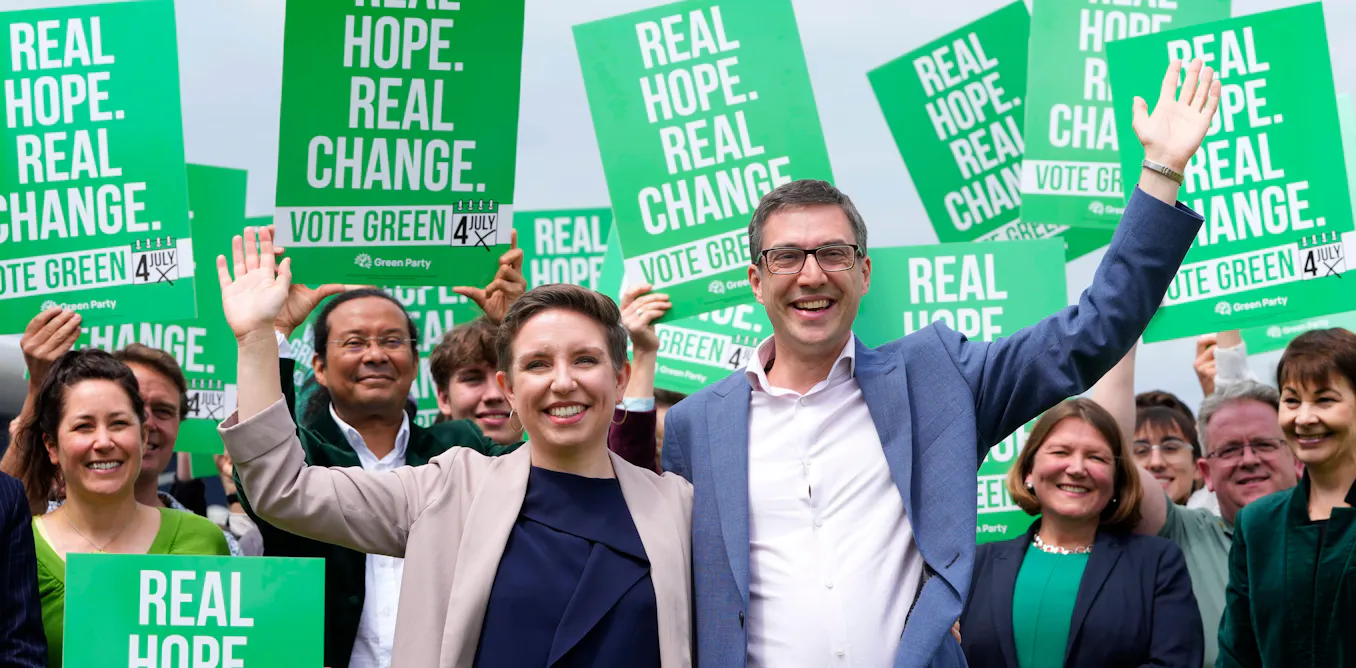
The Green party’s target is to take four seats at the upcoming UK election. Recognising it has no chance of forming a government, its manifesto is written from the perspective of a future pressure group within Westminster.
In doing so, the party highlights some key ideas and steps that could help the UK achieve meaningful climate action. This provides a refreshing attempt to outline an alternative way forward, at a time when climate leadership is severely lacking from other parties.
The Greens’ manifesto has climate action woven through it and the wording often emphasises the link between climate and socioeconomic issues, as the impacts of a changing climate could push more people into poverty and disrupt global food supply chains. It states: “The solutions to the climate crisis are the same as those needed to end the cost of living and inequity crises, making the future not just more liveable but fairer for us all too.”
The Greens argue that a rebalancing of the economy is required to achieve such a just transition. While the party stops short of calling for degrowth (producing fewer unnecessary goods and services in favour of more socially beneficial economic activity), the focus on a carbon tax and push for investment in public services and renewables could deliver a similar impact.
The party also wants to change how success is measured in the economy, calling for “new indicators that take account of the wellbeing of people and planet, and track our progress towards building a greener and fairer future”. This is the first time an established party has explicitly reframed what the measures of a successful nation should be.
The manifesto embraces an agreed basic standard of living and a set of planetary boundaries that our activities shouldn’t push us beyond, based on the theory of “doughnut economics”. By comparison, the existing model focuses almost solely on economic growth as the key measure of success.
Steps to decarbonise
One of the key issues the Greens want to address is the fact the UK’s housing stock is some of the worst in Europe. A vast programme of insulation and decarbonisation measures is needed across all tenures, and the Greens earmark £50 billion over the length of the parliament for retrofitting buildings. One issue here is that they don’t specify how the current supply chain could be scaled up to achieve this.
The manifesto does recognise that to reduce the UK’s carbon impact, buildings can’t just be demolished and rebuilt. Circularity is needed with zero extraction of new materials in the construction of new homes and buildings.
The Greens propose to tackle this with planning applications to include whole-life carbon and energy calculations. Plus, all materials from demolished buildings will need to be considered for reuse, and increased rates for the disposal of builders’ waste would ensure that this is financially viable.
Significant investment is also needed to upgrade the UK’s energy networks to enable decarbonisation, with another proposed £50 billion assigned to electricity generation, transmission and storage. The manifesto also highlights the potential for greater community involvement in – and direct benefit from – new solar and wind farms, which research suggests can speed up the provision of decentralised energy generation.
Where the Greens diverge most widely from the current energy decarbonisation orthodoxy is on nuclear. Their proposal to cancel funding for research on new technology, namely small modular reactors, appears reactionary at a time where its potential is still being explored.
The Green Party would not fund research into small modular nuclear reactors. stocker1970/Shutterstock
In transport, the Greens recognise that simply rolling out the sale of electric vehicles is not enough. They want to expand public transport and active travel (walking and cycling) through a £13 billion investment to deliver public transport as a service rather than for profit.
But this would depend on giving local authorities in England the powers that London has to act as bus operators. Combined Authorities in Greater Manchester, South and West Yorkshire are currently transitioning to a franchised system, but a full “London-style” network is some way off.
The Greens are also the only party to take the bold action of proposing a frequent flyer levy, although they do not detail how it will work. Typically, proposed plans for such levies increase on a sliding scale as the number of flights increases, therefore targeting the 15% of people who make 70% of the trips.
There are also proposals to remove the aviation fuels exemption from fuel duty and introduce a domestic flight ban on journeys that can be done by rail in less than three hours, making this manifesto is an exemplar of action targeted at reducing high consumption in the form of frequent flights.
How would they deliver it?
With all this investment, there’s inevitably a question about how the Greens would pay for their plans. Figures in the manifesto suggest significant government borrowing is needed for such radical changes.
On environmental measures alone, an average annual capital and revenue spend of £40 billion would be required, including £7 billion to be invested in climate adaptation. The entire manifesto requires a budget deficit of £65 billion a year for the next five years, gambled against the as yet unknown costs of inaction.
There are some other ideas on funding. A carbon tax would make polluters pay while providing money to invest in the green transition. And taxing multi-millionaires and billionaires could help fund public services, including renationalised utilities such as water companies.
There is also a question of how practical the plans are. Nothing within the Green party manifesto relies on tech that has yet to be invented or impossible interventions. This is not the stuff of techno-optimism. But there are no cities, regions or devolved nations in the UK that have yet adopted the root and branch transformation this manifesto would require.
However, surveys show most people in the UK want decisions on the overwhelming evidence for climate change and the nature crisis, in order to create a more resilient society. The Green manifesto, then, is an imperfect but sorely needed attempt at climate leadership that reflects the urgency of significant rather than iterative change. That should be welcomed in an election where you could otherwise be forgiven for thinking that a response to the climate emergency was an optional extra.
The UK’s energy bills were £22bn higher over the past decade than they would have been if Conservative governments had not cut “green crap” climate policies.
In 2013, then-prime minister David Cameron was infamously reported to have asked colleagues to “get rid of the green crap”, referring to climate policies supporting better home insulation.
His government later scrapped a “zero-carbon homes” (ZCH) standard for new-build homes, ended support for solar power and blocked the expansion of onshore wind.
The number of homes getting insulated each year is now 98% below 2012 levels, while the growth of onshore wind and solar remains far below previous peaks.
Carbon Brief’s new analysis updates figures published in January 2022, showing that the “green crap” rollbacks left UK billpayers more exposed to record gas prices during the energy crisis.
The £22bn added to energy bills since 2015 as a result of the rollbacks includes £9bn due to not having built more cheap onshore wind, £5bn due to poorly insulated homes, £5bn due to low solar deployment and another £3bn because new homes were less efficient than the ZCH standard.
In total, the UK’s gas demand is 99 terawatt hours (TWh, 14%) higher than it would have been if climate measures had been added at earlier rates, the analysis shows. This means the UK’s net gas imports are 31% higher than they would have been with more “green crap” in place.
‘Green crap’ cuts
In November 2013, a Sun frontpage reported then-prime minister David Cameron’s “solution to soaring energy price[s]” with the headline: “Get rid of the green crap.”
Cameron’s government, in coalition with the Liberal Democrats, went on to make a series of changes, including cutting spending on energy-efficiency improvements and introducing the “green deal” efficiency scheme, later described by the National Audit Office as a “fail[ure]”.
The number of homes getting their lofts or cavity walls insulated each year plummeted almost immediately – by 92% and 74% in 2013, respectively – and has never recovered.