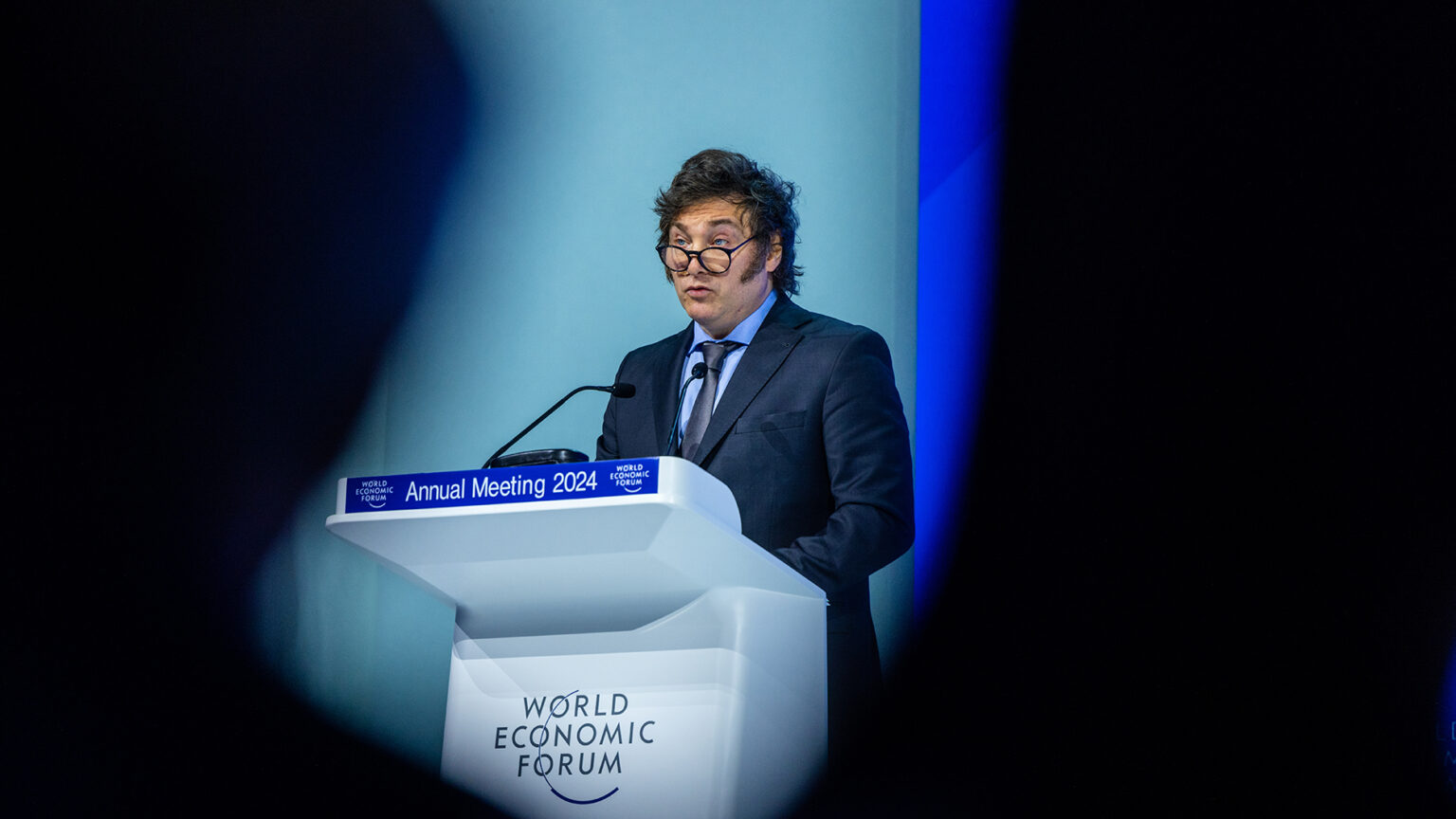
Javier Milei’s right-wing government promised to stop inflation in Argentina, and has thus far failed
The neoliberal economic measures of Javier Milei’s government are not improving the economic situation they promised to eradicate. During the election campaign, Milei made several promises that thus far he has been unable to keep. For example, he stated that the price of gas would not increase under his government, but from April to May rates rose by 450%. He also promised that public transportation fares would not increase, but the price of the subway went from 125 to 757 pesos.
The government has not been able to stimulate the growth of the Argentine economy either. According to the IMF itself, which bases a good part of its analysis and recommendations on neoliberal economic theory, the GDP of the Argentine economy will fall by 3.5% in 2024. In this sense, the recession the country is enduring does not seem to have a clear way out. Initially, the IMF thought that the economic contraction would be 2.8% of the GDP, but given the incontestable evidence, it had to adjust its forecast.
However, the IMF maintains that there will be a rebound effect, and that, therefore, in 2025 Argentina will grow by 5%. In addition, the agency praised the economic measures of the Milei government to curb the inflationary process, fiscal adjustment, and liberalization of the economy. Petya Koeva Brooks, deputy director of the Research Department, said that “looking ahead, even in the coming quarters, we expect growth to rebound because we see the effects of fiscal adjustment, the return of confidence and rising wages.”
However, several Argentine economists have stated that such expectations are not based on the reality of the national economy, as the problems caused by high inflation have worsened, as well as the evident decrease in employment in the country. According to data for the first half of 2024, Argentina has the highest cumulative inflation worldwide, 79.8%, and a peak year-on-year inflation of 271.5%.
Another unfulfilled promise of Milei was the increase of employment in the country thanks, according to the libertarian government, to the radical liberalization of the economy. However, despite the set of neoliberal economic measures, there has been a 7.7% increase in unemployment during the first quarter of 2024.
Milei’s administration celebrates the fact that the inflationary process decreased a little compared to previous years, claiming that this is thanks to certain public policies of his administration. This is even though Milei’s brutal fiscal adjustment, the contraction of the State, and the loss of thousands of jobs, which Milei stated would have a very positive impact on inflation, have not had the expected results. For example, food prices in Argentina have risen 260% (40 times more than Mexico), one of many figures which confirms that the neoliberal “shock” measures of Milei are not likely to benefit workers in the long run.
Original article by Nicholas Mwangi republished from peoples dispatch under a Creative Commons Attribution-ShareAlike 4.0 (CC BY-SA) license.
Police heavily repressed the protests against the Finance Bill 2024 on Tuesday June 18. Photo: Mathare Justice Center
Hundreds were arrested and brutalized in Nairobi by police forces during protests against the government’s finance bill
On Tuesday June 18, the streets of Kenya’s capital were the site of a major showdown, as peaceful protesters advocating for the rejection of the Finance Bill 2024 were met with brutal repression by state forces. According to human rights groups in Kenya, between 300-400 protesters were arrested as they rallied against the punitive tax measures proposed by the government. The protest organized by a wide variety of civil society organizations and left groups was violently disrupted by police forces attempting to prevent the demonstrators from reaching the parliament building, where organizers had planned to launch a sit-in at 2 pm.
Despite the heavy-handed police attacks with water cannons, and tear gas, the protesters persisted throughout the day, ensuring their voices were heard by those in power and not allowing their right enshrined in article 37 of the constitution – “Assembly, demonstration, picketing and petition” to be compromised. This article outlines that every person has the right, peaceably and unarmed, to assemble, to demonstrate, to picket, and to present petitions to public authorities.”
The tension and public dissent exerted considerable pressure on the government. This was evident as President William Ruto convened an early meeting with members of parliament. The outcome of this meeting saw some “compromises” in the government’s stance on the contentious finance bill. The parliamentary finance committee announced the government’s U-turn at a press briefing on Tuesday, attended by the president and ruling party lawmakers. They announced the decision to withdraw certain proposed taxes, including those on cooking oil, mobile money services, and motor vehicles. The concession was clearly a direct response to the mounting public outcry nationwide.
However, the selective removal of these taxes has done little to appease the masses. Many view it as a strategic move by the government to placate the population while still pushing through other unpopular measures. The finance bill of 2024, in its entirety, remains widely rejected by the masses. The protesters’ message is clear: they demand a complete overhaul of the proposed financial policies, not just a piecemeal reduction of specific taxes.
Ruto’s neoliberal Finance Bill
The Finance Bill 2024, much like its predecessor in 2023, has stirred controversy and discontent across Kenya due to its stringent and, many argue, draconian proposals. This widespread dissatisfaction is deeply rooted within the broader context of an already high cost of living, which will be increased by the proposed new taxes. Beginning last week, Kenyans have voiced their disapproval with the finance bill by taking to social media, where they posted the contacts of Members of Parliament (MPs) and encouraged each other to reach out to their leaders, urging them to reject the bill.
The Finance Bill 2024, officially published by the National Assembly on May 9, 2024, outlines the Government of Kenya’s proposed tax measures for the financial year 2024-2025. Among the numerous changes proposed are significant amendments to Income Tax, Value Added Tax (VAT), and Excise Duty, as well as modifications to the administration of taxes in Kenya. One of the most contentious proposals in the bill is the imposition of a 16% Value Added Tax on financial transactions, and among basic commodities.
Many protested as they believe this will worsen their financial hardships rather than alleviate them. The protests are set to continue, with the third round of Parliament scheduled for June 20th.
The government’s justification for raising taxes, claiming it is necessary for Kenya to live within its means, is hypocritical given its extensive and often unnecessary expenditures. For instance, the government has increased its borrowing target for the fiscal year starting in July to Sh 597 billion, a substantial sum that raises questions about fiscal responsibility. A closer look at government spending reveals significant outlays that contrast sharply with its message.
According to Business Daily, the latest budget control data show a significant rise in travel perks for foreign and local trips, with an increase of Sh 1.62 billion from the Sh 12.4 billion spent in a similar period the previous year. The Parliamentary Service Commission’s spending has also surged by 18.5% to Sh 1.86 billion, and the bill for Members of Parliament (MPs) has grown by 4% to Sh 4 billion. Such figures highlight a pattern of lavish expenditure that stands in stark contradiction to the government’s narrative of financial prudence.
Further, the bill has received backing from the International Monetary Fund (IMF), despite widespread public outcry against it. This support from the IMF is not surprising as they did the same last year, and many Kenyans feel that the country has been effectively mortgaged to the institution. Historically, the IMF’s involvement has brought about economic policies and austerity measures that are seen as an attack on the working class and the marginalized peasants alike, often leading to increased economic strain for the average citizen.
Organized resistance poses more serious challenge to government
What distinguishes the current wave of protests from previous ones is the nature of their organization. Unlike past protests that were primarily mobilized by opposition party leader Raila Odinga against the government, these demonstrations have been driven by different organizations and particularly on online platforms, which have successfully translated their digital activism into tangible, on-the-ground action. This movement has seen an unexpectedly high level of participation from “Gen Z” and the middle class, groups that have traditionally been less involved in these demonstrations.
As the protests continue, the Kenyan government will continue to face mounting pressure to address the economic concerns of the masses. In the last two months there have been three major protests organized by grassroots movements among them against state demolitions on the informal settlements of the downtrodden coming to terms with the recent flood crisis that killed many and destroyed properties of unknown value. The fight for total liberation continues.
Nicholas Mwangi is a member of the Ukombozi Library in Kenya.
Original article by Nicholas Mwangi republished from peoples dispatch under a Creative Commons Attribution-ShareAlike 4.0 (CC BY-SA) license.
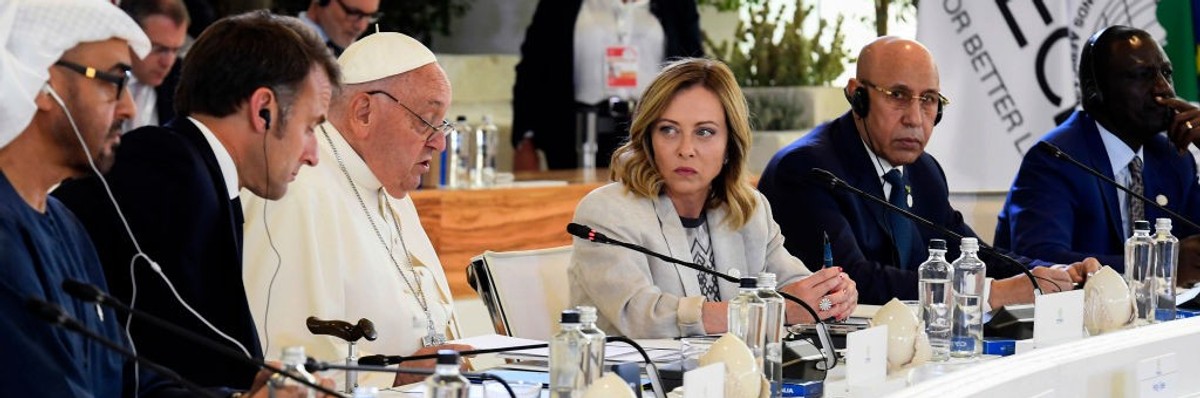
Italian Prime Minister Giorgia Meloni (center) looks toward Pope Francis as he speaks during the G7 Leaders Summit in Fasano, Italy on June 14, 2024. (Photo: Vatican Media via Vatican Pool/Getty Images)
“If these embattled leaders want to leave a lasting legacy, they need to heed the will of voters demanding a safe environment and climate,” one campaigner asserted.
As the Group of Seven summit wrapped up Friday in Italy, climate defenders condemned G7 leaders for their continued failure to take meaningful action to combat the worsening planetary emergency.
Taking aim at what critics called the G7 leaders’ largely empty pledge to undertake “concrete steps to address the triple crisis of climate change, pollution, and biodiversity loss,” 350.org U.S. campaigns manager Candice Fortin lamented that “yet another meeting ends without real commitments to revert the situation rich countries like the U.S. put us in.”
“As COP29 approaches and the world deals with worsening climate impacts, we can’t afford to waste more time,” Fortin said, referring to the United Nations Climate Change Conference scheduled to take place in Baku, the capital of Azerbaijan—a major fossil fuel-producing nation—in November. COP29 is set to be chaired by a former oil executive.
“If the U.S. wants to pride itself on being a ‘world leader,’ it needs to show how it will pay its climate debt to climate-vulnerable countries that bear the most significant climate impacts without the necessary funds for adaptation,” Fortin added.
— Fossil Fuel Treaty Initiative (@fossiltreaty) June 14, 2024
While G7 governments hailed their recent agreement to phase out existing unabated coal power generation in energy systems during the first half of the 2030s, critics took issue with the policy’s timeline and banks’ continued financing of fossil fuels.
“Our leaders are not leading. In the hottest 12 consecutive months of recorded human history, our leaders are failing us,” argued Bronwen Tucker, Oil Change International’s public finance lead. “G7 countries are adopting an inadequate coal phaseout date and endorsing increased fossil gas production, sending a terrible signal at a time when countries should be focusing on accelerating the phaseout, not delaying it.”
Tucker continued:
G7 leaders can’t say they’re committed to a livable climate while expanding and bankrolling the fossil fuel industry at home and abroad. At the same time, these rich countries should not be congratulating themselves for delivering $100 billion for climate finance two years too late. Trillions are needed to cover climate damages and the G7’s finance was largely provided as loans which only worsens unjust debts.
“The G7 must end the billions of dollars in taxpayer finance still flowing to fossil fuel projects abroad and fund the buildout of affordable renewable energy on fair terms,” Tucker asserted. “If their oil and gas expansion plans are allowed to proceed, it will lock in climate chaos and an unlivable future.”
#G7Italy: COUNTER-DINNER OF THE POOR Yesterday, during the #G7 leaders' dinner, @DebtforClimate set up a "Trojan horse" in Brindisi to call out the colonial policies of the G7, International Monetary Found, and World Bank, demanding them pay their Climate Debt and #CancelTheDebtpic.twitter.com/aqorlJr5vM
— Extinction Rebellion Italia (@XrItaly) June 14, 2024
Greenpeace International climate politics expert Tracy Carty said in a statement that “if these embattled leaders want to leave a lasting legacy, they need to heed the will of voters demanding a safe environment and climate.”
“Taxing the billions of dollars in profits of the fossil fuel industry to fund climate action at home and abroad could be their stake in history and a win for people and planet,” Carty continued. “G7 leaders need to seize the moment ahead of the U.N. climate talks in Baku and show they will lead the transition away from fossil fuels and build trust they will significantly increase climate finance support to developing countries.”
Argentinian President Javier Milei looks on after the polls close in the presidential runoff election on November 19, 2023 in Buenos Aires, Argentina. (Photo: Tomas Cuesta/Getty Images)
“Protest is elemental to Argentine social and political life, so it’s not difficult to imagine how this ends,” said one journalist.
As the human impact of Argentinian President Javier Milei’s “shock treatment” to the South American country’s economy became increasingly clear with rising prices on Thursday, Security Minister Patricia Bullrich announced what one journalist said were doubtlessly “preemptive” new controls on protests to discourage a struggling population from speaking out.
Bullrich said four security forces—the Federal Police, the Gendarmerie, the Naval Prefecture, and the Airport Security Police—will work together to stop protests that block streets and suggested the protocol is aimed only at ensuring “that people can live in peace” without demonstrators blocking traffic.
But as Progressive International co-general coordinator David Adler and others noted, the measures also include calls for armed forces to break labor strikes, create a national registry of people who organize protests, and sanctions against parents who bring their children to demonstrations.
The new package amounts to “a total crackdown on Argentine civil society,” Adler said.
Bullrich’s announcement came days after Milei, a far-right libertarian economist who has called the climate crisis “a socialist lie” and has been compared to former U.S. President Donald Trump, announced in the first weeks of his presidency an economic “shock treatment” package including a devaluation of the peso by 50%, from 400 pesos to the U.S. dollar to 820 pesos.
The administration also said it would cut public spending by closing some government ministries, increasing retirements ordered by decree, reducing energy and transportation subsidies, and freezing public works, with further “profound” measures expected in the future.
Milei claimed that with the spending cuts, government revenues will ultimately increase by 2.2 points, helping to confront an economic crisis in which annual inflation exceeds 160%, the country has a trade deficit of $43 billion, and $45 billion is owed to the International Monetary Fund (IMF).
But as Milei’s “open heart surgery of the economy,” as El País called the package, took hold, prices of some goods and services rose by 100% and some commuters worried that they will no longer to be able to afford their daily commutes it transit agencies are forced to raise prices due to lost subsidies.
“If [the bus fare] goes up, my salary will be spent on transport,” Julia González, who takes three buses and a train to her job in downtown Buenos Aires, toldThe Associated Press.
About 40% of Argentinians live below the poverty line and more than 9% are destitute, reported El País, with incomes insufficient to buy food.
Economist Juan Manuel Telechea told the outlet that monthly inflation could reach 30-40% due to the devaluation and that social aid will be “highly insufficient.”
Presidential spokesperson Manuel Adorni said of the economy Wednesday that Milei “found a patient in intensive care about to die,” but one trade unionist told El País the president is “exaggerating the inherited crisis situation to justify inadmissible measures, which will increase poverty levels in Argentina above 50% in a matter of days.”
“The mega-devaluation that is being carried out is a matter of concern because it may devolve into hyperinflation,” Pato Laterra, an economist at the National University of La Plata, told the newspaper.
Mark Weisbrot, co-director of the Center for Economic and Policy Research, said last month that Argentina’s current economic crisis is the result of right-wing former President Mauricio Macri’s administration, which took out the largest loan ever from the IMF and pushed the economy into a recession, with poverty and inflation rising by 50% or more.
“But a crazed, economically suicidal approach would only make things worse—and as Argentina has experienced, things can get a lot worse,” said Weisbrot. “Milei displays a callous disregard for most people’s living standards, values, and well-being, as well as a commitment to widely discredited economic policies, that is unprecedented.”
Jacob Sugarman of the Buenos Aires Heraldsaid Wednesday that it remains to be seen “how long Argentine society is willing to tolerate this kind of pain” and suggested that Bullrich’s announcement of a crackdown on dissent is likely to further anger the public.
“Protest is elemental to Argentine social and political life, so it’s not difficult to imagine how this ends,” said Sugarman, “especially with Bullrich announcing that the government will use federal forces including the National Military Police to break picket lines.”